- Product Description Description
- Table of Contents TOC
- List of Table & Figure LOT
- Get Free Sample PDF Sample PDF
Market Size, 2025
$9.04 BnMarket Estimate, 2026
$9.41 BnMarket Forecast, 2034
$13.02 BnCAGR, 2026–2034
4.14%North America Genset Market Size, Growth, Trends & Forecast (2026–2034)
The North America Genset Market size was calculated to be USD 9.04 billion in 2025, is anticipated to be worth USD 9.41 billion in 2026, and is expected to reach USD 13.02 billion by 2034, growing at a compound annual growth rate (CAGR) of 4.14% during the forecast period from 2026 to 2034. Growth is propelled by increasing climate-induced power disruptions, aging infrastructure, and escalating reliance on uninterrupted electricity across residential, commercial, and industrial facilities.
Key Executive Metrics (At-a-Glance)
- 2025 Base Valuation: USD 9.04 billion
- 2026 Current Valuation: USD 9.41 billion
- 2034 Forecast Valuation: USD 13.02 billion
- Compound Annual Growth Rate (CAGR): 4.14% (2026–2034)
- Dominant Fuel Segment: Diesel fuel (holding a dominant market share in 2025 due to high energy density and runtime reliability)
- Fastest-Growing Fuel Segment: Natural gas (emerging with an expected CAGR of 7.4% due to stricter EPA and CARB emissions standards)
- Dominant Portability Segment: Stationary gensets (leading due to high-capacity industrial and institutional power needs)
- Fastest-Growing Portability Segment: Portable gensets (projected at a CAGR of 6.8% from 2026 to 2034)
- Dominant End-User Segment: Industrial end-users (holding 48.3% of the market share in 2025)
- Fastest-Growing End-User Segment: Residential segment (projected at a CAGR of 8.2% from 2026 to 2034)
- Dominant Power Rating Segment: 100–350KVA (holding 38.2% market share in 2025)
- Fastest-Growing Power Rating Segment: Up to 100KVA (projected at a CAGR of 8.6%)
- Dominant Application Segment: Industrial applications
- Fastest-Growing Application Segment: Construction applications (projected at a CAGR of 9.1%)
- Dominant Country: United States (holding 78.3% of the regional market share in 2025)
- Fastest-Growing Country Hub: Canada (driven by cold-weather resilience and remote northern mining operations)
Core Market Drivers
- Extreme Weather Disruptions: Rising frequency of hurricanes, winter storms, and wildfires triggering prolonged blackouts.
- Data Center Expansion: High redundancy requirements for hyperscale data centers requiring instant, full-site backup power.
Primary Market Restraints & Challenges
- Stringent Emission Rules: EPA Tier 4 standards and CARB regulations increasing production costs and promoting alternative energy adoption.
North America Genset Market Segmentation Breakdown
| Segment Category | Leading Sub-Segment | Fastest-Growing Sub-Segment |
|---|---|---|
| By Fuel | Diesel (Dominant share in 2025) | Natural Gas (CAGR of 7.4%) |
| By Portability | Stationary (Dominant share in 2025) | Portable (CAGR of 6.8% from 2026–2034) |
| By End User | Industrial (48.3% share in 2025) | Residential (CAGR of 8.2% from 2026–2034) |
| By Power Rating | 100–350KVA (38.2% share in 2025) | Up to 100KVA (CAGR of 8.6%) |
| By Application | Industrial Application | Construction Application (CAGR of 9.1%) |
| By Region | United States (78.3% share in 2025) | Canada (Driven by cold-weather resilience and remote industrial sites) |
Major Industry Players Profiled
Key manufacturing leaders shaping the North American genset landscape include Caterpillar Inc., Cummins Inc., Generac Holdings Inc., Kohler Co., Atlas Copco AB, MTU Onsite Energy (Rolls-Royce Power Systems), Briggs & Stratton Corporation, Wacker Neuson SE, Doosan Corporation, Himoinsa S.L., Multiquip Inc., Gillette Generators, and GE Power.
North America Genset Market Size
The North America Genset Market Size was calculated to be USD 9.04 billion in 2025 and is anticipated to be worth USD 13.02 billion by 2034, from USD 9.41 billion in 2026, growing at a CAGR of 4.14% during the forecast period.
The genset is designed to produce electrical power during grid outages or in off-grid locations. These systems are crucial for maintaining operational continuity across residential, commercial, industrial, and institutional sectors. In recent years, the demand for reliable power solutions has surged due to increasing frequency of extreme weather events, aging infrastructure, and a growing reliance on uninterrupted electricity supply. According to data from the U.S. Energy Information Administration (EIA), the United States alone experienced over 600 major power outages in 2023, marking a significant increase compared to previous decades. This trend has been further compounded by rising investments in advanced infrastructure such as healthcare facilities, data centers, and emergency response systems, all of which rely heavily on backup power solutions like gensets.
MARKET DRIVERS
Increasing Frequency of Climate-Induced Power Disruptions
The escalating frequency of climate-induced power disruptions is likely to degrade the growth of the North America genset market. As global temperatures rise, extreme weather events such as hurricanes, wildfires, winter storms, and flooding have become more intense and frequent. According to the National Oceanic and Atmospheric Administration (NOAA), the U.S. faced 28 weather-related disasters in 2023, each causing damages exceeding $1 billion an increase from the annual average of 18 such events recorded between 2018 and 2022. These events often lead to prolonged grid outages, compelling households, businesses, and municipalities to invest in gensets for uninterrupted power supply. For instance, Texas, one of the most affected states in terms of winter storm-related blackouts, saw a 42% year-over-year surge in residential genset purchases following the 2021 deep freeze, as reported by the Electric Reliability Council of Texas (ERCOT). Similarly, California’s wildfire seasons have led to widespread Public Safety Power Shutoffs (PSPS) by utility companies, prompting both homeowners and small businesses to adopt backup power systems. This shift reflects a growing consumer preference for resilience against unpredictable energy availability. Industrial and institutional users in healthcare and logistics, have also ramped up genset installations to comply with federal regulations requiring continuous power for life-support systems and cold-chain storage, especially post-pandemic.
Growth in Data Centers and Infrastructure Development
The rapid expansion of data centers and infrastructure development in the U.S is additionally to promote the growth of the North America genset market. The U.S. accounted for nearly 40% of global hyperscale data center capacity in 2023, hosting over 700 large-scale facilities operated by tech giants such as Amazon, Microsoft, and Google. The Uptime Institute reports that even a single hour of downtime in a Tier IV data center can cost operators upwards of $1 million. To mitigate this risk, major cloud service providers are investing heavily in redundant power architectures, including multiple genset units capable of providing full-site backup within seconds of a grid failure. Additionally, government initiatives aimed at modernizing infrastructure, including hospitals, airports, and emergency services, are reinforcing genset demand. The Federal Emergency Management Agency (FEMA) mandates that all Level I trauma centers maintain on-site backup power capable of supporting full operations for at least 96 hours.
MAKET RESTRAINTS
Stringent Emission Regulations and Environmental Compliance Costs
The imposition of increasingly stringent emission regulations by environmental authorities is limiting the growth of the North America genset market. In the U.S., the Environmental Protection Agency (EPA) enforces strict standards under the Clean Air Act, particularly targeting nitrogen oxides (NOx), particulate matter (PM), and greenhouse gases (GHG) emitted by internal combustion engines used in gensets. As per data from the EPA, compliance with Tier 4 standards has raised the average cost of diesel gensets by approximately 15–20%, making them less attractive to price-sensitive customers. Additionally, the California Air Resources Board (CARB), known for having the most rigorous air quality rules in the country, mandates ultra-low NOx levels for stationary engines operating in non-attainment zones. These restrictions have limited the use of traditional diesel-fueled gensets, pushing buyers toward alternative technologies such as battery storage or hydrogen-based power systems, which are still in early adoption phases. Moreover, the push toward decarbonization under federal policies like the Inflation Reduction Act (IRA) has incentivized cleaner energy sources, indirectly discouraging diesel genset usage.
Rising Adoption of Renewable and Alternative Energy Systems
The growing adoption of renewable and alternative energy systems, which are increasingly being used as substitutes for conventional gensets is another attribute impeding the growth of the North America genset market. Solar photovoltaic (PV) systems, wind turbines, and battery energy storage systems (BESS) are gaining traction as viable options for backup and off-grid power generation. According to the U.S. Department of Energy, distributed solar installations grew by 32% in 2023 compared to the previous year, with over 17 gigawatts (GW) of new capacity added nationwide.
The decline in battery storage costs has further accelerated this shift. BloombergNEF reports that lithium-ion battery prices fell by 89% between 2010 and 2023, reaching an average of $151 per kilowatt-hour (kWh), making BESS an economically feasible option for short-term backup power. In California, where rolling blackouts have become common, many residential and commercial consumers are opting for hybrid solar-plus-storage systems instead of traditional diesel gensets. Additionally, corporate sustainability commitments and investor pressure are steering businesses away from fossil fuel-based power solutions. Major corporations like Apple, Walmart, and Google have pledged net-zero emissions by 2030 or earlier, favoring green alternatives over diesel generators.
MARKET OPPORTUNITIES
Expansion of Microgrid and Off-Grid Power Solutions
The growing development and deployment of microgrid and off-grid power systems is setting up new opportunities for the growth of the North America genset market. As centralized power grids face increasing strain from aging infrastructure and rising demand, decentralized energy solutions are gaining prominence across various sectors. According to the U.S. Department of Energy, there are currently over 400 operational microgrids in the United States, with an additional 200+ projects in planning or development stages as of 2023.
Microgrid is localized energy networks that can operate independently or in conjunction with the main grid are increasingly integrating gensets as part of their hybrid power architecture. These systems combine renewable energy sources like solar and wind with battery storage and gensets to ensure reliability and stability. According to the Rocky Mountain Institute, microgrids incorporating gensets provide a balanced solution for mission-critical applications in military bases, universities, hospitals, and remote communities where grid access is limited or unreliable.
For example, the Alaska Center for Energy and Power has implemented numerous microgrid projects using diesel and natural gas gensets in combination with wind turbines and batteries to support remote villages disconnected from the main grid. Similarly, in the wake of increasing cyberattacks on national power infrastructure, federal agencies such as the Department of Defense are investing in resilient microgrids equipped with gensets to ensure continuous operation of defense installations.
Integration of Hybrid and Dual-Fuel Gensets
The increasing adoption of hybrid and dual-fuel gensets, which offer enhanced efficiency, lower emissions, and greater fuel flexibility is also to escalate the growth of the North America genset market. Unlike conventional diesel-only systems, dual-fuel gensets can operate on a combination of diesel and natural gas, reducing dependency on liquid fuels and lowering overall carbon footprint. According to the Gas Technology Institute, dual-fuel gensets can achieve up to a 40% reduction in diesel consumption while maintaining equivalent power output.
Natural gas availability through pipeline infrastructure in the U.S. and Canada provides a stable and cost-effective alternative to diesel, especially in urban and semi-urban areas. The American Clean Power Association reports that natural gas prices in North America remained relatively low in 2023, averaging $2.70 per million British thermal units (MMBtu), making dual-fuel systems more economical than ever before. Moreover, the integration of gensets with renewable energy sources and battery storage in hybrid configurations allows for dynamic load management and optimized fuel use.
MARKET CHALLENGES
Supply Chain Disruptions and Component Shortages
The ongoing supply chain disruptions and component shortages, which have significantly impacted production timelines and cost structures. The global semiconductor shortage, exacerbated by geopolitical tensions and pandemic-related shutdowns, has delayed the manufacturing of genset components such as control modules, sensors, and inverters. Additionally, logistical bottlenecks at major ports, labor shortages in manufacturing hubs, and inflationary pressures have contributed to rising input costs. These challenges have not only affected OEMs but also aftermarket parts suppliers, limiting repair and maintenance capabilities for existing genset installations.
Skilled Labor Shortage in Installation and Maintenance Services
The persistent shortage of skilled labor for installation, operation, and maintenance of complex genset systems is additionally to restrict the growth of the market. However, workforce gaps persist due to an aging technician population, insufficient vocational training programs, and a general disinterest among younger workers in pursuing trades. This labor gap extends beyond initial installation to routine maintenance and emergency repairs, which are crucial for ensuring genset reliability, especially in mission-critical applications. Hospitals, data centers, and industrial plants depend on regular servicing to meet compliance standards, yet many facility managers report longer wait times for technician visits and increased service costs.
REPORT COVERAGE
| REPORT METRIC | DETAILS |
| Market Size Available | 2025 to 2034 |
| Base Year | 2025 |
| Forecast Period | 2026 to 2034 |
| CAGR | 4.14% |
| Segments Covered | By Fuel, Portability, End User, Power Rating, Application, And Region |
| Various Analyses Covered | Global, Regional & Country Level Analysis; Segment-Level Analysis; DROC, PESTLE Analysis; Porter’s Five Forces Analysis; Competitive Landscape; Analyst Overview of Investment Opportunities |
| Regions Covered | Us, Canada, and the Rest of North America |
| Market Leaders Profiled | Caterpillar Inc., Cummins Inc., Generac Holdings Inc., Kohler Co., Atlas Copco AB, MTU Onsite Energy (Rolls-Royce Power Systems), Briggs & Stratton Corporation, Wacker Neuson SE, Doosan Corporation, Himoinsa S.L., Multiquip Inc., Gillette Generators, GE Power |
SEGMENTAL ANALYSIS
By Fuel Insights
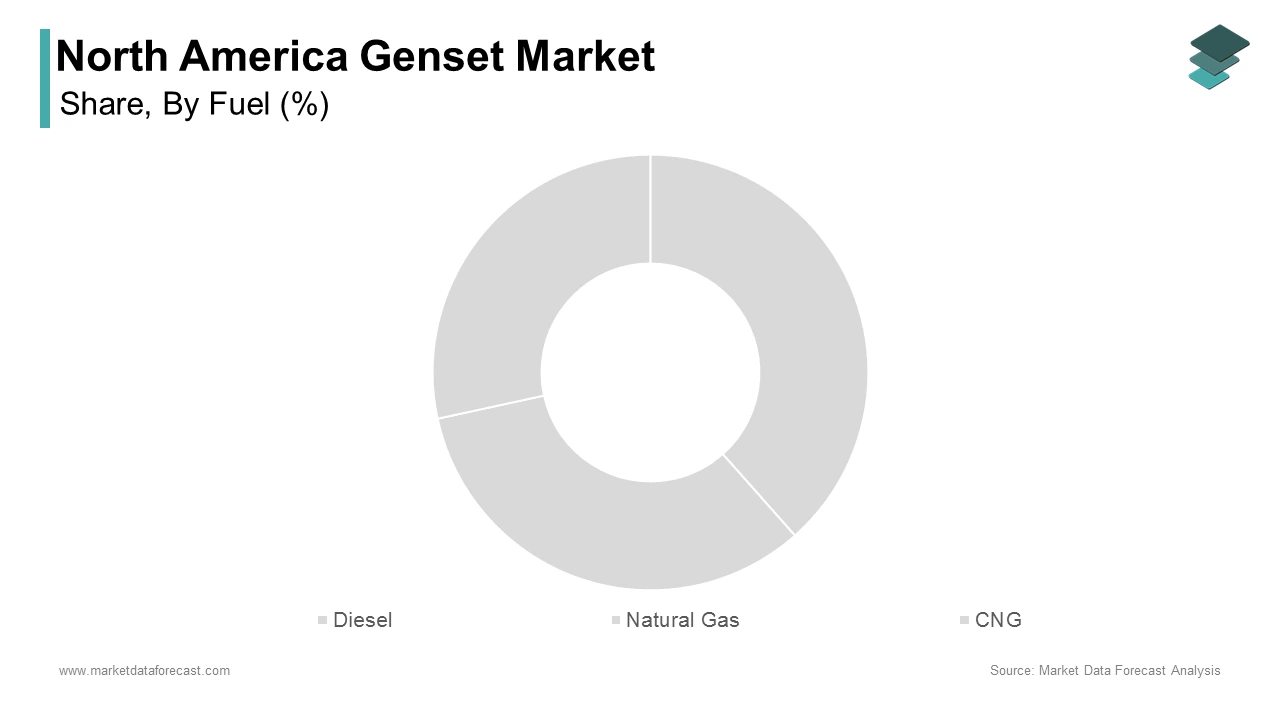
The diesel fuel segment was accounted in holding a dominant share of the North America genset market in 2025 with its superior energy density compared to other fuels. Diesel delivers more kilowatt-hours per liter than natural gas or CNG, making it ideal for high-load applications requiring extended runtime without frequent refueling. The existing regulatory framework that favors diesel for mission-critical installations is additionally to enhance the growth of the segment. The Federal Emergency Management Agency mandates that healthcare facilities maintain on-site diesel gensets capable of sustaining full hospital operations for at least 96 hours during outages.
The natural gas segment is swiftly emerging with an expected CAGR of 7.4% in the next coming years with the shift toward lower-emission power generation. The Environmental Protection Agency has mandated stricter emission norms under Tier 4 Final standards, which have made natural gas gensets more attractive due to their reduced nitrogen oxide (NOx) and particulate matter emissions. In California, where air quality laws are among the most stringent in the country, the California Air Resources Board recorded a 38% increase in natural gas genset installations between 2021 and 2023.
Additionally, the affordability and stability of natural gas prices contribute significantly to its rising adoption. The U.S. Energy Information Administration reported that natural gas averaged $2.67 per million British thermal units (MMBtu) in 2023, nearly 30% cheaper than diesel on an energy-equivalent basis. This cost advantage makes natural gas an appealing option for utilities, telecom towers, and commercial buildings seeking reliable yet economically viable backup power solutions.
By Portability Insights
The stationary genset segment was accounted in holding a dominant share of the North America genset market in 2025. This dominance stems from the increasing demand for continuous, high-capacity power in industrial and institutional settings. Hospitals, data centers, manufacturing plants, and wastewater treatment facilities rely heavily on stationary gensets for uninterrupted operations during grid failures. Moreover, government policies mandating backup power systems in commercial buildings and utility grids further bolster the demand for stationary gensets. The National Fire Protection Association requires all high-rise commercial buildings to have permanently installed backup power systems.
The portable genset segment is likely to witness a CAGR of 6.8% from 2026 to 2034 with the rise in extreme weather events leading to prolonged power outages. As reported by the U.S. Energy Information Administration, the number of major electrical disturbances in the U.S. increased by 67% between 2017 and 2023. This trend has prompted homeowners, particularly in hurricane-prone regions like Florida and Texas, to invest in portable gensets. Additionally, the construction industry’s resurgence has amplified demand for mobile power sources. The U.S. Census Bureau recorded $1.5 trillion in total construction spending for 2023, with infrastructure and residential projects contributing significantly. Portable gensets offer flexibility and ease of deployment, making them indispensable for contractors working on remote job sites where access to grid power is limited.
By End User Insights
The industrial end-user segment was the largest by holding 48.3% of the North America genset market share in 2025 with the increasing automation and digitalization of industrial processes, which heighten sensitivity to power interruptions. Furthermore, regulatory mandates require continuous power supply for safety functions in sectors such as chemicals and pharmaceuticals. The Occupational Safety and Health Administration mandates that hazardous material storage facilities maintain backup power to prevent leaks or explosions.
The residential segment is deemed to grow with a CAGR of 8.2% from 2026 to 2034. Extreme weather events are a major catalyst behind this trend. The National Oceanic and Atmospheric Administration recorded 28 weather-related disasters exceeding $1 billion in damages in 2023 alone, many of which caused widespread blackouts. Consequently, homeowners are increasingly adopting standby generators to protect against disruptions to heating, refrigeration, and medical devices.
Additionally, the expansion of smart home technologies has increased dependence on consistent electricity. Smart thermostats, security systems, and connected appliances require stable power to function. The Home Innovation Research Labs found that homes equipped with whole-house generators sold for 3–5% more than comparable homes without them, indicating strong consumer interest and long-term value addition.
By Power Rating Insights
The 100–350KVA power rating segment was the largest and held 38.2% of the North America genset market share in 2025 with the growing need for mid-range power solutions in educational institutions, hotels, and healthcare clinics. These facilities often require backup power sufficient to run HVAC systems, lighting, elevators, and IT infrastructure without necessitating massive installations. Another reason for dominance is the favorable economics of this size class. Equipment costs are relatively lower than higher KVA models, while still offering sufficient redundancy for loads.
The up to 100KVA segment is likely to grow with an expected CAGR of 8.6% throughout the forecast period with the surge in residential generator adoption, particularly among homeowners in storm-prone areas. The Consumer Electronics Association notes that retail sales of sub-100KVA portable and standby generators grew by 41% between 2020 and 2023, driven by severe climate conditions and greater affordability. Additionally, small businesses in food service, retail, and telecommunications are increasingly investing in compact gensets to ensure continuity. The Small Business Administration reported that 72% of surveyed firms experienced at least one power disruption in 2023, prompting many to install low-KVA backup systems.
By Application Insights
The industrial application segment was accounted in holding a dominant share of the North America genset market in 2025 with the increasing complexity of industrial automation systems, which are highly sensitive to voltage fluctuations and outages. Another factor is the regulatory environment mandating backup power for safety and compliance purposes. OSHA guidelines require continuous ventilation and monitoring in underground mines and chemical plants, necessitating reliable genset integration.
The construction application segment is expected to register a CAGR of 9.1% from 2026 to 2034. A primary catalyst is the rise in public-private partnership (PPP) initiatives for transportation and utility upgrades. These projects necessitate mobile gensets for lighting, welding, and equipment operation at remote job sites. Additionally, the construction workforce shortage has led to increased mechanization and reliance on automated tools, which depend on stable power sources. The Associated General Contractors of America reported that 82% of construction firms faced labor shortages in 2023, prompting investments in technology-driven solutions powered by gensets.
REGIONAL ANALYSIS
United States Genset Market Insights
The United States held 78.3% of the North America genset market share in 2025 with the frequency of extreme weather events disrupting grid stability. According to the U.S. Energy Information Administration, there were over 600 major power outages in the country in 2023, a 23% increase from the previous year. These disruptions have spurred both residential and commercial investments in gensets, particularly in states like Texas, Florida, and California. Additionally, federal mandates requiring backup power in healthcare, defense, and data center sectors reinforce steady demand. The Centers for Medicare & Medicaid Services mandate that all licensed hospitals maintain fully operational backup power systems by ensuring the U.S. remains the central hub for genset deployment in North America.
Canada Genset Market Insights
Canada genset market growth is likely to be driven by the cold-weather resilience needs and remote industrial operations. The expansion of northern mining and oil sands operations, which require off-grid power solutions shall promote new opportunities for the market growth in this country. Natural Resources Canada reports that over 60% of remote mining sites now utilize gensets for primary or backup power, supported by government incentives for energy security in isolated communities.
Additionally, colder winters have increased residential demand for backup power. Environment Canada recorded record-low temperatures in several provinces in early 2023 by prompting homeowners to invest in standby generators.
LEADING PLAYERS IN THE NORTH AMERICA GENSET MARKET
Cummins Inc.
Cummins is a leading global manufacturer of diesel and natural gas gensets, known for its innovation in power solutions and strong distribution network across North America. The company offers a wide range of generator sets tailored for industrial, commercial, and residential applications. Cummins has positioned itself as a reliable partner for power needs, supporting infrastructure resilience and energy efficiency with a focus on sustainability and digital integration.
Caterpillar Inc.
Caterpillar is a major player in the genset industry, offering durable and high-performance power generation systems designed for demanding environments. The company leverages its extensive experience in engine manufacturing to deliver robust genset solutions for construction, mining, and utility sectors. Caterpillar’s commitment to customer support, product reliability, and technological advancement has made it a preferred choice among large-scale industrial users seeking dependable backup and prime power systems.
Generac Power Systems
Generac specializes in residential, commercial, and industrial power generation equipment, with a strong presence in the North American market. Generac has expanded its offerings beyond traditional gensets to include smart home backup systems and microgrid solutions are known for its innovative product lines and consumer-focused approach. Its emphasis on ease of use, automation, and fuel flexibility has helped drive widespread adoption across diverse end-user segments.
TOP STRATEGIES USED BY KEY MARKET PARTICIPANTS
One key strategy employed by leading genset manufacturers is product diversification, wherein companies expand their portfolios to include a variety of fuel types, power ratings, and application-specific models. This allows them to cater to a broader customer base ranging from homeowners to large-scale industrial operators.
Another important strategy is technological innovation in developing hybrid gensets, integrating IoT-based monitoring systems, and enhancing fuel efficiency. These advancements improve performance, reduce environmental impact, and offer greater control over power management.
The strategic partnerships and acquisitions are widely used to strengthen market position. Companies collaborate with technology firms or acquire smaller players to enhance their R&D capabilities, expand regional reach, and integrate complementary technologies into their existing product lines.
KEY MARKET PLAYERS AND COMPETITION OVERVIEW
Major Players of the North America Genset Market include Caterpillar Inc., Cummins Inc., Generac Holdings Inc., Kohler Co., Atlas Copco AB, MTU Onsite Energy (Rolls-Royce Power Systems), Briggs & Stratton Corporation, Wacker Neuson SE, Doosan Corporation, Himoinsa S.L., Multiquip Inc., Gillette Generators, GE Power
The North America genset market is characterized by intense competition driven by the presence of well-established global and regional players. Market participants continuously strive to differentiate themselves through innovation, customization, and after-sales service excellence. As demand for reliable and sustainable power solutions grows, companies are focusing on enhancing product performance, expanding service networks, and leveraging digital tools to improve operational efficiency. The competitive landscape is also shaped by evolving regulatory standards that push manufacturers toward cleaner, more efficient technologies. In response, firms are investing in research and development to align with decarbonization goals while maintaining high levels of reliability and output. Additionally, the increasing preference for integrated power systems, including hybrid and smart gensets, has intensified rivalry as companies race to capture new market segments.
RECENT HAPPENINGS IN THE MARKET
- In January 2025, Cummins Inc. launched a new line of low-emission natural gas gensets designed specifically for data centers and healthcare facilities, which is reinforcing its commitment to sustainable power solutions and meeting stricter environmental regulations.
- In March 2025, Caterpillar introduced an upgraded remote monitoring system for its genset portfolio, enabling real-time diagnostics and predictive maintenance, thereby improving uptime and customer service efficiency across industrial applications.
- In June 2025, Generac Power Systems announced a strategic partnership with a leading battery storage provider to develop hybrid power systems that combine gensets with energy storage, addressing growing demand for resilient and eco-friendly backup power.
- In September 2025, Kohler Co. expanded its manufacturing facility in Louisiana to increase production capacity for residential and light commercial gensets by aiming to meet rising demand driven by extreme weather events and grid instability.
- In November 2025, Briggs & Stratton introduced a new series of portable gensets equipped with advanced noise reduction and fuel-saving technologies, which is targeting both professional contractors and residential users seeking quieter and more efficient power options.
MARKET SEGMENTATION
This research report on the North America genset market has been segmented and sub-segmented based on fuel, portability, end user, power rating, application, and region.
By Fuel
- Diesel
- Natural Gas
- CNG
By Probability
- Stationary
- Portable
By End User
- Industrial
- Commercial
- Residential
By Power Rating
- Up to 100KVA
- 100–350KVA
- 350–1000KVA
- Above 1000KVA
By Application
- Agricultural
- Construction
- Forestry
- Industrial
- Pumps
- Power Generation
By Region
- US
- Canada
- Rest of North America