- Product Description Description
- Table of Contents TOC
- List of Table & Figure LOT
- Get Free Sample PDF Sample PDF
Market Size, 2025
$11.83 BnMarket Estimate, 2026
$12.26 BnMarket Forecast, 2034
$16.28 BnCAGR, 2026–2034
3.61%North America Glass Packaging Market Size, Growth, Trends & Forecast (2026–2034)
The North America glass packaging market size was valued at USD 11.83 billion in 2025, reached USD 12.26 billion in 2026, and is projected to scale up to USD 16.28 billion by 2034, registering a compound annual growth rate (CAGR) of 3.61% during the forecast period from 2026 to 2034. Driven by rising consumer preferences for sustainable, eco-friendly, and premium packaging materials, the market continues to expand steadily across food, beverage, and pharmaceutical sectors.
Key Executive Metrics (At-a-Glance)
- 2025 Base Valuation: USD 11.83 Billion
- 2026 Current Valuation: USD 12.26 Billion
- 2034 Forecast Valuation: USD 16.28 Billion
- Compound Annual Growth Rate (CAGR): 3.61% (2026–2034)
- Dominant Country Market: United States (accounting for 62.4% of total regional revenue in 2025, supported by massive manufacturing bases and strong packaged food/beverage demand)
- Key Growth Segments: Soda lime glass, borosilicate glass, alcoholic beverages, and pharmaceutical applications
Core Market Drivers & Growth Triggers
- Sustainability & Eco-Consciousness: High consumer inclination toward recyclable, chemically inert materials with minimal carbon footprints, such as glass.
- Specialty Beverage Surge: Rapid expansion of craft beer, organic wines, artisanal sodas, and cold-pressed juices demanding premium, aesthetic protection.
Primary Market Restraints & Challenges
- Logistical & Transportation Expenses: Higher freight costs driven by the weight and fragility of glass containers compared to alternative packaging inputs.
- Energy Intensity & Environmental Regulation: High-temperature furnace operations facing strict emission caps and sustainability compliance mandates.
North America Glass Packaging Market Segmentation Breakdown
| Segment Category | Largest Segment / Leader | Fastest-Growing Segment |
|---|---|---|
| By Product | Soda Lime Glass (Commanded 68.8% of total value in 2025 due to cost-effectiveness and broad recycling infrastructure) | Borosilicate Glass (Projected to grow at a 6.3% CAGR, driven by superior thermal and chemical resistance) |
| By Application | Alcoholic Beverages (Captured 32.5% market share in 2025 for wines, spirits, and luxury liquors) | Pharmaceuticals (Projected to grow at a 5.9% CAGR due to strict drug stability and safety mandates) |
| By Country | United States (Led regional revenue with 62.4% share in 2025) | Mexico (Emerging player experiencing dynamic growth across export brewing and bottled water sectors) |
Major Industry Players Profiled
Key corporations shaping the North American glass packaging landscape include Owens-Illinois, Inc. (O-I Glass), Ardagh Group, Vitro Packaging, Amcor Limited, The Sherwin-Williams Company, and RPM International Inc.
 Download Free Sample Report
North America Glass Packaging Market Size
The North America glass packaging market size was valued at USD 11.83 billion in 2025 and is predicted to reach USD 16.28 billion by 2034 from USD 12.26 billion in 2026, growing at a CAGR of 3.61% from 2026 to 2034.
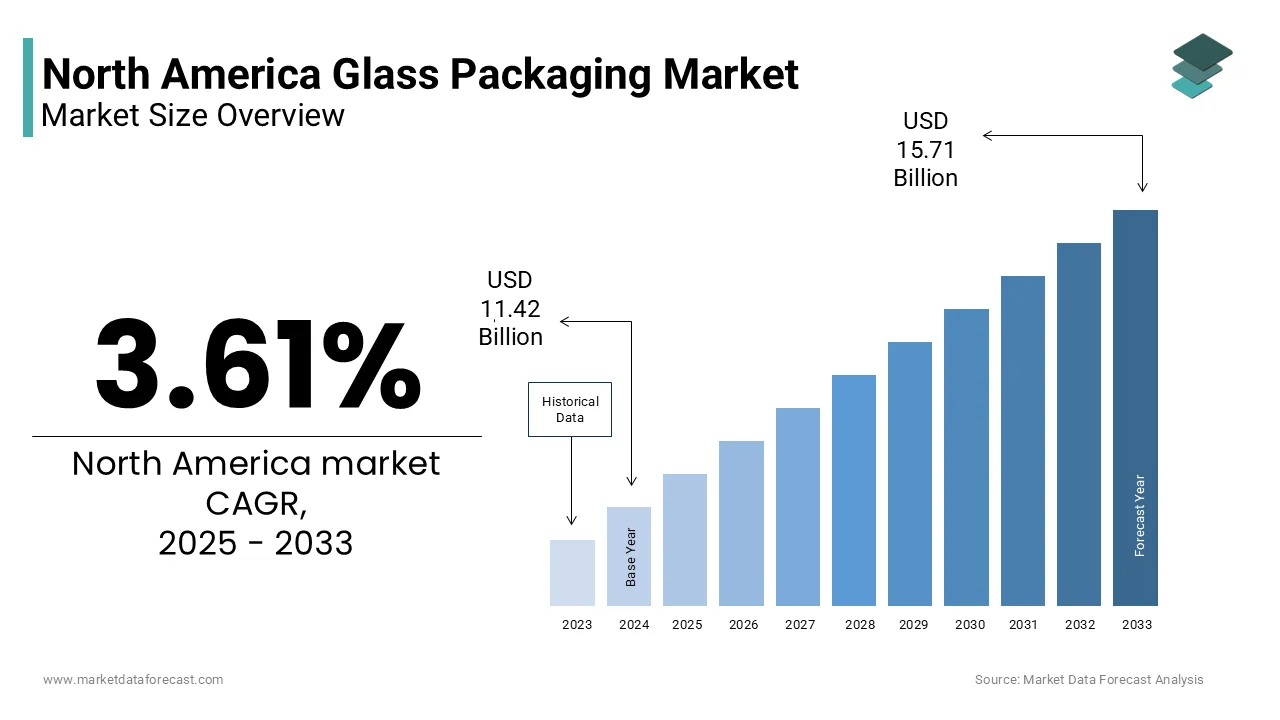
Glass packaging is used across various industries such as food and beverage, pharmaceuticals, cosmetics, and household products. It is valued for its inert properties, recyclability, and ability to preserve product integrity without chemical interaction. In recent years, the market has seen a revival driven by consumer preference for sustainable and premium packaging solutions. Canada has also witnessed rising domestic demand, particularly in the craft beverage sector, where local breweries and distilleries favor glass bottles for branding and environmental reasons. Further, regulatory bodies like Environment and Climate Change Canada have endorsed glass recycling initiatives, reinforcing its role in circular economy models. The region's well-established manufacturing base, combined with increasing awareness around health and sustainability, continues to shape the dynamics of the North America glass packaging industry.
MARKET DRIVERS
Rising Consumer Preference for Sustainable and Eco-Friendly Packaging
Growing consumer inclination toward sustainable and environmentally responsible packaging materials is a significant driver of the North America glass packaging market. As per the Shelton Group’s 2023 sustainability survey, nearly 68% of American consumers expressed a strong preference for products packaged in recyclable materials, with glass being one of the most trusted options due to its infinite recyclability and minimal carbon footprint. This trend is particularly pronounced in the food and beverage sector, where companies are shifting away from plastic and PET containers to meet eco-conscious demands. For instance, in Canada, as per the Ontario Ministry of the Environment, glass bottle return rates reached 75% in 2023, highlighting improved consumer participation in recycling programs. These behavioral shifts are prompting manufacturers to expand their glass packaging lines and invest in lightweighting technologies to reduce energy consumption during production and transportation.
Expansion of Premium and Specialty Beverage Markets
The rapid expansion of premium and specialty beverage segments, including craft beer, organic wines, artisanal sodas, and cold-pressed juices, is another key factor fueling the North America glass packaging market. In Canada, the Canadian Vintners Association noted that sales of locally produced wine in glass bottles grew, driven by domestic tourism and direct-to-consumer sales. Glass is preferred in these categories not only for its aesthetic value but also for its ability to maintain flavor integrity and prevent chemical leaching. Furthermore, the rise of e-commerce platforms specializing in niche beverages has increased demand for durable, visually appealing packaging, further boosting glass adoption. Companies like Owens-Illinois and Ardagh Group have expanded their custom bottle offerings to cater to this segment, strengthening the alignment between premium product positioning and glass packaging usage across North America.
MARKET RESTRAINTS
High Transportation Costs Due to Weight and Fragility of Glass Containers
The high cost associated with transporting glass due to its weight and susceptibility to breakage is one of the primary constraints affecting the North America glass packaging market. Unlike lighter alternatives such as plastic or aluminum, glass packaging adds significant logistical expenses, particularly over long distances. According to the U.S. Department of Transportation, freight costs for glass shipments are approximately 25% higher than those for comparable volumes of plastic-packaged goods, largely due to fuel surcharges and handling precautions. This issue disproportionately affects small and mid-sized beverage producers who rely on regional distribution networks but lack economies of scale. To mitigate these challenges, some manufacturers have opted to establish localized bottling facilities near major consumption hubs, though this requires substantial capital investment. Despite advancements in lightweight glass technology, the inherent physical limitations of the material continue to pose economic barriers to broader market penetration.
Regulatory Restrictions on Energy Intensity in Glass Manufacturing
Glass production is an energy-intensive process, primarily due to the high temperatures required for melting raw materials such as silica sand, soda ash, and limestone. This aspect has led to increasing regulatory scrutiny, especially under climate-focused policies aimed at reducing industrial carbon emissions. Several states, including California and New York, have introduced emissions caps under their respective climate action plans, compelling glass producers to invest in cleaner technologies or face penalties. In Canada, Natural Resources Canada has mandated a 30% reduction in carbon intensity for industrial sectors by 2030, directly impacting glass manufacturing operations. Compliance with these regulations often necessitates costly upgrades to furnaces, adoption of alternative fuels, or integration of electric melting systems, all of which affect production economics.
MARKET OPPORTUNITIES
Surge in Demand for Reusable Glass Packaging Solutions
The increasing adoption of reusable glass containers, particularly in urban centers and among environmentally conscious consumers, is an emerging opportunity for the North America glass packaging market. Cities such as Seattle, San Francisco, and Toronto have implemented policies promoting refill stations and zero-waste retail formats, encouraging brands to transition from single-use packaging. In the dairy industry, for example, companies like Maple Hill Creamery and Strauss Family Creamery have reintroduced glass milk bottles with deposit-return schemes, aligning with consumer preferences for waste-free consumption. Similarly, in Canada, Loop Industries partnered with Loblaw Companies Limited to introduce refillable glass jars for household and personal care products in select stores. These initiatives not only reduce packaging waste but also offer cost savings over time for both retailers and consumers.
Innovation in Lightweight and Shatter-Resistant Glass Technologies
Advancements in glass engineering have opened new growth avenues for the North America glass packaging market through the development of lightweight and shatter-resistant variants. Innovations such as chemically strengthened glass, polymer-coated bottles, and ultra-thin borosilicate containers are addressing traditional drawbacks related to weight and fragility. Like, modern lightweight glass bottles now weigh less than conventional versions while maintaining structural integrity and barrier properties. This development is particularly beneficial for the beverage industry, where logistics efficiency and consumer convenience play crucial roles. Major glass manufacturers like Vitro Packaging and O-I Glass have launched proprietary lightweight lines tailored for soft drinks, spirits, and premium waters. Moreover, research conducted by Corning Incorporated has demonstrated the feasibility of flexible glass substrates that can withstand impact without breaking, potentially expanding applications into on-the-go and outdoor markets.
MARKET CHALLENGES
Competition from Alternative Packaging Materials
Intense competition from alternative materials such as plastic, aluminum, and biodegradable polymers, each offering distinct benefits in terms of cost, durability, and convenience, is a major challenge for the North America glass packaging market. Plastic remains a dominant force in food and beverage packaging due to its lightweight nature, lower production costs, and ease of customization. Aluminum has gained traction, especially in the beverage sector, with canned beer and ready-to-drink cocktails experiencing double-digit growth. In Canada, as per the Aluminum Association of Canada, there was a 14% increase in aluminum can production in 2023, attributed to rising consumer demand for portable and recyclable packaging. Meanwhile, bioplastics and compostable materials are gaining ground in niche markets focused on zero-waste and circular economy principles. These competing materials collectively challenge glass’s dominance by offering cost-effective, versatile, and sometimes more transport-efficient options, forcing glass packaging firms to continuously innovate and differentiate their offerings.
Fluctuations in Raw Material Availability and Pricing
Volatility in the availability and pricing of essential raw materials such as silica sand, soda ash, and limestone is another key challenge for the North America glass packaging market. These components form the foundation of glass production, and any disruptions in their supply chain—whether due to mining restrictions, geopolitical tensions, or transportation bottlenecks—can lead to production delays and cost increases. According to the U.S. Geological Survey (USGS), soda ash prices rose in 2023 due to supply shortages from key exporting regions. In Canada, as per the Mining Association of Canada, environmental permitting delays for silica sand extraction projects contributed to a tightening of raw material inventories. Besides, energy costs, particularly natural gas used in furnace operations, remain a critical variable affecting profitability. These fluctuations make it difficult for manufacturers to maintain stable pricing structures and consistent production schedules.
REPORT COVERAGE
| REPORT METRIC | DETAILS |
| Market Size Available | 2025 to 2034 |
| Base Year | 2025 |
| Forecast Period | 2026 to 2034 |
| CAGR | 3.61% |
| Segments Covered | By Product, Application, and Region |
|
Various Analyses Covered | Regional & Country Level Analysis, Segment-Level Analysis, DROC, PESTLE Analysis, Porter’s Five Forces Analysis, Competitive Landscape, Analyst Overview on Investment Opportunities |
| Regions Covered | The United States, Canada, Mexico, and Rest of North America |
| Market Leaders Profiled | Sherwin-Williams Company, Owen-Illinois, Inc., Amcor Limited, RPM International Inc., and others |
SEGMENTAL ANALYSIS
By Product Insights
The soda lime glass segment commanded the North America glass packaging market by accounting for 68.8% of total value in 2025. Its cost-effectiveness compared to other glass types and its well-established recycling infrastructure is largely attributed to the dominance of soda lime glass segment. This segment is widely used across food and beverage, pharmaceutical, and household product packaging due to its affordability, ease of manufacturing, and compatibility with high-speed production lines. Apart from these, its widespread use in mass-market consumer goods ensures sustained demand across both industrial and retail sectors.

The Borosilicate glass segment is currently the fastest-growing product in the North America glass packaging market and is projected to expand at a CAGR of 6.3% from 2026 to 2034. Known for its superior thermal resistance and chemical durability, borosilicate glass is increasingly being adopted in premium food storage, laboratory equipment, and specialty beverage packaging. In the U.S., companies like Pyrex and Anchor Hocking have expanded their borosilicate-based kitchenware lines, capitalizing on growing consumer interest in durable and sustainable alternatives to plastic. In Canada, Health Canada’s endorsement of non-plastic food contact materials has encouraged manufacturers to adopt borosilicate options in baby food jars and pharmaceutical vials. These factors are collectively propelling the growth trajectory of this high-performance glass category.
 By Application Insights
The alcoholic beverages segment dominated the North America glass packaging market by capturing an estimated 32.5% of total share in 2025. Glass remains the preferred packaging material for spirits, wines, and liqueurs due to its ability to preserve taste integrity and enhance brand perception. According to the Distilled Spirits Council of the United States (DISCUS), U.S. spirits sales exceeded $36 billion in 2023, with over 90% of premium brands opting for glass bottles. Wine consumption also saw strong growth, with as per the Wine Institute, California alone shipped over 200 million cases domestically and internationally in the same year. The continued expansion of craft distilleries and luxury liquor markets further reinforces the entrenched preference for glass packaging in this sector.
The pharmaceuticals application segment is emerging as the fastest-growing category in the North America glass packaging market and is projected to grow at a CAGR of 5.9% through 2034. Stringent regulatory requirements for drug stability and safety, which mandate the use of chemically inert and impermeable packaging materials, is largely propelling the growth of pharmaceuticals application segment. In 2023, the U.S. biopharmaceutical industry invested heavily in vaccine and monoclonal antibody production, increasing demand for high-quality glass containers. In Canada, Health Canada emphasized the importance of glass in maintaining sterility for compounded medicines and clinical trial drugs.
REGIONAL ANALYSIS
United States
The United States led the North America glass packaging market by accounting for a 62.4% of total regional revenue in 2025. As one of the world’s largest consumers of packaged food and beverages, the U.S. maintains a robust demand for glass containers across multiple industries. The country benefits from a well-established manufacturing base, including key players such as Owens-Illinois and Vitro Packaging, which operate large-scale facilities across states like Pennsylvania, Ohio, and California. Further, the rise of e-commerce and direct-to-consumer beverage models has spurred demand for premium glass packaging solutions.
Canada
Canada occupies a significant position in the North America glass packaging market. The country's market is driven by its thriving beverage industry, particularly in the craft brewing and wine sectors. Moreover, British Columbia and Ontario lead in wine production, where glass remains the dominant packaging format. Major glass manufacturers like Encirc and O-I Glass have expanded their Canadian operations to meet rising demand, particularly in the food and pharmaceutical sectors. These factors collectively underscore Canada’s strong presence in the regional glass packaging market.
Mexico
Mexico is emerging player in the North America glass packaging market. The country’s market is primarily driven by its expanding food and beverage sector, particularly in beer exports and bottled water consumption. Besides, the Mexican bottled water industry, one of the largest in Latin America, continues to rely on glass for premium segments. The government has also been promoting circular economy initiatives, encouraging reuse and recycling programs in urban centers. Despite logistical challenges related to raw material imports and energy costs, Mexico’s glass packaging market is gaining momentum as domestic producers invest in new technologies and distribution networks to support growing consumer demand.
KEY MARKET PLAYERS AND COMPETITIVE LANDSCAPE
The Sherwin-Williams Company, Owen-Illinois, Inc., Amcor Limited, RPM International Inc. are the key players in the North America glass packaging market.
The competition in the North America glass packaging market is characterized by a mix of large multinational corporations, regional manufacturers, and niche specialty players striving to maintain relevance in a dynamic environment. While a few dominant firms control a significant portion of the market, mid-sized and local producers continue to carve out competitive advantages through agility, customization, and proximity to end-use industries. The market is highly influenced by trends such as sustainability, premiumization, and health-conscious consumption, which are driving demand for high-quality, eco-friendly packaging solutions. Innovation remains a key battleground, with companies investing in new materials, lightweighting technologies, and digital printing to differentiate their offerings. Apart from these, environmental regulations and rising consumer awareness around recyclability are pushing competitors to adopt greener production methods and closed-loop systems. As demand for reusable and recyclable packaging intensifies, the level of competition is expected to rise further, prompting continuous evolution in product offerings and operational strategies across the region.
TOP PLAYERS IN THE MARKET
Owens-Illinois, Inc. (O-I Glass)
Owens-Illinois is a global leader in glass packaging and holds a dominant presence in North America. The company operates numerous manufacturing facilities across the U.S. and Canada, offering a wide range of glass containers for food, beverages, and pharmaceuticals. Known for its innovation and sustainability initiatives, O-I Glass has been instrumental in advancing lightweight and recyclable glass solutions. Its strong distribution network and long-standing partnerships with major consumer goods brands make it a key player in shaping the regional market landscape.
Ardagh Group
Ardagh Group is a diversified global supplier of glass packaging with a significant footprint in North America. The company serves a broad customer base through its extensive production capabilities and product customization offerings. Ardagh focuses on premium glass packaging for alcoholic beverages, soft drinks, and food products. With an emphasis on design innovation and environmental responsibility, Ardagh plays a vital role in meeting evolving consumer preferences while supporting circular economy goals through high recycling rates and energy-efficient manufacturing practices.
Vitro Packaging
Vitro Packaging is one of the largest manufacturers of glass containers in the Americas, with a strong presence in both the U.S. and Mexico. The company specializes in sustainable glass packaging for beer, wine, spirits, and food products. Vitro is known for integrating advanced technologies into its production processes to enhance efficiency and reduce environmental impact. Its strategic investments in capacity expansion and green manufacturing have solidified its position as a leading contributor to the North American glass packaging sector.
TOP STRATEGIES USED BY KEY PLAYERS
One of the primary strategies employed by key players in the North America glass packaging market is product innovation and differentiation. Companies are investing heavily in developing unique bottle designs, lightweight containers, and enhanced barrier properties to meet specific industry needs. These innovations help brands stand out on shelves while improving functionality and sustainability.
Another critical strategy is expanding sustainable practices and promoting circular economy models . Leading firms are focusing on increasing recycled content in their glass products, optimizing energy use during production, and collaborating with recycling infrastructure providers. This not only aligns with regulatory requirements but also appeals to environmentally conscious consumers and brand owners.
Strategic acquisitions and partnerships also play a crucial role in strengthening market position. Major players are acquiring regional glass producers, forming joint ventures with logistics providers, and partnering with beverage and food companies to secure long-term contracts. These moves enable companies to expand their reach, improve supply chain efficiency, and offer integrated packaging solutions tailored to client demands.
RECENT HAPPENINGS IN THE MARKET
- In February 2025, Owens-Illinois launched a new line of ultra-lightweight glass bottles designed specifically for premium water and craft spirits, aiming to reduce transportation costs and carbon emissions without compromising durability.
- In May 2025, Ardagh Group announced a partnership with a leading beverage brand to develop fully customizable digital labeling solutions for glass bottles, enhancing brand engagement and consumer experience.
- In July 2025, Vitro Packaging invested in a state-of-the-art glass recycling facility in California, aimed at boosting domestic recycled glass supply and reducing dependency on raw materials.
- In September 2025, Anchor Glass Container Corporation introduced a new range of tamper-evident glass jars for the organic food and wellness sectors, addressing growing consumer concerns about product safety and authenticity.
- In November 2025, Encirc Glass expanded its U.S. operations by opening a new production plant in Texas, focused on supplying sustainable glass packaging to the booming craft beverage and premium alcohol markets.
MARKET SEGMENTATION
This research report on the North America glass packaging market has been segmented and sub-segmented based on the following categories.
By Product
-
Borosilicate
-
De-Alkalized Soda Lime
-
Soda Lime
By Application
-
Alcoholic Beverages
-
Food & Beverages
-
Pharmaceutical
-
Beer
By Country
- The United States
- Canada
- Rest of North America