- Product Description Description
- Table of Contents TOC
- List of Table & Figure LOT
- Get Free Sample PDF Sample PDF
Market Size, 2025
$3.52 BnMarket Estimate, 2026
$3.81 BnMarket Forecast, 2034
$7.12 BnCAGR, 2026–2034
8.13%Executive Summary: North America Heat Exchanger Market
- Market Scope: Comprehensive North America heat exchanger market analysis covering product types, end-user industry verticals, material configurations, regional country frameworks, and efficiency-driven adoption metrics.
- Market Valuation: Valued at USD 3.52 billion (2025), estimated at USD 3.81 billion (2026), and projected to reach USD 7.12 billion by 2034, registering a robust CAGR of 8.13% (2026–2034).
- Primary Growth Drivers: Escalating global focus on sustainable energy, rigorous regulatory efforts to mitigate greenhouse gas (GHG) emissions, and high industrial demand for heat recovery systems to optimize processes and lower energy costs. Key operational drivers include expanding oil and gas explorations in the U.S. and surging energy demand across industrial and commercial Canadian sectors.
Key Market Segment Metrics (2026–2034)
| Category | Leading Segment (2025 Position) | Fastest-Growing Segment |
|---|---|---|
| By Type | Shell & tube (foreseen to expand with a notable CAGR due to cost-effectiveness and high temperature/pressure tolerance) | Plate & frame and microchannel heat exchangers |
| By End User | Oil & gas and petrochemical sectors (led regional process and thermal applications) | HVACR and power generation applications |
| By Material | Stainless steel (accounted for a substantial portion due to erosion resistance, lightweight build, and high thermal conductivity) | Specialized nickel and corrosion-resistant alloy configurations |
| By Region / Country | United States (served as the primary demand hub driven by expanded oil and gas explorations) | Canada and U.S. industrial hubs experiencing surging energy efficiency demands |
Major Market Players & Market Structure
Market Structure: Highly competitive North American thermal management landscape featuring global engineering and manufacturing leaders competing intensely on local production footprint expansion, rapid lead times, and high-temperature gas-to-liquid efficiency solutions.
Key Companies: Danfoss A/S, General Electric Company, Alfa Laval AB, Kelvion Holding GmbH, and SPX Flow Inc.
North America Heat Exchanger Market Size
The North America heat exchangers market size was valued at USD 3.52 billion in 2025 and is predicted to reach USD 7.12 billion by 2034 from USD 3.81 billion in 2026, growing at a CAGR of 8.13%.
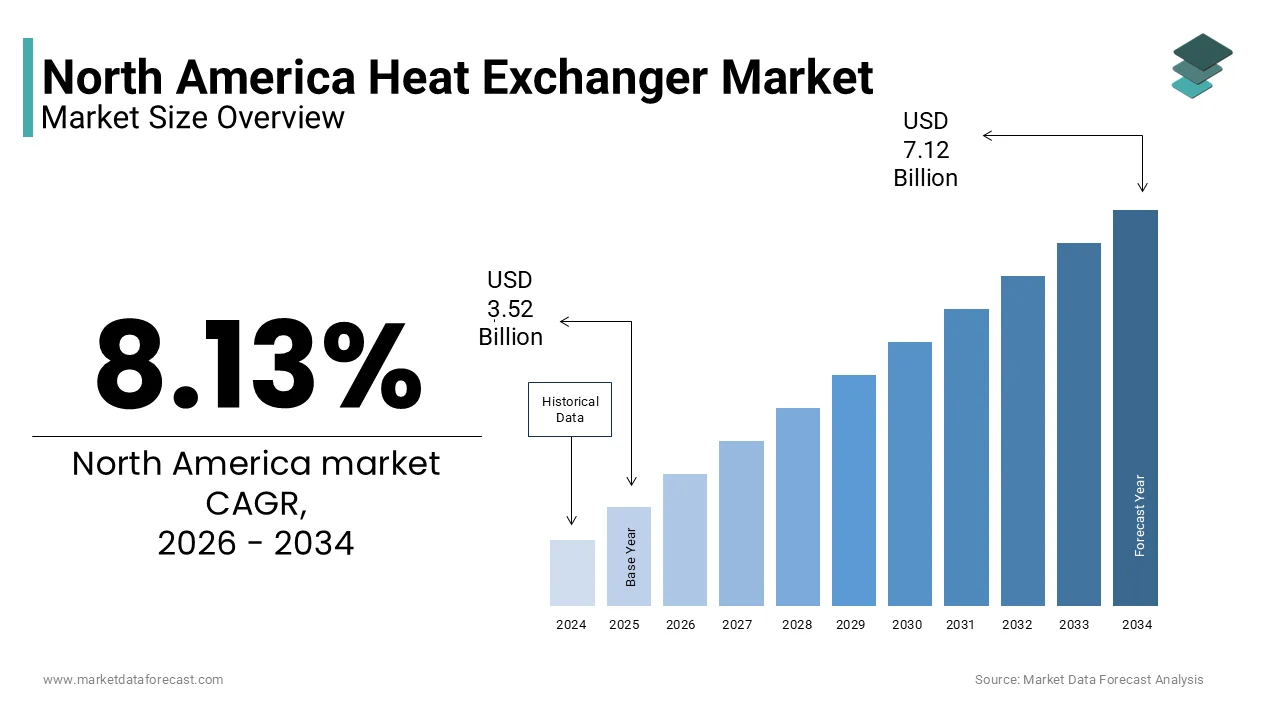
The heat exchangers are thermal management systems such as energy transfer across industrial, commercial, and residential sectors. These devices facilitate efficient temperature regulation in applications ranging from power generation and chemical processing to HVAC and data center cooling. According to the study, the industrial sector consumed approximately 32% of total US energy in 2023 with the massive scale of thermal management requirements. The American Society of Heating Refrigerating and Air Conditioning Engineers states that optimizing heat exchange efficiency can reduce building energy consumption. Furthermore, secondary energy use in Canadian industry, driving demand for advanced exchanger technologies. This convergence of industrial modernization, stringent environmental regulations, and digital infrastructure expansion defines the current operational landscape for thermal transfer equipment across the continent.
MARKET DRIVERS
Industrial Modernization and Reshoring Initiatives
The resurgence of domestic manufacturing and extensive industrial modernization programs is accelerating the growth of the North America Heat Exchangers Market. According to the research, construction spending on manufacturing facilities reached a record 198 billion dollars in 2023, reflecting massive capital investment in new production capacity. This construction boom directly translates to procurement orders for process heat exchangers used in semiconductor fabrication, battery manufacturing, and chemical synthesis. These statistics demonstrate a direct correlation between industrial capital expenditure and market volume. New facilities require state of the art shell and tube or plate heat exchangers to meet precise thermal specifications, while retrofits focus on high efficiency models to reduce operating costs.
Data Center Expansion and Cooling Demands
The exponential growth of digital infrastructure and artificial intelligence computing is also promoting the growth of the North America heat exchangers market. North American data center inventory expanded with northern Virginia alone absorbing of new power capacity. This physical expansion necessitates corresponding increases in cooling infrastructure to manage rising rack densities. The average rack density has increased, pushing traditional air cooling beyond its limits and accelerating adoption of liquid based heat exchangers. These figures illustrate the critical link between computational intensity and thermal management market growth. Liquid to liquid and immersion cooling heat exchangers are becoming standard for high performance computing environments where air cooling is insufficient.
MARKET RESTRAINTS
Volatility in Raw Material Prices
The significant fluctuations in the cost of key metals is hindering the growth of the North America heat exchangers market. According to the survey, the price of copper averaged 3.85 dollars per pound in 2023 but experienced intrayear swings exceeding due to global supply disruptions. Stainless steel and nickel alloys, essential for corrosion resistance in harsh industrial environments, face similar volatility driven by geopolitical tensions and trade tariffs. The metal product manufacturing shows that input costs for heat exchanger producers rose, compressing margins significantly. These statistics highlight the financial risk manufacturers face when quoting long term projects. Budget sensitive end users in construction and municipal sectors may postpone upgrades when equipment prices become unpredictable.
Technical Complexity of Retrofitting Aging Infrastructure
The widespread presence of obsolete thermal systems that is limiting the growth of the North America heat exchangers market. According to the study, nearly 40% of US bridges and industrial structures were built before 1970, implying a vast installed base of legacy mechanical systems designed to outdated standards. Integrating modern high efficiency heat exchangers into these constrained spaces often requires extensive custom engineering and auxiliary modifications. These data points reveal why replacement cycles lag behind technological availability. Facility managers frequently opt for like for like replacements rather than superior but incompatible modern units to avoid operational downtime and excessive capital outlay. The engineering complexity and associated soft costs of adaptation deter rapid adoption of next generation heat transfer technologies, effectively slowing the overall market transition rate despite the clear efficiency benefits of newer equipment.
MARKET OPPORTUNITIES
Waste Heat Recovery and Decarbonization Mandates
The stringent decarbonization policies and corporate sustainability targets is to setup new opportunities for the growth of the North America heat exchangers market. The Inflation Reduction Act provides tax credits covering the cost for qualified energy efficiency improvements, directly incentivizing capital investment in heat recovery systems. These statistics underscore the economic viability of thermal recycling projects under current policy frameworks. Industries such as cement, steel, and glass manufacturing are actively seeking regenerative heat exchangers to preheat combustion air or generate steam, thereby reducing fuel consumption and carbon footprints. The alignment of regulatory incentives with operational savings transforms waste heat recovery from a niche concept into a mainstream capital priority. Manufacturers offering integrated heat recovery solutions are uniquely positioned to capture value from this transition, turning compliance pressures into revenue streams while helping clients achieve net zero commitments.
Electrification of Transportation and Thermal Management
The rapid shift toward electric vehicles, which is solely boosting the growth of the North America automotive heat exchangers market. Electric powertrains require sophisticated thermal management systems to regulate battery temperatures, motor cooling, and cabin comfort, utilizing multiple compact heat exchangers per vehicle. According to the Department of Energy, the EV charging network must expand tenfold by 2030, creating parallel demand for cooling systems in fast charging stations. These figures indicate a structural shift in automotive thermal demand distinct from internal combustion engines. Battery thermal management systems rely heavily on lightweight aluminum brazed heat exchangers and liquid cold plates to ensure safety and performance. As automakers localize battery production and assembly within North America to comply with trade agreements, regional suppliers gain preferential access to this growing value chain.
MARKET CHALLENGES
Skilled Labor Shortages in Specialized Manufacturing
A shortage of skilled welders and fabricators is a huge challenge for the growth of the North America Heat Exchangers Market. According to the study, the industry faces a deficit of over 90000 welding professionals, with the average age of existing workers exceeding 55 years. Heat exchanger manufacturing relies heavily on precision welding techniques for pressure vessels and tube sheets, making human capital a bottleneck regardless of automation levels. These statistics illustrate a systemic vulnerability in the supply base. Production delays caused by labor constraints lead to extended lead times, frustrating customers and potentially pushing them toward imported alternatives with shorter delivery schedules. Training new workers takes years due to the specialized nature of pressure equipment codes, meaning the shortage cannot be resolved quickly.
Regulatory Compliance and Certification Burdens
The complex and evolving safety standards is also to limit the growth of the North America Heat Exchangers Market. According to the study, obtaining and maintaining Boiler and Pressure Vessel Code certification requires rigorous documentation, third party inspections, and continuous quality system audits. Transport Canada and provincial safety authorities enforce additional jurisdictional requirements that vary across borders, complicating pan continental distribution strategies. While essential for public safety, the cumulative cost of compliance diverts resources from research and development or capacity expansion. Small and medium sized enterprises struggle disproportionately with these fixed overheads, leading to market consolidation. Furthermore, harmonization gaps between US and Canadian standards necessitate dual testing for cross border sales, adding time and expense.
REPORT COVERAGE
| REPORT METRIC | DETAILS |
| Market Size Available | 2025 to 2034 |
| Base Year | 2025 |
| Forecast Period | 2026 to 2034 |
| CAGR | 8.13% |
| Segments Covered | By Type, End User, Material, and Region |
| Various Analyses Covered | Regional & Country Level Analysis, Segment-Level Analysis, DROC, PESTLE Analysis, Porter’s Five Forces Analysis, Competitive Landscape, Analyst Overview on Investment Opportunities |
| Regions Covered | The United States, Canada, Mexico, and Rest of North America |
| Market Leaders Profiled | Danfoss A/S, General Electric Company, Alfa Laval AB, Kelvion Holding GmbH, Xylem Inc., and SPX Flow Inc. |
SEGMENTAL ANALYSIS
By Type Insights
The shell and tube segment was the largest by holding 45.3% of the North America Heat Exchangers Market share in 2025 due to its exceptional ability to withstand extreme pressures and temperatures inherent in heavy industrial processes. According to the study, over 60% of heat transfer equipment in refineries and chemical plants utilizes shell and tube designs because they can handle pressures exceeding 1000 psi without structural failure. This robustness is critical for safety and operational continuity in sectors like oil and gas where process conditions are severe. The design allows for easy maintenance and cleaning, which is vital for minimizing downtime in continuous production environments. As per data, the average lifespan of a well maintained shell and tube exchanger exceeds 20 years by offering superior long term value compared to more delicate alternatives.
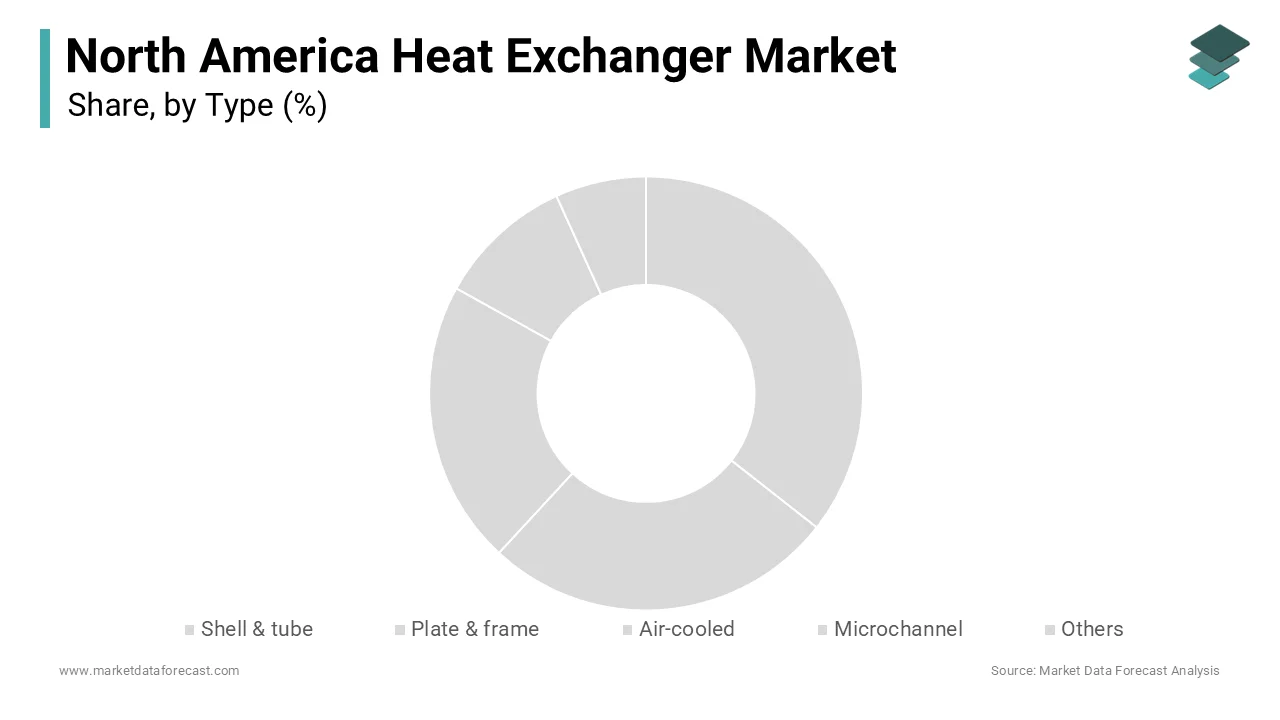
The microchannel segment is expected to grow at a fastest CAGR of 12.3% during the forecast period with the superior thermal efficiency and compact physical footprint. This efficiency is crucial for modern applications where space is limited and energy conservation is paramount. These statistics demonstrate the technology's alignment with contemporary performance requirements. The compact size allows for integration into tight spaces within data centers and electronic devices, addressing the miniaturization trend. As per data, the use of microchannel coolers in high performance computing chips has increased annually to manage rising heat fluxes.
By End User Insights
The oil and gas sector was the largest by accounting for 34.2% of the North America Heat Exchangers Market share in 2025 due to its extensive infrastructure and intensive processing requirements. According to the United States Energy Information Administration, the United States produces approximately 12 million barrels of crude oil per day, requiring vast networks of refining and processing facilities equipped with thermal management systems. Each refinery utilizes hundreds of heat exchangers for distillation, cracking, and treatment processes by creating substantial baseline demand. These figures underscore the critical role of heat exchangers in maintaining operational efficiency and safety. The complexity of hydrocarbon processing necessitates robust and reliable thermal solutions that can handle corrosive fluids and high temperatures.
The HVACR segment is anticipated to grow at a fastest CAGR of 12.3% from 2026 to 2034 with the rapid urbanization and stringent green building standards. The Leadership in Energy and Environmental Design certification program mandates high efficiency HVAC systems, which rely on advanced plate and microchannel heat exchangers to meet energy performance criteria. As cities expand, the need for efficient cooling and heating becomes crucial for occupant comfort and energy conservation. The International Code Council updates building codes regularly to enforce higher efficiency standards, compelling manufacturers to upgrade their equipment. This regulatory push ensures that new constructions incorporate state of the art heat exchange technology, driving rapid growth in the HVACR segment as it adapts to sustainable urban development requirements.
By Material Insights
The stainless steel was the largest by holding 42.3% of the North America Heat Exchangers Market due to its exceptional corrosion resistance and adherence to strict hygiene standards in critical industries. According to the study, stainless steel accounts for over 40% of all heat exchanger material usage in the food and beverage and pharmaceutical sectors due to its non-reactive surface. The Food and Drug Administration mandates that all equipment contacting consumable products must be made of materials that do not leach contaminants by making stainless steel the preferred choice. These statistics underscore the material's indispensability in regulated environments. Its ability to withstand frequent cleaning with harsh sanitizers without degrading ensures long term reliability and safety. As per the study, the durability of stainless steel reduces lifecycle costs by minimizing replacement frequency.
Nickel alloys segment is likely to foster at a fastest CAGR of 12.3% from 2026 to 2034 with the need for performance in extreme environments. The Department of Energy states that next generation nuclear reactors and concentrated solar power plants require materials that can withstand unprecedented thermal stresses, driving adoption of nickel alloys. As industries seek to improve efficiency by operating at higher temperatures, traditional materials fail, necessitating the use of nickel alloys. The ability of these alloys to maintain strength and resist oxidation under extreme conditions makes them indispensable for cutting edge applications.
REGIONAL ANALYSIS
United States Market Analysis
The United States was the largest contributor in the North America Heat Exchangers Market by accounting for 85.7% of share in 2025 due to its massive industrial base and technological dominance. According to the United States Department of Commerce, the manufacturing sector contributes over 2 trillion dollars to the GDP, driving continuous demand for industrial thermal management equipment. The presence of major oil and gas producers in Texas and Louisiana creates a concentrated hub for heat exchanger consumption, with the Permian Basin alone accounting for 40% of US crude production as per the Energy Information Administration. This industrial activity necessitates extensive refining and processing infrastructure equipped with advanced heat transfer systems. Additionally, the rapid expansion of data centers in states like Virginia and California fuels demand for specialized cooling solutions. Strict environmental regulations enforced by the EPA further drive replacement cycles with high efficiency models.
Canada Market Analysis
Canada heat exchangers market was ranked second by holding 13.2% of share in 2025 with its focus on resource extraction and cold climate HVAC requirements. The oil sands operations in Alberta require massive amounts of steam and heat recovery equipment, driving specific demand for large scale shell and tube units. Additionally, the extreme winter climate necessitates robust HVAC systems for residential and commercial buildings, boosting the market for efficient heating exchangers. The government’s commitment to carbon neutrality by 2050 is also spurring investments in carbon capture and storage projects, which utilize specialized heat exchangers.
COMPETITIVE LANDSCAPE
The competition in the North America heat exchangers market is characterized by intense rivalry among established multinational corporations and emerging niche brands seeking to capture market share. Large dairy conglomerates leverage their extensive distribution networks and brand recognition to dominate mainstream segments while specialized biotechnology firms focus on high potency supplements and personalized solutions. Price competition is moderate due to the premium nature of functional foods but private label offerings from major retailers exert pressure on branded products. Innovation serves as a key differentiator with companies constantly launching new formats and strains to appeal to health-conscious consumers. Regulatory compliance creates barriers to entry favoring players with robust scientific validation capabilities. Digital transformation has intensified competition as online platforms enable direct to consumer models that bypass traditional retail channels. Collaborations with healthcare professionals enhance credibility and drive prescription-based sales.
Key Market Players
Some of the key players in the North America heat exchangers market are
- Danfoss AS
- General Electric Company
- Alfa Laval AB
- Kelvion Holding GmbH
- Xylem Inc
- SPX Flow Inc.
Top Players in the Market
- Alfa Laval maintains a prominent position in the North America Heat Exchangers Market through its extensive portfolio of plate and spiral heat exchangers. The company focuses on delivering energy efficient solutions for HVAC, food processing, and marine applications. Recent initiatives include expanding its manufacturing capacity in Kansas to meet growing demand for brazed plate units. Alfa Laval actively invests in digital services that optimize heat transfer performance and reduce maintenance costs for clients. The company collaborates with local engineering firms to customize solutions for specific industrial needs. By prioritizing sustainability and innovation, Alfa Laval strengthens its reputation as a reliable partner for thermal management. Its commitment to reducing carbon footprints aligns with regional regulatory goals, driving adoption of its advanced technologies across diverse sectors.
- Kelvion contributes significantly to the North America Heat Exchangers Market by specializing in high performance plate heat exchangers for demanding industrial processes. The company leverages its global expertise to provide tailored solutions for chemical, pharmaceutical, and energy sectors. Recent actions include launching new gasket materials that enhance durability and resistance to aggressive media. Kelvion has expanded its service network in the United States to offer faster response times and technical support. The company emphasizes modular designs that simplify installation and maintenance for end users. Its strategic investments in research and development ensure that products meet evolving safety and environmental standards, reinforcing its competitive edge in the region.
- Xylem Inc plays a vital role in the North America Heat Exchangers Market through its integrated water and thermal management solutions. The company offers a wide range of heat exchange equipment for municipal, industrial, and commercial applications. Recent strategies involve acquiring specialized technology firms to enhance its digital monitoring capabilities. Xylem focuses on smart water systems that optimize heat recovery and reduce energy consumption. The company partners with utilities and industrial plants to implement sustainable thermal solutions. Its emphasis on resource efficiency and resilience supports infrastructure modernization efforts.
Top Strategies Used by Key Market Participants
Key players in the North America heat exchangers market employ diverse strategies to maintain competitive advantage and drive growth. Product innovation remains a primary focus with companies investing heavily in research and development to create novel formulations that address specific health needs such as immune support and mental well-being. Strategic partnerships and collaborations with academic institutions enable firms to validate product efficacy through rigorous clinical trials enhancing consumer trust and regulatory compliance. Expansion into digital health platforms allows brands to offer personalized nutrition advice and subscription services fostering long term customer loyalty and recurring revenue streams. Mergers and acquisitions facilitate access to new technologies and distribution networks enabling rapid market penetration and portfolio diversification. Sustainability initiatives are increasingly central to corporate strategies with manufacturers adopting eco-friendly packaging and ethical sourcing practices to align with consumer values and regulatory requirements.
MARKET SEGMENTATION
This research report on the North America heat exchangers market has been segmented and sub-segmented based on the following categories.
By Type
- Shell & tube
- Plate & frame
- Air-cooled
- Microchannel
- Others
By End User
- Chemical
- Petrochemical
- Oil & gas
- HVACR
- Food & beverage
- Power generation
- Others.
By Material
- Carbon steel
- Stainless steel
- Nickel
- Others
By Country
- The United States
- Canada
- Rest of North America