- Product Description Description
- Table of Contents TOC
- List of Table & Figure LOT
- Get Free Sample PDF Sample PDF
Market Size, 2025
$0.48 BnMarket Estimate, 2026
$0.50 BnMarket Forecast, 2034
$0.70 BnCAGR, 2026–2034
4.23%North America Heat Recovery Steam Generator Market Size, Growth, Trends & Forecast (2026–2034)
The North America Heat Recovery Steam Generator Market size was calculated at USD 0.48 billion in 2025, is anticipated to be worth USD 0.50 billion in 2026, and is expected to reach USD 0.70 billion by 2034, growing at a compound annual growth rate (CAGR) of 4.23% during the forecast period. Growth is strongly driven by the expanding adoption of combined cycle power plants (CCPPs), rising industrial demand for cogeneration and process heating efficiency, and integration needs within hybrid renewable energy systems.
Key Executive Metrics (At-a-Glance)
- 2025 Base Valuation: USD 0.48 Billion
- 2026 Current Valuation: USD 0.50 Billion
- 2034 Forecast Valuation: USD 0.70 Billion
- Compound Annual Growth Rate (CAGR): 4.23% (2026–2034)
- Dominant Design Segment: Horizontal drum HRSGs (accounting for 59.1% of the market share)
- Fastest-Growing Design Segment: Vertical drum HRSGs (estimated CAGR of 6.2%)
- Dominant Mode of Operation Segment: Combined cycle mode
- Fastest-Growing Mode of Operation Segment: Cogeneration / CHP (projected CAGR of 6.9%)
- Dominant Power Capacity Segment: 201–300 MW capacity range
- Fastest-Growing Power Capacity Segment: Up to 30 MW capacity range (emerging CAGR of 7.4%)
- Dominant End-Use Segment: Utilities (accounting for 41.2% of market share)
- Fastest-Growing End-Use Segment: Refineries (expected CAGR of 7.1%)
- Dominant Country: United States (holding 74.3% of the regional market share)
- Fastest-Growing Country: Canada (supported by oil sands extraction and cogeneration growth)
Core Market Drivers
- Combined Cycle Expansion: Rising utility-scale utilization of natural gas-fired combined cycle power plants to maximize thermal efficiency beyond 60%.
- Industrial Cogeneration: Increasing use of combined heat and power (CHP) systems across manufacturing, chemical processing, and refining sectors to lower operating costs.
Primary Market Restraints & Challenges
- High Capital Costs & Regulatory Shifts: Substantial upfront investments (15–20% of total plant cost) paired with evolving clean energy mandates and climate regulations.
North America Heat Recovery Steam Generator Market Segmentation Breakdown
| Segment Category | Leading Sub-Segment | Fastest-Growing Sub-Segment |
|---|---|---|
| By Design | Horizontal Drum (59.1% share) | Vertical Drum (CAGR of 6.2%) |
| By Mode of Operation | Combined Cycle (Dominant share) | Cogeneration / CHP (CAGR of 6.9%) |
| By Power Capacity | 201–300 MW (Prominent share) | Up to 30 MW (CAGR of 7.4%) |
| By End Use | Utilities (41.2% share) | Refineries (CAGR of 7.1%) |
| By Region | United States (74.3% share) | Canada (Oil sands and provincial incentives) |
Major Industry Players Profiled
Key market participants shaping the North American landscape include General Electric, Siemens Energy, Mitsubishi Power, Babcock & Wilcox Enterprises, CMI Group, Doosan Škoda Power, Nooter/Eriksen, Kelvion Holdings, Cleaver-Brooks, and John Cockerill.
North America Heat Recovery Steam Generator Market Size
The North America Heat Recovery Steam Generator Market size was calculated at USD 0.48 billion in 2025 and is anticipated to reach USD 0.70 billion by 2034, from USD 0.50 billion in 2026, growing at a CAGR of 4.23% during the forecast period.
The heat recovery steam generator (HRSG) are components of combined cycle power plants, where they capture waste heat from gas turbines to generate steam that drives steam turbines for additional electricity production. This technology significantly improves overall plant efficiency while reducing greenhouse gas emissions. According to the U.S. Department of Energy, combined cycle power plants utilizing HRSGs can achieve efficiencies exceeding 60% , making them among the most efficient fossil-fuel-based power generation systems available today.
MARKET DRIVERS
Rising Adoption of Combined Cycle Power Plants
One of the primary drivers of the North America heat recovery steam generator (HRSG) market is the growing deployment of combined cycle power plants (CCPPs) , which utilize HRSGs to maximize energy efficiency by converting waste heat into additional electricity. According to the U.S. Energy Information Administration (EIA), combined cycle plants accounted for nearly 45% of all utility-scale natural gas-fired electricity generation in the U.S. in 2023 , up from 30% a decade earlier. Moreover, the expansion of natural gas infrastructure and declining shale gas prices in North America has made gas-fired power generation more economically viable, further reinforcing the demand for HRSG systems.
Industrial Demand for Cogeneration and Process Heating Efficiency
Another significant driver fueling the North America HRSG market is the increasing use of cogeneration (combined heat and power or CHP) systems in industrial applications , where HRSGs play a central role in recovering waste heat for process heating, cooling, and steam generation. According to the U.S. Department of Energy (DOE), over 80 gigawatts of CHP capacity were installed across U.S. industries in 2023, with manufacturing, chemical processing, and food production being key adopters. Cogeneration allows industries to simultaneously produce electricity and usable thermal energy from a single fuel source, thereby achieving system efficiencies often exceeding 70%. Additionally, regulatory incentives and government-backed programs aimed at promoting energy efficiency are encouraging companies to invest in HRSG-equipped CHP systems. For instance, the EPA’s Combined Heat and Power Partnership program supported over 150 new CHP projects across North America in 2023, many of which incorporated HRSG technology.
MARKET RESTRAINTS
High Initial Capital Investment and Long Payback Periods
One of the major restraints affecting the North America heat recovery steam generator (HRSG) market is the substantial upfront capital investment required for installation and integration into power generation or industrial systems. According to the Electric Power Research Institute (EPRI), the cost of an HRSG unit can account for up to 15–20% of the total investment in a combined cycle power plant, depending on size, configuration, and performance specifications. These high initial costs often result in extended payback periods, especially for smaller-scale operations or emerging markets with limited access to financing. As noted by the International Renewable Energy Agency (IRENA), many industrial firms delay HRSG adoption due to concerns about return on investment timelines, which can range from five to ten years depending on operating conditions and energy savings achieved. Furthermore, fluctuating commodity prices and inflationary pressures on steel, alloys, and engineering services have added financial uncertainty to HRSG procurement decisions. The U.S. Bureau of Labor Statistics reported that input costs for industrial machinery manufacturing rose by 8.3% in 2023, which is impacting project economics and delaying procurement cycles.
Regulatory Uncertainty and Shifting Energy Policies
Another significant restraint influencing the North America HRSG market is the uncertain regulatory landscape and evolving energy policies , particularly regarding fossil fuel-based power generation. While HRSGs contribute to greater efficiency and lower emissions compared to traditional boilers, their reliance on natural gas and occasional coal-fired support makes them vulnerable to shifting climate regulations and policy incentives favoring renewables. According to the Center for Climate and Energy Solutions (C2ES), at least 22 U.S. states had enacted clean energy mandates requiring utilities to source 50% or more of their electricity from renewable sources by 2030 , potentially limiting future investments in gas-fired combined cycle plants equipped with HRSGs. Additionally, Mexico’s recent policy shifts toward state-controlled energy infrastructure and away from private-sector-led gas-fired power projects have created uncertainty for HRSG manufacturers and suppliers.
MARKET OPPORTUNITIES
Integration with Renewable Hybrid Power Systems
A significant opportunity emerging in the North America heat recovery steam generator (HRSG) market is the integration of HRSG technology within hybrid power systems that combine renewable energy sources with thermal generation. As intermittent renewable sources like wind and solar gain prominence, grid operators increasingly rely on flexible and dispatchable power assets such as gas-fired combined cycle plants equipped with HRSGs. According to the National Renewable Energy Laboratory (NREL), hybrid power plants using HRSGs to balance renewable intermittency could provide up to 20% of North America’s electricity needs by 2030 , offering a practical solution for maintaining grid reliability without compromising decarbonization goals. Additionally, several utilities are exploring dual-mode HRSG configurations that allow for rapid start-up and load-following capabilities , enabling seamless transitions between renewable surplus and thermal backup.
Expansion of Industrial Decarbonization Initiatives
Another promising avenue for growth in the North America HRSG market lies in the expansion of industrial decarbonization initiatives in energy-intensive sectors such as chemicals, refining, and pulp and paper. Governments and industry bodies are increasingly incentivizing the adoption of energy-efficient technologies to reduce carbon footprints and meet net-zero commitments. As reported by the International Energy Agency (IEA), industrial heat accounts for nearly one-third of global final energy consumption , much of which is currently sourced from fossil fuels. In response, U.S. federal agencies such as the Department of Energy (DOE) have launched programs supporting the retrofitting of existing industrial facilities with HRSG-equipped CHP systems , aiming to enhance competitiveness while aligning with climate targets.
MARKET CHALLENGES
Technological Complexity in Customized HRSG Design and Installation
A major challenge confronting the North America heat recovery steam generator (HRSG) market is the technological complexity involved in designing and installing customized HRSG units tailored to specific plant configurations and operational requirements. Unlike standardized boiler systems, HRSGs must be precisely engineered to match gas turbine exhaust characteristics, ambient conditions, and desired steam parameters, necessitating extensive computational modeling and field testing. According to the American Society of Mechanical Engineers (ASME), each HRSG design requires detailed thermodynamic analysis, flow simulations, and material selection to prevent issues such as corrosion, erosion, and thermal stress , which can compromise long-term reliability. These complexities increase project timelines and costs, making it essential for manufacturers and engineering firms to maintain high levels of technical expertise and customization capability to remain competitive in this specialized market.
Skilled Labor Shortage and Supply Chain Constraints
Another critical challenge facing the North America HRSG market is the shortage of skilled labor and supply chain disruptions affecting component availability and project execution timelines. HRSG manufacturing and installation require highly specialized engineering, welding, and commissioning expertise, yet the workforce in these disciplines has been shrinking due to aging professionals and insufficient training pipelines. According to the U.S. Bureau of Labor Statistics (BLS), there was a 9% decline in qualified boilermakers and industrial mechanics between 2018 and 2023, which is leading to longer lead times and increased labor costs for HRSG projects. Additionally, global supply chain bottlenecks—particularly for high-grade alloys, refractory materials, and precision instrumentation—have delayed deliveries and inflated procurement costs. As per the Manufacturing Institute, over 70% of U.S. industrial equipment manufacturers reported supply chain-related production slowdowns in 2023 , including those supplying HRSG components.
REPORT COVERAGE
| REPORT METRIC | DETAILS |
| Market Size Available | 2024 to 2033 |
| Base Year | 2024 |
| Forecast Period | 2025 to 2033 |
| CAGR | 4.23% |
| Segments Covered | By Design, Mode of Operation, Power Capacity, End Use, And Region |
| Various Analyses Covered | Global, Regional & Country Level Analysis; Segment-Level Analysis; DROC, PESTLE Analysis; Porter’s Five Forces Analysis; Competitive Landscape; Analyst Overview of Investment Opportunities |
| Regions Covered | Us, Canada, and the Rest of North America |
| Market Leaders Profiled | General Electric, Siemens Energy, Mitsubishi Power, Babcock & Wilcox Enterprises, CMI Group, Doosan Škoda Power, Nooter/Eriksen, Kelvion Holdings, Cleaver-Brooks, John Cockerill |
SEGMENTAL ANALYSIS
By Design Insights
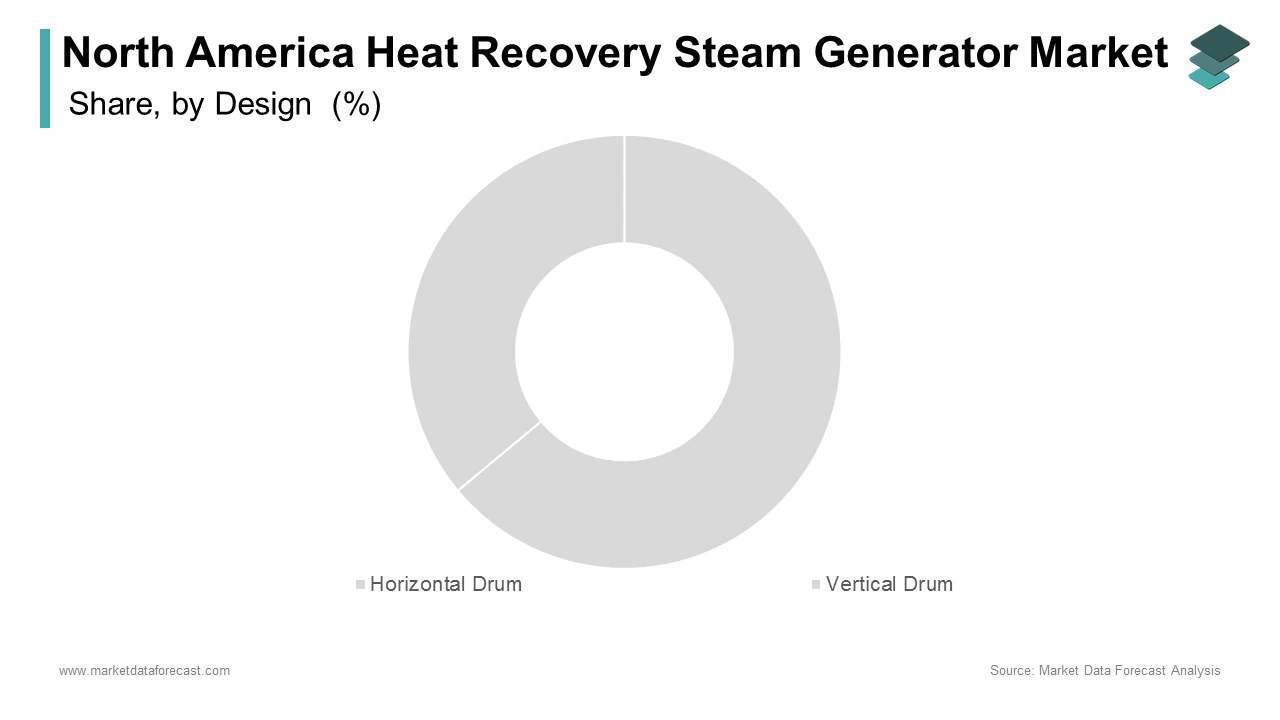
The horizontal drum HRSG segment was the largest by capturing 59.1% of the North America heat recovery steam generator market share in 2024 due to the widespread adoption of horizontal drum configurations in combined cycle power plants due to their superior thermal efficiency and ease of integration with gas turbines. A key driver behind this segment’s dominance is the established infrastructure of combined cycle power plants across the United States , where horizontal drum HRSGs are standard components. As reported by the U.S. Energy Information Administration (EIA), combined cycle plants accounted for nearly 45% of all natural gas-fired electricity generation in 2023.Additionally, the modular nature of horizontal drum HRSGs allows for easier transportation and field assembly , making them suitable for retrofitting existing facilities.
The vertical drum HRSG segment is more likely to grow with an estimated CAGR of 6.2% in the next coming years. One major growth enabler is the growing preference for vertical drum HRSGs in refineries, chemical plants, and pulp & paper mills , where floor space optimization is critical. As noted by Natural Resources Canada, industrial facilities adopting vertical drum HRSGs achieved an average of 18% reduction in layout footprint compared to horizontal alternatives , making them ideal for brownfield expansions. Moreover, advancements in vertical drum design have improved reliability and reduced maintenance downtime , addressing previous concerns about uneven steam-water separation.
By Mode Of Operation Insights
The combined cycle mode of operation dominated the North America HRSG market share in 2024. A primary factor driving this segment’s dominance is the expansion of natural gas-fired power generation infrastructure in the United States , supported by abundant shale gas reserves and favorable environmental regulations. As per the U.S. Energy Information Administration (EIA), natural gas accounted for nearly 40% of total U.S. electricity generation in 2023 , with a significant portion coming from CCPPs equipped with HRSGs. Furthermore, regional grid operators increasingly favor combined cycle plants for their flexibility and load-following capabilities , particularly in balancing renewable energy intermittency.
The cogeneration (combined heat and power or CHP) mode of operation segment is is the fastest-growing segment in the North America HRSG market , projected to expand at a CAGR of 6.9% from 2023 to 2030 . This rapid growth is fueled by increasing industrial demand for energy-efficient systems that simultaneously generate electricity and usable thermal energy , thereby maximizing fuel utilization and reducing operational costs. According to the U.S. Department of Energy (DOE), CHP systems using HRSGs can achieve total system efficiencies exceeding 70%, which is making them highly attractive for manufacturing, refining, and chemical processing sectors. A key growth driver is the rising emphasis on industrial decarbonization and energy security , particularly among large-scale manufacturers seeking to reduce reliance on external utilities. Additionally, government incentives and regulatory support for energy-efficient technologies have accelerated CHP adoption across North America. The EPA’s Combined Heat and Power Partnership program supported over 150 new projects incorporating HRSG-based CHP systems in 2023, which is reinforcing the momentum behind this rapidly expanding market segment.
By Power Capacity Insights
The 201–300 MW power capacity segment was accounted in holding a prominent share of the North America HRSG market in 2024. A major driver behind this segment’s prominence is the optimal balance between scalability and efficiency offered by HRSGs in this power range , making them ideal for both base-load and peaking power applications. Additionally, utilities and independent power producers prefer this size category due to its compatibility with standard gas turbine models such as GE’s 7F and Siemens’ SGT-800 , ensuring standardized procurement and operational consistency. The American Public Power Association noted that over 50 new HRSG-equipped power plants in the 200–300 MW range entered commercial operation in North America in 2023.
The up to 30 MW power capacity segment is likely to grow with an emerging CAGR of 7.4% in the next coming years. This rapid growth is primarily driven by the increasing deployment of small-scale industrial cogeneration (CHP) systems and distributed energy projects , particularly in manufacturing, food processing, and institutional campuses. According to the U.S. Department of Energy (DOE), small-scale CHP systems under 30 MW accounted for over 40% of new industrial energy efficiency investments in 2023 , reflecting strong adoption trends. Moreover, government grants and tax incentives targeting small-scale clean energy projects have encouraged wider adoption. The EPA’s Combined Heat and Power Partnership reported that facilities deploying sub-30 MW HRSG-based CHP systems achieved average annual energy savings of 15–20% by making them a cost-effective solution for businesses aiming to reduce operational expenses and carbon footprints.
By End-use Insights
The utilities sector was the largest by accounting for 41.2% of the North America HRSG market share in 2024 with the extensive use of HRSGs in combined cycle power plants operated by electric utilities , where waste heat from gas turbines is converted into additional electricity to enhance overall plant efficiency. Additionally, utilities continue to invest in hybrid power systems integrating renewables with flexible HRSG-based gas plants , ensuring stable power supply during intermittent renewable periods. According to the National Renewable Energy Laboratory (NREL), HRSG-equipped plants contributed to a 15% reduction in wind curtailment in Texas in 2023 due to their growing importance in supporting a resilient and low-carbon energy mix.
The refineries end-use segment is expected to register a CAGR of 7.1% in the next coming years. A major growth enabler is the integration of HRSGs into refinery cogeneration units , where waste heat from process operations and gas turbines is used to produce steam for distillation, cracking, and other thermal processes. Moreover, environmental mandates and corporate sustainability goals are pushing refineries to adopt cleaner energy strategies , including advanced HRSG technology. The Environmental Protection Agency (EPA) reported that over 25 new HRSG retrofits were completed in North American refineries in 2023, which aimed at reducing greenhouse gas emissions and complying with federal climate policies.
REGIONAL ANALYSIS
United States Heat Recovery Steam Generator Market Insights
The United States was the top performer in the North America HRSG market with 74.3% of the share in 2024. A key growth driver is the modernization of aging power infrastructure , with numerous utility companies investing in repowering projects that integrate HRSGs into existing gas-fired plants. As reported by the Electric Power Research Institute (EPRI), over 50 new HRSG-equipped power plants entered commercial operation in the U.S. in 2023 , contributing to enhanced grid stability and emissions reduction. Additionally, industrial sectors such as refining, chemicals, and food processing are increasingly adopting HRSG-based cogeneration systems to meet rising energy demands while adhering to sustainability targets. The U.S. Department of Energy (DOE) noted that industrial CHP installations utilizing HRSGs grew by 6.5% in 2023, which is signaling broader adoption beyond the power generation sector.
Canada Heat Recovery Steam Generator Market Insights
Canada HRSG market held 14.3% of the share in 2024 due to the adoption of HRSGs in oil sands extraction and upgrading facilities , where process heat recovery enhances both productivity and environmental compliance. As per the Canadian Energy Regulator (CER), Alberta and Saskatchewan saw a 9% increase in HRSG-based cogeneration projects in 2023 , particularly in heavy oil processing plants. Moreover, provincial governments are offering financial incentives and regulatory support to promote energy-efficient technologies , encouraging manufacturers and utilities to invest in HRSG-integrated systems. The Conference Board of Canada reported that Canadian firms adopting HRSG-based CHP systems achieved an average energy cost reduction of 20%, which is reinforcing the economic appeal of these solutions.
LEADING PLAYERS IN THE NORTH AMERICA HEAT RECOVERY STEAM GENERATOR MARKET
One of the leading players in the North America heat recovery steam generator (HRSG) market is Bharat Heavy Electricals Limited (BHEL). The company specializes in designing and manufacturing high-efficiency HRSGs tailored for combined cycle power plants, which is contributing significantly to global advancements in thermal energy optimization and plant efficiency. Another key player is Mitsubishi Power is a division of Mitsubishi Heavy Industries. The company is globally recognized for its cutting-edge HRSG technology, offering highly efficient and customizable solutions for utility-scale power generation and industrial cogeneration applications.
Thermax Limited is also a prominent participant in the regional HRSG market. While traditionally known for boilers and process heating systems, Thermax has expanded into advanced HRSG solutions tailored for industrial sectors such as chemicals, refineries, and food processing. Its emphasis on modular design, fuel flexibility, and emissions reduction has positioned it as a growing force in the North American energy efficiency landscape.
TOP STRATEGIES USED BY KEY MARKET PARTICIPANTS
Key players in the North America HRSG market are leveraging technological innovation and product customization to meet evolving industry requirements. Companies are investing heavily in R&D to develop advanced materials, improve thermal efficiency, and enhance corrosion resistance by ensuring longer asset life and reduced maintenance costs.
Another major strategy involves strategic partnerships and collaborations with gas turbine manufacturers and power plant developers , enabling seamless integration of HRSGs into combined cycle and cogeneration systems. These alliances help firms offer turnkey solutions and strengthen their foothold in complex project environments.
Additionally, companies are focusing on expanding service offerings beyond equipment supply to include lifecycle support, predictive maintenance, and digital monitoring platforms , enhancing customer retention and operational reliability.
KEY MARKET PLAYERS AND COMPETITION OVERVIEW
Major Players of the North America Heat Recovery Steam Generator Market include General Electric, Siemens Energy, Mitsubishi Power, Babcock & Wilcox Enterprises, CMI Group, Doosan Škoda Power, Nooter/Eriksen, Kelvion Holdings, Cleaver-Brooks, John Cockerill
The competition in the North America HRSG market is characterized by a mix of global engineering giants, specialized boiler manufacturers, and regional system integrators vying for dominance across utility and industrial sectors. The market remains highly technical, requiring deep expertise in thermodynamics, material science, and integration with gas turbines or industrial processes. Companies are differentiating themselves through advanced design capabilities, modular construction techniques, and enhanced performance features tailored to specific end-use applications as energy efficiency and emissions reduction become central to power and industrial planning.
Innovation cycles have accelerated, with vendors introducing next-generation HRSGs that offer improved turndown ratios, faster start-up times, and better compatibility with renewable hybrid systems. Strategic mergers and acquisitions are also becoming more frequent, which is allowing firms to expand their geographic reach and diversify their product portfolios. In this environment, success hinges on the ability to deliver customized, high-performance solutions while maintaining strong after-sales service and lifecycle support capabilities.
RECENT HAPPENINGS IN THE MARKET
- In January 2024, Mitsubishi Power announced the launch of an advanced modular HRSG platform designed for rapid deployment in hybrid power plants by enhancing flexibility and reducing installation timelines for combined cycle projects across North America.
- In March 2024, BHEL entered into a strategic collaboration with a leading U.S.-based engineering firm to co-develop HRSGs optimized for hydrogen-fueled power plants, which is aligning with regional decarbonization goals and positioning itself at the forefront of clean energy transitions.
- In May 2024, Thermax unveiled a new line of compact vertical drum HRSGs specifically engineered for space-constrained industrial facilities by targeting growth opportunities in small-scale cogeneration and distributed energy systems across the region.
- In July 2024, a major European boiler manufacturer acquired a Houston-based HRSG service and retrofitting company, which is strengthening its presence in the North American aftermarket segment and expanding its capabilities in plant upgrades and performance optimization.
- In September 2024, GE Gas Power partnered with a Canadian CHP solutions provider to integrate its gas turbines with custom-designed HRSGs for industrial applications by aiming to capture a larger share of the growing cogeneration market in North America.
DETAILED SEGMENTATION OF THE NORTH AMERICA HEAT RECOVERY STEAM GENERATOR MARKET INCLUDED IN THIS REPORT
This research report on the North America Heat Recovery Steam Generator Market has been segmented and sub-segmented based on design, mode of operation, power capacity, end use & region.
By Design Insights
- Horizontal Drum
- Vertical Drum
By Mode Of Operation Insights
- Cogeneration
- Combined Cycle
By Power Capacity Insights
- Up to 30 MW
- 31–100 MW
- 101–200 MW
- 201–300 MW
- Above 300 MW
By End-use Insights
- Commercial
- Chemical
- Refineries
- Utilities
- Pulp & Paper
- Others
By Region
- US
- Canada
- Mexico
- Rest of North America