- Product Description Description
- Table of Contents TOC
- List of Table & Figure LOT
- Get Free Sample PDF Sample PDF
Market Size, 2025
$79.32 BnMarket Estimate, 2026
$83.13 BnMarket Forecast, 2034
$120.96 BnCAGR, 2026–2034
4.80%North America Heavy Duty Trucks Market Summary
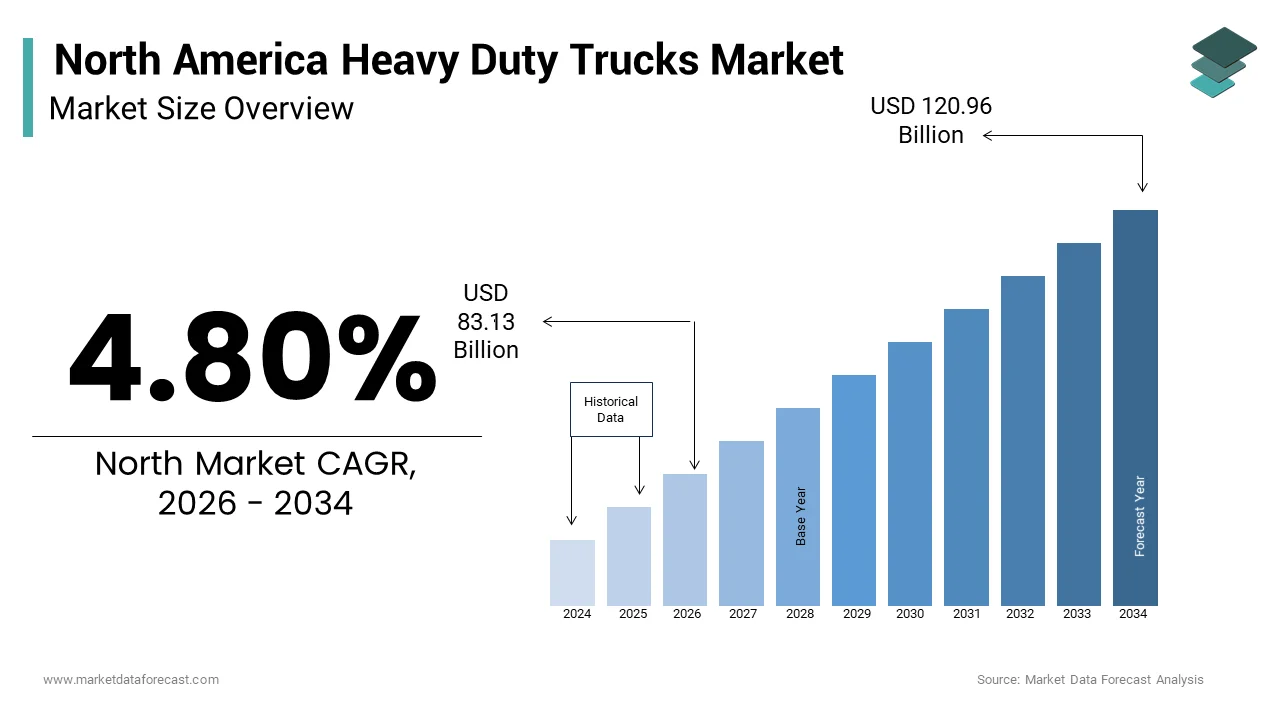
The North American heavy-duty trucks market was valued at USD 79.32 billion in 2025 and is anticipated to reach USD 83.13 billion in 2026 to reach USD 120.96 billion by 2034, growing at a CAGR of 4.80% during the forecast period from 2026 to 2034.
Key Market Trends & Insights
- The United States was the largest contributor to the North American Market in 2025
- Canada is expected to showcase strong growth throughout the forecast period.
- Based on Toonage, the exceeding 15 tons segment dominated the market in 2025
- Based on Propulsion, the exceeding 15 tons segment led the market in 2025.
- Based on the Application, the construction and mining application segment held the market in 2025.
- Based on Truck Body, the tractor-trailer configurations segment is leading the market in 2025.
Market Size & Forecast
2025 Market Size: USD 79.32 Billion
2034 projected Market Size: USD 120.96 Billion
CAGR (2026 to 2034): 4.80%
United States: Largest Market in 2025
Canada: Strongest Growth Region
North America Heavy Duty Trucks Market Size
The North American heavy-duty trucks market was valued at USD 79.32 billion in 2025 and is anticipated to reach USD 83.13 billion in 2026 to reach USD 120.96 billion by 2034, growing at a CAGR of 4.80% during the forecast period from 2026 to 2034.
The heavy-duty trucks serve as the backbone of freight transportation, construction, and industrial operations across the United States, Canada, and Mexico. According to the American Trucking Associations, the trucking industry transports approximately 72.5% of all freight tonnage in the United States annually, with the sector's fundamental importance to economic activity. The market encompasses various vehicle categories, including Class 8 tractor-trailers, dump trucks, concrete mixers, refuse haulers, and specialized hauling equipment. As per the Federal Highway Administration, there are over 15.5 million registered commercial vehicles in the United States, with heavy-duty trucks comprising a significant portion of this fleet. Economic indicators such as GDP growth, industrial production indices, and infrastructure investment levels directly correlate with heavy-duty truck demand patterns, which is making this sector a reliable economic barometer.
MARKET DRIVERS
E-commerce Growth and Freight Demand Expansion
The exponential growth of e-commerce has fundamentally transformed freight transportation requirements is fuelling the growth of the North American heavy-duty trucks market. This surge in online retail has necessitated expanded last-mile delivery networks and enhanced distribution capabilities, directly driving the need for additional heavy-duty trucks. The National Retail Federation projects that holiday season freight volumes will continue growing at rates exceeding 3-5% annually through 2025. According to the American Trucking Associations, each dollar of e-commerce growth generates approximately 1.5 pounds of freight requiring transportation services. The proliferation of fulfillment centers and regional distribution hubs has created a fragmented shipping landscape that requires more frequent, smaller-batch deliveries, increasing the overall truck requirement.
Infrastructure Investment and Construction Activity
Massive infrastructure investment initiatives have created substantial demand for heavy-duty trucks in construction and material hauling applications, which is also promoting the growth of the North American heavy-duty trucks market. The Infrastructure Investment and Jobs Act allocates $1.2 trillion over five years for transportation, broadband, and utility infrastructure projects, according to the White House Office of Management and Budget. This construction boom requires extensive fleets of dump trucks, concrete mixers, crane trucks, and specialized hauling equipment to transport materials and support project execution. The U.S. Census Bureau reports that highway and street construction alone accounts for over $200 billion annually in construction spending, directly correlating with heavy-duty truck procurement needs. According to the Bureau of Labor Statistics, the construction sector employed over 8 million workers in 2023, with heavy equipment operators comprising a significant portion of skilled labor demand.
MARKET RESTRAINTS
Regulatory Compliance Costs and Emission Standards
The stringent emission regulations and safety standards have significantly increased the cost of heavy-duty truck ownership and operation across North America. The Environmental Protection Agency's Phase 2 greenhouse gas emission standards require heavy-duty vehicles to achieve up to a 25% reduction in fuel consumption and emissions by 2027 compared to 2017 models. According to the California Air Resources Board, compliance with advanced emission standards increases the average purchase price of new heavy-duty trucks by $15,000 to $25,000 per vehicle. The North American Council for Freight Efficiency reports that regulatory compliance costs have escalated by 40% over the past five years, creating financial pressure for fleet operators and independent owner-operators. As per the Owner-Operator Independent Drivers Association, over 60% of small fleet operators cite regulatory compliance costs as their primary financial challenge. The complexity of meeting multiple jurisdictional requirements across different states and provinces has created additional administrative burdens and expenses. According to the Trucking Alliance, the cumulative effect of federal, state, and local regulations requires an average of 120 additional compliance hours per truck annually.
Driver Shortage and Labor Cost Pressures
The persistent shortage of qualified commercial drivers is another factor to limits the growth of the North American heavy-duty trucks market. According to the American Trucking Associations, the industry faces a driver shortage of approximately 80,000 operators, with projections indicating this gap could widen to 160,000 by 2030. As per the Bureau of Labor Statistics, the median age of truck drivers has increased to 51 years, with fewer young individuals entering the profession due to demanding work schedules and lifestyle constraints. According to the Owner-Operator Independent Drivers Association, driver turnover rates exceed 90% annually among large carriers, creating continuous recruitment and training challenges. The Federal Motor Carrier Safety Administration reports that only 65% of authorized commercial driver's license holders are actively employed in trucking operations, indicating significant underutilization of available labor resources. Wage inflation has accelerated dramatically, with average driver compensation increasing by 18% annually over the past three years, according to the Bureau of Labor Statistics.
MARKET OPPORTUNITIES
Electric Vehicle Transition and Alternative Fuel Technologies
The transition toward electric and alternative fuel heavy-duty trucks is creating new opportunities for the growth of the North American heavy-duty trucks market. California's Advanced Clean Trucks regulation mandates that 30% of new Class 8 trucks sold by manufacturers must be zero-emission by 2030, according to the California Air Resources Board. As per the Edison Electric Institute, over 40 states have adopted similar zero-emission vehicle standards, creating a substantial addressable market for electric heavy-duty trucks. The North American Council for Freight Efficiency estimates that truck total cost of ownership could be 20-30% lower than diesel equivalents by 2030 due to reduced fuel and maintenance expenses.
Autonomous Driving and Fleet Management Technologies
The advanced autonomous driving technologies and fleet management systems are also expected to significantly boost the growth of the North American heavy-duty trucks market. The American Transportation Research Institute reports that platooning technology could reduce fuel consumption by 7-10% while improving highway capacity utilization. According to the International Transportation Forum, autonomous trucks could reduce operating costs by up to 45% through the elimination of driver wages and improved fuel efficiency. As per the National Highway Traffic Safety Administration, automated emergency braking systems have reduced rear-end collisions by 44% in commercial vehicle applications. Major technology companies, including Waymo, TuSimple, and Aurora, have established partnerships with traditional truck manufacturers to accelerate autonomous vehicle deployment.
MARKET CHALLENGES
Supply Chain Disruptions and Component Shortages
The global supply chain disruptions are affecting production schedules, and vehicle availability is hampering the growth of the North American heavy-duty trucks market. The Semiconductor Industry Association reports that the automotive industry accounts for approximately 12% of global semiconductor demand, with heavy-duty trucks requiring over 1,500 semiconductor chips per vehicle on average. As per the Automotive Industry Action Group, semiconductor shortages resulted in production delays of 15-20% for heavy-duty truck manufacturers during 2022-2023. According to the Institute for Supply Management, 75% of surveyed heavy-duty truck manufacturers reported ongoing supply chain disruptions affecting component availability and delivery schedules. The Federal Reserve Bank of New York reports that supply chain pressure indices remain 40% above pre-pandemic levels, indicating persistent manufacturing constraints. As per the Original Equipment Suppliers Association, lead times for components, including engines, transmissions, and electronic control units, have extended from 8-12 weeks to 16-24 weeks. These disruptions have forced fleet operators to extend vehicle retention periods and delay planned replacement cycles, creating inventory management challenges and potential maintenance cost escalations. The complexity of global sourcing networks has increased vulnerability to geopolitical tensions, natural disasters, and transportation bottlenecks that compound supply chain risks.
Economic Volatility and Interest Rate Fluctuations
Macroeconomic volatility and rising interest rates are also expected to reduce the growth of the North American heavy-duty trucks market. The Federal Reserve's monetary policy actions have increased commercial lending rates to levels not seen since 2007, according to the Federal Reserve Economic Data. As per the National Automobile Dealers Association, heavy-duty truck financing costs have increased by 35-40% compared to 2021 levels, directly impacting fleet operator purchasing decisions. The Conference Board reports that business confidence indices among transportation companies have declined by 22% over the past 18 months, reflecting concerns about economic uncertainty and freight demand volatility. According to the Equipment Leasing and Finance Association, equipment financing approval rates have decreased to 72% in 2023 compared to 81% in 2021, indicating tightened credit conditions. As per the Bureau of Economic Analysis, GDP growth projections have been revised downward to 1.4% for 2024, creating cautious spending environments among fleet operators. The Institute for Supply Management Manufacturing Index has fluctuated between contraction and expansion territories, creating uncertainty about future freight demand patterns.
REPORT COVERAGE
| REPORT METRIC | DETAILS |
| Market Size Available | 2025 to 2034 |
| Base Year | 2025 |
| Forecast Period | 2026 to 2034 |
| CAGR | 4.80% |
| Segments Covered | By Tonnage, Propulsion, Application, Truck Body, and Region. |
| Various Analyses Covered | Global, Regional & Country Level Analysis, Segment-Level Analysis, DROC, PESTLE Analysis, Porter’s Five Forces Analysis, Competitive Landscape, Analyst Overview on Investment Opportunities |
| Regions Covered | The United States, Canada, Mexico, Rest of North America |
| Market Leaders Profiled | Daimler Truck Holding AG, Traton SE, Volvo Group, PACCAR Inc., Dongfeng Motor Corporation, Tata Motors Ltd, FAW Group Corp., CNHTC (Sinotruk), Ashok Leyland Ltd, Isuzu Motors Ltd, Hino Motors Ltd, Navistar International, Iveco Group N.V., Hyundai Motor Co., Nikola Corporation, JAC Motors, Kamaz PJSC, Foton Motor Co. Ltd. |
SEGMENTAL ANALYSIS
By Tonnage Insights
The exceeding 15-ton segment dominated the NorthAmerican dutyy trucks market share in 2025. The substantial infrastructure development initiatives across North America have created unprecedented demand for heavy-duty trucks exceeding 15 tons, establishing this segment as the market leader. The construction industry's reliance on trucks capable of carrying payloads exceeding 15 tons has intensified due to the scale and complexity of modern infrastructure projects. Mining operations, particularly in resource-rich regions of Canada and the western United States, have also contributed significantly to the demand for high-tonnage trucks. The National Mining Association indicates that mineral extraction activities increased by 18% in 2023, necessitating specialized heavy-duty trucks for ore transportation and equipment movement. The complexity of modern construction projects, including skyscrapers, tunnels, and large-scale commercial developments, requires trucks with enhanced hauling capabilities that only the more than 15-ton segment can provide.
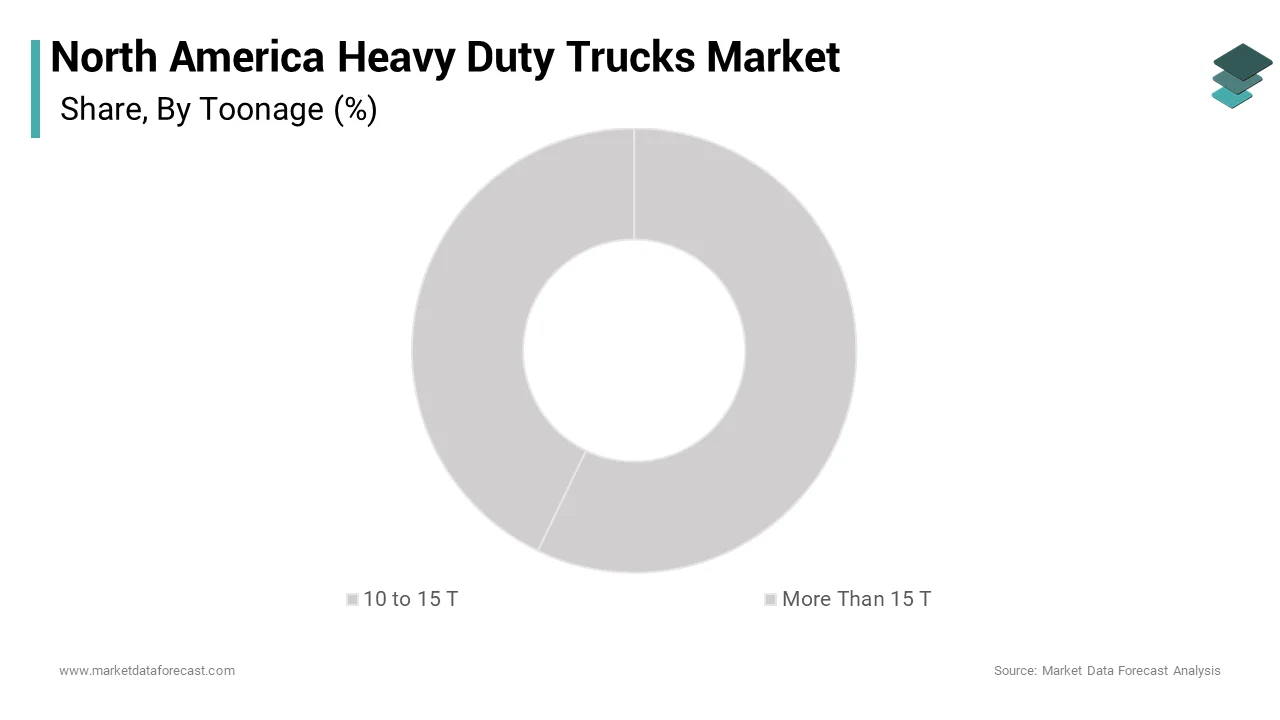
The 10 to 15-ton heavy-duty trucks segment is likely to expand with a CAGR of 9.2% from 2025 to 2033. The unprecedented expansion of urban delivery services and last-mile logistics operations has become the primary catalyst driving the rapid growth of 10 to 15-ton heavy-duty trucks throughout North America. The explosive growth of e-commerce and same-day delivery expectations has transformed urban freight transportation requirements, creating demand for vehicles that balance payload capacity with maneuverability in congested city environments. The rise of fulfillment centers located in suburban areas has intensified requirements for trucks capable of serving both urban and regional delivery routes. The integration of electric vehicle technology in this tonnage range has also attracted environmentally conscious fleet operators seeking to reduce urban emissions while maintaining operational efficiency. Municipal regulations in major cities increasingly favor medium-heavy duty trucks for their reduced environmental impact compared to larger vehicles. The American Public Transportation Association reports that 45 North American cities have implemented low-emission zones that restrict heavy-duty vehicle access by encouraging the adoption of 10 to 15-ton trucks for urban operations.
By Propulsion Insights
The diesel propulsion segment was the largest and held a dominant share of the North American heavy-duty trucks market in 2024. The proven performance and exceptional reliability of diesel engines in demanding heavy-duty truck applications have solidified this propulsion type as the market leader throughout North America. Diesel engines offer superior torque characteristics and fuel efficiency that are essential for heavy hauling and long-distance transportation operations. The durability of diesel engines, with average service intervals exceeding 300,000 miles, has made them the preferred choice for fleet operators requiring maximum uptime and minimal maintenance costs. A comprehensive 2023 fleet performance study by Heavy Duty Trucking magazine revealed that diesel trucks experienced 31% fewer breakdowns per 100,000 miles compared to alternative propulsion systems. The established network of diesel service facilities and trained technicians across North America provides fleet operators with reliable support infrastructure that alternative technologies cannot yet match. The American Trucking Associations reports that 96% of long-haul trucking companies rely exclusively on diesel propulsion due to its proven track record in demanding operating conditions. The maturity of diesel technology has enabled manufacturers to optimize engine performance, emissions control, and fuel efficiency through decades of continuous improvement.
The battery-electric propulsion segment is expected to grow with a CAGR of 34.7% from 2025 to 2033. Stringent environmental regulations and evolving emissions standards are primarily propelling the growth of the segment. The Environmental Protection Agency's new heavy-duty vehicle greenhouse gas emissions standards, implemented in 2023, require a 35% reduction in carbon emissions by 2030 compared to 2010 baseline levels. These regulations have intensified pressure on fleet operators to adopt zero-emission technologies, particularly in urban areas where air quality concerns are paramount. According to the California Air Resources Board, zero-emission truck requirements for drayage operations at ports and intermodal facilities will mandate 100% electric adoption by 2035, creating substantial demand for battery-electric heavy-duty trucks.
By Application Insights
The construction and mining application segment held 42.3% of the North America heavy-duty trucks market share in 2024. The unprecedented scale of infrastructure development initiatives across North America has created enormous demand for heavy-duty trucks in construction and mining applications, which is greatly influencing the growth of the segment. The United States Infrastructure Investment and Jobs Act represents the largest federal infrastructure investment in American history, allocating $1.2 trillion for transportation, utilities, and broadband infrastructure improvements through 2026. According to the American Society of Civil Engineers, the United States requires $2.59 trillion in infrastructure investment by 2025 to address existing deficiencies and support economic growth, creating sustained demand for heavy-duty construction trucks. The construction industry's reliance on specialized heavy-duty trucks for material transportation, equipment hauling, and site preparation has intensified due to the complexity and scale of modern projects. The U.S. Census Bureau reports that construction spending reached $2.1 trillion in 2023, representing a 12% increase from the previous year and driving sustained demand for heavy-duty transportation solutions.
The logistics and transportation application segment is anticipated to grow with a CAGR of 8.9% from 2025 to 2033. The shift toward direct-to-consumer delivery models is surging the growth of the segment. The integration of same-day and next-day delivery expectations has transformed logistics operations, requiring more frequent but smaller shipments that favor medium-heavy duty trucks in the 10 to 15-ton range. The rise of fulfillment centers located in suburban areas has intensified requirements for trucks capable of serving both urban and regional delivery routes. The rapid technological integration and advanced fleet optimization capabilities have dramatically enhanced the efficiency and economic viability of logistics and transportation applications, which is driving unprecedented adoption rates throughout North America.
By Truck Body Insights
The tractor-trailer configurations segment was the largest by capturing a dominant share of the North American heavy-duty trucks market in 2024. The substantial growth in intermodal freight transportation has created unprecedented demand for tractor-trailer configurations, establishing this body type as the market leader throughout North America. According to the Association of American Railroads, intermodal freight volume increased by 12% in 2023, with truck-rail intermodal services accounting for 65% of all intermodal movements and driving sustained demand for tractor-trailer combinations. The expansion of port infrastructure and the development of inland container terminals have created new requirements for tractor-trailers that can efficiently move shipping containers between transportation modes.
The dump trucks segment is likely to register a CAGR of 11.3% from 2025 to 2033. The unprecedented scale of infrastructure development and construction activities across North America has become the primary catalyst driving the rapid expansion of dump truck applications throughout the heavy-duty trucks market. According to the American Society of Civil Engineers, the United States requires $2.59 trillion in infrastructure investment by 2025 to address existing deficiencies and support economic growth, creating sustained demand for specialized dump trucks in earthmoving and material handling operations. The U.S. Census Bureau reports that construction spending reached $2.1 trillion in 2023, representing a 12% increase from the previous year and driving sustained demand for heavy-duty dump truck solutions. Mining operations, particularly in resource-rich regions of Canada and the western United States, have also contributed significantly to th demand for specialized dump trucks in ore transportation and overburden removal. The National Mining Association indicates that mineral extraction activities increased by 18% in 2023, necessitating specialized heavy-duty dump trucks for efficient material handling. The complexity of modern construction projects, including skyscrapers, tunnels, and large-scale commercial developments, requires dump trucks with enhanced hauling capabilities and specialized configurations that only the construction and mining segment can provide.
COUNTRY ANALYSIS
United States Market Analysis
The United States was the largest contributor in the North American heavy-duty trucks market with 87.3% of the share in 2024. The United States maintains its unrivaled market dominance through a sophisticated network of over 3.8 million registered heavy-duty trucks, according to the Federal Motor Carrier Safety Administration, supporting the nation's extensive freight transportation requirements. The country's market strength is further reinforced by favorable regulatory frameworks that facilitate rapid technology adoption and innovation in commercial vehicle applications. Economic factors significantly contribute to market strength, with the U.S. Department of Transportation reporting that freight transportation accounts for 72% of all goods movement by tonnage, creating sustained demand for heavy-duty trucks. The cultural normalization of trucking as an economic driver, particularly in major freight corridors such as I-95, I-75, and I-40, has created sustained demand for advanced heavy-duty truck technologies.
Canada Market Analysis
Canada was positioned second in the North American heavy-duty trucks market with 13.3% of share in 2024. According to Transport Canada, commercial vehicle registrations increased by 8% between 2022 and 2023, with heavy-duty trucks representing the fastest-growing category within this expansion. The country's resource-based economy creates unique market dynamics where heavy-duty trucks are essential for mining, forestry, and energy sector operations, fostering a competitive environment that drives service quality and innovation. Fleet operator preferences demonstrate strong emphasis on durability and cold-weather performance, with the Canadian Trucking Alliance reporting that 78% of Canadian fleet operators prioritize vehicle reliability in harsh winter conditions. Geographic market distribution shows the highest concentration in resource-rich provinces such as Alberta, Ontario, and British Columbia, which account for 62% of national heavy-duty truck registrations. The multicultural demographics and bilingual requirements have created demand for heavy-duty trucks with enhanced communication and navigation systems suitable for diverse operator populations.
COMPETITIVE LANDSCAPE
The North American heavy-duty trucks market presents a highly competitive landscape characterized by technological innovation, strategic positioning, and customer-centric approaches among major manufacturers. The competitive environment is dominated by established players who continuously invest in research and development to differentiate their product offerings through advanced safety features, fuel efficiency improvements, and operational performance enhancements. Market participants compete not only on vehicle specifications and pricing but also through comprehensive service ecosystems that include financing options, maintenance programs, and digital connectivity solutions.
Competition extends beyond traditional manufacturing capabilities to encompass supply chain optimization, dealer network effectiveness, and after-sales support quality. Companies are increasingly focusing on building long-term relationships with fleet operators through customized solutions, training programs, and technical support services.
Regional market dynamics are influenced by varying regulatory requirements across different states and provinces, requiring manufacturers to develop flexible product strategies that can adapt to diverse operational environments. The competitive landscape is also shaped by economic cycles, fuel price volatility, and infrastructure development patterns that affect customer purchasing decisions and fleet replacement timing.
KEY MARKET PLAYERS
These are the market players that are dominating the North America heavy-duty trucks market.
- Daimler Truck Holding AG
- Traton SE
- Volvo Group
- PACCAR Inc.
- Dongfeng Motor Corporation
- Tata Motors Ltd,
- FAW Group Corp.
- CNHTC (Sinotruk)
- Ashok Leyland Ltd
- Isuzu Motors Ltd
- Hino Motors Ltd
- Navistar International
- Iveco Group N.V.
- Hyundai Motor Co.
- Nikola Corporation
- JAC Motors
- Kamaz PJSC
- Foton Motor Co. Ltd
Top Strategies Used By Key Market Participants
Technology Integration and Digital Transformation
Leading heavy-duty truck manufacturers are implementing comprehensive digital transformation strategies that include connected vehicle technologies, predictive maintenance systems, and advanced telematics platforms. These initiatives enable fleet operators to optimize performance, reduce downtime, and improve operational efficiency through real-time data analytics and remote monitoring capabilities.
Strategic Partnerships and Joint Ventures
Key players are forming strategic alliances with technology companies, component suppliers, and fleet management organizations to accelerate innovation and expand market reach. These partnerships facilitate knowledge sharing, risk mitigation, and access to emerging technologies while creating synergies that strengthen competitive positioning across multiple market segments.
Product Portfolio Diversification
Manufacturers are expanding their product offerings to include alternative fuel vehicles, specialized vocational trucks, and customized solutions for specific industry applications. This diversification strategy helps companies capture emerging market opportunities while reducing dependence on traditional diesel-powered truck segments and positioning themselves for future regulatory requirements.
RECENT MARKET NEWS
- In March 2024, Volvo Trucks North America announced a strategic partnership with ChargePoint to develop comprehensive electric vehicle charging infrastructure solutions for fleet customers transitioning to electric heavy-duty trucks.
- In February 2024, Daimler Trucks North America acquired a specialized software company to enhance its fleet management platform capabilities and integrate advanced artificial intelligence algorithms for predictive maintenance and operational optimization.
- In December 2023, Paccar Inc. launched its new MX-13 Pro engine platform, featuring improved fuel efficiency and reduced emissions, specifically designed for North American operating conditions and regulatory requirements.
- In October 2023, Navistar International established a joint venture with a leading battery manufacturer to secure long-term supply agreements for electric truck battery systems and accelerate its electrification timeline.
- In July 2023, General Motors acquired an autonomous vehicle technology startup to accelerate development of self-driving heavy-duty truck capabilities and establish competitive advantages in the emerging autonomous freight market.
MARKET SEGMENTATION
This research report on the North American heavy-duty trucks market is segmented and sub-segmented into the following categories.
By Tonnage Type
- 10 to 15 T
- More Than 15 T
By Propulsion Type
- Diesel
- Battery-Electric
- Fuel-Cell Electric (FCEV)
- Alternative Fuels (CNG, LNG, Biodiesel)
By Application
- Construction and Mining
- Freight and Logistics
- Municipal and Utilities
- Others
By Truck Body Type
- Tractor-Trailer
- Rigid Dump
- Tanker
- Others
By Country
- The United States
- Canada
- Mexico