North America Helicopter Market Size, Share, Trends & Growth Forecast Report - Segmented By Type (Civil & Commercial, Military), Number of Engines, Maximum Take-off Weight (MTOW), Application and Country (The United States, Canada and Rest of North America), Industry Analysis From 2025 to 2033
North America Helicopter Market Report Summary
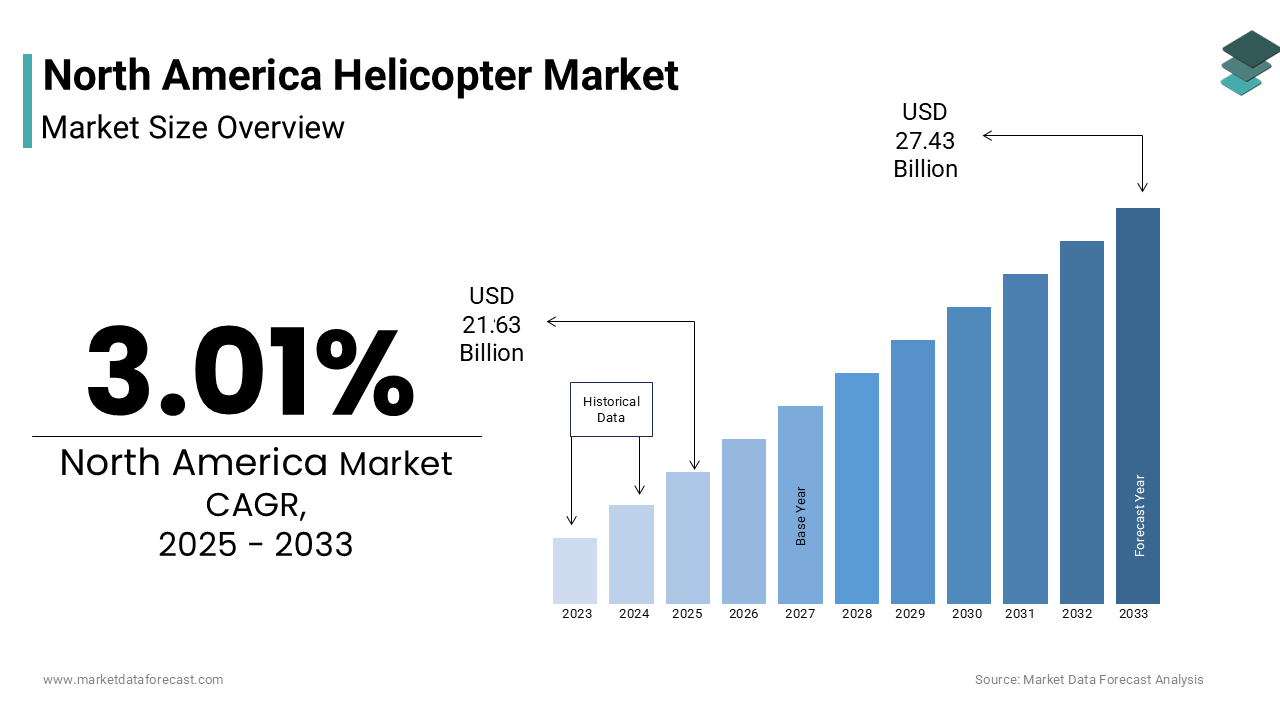
The North America helicopter market was valued at USD 21.00 billion in 2024, reached USD 21.63 billion in 2025, and is projected to grow to USD 27.43 billion by 2033, registering a CAGR of 3.01% during the forecast period from 2025 to 2033. Market growth is supported by the critical role of helicopters in emergency medical services, military defense modernization, offshore energy operations, and public safety missions. Helicopters remain indispensable across North America due to their vertical takeoff capability, operational flexibility, and ability to access remote or congested environments where fixed-wing aircraft cannot operate efficiently.
Key Market Drivers
- Rising demand for emergency medical services (EMS) is driven by aging populations, trauma care requirements, and rural healthcare accessibility.
- Military modernization programs and defense procurement initiatives, including fleet upgrades and next-generation rotary-wing platforms.
- Continued reliance on helicopters for offshore oil & gas transport, search and rescue, homeland security, and disaster response operations.
- Technological advancements in avionics, composite materials, digital cockpits, and survivability systems are enhancing safety and mission effectiveness.
Segmental Insights
- By type, the civil & commercial segment dominated the market with a 62.5% share in 2024, driven by extensive use in emergency medical services, offshore transportation, tourism, and corporate aviation. The military segment is expected to grow at the fastest CAGR of 6.8%, supported by defense modernization, special operations requirements, and foreign military sales programs.
- By number of engines, twin-engine helicopters led the market with a 58.1% share in 2024, owing to superior safety, redundancy, and regulatory preference for offshore and critical missions. Single-engine helicopters are projected to grow rapidly due to lower acquisition costs and strong demand from pilot training, law enforcement, and budget-conscious operators.
- By MTOW, helicopters in the 3,000 kg to 9,000 kg category held the largest share at 55.3%, supported by balanced payload capacity, versatility, and suitability for EMS and commercial transport. The greater than 9,000 kg segment is expected to register the highest CAGR, driven by military heavy-lift, offshore wind, and logistics operations.
- By application, emergency medical services accounted for the largest share at 35.5% in 2024, reflecting helicopters’ essential role in trauma response and critical care transport. The defense application segment is projected to grow at the fastest CAGR of 7.9%, supported by military procurement, border security, and international cooperation programs.
Regional Insights
The United States dominated the North American helicopter market with a 94.5% share in 2024, supported by a vast military inventory, strong civil helicopter operations, and domestic manufacturing leadership from companies such as Sikorsky, Bell, and Boeing. Canada represents a significant secondary market, driven by search and rescue operations, resource sector demand, and cold-climate operational requirements.
Competitive Landscape
The North America helicopter market is highly competitive, characterized by the presence of global aerospace leaders and specialized manufacturers. Competition centers on technological innovation, defense contracts, lifecycle support services, and digital capabilities rather than price alone. Leading players invest heavily in R&D, advanced avionics, sustainability initiatives, and strategic defense partnerships to maintain market leadership. Key companies include Bell Textron Inc., Boeing Company, Lockheed Martin Corporation (Sikorsky), Airbus Helicopters, Leonardo S.p.A., Robinson Helicopter Company, MD Helicopters, Kaman Aerospace Group, and Enstrom Helicopter Corporation.
North America Helicopter Market Size
The North America helicopter market size was valued at USD 21.00 billion in 2024 and is anticipated to reach USD 21.63 billion in 2025 from USD 27.43 billion by 2033, growing at a CAGR of 3.01% during the forecast period from 2025 to 2033.
helicopter refers to a specific type of versatile rotorcraft aircraft and the entire industry surrounding its manufacture, sales, services, and operation. This specialized aviation segment serves critical functions including emergency medical services, law enforcement operations, offshore oil and gas transportation, news gathering, and military defense missions. According to sources, the number of registered civil helicopters operating within the United States has largely remained substantial, with a focus on safety improvements and operational efficiency across the busy national airspace. The market's complexity stems from its multifaceted nature, incorporating advanced avionics systems, composite materials technology, and sophisticated engine configurations that enable vertical flight capabilities in varied operational environments. Military applications represent a vital part of the market, with the Department of Defense maintaining a substantial and diverse rotary-wing inventory to support various mission requirements across all service branches. Civil applications span commercial passenger transport, aerial work operations, and private ownership, creating diverse demand patterns across different helicopter categories. The market includes new aircraft deliveries, aftermarket support services, maintenance operations, and pilot training programs that collectively form an integrated aerospace ecosystem. Helicopter operations require specialized infrastructure including heliports, maintenance facilities, and trained personnel that distinguish this market from fixed-wing aviation sectors. The integration of advanced technologies such as fly-by-wire systems, composite rotor blades, and digital cockpit displays has transformed helicopter capabilities and operational safety standards. Regulatory frameworks established by the FAA and Transport Canada govern aircraft certification, pilot licensing, and operational requirements that ensure market safety and compliance.
MARKET DRIVERS
Emergency Medical Services and Healthcare Applications
The expanding emergency medical services requirements and healthcare applications necessitate rapid patient transportation and specialized medical capabilities, which in turn drives the growth of the North America helicopter market. Air medical transport operations are a regular part of healthcare systems in North America, with helicopter-based services comprising a significant portion of activity. Moreover, an aging population creates an increased need for rapid medical transportation to specialized healthcare facilities. Geographic considerations influence demand for emergency medical helicopter transport, especially in areas with longer ground ambulance response times. The existence of verified trauma centers creates a focused need for helicopter medical transport services that can rapidly move critically injured patients. Healthcare system efficiency improvements drive adoption of helicopter emergency medical services to reduce patient mortality rates and improve clinical outcomes. The integration of advanced life support equipment and specialized medical personnel on helicopter platforms enables sophisticated medical interventions during transport that were previously only available in hospital settings. Besides, insurance coverage expansion and healthcare payment reforms have increased accessibility to air medical transport services for broader patient populations. These healthcare-driven factors create sustained demand momentum that supports market growth across diverse operational environments.
Military Defense Modernization and Security Requirements
Military defense modernization initiatives and evolving security requirements is another key accelerator propelling the expansion of the North American helicopter market. Substantial procurement programs and capability enhancement projects are driving this expansion. Rotary-wing aircraft maintain a significant role in modern military operations. Procurement and modernization of these aircraft are continuing efforts within the defense planning. Army aviation priorities include a program intended to provide advanced reconnaissance platforms. This particular Army effort seeks to field a successor to the existing observation and attack helicopters. A substantial Marine Corps initiative is modernizing a large number of utility and attack helicopters. This Marine Corps program is a major rotary-wing upgrade effort. Special operations forces requirements drive demand for specialized helicopter configurations that can operate in challenging environments and support clandestine missions. The integration of advanced weapons systems, electronic warfare capabilities, and survivability enhancements creates demand for sophisticated helicopter platforms that can operate effectively in contested environments. Homeland security missions, including border patrol operations and disaster response activities, create additional military helicopter requirements that support civil authorities during emergency situations. The development of unmanned helicopter systems for military applications creates new market opportunities while complementing traditional manned helicopter operations. These defense-driven modernization initiatives create substantial long-term demand prospects that support sustained market expansion.
MARKET RESTRAINTS
High Capital Investment Requirements and Operating Costs
Significant capital investment requirements and substantial operating costs are one of the major restraints limiting the growth of the North American helicopter market. Helicopter acquisition costs represent considerable upfront expenditures. These substantial investment requirements create budget constraints for smaller operators, law enforcement agencies, and emergency medical services providers that may defer replacement or upgrade projects during economic uncertainty periods. Operating costs further compound financial challenges. Maintenance expenses constitute a significant portion of total operating costs, with major inspections and component replacements requiring substantial financial resources and specialized technical expertise. Pilot training and certification requirements add additional cost burdens. Insurance premiums for helicopter operations remain significantly higher than fixed-wing aircraft due to perceived operational risks and liability considerations. Fuel consumption rates for helicopters exceed those of comparable fixed-wing aircraft, creating ongoing operational cost pressures that impact mission viability and frequency. These economic sensitivities create project deferral patterns that constrain market growth despite underlying demand fundamentals.
Regulatory Complexity and Pilot Shortage Challenges
Regulatory complexity and significant pilot shortage issues that restrain the expansion of the North American helicopter market. The Federal Aviation Administration's stringent certification requirements for helicopter pilots, including minimum flight hour requirements and recurrent training mandates, create barriers to entry that limit qualified pilot availability. Advanced helicopter operations require specialized training and certification that extends beyond basic pilot licensing, including instrument flight rules certification, night vision goggle qualifications, and emergency medical services training. The complexity of modern helicopter avionics systems and digital cockpit displays necessitates extensive training programs that increase pilot qualification costs and time requirements. Regulatory compliance burdens extend to aircraft maintenance requirements, with the FAA mandating extensive inspection cycles and documentation procedures that increase operational complexity and costs. Weather minimums and operational restrictions imposed by aviation authorities limit helicopter mission capabilities and revenue generation potential. The concentration of qualified maintenance personnel in major metropolitan areas creates regional disparities in service availability and operational support capabilities. These workforce constraints limit market penetration and create bottlenecks that constrain overall industry growth potential.
MARKET OPPORTUNITIES
Urban Air Mobility and Electric Vertical Takeoff Aircraft
The emergence of urban air mobility concepts and electric vertical takeoff aircraft development offers significant growth opportunities for the North America helicopter market. These opportunities originate from next-generation transportation solutions and sustainable aviation technologies. Electric propulsion technologies offer significant advantages including reduced noise pollution, lower operating costs, and enhanced environmental sustainability that address traditional helicopter operational limitations. The integration of autonomous flight capabilities and advanced traffic management systems creates opportunities for revolutionary transportation solutions that can operate in congested urban environments. Investment activity in urban air mobility has accelerated significantly. The development of vertiport infrastructure and air traffic management systems creates additional market opportunities for helicopter operators and service providers. These urban mobility opportunities create substantial long-term demand prospects that support sustained market expansion.
Advanced Technology Integration and Digital Transformation
Advanced technology integration and digital transformation initiatives generate fresh prospects for the North America helicopter market. They achieve this through enhanced operational capabilities and value-added services that differentiate modern helicopter solutions. The integration of artificial intelligence, machine learning, and predictive analytics transforms traditional helicopter operations through enhanced safety systems, optimized maintenance scheduling, and improved mission planning capabilities. Cybersecurity requirements for critical aviation infrastructure create demand for helicopter systems with enhanced security features and secure communication protocols that protect against cyber threats. The development of connected aircraft technologies enables real-time monitoring, remote diagnostics, and predictive maintenance capabilities that reduce operational downtime and improve mission reliability. Advanced materials research, including carbon fiber composites and ceramic matrix composites, enables lighter, more durable helicopter designs that improve fuel efficiency and operational performance. The convergence of operational technology and information technology creates opportunities for helicopter manufacturers to develop integrated solutions that bridge traditional aviation systems with modern data management platforms. These digital transformation opportunities enable premium pricing and expanded service offerings that enhance market profitability.
MARKET CHALLENGES
Environmental Regulations and Noise Abatement Requirements
Navigating complex environmental regulations and evolving noise abatement requirements remain a major challenge for the North America helicopter market. These issues significantly impact product development and operational strategies. The Environmental Protection Agency's noise certification standards impose stringent requirements on helicopter manufacturers to reduce community noise impacts and comply with airport noise restrictions. International environmental standards, including European Union aviation regulations, create additional compliance burdens for North American manufacturers seeking global market access. The development of sustainable aviation fuels and electric propulsion systems requires significant investment in alternative powerplant technologies that may not achieve commercial viability for several years. Noise-sensitive communities surrounding airports and heliports create operational restrictions that limit helicopter mission capabilities and revenue generation potential. The concentration of helicopter operations in urban areas increases community noise complaints and regulatory pressure for additional restrictions. These environmental challenges require continuous adaptation and investment that can constrain market flexibility and increase operational costs.
Supply Chain Disruptions and Component Availability
Supply chain disruptions and component availability constraints inhibit the expansion of the North America helicopter market. This negatively affects production schedules and cost management. Global sourcing dependencies for critical components, including engines, avionics systems, and composite materials, create exposure to international supply chain disruptions and geopolitical tensions. Raw material price volatility, particularly for titanium and carbon fiber composites, creates cost uncertainty that impacts project budgeting and pricing strategies. The concentration of manufacturing capacity in specific geographic regions creates single points of failure that amplify supply chain risks during disruption events. Transportation bottlenecks, including port congestion and air freight capacity constraints, extend delivery times and increase logistics costs. Component substitution challenges arise when preferred materials become unavailable, requiring design modifications and re-certification processes that delay project execution. These supply chain challenges create project execution risks that impact customer satisfaction and market competitiveness.
REPORT COVERAGE
| REPORT METRIC | DETAILS |
| Market Size Available | 2024 to 2033 |
| Base Year | 2024 |
| Forecast Period | 2025 to 2033 |
| CAGR | 3.01% |
| Segments Covered | By Type, Number of Engines, Maximum Take-off Weight (MTOW), Application and Region. |
| Various Analyses Covered | Global, Regional & Country Level Analysis, Segment-Level Analysis, DROC, PESTLE Analysis, Porter’s Five Forces Analysis, Competitive Landscape, Analyst Overview of Investment Opportunities |
| Regions Covered | North America, Europe, APAC, Latin America, Middle East & Africa |
| Market Leaders Profiled | Bell Textron Inc., Boeing Company, Lockheed Martin Corporation (Sikorsky), Airbus Helicopters, Leonardo S.p.A., MD Helicopters, Robinson Helicopter Company, Textron Aviation Defense, Kaman Aerospace Group, and Enstrom Helicopter Corporation |
SEGMENTAL ANALYSIS
By Type Insights
The civil and commercial helicopter segment dominated the North American helicopter market by capturing a 62.5% share in 2024. The dominance of the civil and commercial helicopter segment is driven by the diverse applications and extensive operational requirements of civil helicopter operations across emergency services, commercial transportation, and private aviation sectors. Moreover, the growth of this segment also driven by extensive emergency medical services requirements and healthcare transportation needs that create sustained demand for specialized helicopter operations. Air medical transport operations in North America involve many missions each year. Most air medical transport activity is carried out by helicopter-based emergency medical services. The general population is aging. This demographic shift leads to an increased need for timely medical transportation to specialized healthcare facilities and trauma centers. Geographic factors significantly influence emergency medical helicopter demand, particularly in rural areas. Healthcare system efficiency improvements drive adoption of helicopter emergency medical services to reduce patient mortality rates and improve clinical outcomes. The integration of advanced life support equipment and specialized medical personnel on helicopter platforms enables sophisticated medical interventions during transport that were previously only available in hospital settings. Additionally, insurance coverage expansion and healthcare payment reforms have increased accessibility to air medical transport services for broader patient populations. Commercial and corporate transportation requirements significantly contribute to civil and commercial helicopter market dominance through extensive business aviation and passenger transport operations that create sustained demand for sophisticated helicopter solutions. Offshore oil and gas operations, particularly in the Gulf of Mexico, create substantial demand for commercial helicopter transportation services that can safely transport personnel to remote drilling platforms and production facilities. News gathering and media operations represent another significant commercial application, with major television networks operating helicopter fleets for live reporting and traffic monitoring activities. The integration of advanced avionics systems and passenger comfort features in commercial helicopters creates demand for sophisticated aircraft that can support extended operations and premium service standards. Besides, tourism and sightseeing operations, particularly in scenic locations such as the Grand Canyon and coastal regions, generate substantial revenue opportunities for commercial helicopter operators. These commercial-driven factors create sustained demand momentum that reinforces the civil and commercial segment's market leadership position.
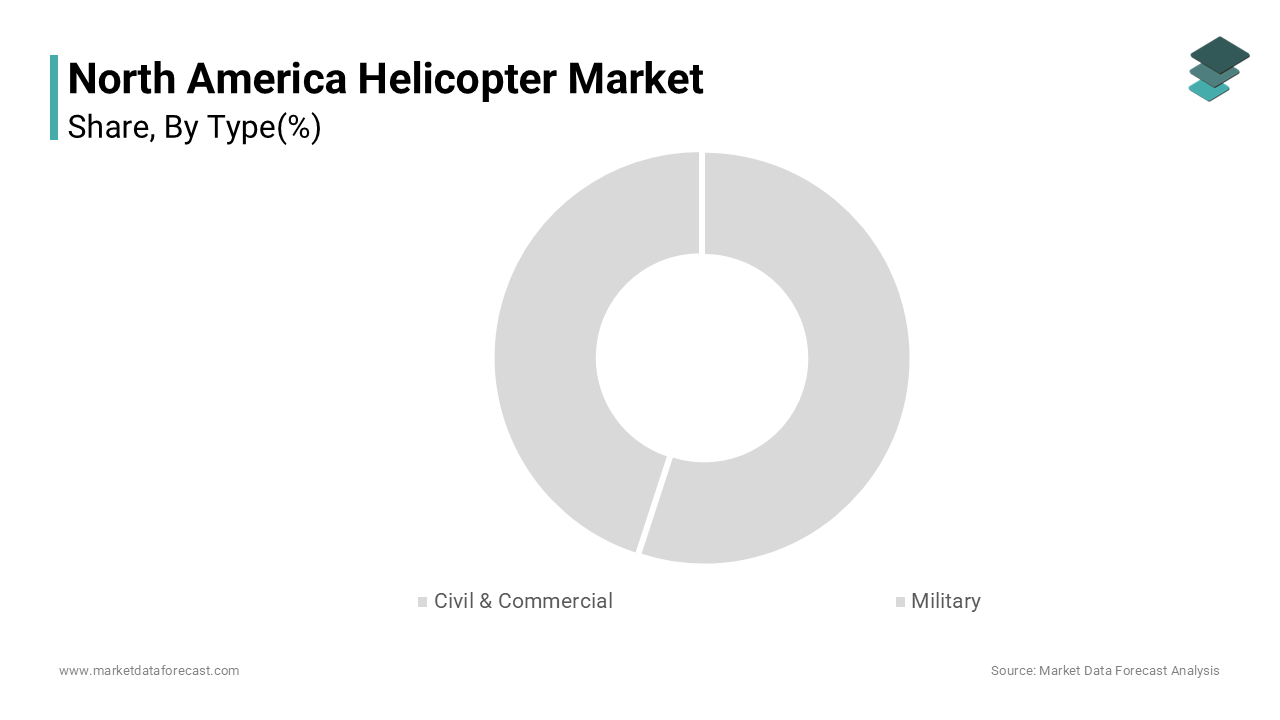
The military helicopter segment is on the rise and is expected to be the fastest growing segment in the market by witnessing a CAGR of 6.8% from 2025 to 2033 due to comprehensive defense modernization initiatives and evolving security requirements that create substantial procurement opportunities for advanced rotary-wing aircraft. The exceptional growth trajectory of the military helicopter segment is also fueled by extensive defense modernization initiatives and capability enhancement programs that require advanced rotary-wing aircraft for contemporary military operations. Current programming reflects the important role of vertical lift aircraft in military operations. Aviation modernization efforts within ground forces include a program aimed at replacing existing reconnaissance helicopters with more modern platforms. A major effort involving upgrades to a large number of attack and utility helicopters represents a significant modernization of vertical lift capabilities within naval expeditionary forces. Special operations forces requirements drive demand for specialized helicopter configurations that can operate in challenging environments and support clandestine missions. The integration of advanced weapons systems, electronic warfare capabilities, and survivability enhancements creates demand for sophisticated helicopter platforms that can operate effectively in contested environments. Homeland security missions, including border patrol operations and disaster response activities, create additional military helicopter requirements that support civil authorities during emergency situations. The development of unmanned helicopter systems for military applications creates new market opportunities while complementing traditional manned helicopter operations. International export opportunities and alliance support initiatives drive the rapid expansion of military helicopter demand through foreign military sales programs and coalition support requirements that create substantial revenue opportunities for North American manufacturers. NATO alliance requirements create demand for interoperable helicopter systems that can support multinational operations and joint training exercises. The integration of advanced communication systems and standardized weapon interfaces enables military helicopters to operate effectively within coalition frameworks and multinational task forces. Foreign military sales programs facilitate technology transfer and co-production arrangements that enhance international partnerships while supporting domestic manufacturing capabilities. The development of trainer helicopter variants creates additional export opportunities for allied nations seeking to develop their own military aviation capabilities. In addition, peacekeeping and humanitarian assistance missions create demand for versatile military helicopters that can support diverse operational requirements in international environments. These export-driven factors create substantial long-term growth prospects that differentiate the military segment from civil and commercial alternatives.
By Number of Engines Insights
The twin engine helicopters segment led the North American helicopter market by capturing a share of 58.1% in 2024. The leading position of the twin engine helicopter segment is credited to its superior safety characteristics, enhanced performance capabilities, and widespread acceptance across diverse operational environments that have sustained their prevalence for decades. Stringent safety regulations and comprehensive compliance mandates are the primary reasons twin-engine helicopters dominate the market, as they require redundant power systems for critical operations. Offshore oil and gas transportation operations mandate twin engine configurations due to the inherent risks associated with over-water operations and the critical importance of reliable powerplant performance. Search and rescue operations, which often involve challenging environmental conditions and extended flight times, require twin engine reliability to ensure mission success and crew safety. Additionally, insurance underwriting requirements for commercial helicopter operations typically favor twin engine configurations due to reduced risk profiles and enhanced safety margins. These safety-driven requirements create universal demand for twin engine helicopters that transcends specific application categories and supports sustained market dominance. Performance capabilities and operational flexibility characteristics significantly contribute to twin engine helicopter market dominance through enhanced lifting capacity, extended range performance, and superior operational envelopes that appeal to diverse operator requirements. Twin engine helicopters typically demonstrate greater payload capacity compared to equivalent single engine platforms, enabling operators to carry additional passengers, cargo, or specialized equipment. The integration of advanced avionics systems and digital flight controls in twin engine platforms creates demand for sophisticated aircraft that can support complex mission profiles and challenging operational environments. Extended range capabilities enable twin engine helicopters to operate effectively in large geographic areas, including offshore operations, remote location access, and inter-city transportation services. The ability to maintain controlled flight following single engine failure provides critical safety margins that enable continued mission completion and safe landing capabilities in emergency situations. Additionally, twin engine configurations offer enhanced redundancy for critical systems including hydraulic, electrical, and avionics subsystems that improve overall aircraft reliability and operational availability. These performance-driven advantages create operational efficiency benefits that support sustained market preference and leadership position.
The single engine helicopters segment is expected to exhibit a noteworthy CAGR of 7.2% during the forecast period due to evolving training requirements and cost-effective operational solutions that favor single engine platforms for specific applications. The rapid expansion of single engine helicopters is primarily driven by increasing pilot training and flight instruction requirements that necessitate cost-effective training platforms for initial helicopter certification and recurrent training activities. Flight training organizations, which operate considerable number of training helicopters, prefer single engine platforms for initial instruction due to reduced fuel consumption and maintenance costs. The integration of modern training technologies, including glass cockpit displays and flight simulation systems, in single engine training helicopters creates demand for sophisticated instruction platforms that prepare pilots for advanced aircraft operations. Military training programs increasingly utilize single engine helicopters for primary flight instruction. Additionally, the development of turbine-powered single engine trainers creates opportunities for advanced training capabilities that bridge the gap between piston-powered trainers and advanced military aircraft. These training-driven requirements create sustained demand growth that supports the segment's exceptional expansion rate. Cost-effective operations and budget constraints drive the rapid expansion of single engine helicopters through demand for affordable helicopter solutions that enable broader market participation and operational accessibility. Single engine helicopters typically demonstrate lower acquisition costs compared to equivalent twin engine platforms, making helicopter ownership accessible to smaller operators and private pilots. Operating cost advantages, including reduced fuel consumption and simplified maintenance requirements, enable operators to conduct more frequent missions while maintaining economic viability. The simplicity of single engine systems reduces pilot workload and training requirements, making helicopter operations more accessible to recreational pilots and part-time operators. Additionally, the development of advanced single engine helicopters with improved safety features and performance characteristics creates opportunities for enhanced operational capabilities within budget constraints. Budget-conscious operators, including law enforcement agencies and small commercial operators, increasingly specify single engine solutions that deliver essential capabilities without premium pricing premiums. These cost-driven factors create substantial demand growth prospects that support the segment's accelerated expansion trajectory.
By Maximum Take-off Weight (MTOW) Insights
The 3,000 kg to 9,000 kg segment held the leading share of the 55.3% of the North America helicopter market in 2024. The supremacy of the 3,000 kg to 9,000 kg segment is because of the optimal balance of payload capacity, operational flexibility, and cost-effectiveness that medium-weight helicopters provide across diverse application requirements. A further driving factor of this segment is extensive emergency medical services requirements and passenger transport operations that demand optimal payload capacity and cabin configurations for effective mission execution. Geographic factors significantly influence emergency medical helicopter demand, particularly in rural areas. Healthcare system efficiency improvements drive adoption of medium-weight helicopters to reduce patient mortality rates and improve clinical outcomes. The integration of advanced life support equipment and specialized medical personnel on medium-weight helicopter platforms enables sophisticated medical interventions during transport that were previously only available in hospital settings. In addition, insurance coverage expansion and healthcare payment reforms have increased accessibility to air medical transport services for broader patient populations. Commercial and corporate transportation applications significantly contribute to the 3,000 kg to 9,000 kg MTOW segment's market dominance through extensive business aviation and passenger transport operations that create sustained demand for sophisticated medium-weight helicopter solutions. Offshore oil and gas operations, particularly in the Gulf of Mexico, create substantial demand for commercial helicopter transportation services that can safely transport personnel to remote drilling platforms and production facilities. News gathering and media operations represent another significant commercial application, with major television networks operating medium-weight helicopter fleets for live reporting and traffic monitoring activities. The integration of advanced avionics systems and passenger comfort features in medium-weight helicopters creates demand for sophisticated aircraft that can support extended operations and premium service standards. Furthermore, tourism and sightseeing operations, particularly in scenic locations such as the Grand Canyon and coastal regions, generate substantial revenue opportunities for commercial helicopter operators utilizing medium-weight platforms. These commercial-driven factors create sustained demand momentum that reinforces the segment's market leadership position.
The greater than 9,000 kg segment is predicted to witness the highest CAGR of 8.1% from 2025 to 2033. The rapid expansion of the greater than 9,000 kg segment is propelled by evolving military requirements and heavy-lift applications that favor large helicopter platforms for specific operational needs. In addition, an additional growth driver of this segment is extensive military heavy-lift and transport requirements that necessitate large helicopter platforms for contemporary military operations and logistics support. Army aviation requirements for heavy equipment transport, including armored vehicles and artillery systems, create demand for large helicopter platforms that can support combat operations and rapid deployment activities. The Marine Corps' expeditionary warfare doctrine emphasizes heavy-lift helicopter capabilities for amphibious assault operations and logistics support in remote operational environments. Special operations forces requirements drive demand for specialized heavy-lift helicopter configurations that can operate in challenging environments and support clandestine missions requiring substantial payload capacity. The integration of advanced weapons systems, electronic warfare capabilities, and survivability enhancements creates demand for sophisticated heavy-lift helicopter platforms that can operate effectively in contested environments. Homeland security missions, including disaster response activities and humanitarian assistance operations, create additional heavy-lift helicopter requirements that support civil authorities during emergency situations. These military-driven factors create substantial long-term growth prospects that support the segment's accelerated expansion. Offshore oil and gas heavy-lift operations drive the rapid expansion of large helicopter platforms through demand for substantial payload capacity and extended range capabilities that enable efficient transportation to remote drilling platforms and production facilities. The integration of advanced avionics systems and safety equipment in heavy-lift helicopters creates demand for sophisticated aircraft that can operate safely in challenging offshore environments and adverse weather conditions. Extended range capabilities enable heavy-lift helicopters to operate effectively across large geographic areas, including deep-water drilling operations and remote production facilities. The development of specialized heavy-lift helicopter variants with enhanced cargo handling capabilities creates opportunities for equipment transport and logistics support that were previously only available through fixed-wing aircraft or maritime transportation. In addition, the expansion of offshore wind energy development creates new opportunities for heavy-lift helicopter operations that can support construction and maintenance activities in marine environments. These heavy-lift driven factors create substantial demand growth prospects that support the segment's exceptional expansion rate.
By Application Insights
The emergency medical service segment was the largest segment in the North American helicopter market and held a share of 35.5% in 2024. The prominence of the emergency medical service segment is supported by the important role that helicopter emergency medical services play in healthcare delivery and the extensive operational requirements that create sustained demand for specialized helicopter operations. Moreover, extensive healthcare system integration and trauma care requirements that necessitate rapid patient transportation and specialized medical capabilities further contribute to the growth of this segment. Geographic factors significantly influence emergency medical helicopter demand, particularly in rural areas. Healthcare system efficiency improvements drive adoption of helicopter emergency medical services to reduce patient mortality rates and improve clinical outcomes. The integration of advanced life support equipment and specialized medical personnel on helicopter platforms enables sophisticated medical interventions during transport that were previously only available in hospital settings. Additionally, insurance coverage expansion and healthcare payment reforms have increased accessibility to air medical transport services for broader patient populations. Regulatory mandates and public safety requirements significantly contribute to emergency medical service helicopter market dominance through comprehensive coverage requirements and response time standards that create sustained demand for specialized helicopter operations. State and local emergency medical service regulations mandate helicopter coverage for designated geographic areas and trauma response zones, creating guaranteed demand for emergency medical helicopter services. Public safety agencies increasingly rely on helicopter emergency medical services for disaster response and mass casualty incident management that require rapid deployment and specialized medical capabilities. The integration of advanced communication systems and hospital coordination protocols enables helicopter emergency medical services to operate effectively within comprehensive healthcare networks and emergency response frameworks. Additionally, quality improvement initiatives and outcome-based reimbursement systems create incentives for helicopter emergency medical service providers to maintain high operational standards and clinical excellence. These regulatory-driven factors create sustained demand momentum that reinforces the emergency medical service segment's market leadership position.
The defense segment is estimated to register the fastest CAGR of 7.9% from 2025 to 2033. The swift growth of the defense segment is credited to comprehensive military modernization initiatives and evolving security requirements that create substantial procurement opportunities for advanced rotary-wing aircraft. In addition, the exceptional growth of the defense application segment is also propelled by extensive military modernization initiatives and capability enhancement programs that require advanced rotary-wing aircraft for contemporary military operations. Special operations forces requirements drive demand for specialized helicopter configurations that can operate in challenging environments and support clandestine missions. The integration of advanced weapons systems, electronic warfare capabilities, and survivability enhancements creates demand for sophisticated helicopter platforms that can operate effectively in contested environments. Homeland security missions, including border patrol operations and disaster response activities, create additional military helicopter requirements that support civil authorities during emergency situations. The development of unmanned helicopter systems for military applications creates new market opportunities while complementing traditional manned helicopter operations. International security cooperation and alliance support initiatives drive the rapid expansion of defense helicopter demand through foreign military sales programs and coalition support requirements that create substantial revenue opportunities for North American manufacturers. NATO alliance requirements create demand for interoperable helicopter systems that can support multinational operations and joint training exercises. The integration of advanced communication systems and standardized weapon interfaces enables military helicopters to operate effectively within coalition frameworks and multinational task forces. Foreign military sales programs facilitate technology transfer and co-production arrangements that enhance international partnerships while supporting domestic manufacturing capabilities. The development of trainer helicopter variants creates additional export opportunities for allied nations seeking to develop their own military aviation capabilities. Additionally, peacekeeping and humanitarian assistance missions create demand for versatile military helicopters that can support diverse operational requirements in international environments. These export-driven factors create substantial long-term growth prospects that differentiate the defense segment from other application categories.
REGIONAL ANALYSIS
United States Helicopter Market Analysis
The United States was the top performer in the North American helicopter market and accounted for a 94.5% share in 2024. The supremacy of the US market is driven by the country's extensive military helicopter inventory, sophisticated civil helicopter operations, and comprehensive aerospace manufacturing base that create sustained demand for advanced rotary-wing aircraft. Sustained demand for sophisticated rotary-wing aircraft and support services in the U.S. is fueled by the foundational strength of its large military and extensive civil helicopter sectors. There are a significant number of registered helicopters operating within the United States, which represents a very large civil helicopter fleet. The Department of Defense also operates many military helicopters as part of its inventory, contributing to ongoing procurement and modernization needs. Regional market dynamics vary significantly, with states like Texas, California, and Alaska generating disproportionate market activity due to large oil and gas operations, extensive emergency medical services networks, and unique geographic requirements. Economic factors, including historically favorable business conditions and robust defense spending, support continued investment in premium helicopter solutions. The presence of sophisticated distribution networks, including major manufacturers like Sikorsky, Bell, and Boeing, ensures comprehensive market coverage and product availability. Additionally, the United States hosts the majority of North American helicopter manufacturing facilities, creating integrated supply chains that support both domestic and export markets. This combination of market scale, operational sophistication, and manufacturing capability establishes the United States as the uncontested leader in North American helicopter activities.
Canada Helicopter Market Analysis
Canada was the second-largest player in the North American helicopter market due to its developed helicopter industry, extensive resource sector operations, and sophisticated search and rescue capabilities that drive demand for reliable rotary-wing aircraft. In addition, Canadian market dynamics are significantly propelled by the country's vast geographic territory and resource-based economy that create consistent demand for helicopter operations across diverse applications. Provincial variations create distinct market opportunities. Economic factors, including government infrastructure investment programs and resource sector expansion, support continued market growth. The presence of major North American manufacturers and specialized Canadian operators ensures product availability and competitive pricing. Additionally, Canada's climate considerations necessitate specific helicopter solutions that address cold weather operation and environmental resilience, creating niche market opportunities for specialized products. These factors combine to establish Canada as a significant but distinct component of the broader North American helicopter landscape.
COMPETITIVE LANDSCAPE
The North America helicopter market exhibits intense competitive dynamics characterized by the presence of established multinational corporations, regional specialists, and emerging technology-focused companies. Market leaders leverage brand recognition, extensive distribution networks, and comprehensive product portfolios to maintain dominant positions, while smaller players differentiate through niche specialization and localized service excellence. The competitive landscape is increasingly influenced by technological innovation, with smart helicopter solutions and sustainable technologies becoming key differentiators. Price competition remains significant across value segments, though premium brands successfully command higher margins through design excellence and advanced functionality. Distribution channel evolution, including digital platforms and direct sales models, has altered traditional competitive dynamics and created new market access opportunities. Regional variations in competitive intensity reflect local market conditions, regulatory requirements, and customer preferences. Military procurement relationships and specification influence play crucial roles in determining market share, particularly in large-scale defense contracts. The market's fragmented nature allows specialized players to compete effectively against larger corporations through superior customer service and localized expertise. Innovation cycles accelerate competitive pressure, requiring continuous investment in research and development to maintain relevance. Brand loyalty remains strong among established customers, though evolving technologies and changing customer expectations create opportunities for market disruption and new entrant success.
KEY MARKET PLAYERS
Some of the companies that are playing a dominating role in the North America Helicopter Market include
- Bell Textron Inc.
- Boeing Company
- Lockheed Martin Corporation (Sikorsky)
- Airbus Helicopters
- Leonardo S.p.A
- MD Helicopters
- Robinson Helicopter Company
- Textron Aviation Defense
- Kaman Aerospace Group
- Enstrom Helicopter Corporation
Top Players in the North America Helicopter Market
Sikorsky Aircraft Corporation
Sikorsky Aircraft Corporation stands as a preeminent force in the North American helicopter market, leveraging decades of aerospace excellence and comprehensive product innovation. The company's extensive portfolio encompasses military helicopters, commercial aircraft, and advanced technology platforms that serve diverse civil and defense applications. Sikorsky's commitment to technological advancement is evident through their development of intelligent helicopter systems that integrate digital monitoring, predictive maintenance capabilities, and advanced flight control algorithms. Their global manufacturing footprint ensures consistent product availability and quality standards across North American markets. Sikorsky's customer-centric approach includes comprehensive technical support, training programs, and lifecycle services that enhance customer satisfaction and retention. The company's strategic acquisitions and partnerships have expanded their technological capabilities and market reach within the helicopter segment. Sikorsky's emphasis on safety and environmental responsibility aligns with evolving regulatory requirements and customer expectations, positioning them favorably in the transitioning aviation landscape.
Bell Textron Inc.
Bell Textron Inc. maintains a formidable presence in the North American helicopter market through its comprehensive product portfolio and innovative aerospace solutions. The company's helicopter offerings include advanced military platforms, commercial aircraft, and specialized mission equipment that cater to diverse operational requirements. Bell's focus on digital transformation has yielded intelligent helicopter systems that provide real-time monitoring, predictive analytics, and remote management capabilities. Their commitment to cybersecurity ensures that helicopter solutions meet stringent critical infrastructure protection requirements. The company's extensive distribution network and authorized partner ecosystem facilitate widespread market penetration and customer support. Bell's research and development investments drive continuous innovation in helicopter technology, including electric propulsion alternatives and autonomous flight capabilities. Their holistic approach to aerospace encompasses design consultation, installation support, and comprehensive maintenance services that create customer loyalty and market differentiation.
Airbus Helicopters Inc.
Airbus Helicopters Inc. commands significant influence in the North American helicopter market through its diversified product portfolio and technological leadership in rotary-wing aviation solutions. The company's helicopter offerings include innovative civil and military platforms that incorporate advanced digital technologies and smart aviation capabilities. Airbus Helicopters' commitment to Industry 4.0 principles is reflected in their development of intelligent helicopter solutions that enable predictive maintenance, operational optimization, and enhanced safety performance. Their global research and development capabilities facilitate rapid adaptation of international innovations to North American market requirements and standards. Airbus Helicopters' comprehensive service ecosystem includes technical consulting, installation support, and lifecycle management programs that ensure customer satisfaction and long-term relationships. The company's strategic focus on sustainability drives development of environmentally responsible helicopter technologies and alternative propulsion systems. Their integration capabilities with broader aerospace systems create value-added solutions that differentiate them from competitors and reinforce market positioning.
Top Strategies Used by Key Market Participants
Strategic Partnerships and Technology Collaborations
Leading players in the North American helicopter market actively pursue strategic partnerships with technology companies, aerospace suppliers, and research institutions to enhance their innovation capabilities and expand market reach. These collaborations enable manufacturers to integrate cutting-edge technologies such as artificial intelligence, advanced materials science, and autonomous flight systems into their helicopter solutions. Partnerships with major aerospace companies and defense contractors facilitate early adoption of new technologies and provide valuable feedback for product development. Technology collaborations with avionics manufacturers and electronic component suppliers ensure access to advanced systems and materials that enhance helicopter performance. These strategic alliances also encompass joint marketing initiatives and co-development projects that accelerate time-to-market for innovative solutions. Additionally, partnerships with educational institutions and training organizations help develop skilled workforce capabilities that support industry growth and technical advancement.
Product Innovation and Digital Transformation
Market leaders consistently invest in research and development to introduce innovative helicopter solutions that address evolving customer requirements and regulatory standards. This strategy encompasses the development of smart helicopter technologies, electric propulsion systems, and advanced flight control systems that enhance operational efficiency and environmental sustainability. Companies focus on integrating digital monitoring capabilities, predictive maintenance features, and cybersecurity protections that align with modern aviation requirements and safety initiatives. Innovation efforts also target autonomous flight technologies, composite materials research, and advanced avionics systems that address future operational challenges. The development of standardized interfaces and communication protocols enables seamless integration with broader aerospace systems and ground support infrastructure. Advanced manufacturing research facilitates development of more efficient, reliable, and environmentally responsible helicopter solutions. These innovation strategies not only command premium pricing but also establish technological leadership positions that create competitive advantages.
Market Expansion and Geographic Penetration
Key players actively pursue market expansion strategies that include geographic penetration, channel diversification, and segment targeting to maximize revenue opportunities and market share. Companies establish regional manufacturing facilities and localized service centers to improve customer accessibility and response times. Geographic expansion efforts focus on emerging markets with growing helicopter demand and infrastructure development requirements. Channel diversification includes direct sales models, authorized dealer networks, and strategic distributor partnerships that complement traditional sales networks. Market leaders also pursue segment expansion by developing specialized helicopter solutions that address previously underserved application categories, including urban air mobility and electric vertical takeoff aircraft. International expansion strategies leverage existing brand recognition and manufacturing capabilities to enter adjacent markets and global opportunities. Strategic acquisitions of regional players provide immediate market presence and established customer relationships. These expansion initiatives enable companies to achieve economies of scale while reducing market concentration risks.
MARKET SEGMENTATION
This research report on the north america helicopter market has been segmented and sub–segmented into the following categories.
By Type
- Civil & Commercial
- Military
By Number of Engines
- Single Engine
- Twin Engine
By Maximum Take-off Weight (MTOW)
- Less than 3,000 Kg
- 3,000 Kg to 9,000 Kg
- Greater than 9,000 Kg
By Application
- Emergency Medical Service
- Corporate Service
- Search and Rescue Operation
- Oil & Gas
- Defense
- Homeland Security
- Others
By Point of Sale
- New
- Pre-Owned
By Country
- U.S.
- Canada
- Rest of North America
Frequently Asked Questions
What is the North America helicopter market?
The North America helicopter market includes the design, manufacturing, sales, maintenance, and operation of rotary-wing aircraft used for civil, commercial, and military applications.
Which sectors drive demand in the North America helicopter market?
Major demand comes from defense, emergency medical services (EMS), law enforcement, offshore oil and gas, search and rescue, and corporate transport.
What factors are driving market growth?
Growth is driven by increasing defense spending, rising demand for EMS helicopters, border security needs, and fleet modernization initiatives.
What types of helicopters are commonly used in North America?
Light, medium, and heavy helicopters are widely used, depending on mission requirements and payload capacity.
Which country leads the North America helicopter market?
The United States leads the market due to its strong defense sector, large commercial aviation base, and extensive helicopter fleet.
How does defense modernization impact the helicopter market?
Ongoing replacement of aging military helicopters with advanced multi-mission platforms significantly boosts market growth.
What challenges does the North America helicopter market face?
High acquisition and maintenance costs, strict regulatory requirements, and pilot shortages are key challenges.
How do technological advancements influence the market?
Advancements such as improved avionics, autonomous systems, lightweight materials, and fuel-efficient engines enhance helicopter performance and safety.
What trends are shaping the North America helicopter market?
Key trends include increased use of multi-mission helicopters, integration of digital cockpit systems, and adoption of advanced training simulators.
What is the future outlook for the North America helicopter market?
The market is expected to grow steadily due to continued defense investment, rising EMS demand, and technological advancements.
Access the study in MULTIPLE FORMATS
Purchase options starting from
$ 2000
Didn’t find what you’re looking for?
TALK TO OUR ANALYST TEAM
Need something within your budget?
NO WORRIES! WE GOT YOU COVERED!
Call us on: +1 888 702 9696 (U.S Toll Free)
Write to us: sales@marketdataforecast.com