North America Home Audio Equipment Market Size, Share, Trends, & Growth Forecast Research Report, Segmented By Technology, Distribution Channel, And By Region (The United States, Canada, Mexico), Industry Analysis From 2026 to 2034
Market Size, 2025
$12.36 BnMarket Estimate, 2026
$13.76 BnMarket Forecast, 2034
$32.42 BnCAGR, 2026–2034
11.31%North America Home Audio Equipment Market Size
The North American home audio equipment market size was valued at USD 12.36 billion in 2025 and is anticipated to reach USD 13.76 billion in 2026 to reach USD 32.42 billion by 2034, growing at a CAGR of 11.31% during the forecast period from 2026 to 2034.

The home audio equipment has evolved significantly with advancements in wireless connectivity, voice recognition, and immersive audio technologies such as Dolby Atmos and DTS: X. The integration of artificial intelligence and IoT-enabled devices into home entertainment systems has further enhanced user experience and convenience. According to the Consumer Technology Association (CTA), U.S. consumers spent over $3.2 billion on audio equipment in 2023, reflecting sustained demand for premium audio experiences at home.
MARKET DRIVERS
Rising Demand for Immersive Home Entertainment Experiences
The growing consumer preference for immersive, theater-like entertainment experiences within homes is propelling the growth of the North American home audio equipment market. Households are increasingly investing in high-quality audio setups to complement their visual content with the proliferation of streaming platforms like Netflix, Disney+, and Amazon Prime Video. According to Parks Associates, over 85% of U.S. broadband households subscribed to at least one video streaming service in 2023, up from 79% in 2021, indicating a strong shift toward home-based media consumption. This trend has led to higher adoption of surround sound systems, soundbars with Dolby Atmos support, and high-resolution audio speakers. North America accounting for nearly 35% of this revenue. Consumers are particularly drawn to compact yet powerful audio solutions that integrate seamlessly with smart TVs and voice assistants. Furthermore, the average selling price of premium home audio systems has risen due to the inclusion of AI-driven features and spatial audio capabilities, suggesting a shift toward value-added products rather than basic audio setups.
Increasing Disposable Incomes and Urbanization Rates
Another significant driver of the North American home audio equipment market is the rise in disposable incomes, coupled with rapid urbanization, especially in metropolitan areas where smart living concepts are gaining traction. According to the U.S. Bureau of Economic Analysis, real disposable personal income in the United States grew by 5.2% in 2023 compared to the previous year, which is providing consumers with greater financial flexibility to invest in premium lifestyle products, including home audio systems. Urbanization has also played a crucial role in shaping purchasing behaviors. In Canada, for instance, over 81% of the population resides in urban centers, as reported by Statistics Canada in 2023. These densely populated regions tend to have higher internet penetration, better access to e-commerce platforms, and a stronger presence of specialty electronics retailers, all of which facilitate easier access to high-end audio equipment. Moreover, the rise of remote work and hybrid work models post-pandemic has led to increased time spent at home, prompting homeowners to enhance their living environments with superior audio-visual setups. Additionally, the increasing number of multi-family housing units in cities like New York, Toronto, and Los Angeles has created a demand for compact, space-efficient, yet powerful audio solutions. These socio-economic shifts continue to underpin robust growth in the North American home audio equipment market.
MARKET RESTRAINTS
High Price Points of Premium Audio Systems
The elevated cost associated with premium audio systems is likely to restrain the growth of the North American home audio equipment market. While there is a growing consumer appetite for high-fidelity and immersive audio experiences, the entry-level pricing for advanced systems such as Dolby Atmos-enabled speaker setups or audiophile-grade amplifiers often exceeds USD 1,000, limiting accessibility for mid-tier consumers. Moreover, leading brands such as Sonos, Bowers & Wilkins, and KEF maintain premium positioning, often pricing their flagship products beyond the reach of mainstream buyers. For example, the Sonos Arc soundbar retails for approximately USD 899, while a full surround setup can easily surpass USD 2,000. Despite strong brand loyalty and product performance, these high costs deter widespread adoption, especially among younger or budget-conscious demographics. Additionally, the availability of more affordable alternatives, such as budget-friendly Bluetooth speakers or built-in TV audio enhancements, further suppresses demand for complex, high-cost setups.
Supply Chain Disruptions and Component Shortages
The North American home audio equipment market has faced persistent supply chain disruptions and semiconductor shortages, which have constrained production capacities and delayed product launches. According to the Institute for Supply Management (ISM), over 75% of U.S. manufacturers reported experiencing material delays in 2023, with semiconductors being one of the most affected components. For instance, companies like Yamaha and Denon experienced shipment delays of up to six months for certain AV receivers and smart speakers due to the unavailability of specific ICs and capacitors. These disruptions have not only caused inventory shortages but have also forced manufacturers to increase retail prices to offset production costs. Furthermore, geopolitical tensions, trade restrictions, and logistical bottlenecks have exacerbated the situation.
MARKET OPPORTUNITIES
Integration of Voice Assistants and Smart Home Ecosystems
A significant opportunity emerging in the North American home audio equipment market is the deepening integration of voice assistants and smart home ecosystems into audio devices. As smart homes become more prevalent, consumers increasingly seek seamless control over lighting, climate, security, and entertainment through unified platforms. According to a 2023 report by Strategy Analytics, over 62 million smart speaker units were sold in the United States alone, marking a 12% year-over-year increase. Leading manufacturers such as Amazon, Google, and Apple have embedded their proprietary voice assistants Alexa, Google Assistant, and Siri into an expanding array of audio products, including soundbars, AV receivers, and high-fidelity speakers. For example, Sonos reported that 84% of its 2023 product sales included voice assistant compatibility. Additionally, partnerships between audio equipment providers and smart home platform developers are accelerating product innovation. This convergence presents a lucrative avenue for growth, enabling vendors to offer differentiated, ecosystem-integrated solutions that align with evolving consumer expectations around automation and convenience.
Growth of Multi-Room Audio Systems and Wireless Technologies
The proliferation of multi-room audio systems and advancements in wireless technologies represent a substantial growth opportunity for the North American home audio equipment market. Consumers are increasingly seeking flexible, synchronized audio experiences across different rooms without the clutter of wired setups. Technological innovations such as Wi-Fi 6, Bluetooth Mesh, and Apple’s AirPlay 2 have enabled seamless streaming and device synchronization across home networks. Companies like Sonos, Bose, and Yamaha have capitalized on this trend by launching scalable, app-controlled speaker systems that allow users to manage audio zones effortlessly. For instance, Sonos' portfolio accounted for over 30% of multi-room speaker sales in North America in 2023, according to data from NPD Group. Moreover, the rise of remote work and hybrid lifestyles has heightened demand for ambient background music and noise-cancelling features in home environments. As per Parks Associates, 43% of U.S. broadband households now own at least one multi-room speaker system, up from 31% in 2021.
MARKET CHALLENGES
Intense Market Competition and Brand Saturation
A major challenge facing the North American home audio equipment market is the intense level of competition among established players and emerging brands, leading to market saturation and pricing pressures. The industry is dominated by well-known global brands such as Sony, Samsung, Sonos, Bose, and Harman Kardon, each vying for market share through aggressive marketing and continuous product innovation. New entrants face significant barriers due to the entrenched brand loyalty of consumers. For example, a Nielsen survey revealed that 68% of U.S. consumers prefer purchasing audio equipment from recognized brands rather than lesser-known alternatives. This preference limits opportunities for smaller firms to gain traction unless they offer disruptive features or competitive pricing strategies. Additionally, the influx of budget-friendly products from Asian manufacturers has intensified price wars, squeezing profit margins for mid-tier companies. As per the U.S. International Trade Commission, imports of consumer audio equipment from China increased by 9.3% in 2023, contributing to downward pressure on retail prices.
Rapid Technological Obsolescence and Product Lifecycle Shortening
Rapid technological advancements pose a significant challenge to the North American home audio equipment market, as product lifecycles continue to shorten due to frequent updates and innovations. Manufacturers must contend with the fast-evolving nature of audio technology, including improvements in digital signal processing, wireless connectivity standards, and voice recognition capabilities. This accelerated pace of innovation increases research and development expenditures. For instance, Dolby Laboratories reported spending over USD 200 million on R&D in 2023 to advance spatial audio technologies, while companies like Qualcomm invested heavily in next-gen audio chipsets to support lossless streaming and low-latency Bluetooth transmission. Moreover, consumers are becoming more cautious about purchasing decisions, often delaying purchases in anticipation of newer models. Data from the Consumer Electronics Association shows that 54% of North American consumers wait for product upgrades before buying new audio equipment, leading to fluctuating demand patterns.
REPORT COVERAGE
| REPORT METRIC | DETAILS |
| Market Size Available | 2025 to 2034 |
| Base Year | 2025 |
| Forecast Period | 2026 to 2034 |
| CAGR | 11.31% |
| Segments Covered | By Type, Technology, Distribution Channel, and Region. |
|
Various Analyses Covered | Global, Regional, and Country Level Analysis, Segment-Level Analysis, DROC, PESTLE Analysis, Porter’s Five Forces Analysis, Competitive Landscape, Analyst Overview of Investment Opportunities |
| Regions Covered | The United States, Canada, and Mexico |
|
Market Leaders Profiled | Akai (inMusic, Inc.), Audio Partnership Plc, Bose Corporation, Dolby Laboratories, Inc., XPERI INC, HARMAN International, Intex Technologies, JVCKENWOOD Corporation, LG Electronics, Nakamichi Corporation, Nice North America, Panasonic Holdings Corporation, Koninklijke Philips N.V., SHARP CORPORATION, Vistron (Dong Guan) Audio Equipment Co., Ltd., SAMSUNG |
SEGMENTAL ANALYSIS
By Technology Insights
The wired home audio equipment segment was the largest in the North American market by accounting for 54.3% of the share in 2024, owing to the preference for high-fidelity (Hi-Fi) audio among dedicated music enthusiasts and home theater aficionados. Wired setups, such as analog turntables, multi-channel AV receivers, and passive speaker systems, are often favored for their minimal signal loss and consistent performance. Additionally, professional installation services and integration with existing home entertainment infrastructures further bolster demand for wired products. The residential audio installation industry in the U.S. grew by 4.3% in 2023, driven largely by custom-built homes and luxury apartments incorporating fixed audio systems.
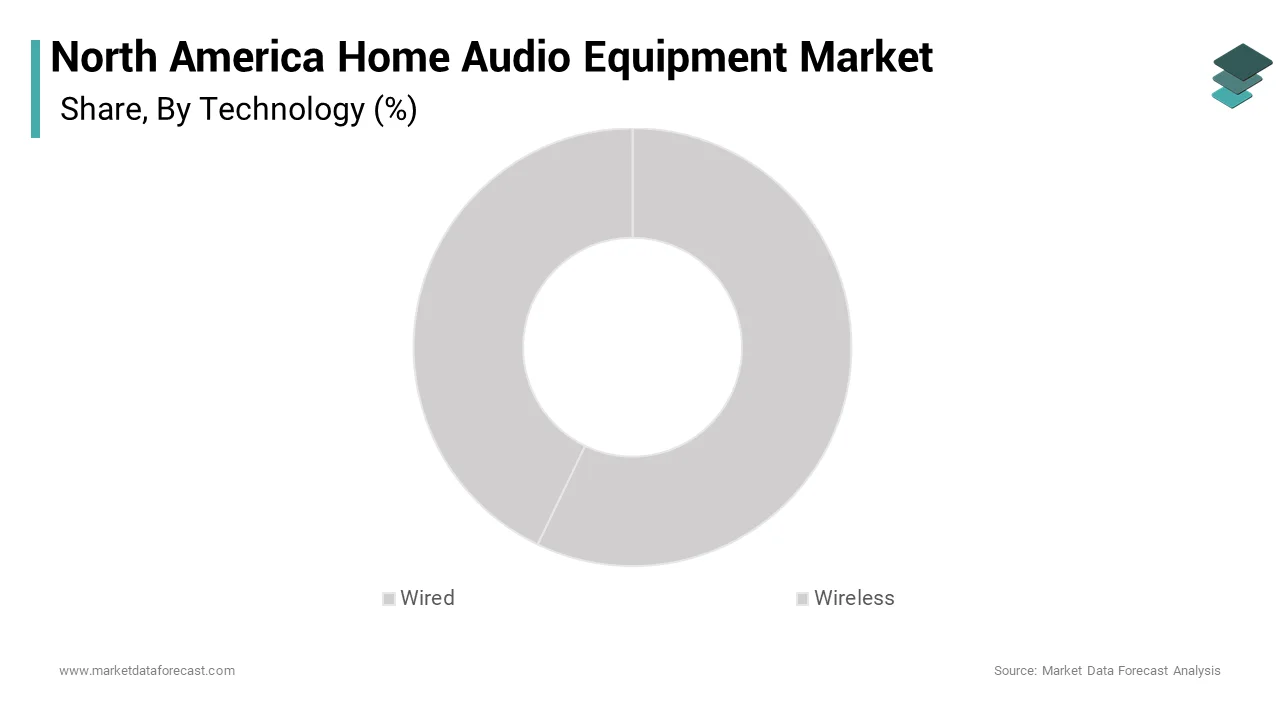
The wireless home audio equipment segment is growing lucratively with an estimated CAGR of 9.4% in the coming years. This rapid growth is primarily fueled by advancements in Bluetooth, Wi-Fi 6, and mesh networking technologies, which have significantly improved connectivity stability and streaming quality. Strategy Analytics reported that over 62 million smart speakers were sold in the U.S. alone in 2023, many of which serve as central nodes in multi-room audio systems. Consumers increasingly prefer the flexibility and ease of use offered by wireless speakers, especially those that support Apple AirPlay 2, Spotify Connect, and multi-zone synchronization. Moreover, urbanization and space constraints in metropolitan areas are driving demand for compact, wire-free audio solutions. The rise in remote work has also increased the need for ambient sound systems that can be controlled via smartphones or voice commands.
By Distribution Channel Insights
The offline distribution channel was the largest by capturing 58.4% of the North American home audio equipment market share in 2024. A primary driver of offline dominance is the availability of premium brand showrooms and specialty audio retailers, which offer immersive listening environments and expert consultation. Furthermore, B2B installations in luxury residences, home theaters, and commercial spaces heavily rely on offline channels for large-scale deployments.
The online distribution channel segment is anticipated to grow with an expected CAGR of 10.2% during the forecast period. The growth of the segment is quietly driven by the increased penetration of e-commerce platforms and the rising preference for convenient, price-comparison-driven shopping experiences. According to Digital Commerce 360, U.S. online electronics sales surged by 14.6% in 2023, outpacing traditional retail growth for the first time in five years. Additionally, digital marketing and influencer-led content have played a pivotal role in shaping consumer awareness and purchase intent. YouTube reviews, TikTok unboxings, and tech blogs have made it easier for buyers to evaluate products remotely. According to a 2023 Nielsen study, nearly 55% of consumers under 35 now research and buy audio gear entirely online, reflecting a generational shift in purchasing behavior. These evolving digital trends continue to propel the online channel’s accelerated growth trajectory.
COUNTRY-LEVEL ANALYSIS
United States
The United States was the largest contributor by holding 74.3% of the North American home audio equipment market share in 2024. A major growth driver is the popularity of home entertainment systems, especially among households subscribing to multiple streaming platforms. Data from Parks Associates shows that over 85% of U.S. broadband households had at least one video streaming subscription in 2023, prompting investments in complementary audio equipment such as soundbars and surround systems. Moreover, the presence of major manufacturers and retailers, such as Sonos, Bose, and Best Buy, has fostered innovation and accessibility.
Canada
Canada was ranked second by holding 12.3% of the North American home audio equipment market share in 202,4, with the rising urbanization rates, increasing disposable income, and a growing middle-class population. According to Canada, median household income rose by 4.1% in 2023, supporting greater spending on lifestyle-enhancing products such as premium speakers and smart audio systems. E-commerce expansion has also played a role, with platforms like Amazon.ca and Best Buy Canada offering competitive pricing and fast delivery options. As reported by the Canadian Internet Registration Authority (CIRA), online electronics sales in Canada grew by 13.7% in 2023, which is reinforcing the digital shift in consumer purchasing behavior and supporting broader market expansion.
COMPETITIVE LANDSCAPE
The competition in the North American home audio equipment market is marked by intense rivalry among established global brands and emerging local players. Companies continuously strive to differentiate themselves through superior product design, cutting-edge technology, and seamless integration within smart home environments. Innovation remains a central battleground, with manufacturers investing heavily in research and development to introduce next-generation audio solutions that offer improved connectivity, higher fidelity, and greater convenience. Brand reputation and ecosystem compatibility play pivotal roles in shaping consumer preferences among high-end buyers seeking premium experiences. Additionally, pricing strategies and distribution efficiency influence market positioning, especially in the mid-tier segmentwhere affordability and performance are equally important.
KEY MARKET PLAYERS
These are the market players that are dominating the North American home audio equipment market include are
- Akai (inMusic, Inc.)
- Audio Partnership Plc
- Bose Corporation
- Dolby Laboratories, Inc.
- XPERI INC
- HARMAN International
- Intex Technologies
- JVCKENWOOD Corporation
- LG Electronics
- Nakamichi Corporation
- Nice North America
- Panasonic Holdings Corporation
- Koninklijke Philips N.V.
- SHARP CORPORATION
- Vistron (Dong Guan) Audio Equipment Co., Ltd.
- SAMSUNG
Top Players In The Market
- One of the leading players in the North American home audio equipment market is Sonos Inc. Sonos has carved a niche by offering seamless integration with smart home ecosystems, which are known for their innovative multi-room audio systems. The company’s product lineup, which includes wireless speakers, soundbars, and subwoofers, emphasizes high-quality sound and user-friendly control via mobile apps. Sonos continues to influence the market through continuous product innovation and strategic partnerships with streaming platforms.
- Another dominant player is Bose Corporation, a pioneer in premium audio technology. Bose offers a diverse range of products, including home theater systems, soundbars, and high-fidelity speakers that cater to both casual listeners and audiophiles. Bose maintains a loyal customer base and contributes significantly to global advancements in residential audio solutions with a strong emphasis on acoustic engineering and immersive listening experiences.
- Sony Corporation is also a key player in the market, leveraging its global brand reputation and extensive R&D capabilities. Sony's home audio offerings include AV receivers, surround sound systems, and soundbars that integrate well with its television and gaming consoles. The company plays a crucial role in shaping consumer preferences through technological convergence and ecosystem synergy, which is reinforcing its presence in both mass-market and premium segments.
Top Strategies Used By Key Market Participants
- Key players in the North American home audio equipment market employ several strategies to strengthen their positions. One major approach is product innovation and differentiation, where companies focus on introducing technologically advanced products with enhanced features such as voice control, spatial audio, and seamless smart home integration. These innovations help brands stand out in a competitive landscape and meet evolving consumer expectations.
- Another critical strategy is strategic partnerships and ecosystem integrations, wherein manufacturers collaborate with software developers, streaming services, and smart home platform providers. By ensuring compatibility across devices and platforms, companies enhance user experience and build brand loyalty.
- Expanding omnichannel distribution networks is a widely adopted tactic. Companies are strengthening both online and offline retail channels, optimizing logistics, and enhancing after-sales service to improve accessibility and customer satisfaction. This approach ensures broader market reach and sustained growth.
RECENT MARKET NEWS
- In June 2024, Sonos launched an updated version of its flagship soundbar, featuring enhanced AI-driven voice controls and deeper integration with third-party smart home platforms by aiming to strengthen its dominance in the premium audio space.
- In March 2024, Bose introduced a new line of compact home theater systems designed specifically for small living spaces, which is targeting urban consumers who prioritize space-saving yet powerful audio solutions.
- In February 2024, Sony partnered with a leading streaming service to co-develop exclusive audio calibration features by enhancing the viewing and listening experience for users of its home theater products.
- In August 2024, Denon expanded its dealer network across North America by onboarding over 200 new authorized retailers, which are focusing on improving localized support and installation services for high-end home audio customers.
MARKET SEGMENTATION
This research report on the North American home audio equipment market is segmented and sub-segmented into the following categories.
By Type
- Home Theater in a Box
- Home Audio Speakers and Systems
- Home Radios
- Others
By Technology
- Wired
- Wireless
By Distribution Channel
- Online
- Offline
By Country
- The United States
- Canada
- Mexico
Frequently Asked Questions
What is driving the growth of the home audio equipment market in North America?
The market is growing due to rising consumer interest in immersive entertainment experiences at home. With more people investing in home theaters, gaming setups, and smart living environments, demand for high-quality speakers, soundbars, AV receivers, and wireless audio systems is on the rise. Additionally, remote work and hybrid learning have increased the need for better audio solutions in home offices and study spaces.
How has the pandemic affected consumer behavior in this market?
The pandemic significantly shifted how people use their homes, turning them into multi-functional spaces for entertainment, work, and education. As a result, consumers began upgrading their home audio setups to replicate cinema-like experiences and improve virtual communication. This trend has continued even post-pandemic, with many households prioritizing premium audio as part of their lifestyle upgrades.
Which types of home audio equipment are most popular in North America?
Soundbars remain one of the most sought-after products due to their ease of setup and space-saving design. Wireless Bluetooth speakers and smart speakers like Amazon Echo and Google Nest are also highly popular. Among audiophiles, there's strong demand for high-fidelity (hi-fi) systems, including floor-standing speakers, AV receivers, and dedicated subwoofers that offer superior sound quality.
How are smart technologies influencing the home audio market?
Smart technologies are transforming the way consumers interact with audio devices. Voice assistants, Wi-Fi connectivity, multi-room synchronization, and app-based controls are now standard features. Consumers expect seamless integration with other smart home systems, such as lighting and security, making interoperability a key selling point for manufacturers.
Are wired audio systems still relevant in today’s market?
While wireless systems dominate new purchases, especially among younger consumers, wired audio systems remain popular among audiophiles who prioritize sound fidelity and low latency. High-end wired speakers and amplifiers continue to be preferred in dedicated listening rooms and by professional musicians and producers who demand studio-grade quality.
How important is brand loyalty in the North American home audio market?
Brand loyalty plays a significant role, especially among established names like Sonos, Bose, Yamaha, Denon, and Klipsch. These brands have built trust over decades through consistent performance and innovation. However, newer entrants and budget-friendly brands are gaining traction by offering competitive features at lower price points, particularly among tech-savvy younger buyers.
What impact are streaming services having on home audio equipment adoption?
Streaming platforms like Netflix, Disney+, Spotify, and Apple Music have raised expectations for audio quality. Consumers are investing in better home audio systems to fully experience high-resolution audio, surround sound, and Dolby Atmos content available on these platforms. This has led to increased demand for compatible equipment like Atmos-enabled soundbars and 4K-compatible AV receivers.
Are there regional differences in product preferences across North America?
Yes, there are noticeable differences. Urban consumers in major cities like New York, Los Angeles, and Toronto tend to prefer compact, smart, and multi-room audio systems suited for apartments and smaller living spaces. In contrast, suburban and rural areas show higher demand for full home theater setups and outdoor audio systems, reflecting larger living spaces and a preference for immersive experiences.
How are sustainability and eco-friendliness shaping product development?
More consumers are looking for environmentally responsible products. Manufacturers are responding by using recycled materials, reducing packaging waste, and improving energy efficiency. Some companies are also launching take-back and recycling programs for old equipment. Energy Star-certified devices are becoming increasingly common, appealing to eco-conscious buyers.
What challenges does the North American home audio equipment market face?
One of the main challenges is market saturation in mature segments like basic soundbars and Bluetooth speakers, which limits growth unless innovation continues. Supply chain disruptions, especially related to semiconductor shortages, have also impacted production timelines and pricing. Additionally, economic fluctuations can affect discretionary spending on premium audio gear.
Related Reports
Access the study in MULTIPLE FORMATS
Purchase options starting from
$ 2000
Didn’t find what you’re looking for?
TALK TO OUR ANALYST TEAM
Need something within your budget?
NO WORRIES! WE GOT YOU COVERED!
Call us on: +1 888 702 9696 (U.S Toll Free)
Write to us: sales@marketdataforecast.com