- Product Description Description
- Table of Contents TOC
- List of Table & Figure LOT
- Get Free Sample PDF Sample PDF
Market Size, 2025
$892.62 MnMarket Estimate, 2026
$1060 MnMarket Forecast, 2034
$4213 MnCAGR, 2026–2034
18.82%Executive Summary: North America HVAC-Contained Server Market
- Market Scope: Regional North American HVAC-contained server market analysis covering form factors, cooling capacities, country leadership frameworks, and edge data center thermal management adoption metrics.
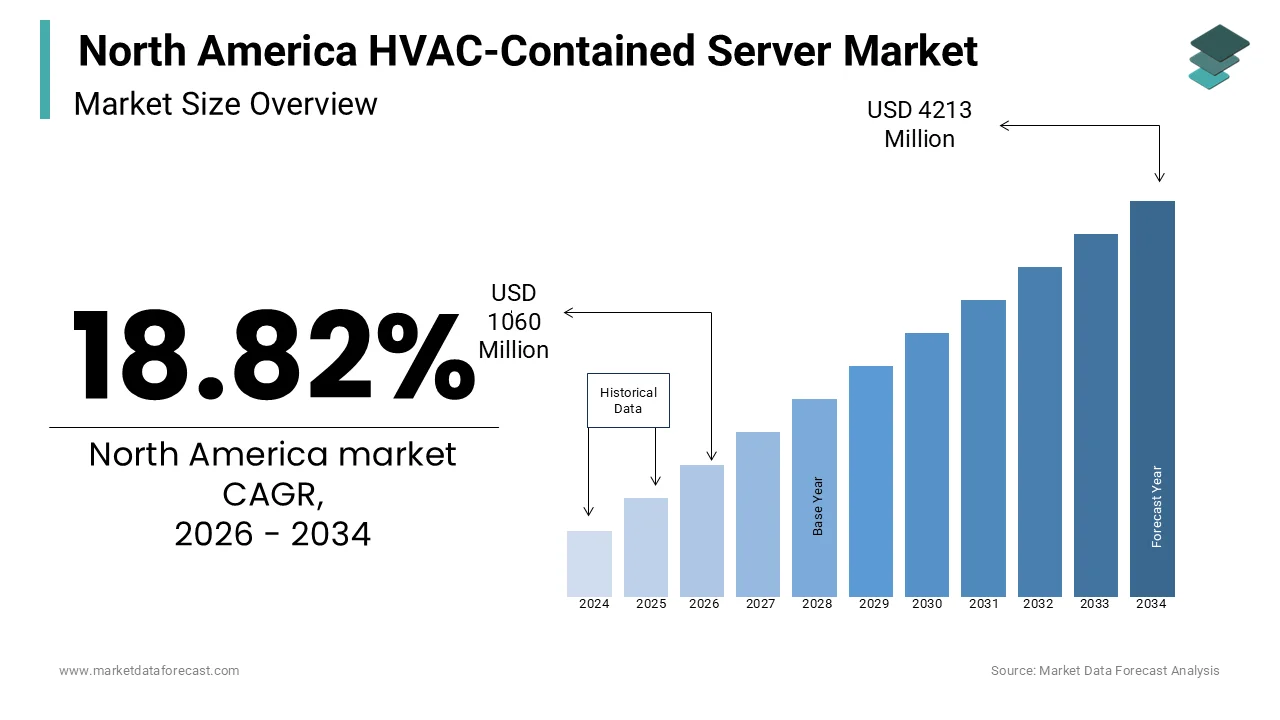
- Market Valuation: Valued at USD 892.62 million in 2025, estimated at USD 1,060.61 million in 2026, and projected to reach USD 4,213.79 million by 2034, registering a CAGR of 18.82% from 2026 to 2034.
- Primary Growth Drivers: Rapid expansion of edge computing infrastructure, increasing deployment of 5G-enabled edge data centers, and stringent energy efficiency and environmental regulations promoting advanced cooling technologies.
Key Market Segment Metrics (2026–2034)
| Category | Leading Segment (Position) | Fastest-Growing / Key Growth Segment |
|---|---|---|
| By Form Factor & Cooling Capacity | 20 to 40 U (largest form factor) & 6,000 to 10,000 BTU (largest cooling capacity) | Above 40 U (fastest-growing form factor) & Above 10,000 BTU (fastest-growing cooling capacity) |
| By Technology & Innovation | Standard rack enclosures and conventional thermal management systems | AI-ready high-density server infrastructure, intelligent thermal controls, and sustainable refrigerants |
| By Region / Country | United States (leading country market) | Canada (fastest-growing country market) |
Major Market Players & Market Structure
Market Structure: Highly competitive North American HVAC-contained server sector characterized by modular edge data center solutions, energy-efficient integrated cooling innovations, AI-ready server infrastructure investments, and sustainable refrigerant adoption.
Key Companies: Black Box Corporation, Vertiv Co., Schneider Electric SE, STULZ GmbH, Hitachi Systems, Tripp Lite, Rackmount Solutions, EIC Solutions, Inc., Crenlo, and Karis Technologies Inc.
North America HVAC-Contained Server Market Size
The North America HVAC-contained server market size was valued at USD 892.62 million in 2025 and is anticipated to reach USD 1,060.61 million in 2026 and USD 4,213.79 million by 2034, growing at a CAGR of 18.82%, from 2026 to 2034.
The HVAC-contained server is an integrated system that combines data processing hardware with dedicated heating, ventilation, and air conditioning units designed specifically for thermal regulation within compact or edge computing environments. These systems are engineered to operate in demanding physical conditions where space, energy efficiency, and environmental control are important, particularly in decentralized IT infrastructure. The integration of climate control directly into server housing ensures consistent performance under fluctuating ambient temperatures. According to the U.S. Energy Information Administration, commercial and industrial sectors in the United States consumed approximately 35% of the nation’s total electricity in 2023, a significant portion of which powers IT and cooling infrastructure.
MARKET DRIVERS
Growing Demand for Edge Computing Infrastructure Driving Market Expansion
The proliferation of edge computing across North America is a primary factor propelling the growth of the North America HVAC-contained server market. This transition necessitates robust, self-contained server units capable of operating in non-traditional environments such as cell towers, manufacturing floors, and retail backrooms. According to Cisco, by 2025, more than 75% of enterprise data will be processed at the edge, up from less than 20% in 2020, signaling a structural shift in IT architecture. In 2023, the number of edge data centers in the United States surpassed 450, as reported by the International Data Corporation, with ongoing deployments by telecom operators like Verizon and AT&T accelerating this trend. These facilities often operate in uncontrolled environments where ambient temperatures can exceed 38°C, which is making integrated HVAC systems essential for hardware longevity. Additionally, as per the U.S. Department of Energy, edge servers consume up to 30% less energy when equipped with precision cooling systems compared to retrofitting standalone cooling units.
Stringent Environmental Regulations Influencing System Design and Deployment
Environmental regulations in favor of the government rules are boosting the growth of the North America HVAC-contained server market. Federal and state-level mandates aimed at reducing greenhouse gas emissions and improving energy efficiency are compelling manufacturers and operators to adopt sustainable thermal management solutions. The U.S. Environmental Protection Agency’s updated guidelines under the Clean Air Act restrict the use of high-global-warming-potential (GWP) refrigerants, directly impacting HVAC system composition. As of 2025, hydrofluorocarbons (HFCs) with a GWP above 750 are prohibited in new commercial refrigeration and cooling equipment, a rule that extends to integrated server cooling units. According to the Environmental Investigation Agency, this regulation affects over 60% of HVAC units deployed in IT environments across the United States.
MARKET RESTRAINTS
High Initial Capital Expenditure Limiting Adoption Among Small and Medium Enterprises
The elevated initial capital expenditure associated with these integrated systems is restricting the growth of the North America HVAC-contained server market. According to the National Institute of Standards and Technology, the average upfront cost of an HVAC-contained server is 2.3 times higher than that of a standard rack-mounted server with external cooling. For small and medium-sized enterprises (SMEs), which constitute over 99% of all businesses in the United States, as reported by the U.S. Small Business Administration, this cost differential presents a formidable barrier. Furthermore, the lifecycle cost analysis by the Department of Energy reveals that while HVAC-contained servers achieve 40% lower operational energy costs over five years, the payback period exceeds 48 months, which exceeds typical SME financial planning horizons. This economic reality discourages investment despite long-term efficiency gains. Additionally, limited access to specialized technical support for maintenance amplifies perceived risk, further deterring cost-sensitive organizations from adopting these systems in rural and underserved regions.
Supply Chain Constraints for Cooling Component
The supply chain disruptions are hindering the growth of the North American HVAC-contained server market. The geopolitical instability and raw material shortages experienced since 2022 have severely impacted the production timelines of HVAC subsystems. This scarcity has cascaded into delays across the manufacturing pipeline, with lead times for cooling modules extending from 8 to 22 weeks, as reported by the Air-Conditioning, Heating, and Refrigeration Institute. Additionally, the phaseout of high-GWP refrigerants under the AIM Act has created a transitional bottleneck, as manufacturers struggle to secure sufficient quantities of approved low-GWP alternatives like R-1234yf and R-32. The U.S. Environmental Protection Agency confirms that domestic production of these next-generation refrigerants meets only 60% of current demand. This imbalance forces system integrators to ration inventory or redesign cooling loops, delaying product launches. Moreover, the reshoring of manufacturing under the CHIPS and Science Act has redirected semiconductor capacity toward microelectronics, inadvertently reducing component availability for embedded HVAC controls. As per the Semiconductor Industry Association, only 12% of North American semiconductor output in 2023 was allocated to industrial automation and climate control systems.
MARKET OPPORTUNITIES
Integration with Renewable Energy Systems: Creating New Deployment Pathways
The integration of these systems with renewable energy sources, particularly solar and wind-powered microgrids, is another factor contributing to the growth of the North American HVAC-contained server market. As organizations strive to meet net-zero emissions targets, there is growing interest in deploying self-sustaining edge computing nodes powered by clean energy. HVAC-contained servers, with their closed-loop thermal regulation and energy-efficient compressors, are inherently compatible with intermittent power sources when paired with battery storage and intelligent load management. According to the National Renewable Energy Laboratory, hybrid solar-microgrid-powered server enclosures can reduce carbon emissions by up to 85% compared to grid-dependent units.
Rising Cybersecurity Threats in Decentralized Server Environments
HVAC-contained servers are becoming vulnerable targets for cyber threats, which is more likely to create opportunities for the expansion of the North American HVAC-contained server market. Unlike traditional data centers with layered physical and digital defenses, edge-located contained servers often operate in unsecured environments such as utility substations, transportation hubs, and retail facilities. According to the Cybersecurity and Infrastructure Security Agency, the number of reported cyber incidents targeting edge computing infrastructure in the United States increased by 156% between 2021 and 2023. A significant portion of these attacks exploited unpatched firmware in embedded HVAC control systems, which are frequently overlooked in enterprise security protocols. In response, vendors such as Vertiv and Eaton have begun incorporating zero-trust security architectures into their contained server designs, enabling encrypted communication between cooling modules and central IT systems. As per a 2023 analysis by the Ponemon Institute, organizations that implement integrated cybersecurity in edge infrastructure experience 62% fewer downtime incidents.
Technical Complexity in Retrofitting Legacy Facilities
The technical complexity involved in retrofitting legacy commercial and industrial facilities is acting as a big barrier to the growth of the North American HVAC-contained server market. Many existing buildings, particularly those constructed before 2000, lack the electrical load capacity, structural support, and spatial configuration required for modern integrated server units. According to the U.S. General Services Administration, over 60% of federal buildings in operation have outdated electrical systems incapable of supporting high-density computing loads without extensive upgrades. HVAC-contained servers, while self-cooled, still require stable 208V or 480V power inputs and robust grounding to prevent thermal throttling or hardware failure. A 2023 study by the Building Owners and Managers Association revealed that retrofitting a single contained server unit in a legacy office building incurs an average additional cost of $18,500 due to electrical panel upgrades, conduit installation, and fire suppression compliance. Moreover, spatial constraints pose a significant hurdle; these units often exceed standard floor load limits, necessitating structural reinforcement. The National Fire Protection Association notes that 44% of retrofit projects in urban centers like Chicago and Toronto were delayed due to insufficient ceiling height or inadequate load-bearing capacity. Additionally, integrating these systems with existing building management systems (BMS) requires specialized protocols such as BACnet or Modbus, which are absent in older facilities.
Workforce Shortage in Multidisciplinary Technical Expertise
The deployment and maintenance of HVAC-contained servers require experienced and qualified skills in IT infrastructure, thermodynamics, and electrical systems, which is attributed to the decline in the growth of the North American HVAC-contained server market. However, according to the U.S. Bureau of Labor Statistics, there is a deficit of over 120,000 qualified HVAC and controls technicians nationwide, with only 18,000 new entrants entering the field annually. This gap is exacerbated by the aging workforce; the average age of certified HVAC technicians is 47, and nearly 35% are expected to retire by 2030. The Information Technology Industry Council reports a shortage of 620,000 IT professionals across the United States, particularly in edge computing and network operations. A 2023 survey by the Associated Builders and Contractors found that 74% of contractors delayed edge server installations due to the unavailability of personnel skilled in both server management and climate control systems.
REPORT COVERAGE
| REPORT METRIC | DETAILS |
| Market Size Available | 2025 to 2034 |
| Base Year | 2025 |
| Forecast Period | 2026 to 2034 |
| CAGR | 18.82% |
| Segments Covered | By Form Factor, Cooling Capacity, Organization, Vertical, Country |
| Various Analyses Covered | Global, Regional, and Country Level Analysis; Segment-Level Analysis; DROC; PESTLE Analysis; Porter’s Five Forces Analysis; Competitive Landscape; Analyst Overview of Investment Opportunities |
| Regions Covered | The United States, Canada, Mexico, Rest of North America |
| Market Leaders Profiled | Black Box Corporation, Vertiv Co, Schneider Electric Se, Stulz GmbH, Hitachi Systems, Tripp Lite, Rackmount Solutions, EIC Solutions, Inc, Crenlo, Karis Technologies Inc. |
SEGMENTAL ANALYSIS
By Form Factor Insights
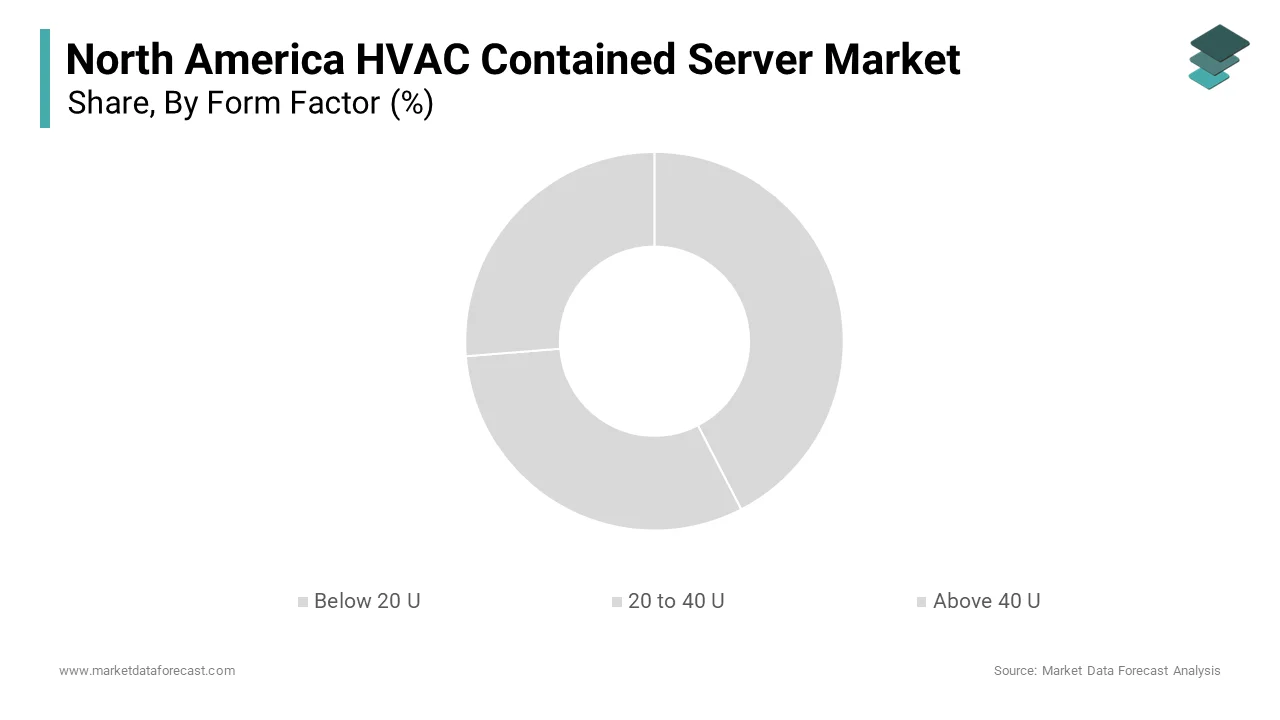
The 20 to 40 U category was the largest by accounting for 48.2% of the North American HVAC-contained server market share in 2025. The rapid expansion of 5G networks across North America has significantly amplified demand for 20 to 40 UHVAC-contained servers in carrier-neutral cell towers and distributed antenna systems. According to the Federal Communications Commission, over 620,000 5G small cells were deployed across the United States by the end of 2023, each requiring localized computing power to support ultra-low latency applications such as autonomous vehicles and remote surgery. These installations typically house server units between 24 and 36 U to accommodate multi-node processing, redundant power supplies, and integrated cooling systems within constrained footprints. The Telecommunications Industry Association confirms that 78% of new edge server deployments in 2023 fell within the 20 to 40 U range due to compatibility with standard 42U rack ecosystems. Furthermore, as per the Department of Energy, this form factor achieves a 34% higher energy efficiency ratio (EER) than larger units due to optimized airflow distribution and reduced compressor cycling, making it the preferred choice for operators seeking to minimize power usage effectiveness (PUE) in outdoor or semi-enclosed environments.
Additionally, the 20 to 40 U segment benefits from seamless integration with hybrid cloud architectures adopted by enterprises across finance, healthcare, and logistics. According to a 2023 survey by the Computing Technology Industry Association, 63% of medium-sized enterprises in North America prefer modular server units in this range for private edge clouds due to their ability to support virtualized workloads while fitting within standard mechanical rooms. The American Society of Heating, Refrigerating, and Air-Conditioning Engineers notes that HVAC systems in this form factor maintain a consistent internal temperature differential of ±1.5°C for sustaining high-performance computing without thermal throttling.
The above-40 U form factor is likely to grow with an expected CAGR of 14.7% from 2025 to 2033, owing to the rising deployment of high-density computing clusters in AI training facilities, federal defense installations, and large-scale industrial IoT gateways, where processing intensity surpasses the capacity of smaller enclosures. The exponential growth in AI model complexity has necessitated larger, more powerful contained server units capable of housing multiple GPU arrays and high-throughput networking modules. As per the Stanford Institute for Human-Centered Artificial Intelligence, the computational demand for training large language models doubled every 10 months between 2020 and 2023, requiring server stacks exceeding 40 U to accommodate liquid-assisted hybrid cooling and redundant power systems.
By Cooling Capacity Insights
The 6,000 to 10,000 BTU cooling capacity segment accounted in holding 52.3% of the North American HVAC-contained server market share in 2025, with mid-range edge computing systems that require precise thermal control without excessive energy draw. Telecom operators are the primary adopters of HVAC-contained servers in this cooling range, particularly for outdoor cabinet deployments supporting 5G and fiber-to-the-premises (FTTP) networks. According to the Alliance for Telecommunications Industry Solutions, over 410,000 outdoor network enclosures were installed across the United States in 2023, with 76% equipped with HVAC units rated between 6,000 and 10,000 BTU. These systems are engineered to maintain internal temperatures between 18°C and 27°C despite external fluctuations ranging from -20°C in northern Canada to 45°C in the Southwestern U.S. The National Telecommunications and Information Administration confirms that this cooling range provides sufficient capacity to dissipate heat from server loads of 3 to 6 kW, typical for edge routers, baseband units, and micro data centers.
The Above 10,000 BTU cooling capacity segment is expected to grow with a CAGR of 15.3% from 2025 to 2033. Modern AI training clusters are generating unprecedented heat densities, with some GPU racks exceeding 30 kW per cabinet. According to the Massachusetts Institute of Technology’s Climate and Sustainability Consortium, the average power density in AI-optimized edge servers increased from 7.2 kW in 2020 to 18.6 kW in 2023, necessitating HVAC units with cooling capacities above 10,000 BTU to prevent thermal throttling. In response, companies like Cerebras and Graphcore have begun shipping contained servers with dual-compressor HVAC systems rated at 15,000 BTU or higher, capable of maintaining sub-20°C internal temperatures even in 40°C ambient conditions. The Department of Energy confirms that such units reduce AI model training downtime by 41% compared to air-cooled alternatives. Furthermore, as per the Lawrence Berkeley National Laboratory, above 10,000 BTU systems utilize advanced refrigerants like R-1234ze, which offer a 60% lower global warming potential than legacy coolants while delivering superior heat transfer efficiency.
Additionally, extreme climate zones across North America are accelerating demand for high-capacity cooling. The National Oceanic and Atmospheric Administration reports that the average summer temperature in the U.S. Southwest exceeded 35°C in 2023, with Phoenix recording 54 days above 43°C. In such environments, standard HVAC units fail to maintain safe operating temperatures, forcing operators to deploy above 10,000 BTU systems.
COUNTRY-LEVEL ANALYSIS
United States
The United States was the top performer in the North American HVAC-contained server market with 89.2% of the share in 2025. The Federal Communications Commission reports that the U.S. has deployed more than 500,000 5G small cells, each requiring at least one HVAC-contained server for edge processing, driving widespread adoption across urban and rural zones. Additionally, the Department of Defense’s Joint Warfighting Cloud Capability mandates the use of self-contained, climate-controlled server units in forward operating bases, contributing to a 71% increase in federal procurement of contained systems in 2023. The U.S. Department of Energy highlights that edge data centers in the country consume 14% of total commercial IT energy by making integrated HVAC solutions essential for compliance with Executive Order 14057 on federal sustainability.
Canada
Canada held 11.2% of the North American HVAC-contained server market share in 2025. While smaller in scale, the country’s market is distinguished by its focus on climate-resilient infrastructure and energy-efficient computing in remote regions. The Canadian Radio-television and Telecommunications Commission confirms that 5G coverage expanded to 82% of populated areas in 2023, necessitating outdoor edge servers with robust cooling systems. Moreover, Quebec and British Columbia’s abundant hydroelectric power has attracted data-intensive AI firms like Meta and Scale AI, which are deploying contained servers to leverage clean energy while maintaining thermal precision. The National Research Council of Canada notes that HVAC-contained systems in Canadian edge facilities achieve a PUE of 1.28 on average, among the lowest in North America, due to advanced heat recovery and ambient-assisted cooling.
KEY MARKET PLAYERS
Black Box Corporation, Vertiv Co, Schneider Electric Se, Stulz GmbH, Hitachi Systems, Tripp Lite, Rackmount Solutions, EIC Solutions, Inc, Crenlo, Karis Technologies Inc. are the market players that are dominating the North America HVAC-contained server market.
Top Players in the Market
Vertiv Co.
Vertiv stands as a pivotal innovator in the North America HVAC-contained server market by delivering integrated thermal and IT infrastructure solutions tailored for edge and hybrid computing environments. The company has pioneered modular, self-cooled server enclosures that combine precision cooling with cybersecurity-hardened computing, enabling deployment in telecommunications, healthcare, and industrial settings. Its focus on intelligent infrastructure management allows for remote monitoring and adaptive climate control, ensuring reliability in unattended locations. Vertiv’s extensive distribution network and partnerships with telecom carriers and cloud providers have solidified its reputation as a trusted enabler of decentralized digital ecosystems.
Schneider Electric SE
Schneider Electric has emerged as a dominant force through its holistic approach to energy-efficient digital infrastructure, integrating power management, automation, and thermal control within unified server enclosures. The company’s EcoStruxure platform enables seamless coordination between HVAC subsystems and IT workloads, optimizing performance across dynamic environments. With a strong emphasis on sustainability and interoperability, Schneider’s contained server solutions are widely adopted in smart buildings, utility grids, and federal facilities. Its commitment to open architecture ensures compatibility with third-party systems, enhancing scalability for enterprise clients.
Eaton Corporation plc
Eaton has established a distinguished presence by merging power quality solutions with advanced thermal management in its HVAC-contained server offerings. The company specializes in ruggedized, mission-critical enclosures designed for industrial automation, defense, and transportation sectors where resilience is paramount. Eaton’s systems integrate UPS technology with variable-speed cooling and environmental sensors, enabling autonomous operation in extreme conditions. Its engineering focus on system-level efficiency and fail-safe design has earned trust in high-stakes environments, including air traffic control and emergency response networks. Through strategic collaborations with systems integrators and government agencies, Eaton has expanded its footprint in secure and remote deployments.
Top Strategies Used By Key Market Participants
One major strategy employed by leading players is the integration of intelligent management platforms that unify IT operations with environmental controls. Companies are embedding AI-driven monitoring systems into their HVAC-contained servers, enabling predictive maintenance, dynamic cooling adjustments, and remote diagnostics. This convergence enhances operational efficiency and reduces downtime, particularly in edge environments where on-site support is limited.
Another key approach is strategic collaboration with telecommunications providers and cloud infrastructure firms. By aligning with 5G network operators and hyperscalers, manufacturers ensure their contained server units are optimized for next-generation edge applications. These partnerships facilitate co-engineering of form factors, cooling performance, and security protocols by accelerating deployment readiness and ensuring compliance with evolving industry standards.
The emphasis on sustainable engineering and regulatory alignment is another important strategy that can expand the market position. Leading firms are redesigning cooling systems to comply with environmental mandates, incorporating low-global-warming-potential refrigerants and energy-recycling technologies. This not only ensures future-proofing against tightening regulations but also appeals to enterprises pursuing net-zero goals. Companies enhance brand credibility and capture demand from public sector and ESG-focused organizations by positioning their products as environmentally responsible and energy-smart.
COMPETITION OVERVIEW
The competitive landscape of the North America HVAC-contained server market is defined by technological differentiation, strategic agility, and deep domain expertise. While a handful of global players dominate through integrated solutions and expansive service networks, niche innovators are gaining traction by addressing specialized needs in defense, industrial IoT, and rural connectivity. The convergence of IT and mechanical engineering in these systems creates a high barrier to entry, favoring established firms with cross-disciplinary capabilities. However, rapid advancements in edge computing and artificial intelligence are prompting continuous innovation by pushing vendors to enhance cooling intelligence, cybersecurity integration, and modularity. Competition is less about price and more about performance reliability, lifecycle resilience, and ease of deployment in non-traditional environments. Companies are increasingly focused on ecosystem development, partnering with software providers, telecom operators, and government agencies to offer turnkey solutions rather than standalone hardware. Brand trust, technical support infrastructure, and compliance with federal and environmental standards further influence market positioning.
RECENT HAPPENINGS IN THE MARKET
- In March 2025, Vertiv launched a new line of AI-optimized HVAC-contained server enclosures featuring adaptive cooling algorithms and integrated cybersecurity protocols, which are designed specifically for edge data centers supporting generative AI workloads.
- In June 2023, Schneider Electric partnered with a major U.S. telecommunications provider to deploy climate-resilient contained server units across 500 5G edge sites by enhancing network latency and operational uptime in extreme weather zones.
- In January 2025, Eaton introduced a ruggedized HVAC-contained server system certified for use in defense and emergency response applications, featuring electromagnetic shielding and autonomous thermal regulation for off-grid operations.
- In September 2023, Vertiv expanded its manufacturing footprint in Texas to increase production capacity for modular contained servers by aiming to reduce lead times and support federal infrastructure modernization projects.
- In May 2025, Schneider Electric unveiled a software-defined cooling platform that enables real-time adjustment of HVAC performance based on server load and ambient conditions, which improves energy efficiency in distributed edge deployments.
MARKET SEGMENTATION
This research report on the HVAC server-connected market is segmented and sub-segmented into the following categories.
By Form Factor Type
- Below 20 U
- 20 to 40 U
- Above 40 U
By Cooling Capacity Type
- Below 6,000 BTU
- 6,000 to 10,000 BTU
- Above 10,000 BTU
By Organization Size Type
- Small and Medium-sized Enterprises (SMEs)
- Large enterprises
By Vertical Type
- Banking, Financial Services, and Insurance (BFSI)
- IT and telecom
- Manufacturing
- Retail
- Education
- Healthcare
- Government and defense
- Others (media and entertainment, transportation, and logistics)
By Country
- The US
- Canada