North America Industrial Air Filtration Market Size, Share, Trends & Growth Forecast Report By Type (Air & Gas Filtration, Liquid Filtration), Filter Media, Application and Country (The United States, Canada and Rest of North America), Industry Analysis From 2024 to 2033
North America Industrial Air Filtration Market Size
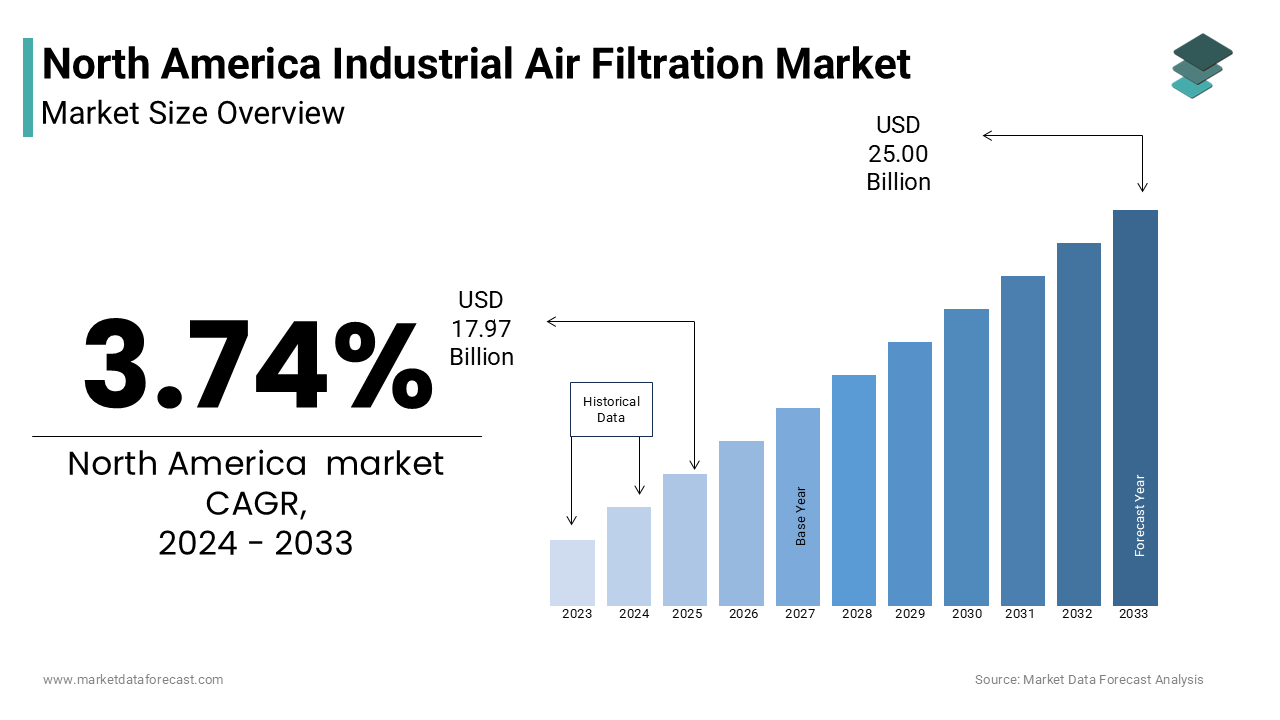
The North America industrial air filtration market is projected to grow from USD 17.97 billion in 2024 to USD 25.00 billion by 2033, at a CAGR of 3.74%.
The Industrial air filtration are important for maintaining regulatory compliance, protecting worker health, and ensuring operational efficiency across sectors such as manufacturing, energy, pharmaceuticals, food processing, and chemical production. According to the American Industrial Hygiene Association (AIHA), air quality in industrial environments has become a central concern due to increasing awareness of occupational respiratory diseases and stricter emissions regulations. The U.S. Environmental Protection Agency (EPA) enforces stringent air pollution control standards under the Clean Air Act, compelling industries to adopt high-efficiency filtration systems to minimize harmful emissions. In Canada, the adoption of advanced air filtration technologies is being driven by growing investments in clean manufacturing and environmental sustainability initiatives. Mexico’s market is also gaining traction, particularly in automotive and electronics manufacturing zones where cleanroom standards require sophisticated air purification.
MARKET DRIVERS
Stricter Environmental Regulations and Emission Control Standards
One of the key drivers of the North America industrial air filtration market is the implementation of stringent environmental regulations aimed at reducing industrial emissions and improving air quality. In the United States, the Clean Air Act serves as the foundation for national air quality policies, mandating industries to install and maintain efficient air filtration systems to curb pollutants such as PM2.5, NOx, SO2, and volatile organic compounds (VOCs). According to the Environmental Protection Agency (EPA), non-compliance with these standards can result in penalties exceeding USD 100,000 per violation, incentivizing companies to invest in high-performance filtration equipment. Additionally, agencies such as the Occupational Safety and Health Administration (OSHA) enforce workplace safety guidelines that necessitate effective ventilation and air cleaning mechanisms to protect workers from exposure to harmful airborne particles. Furthermore, Canadian provinces like Ontario and Alberta have introduced emission reduction targets aligned with federal climate goals, pushing manufacturers to upgrade their air handling systems.
Expansion of Energy and Manufacturing Sectors Driving Demand
Another significant driver of the North America industrial air filtration market is the expansion of the energy and manufacturing sectors, which rely heavily on air filtration for process efficiency, emissions control, and worker safety. In the United States, the resurgence of domestic manufacturing, supported by government incentives such as the CHIPS and Science Act, has led to increased capital investment in industrial facilities. The energy sector, particularly natural gas processing and power generation, is another major contributor. Moreover, the growth of renewable energy projects, including hydrogen production and battery manufacturing, is introducing new air purification requirements. As per Natural Resources Canada, new industrial parks focused on EV battery production mandated the use of HEPA and activated carbon filtration units to ensure cleanroom conditions, further expanding the market footprint.
MARKET RESTRAINTS
High Capital and Maintenance Costs Limiting SME Adoption
A significant restraint affecting the North America industrial air filtration market is the high initial capital expenditure and ongoing maintenance costs associated with advanced filtration systems, which often deter small and medium-sized enterprises (SMEs) from investing in optimal solutions. According to the Small Business Administration (SBA), nearly 70% of SMEs in the U.S. cited cost concerns as a primary barrier to adopting industrial air filtration technologies, despite recognizing their importance for regulatory compliance and worker safety. Beyond installation, ongoing expenses related to filter replacements, energy consumption, and system monitoring add to the financial burden. Additionally, economic volatility and fluctuating raw material prices—particularly for high-grade filter media such as PTFE-coated fibers and activated carbon—have further constrained procurement budgets.
Complexity of Compliance Across Diverse Industries
Another challenge restraining the growth of the North America industrial air filtration market is the complexity of navigating industry-specific compliance requirements and varying regional regulations. Industrial air filtration standards differ significantly across sectors such as pharmaceuticals, food processing, chemicals, and power generation, each governed by distinct regulatory frameworks. According to the International Society for Pharmaceutical Engineering (ISPE), compliance with ISO 14644-1 for cleanrooms alone requires multi-stage filtration systems, increasing both design complexity and cost. In addition, regulatory divergence between U.S. states, Canadian provinces, and Mexican jurisdictions creates uncertainty for multinational companies deploying standardized air filtration solutions across North America. Furthermore, lack of uniformity in testing and certification protocols leads to extended product validation timelines, delaying deployment in time-sensitive industrial projects.
MARKET OPPORTUNITIES
Growth in Renewable Energy and Green Manufacturing Initiatives
A major opportunity emerging in the North America industrial air filtration market is the rising adoption of filtration technologies within the renewable energy and green manufacturing sectors. As governments and corporations intensify efforts to transition toward low-carbon industrial practices, the need for advanced air purification systems has grown significantly. In particular, battery manufacturing plants for electric vehicles (EVs) and energy storage systems generate ultrafine particulates and volatile organic compounds (VOCs) that necessitate high-efficiency particulate air (HEPA) and activated carbon filtration systems. Additionally, green building certifications such as LEED and WELL are encouraging the use of advanced industrial ventilation and filtration systems in manufacturing and warehouse environments, which is promoting healthier indoor air quality while aligning with corporate sustainability goals.
Increasing Focus on Indoor Air Quality in Industrial Workplaces
Another promising avenue for growth in the North America industrial air filtration market is the heightened focus on indoor air quality (IAQ) in industrial workplaces, driven by worker health concerns and evolving occupational safety standards. According to the Centers for Disease Control and Prevention (CDC), occupational exposure to industrial dust, fumes, and aerosols contributes to over 15,000 cases of work-related asthma annually with the urgent need for improved air management systems. Occupational health agencies such as OSHA and NIOSH are strengthening guidelines around permissible exposure limits for airborne contaminants by prompting manufacturers to upgrade their ventilation and filtration infrastructure. As reported by the National Institute for Occupational Safety and Health (NIOSH), workplace air quality assessments conducted in 2023 revealed that nearly 45% of non-compliant facilities lacked adequate industrial air filtration systems, which is indicating substantial room for improvement. Moreover, increased awareness among employees and unions regarding respiratory health has led to greater pressure on employers to invest in cleaner working environments.
MARKET CHALLENGES
Supply Chain Disruptions and Material Shortages
A major challenge confronting the North America industrial air filtration market is the persistent supply chain disruptions and shortages of critical materials used in filter media and housing components. The global semiconductor shortage, logistical bottlenecks, and geopolitical tensions have contributed to delays in sourcing essential inputs such as synthetic fibers, resins, and specialty metals required for high-efficiency filters. Furthermore, the availability of high-quality filter media such as ePTFE, glass fiber, and electrostatic membranes has been impacted by raw material scarcity and supplier consolidation. Additionally, rising transportation costs and labor shortages at logistics hubs have compounded delivery challenges, which is affecting both OEMs and end-users. The Journal of Commerce recorded a 10-day average container dwell time at major U.S. ports during peak season in 2023 by reflecting ongoing supply chain inefficiencies.
Rapid Technological Evolution and Product Obsolescence
Another critical challenge facing the North America industrial air filtration market is the fast-paced evolution of filtration technology and the risk of product obsolescence, which is making it difficult for manufacturers to keep pace with changing performance expectations. Advances in nanofiber media, smart filtration sensors, and electrostatic precipitators are redefining efficiency benchmarks, compelling companies to continuously innovate or risk falling behind. As noted by the American Filtration & Separations Society (AFSS), the lifecycle of industrial air filtration products has shortened from five to seven years down to just three to four years due to rapid technological advancements, which is increasing R&D expenditures and capital replacement cycles for end-users. Additionally, vendors face the challenge of integrating legacy systems with newer, more intelligent filtration platforms, particularly in aging industrial facilities. Companies must balance innovation with backward compatibility and cost-effectiveness, adding layers of difficulty to market expansion and product adoption strategies.
SEGMENTAL ANALYSIS
By Type Insights
The air and gas filtration segment was accounted in holding a prominent share of the North America industrial air filtration market in 2024 with the air filtration in maintaining clean environments across manufacturing, energy production, pharmaceuticals, and food processing industries. A key driver behind this segment’s dominance is the stringent regulatory environment governing workplace air quality and emissions standards. The U.S. Environmental Protection Agency (EPA) enforces strict limits on industrial pollutants under the Clean Air Act, compelling manufacturers to invest in high-efficiency particulate and gas removal systems. Additionally, the rapid expansion of advanced manufacturing sectors such as semiconductors, EV battery production, and hydrogen energy has further boosted demand for precision air filtration systems.
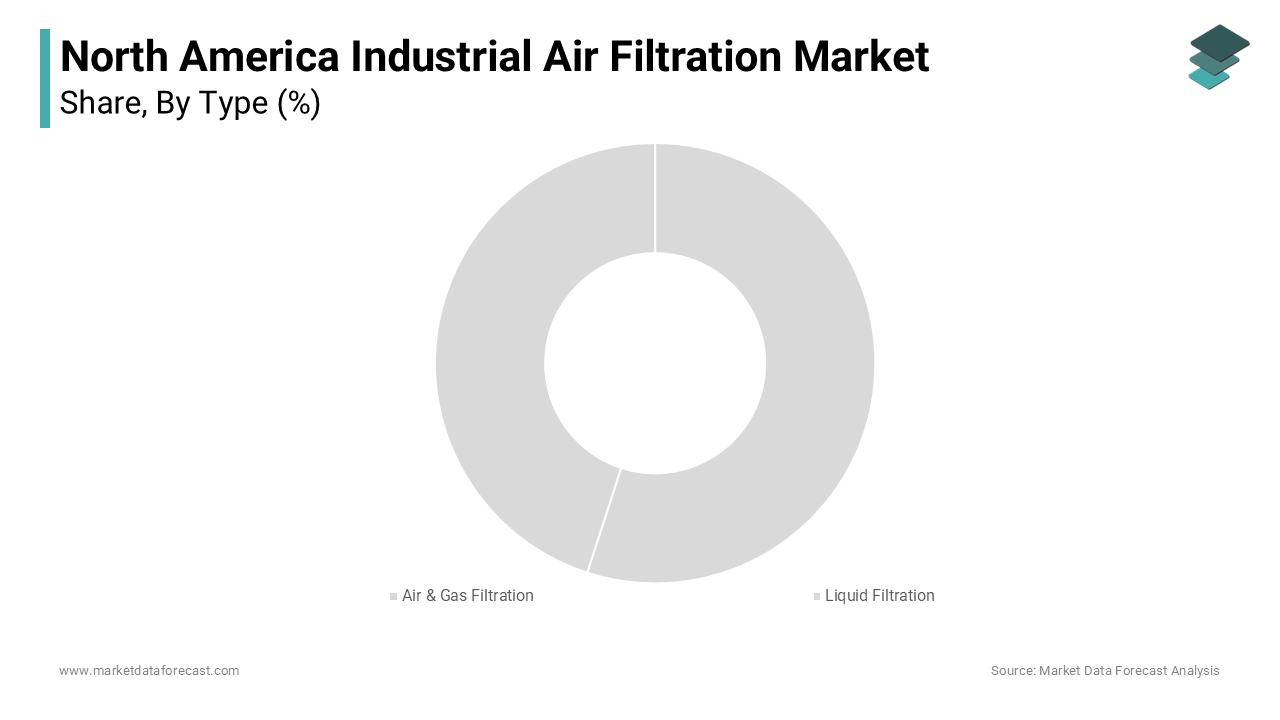
The liquid filtration segment is likely to grow with an estimated CAGR of 7.2% in the next coming years. One major growth enabler is the rising emphasis on sustainable water management in energy-intensive sectors such as oil refining, power generation, and food processing, where water-based contaminants must be effectively removed to prevent equipment corrosion and contamination risks. Moreover, the adoption of membrane-based and ultrafiltration systems in biopharmaceutical and semiconductor manufacturing has driven innovation and investment in hybrid filtration technologies.
By Filter Media Insights
The nonwovens filter media segment dominated the North America industrial air filtration market by capturing 35.3% of share in 2024. A primary factor driving this segment’s dominance is the increasing use of spunbond and meltblown nonwovens in HEPA and ULPA filters, particularly in cleanrooms and controlled environments. As reported by the International Society for Pharmaceutical Engineering (ISPE), over 60% of pharmaceutical and semiconductor cleanrooms in North America utilized nonwoven-based filters to achieve ISO Class 5 or higher air purity levels. Furthermore, nonwovens offer superior particle retention, low pressure drop, and compatibility with electrostatic enhancement techniques by making them ideal for both disposable and semi-permanent filtration applications.
The activated carbon and charcoal filter media segment is projected to expand with a CAGR of 8.1% in the next coming years. This rapid ascent is driven by the rising demand for volatile organic compound (VOC) removal, odor control, and hazardous gas abatement in industrial settings such as chemical processing, automotive painting, and waste treatment facilities. According to the American Chemistry Council (ACC), VOC emissions from industrial sources remained a key focus of regulatory enforcement in 2023, prompting companies to adopt activated carbon-based filtration solutions. Also, the expansion of battery manufacturing and hydrogen production facilities are prompting the growth of the segment. Additionally, government-backed indoor air quality programs and LEED-certified building standards are encouraging the integration of activated carbon filters in commercial and industrial HVAC systems.
By Application Insights
The power generation application segment held 28.3% of the North America industrial air filtration market share in 2024. A major growth driver is the modernization of aging power infrastructure, particularly in the United States, where coal-fired plants are transitioning to combined cycle gas turbines that rely extensively on high-efficiency air filtration to protect downstream components. sMoreover, the rise of hydrogen-fueled power projects and green ammonia initiatives has introduced new air purification requirements, including molecular filtration for trace contaminants. According to the National Renewable Energy Laboratory (NREL), new hydrogen power pilot plants in California and Texas integrated advanced activated carbon and HEPA filtration units in 2023 by ensuring optimal combustion efficiency and emissions compliance, which is further strengthening the power generation sector's position as the largest market application.
The semiconductors and electronics application segment is likely to witness a CAGR of 8.9% during the forecast period. The growth of the segment can be attributed by the surge in domestic semiconductor manufacturing investments following the passage of the CHIPS and Science Act, which allocated USD 52 billion in federal funding to revitalize the U.S. microelectronics industry. According to the Semiconductor Industry Association (SIA), North America’s semiconductor fabrication capacity is expected to grow by 34% by 2027, which is ultra-clean environments supported by HEPA and ULPA filtration systems. Additionally, the expansion of electric vehicle battery production facilities, which also operate under clean manufacturing conditions, has further boosted demand for industrial air filtration in the electronics sector.
REGIONAL ANALYSIS
United States Industrial Air Filtration Market Insights
The United States was the top performer in the North America industrial air filtration market with 76.3% of share in 2024 with a robust industrial base, stringent environmental regulations, and widespread investments in clean manufacturing and energy transition projects. According to the U.S. Environmental Protection Agency (EPA), over 15,000 industrial facilities nationwide were subject to updated air pollution control mandates in 2023, necessitating upgrades in filtration and ventilation infrastructure. Additionally, the implementation of the Inflation Reduction Act (IRA) and CHIPS Act has accelerated capital expenditures in clean technology and semiconductor fabrication, introducing new air purification challenges. As per the National Institute of Standards and Technology (NIST), over 40% of new cleanroom installations in 2023 included customized multi-stage filtration systems that boosts the U.S.’s dominance in industrial air filtration adoption and innovation.
Canada Industrial Air Filtration Market Insights
Canada was ranked second by holding a 13.3% of share in 2024. The country’s industrial air filtration market is characterized by steady growth, driven by government-led clean manufacturing policies, increasing foreign direct investment in battery and EV production, and rising awareness around occupational health and safety. According to Natural Resources Canada, industrial emissions reduction targets have prompted over 60% of surveyed firms to upgrade their air purification systems between 2021 and 2023 by aligning with national climate commitments. Moreover, provincial governments have introduced tax incentives and subsidies for companies adopting energy-efficient ventilation and filtration systems, encouraging small and mid-sized enterprises to modernize their air handling infrastructure. According to the Canadian Centre for Occupational Health and Safety (CCOHS), workplace air quality violations declined by 12% in 2023 by indicating stronger compliance and greater adoption of industrial air filtration technologies across key sectors.
KEY MARKET PLAYERS AND COMPETITIVE LANDSCAPE
Donaldson Company, Parker Hannifin, Camfil, AAF International (Daikin), Filtration Group, Clarcor Inc., Absolent Group, Nederman Holding AB, and 3M are some of the key market players.
The competition in the North America industrial air filtration market is marked by a blend of global leaders, specialized manufacturers, and regional suppliers vying for dominance across diverse industrial sectors. The market is highly fragmented, with players competing not only on product performance but also on customization capabilities, service offerings, and sustainability credentials. As industries increasingly prioritize worker health, regulatory compliance, and clean production standards, demand for high-efficiency filtration systems continues to rise, which is intensifying competition among vendors.
Innovation remains a central battleground, with companies investing heavily in new materials, smart filtration sensors, and modular designs that can be easily integrated into legacy systems. Strategic mergers and acquisitions have also become more frequent by allowing firms to consolidate their technological strengths and expand into niche application areas such as hydrogen processing and EV battery manufacturing.
Customer-centric approaches such as tailored filtration solutions, comprehensive after-sales service, and real-time monitoring are becoming key differentiators. In this dynamic landscape, success depends on a company’s ability to anticipate industry trends, respond swiftly to regulatory changes, and deliver scalable, high.
Top Players in the North America Industrial Air Filtration Market
One of the leading players in the North America industrial air filtration market is Donaldson Company, Inc., a global manufacturer known for its high-efficiency filtration solutions tailored for industrial and commercial applications. The company offers a broad portfolio of dust collectors, gas turbine intake systems, and cleanroom filters, which serve industries ranging from power generation to pharmaceuticals. Donaldson’s focus on innovation and sustainable product development has made it a trusted name across international markets.
Another key player is Pall Corporation, a division of Danaher Corporation, which specializes in advanced filtration technologies for critical industrial processes. Pall's expertise in membrane-based air and gas filtration has positioned it as a leader in high-purity sectors such as semiconductor manufacturing, biotechnology, and life sciences. Its integration with digital monitoring platforms enhances system performance and reliability.
Camfil AB is also a major participant in the regional market, recognized for its commitment to energy-efficient and low-pressure-drop air filtration systems. Camfil plays a crucial role in promoting indoor air quality and emissions reduction across North American facilities with a strong presence in HVAC, cleanrooms, and industrial ventilation.
Top Strategies Used by Key Market Participants
Key players in the North America industrial air filtration market are leveraging technological innovation and product differentiation to maintain a competitive advantage. Companies are investing heavily in R&D to develop next-generation filter media that offer higher efficiency, longer service life, and reduced environmental impact in clean manufacturing and healthcare applications.
Another major strategy involves expanding service networks and offering lifecycle support programs, including predictive maintenance, remote diagnostics, and filter performance analytics. These services help customers reduce downtime, optimize operational costs, and comply with evolving regulatory standards by enhancing customer retention and brand loyalty.
Additionally, firms are focusing on strategic partnerships and acquisitions to broaden their geographical reach and diversify product portfolios. Companies are strengthening their ability to deliver customized, end-to-end air filtration solutions tailored to industry-specific needs by aligning with local distributors, technology providers, and complementary filtration specialists.
RECENT MARKET DEVELOPMENTS
- In January 2024, Donaldson launched a new line of ultra-low particulate emission filters designed specifically for natural gas turbines, which is aiming to enhance performance and compliance for power generation clients across North America.
- In March 2024, Pall Corporation expanded its manufacturing footprint in Texas with a new facility dedicated to producing high-efficiency HEPA and ULPA filters by supporting growing demand from semiconductor and pharmaceutical clients requiring precision air purification.
- In May 2024, Camfil introduced an AI-powered air filtration monitoring platform by enables industrial users to track filter efficiency, predict maintenance intervals, and improve energy consumption through real-time data analytics.
- In July 2024, a leading European filtration firm acquired a Canadian distributor specializing in industrial HVAC filtration, which is strengthening its regional supply chain and expanding access to cleanroom and food processing sector clients.
- In September 2024, Donaldson partnered with a U.S.-based battery manufacturing plant to co-develop custom filtration systems targeting solvent vapor capture during electrode coating processes by reinforcing its strategic position in the fast-growing EV battery industry.
MARKET SEGMENTATION
This research report on the North America industrial air filtration market is segmented and sub-segmented into the following categories.
By Type
- Air & Gas Filtration
- Liquid Filtration
By Filter Media
- Activated Carbon/Charcoal
- Fiberglass
- Nonwovens
- Metals
- Filterpaper
- Combination Filters & Others
By Application
- Food & Beverage
- Power Generation
- Semiconductors & Electronics
- Chemicals & Petrochemicals
- Healthcare
- Metals & Mining
- Paper & Paints
- Others
Frequently Asked Questions
What factors are driving the growth of the North America Industrial Air Filtration Market?
The market is driven by rising environmental regulations on industrial emissions, increasing awareness about workplace safety and employee health, rapid industrialization, and technological advancements in filtration systems.
Which industries are the primary users of industrial air filtration systems in North America?
Key industries include manufacturing, food & beverage, pharmaceuticals, automotive, power generation, metals & mining, and chemical processing.
Which countries contribute most to the North America Industrial Air Filtration Market?
The United States is the leading market, followed by Canada and Mexico, owing to their large industrial base and stringent air quality standards.
What is the market outlook for the next five years?
The North America Industrial Air Filtration Market is expected to grow steadily, supported by stricter environmental laws, modernization of industrial facilities, and the need for sustainable manufacturing practices.
Related Reports
Access the study in MULTIPLE FORMATS
Purchase options starting from
$ 2000
Didn’t find what you’re looking for?
TALK TO OUR ANALYST TEAM
Need something within your budget?
NO WORRIES! WE GOT YOU COVERED!
Call us on: +1 888 702 9696 (U.S Toll Free)
Write to us: sales@marketdataforecast.com