- Product Description Description
- Table of Contents TOC
- List of Table & Figure LOT
- Get Free Sample PDF Sample PDF
Market Size, 2025
$0.95 BnMarket Estimate, 2026
$1.53 BnMarket Forecast, 2034
$69.47 BnCAGR, 2026–2034
61.11%North America Li-Fi Market Size
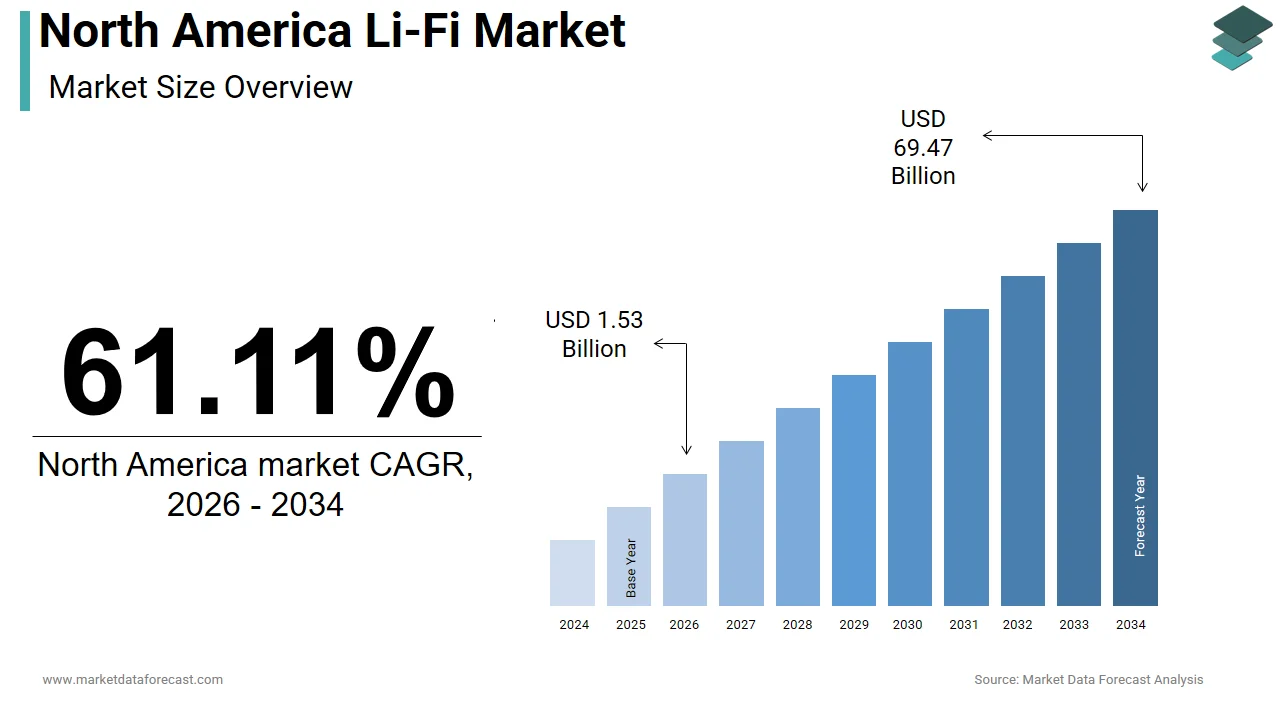
The North America Li-Fi market was valued at USD 0.95 billion in 2025, is estimated to reach USD 1.53 billion in 2026, and is projected to reach USD 69.47 billion by 2034, growing at a CAGR of 61.11% from 2026 to 2034.
Li-Fi is the adoption and deployment of Light Fidelity technology, a high-speed wireless communication system that uses LED light waves for data transmission. Unlike traditional Wi-Fi, which relies on radio frequency signals, Li-Fi leverages visible light to enable faster, more secure, and interference-free connectivity. This technology is gaining relevance in environments where electromagnetic interference is a concern, such as hospitals, aircraft cabins, and industrial facilities. As per the U.S. Department of Commerce, the demand for ultra-secure and high-density network solutions has led to increased exploration of alternative connectivity models like Li-Fi.
In recent years, research institutions and tech firms across the U.S. and Canada have been investing in pilot projects to integrate Li-Fi into smart buildings, defense applications, and Internet of Things (IoT) ecosystems. The National Institute of Standards and Technology (NIST) has emphasized the potential of Li-Fi to complement existing networks by providing localized, high-bandwidth access without spectrum congestion. Additionally, the rise in smart infrastructure investments, especially in urban centers like New York, Toronto, and San Jose, is fostering an environment conducive to Li-Fi experimentation and early-stage commercialization.
MARKET DRIVERS
Rising Demand for Secure and High-Speed Connectivity in Sensitive Environments
The increasing need for secure and high-speed connectivity in sensitive environments such as healthcare facilities, defense installations, and financial institutions is driving the growth of the North America Li-Fi market. Traditional Wi-Fi networks are susceptible to eavesdropping and interference, making them unsuitable for settings where data integrity and security are paramount. According to the National Institute of Standards and Technology (NIST), Li-Fi offers a fundamentally secure communication medium because light cannot penetrate walls, limiting unauthorized access to transmitted data. Hospitals are particularly exploring Li-Fi for real-time patient monitoring and surgical robotics, where electromagnetic interference from Wi-Fi can disrupt equipment. For example, Boston Children’s Hospital has collaborated with optical networking researchers to test Li-Fi-enabled operating rooms that support high-definition video streaming without compromising device safety. Additionally, financial institutions in cities like New York and Chicago are piloting Li-Fi systems to protect trading floor communications from external breaches.
Expansion of Smart Infrastructure and IoT Ecosystems
The rapid expansion of smart infrastructure and the proliferation of connected devices within the Internet of Things (IoT) ecosystem is amplifying the growth of the North America Li-Fi market. As cities and enterprises deploy intelligent lighting, surveillance systems, and building automation technologies, the need for dense, low-latency, and energy-efficient communication networks has intensified. According to the U.S. Department of Energy, over 80% of new commercial buildings constructed in the U.S. now incorporate smart lighting systems, creating a ready-made platform for Li-Fi integration. Smart cities such as Toronto, Los Angeles, and Austin are leveraging Li-Fi to enhance municipal connectivity by embedding it into streetlights and public transport hubs. These deployments allow for seamless data exchange between vehicles, traffic management systems, and emergency response units without relying on congested radio frequency spectrums. Furthermore, companies like Acuity Brands and General Electric have introduced hybrid lighting fixtures that combine energy-efficient LEDs with embedded Li-Fi transceivers.
MARKET RESTRAINTS
Limited Range and Line-of-Sight Dependency
The inherent limitation of its operational range and dependency on line-of-sight transmission is hampering the growth of the North America Li-Fi market. Unlike Wi-Fi, which can transmit signals through walls and over longer distances, Li-Fi requires direct exposure to light sources for data transmission, restricting its usability in multi-room or obstructed environments. According to the University of California, Santa Barbara, signal degradation occurs rapidly when objects block the path between the transmitter and receiver, making continuous connectivity challenging in dynamic indoor and outdoor settings. Moreover, ambient lighting conditions and sunlight interference further complicate the reliability of Li-Fi in open spaces. As reported by the IEEE Photonics Society, variations in natural light intensity can cause fluctuations in data transmission rates, limiting the feasibility of outdoor Li-Fi networks.
High Implementation Costs and Lack of Standardization
The relatively high implementation costs and the absence of universally accepted industry standards is limiting the growth of the North America Li-Fi market. Deploying a Li-Fi network requires specialized hardware, including modified LED bulbs, photodetectors, and compatible receiving devices, all of which contribute to elevated setup expenses. According to McKinsey & Company, integrating Li-Fi into existing infrastructures often necessitates retrofitting lighting systems and upgrading end-user devices, which is making it financially unviable for many small and mid-sized organizations. The lack of standardized protocols further complicates market expansion. Unlike Wi-Fi, which operates under globally recognized IEEE 802.11 standards, Li-Fi lacks a unified framework for interoperability across different manufacturers and applications. Additionally, regulatory bodies in North America have yet to establish clear guidelines for spectrum allocation and licensing for optical communication, creating uncertainty for investors and developers.
MARKET OPPORTUNITIES
Integration with Autonomous Vehicles and Transportation Systems
The integration with autonomous vehicles and intelligent transportation systems is likely to promote new opportunities for the growth of the North America Li-Fi market. The demand for ultra-low latency and high-capacity communication networks is driving the growth of the market. According to the Intelligent Transportation Society of America, vehicle-to-infrastructure (V2I) and vehicle-to-vehicle (V2V) communication must operate seamlessly to ensure real-time decision-making and passenger safety. Li-Fi presents a compelling solution by enabling high-speed data transfer through vehicle headlights and taillights. This allows cars to communicate with traffic signals, road signs, and other vehicles using light-based signals, reducing reliance on congested radio frequencies. Companies like Ford and General Motors have already begun testing Li-Fi-enabled vehicle prototypes that use front and rear lights for real-time navigation updates and collision avoidance alerts. Moreover, transit agencies in cities such as Toronto and San Francisco are exploring Li-Fi for bus and subway cabin connectivity by enhancing onboard services while maintaining secure data transmission. As per the U.S. Department of Transportation, deploying Li-Fi in transportation hubs could significantly improve passenger experience and system efficiency.
Adoption in Aerospace and Defense Communication Networks
The growing adoption within aerospace and defense communication networks is also to fuel the growth of the North America Li-Fi market. Aircraft manufacturers such as Boeing and Lockheed Martin are actively exploring Li-Fi for in-flight entertainment, cockpit data transmission, and maintenance diagnostics. Airlines can eliminate electromagnetic interference issues associated with conventional Wi-Fi by improving both performance and safety. Similarly, defense contractors are developing Li-Fi-equipped submarines and command centers where secure, short-range data exchange is crucial. Additionally, NASA has expressed interest in Li-Fi for space missions due to its ability to provide high-speed data links without signal interference. As per the Optical Society of America, space agencies are evaluating Li-Fi for satellite-to-ground communication and intra-spacecraft networking.
MARKET CHALLENGES
Consumer Awareness and Acceptance Barriers
The limited awareness and acceptance among end-users is ascribed to limit the growth of the North America Li-Fi market. Despite its technical advantages, many consumers and businesses remain unfamiliar with Li-Fi and its practical applications. According to a survey conducted by Pew Research Center, less than 20% of U.S. consumers have heard of Li-Fi, and even fewer understand how it functions compared to traditional wireless technologies like Wi-Fi and Bluetooth. This knowledge gap results in hesitation among potential adopters in residential and small business markets. Consumers accustomed to the convenience of Wi-Fi find it difficult to envision a scenario where connectivity depends on lighting conditions and physical positioning. Educational campaigns and demonstration projects have been slow to materialize, which is limiting opportunities for hands-on user engagement.
Competition from Established Wireless Technologies
Intense competition from well-established wireless technologies is hampering the growth of the North America Li-Fi market. Wi-Fi, 5G, and Bluetooth dominate the current connectivity landscape, benefiting from mature infrastructure, widespread compatibility, and continuous technological advancements. Its inability to replace existing wireless systems outright hampers adoption despite Li-Fi’s superior speed and security. Many organizations prefer incremental upgrades to their current networks rather than complete overhauls involving new hardware and training. Furthermore, the rollout of Wi-Fi 6E and 5G Ultra-Wideband has extended the capabilities of traditional wireless technologies by offering enhanced speeds and lower latency without requiring line-of-sight connectivity.
REPORT COVERAGE
| REPORT METRIC | DETAILS |
| Market Size Available | 2025 to 2034 |
| Base Year | 2025 |
| Forecast Period | 2026 to 2034 |
| Segments Covered | By End-User Industry and Region. |
| Various Analyses Covered | Global, Regional and Country-Level Analysis, Segment-Level Analysis, Drivers, Restraints, Opportunities, Challenges; PESTLE Analysis; Porter’s Five Forces Analysis, Competitive Landscape, Analyst Overview of Investment Opportunities |
| Countries Covered | United States, Canada, Mexico, Rest of North America |
| Market Leaders Profiled | Signify Holding BV, Panasonic Corporation, VLC Technologies, Purelifi Ltd, LVX System, Oledcomm SAS, OSRAM Licht AG, and others. |
SEGMENTAL ANALYSIS
By End-User Industry Insights
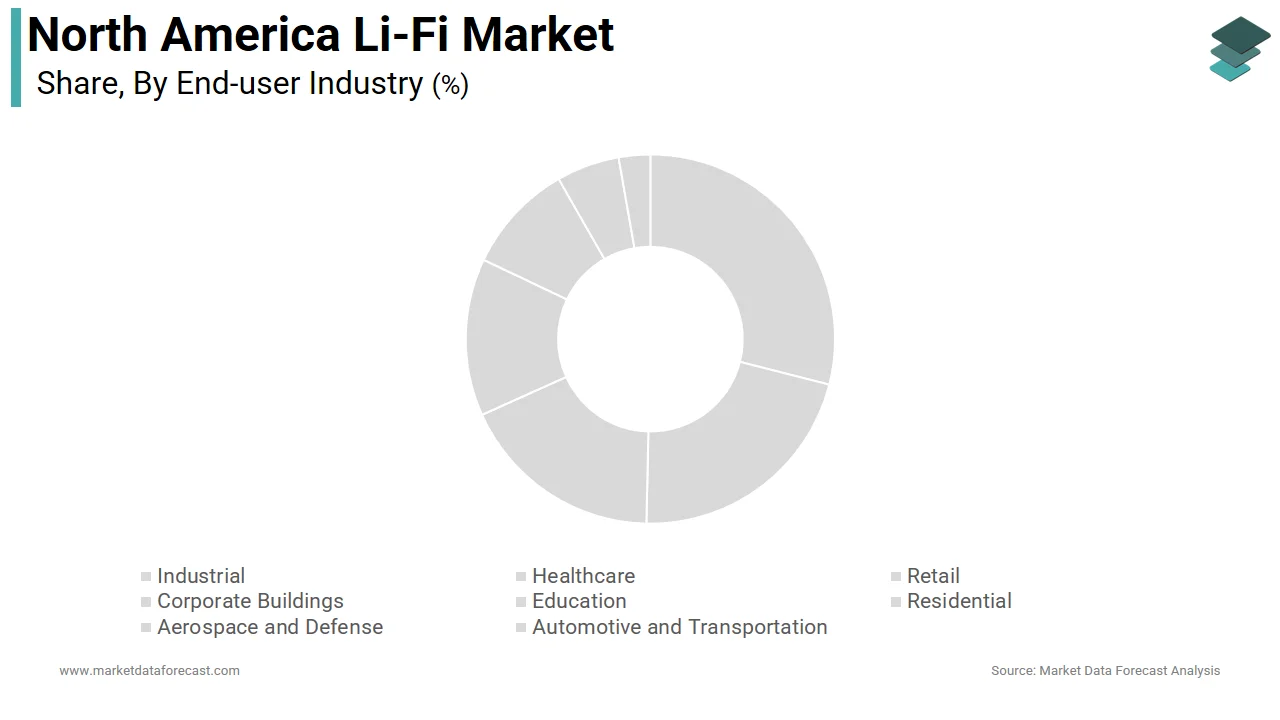
The healthcare sector was the largest in the North America Li-Fi market by accounting for 28.3% of the share in 2024, with the increasing integration of real-time medical devices that require high-speed, low-latency connectivity without disrupting other electronic equipment. According to the U.S. Food and Drug Administration (FDA), electromagnetic interference from Wi-Fi signals can impair the performance of life-support systems and imaging devices. Li-Fi offers a safer alternative by using LED lighting for data transmission, eliminating radio frequency disruptions. Additionally, hospitals are adopting Li-Fi for patient monitoring and telemedicine applications. For example, Boston Medical Center has piloted Li-Fi-enabled surgical suites to stream high-definition video during procedures without compromising device safety. The Canadian Agency for Drugs and Technologies in Health also supports the exploration of optical wireless networks to enhance hospital cybersecurity and reduce data breach risks.
The aerospace and defense sector is emerging with a CAGR of 35.3% throughout the forecast period.
The strategic shift toward optical communication to replace traditional RF-based networks in defense operations is escalating the growth of the segment. As per the U.S. Department of Defense, radio frequency spectrum congestion and susceptibility to cyberattacks have prompted agencies to explore alternatives like Li-Fi for mission-critical transmissions. Lockheed Martin and Boeing are actively developing Li-Fi-integrated cockpits that use cabin lighting for secure data exchange between pilots, ground control, and onboard systems. Furthermore, NASA and the Canadian Space Agency are evaluating Li-Fi for satellite communications due to its potential to deliver gigabit-per-second data rates without signal interference. In military settings, armored vehicles and naval vessels are being retrofitted with Li-Fi transceivers to maintain encrypted internal communication without emitting detectable signals.
COUNTRY-LEVEL ANALYSIS
United States Li-Fi Market Insights
The United States was the top performer in the North America Li-Fi market with 70.3% of share in 2024, with the strong presence of tech innovators and academic institutions advancing optical wireless communication. Universities like MIT and Stanford are conducting extensive R&D on Li-Fi modulation techniques, while companies such as General Electric and Acuity Brands are integrating Li-Fi into intelligent lighting systems for enterprise applications. Additionally, federal funding initiatives, including grants from the National Science Foundation (NSF), support pilot deployments in government facilities and airports. Moreover, the expansion of 5G and IoT ecosystems has created demand for complementary high-capacity networks, encouraging enterprises to adopt hybrid connectivity models that include Li-Fi.
Canada Li-Fi Market Insights
Canada Li-Fi market held 20.3% of the share in 2024, with the growing emphasis on secure and energy-efficient communication solutions. Canadian hospitals, including those in Toronto and Montreal, are testing Li-Fi for secure data transfer in radiology departments and surgical theaters. According to the Canadian Institute for Health Information, these implementations help mitigate electromagnetic interference with medical equipment, enhancing operational efficiency. Additionally, urban development projects in cities like Vancouver and Calgary are incorporating Li-Fi-enabled streetlights and municipal hubs to improve connectivity in public spaces. According to Natural Resources Canada, the integration of Li-Fi into smart lighting systems aligns with national sustainability goals by reducing energy consumption and supporting connected infrastructure.
COMPETITIVE LANDSCAPE
The competition in the North America Li-Fi market is characterized by a mix of emerging startups and established technology and lighting firms striving to capture early-mover advantage in a nascent but rapidly evolving sector. Traditional Wi-Fi providers and semiconductor companies are also entering the space, either through direct investment or strategic acquisitions, intensifying rivalry. PureLiFi remains at the forefront due to its strong intellectual property portfolio and extensive product development experience, while VLC Technologies leverages its deep ties with defense agencies to maintain a unique position in secure communication applications.
Meanwhile, lighting giants like OSRAM and Acuity Brands are integrating Li-Fi into their smart infrastructure offerings, aiming to differentiate themselves in the competitive smart buildings market. Startups and academic spin-offs are also gaining traction by developing specialized components and software enhancements that improve performance and usability. Despite the growing number of participants, market penetration remains limited due to technological constraints and consumer awareness challenges. However, increasing interest from enterprise and government sectors is driving innovation and prompting companies to refine their strategies to scale effectively in this high-potential domain.
KEY MARKET PLAYERS
Noteworthy Companies dominating the North America Li-Fi market profiled in the report are
- Signify Holding BV
- Panasonic Corporation
- VLC Technologies
- Purelifi Ltd
- LVX System
- Oledcomm SAS
- OSRAM Licht AG
TOP LEADING PLAYERS IN THE MARKET
- Headquartered in the U.S., pureLiFi is a pioneer in Li-Fi technology and plays a leading role in shaping the North American market. The company develops high-speed, secure wireless communication solutions using LED lighting, catering to enterprise, healthcare, and defense sectors. pureLiFi has been instrumental in demonstrating the commercial viability of Li-Fi through partnerships with major lighting and tech firms. Its collaboration with Cisco and Acuity Brands has accelerated the integration of Li-Fi into smart buildings and IoT ecosystems across North America.
- VLC Technologies is a key player advancing Li-Fi adoption in the U.S. government and defense sectors. The company specializes in secure optical communication systems for military applications where radio frequency interference and cyber threats are concerns. VLC has worked closely with U.S. defense agencies on experimental deployments of Li-Fi for secure data transmission in command centers and aircraft cabins, positioning itself as a strategic partner in mission-critical connectivity solutions.
- OSRAM’s North American division contributes significantly to the Li-Fi ecosystem by embedding connectivity features into its intelligent lighting products. The company collaborates with technology partners to integrate Li-Fi transceivers into commercial lighting fixtures, enabling seamless data transmission in office environments and industrial settings. OSRAM’s focus on smart infrastructure and energy-efficient lighting makes it a vital enabler of Li-Fi adoption in the region's evolving digital landscape.
TOP STRATEGIES USED BY KEY MARKET PARTICIPANTS
Strategic Partnerships with Lighting and IT Infrastructure Providers Leading companies are forging alliances with established lighting manufacturers and IT infrastructure vendors to embed Li-Fi capabilities into mainstream products. These collaborations enable seamless integration of Li-Fi into existing smart building systems by enhancing adoption in commercial and institutional environments.
Product Innovation through R&D Collaborations Major players are investing heavily in research and development by partnering with universities and research institutions to advance modulation techniques, increase data transmission speeds, and improve signal reliability. These innovations aim to overcome current technical limitations and expand the applicability of Li-Fi in diverse industries.
Targeted Deployment in High-Security Sectors to establish early-market dominance, companies are focusing on niche verticals such as defense, aerospace, and healthcare where Li-Fi’s inherent security advantages offer compelling value. Vendors are building credibility and paving the way for broader commercial expansion across North America by demonstrating real-world use cases in these sectors.
RECENT MARKET DEVELOPMENTS
- In January 2024, pureLiFi announced a strategic partnership with Cisco to integrate its Li-Fi modules into Cisco’s networking hardware by enabling seamless deployment of light-based connectivity in corporate offices and data centers across North America.
- In March 2024, VLC Technologies received a contract from the U.S. Air Force to test Li-Fi systems in aircraft cockpits, which is aiming to enhance onboard data security and reduce electromagnetic interference in next-generation military aviation platforms.
- In June 2024, OSRAM North America launched a pilot program with several Fortune 500 companies to deploy Li-Fi-enabled lighting systems in their headquarters by offering employees high-speed, secure internet access without relying on traditional Wi-Fi networks.
- In August 2024, Acuity Brands introduced a new line of smart luminaires embedded with Li-Fi transceivers by targeting large-scale commercial and educational facilities seeking enhanced connectivity options within energy-efficient lighting infrastructures.
- In October 2024, General Electric collaborated with Boston Medical Center to implement a Li-Fi-based patient monitoring system in operating rooms by ensuring uninterrupted and secure transmission of high-definition surgical video feeds without disrupting medical equipment.
MARKET SEGMENTATION
This North America Li-Fi market research report is segmented and sub-segmented into the following categories.
By End-user Industry
- Industrial
- Healthcare
- Retail
- Corporate Buildings
- Education
- Residential
- Aerospace and Defense
- Automotive and Transportation
- Other End-user Industries (Hospitality, Disaster Management, and Others)
By Country
- United States
- Canada
- Mexico
- Rest of North America