- Product Description Description
- Table of Contents TOC
- List of Table & Figure LOT
- Get Free Sample PDF Sample PDF
Market Size, 2025
$4.49 BnMarket Estimate, 2026
$5.39 BnMarket Forecast, 2034
$23.32 BnCAGR, 2026–2034
20.09%North America Lithium Compound Market Size
The North America Lithium Compound Market Size was calculated to be USD 4.49 billion in 2025 and is anticipated to be worth USD 23.32 billion by 2034, from USD 5.39 billion in 2026, growing at a CAGR of 20.09% during the forecast period.
The lithium compound is an inorganic chemical product derived from lithium, including lithium carbonate, lithium hydroxide, lithium chloride, and butyllithium. These compounds serve as foundational materials for various high-growth industries such as electric vehicle (EV) battery manufacturing, energy storage systems, glass and ceramics production, pharmaceuticals, and industrial lubricants. As per the U.S. Geological Survey (USGS), lithium production in the United States reached approximately 1,000 metric tons in 2023, with Nevada being a key extraction hub. Canada has also emerged as a significant player, with Quebec leading in lithium exploration and mining investments. According to Natural Resources Canada, the country’s lithium reserves have grown substantially, supporting its ambition to become a critical supplier in the North American supply chain.
MARKET DRIVERS
Expansion of Electric Vehicle Manufacturing Capacity in North America
The rapid expansion of electric vehicle (EV) manufacturing capacity is a major factor that is driving the growth of the North American lithium compound market. In 2023, U.S. EV sales exceeded 1.2 million units, marking a year-over-year increase of over 40%, according to data from the Edison Electric Institute. These investments directly translate into heightened demand for lithium carbonate and lithium hydroxide, which are essential precursors for producing nickel-manganese-cobalt (NMC) and lithium iron phosphate (LFP) cathodes. For instance, Tesla’s Gigafactory Texas alone requires an estimated 20,000 metric tons of lithium compounds annually. Furthermore, the U.S. Department of Energy projects that by 2030, North America will need over 600,000 metric tons of lithium carbonate equivalent (LCE) to support domestic battery manufacturing, up from just 50,000 metric tons in 2022.
Growth in Renewable Energy Storage Systems
The rapid deployment of renewable energy storage systems such as utility-scale and residential battery installations is amplifying the growth of the North America lithium compound market. The intermittent nature of these energy sources necessitates robust storage solutions to ensure grid stability and reliability with increasing penetration of solar and wind power. Lithium-ion batteries have become the preferred choice due to their high energy density, long cycle life, and declining costs. According to Wood Mackenzie, the U.S. added nearly 4.9 gigawatts (GW)/10.7 gigawatt-hours (GWh) of energy storage capacity in 2023, representing a 108% increase compared to the previous year. California, Texas, and New York led this expansion, driven by state-level mandates and incentives aimed at achieving net-zero emissions. Each gigawatt-hour of lithium-ion battery storage requires approximately 500 metric tons of lithium carbonate equivalent (LCE).
MARKET RESTRAINTS
Limited Domestic Lithium Supply and Processing Infrastructure
The limited domestic supply of lithium and insufficient processing infrastructure to convert raw ore or brine into usable compounds is greatly influencing the growth of the North America lithium compound market. According to the U.S. Geological Survey (USGS), the United States imported approximately 60% of its lithium needs in 2023, with over 40% sourced from China. Moreover, while the number of lithium extraction and refining projects has increased, commercial-scale operations remain scarce.
Additionally, converting raw lithium into battery-grade lithium hydroxide or carbonate requires advanced chemical processing plants, which are still underdeveloped in North America. As per S&P Global Commodity Insights, the region accounted for less than 5% of global lithium refining capacity in 2023.
Environmental and Regulatory Challenges in Lithium Mining Operations
Environmental concerns and stringent regulatory frameworks present another significant restraint on the growth of the North America lithium compound market. Lithium extraction processes, whether through hard rock mining or brine evaporation, often involve high water consumption, habitat disruption, and potential contamination of local ecosystems. These environmental impacts have triggered opposition from indigenous communities and environmental groups, delaying or halting several lithium projects. In the U.S., the permitting process for new lithium mines can take upwards of seven to ten years due to extensive environmental impact assessments mandated by the National Environmental Policy Act (NEPA). For instance, the proposed Thacker Pass lithium project in Nevada faced multiple legal challenges and community protests over concerns about groundwater depletion and damage to sacred Native American lands.
MARKET OPPORTUNITIES
Development of Direct Lithium Extraction (DLE) Technologies
The advancement and commercialization of Direct Lithium Extraction (DLE) technologies is also to elevate the growth of the North America lithium compound market. Unlike conventional lithium recovery methods that rely on lengthy evaporation ponds, DLE enables the selective extraction of lithium from brine using adsorbents, membranes, or solvent-based systems dramatically reducing water usage, land footprint, and production timelines. Several North American firms are pioneering DLE innovations. For example, Lilac Solutions, based in California, has developed ion-exchange technology capable of recovering over 90% of lithium from brine with minimal environmental impact. Their pilot plant in Arkansas achieved commercial readiness in 2023, producing battery-grade lithium carbonate within weeks rather than months. Moreover, the U.S. Department of Energy has allocated over $150 million in grants to support DLE research and deployment under its Earthshot Initiative. With abundant lithium-rich brines in regions such as the Smackover Formation in the southeastern U.S., DLE presents a scalable solution to unlock untapped resources.
Integration of Circular Economy Models Through Lithium Recycling
The growing emphasis on circular economy principles is a significant opportunity for the North America lithium compound market through the development of lithium battery recycling infrastructure. According to the International Energy Agency (IEA), by 2030, approximately 1.2 million metric tons of lithium-ion batteries will reach end-of-life globally, offering a vast secondary source of lithium. In North America, companies such as Li-Cycle, Redwood Materials, and Cirba Solutions have established commercial-scale recycling operations. Li-Cycle, for instance, operates a hub-and-spoke model across North America, aiming to recover over 95% of lithium from batteries. Furthermore, policy incentives under the Inflation Reduction Act (IRA) provide tax credits for domestically recycled battery materials, encouraging closed-loop supply chains. As per BloombergNEF, North America could generate over 20,000 metric tons of recycled lithium annually by 2030, meeting nearly 15% of the region’s demand.
MARKET CHALLENGES
High Capital and Operational Costs of Lithium Production Facilities
The prohibitively high capital and operational costs associated with establishing and maintaining lithium production facilities is to limit the growth of the North America lithium compound market. For example, constructing a lithium hydroxide plant typically requires an investment of over $500 million, with full commissioning taking three to five years, according to Wood Mackenzie. In contrast, expanding existing facilities in countries like China, where economies of scale and mature supply chains exist, can be done at significantly lower costs. Moreover, operational costs in North America are elevated due to stringent labor laws, environmental compliance requirements, and energy expenses.
Skilled Labor Shortage and Technological Readiness Gaps
The shortage of skilled labor and gaps in technological readiness required to support large-scale lithium extraction and processing is also to degrade the growth of the North America lithium compound market. According to a 2023 workforce analysis by the Colorado School of Mines, the U.S. mining and minerals sector will require an additional 10,000 skilled workers by 2030 to support critical mineral projects, including lithium. However, current training programs and educational pipelines are not keeping pace with this demand. The lack of specialized technical personnel hampers the timely commissioning of new lithium facilities and increases the likelihood of operational inefficiencies. Additionally, while North America hosts cutting-edge research institutions, the transfer of innovative lithium processing technologies from lab-scale to commercial deployment remains slow. Many emerging technologies, such as electrochemical extraction or membrane-based separation, are still in pilot phases and face scalability issues.
REPORT COVERAGE
| REPORT METRIC | DETAILS |
| Market Size Available | 2025 to 2034 |
| Base Year | 2025 |
| Forecast Period | 2026 to 2034 |
| CAGR | 20.09% |
| Segments Covered | By Type, End Use And Region |
| Various Analyses Covered | Global, Regional & Country Level Analysis; Segment-Level Analysis; DROC, PESTLE Analysis; Porter’s Five Forces Analysis; Competitive Landscape; Analyst Overview of Investment Opportunities |
| Regions Covered | Us, Canada, and the Rest of North America |
| Market Leaders Profiled | Albemarle Corporation, Livent Corporation, Sociedad Química y Minera de Chile S.A. (SQM), FMC Corporation, Tesla Inc., Nemaska Lithium, Lithium Americas Corp., American Battery Technology Company, Piedmont Lithium Inc., Avalon Advanced Materials Inc., Rock Tech Lithium Inc., Energy Exploration Technologies Inc. (EnergyX), Standard Lithium Ltd. |
SEGMENTAL ANALYSIS
By Type Insights
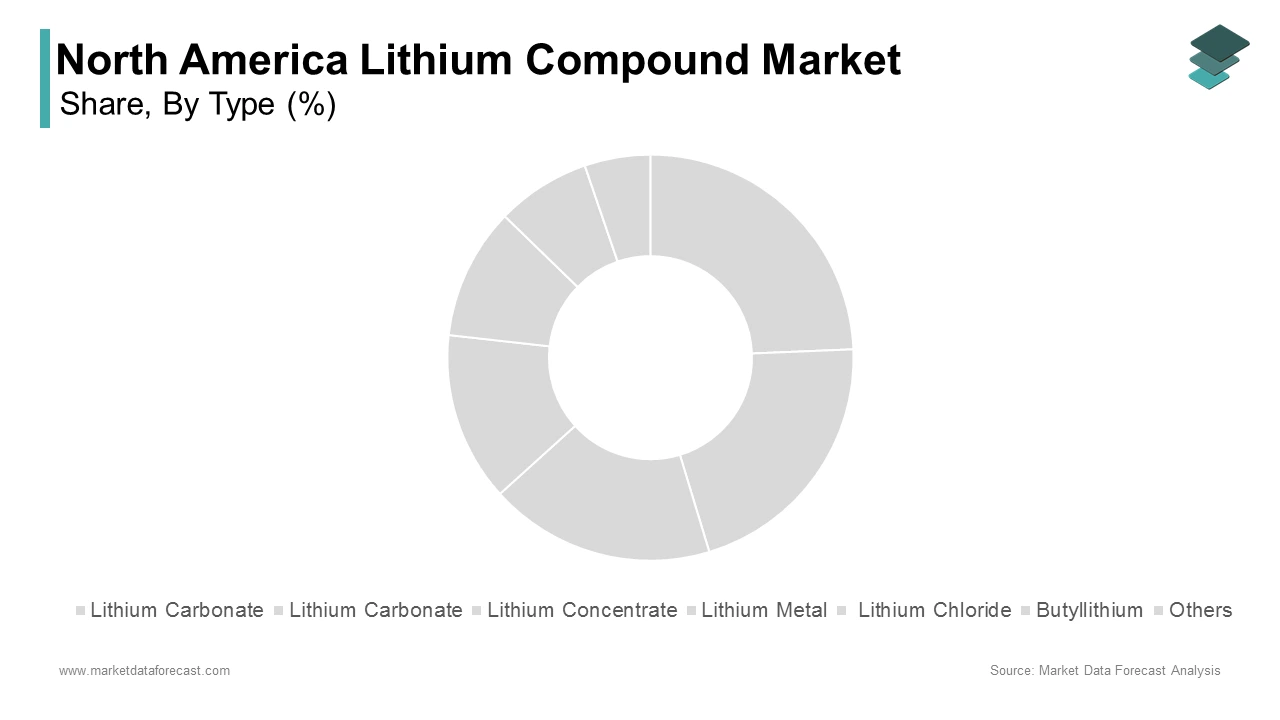
The lithium carbonate segment held 35.4% of the North America lithium compound market with 35.4% of the share in 2025. The majority of LFP (lithium iron phosphate) batteries still rely on lithium carbonate due to its thermal stability and cost-effectiveness. As per Benchmark Minerals, around 60% of North American battery manufacturers continue to utilize lithium carbonate in their formulations in stationary energy storage projects where safety and longevity are prioritized. Additionally, the glass and ceramics industry in the U.S. continues to be a strong consumer of lithium carbonate. It acts as a fluxing agent, reducing melting temperatures and improving product durability.
The lithium hydroxide segment is likely to grow with an expected CAGR of 14.2% in the next coming years. The shift toward high-energy-density batteries has been led by automakers such as Tesla, Ford, and Rivian, who are increasingly sourcing lithium hydroxide for gigafactory operations. In 2023, Tesla’s Gigafactory Nevada alone consumed over 10,000 metric tons of lithium hydroxide , with plans to double this volume by 2027. Moreover, government incentives such as the Inflation Reduction Act (IRA) have accelerated investments in lithium hydroxide refining capacity within the region. Companies like Livent and Piedmont Lithium are developing new processing facilities in North Carolina and Quebec, aiming to supply over 40,000 metric tons of battery-grade lithium hydroxide per year by 2026.
By End-Use Insights
The batteries segment dominated the North America lithium compound market by holding a dominant share in 2025 due to the surge in electric vehicle (EV) production. In 2023, U.S. EV sales surpassed 1.4 million units , marking a year-over-year increase of 45%, as reported by the Edison Electric Institute. Simultaneously, the energy storage sector is experiencing unprecedented growth. According to Wood Mackenzie, North America added over 5.2 GW/11 GWh of new battery storage capacity in 2023, representing a 115% increase from 2022. California and Texas are leading this charge, with state-level mandates pushing for grid-scale deployment of lithium-ion systems.
The automotive parts segment is deemed to witness a CAGR of 13.5% in the next coming years with the use of lithium-containing alloys and composites in automotive manufacturing. Lithium is being incorporated into aluminum-lithium (Al-Li) alloys, which offer significant weight reduction benefits without compromising structural integrity. For example, companies like Magna International and Martinrea International are leveraging these materials to produce lighter vehicle frames and body panels, contributing to improved fuel efficiency and extended EV range. According to the Aluminum Association, Al-Li alloys can reduce vehicle weight by up to 10% , enhancing energy efficiency by 5–7% . In 2023, over 15% of all new EV models introduced in North America featured some level of lithium-infused composite material in their chassis design.
REGIONAL ANALYSIS
United States Lithium Compound Market Insights
The United States was the largest contributor by occupying 68.3% of the North America lithium compound market share in 2025 with the expansion of domestic battery gigafactories with the Inflation Reduction Act (IRA). By 2023, the U.S. had over 400 GWh of planned battery manufacturing capacity, with Tesla, Panasonic, and CATL jointly operating several large-scale facilities. Additionally, the U.S. Geological Survey (USGS) reported that domestic lithium production reached 1,000 metric tons in 2023 , with Nevada and Arkansas serving as key extraction zones.
Canada Lithium Compound Market Insights
Canada lithium compound market growth is driven by the increasingly pivotal role in securing the regional lithium supply chain, particularly through Quebec and Ontario, which host multiple hard-rock lithium mines and chemical conversion facilities.
The government-backed critical minerals strategy, which includes over CAD 4 billion in funding to develop lithium mining, refining, and battery manufacturing. In 2023, Quebec alone attracted over CAD 2 billion in lithium-related investments , supporting projects like Sayona Mining’s Authier Lithium Project and Nemaska Lithium’s hydrometallurgical plant. Furthermore, Canada’s alignment with the U.S.-Mexico-Canada Agreement (USMCA) enhances its role in supplying duty-free raw materials and intermediate products to U.S. battery makers.
LEADING PLAYERS IN THE NORTH AMERICA LITHIUM COMPOUND MARKET
Albemarle Corporation
Albemarle is a global leader in lithium production and one of the most influential players in the North America lithium compound market. The company operates the only commercial lithium brine extraction facility in the United States, located in Nevada. With decades of experience in specialty chemicals, Albemarle plays a crucial role in supplying high-purity lithium compounds to battery manufacturers across North America. Its strategic partnerships with automakers and battery producers further reinforce its influence in shaping the regional supply chain.
Livent Corporation
Livent specializes in lithium compounds tailored for high-performance applications, particularly in the electric vehicle and energy storage sectors. As a U.S.-based producer, Livent has positioned itself as a key supplier of lithium hydroxide, a critical input for advanced battery chemistries. The company’s focus on sustainable sourcing and long-term customer contracts has enabled it to build strong relationships within the North American EV ecosystem. Livent’s dedicated North American operations support regional efforts to localize battery material supply chains.
Piedmont Lithium Inc.
Piedmont Lithium is emerging as a key player with its focus on developing integrated lithium projects in the southeastern United States. The company aims to produce both lithium concentrate and refined lithium compounds locally, supporting the growing demand from domestic battery manufacturers. By aligning with major automotive and battery industry players, Piedmont Lithium contributes to reducing North America’s reliance on overseas suppliers, strengthening the region’s position in the global lithium value chain.
TOP STRATEGIES USED BY KEY MARKET PARTICIPANTS
Vertical Integration Across the Supply Chain
Major players are increasingly adopting vertical integration strategies to control multiple stages of the lithium value chain from mining and processing to refining and end-use manufacturing. This approach ensures a stable supply of lithium compounds while reducing dependency on external suppliers and enhancing cost efficiency.
Strategic Partnerships and Joint Ventures
To accelerate project development and secure long-term demand, companies are forming strategic alliances with automakers, battery manufacturers, and technology firms. These collaborations help align production capacity with future market needs and facilitate access to capital and technical expertise.
Sustainable and Ethical Sourcing Initiatives
With growing emphasis on environmental, social, and governance (ESG) compliance, leading firms are investing in responsible mining practices, water conservation technologies, and community engagement programs. These initiatives not only improve corporate reputation but also align with regulatory expectations and investor demands in North America.
KEY MARKET PLAYERS AND COMPETITIVE OVERVIEW
Major Players of the North America Lithium Compound Market include Albemarle Corporation, Livent Corporation, Sociedad Química y Minera de Chile S.A. (SQM), FMC Corporation, Tesla Inc., Nemaska Lithium, Lithium Americas Corp., American Battery Technology Company, Piedmont Lithium Inc., Avalon Advanced Materials Inc., Rock Tech Lithium Inc., Energy Exploration Technologies Inc. (EnergyX), Standard Lithium Ltd.
The competition in the North America lithium compound market is intensifying as the region strives to establish a self-sufficient supply chain for critical battery materials. Traditional chemical and mining companies are now competing alongside new entrants focused exclusively on lithium extraction and refining. Established players like Albemarle and Livent leverage their existing infrastructure and global reach, while emerging firms such as Piedmont Lithium and Standard Lithium are positioning themselves as key contributors through innovative extraction methods and localized production capabilities. The competitive environment is further shaped by government policies promoting domestic mineral processing and clean energy manufacturing. Strategic investments in direct lithium extraction, recycling, and sustainable production are becoming essential differentiators. As demand surges from the electric vehicle and energy storage sectors, companies must navigate complex permitting processes, environmental concerns, and technological challenges to maintain or gain market share. The race to develop scalable, low-impact lithium solutions is redefining the landscape, fostering both collaboration and rivalry among stakeholders aiming to capture a dominant position in this rapidly evolving market.
RECENT HAPPENINGS IN THE MARKET
- In January 2025, Albemarle announced a strategic partnership with General Motors to co-develop a North American lithium supply chain by ensuring a steady flow of raw materials for GM’s upcoming electric vehicle models.
- In March 2025, Livent Corporation initiated construction on a new lithium hydroxide processing plant in North Carolina that aimed at meeting growing demand from U.S.-based battery manufacturers.
- In June 2025, Piedmont Lithium secured a long-term off-take agreement with Tesla, which is reinforcing its role as a key supplier of spodumene concentrate for lithium refining in the U.S.
- In September 2025, Standard Lithium launched a pilot plant in Arkansas to test its proprietary Direct Lithium Extraction (DLE) technology by marking a significant step toward commercializing environmentally friendly lithium production.
- In November 2025, Sayona Mining finalized the acquisition of the Tanco Mine in Manitoba, Canada by enhancing its lithium concentrate output and strengthening North America’s upstream supply capabilities.
MARKET SEGMENTATION
This research report on the North American lithium compound market has been segmented and sub-segmented based on type, end use, and region.
By Type
- Lithium Carbonate
- Lithium Hydroxide
- Lithium Concentrate
- Lithium Metal
- Lithium Chloride
- Butyllithium
- Others
By End Use
- Batteries
- Glass and Glass Ceramics
- Automotive Parts
- Greases
- Metallurgy
- Polymer
- Air Treatment
- Others
By Region
- US
- Canada
- Rest of North America