- Product Description Description
- Table of Contents TOC
- List of Table & Figure LOT
- Get Free Sample PDF Sample PDF
Market Size, 2025
$1.07 BnMarket Estimate, 2026
$1.19 BnMarket Forecast, 2034
$2.84 BnCAGR, 2026–2034
11.45%North America Long-Term Care Software Market Size, Share, Trends & Forecast (2026–2034)
- Market Scope: Comprehensive analysis of the North American long-term care software market covering mode of delivery, application variants, end-use care settings, country-level growth paths, and digital health drivers.
- Market Valuation: Valued at USD 1.07 billion (2025), estimated at USD 1.19 billion (2026), and projected to reach USD 2.84 billion by 2034, growing at a compound annual growth rate (CAGR) of 11.45% (2026–2034).
- Primary Growth Drivers: Rapid aging of the baby boomer generation (projected by the U.S. Census Bureau to bring 73 million Americans over 65 by 2030), strict CMS and provincial regulatory compliance mandates, and accelerating integration of AI-driven tools and cloud-native systems.
North America Long-Term Care Software Market Segment Metrics (2026–2034)
| Category | Leading Segment (2025 Position) | Fastest-Growing Segment |
|---|---|---|
| By Mode of Delivery | Cloud-Based Platforms (holding 52% market share in 2025) | Web-Based Platforms (poised at an 11.3% CAGR) |
| By Application | Electronic Health Records (EHR) (accounting for 38.5% market share in 2025) | Electronic Medication Administration Record (eMAR) (growing at a 12.6% CAGR) |
| By End Use | Nursing Homes (prevailing market share driven by high occupancy density and CMS compliance) | Home Healthcare Agencies (projected at a 13.4% CAGR) |
| By Country / Region | United States (holding an estimated 76.4% market share in 2024 backed by EHR certification mandates) | Canada (advancing through provincial digital overhauls and interoperability standards) |
Major Industry Players & Market Structure
Market Structure: Highly competitive enterprise and agile vendor landscape emphasizing FHIR compliance, AI predictive analytics, medication safety, and streamlined care coordination across senior living communities and home health networks.
Key Companies: PointClickCare, MatrixCare, WellSky, AOD Software, Cerner Corporation, Allscripts Healthcare Solutions, Inc., McKesson Corporation, Omnicare, Inc., Omnicell, Inc., Kronos Incorporated, HealthMEDX, Sigma Care, and Optimus EMR.
North America Long-term Care Software Market Size
The Size of the long-term care software market in North America was valued at USD 1.07 billion in 2025. The North American market is expected to be valued at USD 1.19 billion in 2026 and USD 2.84 billion by 2034, exhibiting a CAGR of 11.45% from 2026 to 2034.

The North America long term care software market incorporates a range of digital solutions designed to streamline administrative, clinical, and operational processes within senior living communities, skilled nursing facilities, assisted living centers, and home healthcare agencies. These software platforms have evolved into strategic enablers, integrating clinical workflows, financial operations, and resident engagement under unified digital architectures. The rising penetration of AI-driven tools and cloud-native systems has redefined compliance management and data interoperability across the sector.
According to the U.S. Census Bureau, by 2030, all baby boomers will be over the age of 65, marking a significant demographic shift that is expected to increase the need for long term care services. AI-enabled clinical decision tools and cloud-native EHRs are now foundational to digital care continuity, driving measurable improvements in efficiency, reporting accuracy, and patient engagement across facilities. These trends collectively underscore the expanding role of technology in reshaping long term care operations across North America.
MARKET DRIVERS
Aging Population Driving Demand for Elder Care Services
The most decisive growth catalyst is the demographic inversion toward a predominantly senior population, which is straining legacy care models and accelerating the transition to digitally supported service delivery. According to the U.S. Census Bureau, by 2030, approximately 73 million Americans more than one in every five individuals will be aged 65 or older, doubling the proportion from previous decades. This demographic shift is placing immense pressure on healthcare infrastructure, particularly long-term care facilities, which require efficient tools to manage growing resident populations and complex care needs.
In response, facility operators are increasingly adopting long term care software to streamline operations, reduce human error, and ensure regulatory compliance. For example, the Centers for Medicare & Medicaid Services (CMS) mandates the use of certified EHR technology in nursing homes to enhance transparency and improve patient safety.
Moreover, as families seek higher standards of care, providers are leveraging software tools to offer real-time updates on residents’ health status and daily activities. This shift toward transparency and accountability is accelerating software adoption across both institutional and home-based long term care settings.
Regulatory Mandates Promoting Digital Transformation
Regulatory compulsion, particularly under CMS’s Promoting Interoperability framework and Canada’s provincial digitization mandates, is now a systemic force accelerating software integration in long term care environments. In the United States, the Centers for Medicare & Medicaid Services (CMS) requires nursing homes to adopt certified electronic health record (EHR) systems under the Promoting Interoperability Program, mandates include clinical documentation protocols, cross-provider data exchange requirements, and medication tracking interoperability to support national reporting objectives.
According to the Office of the National Coordinator for Health Information Technology (ONC), over 85% of nursing homes in the U.S. were using certified EHR technology by 2023, up from less than 20% a decade earlier. Adoption is reinforced not just by mandatory benchmarks but by direct financial incentives tied to digital maturity milestones and quality-linked reimbursements. In Canada, similar initiatives are underway. The Canadian Institute for Health Information (CIHI) reports that provincial governments are investing in standardized digital care documentation to support inter-facility data exchange and improve continuity of care.
These regulatory changes are driving procurement decisions toward modular, audit-ready systems capable of aligning with both federal and provincial compliance frameworks.
MARKET RESTRAINTS
High Implementation Costs and Budget Constraints
Capital intensity remains a central barrier, particularly for small and mid-market facilities that lack access to health IT subsidies or economies of scale. While larger chains and institutional providers can absorb the upfront investment required for purchasing, deploying, and training staff on new systems, many independent operators face financial constraints that delay or prevent adoption altogether.
According to the American Health Care Association, a significant portion of nursing homes in the U.S. operate on narrow profit margins, making it difficult for them to allocate capital toward digital transformation efforts. The cost of implementing a comprehensive longterm care software solution including licensing fees, hardware upgrades, customization, and ongoing maintenance.
In Canada, the Canadian Healthcare Association notes that many rural and community-based homes face persistent underfunding, limited provincial grant access, and low digital infrastructure readiness all which compound adoption challenges. Also, smaller facilities often lack in-house IT expertise, requiring external consultants or managed service providers to handle deployment, further increasing costs.
Data Security and Privacy Concerns
Data security and privacy concerns represent a significant barrier to the widespread adoption of long-term care software in North America. With the increasing digitization of patient records and sensitive health information, digital proliferation has expanded threat vectors, exposing long term care operators particularly mid-sized homes to ransomware, insider breaches, and phishing vulnerabilities.
Many small- to medium-sized care homes lack robust IT infrastructure and trained personnel to implement advanced security protocols, making them vulnerable to ransomware attacks and phishing schemes.
In Canada, the Office of the Privacy Commissioner of Canada emphasizes that healthcare organizations must comply with stringent data protection laws such as the Personal Information Protection and Electronic Documents Act (PIPEDA) and provincial regulations like Ontario’s Personal Health Information Protection Act (PHIPA). Non-compliance can result in hefty fines and reputational damage, stalling procurement decisions until vendors can demonstrate advanced encryption, PHIPA/PIPEDA compliance, and managed threat monitoring capabilities.
MARKET OPPORTUNITIES
Integration of AI and Predictive Analytics in Resident Care
AI-powered diagnostics and real-time risk flagging is emerging as key opportunity in the North America long term care software market is the integration of artificial intelligence (AI) and predictive analytics to enhance resident care planning and early intervention strategies. As facilities seek to improve clinical outcomes and reduce hospital readmissions, AI-powered tools are being deployed to analyze resident health data, detect patterns, and generate proactive alerts for potential health deterioration.
According to the U.S. National Institute on Aging, predictive analytics can help identify residents at risk of falls, infections, or chronic disease exacerbations by analyzing historical and real-time data from electronic health records, wearables, and monitoring devices. Several long-term care software vendors, including MatrixCare and PointClickCare, have introduced AI-driven modules that assist caregivers in personalizing treatment plans and optimizing medication management.
Furthermore, academic institutions such as the University of Toronto are collaborating with tech firms to develop machine learning algorithms that predict cognitive decline and behavioral changes in dementia patients. These advancements are positioning vendors to move upstream from administrative utility toward clinical enablement, creating long-term differentiation.
Expansion of Remote Monitoring and Telehealth Capabilities
Another significant opportunity in the North America long term care software market is the growing adoption of remote monitoring and telehealth capabilities, especially considering recent public health crises and evolving consumer expectations. The pandemic accelerated the acceptance of virtual care models, accelerating the fusion of traditional care planning modules with real-time vitals capture, virtual triage, and on-demand consults.
Leading platforms have embedded HIPAA-compliant teleconsultation tools and integrated RPM dashboards to capitalize on virtual care billing codes. Like, Alberta Health Services has launched pilot programs integrating remote monitoring tools with existing long term care systems to reduce emergency department visits and hospitalizations.
With rising demand for flexible and accessible healthcare options, long term care software providers are positioning themselves to capture this growing segment by offering scalable, interoperable, and user-friendly telehealth modules tailored to the unique needs of senior care environments.
MARKET CHALLENGES
Resistance to Technological Adoption Among Staff and Management
A significant challenge facing the North America long term care software market is the resistance to technological adoption among frontline staff and facility management. Despite the availability of advanced software solutions, many caregivers and administrators remain hesitant to transition from traditional paper-based or legacy systems due to familiarity, workflow disruptions, and perceived complexity.
Digital resistance persists among staff segments with limited IT exposure, particularly where absence of structured digital enablement programs and real-time support systems undermines effective software utilization post-deployment.
In Canada, the Canadian Healthcare Association notes that resistance to change is one of the top reasons for delayed software integration in long term care homes, especially in rural and community-based settings where staff turnover is high and resources are limited. Facility managers often express concerns about initial productivity losses during the transition phase, further delaying investment decisions.
Vendors are proactively investing in intuitive UX design, embedded microlearning, and mobile-optimized workflows to reduce resistance and increase adoption velocity.
Interoperability Issues Across Systems and Providers
Interoperability challenges present another major obstacle in the North America long term care software market, as fragmented health IT ecosystems lack FHIR-compliant APIs, preventing seamless clinical data exchange across care settings and impeding continuity of care. Long term care providers frequently use multiple software applications from EHRs to pharmacy management and billing systems that do not seamlessly integrate, leading to fragmented data, inefficiencies, and increased administrative burden.
According to the Office of the National Coordinator for Health Information Technology (ONC), a significant share of long term care facilities report difficulties in exchanging clinical information with hospitals and home health agencies, limiting the ability to provide coordinated care and timely transitions. The lack of standardized data formats and compatible interfaces hampers seamless data flow, resulting in manual entry errors and redundant documentation.
Efforts to adopt FHIR (Fast Healthcare Interoperability Resources) standards are gaining traction, but implementation varies widely across vendors and jurisdictions.
REPORT COVERAGE
| REPORT METRIC | DETAILS |
| Market Size Available | 2025 to 2034 |
| Base Year | 2025 |
| Forecast Period | 2026 to 2034 |
| Segments Covered | By Product, Mode of Delivery, End-user, and Country. |
| Various Analyses Covered | Global, Regional & Country Level Analysis, Segment-Level Analysis; DROC, PESTLE Analysis, Porter's Five Forces Analysis, Competitive Landscape, Analyst Overview of Investment Opportunities |
| Countries Covered | United States, Canada, and the Rest of North America. |
| Market Leader Profiled | AOD Software, Cerner Corporation, Allscripts Healthcare Solutions, Inc., McKesson Corporation, Omnicare, Inc., Omnicell, Inc., Kronos incorporated, HealthMEDX, PointClickCare, Matrix Care, Sigma Care, Optimus EMR. and Others. |
SEGMENTAL ANALYSIS
By Mode of Delivery Insights
The cloud-based deployment leads the market due to its scalability, minimal infrastructure footprint, and alignment with federal and provincial digital compliance mandates. It held an estimated market share of 52% in 2025.
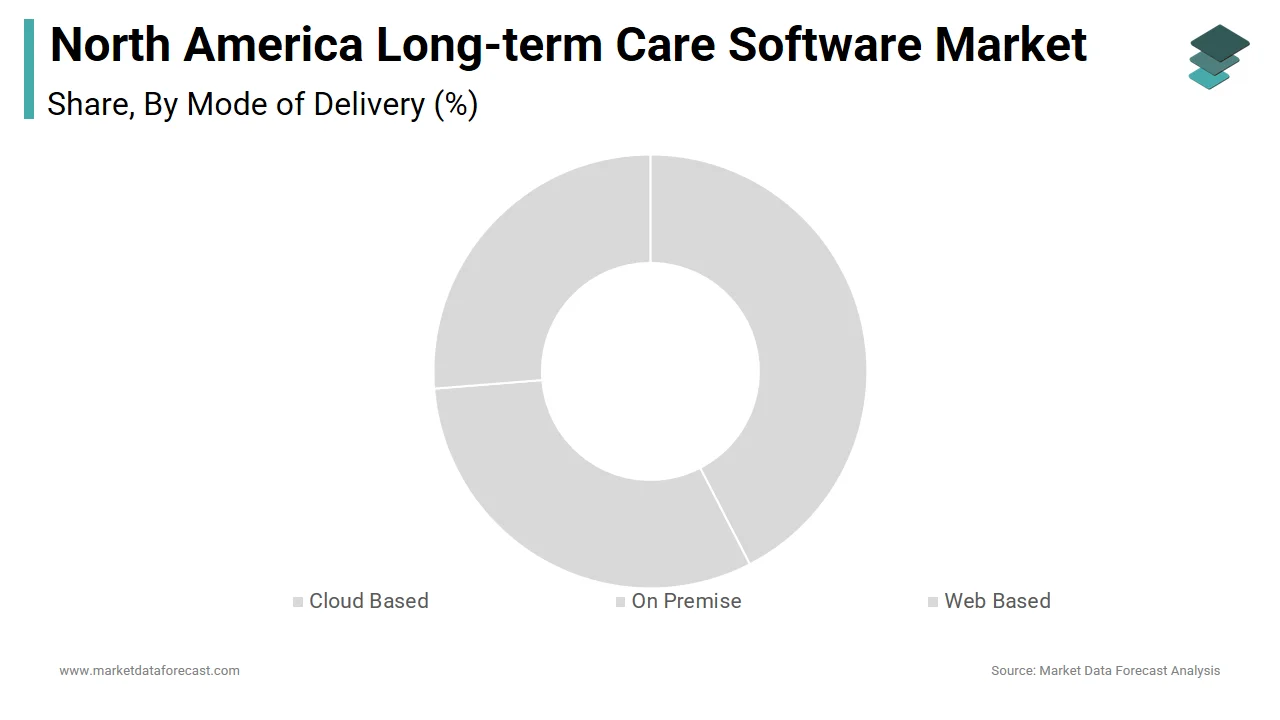
According to the Office of the National Coordinator for Health Information Technology (ONC), a notable percentage of nursing homes in the United States have transitioned to cloud-based EHR systems since 2020, driven by federal mandates and incentives promoting digital health interoperability. The flexibility offered by cloud platforms allows caregivers to access patient records remotely, enhancing continuity of care during transitions between facilities or home healthcare settings. Besides, cloud-based systems reduce the burden of software updates and cybersecurity maintenance, which is particularly beneficial for small- to mid-sized care facilities lacking dedicated IT departments.
Web-based platforms optimized for lightweight access and rapid deployment are gaining traction among small-scale providers seeking affordable, plug-and-play solutions. It is poised to move forward at the highest CAGR of 11.3% from 2025 to 2033. Thsese solutions offer lightweight, browser-accessible interfaces that require minimal installation, making them ideal for smaller care providers seeking rapid deployment without high upfront costs.
With rising demand for flexible, low-cost digital solutions tailored to non-institutional care settings, the web-based segment is gaining traction as a preferred choice for emerging players and small-scale operators in the long term care software market.
By Application Insights
The Electronic Health Records (EHR) application had the largest share of the North America long term care software market, accounting for a 38.5% of total market value in 2025. EHR systems anchor the segment due to their centrality in clinical compliance, audit readiness, and real-time care planning.
According to the Centers for Medicare & Medicaid Services (CMS), all certified nursing homes participating in Medicare and Medicaid must maintain electronic health records using certified EHR technology, ensuring compliance with federal quality standards. As of 2023, over 85% of U.S. nursing homes were using EHR-certified software, up from less than 20% a decade ago, demonstrating the impact of policy-driven adoption.
In Canada, the Canadian Institute for Health Information (CIHI) highlights that provinces like British Columbia and Quebec have mandated the use of standardized EHR templates aligned with national assessment frameworks such as RAI-MDS. These templates facilitate better communication between long term care providers and hospitals, reducing duplication and improving patient safety.
Moreover, EHR systems support advanced analytics, medication tracking, and real-time decision-making, making them essential tools for managing complex geriatric conditions.
The Electronic Medication Administration Record (eMAR) application is expected to grow at the fastest CAGR of 12.6% during the forecast period. This rapid growth is underpinned by policy-linked quality metrics and the proven impact of eMAR tools in reducing adverse drug events in institutional care. To mitigate these risks, CMS has incorporated eMAR compliance into its Quality Assurance and Performance Improvement (QAPI) program, incentivizing adoption through reimbursement policies.
Provinces such as Ontario and Manitoba have actively promoted eMAR adoption through pilot programs and subsidies aimed at reducing adverse drug events.
Apart from these, eMAR tools now integrate barcode scanning, automated alerts for drug interactions, and remote verification capabilities, enhancing both safety and efficiency.
By End Use Insights
The nursing homes end-use segment prevailed in the North America long term care software market in 2025. This lead position is driven by high care complexity, occupancy density, and strict documentation standards under CMS and provincial mandates.
According to the Centers for Disease Control and Prevention (CDC), more than 1.3 million Americans reside in nursing homes , and this number is expected to rise significantly as the baby boomer generation ages. These facilities face stringent federal and state regulations regarding resident assessments, medication tracking, and staffing compliance, necessitating robust software solutions.
In Canada, the Canadian Institute for Health Information (CIHI) indicates that over 200,000 seniors currently reside in licensed nursing homes, with provincial governments mandating the use of standardized digital documentation tools to improve transparency and care outcomes.
Furthermore, nursing homes manage complex medical conditions, including chronic diseases and cognitive impairments, which require integrated software platforms to track treatments, coordinate care plans, and ensure regulatory adherence.
The home healthcare agencies end-use segment is projected to grow at the highest CAGR of 13.4%. This accelerated growth is driven by aging-in-place policies, mobile tech adoption, and reimbursement expansion for virtual and home-based services.
The Canadian Home Care Association emphasizes that digitization of care records and real-time communication tools are crucial for coordinating multidisciplinary teams delivering services in private residences. Moreover, mobile-enabled long-term care software platforms allow caregivers to update resident health records on-the-go, improving service accuracy and compliance.
COUNTRY-WISE ANALYSIS
The United States maintained a dominant position in the North America long term care software market, holding an estimated market share of 76.4% in 2024. This position is defined by regulatory maturity, EHR certification mandates, and extensive vendor ecosystems enabling rapid digital scalability.
Additionally, the American Health Care Association (AHCA) reports that over 85% of U.S. nursing homes have implemented digital documentation systems, driven by federal incentives and quality improvement programs. Private equity investments in senior living communities have also spurred technological upgrades, as investors seek operational efficiencies and compliance enhancements.
With leading software vendors such as PointClickCare, MatrixCare, and WellSky headquartered in the U.S., the domestic ecosystem fosters innovation and scalability.
Canada’s policy-led digital overhaul and province-level interoperability standards are repositioning it as a progressive market for long term care innovation. Provincial governments have responded by implementing digital transformation initiatives aimed at improving data exchange between long term care homes, hospitals, and home healthcare providers.
The Ontario Ministry of Long-Term Care has allocated significant funding to support software procurement and interoperability efforts, aligning with national digital health objectives. With increasing policy alignment and investment, Canada is strengthening its position in the regional long term care software landscape, fostering innovation and cross-sector collaboration.
The Rest of North America is still in early stages compared to the U.S. and Canada. This region is witnessing gradual adoption driven by demographic shifts, urbanization, and international collaborations in eldercare.
In the Caribbean, countries such as Jamaica and Trinidad and Tobago are exploring partnerships with global software providers to enhance home and community-based eldercare services. Despite challenges such as economic constraints and fragmented healthcare systems, the Rest of North America presents promising opportunities for long term care software vendors, particularly as aging demographics drive greater demand for efficient, digitally enabled eldercare solutions.
KEY MARKET PLAYERS
Promising Companies leading the North America long-term care software market profiled in the report are AOD Software, Cerner Corporation, Allscripts Healthcare Solutions, Inc., McKesson Corporation, Omnicare, Inc., Omnicell, Inc., Kronos Incorporated, HealthMEDX, PointClickCare, Matrix Care, Sigma Care, and Optimus EMR.
TOP LEADING PLAYERS IN THE MARKET
- PointClickCare is a leading provider of long term care software solutions, widely recognized for its cloud-based platform that supports nursing homes, assisted living facilities, and home healthcare agencies. The company plays a pivotal role in streamlining clinical documentation, medication management, and billing operations across North America. Its focus on interoperability, regulatory compliance, and user-friendly design has made it a preferred choice among providers seeking to enhance care coordination and operational efficiency. Internationally, PointClickCare contributes to shaping digital transformation in eldercare by setting benchmarks in data integration and resident-centered care planning.
- MatrixCare delivers comprehensive long term care software tailored for senior living communities, post-acute care centers, and home health providers. The company emphasizes integrated care management, wellness programs, and predictive analytics to support holistic aging services. MatrixCare’s commitment to innovation is evident in its expansion into population health management and telehealth-enabled platforms. With strong partnerships across the senior care ecosystem, MatrixCare enhances care delivery models both in North America and globally, positioning itself as a key influencer in technology-driven eldercare solutions.
- WellSky offers a unified suite of long term care software solutions designed to improve clinical outcomes, streamline administrative tasks, and ensure regulatory adherence. The company serves a broad spectrum of providers, including skilled nursing facilities, hospice agencies, and community-based care organizations. WellSky differentiates itself through its flexible, cloud-native architecture and emphasis on person-centered care approaches. Its influence extends beyond North America as it collaborates with global health systems to standardize digital care workflows and support scalable eldercare innovations.
TOP STRATEGIES USED BY KEY MARKET PARTICIPANTS
One of the primary strategies employed by key players in the North America long term care software market is product innovation and feature enhancement, particularly in areas such as AI-driven analytics, medication tracking, and resident engagement tools. Companies are continuously refining their platforms to offer more intuitive interfaces, real-time reporting, and predictive insights that support better clinical decision-making.
Another critical approach is strategic acquisitions and partnerships, aimed at expanding product portfolios, entering new segments, and strengthening regional footholds. Many vendors are acquiring niche software firms specializing in telehealth, electronic medication administration records (eMAR), or remote monitoring to enrich their offerings and provide end-to-end solutions tailored to evolving industry needs.
Lastly, customer-centric deployment models and training initiatives have become essential for sustaining growth. Vendors are increasingly offering hybrid cloud solutions, mobile compatibility, and on-site training programs to ease adoption, particularly among smaller providers with limited technical resources, ensuring seamless integration and long-term client retention.
COMPETITION OVERVIEW
The competition in the North America long term care software market is characterized by a dynamic mix of established enterprise vendors and agile startups striving to capture market share through differentiation in functionality, usability, and integration capabilities. Major players dominate due to their extensive experience, deep domain knowledge, and robust customer networks, but emerging companies are gaining traction by introducing specialized modules tailored to specific care settings or operational challenges. The market is witnessing increasing demand for interoperable systems that can seamlessly exchange data with broader healthcare networks, prompting vendors to invest heavily in FHIR standards and API-driven architectures. At the same time, the growing emphasis on personalized care plans, regulatory compliance, and staff efficiency is driving continuous product evolution. While large-scale providers benefit from comprehensive, all-in-one platforms, smaller operators often seek cost-effective, modular solutions that can be easily deployed without extensive IT infrastructure. This diversity in customer needs fosters a competitive yet fragmented landscape where innovation, adaptability, and strategic collaboration play crucial roles in determining market leadership.
RECENT MARKET DEVELOPMENTS
- In January 2024, PointClickCare launched an enhanced version of its electronic health record (EHR) system featuring embedded AI-driven risk prediction tools designed to assist caregivers in early detection of resident health deterioration, reinforcing its leadership in clinical innovation.
- In March 2024, MatrixCare announced a strategic partnership with a national pharmacy services provider to integrate real-time medication verification and automated dispensing alerts directly within its long term care software platform, improving medication safety and workflow efficiency for clients.
- In June 2024, WellSky acquired a telehealth startup specializing in virtual care for seniors, expanding its service offerings to include remote consultations and real-time vitals monitoring, enabling greater flexibility for home healthcare providers and assisted living facilities.
- In September 2024, Brightree, a subsidiary of ResMed, introduced a new mobile-first long term care solution optimized for small and mid-sized home healthcare agencies, aiming to lower entry barriers and accelerate digital adoption among underserved segments.
- In November 2024, Harmony Healthcare IT entered into a collaborative agreement with several state health departments to pilot a standardized digital assessment tool aligned with federal reporting mandates, enhancing interoperability and regulatory compliance for participating long term care providers.
MARKET SEGMENTATION
This research report on the North America long-term care software market is segmented and sub-segmented into the following categories.
By Mode of Delivery
- Cloud Based
- On Premise
- Web Based
By Application
- Electronic Health Records (EHR)
- Staff Management
- Revenue Cycle Management (RCM)
- Resident Care
- Electronic Medication Administration Record (eMAR)
- Other Application
By End Use
- Nursing Homes
- Home Healthcare Agencies
- Assisted living facilities
- Hospice & Palliative care
- Other End Use
By Country
- United States
- Canada
- Mexico
- Rest of North America