- Product Description Description
- Table of Contents TOC
- List of Table & Figure LOT
- Get Free Sample PDF Sample PDF
North America Luxury Wines and Spirits Market Summary
The North America luxury wines and spirits market size was estimated at USD 275.11 billion in 2024 and is projected to reach USD 435.65 billion by 2033, growing at a CAGR of 5.24% from 2025 to 2033. As per Wine Institute, California alone accounts for nearly 85% of U.S. wine production, with Napa Valley and Sonoma emerging as global hubs for luxury wine production and tourism.
Key Market Trends & Insights
- The United States had the largest share of the North America luxury wines and spirits market, accounting for 79.5% of total revenue in 2024.
- Mexico is positioning itself as an emerging growth hub driven by rising affluence, urbanization, and expanding premium hospitality sectors.
- Based on type, the spirits segment dominated the North America luxury wines and spirits market, capturing 58.6% of total revenue in 2024.
- Based on distribution Channel, the the wholesale channel had the maximum share of the North America luxury wines and spirits market.
Market Size & Forecast
- 2024 Market Size: USD 275.11 Billion
- 2033 Projected Market Size: USD 435.65 Billion
- CAGR (2025-2033): 5.24%
- United States: Largest market in 2024
- Mexico: Fastest growing market
North America Luxury Wines and Spirits Market Size
The Luxury wines and spirits market size in North America was valued at USD 275.11 billion in 2024 and is predicted to be worth USD 435.65 billion by 2033 from USD 289.53 billion in 2025 and grow at a CAGR of 5.24% from 2025 to 2033.
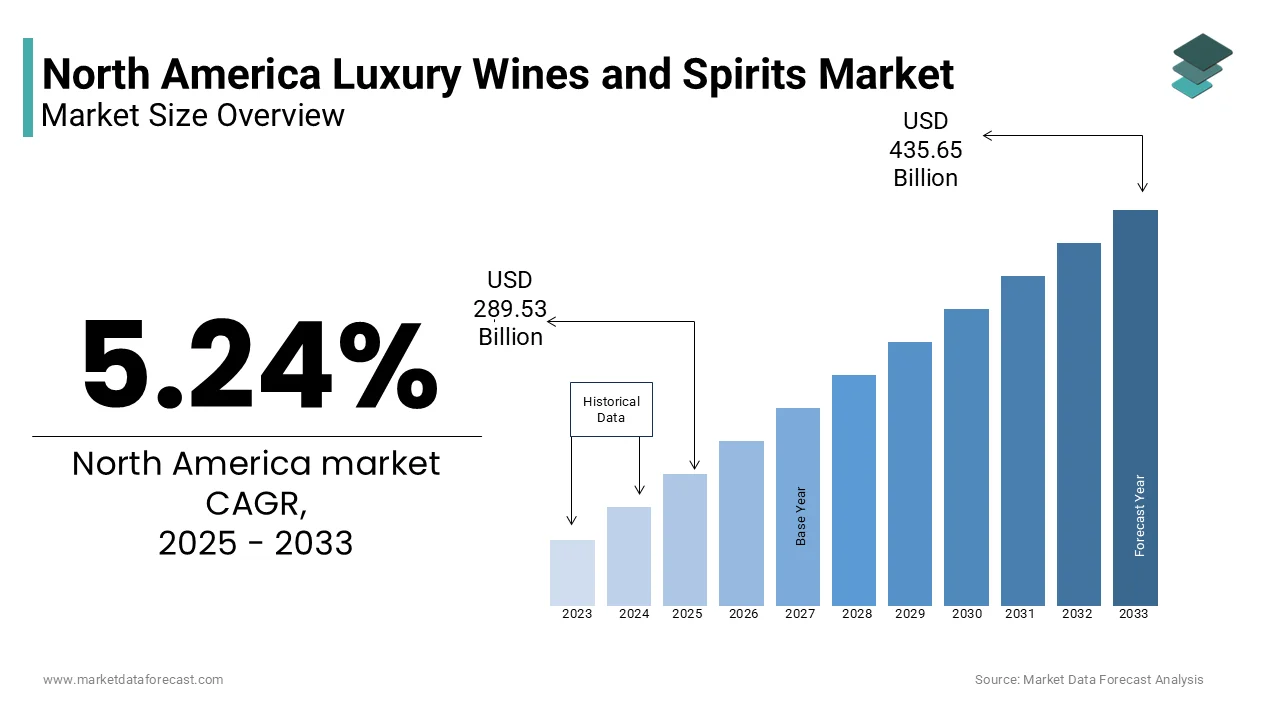
The North America luxury wines and spirits market encompasses high-end, premium alcoholic beverages that are distinguished by their craftsmanship, rarity, heritage, and superior quality. This segment includes fine wines from renowned vineyards, aged whiskies, limited-edition cognacs, vintage champagnes, and artisanal gins and rums. The market has evolved significantly in recent years, driven by a growing consumer preference for exclusivity, authenticity, and experiential consumption.
According to the Distilled Spirits Council of the United States (DISCUS), premium and super-premium spirits categories have consistently outperformed standard offerings, with double-digit growth in value sales over the past five years. As per Wine Institute, California alone accounts for nearly 85% of U.S. wine production, with Napa Valley and Sonoma emerging as global hubs for luxury wine production and tourism.
Besides, shifting consumer behavior toward mindful indulgence and status-driven consumption has further fueled demand for high-value products. In Canada and Mexico, rising disposable incomes and urbanization have also contributed to the expansion of the luxury segment. These dynamics underscore the transformation of the North American beverage alcohol landscape into a more sophisticated and aspirational domain, shaping the trajectory of the luxury wines and spirits market.
MARKET DRIVERS
Rising Affluence and Changing Consumer Preferences
A key driver of the North America luxury wines and spirits market is the growing affluence among consumers, particularly millennials and high-net-worth individuals who prioritize experiential and symbolic consumption. According to the Federal Reserve, household wealth in the United States reached record levels in recent years, with the top 10% of earners accounting for a significant portion of discretionary spending.
This demographic values storytelling, brand heritage, and provenance—attributes that define luxury wines and spirits. Additionally, as per the Wine Market Council, younger consumers are increasingly exploring fine wines not only for special occasions but also as part of everyday lifestyle choices.
Moreover, the rise of food and beverage culture through social media platforms has elevated the status of luxury drinks as symbols of sophistication and exclusivity. Influencer marketing and curated tasting events have further reinforced this trend. As per a report by McKinsey & Company, premium alcohol brands leveraging digital engagement strategies have seen higher conversion rates and customer loyalty, driving sustained demand across North America.
Expansion of Premium On-Premise and E-commerce Channels
Another significant driver of the North America luxury wines and spirits market is the expansion of premium on-premise venues such as high-end restaurants, cocktail bars, and boutique hotels, which serve as critical distribution points for luxury brands. According to the National Restaurant Association, upscale dining establishments have experienced a resurgence post-pandemic, with a particular emphasis on premium liquor pairings and curated beverage programs.
In addition to physical venues, the rapid growth of e-commerce platforms specializing in rare and collectible bottles has transformed how consumers access luxury products. Platforms like ReserveBar, Vivino, and Wine.com offer personalized selections and direct-to-consumer delivery, enhancing accessibility for affluent buyers.
This dual-channel expansion—both offline and online—has created new avenues for market penetration, reinforcing the upward trajectory of the North America luxury wines and spirits industry.
MARKET RESTRAINTS
Regulatory Complexity and Distribution Barriers
One of the most persistent restraints affecting the North America luxury wines and spirits market is the complex regulatory framework governing alcohol distribution, particularly in the United States. Unlike other consumer goods, alcohol is subject to multi-tiered systems involving manufacturers, wholesalers, and retailers, limiting direct access to consumers and increasing operational costs.
Also, cross-border trade restrictions within Canada and varying state-level alcohol laws in the U.S. complicate nationwide distribution strategies. While DTC shipping is expanding, it remains limited to select jurisdictions, preventing widespread availability of luxury products to interested consumers across the continent.
Economic Volatility and Discretionary Spending Cycles
Economic volatility presents another major restraint on the North America luxury wines and spirits market, as these products are inherently discretionary purchases. During periods of financial uncertainty, such as inflationary pressures or recessionary trends, affluent consumers may curtail spending on high-end alcoholic beverages in favor of more essential expenditures.
According to the Federal Reserve Bank of St. Louis, inflation peaked at over 9% in 2022, impacting consumer confidence and purchasing power across various luxury sectors.
Furthermore, as per a survey conducted by McKinsey & Company, approximately 35% of high-net-worth individuals reported adjusting their luxury spending habits due to economic concerns. While ultra-luxury items remained resilient, mid-range luxury spirits and wines faced headwinds. These fluctuations highlight the sensitivity of the market to ma
MARKET OPPORTUNITIES
Growth of Direct-to-Consumer (DTC) Sales Models
A major opportunity for the North America luxury wines and spirits market lies in the continued expansion of direct-to-consumer (DTC) sales models. The pandemic accelerated the adoption of online retail across all consumer segments, and the premium alcohol sector has been no exception.
This shift allows luxury producers to bypass traditional intermediaries, maintain brand control, and engage directly with discerning customers. According to Wine Institute, DTC channels enable wineries to offer exclusive releases, club memberships, and virtual tastings, enhancing brand loyalty and customer retention. Similarly, luxury spirit brands are leveraging digital platforms to offer limited editions and collector’s items tailored to connoisseurs.
Moreover, DTC models allow for data-driven personalization, enabling producers to understand consumer preferences and tailor offerings accordingly. With evolving regulations supporting interstate shipping and increased digital adoption, the DTC channel is poised to become a cornerstone of luxury beverage commerce in North America.
Increasing Demand for Sustainable and Ethically Sourced Luxury Products
Sustainability is emerging as a powerful growth driver in the North America luxury wines and spirits market, as consumers increasingly seek ethically produced, environmentally conscious, and socially responsible products.
Moreover, luxury wine producers are adopting organic farming, biodynamic practices, and carbon-neutral production techniques. As per Wine Institute, California alone has over 2,000 certified sustainable vineyard acres, with leading estates like Opus One and Domaine Carneros committing to comprehensive environmental stewardship initiatives.
Similarly, luxury spirits brands are emphasizing traceability, fair labor practices, and eco-friendly packaging to appeal to conscientious consumers. Also, several premium distilleries have pledged net-zero emissions targets by 2030. This alignment with ethical consumption trends presents a compelling opportunity for market expansion.
MARKET CHALLENGES
Intensifying Competition from Private Labels and Emerging Brands
A major challenge confronting the North America luxury wines and spirits market is the intensifying competition from private labels and emerging boutique brands that are capturing market share by offering high-quality, image-conscious alternatives at competitive price points.
These private labels, often backed by large retailers, benefit from extensive distribution networks and aggressive marketing campaigns that position them as accessible yet premium options. Like, major chains like Costco, Whole Foods, and Marks & Spencer have launched proprietary lines that rival established luxury brands in both quality and perceived exclusivity.
Additionally, a surge in micro-distilleries and small-scale vineyards has introduced an array of artisanal products that appeal to niche markets. The number of small wineries in the U.S. has more than doubled over the last decade, many of which focus on premium positioning. This proliferation of alternatives poses a threat to legacy luxury brands, forcing them to innovate continuously to retain relevance and market leadership.
Counterfeit and Grey Market Trade
Counterfeit and grey market trade present a growing challenge to the North America luxury wines and spirits market, threatening brand equity, consumer trust, and revenue streams. According to the International Trademark Association (INTA), counterfeit alcohol products are one of the fastest-growing segments of illicit trade, with luxury spirits being particularly vulnerable.
High-value whiskies, vintage wines, and limited edition releases are frequently targeted by fraudsters who replicate labels, bottle designs, and even authentication features. As per Interpol, seizures of counterfeit alcohol have increased by over 40% globally in the last five years, with North America serving as both a destination and transit point for illicit goods.
Moreover, as per a report by Deloitte, grey market imports—legally produced but unauthorized resales—have disrupted pricing structures and supply chain controls. Many rare and collectible bottles are sold through auction houses and secondary markets without brand oversight, diluting brand authority and potentially compromising consumer safety.
REPORT COVERAGE
| REPORT METRIC | DETAILS |
| Market Size Available | 2024 to 2033 |
| Base Year | 2024 |
| Forecast Period | 2025 to 2033 |
| CAGR | 5.24% |
| Segments Covered | By Type, Distribution Channel, and Region |
|
Various Analyses Covered | Regional & Country Level Analysis, Segment-Level Analysis, DROC, PESTLE Analysis, Porter’s Five Forces Analysis, Competitive Landscape, Analyst Overview on Investment Opportunities |
| Regions Covered | The United States, Canada, Mexico, and Rest of North America |
| Market Leaders Profiled | Hitejinro Co. Ltd., The Edrington Group Limited, LVMH Moet Hennessy Louis Vuitton S.E, Beam Suntory Inc., and others. |
SEGMENTAL ANALYSIS
By Type Insights
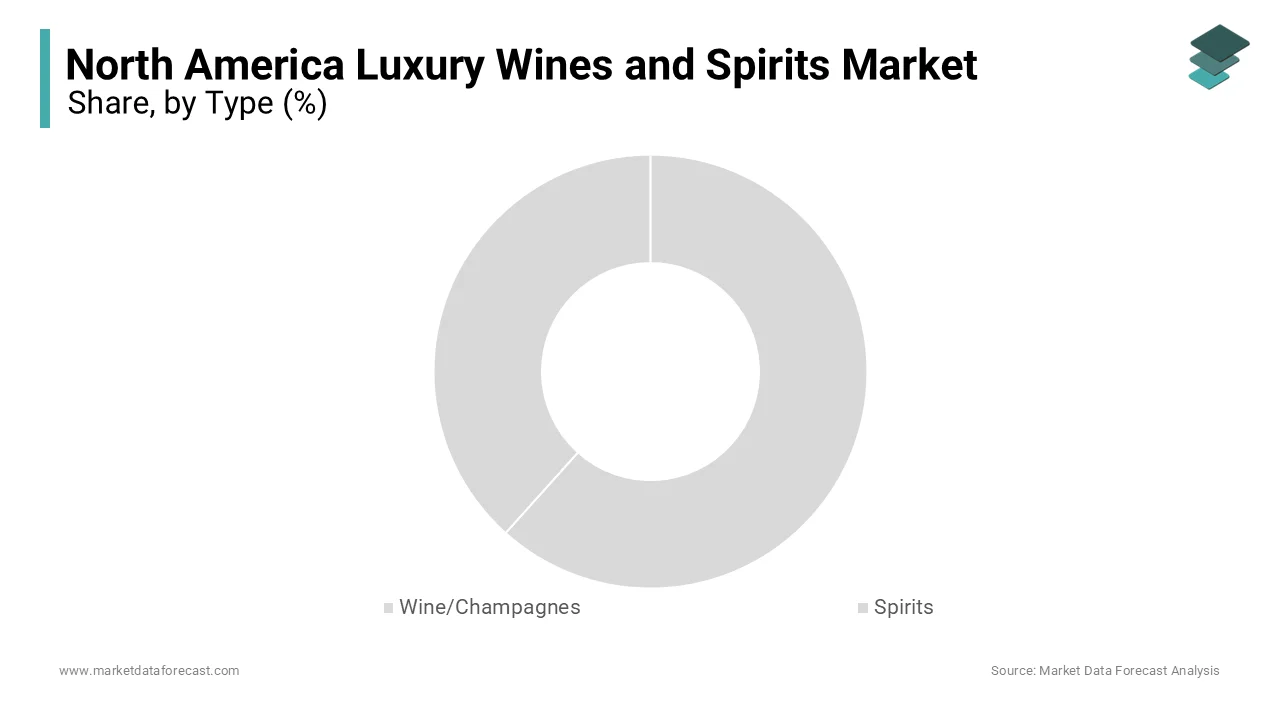
The spirits segment dominated the North America luxury wines and spirits market, capturing 58.6% of total revenue in 2024. This lead poition is primarily attributed to the rising popularity of premium and super-premium whiskies, cognacs, rums, and gins among affluent consumers and collectors.
According to the Distilled Spirits Council of the United States (DISCUS), the value of premium spirit sales has grown at a faster rate than volume, indicating strong consumer preference for high-end products.
Moreover, the rise of cocktail culture, craft distilleries, and experiential drinking trends further reinforce this dominance. These factors collectively underscore the sustained strength of the luxury spirits segment in shaping the North American premium alcohol landscape.
The wine/champagnes segment is projected to register the highest CAGR of around 9.3% in the North America luxury wines and spirits market. This rapid expansion is being driven by increasing demand for fine wines from boutique vineyards, vintage releases, and prestige champagnes among high-net-worth individuals and gourmet consumers.
A key driver behind this growth is the resurgence of fine dining and exclusive wine experiences in major metropolitan areas such as New York, San Francisco, and Toronto.
Additionally, champagne imports into the U.S. also saw record levels in 2023, fueled by celebratory consumption and status-driven gifting. These trends indicate robust momentum for the wine/champagne segment across North America.
 By Distribution Channel Insights
The wholesale channel had the maximum share of the North America luxury wines and spirits market, accounting for 51% of total distribution. This dominance is largely due to the entrenched role of distributors in connecting producers with on-premise establishments such as high-end restaurants, luxury hotels, and specialty bars.
Also, most premium and super-premium brands rely on licensed wholesalers to ensure compliance with state-level alcohol regulations and maintain pricing integrity. Luxury wine producers often partner with specialized distributors who cater to fine dining venues and exclusive retail outlets, ensuring targeted placement and brand visibility.
The e-commerce segment is emerging as the fastest-growing distribution channel in the North America luxury wines and spirits market, projected to grow at a CAGR of 12.6%. This surge is primarily driven by digital transformation, shifting consumer preferences, and the expansion of direct-to-consumer (DTC) models that bypass traditional intermediaries.
One of the main reasons for this shift is the increasing reliance on online platforms for rare and collectible bottles. These platforms offer convenience, authentication services, and personalized selections, enhancing accessibility and trust. These developments highlight the transformative potential of e-commerce in reshaping luxury beverage commerce across North America.
REGIONAL ANALYSIS
United States
The United States had the largest share of the North America luxury wines and spirits market, accounting for 79.5% of total revenue in 2024. As the world’s largest consumer of premium alcoholic beverages, the U.S. benefits from a robust economy, a growing high-net-worth population, and a well-established luxury beverage ecosystem.
According to the Distilled Spirits Council of the United States (DISCUS), the U.S. imported over USD 2 billion worth of luxury spirits in 2023, with single-malt Scotch, Cognac, and Japanese whisky leading the charge. Additionally, as per Wine Institute, California’s Napa Valley and Sonoma County remain global benchmarks for luxury wine production, attracting international investment and tourism.
With a thriving on-premise sector, expanding DTC channels, and a strong collector base, the U.S. continues to define the trajectory of the North American luxury beverage industry.
Canada
Canada is another key player in the market. The country's affluent urban centers—particularly Toronto, Vancouver, and Montreal—are key drivers of demand for premium alcoholic beverages, supported by rising disposable incomes and evolving consumer tastes. The presence of major importers and a regulatory environment that supports responsible alcohol consumption further reinforces Canada’s position as a key player in the regional luxury beverage market.
Mexico
Mexico is positioning itself as an emerging growth hub driven by rising affluence, urbanization, and expanding premium hospitality sectors. The country’s burgeoning middle and upper classes are increasingly embracing luxury alcoholic beverages as symbols of status and sophistication. While still relatively small compared to the U.S. and Canada, Mexico’s evolving consumer behavior and expanding discretionary spending make it a promising frontier for the region’s luxury beverage market.
KEY MARKET PLAYERS AND COMPETITIVE LANDSCAPE
Key players in the North America Luxury Wines and Spirits Market are Hitejinro Co. Ltd., The Edrington Group Limited, LVMH Moet Hennessy Louis Vuitton S.E, Beam Suntory Inc., and others.
The Latin America dicamba herbicide market is characterized by intense competition driven by the dominance of multinational agrochemical firms and the rising influence of domestic players. Market participants compete not only on product formulation and pricing but also through technological differentiation and regulatory compliance. The demand for effective post-emergence herbicides, particularly in soybean and cotton cultivation, has intensified rivalry as companies strive to secure contracts with large-scale agribusinesses and cooperatives.
A significant battleground is the development of low-volatility dicamba formulations that reduce off-target movement and meet stringent environmental standards. Companies are increasingly integrating these products with herbicide-tolerant crop systems to offer comprehensive weed management solutions. Strategic alliances with biotech seed producers have become essential for ensuring compatibility and maximizing adoption. Additionally, localized distribution networks and agronomic support services are being leveraged to strengthen customer relationships and improve product accessibility in rural areas.
While established players such as BASF, Corteva, and Syngenta maintain a strong foothold, smaller domestic and regional firms are gaining traction by offering cost-effective alternatives. This dynamic environment fosters continuous innovation, compelling firms to invest in research, expand their service offerings, and adapt swiftly to shifting regulatory and market conditions.
TOP STRATEGIES USED BY KEY PLAYERS
One major strategy employed by key players in the Latin America dicamba herbicide market is formulation development to enhance crop safety and reduce volatility , ensuring compliance with environmental regulations while maintaining weed control efficacy. Companies are investing heavily in low-volatility formulations that minimize off-target movement and align with sustainable agricultural practices.
Another critical approach is strategic alliances with biotech seed companies to develop integrated weed management systems , particularly those involving dicamba-tolerant genetically modified crops. These partnerships ensure compatibility between herbicides and crop varieties, enhancing adoption among large-scale farmers seeking efficient and reliable solutions.
Lastly, localized agronomic support and farmer engagement initiatives are being leveraged to strengthen market positions. Companies are conducting field trials, training sessions, and direct outreach programs to build trust, improve product understanding, and drive sustainable usage tailored to regional farming conditions and regulatory landscapes.
RECENT HAPPENINGS IN THE MARKET
- In January 2023, Diageo launched its “Reserve World Travel” initiative, expanding premium brand visibility in luxury airports and duty-free locations across North America. This move was designed to capture high-spending travelers and reinforce brand prestige.
- In August 2023, Pernod Ricard acquired a minority stake in a boutique California-based craft distillery known for its small-batch, ultra-premium gin, aiming to diversify its portfolio and appeal to younger, affluent consumers seeking artisanal authenticity.
- In March 2024, Louis Vuitton Moët Hennessy (LVMH) opened a flagship Maison in New York City dedicated to its luxury wine and spirits portfolio, offering immersive tasting experiences and exclusive releases to deepen consumer engagement and brand loyalty.
- In November 2024, Rémy Cointreau partnered with a leading North American digital marketplace to launch an NFT-based authentication system for rare Cognac bottles, enhancing collectibility and consumer trust in the luxury spirits segment.
- In May 2025, Jackson Family Wines introduced a carbon-neutral luxury wine line, targeting environmentally conscious high-net-worth consumers and reinforcing sustainability as a core value proposition within the premium wine category.
MARKET SEGMENTATION
This research report on the North America luxury wines and spirits market has been segmented and sub-segmented based on the following categories.
By Type
- Wine/Champagnes
- Spirits
By Distribution Channel
- Wholesale
- Retail
- E-commerce
- Other
By Country
- The United States
- Canada
- Rest of North America