North America Marine Lubricants Market Size, Share, Research Report - Segmented Based on Oil Type (Synthetic Oil, Mineral Oil, Bio-Based Oil, Grease and Others), Application, Ship Type, and Country (The United States, Canada and Rest of North America) – Analysis From 2026 to 2034

ID: 8253
Pages: 110

Market Size, 2025

$7.07 Bn

Market Estimate, 2026

$7.28 Bn

Market Forecast, 2034

$9.21 Bn

CAGR, 2026–2034

2.98%

North America Marine Lubricants Market Size

The North America marine lubricants market size was valued at USD 7.07 billion in 2025, and is projected to reach USD 9.21 billion by 2034 from USD 7.28 billion in 2026, growing at a CAGR of 2.98%.
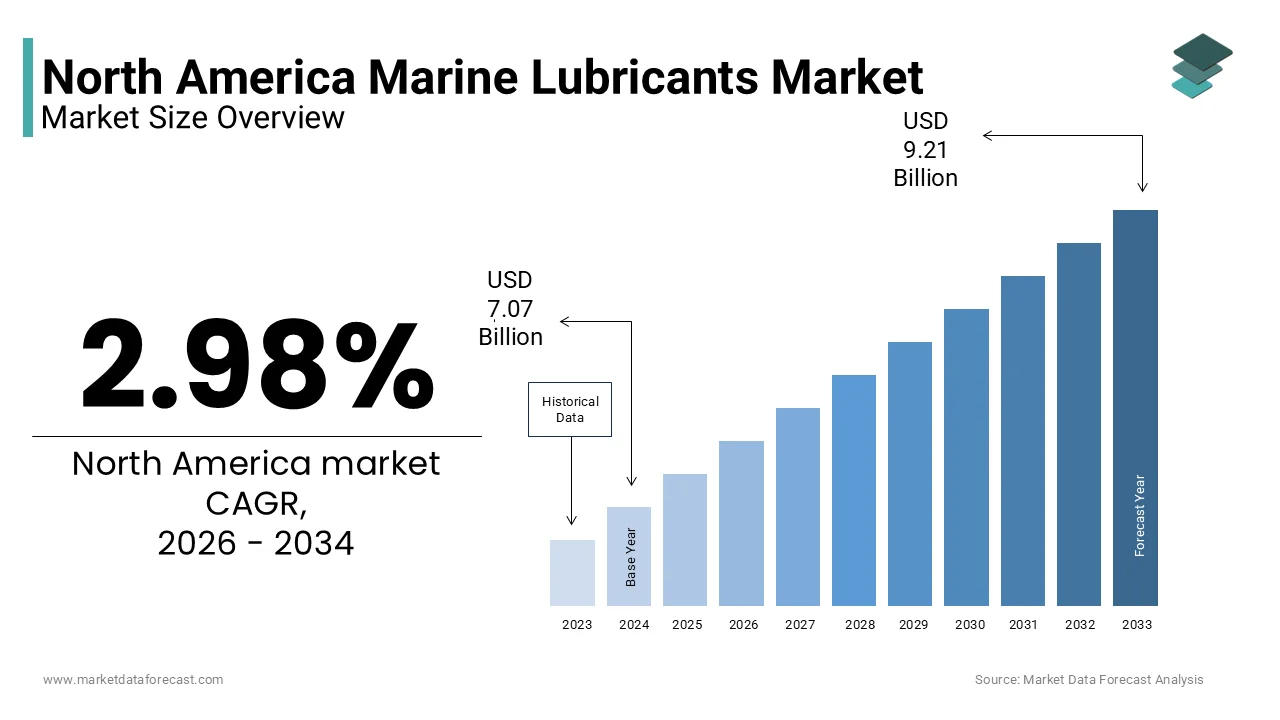
The North America marine lubricants market size is projected to reach USD 9.21 billion by 2034, at a CAGR of 2.98%.

Lubricants are compounds that reduce the friction between any two surfaces in contact. Marine Lubricants are lubricants used in the shipping/marine industry. Marine cylinder lubricants covered the major percentage of the marine lubricants market sales in 2018

REPORT COVERAGE

REPORT METRIC

DETAILS

Market Size Available

2025 to 2034

Base Year

2025

Forecast Period

2026 to 2034

CAGR

2.98%

Segments Covered

By Oil Type, Application, Ship Type, and Region

Various Analyses Covered

Global, Regional, & Country Level Analysis; Segment-Level Analysis; DROC; PESTLE Analysis; Porter’s Five Forces Analysis; Competitive Landscape; Analyst Overview of Investment Opportunities

Regions Covered

United States, Canada and Rest of North America

Market Leaders Profiled

BP Plc., Royal Dutch Shell Plc., Exxon Mobil Corporation, Chevron Corporation, Sinopec Corporation, Idemitsu Kosan Co. Ltd., PJSC Lukoil, Total S.A, Indian Oil Corporation Ltd., Gulf Oil International, JX Nippon Oil & Energy Corporation, Avin Oil S.A., Fuchs Petrolub Se, H&R GmbH & Co., KGaA, JX Nippon Oil & Energy Corporation, Petronas Lubricants International, Quepet Lubricants, Stanley Group, Unimarine LLC, Vickers Oil, World Fuel Service Corporation, AMPNI, Royal Dutch Shell Plc

KEY MARKET PLAYERS

BP Plc., Royal Dutch Shell Plc., Exxon Mobil Corporation, Chevron Corporation, Sinopec Corporation, Idemitsu Kosan Co. Ltd., PJSC Lukoil, Total S.A, Indian Oil Corporation Ltd., Gulf Oil International, JX Nippon Oil & Energy Corporation, Avin Oil S.A., Fuchs Petrolub Se, H&R GmbH & Co., KGaA, JX Nippon Oil & Energy Corporation, Petronas Lubricants International, Quepet Lubricants, Stanley Group, Unimarine LLC, Vickers Oil, World Fuel Service Corporation, AMPNI, Royal Dutch Shell Plc are some of the notable companies in the North America Marine Lubricants market.

MARKET SEGMENTATION

This research report on the North America Marine Lubricants market has been segmented and sub-segmented based on the following categories.

By Oil Type

  • Synthetic Oil
  • Bio-Based Oil
  • Mineral Oil
  • Grease
  • Others.

By Application

  • Hydraulic Fluid
  • Engine Oil
  • Compressor Oil
  • Turbine Oil
  • Others

By Country

  • United States
  • Canada
  • Rest of North America

Trusted by 500+ companies. We respect your privacy and never share your data.

Please wait. . . . Your request is being processed

Frequently Asked Questions

1. What is the North America marine lubricants market?

The North America marine lubricants market consists of lubricating oils and greases used in marine vessels and equipment to improve operational efficiency, reduce wear, and protect machinery from harsh marine conditions.

2. What factors are driving the growth of the North America marine lubricants market?

The market is driven by increasing maritime trade, growing commercial shipping activities, expanding offshore operations, and rising demand for high-performance lubrication solutions.

3. Which countries contribute significantly to the North America marine lubricants market?

United States, Canada, and Mexico are the key contributors due to their extensive coastlines, active ports, and maritime industries.

4. What are the major types of marine lubricants used in the region?

Marine engine oils, cylinder oils, hydraulic oils, compressor oils, turbine oils, and marine greases are among the most commonly used lubricant products.

5. Why are marine lubricants essential for vessel performance?

Marine lubricants help reduce friction, minimize equipment wear, improve fuel efficiency, prevent corrosion, and extend the service life of marine machinery.

6. Which vessel categories generate the highest demand for marine lubricants?

Container ships, tankers, bulk carriers, passenger vessels, offshore support vessels, and fishing boats are major consumers of marine lubricants.

7. How does offshore oil and gas activity influence market demand?

Offshore drilling platforms and support vessels require specialized lubricants to ensure reliable operation under demanding marine and environmental conditions.

8. How are environmental regulations shaping the marine lubricants market?

Regulatory agencies are encouraging the adoption of environmentally acceptable lubricants and low-toxicity formulations to reduce environmental risks in marine ecosystems.

9. What role do ports and shipping routes play in market growth?

The presence of major ports and busy shipping corridors across North America supports consistent demand for marine lubricant products and maintenance services.

10. What challenges does the North America marine lubricants market face?

Challenges include fluctuating crude oil prices, strict environmental regulations, supply chain disruptions, and increasing operational costs for shipping companies.

Click for Request Sample