- Product Description Description
- Table of Contents TOC
- List of Table & Figure LOT
- Get Free Sample PDF Sample PDF
Market Size, 2025
$11.81 BnMarket Estimate, 2026
$12.18 BnMarket Forecast, 2034
$15.67 BnCAGR, 2026–2034
3.19%North America Methanol Market Size
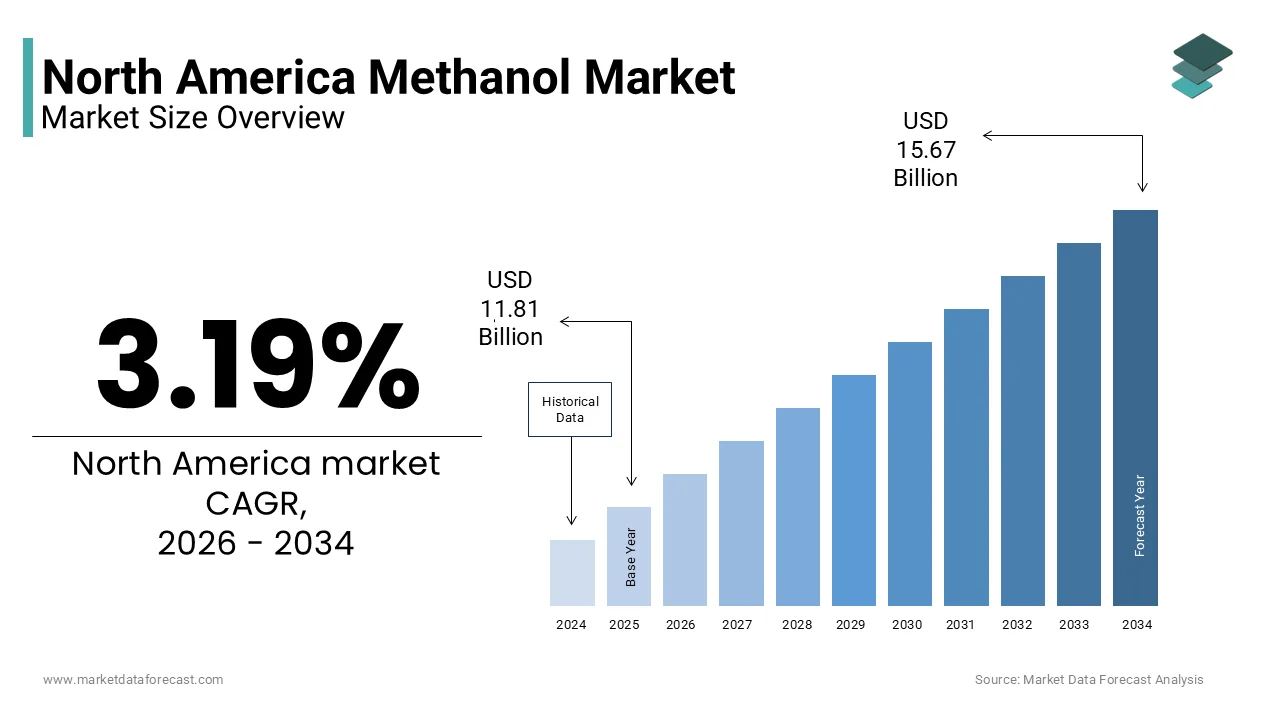
The North America methanol market size was valued at USD 11.81 billion in 2025, and is expected to be worth USD 15.67 billion by 2034 from USD 12.18 billion by 2026. The market is growing at a CAGR of 3.19% during the forecast period.
Methanol is a flammable light liquid that can be produced using natural gas, oil, coal, or renewable resources primarily including biomass and landfill gas as a feedstock. Because of its good blending capabilities and high octane rating, it is widely used as a gasoline alternative in the transportation industry. Formaldehyde, dimethyl ether, gasoline, acetic acid, solvents, methanol to olefins, and other derivatives have been separated from the global methanol market. Because of the high consumption of formaldehyde in several end-use industries such as automotive, cosmetics and personal care, building and construction, healthcare, and the formaldehyde sector had the biggest market share in 2019. Methanol usage is increasing in the building and construction industry, where formaldehyde-based resins are used.
The demand for lightweight vehicles to reduce carbon emissions is driving up automobile production in North America. The North America methanol market is expected to grow due to the increasing use of methanol as a fuel in automobiles due to better engine performance and fuel efficiency. Methanol usage is increasing in the construction industry, where formaldehyde-based resins are used to make composites and engineered wood products. The expansion of the methanol industry is expected to be driven by an increase in residential and commercial construction activity, as well as rising living standards and per capita income.
The rising use of methanol as a fuel in the automotive industry, rising petrochemicals demand, continuous growth, and various joint ventures & agreements undertaken by various businesses are all contributing to the North America methanol market's expansion. The largest application area is formaldehyde, which is widely used in the production of plywood, plastics, and paints. It is also utilized as a fuel due to its excellent mixing properties. In the coming years, the rising acceptance of the methanol-to-olefins (MTO) technique is expected to boost market growth.
One of the main causes for the petrochemical industries is the growing demand for methanol products from industries like as packaging, textiles, plastics, construction, healthcare, and transportation. Petrochemical products such as styrene, ethylene, vinyl, benzene, propylene, xylene, and others are seeing a significant increase in demand.
Market Drivers and Restraints:
Methanol acts as an alternative and provides a solution to reduce the emission of greenhouse gases. This is one of the features which contributed to the growing demand for methanol in North America in the past few years. To add to this, methanol is also biodegradable and hence is in compliance with the environmental regulations imposed by the regulatory bodies. The ease of manufacturing of methanol also accounts for its growing popularity. It is also seen as an alternative or replacement for products such as gasoline, crude oil, and diesel fuel. The raw material is available quite easily which leads to ease of production.
Methanol as a chemical is extremely useful and is growing at a high rate but at the same time, it is costly. This cost ineffectiveness is a major drawback of the industry. The industry also is likely to record high investments in research and development to keep up the quality in order to meet the strict demands that are in line with environmental regulations.
REPORT COVERAGE
| REPORT METRIC | DETAILS |
| Market Size Available | 2025 to 2034 |
| Base Year | 2025 |
| Forecast Period | 2026 to 2034 |
| CAGR | 3.19% |
| Segments Covered | By Feedstock, Derivative, Sub-derivative, End Use Industry, and Region. |
| Various Analyses Covered | Global, Regional & Country Level Analysis, Segment-Level Analysis, DROC, PESTLE Analysis, Porter’s Five Forces Analysis, Competitive Landscape, Analyst Overview of Investment Opportunities |
| Regions Covered | The United States, Canada and Rest of North America |
| Market Leaders Profiled | BASF SE, Celanese Corporation, Huntsman, International LLC., Methanex Corporation, and Croda International |
REGIONAL ANALYSIS
North American methanol manufacturing has been practically limited. However, the shale gas boom in North America has boosted methanol consumption in the region. Natural gas prices have been successfully reduced as a result of shale gas advancements. Regional vendors are embracing solutions such as capacity restarts, plant relocation, and Greenfield initiatives. The global import-export scenario is projected to return as a result of the shale gas development in North America. This will result in increased methanol capacity in the region, transforming it from an importing to an exporting zone. Various novel applications are now being developed in the region, including directly mixing methanol into gasoline, converting methanol to olefins, and converting methanol to gasoline.
Methanol is also a large market in the United States, because of its growing use in water treatment facilities for the denitrification process, which helps to reduce the volume of hazardous effluents emitted. According to the Methanol Institute, methanol is used in the denitrification process in roughly 200 water treatment facilities in the United States.
Oil and natural gas, particularly methanol, are the commodities that normally receive the greatest interest in Canada. Methanol is used to make a wide range of items, including shampoo, carpets, paints, and plastics. Methanol is also utilized as a motor fuel, and its cost has been continuously rising over the previous few years.
KEY MARKET PLAYERS
- BASF SE
- Celanese Corporation
- Huntsman International LLC.
- Methanex Corporation
- Croda International
MARKET SEGMENTATION
This research report on the North America methanol market has been segmented and sub-segmented based on the following categories.
By Feedstock
- Natural Gas
- Coal
By Derivative
- Formaldehyde
- MTO/MTP
- Gasoline
- MTBE
- MMA
By Sub-derivative
- UF/PF Resins
- Olefins
By End-Use Industry
- Construction
- Automotive
- Electronics
- Healthcare
By Country
- The United States
- Canada
- Rest of North America