- Product Description Description
- Table of Contents TOC
- List of Table & Figure LOT
- Get Free Sample PDF Sample PDF
Market Size, 2025
$3 BnMarket Estimate, 2026
$3.49 BnMarket Forecast, 2034
$11.80 BnCAGR, 2026–2034
16.44%North America Micro Irrigation Systems Market Size, Growth, Trends & Forecast (2026–2034)
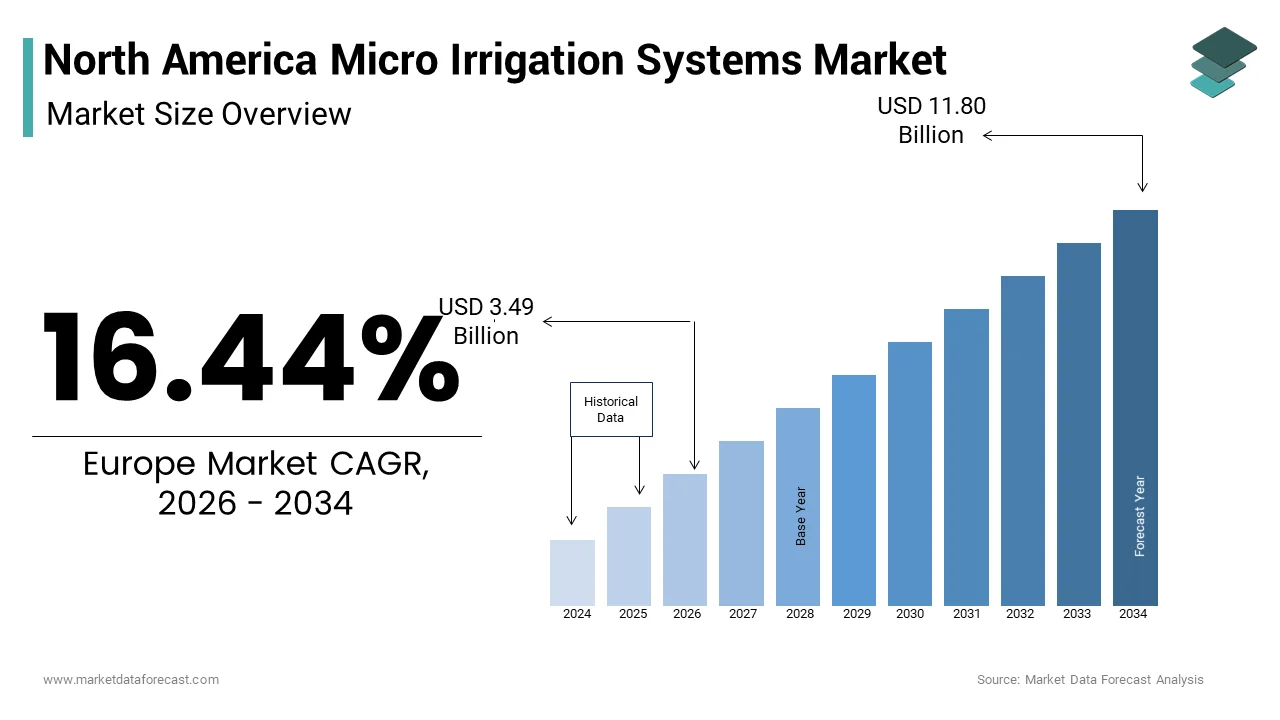
The North America micro irrigation systems market size was valued at USD 3 billion in 2025, is anticipated to reach USD 3.49 billion in 2026, and is projected to scale up to USD 11.80 billion by 2034, registering a compound annual growth rate (CAGR) of 16.44% during the forecast period from 2026 to 2034. Driven by depleting water levels, favorable government policies, and the urgent need to maximize crop yields with minimal resource wastage, the micro irrigation industry continues to expand robustly across the region.
Key Executive Metrics (At-a-Glance)
- 2025 Base Valuation: USD 3.00 Billion
- 2026 Current Valuation: USD 3.49 Billion
- 2034 Forecast Valuation: USD 11.80 Billion
- Compound Annual Growth Rate (CAGR): 16.44% (2026–2034)
- Dominant Technology Segment: Sprinkler Irrigation System (leading the market due to enhanced irrigation efficacy on low-value field crops via micro-sprinklers)
- Fastest-Growing Technology Segment: Drip Irrigation System (expanding at the highest CAGR due to superior water-use efficiency and direct root-zone application minimizing evaporation)
- Dominant Country Market: United States (holding the major regional market share supported by advanced agricultural initiatives and government support programs)
Core Market Drivers
- Depleting Water Levels: Escalating water scarcity prompting a shift from orthodox irrigation methods to advanced precision solutions.
- Favorable Regulations & Government Schemes: Public programs encouraging technology adoption to secure affordable food supplies and enhance agricultural outputs.
- Agronomic Benefits: Negligible soil erosion, reduced weed growth, and trouble-free fertigation implementation.
Primary Market Restraints & Challenges
- High Initial Investment & Maintenance: Substantial upfront installation costs and ongoing maintenance requirements restricting wider adoption among small-scale operations.
- Regulatory Gaps: Absence of a centralized supervising body leading to potential quality control hurdles and product duplication risks.
North America Micro Irrigation Systems Market Segmentation Breakdown
| Segment Category | Leading Sub-Segment (2025 Base) | Fastest-Growing Sub-Segment (2026–2034) |
|---|---|---|
| By Irrigation Technology | Sprinkler Irrigation System (dominant market leader enhancing field crop coverage via micro-sprinklers) | Drip Irrigation System (fastest-growing due to high water-efficiency and negligible evaporation loss) |
| By Application | Orchard Crops & Vineyards / Field Crops (major volume categories utilizing precise delivery) | Greenhouse Crops & Specialized Plantations (fastest-growing driven by controlled environment agriculture) |
| By End User | Farmers (dominant consumer category implementing modern farm schemes) | Industrial Growers (fastest-growing segment scaling up automated large-scale operations) |
| By Country | US (dominant market country backed by advanced infrastructure and financing schemes) | US & Mexico (fastest-growing national markets driven by government modernization initiatives) |
Major Industry Players Profiled
Key enterprises shaping the competitive North American micro irrigation systems market include Jain Irrigation Systems Ltd., Lindsay Corporation, Nelson Irrigation Corporation, The Toro Company, EPC Industries Limited, Valmont Industries Inc., and T-L Irrigation.
North America Micro Irrigation Systems Market Size
The North America's micro irrigation systems market size was valued at USD 3 billion in 2025 and is anticipated to reach USD 3.49 billion in 2026 to reach USD 11.80 billion by 2034, growing at a CAGR of 16.44% from 2026 to 2034. Irrigation means the provision of water to dry land for crop development.
The micro-irrigation method consists of a supply of water at regular periods above and below the soil surface. They are usually low or medium-pressure systems that distribute water in the form of mist, sprinklers, drip, spray, and jet. With the impending dangers of water scarcity, micro-irrigation systems prove to be an advanced and effective solution as compared to orthodox irrigation methods.
The growth of the North America Micro Irrigation Systems market is majorly due to factors such as depleting water levels, Favourable regulatory outlines, and government programs. Negligible soil erosion, low weed growth, and trouble-free fertigation implementation are some of the additional benefits associated with Micro Irrigation Systems. However, factors such as high initial investment and high maintenance requirements are impeding the growth of the market in this region. This industry also lacks a proper supervising agency and guidelines, thereby neglecting product manufacturing operations, which could result in product duplication.
REPORT COVERAGE
| REPORT METRIC | DETAILS |
| Market Size Available | 2025 to 2034 |
| Base Year | 2025 |
| Forecast Period | 2026 to 2034 |
| CAGR | 16.44% |
| Segments Covered | By Irrigation Technology, Application, End-User, and By Country |
| Various Analyses Covered | Global, Regional & Country Level Analysis, Segment-Level Analysis, DROC, PESTLE Analysis, Porter’s Five Forces Analysis, Competitive Landscape, Analyst Overview on Investment Opportunities |
| Regions Covered | USA, Canada, Mexico & Rest of NA |
| Market Leaders Profiled | Jain Irrigation Systems Ltd., Lindsay Corporation, Nelson Irrigation Corporation, The Toro Company, EPC Industries Limited, Valmont Industries Inc., and T-L Irrigation. |
SEGMENT ANALYSIS
By Type Insights
Sprinkler irrigation systems lead the market for micro irrigation systems, whereas drip irrigation systems are growing at the highest CAGR during the forecast period. With the advance of micro-sprinklers, irrigation on low-value field crops has been enhanced, thereby increasing the demand for micro-sprinklers.
COUNTRY ANALYSIS
Governments, particularly in this region, have undertaken several schemes to promote such technology that provides enhanced crop yield at a reduced cost. Increasing the output of irrigated agriculture is anticipated to be the basis for obtaining affordable food for the people of this region. The drip irrigation system is projected to witness a strong growth rate in this region during the forecast period due to the high water efficiency of these systems as compared to the orthodox irrigation methods. The most important advantage of a drip irrigation system when compared to a sprinkler irrigation system is that it helps in decreasing the water wastage due to evaporation, as the water is directly applied to the plant root.
KEY MARKET PLAYERS
The major companies dominating the Micro Irrigation Systems market in this region are
- Jain Irrigation Systems Ltd.
- Lindsay Corporation
- Nelson Irrigation Corporation
- The Toro Company
- EPC Industries Limited
- Valmont Industries Inc.
- T-L Irrigation.
MARKET SEGMENTATION
This research report, the North America micro irrigation systems market is segmented and sub-segmented into the following categories.
By Irrigation Technology
- Drip Irrigation System
- Backflow Preventers
- Filters
- Drip Tubes
- Valves
- Pressure Regulators
- Emitters
- Others
- Sprinkler Irrigation System
- Tubing
- Sprinkler Heads
- Pumping Units
- Couplers
- Fittings & Accessories
- Others
- Center Pivot Irrigation System
- Pipelines
- System Control Towers
- Water Emitters
- Central Towers
- Lateral Move Irrigation System
- Pipelines
- Sprinkler Heads
- Drive Mechanisms
- Control Panels
- Water Distribution Units
- Subsurface Drip Irrigation (SDI) Systems
- Tubing
- Pressure Regulators
- Water Filtration Units
- Drip Emitters
- Boom Irrigation Systems
- Overhead Booms
- Nozzles
- Water Pumps
By Application
- Plantation Crops
- Orchard Crops & Vineyards
- Field Crops
- Forage & Turf Grasses
- Greenhouse Crops
- Others
By End User
- Farmers
- Industrial Growers
- Others
By Country
- US
- Canada
- Mexico