- Product Description Description
- Table of Contents TOC
- List of Table & Figure LOT
- Get Free Sample PDF Sample PDF
Market Size, 2025
$1.82 BnMarket Estimate, 2026
$1.97 BnMarket Forecast, 2034
$3.75 BnCAGR, 2026–2034
8.38%North America Military Laser Systems Market Size, Growth, Trends & Forecast (2025–2034)
The North American military laser systems market size was valued at USD 1.82 billion in 2025, is anticipated to be worth USD 1.97 billion in 2026, and is expected to reach USD 3.75 billion by 2034, growing at a compound annual growth rate (CAGR) of 8.38% during the forecast period. Growth is heavily driven by the increasing proliferation of unmanned aerial vehicles (UAVs), precision-guided munitions, and the strategic push toward directed energy weapons (DEWs) for modern defense modernization.
Key Executive Metrics (At-a-Glance)
- 2025 Base Valuation: USD 1.82 billion
- 2026 Current Valuation: USD 1.97 billion
- 2034 Forecast Valuation: USD 3.75 billion
- Compound Annual Growth Rate (CAGR): 8.38%
- Dominant Application Segment: Weapons (capturing a dominant share driven by cumulative federal allocations exceeding USD 10 billion)
- Fastest-Growing Application Segment: Non-weapons (projected at an estimated CAGR of 9.2% fueled by target designators and rangefinders)
- Dominant Technology Segment: Solid-state lasers (accounting for 39.2% of the market share)
- Fastest-Growing Technology Segment: Fiber lasers (expanding at an estimated CAGR of 10.5%)
- Dominant Country: United States (holding 84.3% of the regional market share)
- Fastest-Growing Country: Canada (supported by modernization efforts, Arctic security, and rising defense procurement)
Core Market Drivers
- Drone & Missile Threats: Escalating usage of low-cost UAVs and hypersonic missiles driving the need for economical, near-instantaneous laser counter-measures.
- Force Modernization: Strategic initiatives by the U.S. Department of Defense to integrate directed energy weapons into air, land, and sea platforms.
Primary Market Restraints & Challenges
- Technical & Power Limitations: Complexities related to atmospheric degradation, heavy power supply requirements, and rigorous thermal management constraints.
North America Military Laser Systems Market Segmentation Breakdown
| Segment Category | Leading Sub-Segment | Fastest-Growing Sub-Segment |
|---|---|---|
| By Application | Weapons (Dominant share) | Non-weapons (Estimated CAGR of 9.2%) |
| By Technology | Solid-state Laser (39.2% share) | Fiber Laser (Estimated CAGR of 10.5%) |
| By Region | United States (84.3% share) | Canada (Expanding via NORAD and NATO alignments) |
Major Industry Players Profiled
Key defense contractors and market leaders shaping the industry include Lockheed Martin Corporation, Northrop Grumman Corporation, Raytheon Technologies Corporation, Boeing Defense Space & Security, L3Harris Technologies, General Dynamics Corporation, BAE Systems, Coherent (II-VI Incorporated), Kratos Defense & Solutions, BlueHalo, and General Atomics.
North America Military Laser Systems Market Size
The North American military laser systems market size was valued at USD 1.82 billion in 2025 and is expected to reach USD 3.75 billion by 2034 from USD 1.97 billion in 2026. The market is projected to grow at a CAGR of 8.38%
Military laser systems refer to high-energy and precision-directed energy weapons or tools used for defense applications such as target designation, range finding, surveillance, countermeasure deployment, and direct energy warfare. These systems are deployed across air, land, and sea platforms to enhance combat efficiency, reduce collateral damage, and provide cost-effective alternatives to traditional kinetic weaponry. The growing integration of directed energy systems into naval vessels, aircraft, and ground vehicles underscores the shift toward advanced electronic warfare capabilities. Moreover, the U.S. Army’s Rapid Capabilities and Critical Technologies Office (RCCTO) has prioritized field testing of high-energy lasers for counter-unmanned aerial system (C-UAS) missions. The increasing use of drones on the battlefield and rising threats from hypersonic weapons have further intensified the demand for compact, scalable, and deployable laser systems.
MARKET DRIVERS
Increasing Threats from Unmanned Aerial Vehicles and Precision-Guided Munitions
One of the primary drivers of the North America military laser systems market is the rapid proliferation of unmanned aerial vehicles (UAVs) and precision-guided munitions, which have become dominant tools in asymmetric warfare and regional conflicts. According to the U.S. Department of Defense, over 500 drone attacks were recorded against coalition forces in conflict zones between 2021 and 2024 with the urgent need for efficient, low-cost countermeasures. Traditional missile-based defense systems often prove economically unsustainable when engaging small, low-altitude drones, making high-energy laser (HEL) systems an attractive alternative. The U.S. Army and Navy have accelerated their deployment of laser-based counter-drone systems due to their ability to deliver near-instantaneous engagement with minimal logistical burden. Each shot from a laser weapon costs only a few dollars in electricity compared to thousands for conventional interceptors. Additionally, the increasing use of commercial off-the-shelf drones by non-state actors and rogue nations has prompted defense planners to integrate laser systems into forward operating bases, airfields, and naval assets.
Strategic Modernization of Armed Forces through Directed Energy Weapons
A key driver fueling the growth of the North America military laser systems market is the strategic push by the U.S. Department of Defense to modernize armed forces through the adoption of directed energy weapons (DEWs). As part of its long-term modernization roadmap, the DoD has prioritized the integration of high-energy lasers into combat platforms to enhance defensive capabilities, reduce ammunition dependency, and improve operational readiness.
Furthermore, the U.S. Navy has successfully tested laser prototypes aboard Arleigh Burke-class destroyers, demonstrating their ability to neutralize airborne threats without expending traditional ordnance. The Office of Naval Research reported that shipboard laser systems could significantly reduce logistics burdens by eliminating the need for physical magazines, allowing vessels to remain operationally effective for longer durations.
MARKET RESTRAINTS
Technological Complexity and Integration Challenges
A major restraint affecting the North America military laser systems market is the inherent technological complexity and integration challenges associated with deploying high-energy laser (HEL) systems in real-world combat environments. Unlike traditional kinetic weapons, laser systems require precise targeting, substantial power sources, and advanced thermal management to maintain effectiveness under varying atmospheric conditions. According to the Defense Science Board, laser performance can be significantly degraded by environmental factors such as fog, smoke, humidity, and turbulence, limiting their reliability in contested or adverse operational settings. Moreover, integrating laser systems onto mobile platforms such as aircraft, ships, and armored vehicles presents significant design and power supply challenges. The U.S. Army’s Rapid Capabilities Office noted that retrofitting existing platforms to accommodate HEL systems requires extensive modifications to electrical architecture, cooling infrastructure, and command-and-control interfaces. Additionally, the scarcity of standardized protocols for laser weapon interoperability complicates multi-service coordination. As per the Government Accountability Office, compatibility issues between different branches of the military have delayed joint deployment strategies by slowing procurement decisions and fielding schedules.
High Development and Acquisition Costs
Another significant barrier to the broader adoption of military laser systems in North America is the high development and acquisition costs associated with directed energy weapons. According to the Congressional Research Service, the U.S. government has spent over $10 billion cumulatively since 2020 on laser weapon system development, with individual prototypes costing hundreds of millions of dollars. For instance, the development of a single 150-kilowatt class laser system involves expenditures exceeding $200 million, excluding integration and testing expenses. Additionally, the requirement for high-capacity power sources, specialized beam control systems, and reinforced platform structures adds to the overall financial burden. Moreover, ongoing maintenance, personnel training, and cybersecurity upgrades further inflate lifecycle costs. As per the Government Accountability Office, full-scale fielding of laser systems remains financially unviable for many service branches unless funding mechanisms evolve or cost-sharing partnerships with industry stakeholders expand.
MARKET OPPORTUNITIES
Expansion of Directed Energy Applications in Hypersonic Missile Defense
A transformative opportunity shaping the North America military laser systems market is the expanding application of directed energy weapons in countering hypersonic missile threats. According to the Missile Defense Review conducted by the Pentagon, traditional interceptor missiles struggle to engage hypersonic threats due to their extreme speeds and unpredictable flight paths. Lasers are offer near-instantaneous response times and the ability to engage multiple targets in quick succession, making them ideal for terminal-phase interception. In 2024, the U.S. Space Development Agency and Missile Defense Agency initiated joint studies on space-based laser platforms capable of detecting and neutralizing hypersonic threats during mid-course flight. Additionally, the Air Force Research Laboratory is exploring airborne laser systems mounted on high-altitude drones or fighter jets to provide mobile defense coverage. Furthermore, industry collaborations between defense primes and academic institutions are accelerating the development of multi-kilowatt fiber lasers that can be scaled to megawatt-level outputs.
Growing Demand for Compact and Mobile Laser Platforms for Tactical Missions
An emerging opportunity in the North America military laser systems market is the growing demand for compact and mobile laser platforms tailored for tactical missions in expeditionary operations and urban warfare scenarios. As military engagements increasingly shift toward asymmetric and hybrid warfare, there is a pressing need for lightweight, rapidly deployable laser systems that can be integrated into ground vehicles, unmanned platforms, and forward operating bases. According to the U.S. Army’s Combat Capabilities Development Command, recent field evaluations demonstrated that compact laser systems with output powers ranging from 50 to 150 kilowatts are highly effective in countering small drones, mortar rounds, and improvised explosive devices (IEDs). The Marine Corps' Force Design 2030 initiative has emphasized the importance of agile, distributed operations, prompting increased interest in vehicle-mounted laser systems that can be deployed on Light Armored Vehicles (LAVs) and Amphibious Assault Vehicles (AAVs).
MARKET CHALLENGES
Power Supply and Thermal Management Limitations
One of the foremost challenges facing the North America military laser systems market is the limitation imposed by current power supply and thermal management capabilities. High-energy laser (HEL) systems require substantial electrical input often in the megawatt range to generate sustained beams capable of neutralizing airborne or ballistic threats. However, most existing military platforms lack the onboard power generation capacity to support continuous laser operation. According to the Defense Science Board, current-generation combat vehicles and naval ships typically provide only a fraction of the required energy needed for multi-hundred kilowatt or megawatt-class laser systems. Retrofitting these platforms to accommodate high-capacity generators or energy storage systems introduces weight, size, and integration constraints that affect mobility and mission flexibility. Thermal management presents another critical hurdle. Prolonged laser firing generates intense heat that must be dissipated efficiently to prevent component degradation and optical distortion. The U.S. Army’s Rapid Capabilities Office reported that thermal buildup in laser modules can reduce beam quality by up to 30%, diminishing effectiveness in extended engagement scenarios. Additionally, environmental factors such as ambient temperature and humidity further complicate thermal regulation, particularly in arid or maritime environments.
Regulatory and Ethical Concerns Surrounding Laser Weapon Use
Another significant challenge confronting the North America military laser systems market is the regulatory and ethical scrutiny surrounding the use of directed energy weapons in combat. While laser systems offer precision strike capabilities with reduced risk of collateral damage, concerns about compliance with international humanitarian law and potential misuse have led to calls for stricter oversight. According to the United Nations Institute for Disarmament Research, several countries have raised questions regarding the legality of laser weapons under the Convention on Certain Conventional Weapons (CCW), particularly concerning blinding effects and unintended harm to civilians. Although the U.S. maintains strict adherence to the Protocol on Blinding Lasers, concerns persist about the potential for escalation if such systems are misused in conflict zones. The Campaign to Stop Killer Robots has called for preemptive bans on fully autonomous laser weapons, which is citing risks of algorithmic bias and unintended engagement errors. Furthermore, public perception and media narratives influence defense procurement decisions. The Government Accountability Office noted that political sensitivities have slowed the approval process for certain laser-based counter-drone deployments in urban areas.
REPORT COVERAGE
| REPORT METRIC | DETAILS |
| Market Size Available | 2024 to 2033 |
| Base Year | 2024 |
| Forecast Period | 2025 to 2033 |
| CAGR | 8.62% |
| Segments Covered | By Application, Technology, And Region |
| Various Analyses Covered | Global, Regional & Country Level Analysis; Segment-Level Analysis; DROC, PESTLE Analysis; Porter’s Five Forces Analysis; Competitive Landscape; Analyst Overview of Investment Opportunities |
| Regions Covered | Us, Canada, and the Rest of North America |
| Market Leaders Profiled | Lockheed Martin Corporation, Northrop Grumman Corporation, Raytheon Technologies Corporation, Boeing Defense Space & Security, L3Harris Technologies, General Dynamics Corporation, BAE Systems, Coherent (II-VI Incorporated), Kratos Defense & Security Solutions, BlueHalo, General Atomics |
SEGMENTAL ANALYSIS
By Application Insights
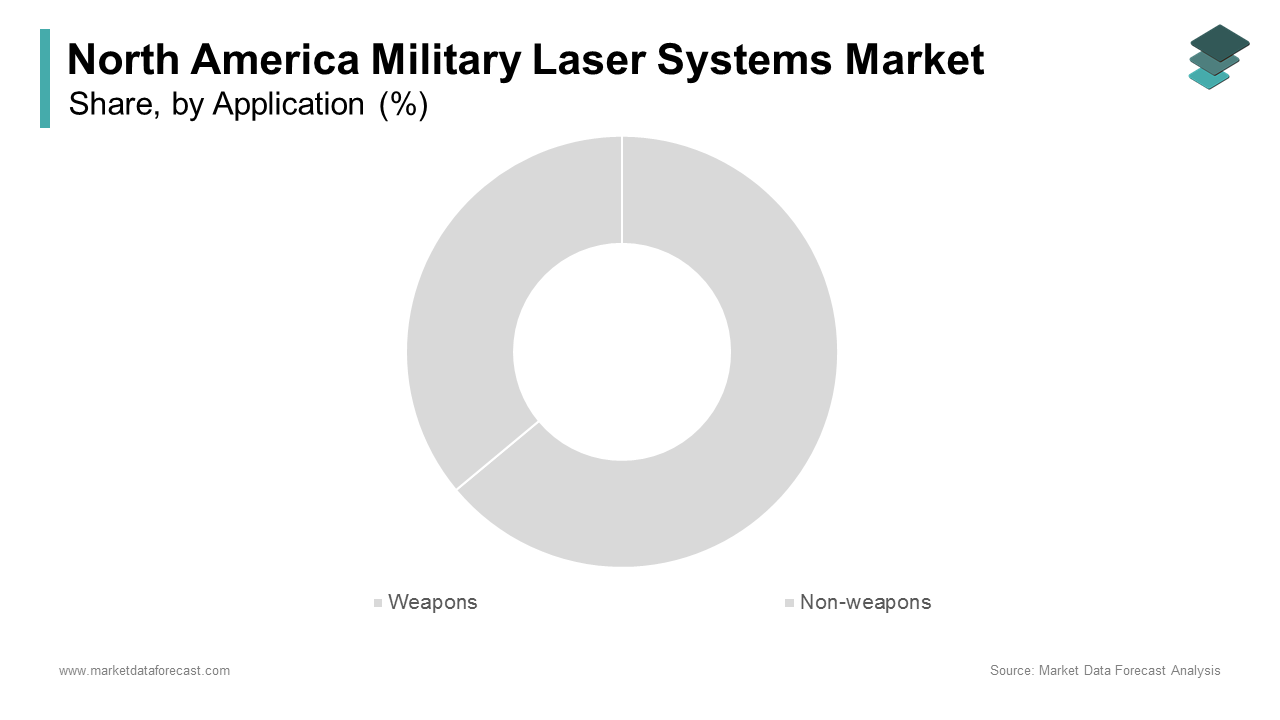
The weapons segment dominated the North America military laser systems market by capturing a dominant share in 2024. According to the Congressional Research Service, over $10 billion has been allocated cumulatively since 2020 for directed energy weapon development across the Army, Navy, and Air Force. The High-Energy Laser Tactical Vehicle Demonstrator (HEL TVD) program, led by the U.S. Army, aims to deploy mobile laser platforms capable of neutralizing rockets, artillery, mortars (RAM), and small unmanned aerial vehicles (UAVs) with precision strikes. Additionally, the U.S. Navy has successfully tested laser prototypes aboard Arleigh Burke-class destroyers, demonstrating their ability to engage airborne threats without expending traditional ordnance.
The non-weapons segment is likely to grow with an estimated a CAGR of 9.2% throughout the forecast period. One major driver is the increasing deployment of laser rangefinders and designators in precision-guided munitions. According to the U.S. Army’s Combat Capabilities Development Command, over 75% of modern guided artillery shells and missiles rely on laser guidance systems for enhanced accuracy and reduced collateral damage. The Precision Guidance Kit (PGK) program alone has equipped more than 150,000 artillery rounds with laser-guidance capabilities since its inception. Furthermore, laser-based communication systems are gaining traction in secure data transmission for airborne and maritime operations. Another key factor is the integration of laser dazzlers for non-lethal deterrence in urban and peacekeeping missions. The Marine Corps’ Force Design 2030 initiative has emphasized the importance of low-intensity conflict tools, which is prompting increased procurement of optical countermeasure systems that disable enemy sensors without causing permanent destruction.
By Technology Insights
The solid-state lasers segment was accounted in holding 39.2% of the North America military laser systems market share in 2024. According to the U.S. Army’s Rapid Capabilities and Critical Technologies Office (RCCTO), solid-state laser systems have become the preferred choice for counter-unmanned aerial system (C-UAS) missions due to their rapid engagement capability and cost-effectiveness. Additionally, the U.S. Navy has integrated solid-state laser demonstrators aboard surface ships, including the USS Ponce and USS Portland, where they have successfully intercepted aerial drones and small boats. Moreover, industry leaders such as Lockheed Martin and Raytheon have made significant advancements in modular solid-state laser architectures, enabling power scaling through beam combining techniques. As per the Defense Science Board, scalable solid-state lasers offer a viable path toward megawatt-level output required for future strategic missile defense applications.
The fiber lasers segment is likely to grow with an estimated CAGR of 10.5% throughout the forecast period. One of the primary drivers is the growing interest in fiber lasers for multi-kilowatt to multi-hundred kilowatt applications in counter-drone and counter-rocket, artillery, and mortar (C-RAM) missions. Furthermore, fiber lasers are increasingly being explored for adaptive optics and sensor protection applications in electronic warfare. The Air Force Research Laboratory has incorporated fiber laser-based countermeasures into aircraft self-protection suites, designed to disrupt enemy radar and infrared tracking systems. Additionally, defense contractors like Northrop Grumman and Boeing are investing heavily in fiber laser research to develop lightweight, high-power modules for installation on fighter jets, armored vehicles, and unmanned platforms.
REGIONAL ANALYSIS
United States Military Laser Systems Market Insights
The United States held 84.3% of the North American military laser systems market share in 2024. The U.S. Department of Defense has identified directed energy weapons as a critical component of future force structure, allocating over $10 billion cumulatively since 2020 for laser weapon development across the Army, Navy, and Air Force. Programs such as the High-Energy Laser Tactical Vehicle Demonstrator (HEL TVD) and the Directed Energy Maneuver Short-Range Air Defense (DE M-SHORAD) system promotes the nation’s commitment to deploying laser-based solutions against emerging threats. Additionally, the U.S. Navy has successfully tested laser prototypes aboard Arleigh Burke-class destroyers, demonstrating their ability to neutralize aerial targets with minimal logistical burden. The Office of Naval Research reported that shipboard laser systems could significantly reduce reliance on traditional ammunition, extending mission endurance for fleet operations.
Canada Military Laser Systems Market Insights
Canada's military laser systems market is likely to gain healthy CAGR in the next coming years with the modernization efforts within the Canadian Armed Forces and increasing participation in NATO-led joint defense programs. The Canadian government has prioritized investments in advanced defense technologies, particularly in areas such as sensor fusion, directed energy countermeasures, and surveillance enhancements.
According to Public Services and Procurement Canada, national defense spending reached CAD $38 billion in fiscal year 2023–2024, with a dedicated allocation for emerging technologies including laser-based targeting and counter-drone systems. The Royal Canadian Air Force and Navy have expressed interest in laser dazzlers for non-lethal deterrence, aligning with broader NATO strategies on low-intensity conflict capabilities.
Additionally, Canada’s involvement in NORAD modernization and Arctic security initiatives has spurred demand for high-precision laser rangefinders and target designators. The Canadian Department of National Defence reported a 12% increase in procurement of laser-guided weapon systems in 2024, reflecting growing reliance on precision strike capabilities.
LEADING PLAYERS IN THE NORTH AMERICAN MILITARY LASER SYSTEMS MARKET
Lockheed Martin Corporation
Lockheed Martin is a leading force in the development and deployment of military laser systems, playing a pivotal role in advancing directed energy weapons for air, land, and sea platforms. The company has been instrumental in delivering high-energy laser prototypes for counter-unmanned aerial system (C-UAS) missions and integrated defense solutions. Its expertise spans solid-state and fiber laser technologies, with a focus on scalability, mobility, and integration with existing combat systems. The company’s contributions extend beyond hardware to include beam control, targeting systems, and command-and-control software that enhance operational effectiveness. Through strategic partnerships with the U.S. Army, Navy, and Air Force, Lockheed Martin continues to drive innovation in next-generation laser weaponry.
Raytheon Technologies Corporation
Raytheon Technologies is at the forefront of military laser system innovation, offering advanced directed energy solutions tailored for missile defense, electronic warfare, and tactical engagements. The company has developed high-power laser demonstrators capable of neutralizing airborne threats with precision and efficiency, aligning with U.S. Department of Defense modernization goals.
Raytheon integrates laser technology into broader combat ecosystems by ensuring seamless interoperability across platforms. Its work on compact, mobile laser systems for ground vehicles and naval vessels reflects a strategic emphasis on deployability and mission flexibility.
Raytheon’s collaboration with government agencies and research institutions has accelerated the transition from experimental to field-deployable systems. Raytheon continues to shape the evolution of laser-based defense technologies, which is reinforcing its position as a major influencer in the global market.
Northrop Grumman Corporation
Northrop Grumman plays a crucial role in the advancement of military laser systems, particularly in the development of high-energy lasers for air and space applications. The company has pioneered fiber laser technology that enables scalable, efficient, and compact directed energy solutions suitable for aircraft and satellite-based platforms.
Its engineering focus on thermal management, beam control, and power integration has significantly contributed to the feasibility of airborne laser weapons. Northrop’s innovations are aligned with evolving battlefield needs, including rapid engagement of small drones and hypersonic threats.
Northrop Grumman delivers laser systems that meet stringent performance and reliability standards by leveraging decades of experience in aerospace and defense electronics. Its ongoing R&D initiatives and strategic collaborations with the U.S. military ensure continued dominance in shaping the future of directed energy warfare and enhancing national security capabilities globally.
TOP STRATEGIES USED BY KEY MARKET PARTICIPANTS
One of the primary strategies employed by key players in the North American military laser systems market is deep collaboration with defense agencies and research institutions. Companies such as Lockheed Martin, Raytheon, and Northrop Grumman maintain strong partnerships with the U.S. Department of Defense, DARPA, and university-led research centers to accelerate technology development and field deployment.
Another critical approach is continuous investment in research and development to refine laser efficiency, scalability, and platform integration. These firms prioritize advancements in beam combining, thermal management, and adaptive optics to overcome technical limitations and improve battlefield readiness. This enables them to stay ahead in an increasingly competitive environment. Companies are focusing on strategic acquisitions and internal innovation programs to expand their directed energy portfolios.
KEY MARKET PLAYERS AND COMPETITION OVERVIEW
Major Key Players of the North America Military Laser Systems Market include Lockheed Martin Corporation, Northrop Grumman Corporation, Raytheon Technologies Corporation, Boeing Defense Space & Security, L3Harris Technologies, General Dynamics Corporation, BAE Systems, Coherent (II-VI Incorporated), Kratos Defense & Security Solutions, BlueHalo, General Atomics
The competition in the North American military laser systems market is highly concentrated among a few dominant defense primes, with Lockheed Martin, Raytheon, and Northrop Grumman leading the way in technology development and program execution. These firms leverage their extensive defense sector experience, established supply chains, and deep relationships with the U.S. Department of Defense to secure long-term contracts and influence strategic direction.
However, emerging players and niche technology developers are gradually entering the ecosystem, offering specialized components such as beam directors, optical sensors, and modular power systems. While these smaller firms lack the scale of industry giants, they contribute valuable innovation and agility, often serving as subcontractors or acquisition targets for larger companies aiming to enhance their directed energy capabilities.
Government-funded research initiatives and classified programs further intensify the competitive landscape, with vendors vying for early-stage involvement in next-generation laser weapon systems. The race to develop deployable, high-power lasers for multi-domain operations is driving continuous technological evolution, which is making intellectual property, system modularity, and integration expertise key differentiators.
RECENT HAPPENINGS IN THE MARKET
- In January 2024, Lockheed Martin successfully demonstrated a mobile high-energy laser system mounted on a Stryker armored vehicle, which is showcasing real-time engagement of multiple aerial targets during a U.S. Army field test, reinforcing its dominance in tactical laser defense solutions.
- In March 2024, Raytheon unveiled a new family of fiber laser modules designed for rapid integration into existing combat platforms by allowing for scalable power outputs tailored to evolving threat scenarios, marking a significant step toward modular, plug-and-play laser weaponry.
- In June 2024, Northrop Grumman announced a breakthrough in airborne laser testing, which is achieving sustained beam stability under flight conditions, a milestone that advances the feasibility of deploying high-energy lasers on fighter jets and unmanned aerial vehicles.
- In September 2024, Boeing partnered with a leading optical systems provider to co-develop next-generation beam control technologies aimed at improving laser accuracy and atmospheric compensation by enhancing target engagement capabilities for future deployments.
- In December 2024, General Atomics Electromagnetic Systems launched a containerized laser defense system prototype capable of rapid deployment in remote locations, which is supporting expeditionary forces with mobile, high-precision counter-drone and anti-munitions capabilities.
DETAILED SEGMENTATION OF THE NORTH AMERICA MILITARY LASER SYSTEMS MARKET INCLUDED IN THIS REPORT
This research report on the North America Military Laser Systems Market has been segmented and sub-segmented based on application, technology & region.
By Application
- Weapons
- Non-weapons
By Technology
- Solid-state Laser
- Fiber Laser
- Semiconductor Laser
- Gas Laser, Liquid Laser
- Free-electron Laser
By Region
- US
- Canada
- Mexico
- Rest of North America