- Product Description Description
- Table of Contents TOC
- List of Table & Figure LOT
- Get Free Sample PDF Sample PDF
North America Millimeter Wave Technology Market Size
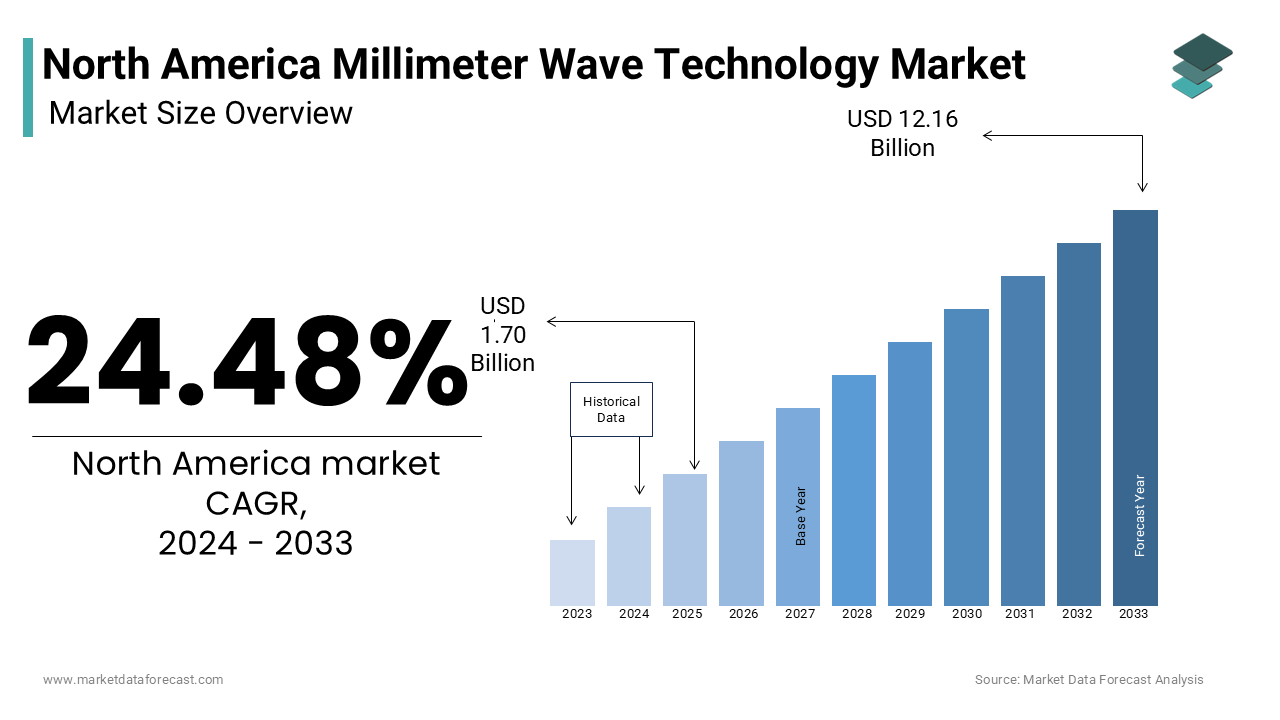
In 2024, the global North America Millimeter Wave Technology Market was valued at USD 1.70 billion and is forecasted to grow to USD 12.16 billion by 2033, at a CAGR of 24.48%.
Millimeter wave technology refers to the use of electromagnetic waves in the frequency range of 30 GHz to 300 GHz, which offer high bandwidth and faster data transmission rates. These waves are increasingly being deployed across telecommunications, automotive, aerospace, defense, and industrial applications due to their ability to support ultra-low latency communication and high-resolution sensing capabilities. In North America, the adoption of millimeter wave technology has accelerated significantly, particularly with the rollout of 5G networks. The United States and Canada have emerged as key markets driven by early deployment of advanced wireless infrastructure and growing investments in R&D for high-frequency applications. Additionally, the integration of millimeter wave systems in autonomous vehicles for real-time object detection and collision avoidance has gained traction. According to the National Highway Traffic Safety Administration (NHTSA), more than 80% of new vehicle models in the U.S. by 2025 will incorporate radar systems operating in the 76–81 GHz band, a key millimeter wave frequency used for precision sensing.
MARKET DRIVERS
Expansion of 5G Infrastructure
The rapid deployment of 5G networks across North America has become a pivotal driver for the growth of the millimeter wave technology market. Unlike traditional sub-6 GHz bands, millimeter wave frequencies offer significantly higher bandwidth, enabling faster download speeds and reduced latency. According to the CTIA, a U.S.-based trade association for the wireless communications industry, over 40% of 5G network deployments in the U.S. as of 2024 utilized millimeter wave spectrum, primarily in urban centers and densely populated areas where demand for high-speed connectivity is highest. The FCC has played a crucial role in accelerating this trend by auctioning high-band spectrum licenses, including the 28 GHz and 39 GHz bands. By mid-2024, these auctions had generated over $10 billion in revenue, indicating strong commercial interest from telecom operators such as Verizon, AT&T, and T-Mobile. Furthermore, enterprise adoption of private 5G networks leveraging millimeter wave technology has surged. ABI Research reported that more than 1,200 private 5G networks were deployed across North America in 2024, with over 60% utilizing millimeter wave bands for mission-critical operations in manufacturing, logistics, and healthcare.
Growth in Automotive Radar Systems
The automotive sector has emerged as a significant growth engine for millimeter wave technology, particularly in advanced driver-assistance systems (ADAS) and autonomous vehicles. Millimeter wave radar systems, especially those operating in the 76–81 GHz band, are widely adopted for their superior performance in object detection, speed measurement, and all-weather reliability. This trend is further reinforced by regulatory mandates and consumer demand for enhanced road safety. Moreover, the shift toward Level 2+ and Level 3 autonomous driving systems has amplified the need for high-resolution sensors capable of real-time environmental mapping. Yole Développement estimates that the number of radar sensors per vehicle in North America is expected to rise from an average of 2.5 in 2023 to over 4 by 2027. This increase directly correlates with the expanding footprint of millimeter wave technology in automotive applications across the region.
MARKET RESTRAINTS
High Deployment and Infrastructure Costs
The widespread adoption of millimeter wave technology in North America is the high cost associated with its deployment and supporting infrastructure. Unlike lower frequency bands, millimeter wave signals have shorter propagation distances and are highly susceptible to signal degradation due to physical obstructions like buildings, foliage, and even human bodies. This necessitates the installation of a dense network of small cells and repeaters to ensure consistent coverage. In addition, the requirement for fiber backhaul connections further escalates capital expenditures. Telecom operators also face operational costs related to maintenance, power consumption, and site acquisition. For instance, Verizon’s initial millimeter wave rollout between 2019 and 2022 reportedly incurred losses due to the limited customer uptake relative to infrastructure investment.
Regulatory and Spectrum Allocation Limitations
The regulatory complexities and spectrum allocation limitations remain a key restraint for the North American millimeter wave technology market. As per the National Telecommunications and Information Administration (NTIA), several millimeter wave bands overlap with existing federal uses, particularly in defense and weather forecasting applications. For example, the 24 GHz band faced regulatory scrutiny due to concerns about potential interference with satellite-based weather monitoring systems. The NOAA and NASA raised alarms that signal leakage in this band could compromise the accuracy of atmospheric water vapor measurements, which is delaying commercial rollouts and creating uncertainty for investors. Additionally, while the FCC has allocated large chunks of millimeter wave spectrum for mobile use, there is still a lack of standardized frameworks for coexistence with fixed wireless access (FWA) and point-to-point microwave links. This creates fragmentation in usage and complicates network planning.
MARKET OPPORTUNITIES
Integration in Industrial IoT and Smart Manufacturing
The convergence of millimeter wave technology with Industrial Internet of Things (IIoT) and smart manufacturing presents a substantial growth opportunity in North America. With the rise of Industry 4.0, manufacturers are increasingly adopting real-time communication systems that require ultra-low latency and high data throughput capabilities inherently offered by millimeter wave frequencies.
According to the Industrial Internet Consortium, over 60% of large-scale manufacturing facilities in the U.S. have begun implementing IIoT platforms to optimize production efficiency and predictive maintenance. Many of these systems rely on millimeter wave-enabled wireless sensors and machine-to-machine (M2M) communication networks to facilitate seamless data exchange without the constraints of wired infrastructure.
Expansion in Aerospace and Defense Surveillance
The aerospace and defense sector in North America represents a robust growth avenue for millimeter wave technology in surveillance, navigation, and electronic warfare systems. According to the U.S. Department of Defense’s 2024 Modernization Strategy, over $4 billion has been earmarked for the development and integration of millimeter wave-based radar and communication systems across fighter jets, unmanned aerial vehicles (UAVs), and ground-based command centers. These systems operate primarily in the 77–81 GHz and 94 GHz bands, offering improved target identification and tracking capabilities compared to legacy radar technologies. Northrop Grumman and Raytheon Technologies have been leading the charge in developing millimeter wave electronic warfare systems that can detect and neutralize enemy drones and stealth aircraft.
MARKET CHALLENGES
Signal Propagation and Environmental Limitations
The inherent limitation of signal propagation in high-frequency bands is one of the major challenges for the growth of the North American millimeter wave technology market. According to research conducted by the IEEE, millimeter wave signals at 28 GHz and 39 GHz exhibit path loss of up to 10 dB more than sub-6 GHz signals over the same distance. In urban environments with dense building structures, this results in frequent signal dropouts and inconsistent coverage unless complemented by beamforming and massive MIMO technologies. Moreover, atmospheric absorption becomes more pronounced beyond 60 GHz, where oxygen molecules absorb a significant portion of the transmitted energy. These propagation challenges necessitate the deployment of a dense array of small cells, relays, and indoor repeaters, thereby increasing both capital and operational expenditures.
Competition from Alternative Wireless Technologies
The stiff competition from alternative wireless solutions that offer comparable or more cost-effective performance in certain applications is limiting the growth of the North American millimeter wave technology market. Sub-6 GHz 5G, Wi-Fi 6/6E, and Low Earth Orbit (LEO) satellite broadband are emerging as viable substitutes in rural and mid-range connectivity scenarios where millimeter wave deployment is economically unfeasible. According to Ookla’s Speedtest Global Index Q1 2024, sub-6 GHz 5G networks in the U.S. achieved median download speeds of 130 Mbps, sufficient for most consumer and enterprise applications outside of ultra-high-definition streaming or real-time cloud computing. Wi-Fi 6E, operating in the 6 GHz band, offers multi-gigabit speeds with lower latency and better wall penetration, making it a preferred choice for indoor enterprise applications.
SEGMENTAL ANALYSIS
By Component Insights
The antennas and transceivers segment held 32.1% of the North American millimeter wave technology market share in 2024 with the rising deployment of high-frequency communication systems that require advanced antenna arrays capable of beamforming and directional signal transmission. According to a report by Yole Développement, the demand for phased array antennas used in 5G base stations and automotive radar applications has surged, with over 8 million units shipped across North America in 2023 alone. Moreover, transceiver modules operating in the millimeter wave band are essential components in both commercial and defense-grade radar systems.
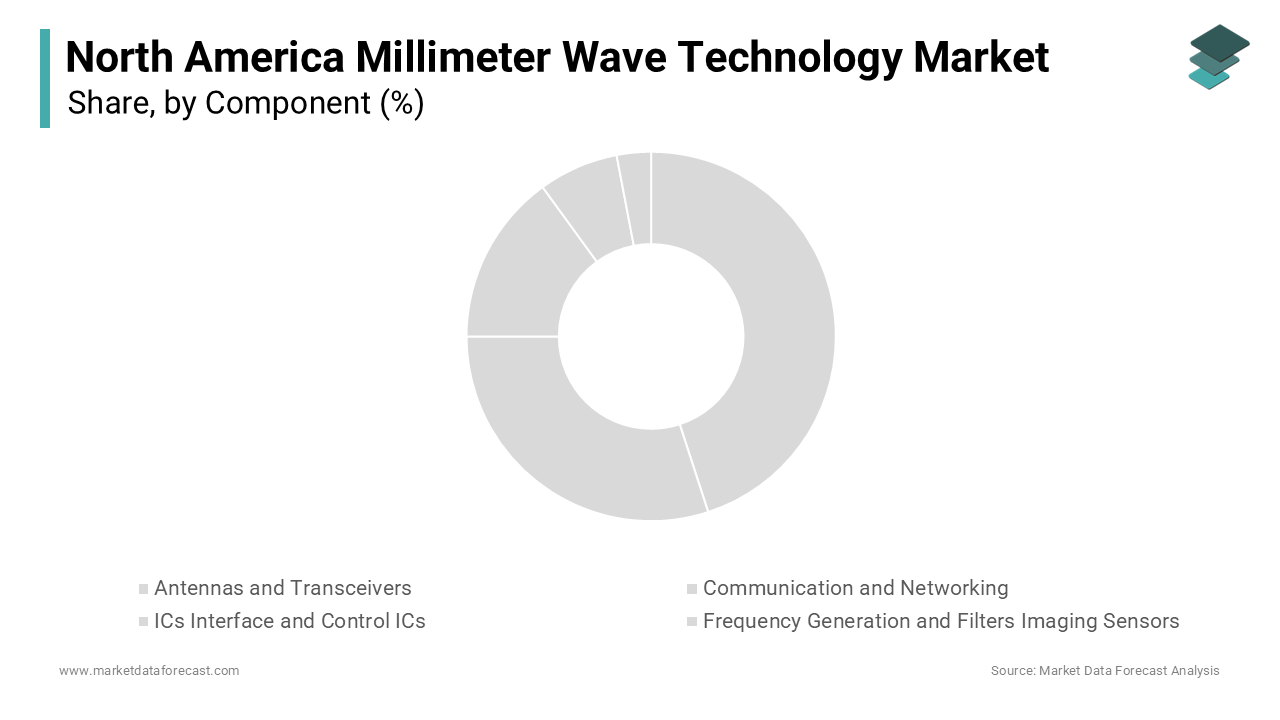
The Frequency Generation and Filters segment is projected to expand with a CAGR of 19.4% from 2025 to 2033 with the proliferation of multi-band 5G networks that necessitate advanced frequency synthesizers and filtering solutions to isolate millimeter wave signals from adjacent bands. As per Skyworks Solutions’ 2024 technical whitepaper, modern smartphones equipped with mmWave support incorporate up to five times more filters compared to sub-6 GHz devices, which is boosting demand for this component category.
Furthermore, aerospace and defense applications are contributing substantially to this growth. In addition, semiconductor manufacturers like Qorvo and Broadcom have introduced compact, high-performance surface acoustic wave (SAW) and bulk acoustic wave (BAW) filters tailored for millimeter wave operations.
Segmental Analysis of the North America Millimeter Wave Technology Market by Licensing Model
The fully/partly licensed model segment held a dominant share of the North American millimeter wave technology market share in 2024 with the regulatory frameworks established by the Federal Communications Commission (FCC), which have prioritized licensed spectrum for high-capacity wireless services. Major carriers such as Verizon and AT&T have invested heavily in licensed mmWave spectrum to build ultra-dense urban 5G networks. According to CTIA, over 40% of all 5G small cell deployments in the U.S. as of early 2024 utilized fully licensed bands in metropolitan areas where guaranteed bandwidth and minimal interference are important. Moreover, enterprise use cases, especially in private 5G networks for manufacturing and logistics, have increasingly favored licensed access to ensure quality of service (QoS).
The unlicensed spectrum segment is projected to grow with a CAGR of 21.2% from 2025 to 2033. The unlicensed 60 GHz band, commonly referred to as WiGig, has seen increased adoption in high-speed indoor networking, including wireless docking stations, VR headsets, and smart home automation systems. In addition, the rollout of IEEE 802.11ay standards which extend Wi-Fi capabilities beyond 10 Gbps in the 60 GHz rangemhas spurred innovation among chipmakers like Intel and MediaTek. Furthermore, enterprises are leveraging unlicensed mmWave for temporary network setups in warehouses, hospitals, and retail environments.
By Frequency Band Insights
The 24–57 GHz band segment was the largest by capturing 48.4% of the North American millimeter wave technology market share in 2024. According to the Federal Communications Commission (FCC), the 28 GHz and 39 GHz bands both within the 24–57 GHz range are among the most auctioned and commercially exploited segments for 5G rollouts. In 2023 alone, the FCC’s mmWave spectrum auctions generated over $9.3 billion with major telecom operators acquiring licenses in these bands to enhance network capacity in urban centers. Verizon, for instance, has built one of the most expansive mmWave 5G footprints in the U.S., covering over 35 metropolitan areas with peak download speeds exceeding 2 Gbps in select locations.
The 95–300 GHz segment is anticipated to grow with a CAGR of 23.1% from 2025 to 2033 with the increasing adoption of terahertz (THz)-range sensors in medical diagnostics and security screening. According to a 2024 report by Grand View Research, the global THz imaging market is expanding rapidly, with North America accounting for over 40% of new system deployments. ssAnother significant driver is the development of ultra-short-range vehicular radar for autonomous driving. Companies like Infineon and Texas Instruments are pioneering radar-on-chip solutions in the 140–180 GHz range, offering higher resolution and faster response times than conventional 76–81 GHz radars. In addition, satellite and point-to-point communication links are exploring the 95–300 GHz band for ultra-secure, high-capacity transmissions. The MIT Lincoln Laboratory recently demonstrated a 100 Gbps data link using the 150 GHz band, paving the way for future ultra-wideband applications.
REGIONAL ANALYSIS
The United States was the top performer in the North American millimeter wave technology market with 78.3% of share in 2024. According to the CTIA, the U.S. leads globally in 5G deployment, with over 200,000 5G small cells installed by mid-2024, many of which utilize millimeter wave spectrum. Major carriers such as Verizon, AT&T, and T-Mobile have been instrumental in rolling out mmWave-based ultra-dense networks in urban centers like New York, Chicago, and Los Angeles. Moreover, the automotive industry is witnessing a surge in mmWave radar adoption. The National Highway Traffic Safety Administration (NHTSA) reports that over 70% of new U.S.-sold vehicles now include ADAS features powered by 76–81 GHz radar modules.
Canada was positioned second in the North American millimeter wave technology market with 14.3% of share in 2024. In 2023, Innovation, Science and Economic Development Canada (ISED) conducted a spectrum auction for the 26 GHz and 38 GHz bands, raising over CAD 2.1 billion, signaling strong interest from telecom providers like Rogers, Bell, and Telus. The Canadian government has also prioritized the integration of millimeter wave technology in intelligent transportation systems. Natural Resources Canada estimates that by 2026, over 60% of new electric vehicles sold in the country will feature embedded mmWave radar for autonomous driving functions. Additionally, academic institutions such as the University of Waterloo and École Polytechnique de Montréal are spearheading research in mmWave propagation and antenna design by fostering innovation in the sector.
KEY MARKET PLAYERS AND COMPETITIVE LANDSCAPE
Key players in the North America Millimeter Wave Technology Market include Aviat Networks, Inc., BridgeWave Communications, E-Band Communications, LLC, SAGE Millimeter, Inc. (Eravant), Siklu Communication Ltd., Millimeter Wave Products, Inc., NEC Corporation, L3Harris Technologies, Inc., Ceragon Networks Ltd., Keysight Technologies, Inc., Ducommun Incorporated, and Smiths Group plc.
The competition in the North America millimeter wave technology market is intense, driven by rapid technological advancements and growing demand across multiple sectors. Major players are continuously innovating to differentiate their offerings and capture a larger share of the expanding ecosystem. The market landscape features a mix of established semiconductor firms, emerging startups, and vertically integrated solution providers, all vying for dominance through enhanced product portfolios and strategic positioning. As industries ranging from telecommunications to automotive embrace high-frequency communication, the pressure to deliver superior performance, reliability, and scalability intensifies. Companies are not only focusing on component-level improvements but also on end-to-end system integration to provide comprehensive solutions. Regulatory developments and spectrum availability further influence competitive dynamics, prompting firms to align closely with policy frameworks.
Top Players in the North America Millimeter Wave Technology Market
One of the leading players in the North America millimeter wave technology market is Qualcomm Technologies, Inc. The company has been at the forefront of developing advanced semiconductor solutions that enable high-frequency communication systems. Qualcomm’s expertise lies in integrating millimeter wave capabilities into mobile and automotive platforms, making ultra-fast connectivity more accessible across consumer and industrial applications.
Another key player is Analog Devices, Inc. (ADI) , known for its cutting-edge RF and microwave technologies. ADI contributes significantly to the global market by offering high-performance transceivers, signal processors, and antenna modules tailored for millimeter wave applications. Their innovations support sectors such as defense, telecommunications, and industrial automation.
Infineon Technologies AG also plays a pivotal role in shaping the millimeter wave ecosystem. Infineon specializes in radar and sensing solutions, particularly for the automotive industry. Its millimeter wave radar chips are widely adopted in advanced driver-assistance systems (ADAS) by enhancing vehicle safety and autonomous driving capabilities globally.
Top Strategies Used by Key Market Participants
One major strategy employed by key players is strategic partnerships and collaborations with telecom operators, automotive manufacturers, and government agencies. These alliances help companies align their R&D efforts with real-world deployment needs, which is accelerating product adoption and regulatory compliance.
Another prevalent approach is product innovation and development, where firms continuously invest in next-generation chipsets, antennas, and system-on-chip solutions tailored for millimeter wave frequencies. This enables them to stay ahead in performance, efficiency, and integration capabilities across diverse applications.
A third key strategy involves expanding manufacturing capabilities and supply chain networks to meet rising demand. Companies are setting up dedicated production lines and working closely with foundries to ensure consistent output of high-frequency components while reducing time-to-market for new products.
RECENT MARKET DEVELOPMENTS
- In February 2024, Qualcomm Technologies announced a joint venture with a leading automotive supplier to integrate its latest millimeter wave radar platform into next-generation electric vehicles, enhancing autonomous driving capabilities and strengthening its foothold in the automotive sector.
- In May 2024, Analog Devices, Inc. launched an advanced millimeter wave evaluation kit designed for industrial IoT and private 5G networks by enabling faster prototyping and deployment of high-bandwidth wireless solutions across enterprise environments in North America.
- In August 2024, Infineon Technologies expanded its North American operations by opening a new research and development center in Silicon Valley focused exclusively on millimeter wave sensor technologies for mobility and security applications.
- In October 2024, Texas Instruments introduced a new family of mmWave ICs optimized for factory automation and robotics, which is supporting precision sensing and real-time decision-making in industrial settings, thereby reinforcing its presence in the manufacturing domain.
- In December 2024, Raytheon Technologies secured a multi-year contract with the U.S. Department of Defense to develop and deploy millimeter wave-based electronic warfare systems, which is boosting its role in national defense and security infrastructure.
MARKET SEGMENTATION
This research report on the North American millimeter wave technology market is segmented and sub-segmented based on categories.
By Component
- Antennas and Transceivers
- Communication and Networking
- ICs Interface and Control ICs
- Frequency Generation and Filters Imaging Sensors
- Other Components
By Licensing Model
- Fully/Partly Licensed
- Unlicensed
By Frequency Band
- 24-57 GHz
- 57-95 GHz
- 95-300 GHz
By Country
- The United States
- Canada
- Rest of North America