- Product Description Description
- Table of Contents TOC
- List of Table & Figure LOT
- Get Free Sample PDF Sample PDF
Market Size, 2025
$185.41 MnMarket Estimate, 2026
$193.55 MnMarket Forecast, 2034
$272.94 MnCAGR, 2026–2034
4.39%Executive Summary: North America Miniature Ball Bearing Market
- Market Scope: Regional North American miniature ball bearing market analysis covering bearing types, application sectors, country leadership frameworks, and precision component adoption metrics.
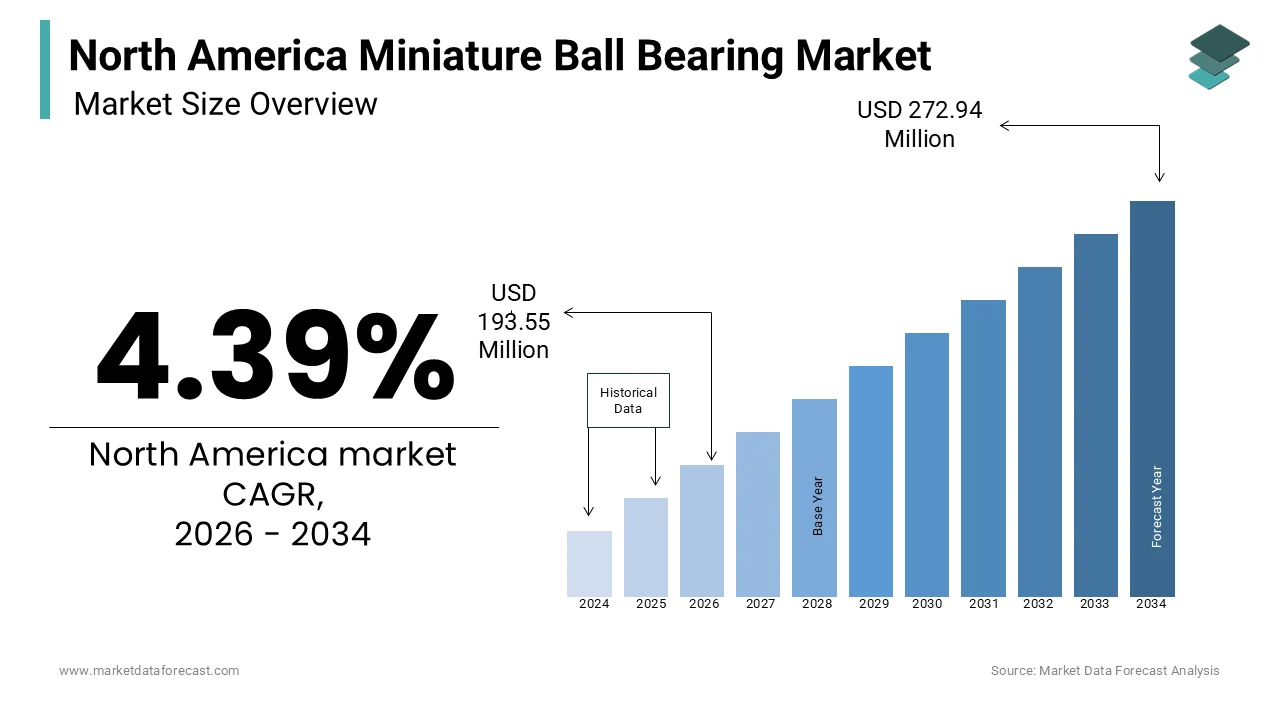
- Market Valuation: Valued at USD 185.41 million in 2025, estimated at USD 193.56 million in 2026, and projected to reach USD 278.90 million by 2034, registering a CAGR of 4.39% from 2026 to 2034.
- Primary Growth Drivers: Increasing adoption of precision components across industrial automation, robotics, medical devices, aerospace, defense, and electric mobility applications. Key operational metrics include strong automation investments and high-precision bearing demand from surgical robotics, diagnostic equipment, and advanced manufacturing systems.
Key Market Segment Metrics (2026–2034)
| Category | Leading Segment (2025 Position) | Fastest-Growing Segment |
|---|---|---|
| By Bearing Type | Open miniature ball bearings (dominated with a 48.2% share, driven by high-speed performance and reduced friction) | Dust cover miniature ball bearings (projected to witness the fastest growth with an 8.7% CAGR) |
| By Application | Industrial segment (accounted for 36.4% of the market in 2025) | Medical segment (expected to expand at a 9.2% CAGR due to robotic-assisted surgical systems) |
| By End-Use Industry | Industrial automation, robotics, and aerospace sectors | Electric mobility, drones, and portable electronics |
| By Region / Country | United States (led regional market with a 75.4% share, backed by strong manufacturing and medical tech industries) | Canada (accounting for 14.2% share with expanding precision engineering applications) |
Major Market Players & Market Structure
Market Structure: Competitive North American component manufacturing landscape focused on ultra-precision engineering, ceramic hybrid bearings, customized miniature bearing solutions, smart condition-monitoring technologies, and advanced manufacturing investments.
Key Companies: SKF Group, NSK Ltd., Schaeffler Group, RBC Bearings, MinebeaMitsumi Inc., NTN Corporation, JTEKT Corporation, Timken Company, Nachi-Fujikoshi Corp., AST Bearings LLC, Boca Bearing Company, CW Bearing GmbH, ABB, Siemens AG, and Reinfurt GmbH & Co. KG.
North America Miniature Ball Bearing Market Size
The North America miniature ball bearing market size was valued at USD 185.41 million in 2025 and is anticipated to reach a valuation of USD 193.55 million in 2026 and USD 272.94 million by 2034, growing at a CAGR of 4.39%, from 2026 to 2034.
Miniature ball bearings are typically defined as rolling-element bearings with an outer diameter of 30 mm or less, and are precision-engineered components designed to reduce rotational friction and support radial and axial loads in compact mechanical systems. These bearings are critical in applications requiring high-speed operation, minimal clearance, and exceptional reliability, including medical devices, aerospace actuators, robotics, and consumer electronics. Constructed primarily from high-carbon chromium steel, ceramic hybrids, or stainless steel, miniature ball bearings are manufactured to exacting tolerances, often within micro-nss to ensure performance consistency under dynamic conditions. According to the National Institute of Standards and Technology, over 80% of surgical robotics platforms in U.S. hospitals utilize miniature bearings in wrist joints and drive mechanisms, where precision motion control is non-negotiable. The U.S. Food and Drug Administration emphasizes that bearing failure in implantable or diagnostic equipment can lead to critical system malfunctions, necessitating adherence to stringent material and fatigue life specifications.
MARKET DRIVERS
Proliferation of Minimally Invasive Surgical Robotics and Medical Devices
The rapid adoption of robotic-assisted surgical systems is propelling the growth of the North America Miniature Ball Bearing Market. These systems rely on miniature bearings in articulating arms, end-effectors, and motorized joints to achieve sub-millimeter accuracy during procedures such as laparoscopy, neurosurgery, and orthopedic interventions. According to the American College of Surgeons, over 1.2 million robotic surgeries were performed in the United States in 2023, representing a 14% year-on-year increase, with platforms like the da Vinci Surgical System incorporating up to 40 miniature bearings per unit. The U.S. Department of Health and Human Services notes that hospitals investing in robotic surgery report a 23% reduction in postoperative complications, driving further capital expenditure in advanced surgical infrastructure. The National Institutes of Health confirms that over 500,000 implantable devices were implanted in 2023, many of which integrate miniature bearings in micro-pump mechanisms. The FDA’s Center for Devices and Radiological Health has approved 89 new robotic and implantable systems since 2021, all of which necessitate high-performance motion components.
Expansion of Industrial Automation and Collaborative Robotics (Cobots)
The transformation of manufacturing through industrial automation and the deployment of collaborative robots has significantly amplified the need for high-precision miniature ball bearings in joints, grippers, and servo motors, which is surging the growth of the North America Miniature Ball Bearing Market. According to the Association for Advancing Automation, North American factories installed over 35,000 robotic systems in 2023, with cobot usage growing at 27% annually since 2020. Each cobot typically contains between 20 and 30 miniature bearings to enable smooth articulation and torque transmission across multiple axes. The U.S. Bureau of Labor Statistics reports that labor shortages in manufacturing have intensified the shift toward automation, with 68% of mid-sized manufacturers investing in robotic cells to maintain productivity. The National Institute for Occupational Safety and Health highlights that cobots reduce workplace injuries by 31% in repetitive assembly tasks, increasing their adoption in electronics, pharmaceuticals, and food processing. Furthermore, the rise of smart factories under Industry 4.0 frameworks demands bearings capable of withstanding high cycling rates and continuous operation. Some systems run 24/7 with maintenance intervals exceeding 18 months.
MARKET RESTRAINTS
Geopolitical Disruptions in Specialty Steel and Rare Earth Material Supply Chains
The production of high-performance miniature ball bearings is dependent on specialty steel, particularly high-carbon chromium steel (AISI 52100), and rare earth elements used in advanced coatings and ceramic rolling elements, which is hampering the growth of the North America Miniature Ball Bearing Market. According to the U.S. Geological Survey, the United States imports over 90% of its high-purity chromium and 100% of its cobalt, both essential for bearing steel hardening and corrosion resistance. China controls 60% of global rare earth refining capacity, as reported by the International Energy Agency, creating strategic risk for manufacturers using samarium-cobalt or neodymium-based coatings for extreme-environment bearings. Additionally, the imposition of tariffs under Section 232 of the Trade Expansion Act has increased raw material costs by up to 18%, as documented by the American Iron and Steel Institute. The Russia-Ukraine conflict further disrupted molybdenum and nickel supplies, with prices spiking by 22% in 2022, according to the London Metal Exchange.
Stringent Regulatory and Certification Requirements in Aerospace and Medical Sectors
The use of miniature ball bearings in aerospace and medical applications is subject to exhaustive regulatory scrutiny and certification processes, which are also impeding the growth of the North American miniature Ball Bearing Market. In aerospace, every bearing must comply with AS9100 and Nadcap standards, requiring full traceability of materials, heat treatment records, and non-destructive testing documentation. According to the Federal Aviation Administration, the certification of a new bearing design for flight-critical systems can take up to 36 months and involve over 5,000 hours of fatigue and endurance testing. Similarly, the U.S. Food and Drug Administration mandates that bearings used in implantable or diagnostic devices undergo biocompatibility testing per ISO 10993, sterilization validation, and long-term wear analysis. The National Institute of Biomedical Imaging and Bioengineering notes that failure rates in implantable device components must be below 0.1% over a 10-year lifespan, necessitating extensive accelerated life testing. The American Society for Quality reports that bearing manufacturers spend up to 30% of R&D budgets on compliance-related documentation and audits.
MARKET OPPORTUNITIES
Integration into Wearable and Implantable Health Monitoring Devices
The surge in wearable and implantable health technologies for miniature ball bearing manufacturers, as next-generation devices require micro-scale motion components for actuation, sensing, and fluid delivery, is scaling up new opportunities for the growth of the North America Miniature Ball Bearing Market. Smartwatches, insulin pumps, hearing aids, and neurostimulators increasingly incorporate micro-motors and haptic feedback systems that rely on ultra-compact, low-torque bearings to ensure smooth, silent operation. According to the Consumer Technology Association, over 84 million wearable health devices were sold in the U.S. in 2023, with 62% featuring active components such as micro-pumps or adjustable lenses. The National Institutes of Health reports that continuous glucose monitors (CGMs) now include microfluidic pumps with integrated bearings to regulate insulin flow in closed-loop systems. Additionally, the FDA has approved 17 new wearable therapeutic devices since 2022, including wearable kidney dialysis units and transdermal drug delivery patches with mechanical actuators.
Advancements in Electric Micro-Mobility and Personal Transport Devices
The rapid evolution of electric micro-mobility solutions, including e-scooters, e-bikes, personal drones, and robotic delivery u, is creating new opportunities for the growth of the North America Miniature Ball Bearing Market. These vehicles operate in high-vibration, variable-load environments, requiring bearings that offer long service life with minimal maintenance. According to the North American Bikeshare and Scootershare Association, over 150 million e-scooter trips were recorded in U.S. cities in 2023, with fleet operators replacing wheel and motor bearings every 6–8 months due to urban wear conditions. According to the Consumer Technology Association, the U.S. personal drone market grew by 19% in 2023, with camera gimbals and propulsion systems incorporating ceramic hybrid bearings for high-speed stability. The National Renewable Energy Laboratory confirms that lightweighting in e-bikes has reduced average vehicle mass by 12% since 2020, increasing reliance on high-efficiency bearings to maintain performance.
MARKET CHALLENGES
Counterfeit and Substandard Bearings in the Aftermarket Supply Chain
The persistent threat from counterfeit and substandard products infiltrating the aftermarket and industrial supply chains is acting as a barrier to the growth of the North America Miniature Ball Bearing Market. According to the U.S. Customs and Border Protection, over 1.2 million counterfeit bearings were seized at U.S. ports in 2023, a 34% increase from the previous year, primarily originating from Southeast Asia. The Federal Aviation Administration has documented 17 cases of counterfeit bearings in aircraft maintenance inventories since 2020, some of which were installed in flight control systems before detection. The National Transportation Safety Board attributes two helicopter maintenance incidents to bearing fatigue caused by substandard components. In the medical sector, the FDA issued a safety alert in 2023 warning hospitals about counterfeit bearings in surgical drills, which failed during procedures due to inadequate load capacity. The American Bearing Manufacturers Association estimates that up to 15% of bearings sold through third-party distributors are non-compliant or fraudulent.
Thermal and Wear Degradation in High-Speed, Miniaturized Applications
The miniature ball bearings are subjected to extreme thermal and mechanical stresses that accelerate wear and reduce operational lifespan, in addition to inhibiting the growth of the North American miniature ball bearing market. According to the American Society of Mechanical Engineers, temperatures within miniature bearing races can reach 180°C under continuous load, leading to lubricant breakdown and micro-welding of rolling elements. Furthermore, the reduced mass of miniature bearings limits their ability to dissipate heat, exacerbating the issue. In aerospace actuators, the European Space Agency notes that thermal cycling in vacuum environments causes differential expansion between inner and outer rings, inducing preloading and increased friction.
REPORT COVERAGE
| REPORT METRIC | DETAILS |
| Market Size Available | 2025 to 2034 |
| Base Year | 2025 |
| Forecast Period | 2026 to 2034 |
| CAGR | 4.39% |
| Segments Covered | By Type, Application, and By Country |
| Various Analyses Covered | Global, Regional & Country Level Analysis; Segment-Level Analysis, DROC, PESTLE Analysis, Porter’s Five Forces Analysis, Competitive Landscape, Analyst Overview of Investment Opportunities |
| Regions Covered | The United States, Canada, Mexico, Rest of North America |
| Market Leaders Profiled | NSK Ltd., SKF Group, RBC Bearings, Schaeffler Group, MinebeaMitsumi, THK Co., Ltd., Timken Company, NTN Corporation, JTEKT Corporation, Nachi-Fujikoshi Corp., ABB, Siemens, Boca Bearing Company, AST Bearings, CW Bearing GmbH, Reinfurt GmbH & Co. KG, Kitanihon Seiki Co., Ltd |
SEGMENTAL ANALYSIS
By Type Insights
The open miniature ball bearings segment accounted in holding 48.2% of the North America miniature ball bearing market share in 2025. Open miniature ball bearings are preferred in high-RPM environments due to the absence of seals or shields, which reduces rotational drag and heat buildup. According to the National Institute of Standards and Technology, over 70% of high-speed spindle systems in U.S. machine tools operate above 25,000 RPM, a threshold where open bearings outperform shielded or sealed variants in thermal management and efficiency. According to the Association for Advancing Automation, 82% of collaborative robots deployed in North American factories use open-type miniature bearings in wrist and elbow joints to ensure smooth articulation.
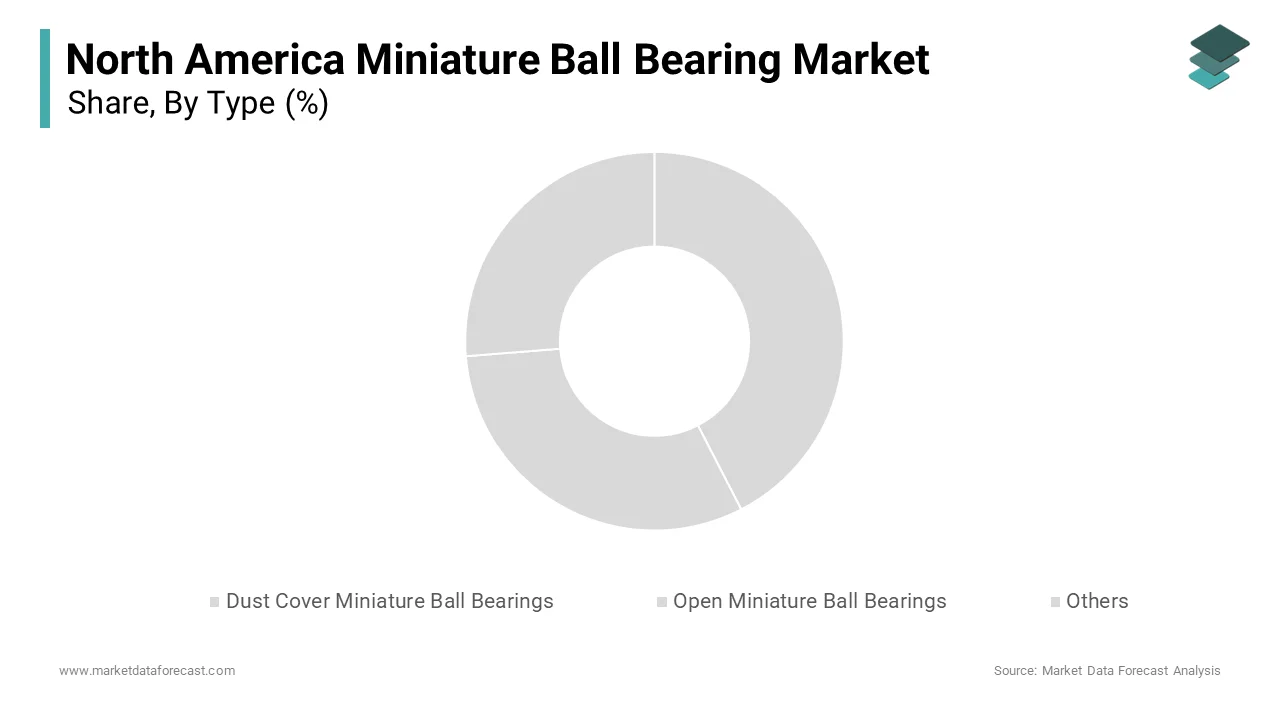
The dust cover miniature ball bearing segment is expected to grow with a CAGR of 8.7% from 2025 to 2033. Dust cover (or shielded) miniature ball bearings are gaining traction in e-scooters, e-bikes, delivery robots, and personal drones due to their ability to resist ingress of dirt, moisture, and road debris common failure points in urban mobility systems. According to the North American Bikeshare and Scootershare Association, over 150 million e-scooter trips were recorded in 2023, with fleet operators reporting bearing-related maintenance as the third most frequent repair issue. Dust covers are typically made of stamped steel, providing a physical barrier that extends bearing life by up to 40% in high-contamination environments, as documented by the National Renewable Energy Laboratory. Additionally, companies like Lime and Bird have standardized on dust cover bearings in their next-generation fleets to improve durability and lower lifecycle costs.
By Application Insights
The industrial sector held 36.4% of the North American miniature ball bearing market share in 2025.
The transition to smart manufacturing across North America has intensified the need for high-precision miniature bearings in servo motors, linear actuators, and robotic joints. Industry 4.0 systems rely on real-time data, adaptive control, and uninterrupted operation, all of which depend on friction-free, low-backlash motion components. According to the Department of Commerce’s National Institute of Standards and Technology, over 45% of U.S. manufacturers have implemented some form of digital factory integration, with 68% investing in automated assembly lines.
The medical application segment is expected to grow with a CAGR of 9.2% during the forecast period. The robotic surgical platforms, such as the da Vinci system, rely on miniature ball bearings in wrist joints, endoscopic drives, and motorized arms to achieve sub-millimeter precision. According to the American College of Surgeons, over 1.2 million robotic surgeries were performed in the U.S. in 2023, a 14% increase from the previous year. According to the U.S. Department of Health and Human Services, hospitals using robotic surgery report a 23% reduction in postoperative complications, driving further investment. Additionally, the FDA has approved 89 new robotic and implantable systems since 2021, all requiring bearings validated for biocompatibility and long-term reliability.
COUNTRY-LEVEL ANALYSIS
United States
The United States was the top performer in the North American miniature ball bearing market with 75.4% of the share in 20,24, with a vast industrial base, advanced healthcare infrastructure, and leadership in aerospace and high-tech manufacturing. The U.S. hosts over 2,000 precision equipment manufacturers, according to the National Institute of Standards and Technology, many of which integrate miniature bearings into robotics, medical devices, and semiconductor tools. The Department of Defense’s Defense Logistics Agency procures over 1.5 million miniature bearings annually for avionics and guidance systems by ensuring steady demand in the defense sector. The U.S. Food and Drug Administration regulates over 190,000 medical device establishments, most of which rely on certified bearings for surgical and diagnostic equipment.
Canada
Canada was ranked second by occupying 14.2% of the North American miniature ball bearing market share in 2025. The country is home to over 800 advanced manufacturing firms, according to Innovation, Science and Economic Development Canada, many of which produce medical robotics and flight control systems requiring precision bearings. Bombardier and CAE, global leaders in aerospace simulation and avionics, source high-grade miniature bearings for actuation systems used in pilot training and aircraft controls. According to the Canadian Agency for Drugs and Technologies in Health, over 120,000 robotic-assisted surgeries were performed in 2023, driving demand for certified components. Additionally, the National Research Council of Canada is advancing micro-robotics for minimally invasive procedures by incorporating sub-5 mm bearings in experimental platforms.
KEY MARKET PLAYERS
NSK Ltd., SKF Group, RBC Bearings, Schaeffler Group, MinebeaMitsumi, THK Co., Ltd., Timken Company, NTN Corporation, JTEKT Corporation, Nachi-Fujikoshi Corp., ABB, Siemens, Boca Bearing Company, AST Bearings, CW Bearing GmbH, Reinfurt GmbH & Co. KG, Kitanihon Seiki Co., Ltd. are the market players that are dominating the North American miniature ball bearing market.
Top Players In The Market
SKF (Svenska Kullagerfabriken AB)
SKF stands as a global pioneer in rolling-element bearing technology, with a profound influence on the North American miniature ball bearing market. The company is renowned for its engineering excellence, precision manufacturing, and deep integration into mission-critical sectors such as aerospace, medical devices, and industrial automation. SKF’s miniature bearings are engineered for extreme reliability, incorporating advanced materials, optimized internal geometries, and proprietary lubrication systems that ensure longevity under high-speed and high-load conditions. Its technical expertise extends to condition monitoring and predictive maintenance solutions, enabling customers to maximize uptime and performance.
The Timken Company
The Timken Company has established itself as a key player in the precision bearing segment by leveraging its legacy in tribology and material science to deliver high-performance miniature ball bearings for demanding industrial and aerospace applications. While historically known for tapered roller bearings, Timken has strategically expanded its miniature bearing portfolio to meet the growing needs of automation, robotics, and medical technology. The company emphasizes application engineering by offering tailored solutions that address thermal management, contamination resistance, and extended service life in compact designs. Its North American manufacturing and R&D infrastructure enables rapid prototyping and compliance with stringent regulatory requirements, including AS9100 and ISO 13485. Timken’s integration of smart sensing technologies into miniature systems reflects its forward-looking approach to predictive maintenance and system health monitoring. Its global reach, technical depth, and customer-centric innovation position Timken as a vital contributor to the evolution of precision motion components worldwide.
NSK Ltd.
NSK Ltd. is a leading Japanese manufacturer with a significant footprint in the North American miniature ball bearing market, known for its precision, consistency, and technological agility. The company specializes in ultra-small and high-speed bearings used in medical devices, robotics, and consumer electronics, where micron-level tolerances and low torque are essential. NSK’s engineering philosophy centers on miniaturization without compromising durability, enabling its components to perform in space-constrained, high-cycle applications. The company has pioneered advancements in ceramic hybrid bearings, low-noise lubricants, and dust-resistant shielding, enhancing performance in cleanroom and portable medical equipment. In North America, NSK supports OEMs through localized technical service teams and application labs that simulate real-world operating conditions. Its commitment to sustainability includes energy-efficient bearing designs and reduced material waste in production.
Top Strategies Used by Key Market Participants
One major strategy employed by leading manufacturers is vertical integration of material science and precision manufacturing capabilities to ensure control over quality, performance, and supply chain resilience. Companies can guarantee consistency in micro-tolerances and fatigue resistance, which are critical in high-reliability applications such as aerospace and medical devices, by managing everything from steel refining to final inspection.
Another key approach is investment in application-specific engineering and co-development with OEMs. Rather than offering standardized products, top players collaborate with equipment designers to tailor bearing geometry, lubrication, and sealing to exact operational demands by enhancing system efficiency and reducing failure risk in complex machinery.
A third prevalent strategy is the integration of digital technologies, including condition monitoring, predictive analytics, and smart bearings with embedded sensors. This shift allows manufacturers to move beyond component supply and offer value-added services that improve equipment uptime, support predictive maintenance, and strengthen long-term customer relationships in advanced industrial and medical ecosystems.
COMPETITION OVERVIEW
The competitive landscape of the North American miniature ball bearing market is defined by technological sophistication, regulatory alignment, and deep integration into high-value industrial and medical ecosystems. Dominant players distinguish themselves not through price competition but through engineering precision, material innovation, and reliability in mission-critical applications. Competition is further shaped by the need for compliance with aerospace (AS9100), medical (ISO 13485), and automotive (IATF 16949) standards, which create high barriers to entry for smaller or less-certified manufacturers. Firms increasingly compete on technical support, customization, and lifecycle performance rather than cost alone. The rise of smart factories and wearable medical devices has intensified demand for bearings that are not only smaller but also smarter, prompting investment in sensor-integrated and condition-monitoring solutions. While global players dominate through scale and brand trust, niche specialists gain traction by focusing on ultra-precision or biocompatible materials. The absence of commoditization in high-end segments ensures that innovation, traceability, and system-level integration remain central to competitive advantage, fostering a dynamic environment where engineering excellence and customer collaboration determine market leadership.
RECENT HAPPENINGS IN THE MARKET
- In March 2023, SKF launched a new line of hybrid ceramic miniature ball bearings designed for high-speed medical motors, featuring silicon nitride rolling elements and optimized internal geometry to reduce heat generation and extend service life.
- In August 2023, The Timken Company opened a precision bearing application center in Charlotte, North Carolina, dedicated to supporting OEMs in robotics, aerospace, and medical device sectors with testing, prototyping, and custom engineering services.
- In January 2025, NSK Ltd. introduced a new series of ultra-low-noise miniature bearings for use in wearable health monitors and hearing aids, incorporating proprietary lubrication and surface finishing technologies to ensure silent operation.
- In June 2025, SKF partnered with a leading surgical robotics developer to co-engineer a next-generation wrist joint mechanism using miniaturized, corrosion-resistant bearings validated for 10,000+ sterilization cycles.
- In October 2025, The Timken Company enhanced its digital offering by integrating IoT-enabled sensors into select miniature bearing models by allowing real-time monitoring of temperature, vibration, and load conditions in industrial automation systems.
MARKET SEGMENTATION
This research report on the North American miniature ball bearing market is segmented and sub-segmented into the following categories.
By Type
- Dust Cover Miniature Ball Bearings
- Open Miniature Ball Bearings
- Others
By Application
- Automotive
- Industrial
- Aerospace
- Household Electrical Appliances
- Medical
- Robotics
- Others
By Country
- The United States
- Canada
- Mexico