- Product Description Description
- Table of Contents TOC
- List of Table & Figure LOT
- Get Free Sample PDF Sample PDF
Market Size, 2025
$26.62 BnMarket Estimate, 2026
$27.49 BnMarket Forecast, 2034
$35.59 BnCAGR, 2026–2034
3.28%Executive Summary: North America MRO Market
- Market Scope: Comprehensive regional assessment of the North American Maintenance, Repair, and Operations (MRO) supply chain network, evaluating distribution channels, specialized product categories, end-user industries, and country-level dynamics across the U.S., Canada, and Mexico.
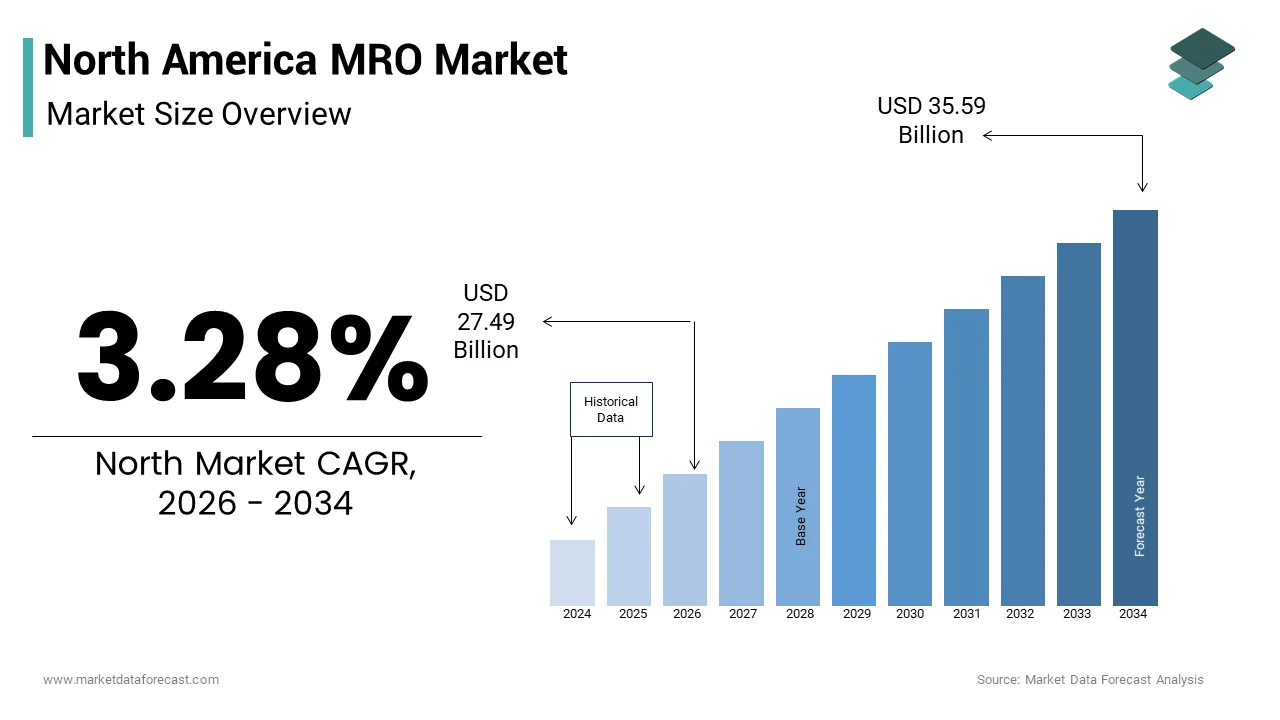
- Market Valuation: Valued at USD 26.62 billion in 2025, estimated at USD 27.49 billion in 2026, and projected to reach USD 35.59 billion by 2034, registering a steady CAGR of 3.28% from 2026 to 2034.
- Primary Growth Drivers: Aging industrial infrastructure requiring asset longevity management, stringent regulatory compliance and safety enforcement, and the fast-paced adoption of digital e-procurement ecosystems and predictive maintenance.
Key Market Segment Metrics (2026–2034)
| Category | Leading Segment Position | Fastest-Growing / Key Growth Segment |
|---|---|---|
| By Distribution Channel | Distributors (captured a leading 48.3% market share in 2025, driven by technical engineering support and on-site vendor management) | E-commerce (projected at the fastest CAGR of 11.6% supported by deep ERP integration and API-driven automated reordering platforms) |
| By Product Type | Mechanical Components (held 31.2% market share in 2024 due to high friction and constant replacement cycles in rotating equipment like bearings and motors) | Industrial Safety Equipment (expected to expand via a high CAGR driven by stricter OSHA silica, noise, and PPE enforcement rules) |
| By End-User Industry | Manufacturing (held a leading 36.4% share in 2024, anchored by massive automated plants and extensive machinery maintenance demands) | Transportation and Logistics (projected to grow at a strong CAGR of 9.8% propelled by the expansion of last-mile delivery networks and fulfillment hubs) |
| By Country | The United States (dominant regional hub holding 87.3% share in 2024, backed by the largest industrial infrastructure and federal modernization bills) | Canada (solid market share of 12.3%, focused heavily on remote resource extraction, mining, and localized distribution networks) |
Major Market Players & Market Structure
Market Structure: Highly consolidated ecosystem featuring national scale distributors, specialized component providers, and technology-driven supply chain platforms competing on embedded on-site inventory services and digital integration.
Key Companies: W.W. Grainger, Fastenal, MSC Industrial Direct, Lowe's, Home Depot, Zoro, Sonepar, Rexel, Siemens, Schneider Electric, Emerson Electric, ABB, Honeywell, and Johnson Controls.
North America MRO (Maintenance, Repair, and Operations) Market Size
The North America MRO (Maintenance, Repair, and Operations) market size was valued at USD 26.62 billion in 2025 and is anticipated to reach USD 27.49 billion in 2026 to reach USD 35.59 billion by 2034, growing at a CAGR of 3.28% during the forecast period from 2026 to 2034.
The MRO (Maintenance, Repair, and Operations) distribution is the supply chain network responsible for delivering non-production inventory essential for the upkeep of industrial, commercial, and institutional operations. This includes tools, safety equipment, lubricants, fasteners, electrical components, and facility maintenance supplies that ensure continuous operational functionality across manufacturing plants, energy facilities, transportation hubs, and healthcare institutions. As of 2023, the U.S. manufacturing sector alone operated over 360,000 industrial establishments, each requiring continuous MRO supply chains, as reported by the U.S. Census Bureau.
MARKET DRIVERS
Aging Industrial Infrastructure and Asset Longevity Management
Industrial and public infrastructure is operating beyond its intended service life, which is necessitating intensified maintenance and component replacement efforts is propelling the growth of the North America MRO (Maintenance, Repair, and Operations) market. In the United States, the average age of manufacturing equipment reached 11.8 years in 2023, the highest level since 1995, as reported by the Federal Reserve. This trend is particularly pronounced in sectors such as utilities, oil and gas, and public transit, where capital-intensive assets are being kept in service longer due to budget constraints and supply chain delays for new equipment. This extended asset utilization drives consistent demand for MRO products such as bearings, valves, gaskets, and control systems. In the energy sector, 62% of U.S. power plants operate with equipment over 30 years old, according to the U.S. Energy Information Administration, which requires frequent maintenance to meet safety and output standards.
Regulatory Compliance and Safety Standards Enforcement
The stringent regulatory requirements across industries are compelling organizations to maintain rigorous maintenance schedules and use certified MRO components, which is directly influencing the growth of the North America MRO (Maintenance, Repair, and Operations) market. The U.S. Occupational Safety and Health Administration reported that in 2023, over 2.8 million non-fatal workplace injuries occurred in industrial sectors by prompting heightened enforcement of preventive maintenance protocols. The Pipeline and Hazardous Materials Safety Administration mandates that 100% of natural gas transmission pipelines undergo integrity testing every five years, generating recurring demand for inspection tools, seals, and replacement parts. In healthcare, the Joint Commission requires hospitals to maintain documented maintenance logs for all medical equipment, driving procurement of calibration tools and replacement components.
MARKET RESTRAINTS
Fragmented Supply Chain and Procurement Inefficiencies
The presence of thousands of small and regional suppliers operating alongside national distributors, which is leading to inefficiencies in procurement, inventory management, and cost control, is impeding the growth of the North America MRO (Maintenance, Repair, and Operations) market. According to the National Association of Manufacturers, the average U.S. industrial facility sources MRO products from over 120 different vendors, creating administrative burdens and inconsistent pricing. The lack of standardization in part numbering and cataloging further complicates procurement, with 38% of maintenance staff reporting difficulty in identifying correct replacement parts, as noted in a 2023 survey by the Maintenance, Repair, and Operations Institute. In municipal operations, decentralized purchasing across departments leads to duplicated orders and excess inventory, with the Government Accountability Office estimating that local governments waste up to $12 billion annually on inefficient MRO spending.
Skilled Labor Shortage in Maintenance and Technical Roles
The deficit of qualified maintenance personnel is undermining the effective deployment of MRO products, and limiting demand for advanced repair solutions is limiting the growth of the North American MRO (Maintenance, Repair, and Operations) market. As of 2023, the U.S. Bureau of Labor Statistics reported a shortfall of over 350,000 industrial maintenance and machinery repair technicians, a gap expected to widen as retiring baby boomers exit the workforce. This shortage is particularly acute in specialized fields such as predictive maintenance, robotics servicing, and HVAC systems, where technical expertise is essential for proper component installation and system calibration. Community colleges and trade schools graduate only about 45,000 skilled maintenance technicians annually, less than half the number needed to meet replacement demand, according to the U.S. Department of Education. Facilities are forced to rely on external contractors or overburden existing staff, both of which increase operational risk.
MARKET OPPORTUNITIES
Digital Procurement Platforms and E-Catalog Integration
The adoption of digital procurement ecosystems is solely to gear towards new opportunities for the growth of the North America MRO (Maintenance, Repair, and Operations) market. Enterprises are increasingly migrating from manual ordering to integrated e-procurement platforms that sync with enterprise resource planning (ERP) systems by enabling automated reordering, real-time inventory tracking, and spend analytics. As of 2023, 68% of Fortune 500 manufacturers had implemented vendor-managed inventory (VMI) systems linked to digital catalogs, according to Gartner, reducing procurement cycle times by up to 50%. These platforms allow distributors to embed product specifications, compliance data, and lifecycle information directly into client systems, minimizing errors and improving part accuracy. Companies like Grainger and Fastenal have developed proprietary digital marketplaces that offer personalized dashboards, predictive ordering, and mobile access for field technicians. According to the U.S. Department of Commerce, digital MRO procurement reduces administrative costs by an average of 30%, making it especially attractive for large industrial and institutional clients. Furthermore, blockchain-enabled platforms are emerging to ensure traceability of high-value components in aerospace and defense.
Expansion of Predictive Maintenance and IoT-Enabled Asset Management
The integration of Internet of Things (IoT) sensors and predictive analytics into industrial equipment is also expected to enhance the growth of the North America MRO (Maintenance, Repair, and Operations) market. In 2023, over 40% of large U.S. manufacturing facilities had deployed IoT-enabled condition monitoring systems on machinery, as reported by the Industrial Internet Consortium. These systems continuously track vibration, temperature, and lubrication levels, generating data that predicts component failure before it occurs. The U.S. Department of Energy estimates that predictive maintenance can reduce equipment breakdowns by up to 70% and extend asset life by 20–40%. Distributors are responding by aligning their product portfolios with predictive maintenance workflows, offering sensor-compatible components, and partnering with technology providers to bundle hardware and analytics services. In Canada, Transport Canada has mandated predictive maintenance systems for all new rail freight locomotives, creating a growing market for compliant MRO parts.
MARKET CHALLENGES
Counterfeit and Substandard Components in the Supply Chain
The infiltration of counterfeit and non-compliant MRO products into the North American supply chain poses a serious threat to operational safety, regulatory compliance, and brand integrity, which is to hinder the growth of the North American MRO (Maintenance, Repair, and Operations) market. The U.S. Customs and Border Protection seized over 3,200 shipments of fraudulent industrial goods in 2023, including bearings, electrical connectors, and safety valves, many of which originated from unauthorized online marketplaces, according to the Homeland Security Investigations division. These substandard components often fail to meet ASTM, ANSI, or UL certification standards, increasing the risk of equipment malfunction and workplace accidents. In the aerospace sector, the Federal Aviation Administration identified 1,427 cases of counterfeit parts in maintenance supply chains between 2020 and 2023, as detailed in its Safety Risk Management Report. The decentralized nature of MRO procurement makes it difficult to enforce traceability, particularly when buyers source from third-party distributors or e-commerce platforms lacking verification protocols.
Volatility in Raw Materials and Logistics Costs
MRO distributors face persistent pressure from fluctuating input costs for metals, polymers, and specialty chemicals, which act as a barrier to the growth of the North American MRO (Maintenance, Repair, and Operations) market. In 2023, the price of industrial-grade steel, a key material for tools and fasteners, rose by 22% year-on-year due to supply constraints and energy inflation, as documented by the U.S. Bureau of Labor Statistics. Similarly, the cost of rare earth elements used in sensors and motors increased by 35%, according to the U.S. Geological Survey, driven by geopolitical tensions and limited refining capacity. In Canada, cross-border logistics delays at major land ports added an average of 18 hours to MRO shipments in 2023, increasing inventory carrying costs, according to the Canadian Transportation Agency. The reliance on global sourcing for specialized components further exposes the sector to trade policy shifts and customs bottlenecks.
REPORT COVERAGE
| REPORT METRIC | DETAILS |
| Market Size Available | 2025 to 2034 |
| Base Year | 2025 |
| Forecast Period | 2026 to 2034 |
| CAGR | 3.28% |
| Segments Covered | By Distribution Channel, Product, End-User, and By Country |
| Various Analyses Covered | Global, Regional & Country Level Analysis; Segment-Level Analysis, DROC, PESTLE Analysis, Porter’s Five Forces Analysis, Competitive Landscape, Analyst Overview of Investment Opportunities |
| Regions Covered | The United States, Canada, Mexico, Rest of North America |
| Market Leaders Profiled | Johnson Controls, Fastenal, Lowe's, Siemens, Zoro, MSC Industrial Supply, Rexel, Schneider Electric, Home Depot, Honeywell, W.W. Grainger, Grainger, Sonepar, Emerson Electric, ABB. |
SEGMENTAL ANALYSIS
By Distribution Channel Insights
The Distributors segment accounted in holding 48.3% of the North America MRO distribution market share in 2025. Industrial buyers increasingly rely on distributors not just for product supply but for engineering support, inventory management, and compliance assurance. As per the Maintenance, Repair, and Operations Institute, 73% of manufacturing facilities in the U.S. now engage distributors with certified technical staff capable of advising on component selection, compatibility, and lifecycle performance. Companies like W.W. Grainger and Fastenal employ over 5,000 field sales engineers who conduct on-site assessments and recommend optimized MRO solutions, reducing equipment downtime and improving procurement efficiency. According to the U.S. Department of Commerce, facilities using technical distributors experience 32% fewer part mismatches than those sourcing through generic channels.
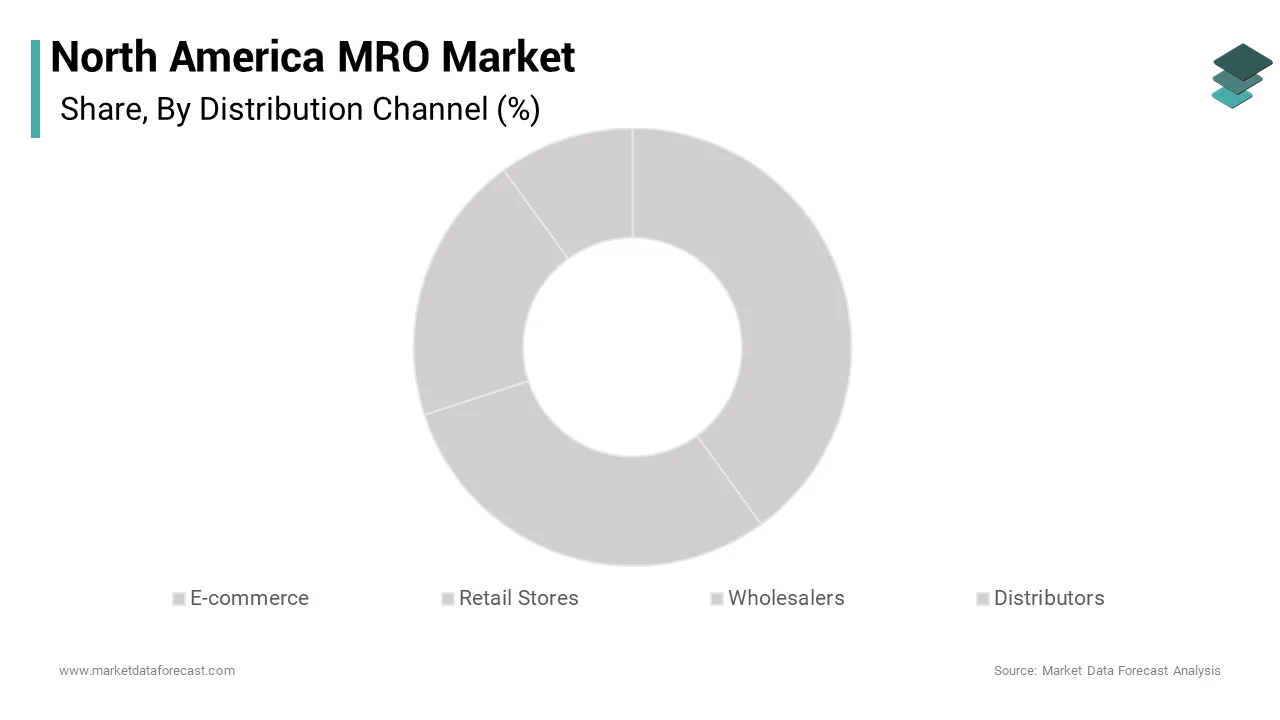
The E-commerce segment is swiftly emerging with an expected CAGR of 11.6% from 2025 to 2033.
Modern e-commerce platforms are no longer standalone marketplaces but are deeply embedded into corporate ERP and procurement systems by enabling automated ordering, budget tracking, and approval workflows. As of 2023, 65% of mid-to-large industrial firms in North America had synchronized their MRO e-procurement portals with SAP, Oracle, or Microsoft Dynamics systems, according to Gartner, which is allowing maintenance technicians to order parts directly from mobile devices with real-time budget validation. This integration reduces administrative delays and maverick spending, which the National Association of Purchasing Management estimates accounts for 18% of uncontrolled MRO expenditures. Companies like MSC Industrial Direct and Zoro Tools have developed API-driven platforms that allow seamless data exchange between client systems and supplier inventories by ensuring part compatibility and stock availability.
By Product Insights
The Mechanical Components segment accounted in holding 31.2% of the North America MRO distribution market share in 2024. Mechanical components are subject to constant stress, friction, and fatigue, with frequent replacement even under optimal operating conditions. According to the U.S. Department of Energy, 55% of unplanned downtime in manufacturing facilities stems from mechanical failures, particularly in rotating equipment such as motors, pumps, and conveyors. Bearings alone account for over 40% of rotating machinery breakdowns, according to the National Research Council, requiring regular inspection and replacement. In 2023, U.S. manufacturers replaced over 280 million bearings across industrial applications, as documented by the American Bearing Manufacturers Association. The automotive and heavy equipment sectors are especially reliant on mechanical components, with an average assembly line containing over 1,200 bearings and 300 belts, all requiring periodic maintenance. In Canada, the mining industry replaces over 15,000 heavy-duty gears and couplings annually due to extreme operational conditions, as reported by the Mining Association of Canada.
The Industrial Safety Equipment segment is expected to grow with a CAGR of 10.3% during the forecast period. OSHA has intensified its enforcement of workplace safety standards, conducting over 33,000 inspections in 2023, a 17% increase from 2020, and issuing penalties totaling $182 million, according to the U.S. Department of Labor. The agency’s revised silica and noise exposure rules have compelled companies to upgrade their safety gear inventories, with 78% of industrial facilities reporting increased PPE spending in 2023, as per the National Safety Council. In Canada, the Canadian Centre for Occupational Health and Safety reported that provincial regulators conducted 41% more workplace audits in 2023, which is leading to a surge in demand for compliant safety equipment. The introduction of mandatory arc-flash protection in electrical maintenance has also driven the procurement of insulated gloves, face shields, and flame-resistant suits.
By End-User Industry Insights
The Manufacturing sector held 36.4% of the North America MRO (Maintenance, Repair, and Operations) market share in 2024. Modern manufacturing plants operate with thousands of interconnected machines, each requiring routine maintenance to prevent disruptions. The average U.S. automotive assembly plant contains over 18,000 pieces of industrial equipment, including robots, conveyors, presses, and CNC machines, all dependent on MRO components for uninterrupted operation, as documented by the Automotive Industry Action Group. A single production line may require hundreds of bearings, sensors, and actuators, any of which can halt output if they fail. The U.S. Department of Commerce estimates that unplanned downtime costs manufacturers an average of $260,000 per hour, creating immense pressure to maintain spare parts inventories and rapid repair capabilities.
The Transportation and Logistics sector is projected to grow at a CAGR of 9.8% in the coming years.
The surge in online shopping has led to a proliferation of delivery vehicles, warehouses, and logistics hubs, all requiring continuous maintenance. In 2023, the U.S. added over 120,000 new delivery vans and trucks to support last-mile operations, a 28% increase from 2020, according to the Federal Highway Administration. These fleets operate under high utilization rates, often exceeding 18 hours per day, accelerating wear on brakes, tires, and powertrain components. The average delivery vehicle undergoes maintenance every 7,500 miles, generating recurring demand for filters, fluids, and suspension parts. Companies like Amazon, UPS, and FedEx have established regional maintenance depots equipped with automated diagnostic systems and on-site MRO inventories.
COUNTRY LEVEL ANALYSIS
United States was the top performer in the North American MRO distribution market by capturing 87.3% of the share in 2024, with the presence of the largest industrial base, the most extensive transportation network, and the highest concentration of manufacturing and energy facilities on the continent. The U.S. also leads in technological adoption, with 68% of large manufacturers utilizing digital MRO procurement platforms, according to the National Institute of Standards and Technology. Major distribution hubs in cities like Chicago, Atlanta, and Dallas serve as national logistics gateways, supporting just-in-time delivery to factories, warehouses, and utility plants. The presence of global MRO leaders such as W.W. Grainger, Fastenal, and MSC Industrial Direct further consolidates the country’s dominance. Federal initiatives like the Bipartisan Infrastructure Law have allocated $110 billion for transportation and utilities modernization, directly stimulating MRO demand.
Canada was positioned second by occupying 12.3% of the North American MRO (Maintenance, Repair, and Operations) market share in 2024. The country’s vast geography and concentrated industrial zones in Alberta’s energy sector, Ontario’s manufacturing belt, and Quebec’s transportation infrastructure shape unique procurement patterns. Canada’s MRO market is characterized by strong public sector involvement, with federal and provincial agencies managing over 45% of industrial maintenance contracts, according to Public Services and Procurement Canada. The mining and forestry industries, which operate in remote locations, rely heavily on centralized distribution and air freight for MRO supplies, increasing logistics complexity.
COMPETITIVE LANDSCAPE
The competitive environment in the North American MRO distribution market is defined by a convergence of scale, specialization, and technological innovation. Established national players leverage vast distribution networks and digital infrastructure to serve large industrial clients, while regional and niche distributors focus on sector-specific expertise in areas such as oil and gas, aerospace, or electrical maintenance. The market is witnessing a strategic shift from product-centric sales to integrated service models, where success is measured not by transaction volume but by operational impact. Distributors are increasingly expected to provide technical guidance, inventory optimization, and compliance assurance, blurring the lines between supplier and consultant. Digital transformation is a key battleground, with companies racing to offer seamless e-procurement, mobile access, and ERP integration to meet the demands of modern maintenance teams. At the same time, private-label product development and sustainability initiatives are emerging as differentiators by allowing firms to control quality and margins while aligning with corporate ESG goals. Consolidation remains a trend, but competition is also fostering innovation in logistics, such as on-site vending and predictive restocking.
KEY MARKET PLAYERS
These are the market players that are dominating the North America MRO market.
- Johnson Controls
- Fastenal
- Lowe's
- Siemens
- Zoro
- MSC Industrial Supply
- Rexel
- Schneider Electric
- Home Depot
- Honeywell
- W.W. Grainger
- Grainger
- Sonepar
- Emerson Electric
- ABB
Top Players In the Market
- W.W. Grainger is a cornerstone of the North American MRO distribution landscape, which is recognized for its comprehensive product range, extensive logistics network, and deep integration with industrial clients. The company serves a diverse array of sectors, including manufacturing, utilities, and government, by offering both digital and direct sales channels tailored to complex maintenance needs. Grainger’s strength lies in its consultative approach, combining technical expertise with inventory management solutions such as vendor-managed inventory and consolidated billing. Its influence extends globally through strategic partnerships and supply chain collaborations, setting benchmarks for service reliability and operational efficiency.
- Fastenal has redefined MRO distribution through its decentralized operational model, placing thousands of on-site vending machines and store-within-a-facility locations directly inside customer plants and construction sites. This proximity-driven strategy enables real-time access to components while integrating with enterprise procurement systems for seamless tracking and accountability. The company emphasizes technical support, deploying field sales teams with engineering expertise to assist in part selection and inventory optimization. Fastenal’s focus on just-in-time delivery and lean inventory management has made it a preferred partner for large industrial and transportation firms. Globally, it's operational agility and customer-centric innovation have influenced how MRO services are delivered, particularly in remote and high-utilization environments. Its model of embedded logistics has been replicated across international markets, reinforcing its role as a pioneer in transforming MRO from a supply function into an integrated operational solution.
- MSC Industrial Direct stands as asana enabler of precision manufacturing and industrial maintenance, specializing in metalworking and production-focused MRO supplies. The company differentiates itself through deep product expertise, particularly in cutting tools, abrasives, and advanced machining components, supporting high-tolerance industries such as aerospace, automotive, and energy. Its consultative sales force works closely with engineers and maintenance teams to optimize tool performance and lifecycle management. MSC has invested heavily in digital transformation, offering advanced e-procurement platforms that integrate with factory automation systems, enhancing supply chain visibility and efficiency. On a global scale, its focus on technical excellence and application-specific solutions has positioned it as a trusted advisor in industrial productivity.
Top Strategies Used By Key Market Participants
A primary strategy employed by leading MRO distributors is the integration of digital procurement ecosystems into client operations. Companies are developing proprietary platforms that synchronize with enterprise resource planning (ERP) and maintenance management systems, enabling automated reordering, real-time inventory tracking, and spend analytics. This shift transforms MRO from a reactive function to a proactive, data-driven process, improving efficiency and reducing maverick spending.
Another key approach is the deployment of on-site inventory solutions, including vending machines, mini-stores, and vendor-managed inventory (VMI) systems. These models place components directly within client facilities, ensuring immediate access while allowing the distributor to monitor usage and replenish stock autonomously. This not only reduces downtime but also deepens customer relationships by aligning the distributor’s success with operational continuity.
A third strategy involves expanding technical service capabilities to include engineering support, lifecycle analysis, and predictive maintenance consulting. Distributors are hiring field engineers and data analysts to advise clients on optimal part selection, equipment reliability, and cost reduction. This value-added approach elevates their role from mere suppliers to strategic partners, which differentiates them in a competitive market and fosters long-term contracts based on performance and expertise.
RECENT MARKET NEWS
- In February 2023, W.W. Grainger launched a new digital platform integrating AI-driven inventory forecasting and automated reordering for enterprise clients. This advancement allows manufacturers to synchronize MRO procurement with production schedules, reducing downtime and improving supply chain predictability.
- In May 2023, Fastenal expanded its on-site vending network by deploying over 5,000 smart lockers across automotive and aerospace facilities in the Midwest. This initiative enhances part accessibility and real-time usage tracking, which is reinforcing Fastenal’s embedded logistics model.
- In September 2023, MSC Industrial Direct partnered with a leading industrial IoT provider to offer predictive maintenance solutions bundled with tooling supplies. This integration enables clients to monitor tool wear and receive automatic replacements before failure occurs.
- In January 2024, W.W. Grainger introduced a suite of sustainability-certified MRO products, including energy-efficient motors and recyclable packaging, by aligning with corporate ESG mandates and attracting environmentally focused industrial clients.
- In June 2024, Fastenal acquired a specialty distributor focused on safety equipment for oil and gas operations, which is enhancing its technical portfolio and expanding its footprint in high-risk industrial maintenance sectors.
MARKET SEGMENTATION
This research report on the North America MRO distribution market is segmented and sub-segmented into the following categories.
By Distribution Channel
- E-commerce
- Retail Stores
- Wholesalers
- Distributors
By Product Type
- Electrical Components
- Mechanical Components
- Piping and Valves
- Industrial Safety Equipment
By End-User
- Oil and Gas
- Manufacturing
- Transportation and Logistics
- Mining
- Construction
By Customer Type
- Industrial and Commercial
- OEMs and Aftermarket
By Service Type
- Parts Distribution
- Repair and Maintenance
- Training
- Consulting
By Country
- The United States
- Canada
- Mexico