- Product Description Description
- Table of Contents TOC
- List of Table & Figure LOT
- Get Free Sample PDF Sample PDF
Market Size, 2025
$7.47 BnMarket Estimate, 2026
$7.89 BnMarket Forecast, 2034
$12.17 BnCAGR, 2026–2034
5.57%North America Natural Gas Liquids (NGL) Market Size
The North America natural gas liquids (NGL) market size was valued at USD 7.47 billion in 2025 and is anticipated to reach USD 7.89 billion in 2026 from USD 12.17 billion by 2034, growing at a CAGR of 5.57% during the forecast period from 2026 to 2034.
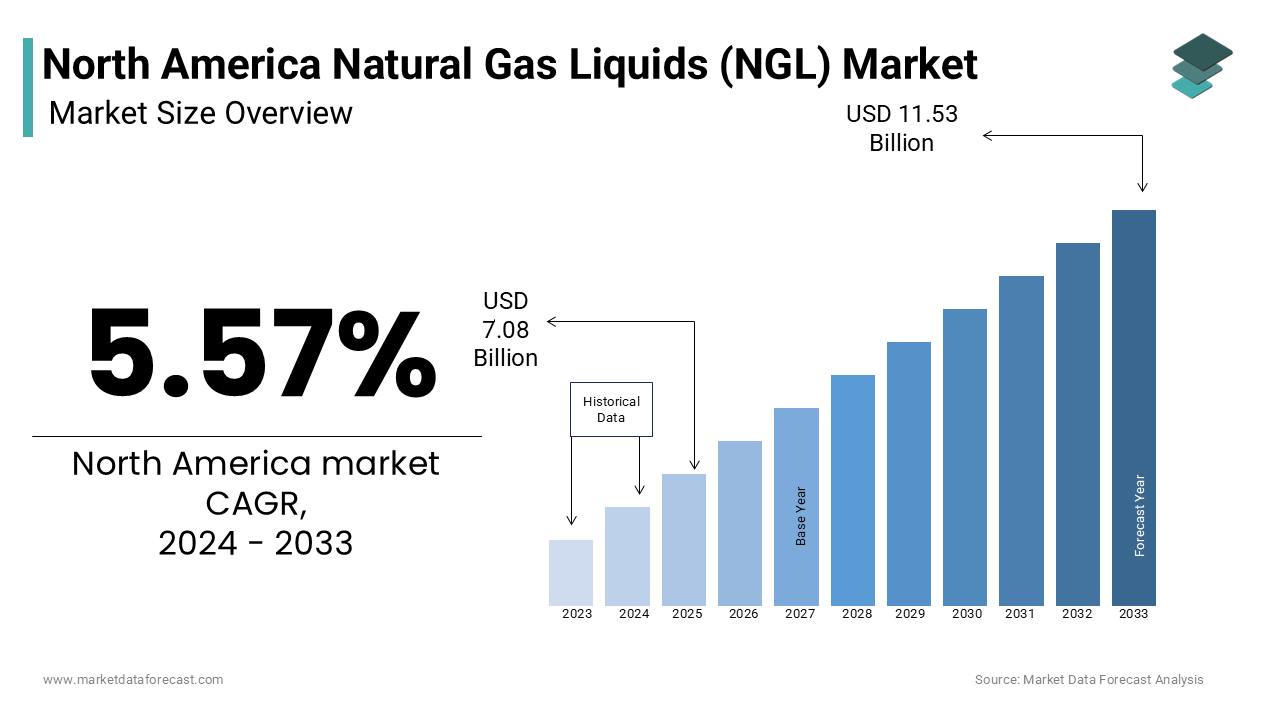
The natural gas liquids are sophisticated and integral segment of the continent’s energy infrastructure, encompassing the extraction, processing, and distribution of ethane, propane, butanes, and pentanes recovered from natural gas streams. As per the U.S. Energy Information Administration (EIA), approximately 40% of total natural gas production in the United States yields NGLs due to their significance in the broader hydrocarbon landscape. The operational framework of the NGL sector is deeply intertwined with advancements in hydraulic fracturing and horizontal drilling technologies, particularly within shale formations such as the Permian Basin and Marcellus Shale. These innovations have not only amplified production volumes but also enhanced recovery efficiencies, which is leading to increased ethane rejection rates during periods of constrained takeaway capacity.
MARKET DRIVERS
Expanding Petrochemical Feedstock Demand
The escalating demand for petrochemical feedstocks, particularly ethane and propane, which serve as foundational inputs for producing ethylene and propylene is a major factor driving the growth of the North America natural gas liquids market. The American Chemistry Council reported that U.S. ethylene capacity utilization exceeded 92% in 2023, driven by new crackers along the Gulf Coast. Ethane consumption in steam crackers rose to over 2 million barrels per day, reflecting robust demand from polymer manufacturers and downstream derivatives such as polyethylene. Propane, another key NGL component, plays a pivotal role in dehydrogenation units that produce propylene, a building block for plastics and synthetic rubbers.
Infrastructure Development and Export Capacity Expansion
Infrastructure development represents a second major catalyst propelling the North America natural gas liquids market forward. Over the past decade, extensive pipeline construction and terminal expansions have facilitated the efficient transportation and export of NGLs to international markets. According to the Energy Infrastructure Council, more than 8,000 miles of NGL pipelines were commissioned between 2015 and 2023, enhancing connectivity between production hubs like the Permian Basin and export terminals along the Gulf Coast. Export capabilities have expanded significantly, with the United States emerging as a net exporter of propane and butane. The EIA reported that U.S. propane exports reached 1.4 million barrels per day in 2023, primarily destined for Asia and Latin America. The development of fractionation capacity has also been instrumental. Enterprise Products Partners and Targa Resources have brought online several large-scale fractionators capable of processing over 200,000 barrels per day collectively. This expansion ensures that mixed NGL streams can be efficiently separated into individual components, meeting both domestic and global product specifications. Furthermore, the integration of pipeline networks with storage facilities provides flexibility in managing seasonal demand fluctuations and optimizing logistics.
MARKET RESTRAINTS
Pipeline and Fractionation Bottlenecks
The significant logistical constraints stemming from inadequate pipeline and fractionation infrastructure is restricting the growth of the North America natural gas liquids market. In the Permian Basin, for instance, pipeline takeaway capacity has historically lagged behind drilling activity, resulting in localized pricing discounts and reduced producer netbacks. Fractionation capacity, although expanding, remains unevenly distributed. The EIA indicates that the Gulf Coast hosts over 70% of total U.S. fractionation capability, leaving inland production centers reliant on long-haul pipelines or rail transport. This imbalance creates inefficiencies and increases transportation costs, particularly for ethane, which is highly volatile and requires specialized handling. Moreover, regulatory delays and permitting challenges have slowed project approvals, particularly for cross-border pipelines and export terminals. The Federal Energy Regulatory Commission (FERC) reported a 20% increase in the average review time for interstate pipeline applications between 2020 and 2023.
Environmental Regulations and Carbon Intensity Concerns
The environmental regulations and increasing scrutiny over carbon intensity are also to restrain the growth of the North America natural gas liquids market. The U.S. Environmental Protection Agency (EPA) has introduced stricter methane emission standards for oil and gas operations, requiring operators to implement enhanced monitoring and leak detection systems. Compliance with these rules necessitates capital expenditures that could otherwise be directed toward production expansion or infrastructure upgrades. Additionally, growing emphasis on reducing Scope 3 emissions throughout the value chain impacts NGL utilization in downstream sectors. For example, the European Union’s Carbon Border Adjustment Mechanism (CBAM) imposes tariffs on carbon-intensive imports, including petrochemical products derived from high-emission NGL processing. Regulatory frameworks such as California’s Low Carbon Fuel Standard (LCFS) also influence NGL demand by incentivizing lower-carbon feedstocks and penalizing high-emission pathways.
MARKET OPPORTUNITIES
Growth in Renewable and Bio-Based NGL Production
The development of renewable and bio-based NGL production pathways is substantially to elevate growth of the North America natural gas liquids market. Advances in renewable natural gas (RNG) upgrading and biomass conversion technologies are enabling the extraction of propane and butane from organic waste streams, creating a sustainable complement to fossil-derived NGLs. The National Renewable Energy Laboratory estimates that the United States could produce up to 400,000 barrels per day of bio-based propane by 2030 through anaerobic digestion and gasification processes. Furthermore, blending mandates and sustainability certifications are driving demand for renewable NGLs in heating, transportation, and industrial applications.
Strategic Export Expansion to Emerging Markets
The strategic export expansion is also to promote the growth of the North America natural gas liquids market. Countries in Asia, Latin America, and Africa are experiencing rising energy demand and industrialization, creating sustained appetite for affordable and reliable NGL supplies. The U.S. Energy Information Administration forecasts that global propane demand will grow at a compound annual rate of 3.2% through 2030, with non-OECD nations accounting for 70% of incremental consumption. Recent trade agreements and diplomatic initiatives have facilitated market access for North American NGL exporters. The U.S.-Mexico-Canada Agreement (USMCA) and bilateral LNG partnerships with India and Vietnam have streamlined customs procedures and reduced tariff barriers. Additionally, the Maritime Administration reported that U.S. NGL export vessel bookings increased by 25% in 2023, reflecting heightened international interest.
Export terminals along the Gulf Coast are being upgraded to accommodate Very Large Gas Carrier (VLGC) vessels, enhancing logistical efficiency and reducing shipping costs. Enterprise Products Partners and Navigator Holdings have commissioned floating storage and regasification units capable of handling over 1 million tons of NGLs annually.
MARKET CHALLENGES
Volatility in Global Commodity Pricing
The persistent volatility in global commodity pricing, which undermines revenue predictability and investment planning is challenging the growth of the North America natural gas liquids market. NGL prices are closely linked to crude oil benchmarks and regional supply-demand imbalances, making them susceptible to macroeconomic shocks and speculative trading. Price instability affects both upstream producers and downstream consumers, complicating hedging strategies and contract negotiations. Ethane pricing, typically indexed to natural gas, has exhibited heightened sensitivity to seasonal weather patterns and power generation demand. Moreover, the correlation between NGL prices and global economic indicators introduces additional uncertainty.
Technological Disruption and Energy Transition Risks
Technological disruption and the accelerating energy transition present multifaceted challenges to the North America natural gas liquids market. Innovations in electrification, hydrogen production, and advanced materials threaten the long-term viability of traditional NGL-dependent industries such as plastics and synthetic fuels. Digital transformation is also reshaping operational paradigms, with artificial intelligence and automation reducing the need for manual labor and conventional processing techniques. According to McKinsey & Company, digital adoption in upstream operations could reduce operating expenses by up to 20%, but may simultaneously accelerate the obsolescence of legacy infrastructure and workforce models. Furthermore, shifting consumer preferences toward circular economy principles and sustainable packaging are influencing downstream demand for virgin polymers derived from NGLs.
SEGMENTAL ANALYSIS
By Application Insights
The industrial application segment dominated the North America natural gas liquid market share in 2024 with the fundamental requirement for natural gas liquids as essential feedstocks in petrochemical manufacturing, refining operations, and industrial processes that form the backbone of North America's manufacturing sector and energy infrastructure. Industrial applications encompass a comprehensive range of uses including ethylene and propylene production, synthetic rubber manufacturing, plastic resin production, and as blending components in gasoline and other fuel formulations. The extensive utilization of natural gas liquids in energy production and fuel blending applications has become a fundamental driver of industrial segment dominance, as North American refineries, fuel producers, and energy companies require substantial quantities of natural gas liquids to enhance gasoline octane ratings, produce clean-burning fuels, and optimize petroleum refining processes that maximize economic value from crude oil processing. According to the American Fuel & Petrochemical Manufacturers Association, North American refineries consumed approximately 1.2 million barrels per day of natural gas liquids for fuel blending and processing applications in 2023, representing 23% of total industrial natural gas liquid consumption and establishing energy applications as the second-largest industrial demand driver.

The residential segment is anticipated to grow with a CAGR of 8.9% from 2025 to 2033. The expanding demand for residential heating and energy applications using natural gas liquids is anticipated to fuel the growth of the segment. According to the Propane Education & Research Council, residential propane consumption in North America increased by 14% in 2023, with over 12.8 million households utilizing propane for heating, cooking, and energy applications, representing the fastest-growing segment of residential energy consumption and establishing propane as the preferred alternative fuel for rural and suburban residential applications. The implementation of energy efficiency standards and building codes has intensified demand for clean-burning natural gas liquids as residential heating solutions that meet environmental requirements while providing cost-effective energy delivery and reduced carbon footprint compared to traditional heating systems. The integration of natural gas liquids with renewable energy systems has created hybrid residential energy approaches that utilize natural gas liquids as backup power sources and heating fuels while developing sustainable alternatives, with the Solar Energy Industries Association reporting that 28% of new residential solar installations incorporate propane backup systems to ensure continuous energy availability during grid outages and peak demand periods.
By Product Insights
The ethane segment dominated the North America natural gas liquid market by accounting for 42.3% of the share in 2024 with ethane production and consumption representing the largest single component of natural gas liquid utilization across industrial, commercial, and residential applications. According to the American Chemistry Council, North American ethylene production consumed approximately 2.1 million barrels per day of ethane in 2023, representing 85% of total ethane consumption and establishing petrochemical feedstock requirements as the primary driver of ethane demand. The expansion of ethylene production capacity has particularly intensified ethane demand, with the International Energy Agency reporting that North America added 8.2 million tons of ethylene capacity in 2023, requiring approximately 450,000 barrels per day of additional ethane feedstock to support new crackers and expansion projects. The development of advanced polymer technologies and specialty chemical applications has created new demand streams for ethane-derived ethylene, with the Plastics Industry Association noting that high-performance polymer production increased by 12% in 2023, driving demand for ethane as the fundamental building block for advanced materials and specialty applications.
The propane segment is lucratively growing with a CAGR of 7.3% from 2025 to 2033 with the increasing adoption of propane for residential heating, commercial applications, and industrial processes as consumers and businesses seek cost-effective, clean-burning alternatives to traditional fuels while benefiting from abundant domestic supplies and competitive pricing. The acceleration of agricultural and industrial process applications using propane has become a fundamental driver of the rapid growth in propane demand, as expanding agricultural operations, food processing facilities, and industrial manufacturing processes require reliable, cost-effective energy sources that can provide comprehensive heating, drying, and process applications without dependence on electrical grid infrastructure or pipeline natural gas distribution systems. According to the National Propane Gas Association, agricultural and industrial propane consumption increased by 19% in 2023, with over 3.2 million agricultural operations and industrial facilities utilizing propane for crop drying, livestock heating, food processing, and manufacturing applications, representing significant growth in commercial propane utilization. The implementation of environmental regulations and emissions standards has intensified demand for clean-burning propane as process heating solutions that meet regulatory requirements while providing cost-effective energy delivery and reduced environmental impact compared to traditional fossil fuels and electric resistance heating systems.
REGIONAL ANALYSIS
United States Natural Gas Liquids (NGL) Market Insights
The United States was the top performer of the North America natural gas liquid market with 92.8% of the share in 2024. This country is a home to extensive shale gas formations, and a sophisticated petrochemical manufacturing sector that drives demand for natural gas liquids as essential feedstocks and energy sources. The extensive natural gas processing infrastructure and fractionation facilities across major producing regions have created ideal market conditions for natural gas liquid recovery, storage, and distribution that enable efficient supply chain operations and competitive pricing for diverse applications. The presence of major petrochemical manufacturers including Dow Chemical, ExxonMobil Chemical, and Chevron Phillips within U.S. borders has created a robust domestic manufacturing base that supports innovation, maintains competitive pricing, and ensures reliable supply chain operations for natural gas liquid utilization. The integration of export infrastructure with international trade capabilities has created market opportunities for natural gas liquid exports, with the American Petroleum Institute reporting that North American natural gas liquid exports increased by 25% in 2023, supporting domestic production growth and international market expansion. The presence of diverse climate conditions and regional energy markets has created varied technology preferences and market opportunities, with northern states favoring propane for heating applications and Gulf Coast regions showing increased adoption of ethane for petrochemical feedstock utilization. The integration of natural gas liquids with renewable energy systems has created hybrid energy approaches that utilize natural gas liquids as transitional energy sources while developing sustainable alternatives, with the Renewable Energy Policy Network reporting that 22% of new energy infrastructure projects incorporate natural gas liquids with carbon capture and utilization technologies.
Canada Natural Gas Liquids (NGL) Market Insights
Canada natural gas liquid market was positioned second in 2024. Canada's substantial natural gas resources, strategic importance as a North American energy partner, and growing recognition of natural gas liquids as essential components of the country's energy transition strategy and industrial development initiatives. The integration of Canada's extensive natural gas infrastructure with petrochemical processing capabilities has created market opportunities for natural gas liquid utilization across diverse applications including residential heating, industrial processes, and chemical manufacturing that leverage domestic resource abundance and international trade capabilities. According to Natural Resources Canada, Canadian natural gas liquids production exceeded 350,000 barrels per day in 2023, with Alberta and British Columbia accounting for 85% of total regional production and establishing western Canada as the primary natural gas liquid producing region. The convergence of federal energy policy with provincial regulatory frameworks has created a sophisticated market environment that drives technology innovation, infrastructure development, and sustainable resource utilization while supporting clean energy transition goals and environmental protection requirements.
COMPETITIVE LANDSCAPE
The North America natural gas liquids market exhibits intense competition characterized by a mix of large integrated energy companies, specialized midstream operators, and regional players vying for market share across various segments of the value chain. Major corporations compete through extensive infrastructure networks, technological capabilities, and financial resources, while smaller companies often focus on niche markets or specific geographic regions. Competition is driven by the ability to provide reliable and cost-effective transportation, processing, and storage services to producers while maintaining operational efficiency and safety standards. Market participants differentiate themselves through service quality, geographic coverage, and specialized expertise in handling different types of NGLs. Strategic positioning near key production areas and access to export facilities creates competitive advantages, leading to consolidation efforts and partnership formations. The competitive landscape is further influenced by regulatory requirements, environmental considerations, and evolving customer demands for sustainable and efficient energy solutions. Companies must continuously innovate and optimize their operations to maintain competitive edge while adapting to changing market dynamics and energy transition pressures.
KEY MARKET PLAYERS
Some of the key market players in the North America natural gas liquids market include
- ExxonMobil
- Chevron Corporation
- ConocoPhillips
- EQT Corporation
- Tourmaline Oil
- Enterprise Products Partners L.P.
- ONEOK, Inc.
- Targa Resources
- Energy Transfer LP
- Kinder Morgan, Inc.
- Keyera Corp.
- NGL Energy Partners LP
- Shell plc
- BP plc
- TotalEnergies SE
- Phillips 66
- Enbridge Inc.
Top Players in the North America Natural Gas Liquids Market
Enterprise Products Partners LP Enterprise Products Partners stands as one of North America's premier midstream energy companies by operating an extensive network of pipelines, storage facilities, and processing plants across the continent. The company's integrated approach encompasses natural gas gathering, treating, and processing, alongside fractionation capabilities that separate mixed NGL streams into individual components. Their strategic positioning along the Gulf Coast and connectivity to major shale plays enables efficient transportation and export of NGLs to domestic and international markets. Enterprise maintains competitive advantages in logistics optimization and operational efficiency, which is serving diverse customer segments ranging from upstream producers to petrochemical manufacturers.
Targa Resources Corp Targa Resources operates as a leading provider of midstream services, specializing in natural gas gathering, compression, treating, processing, and NGL fractionation throughout Texas and other key producing regions. The company's business model emphasizes gathering and processing activities in premium shale formations, including the Permian Basin and Eagle Ford Shale. Their extensive gathering systems and processing plants facilitate efficient extraction of NGLs while maximizing producer returns through optimized recovery rates. Targa's commitment to operational excellence and strategic asset deployment has established them as a preferred midstream partner, enabling seamless integration between production operations and downstream market access through their comprehensive logistics network.
Kinder Morgan Inc Kinder Morgan represents one of North America's largest energy infrastructure companies, operating an expansive portfolio of pipelines, terminals, and storage facilities that support NGL transportation and distribution. Their integrated midstream services encompass natural gas processing, NGL fractionation, and product marketing across major producing basins and consumption centers. The company's extensive pipeline network connects production areas to refineries, petrochemical plants, and export terminals, ensuring reliable supply chain solutions for customers.
Top Strategies Used by Key Market Participants
Strategic Infrastructure Expansion and Integration Leading companies in the North America natural gas liquids market focus heavily on expanding and integrating their midstream infrastructure to capture value across the entire NGL value chain. This involves developing comprehensive pipeline networks that connect production areas directly to processing facilities and export terminals. Companies pursue vertical integration strategies by acquiring or constructing fractionation plants, storage facilities, and marine loading terminals. This approach enables them to control logistics costs, ensure reliable supply chain management, and capture margins across multiple segments. Integration also includes developing interconnectivity between different pipeline systems by allowing for flexible routing and optimized transportation solutions that respond to changing market conditions and customer requirements.
Technology-Driven Operational Optimization Key players increasingly leverage advanced technologies to enhance operational efficiency and reduce costs throughout their NGL operations. This includes implementing sophisticated monitoring systems, automated control technologies, and predictive maintenance programs that optimize pipeline performance and processing plant efficiency. Companies invest in digital twins, artificial intelligence, and machine learning algorithms to improve forecasting accuracy and operational decision-making. Advanced separation technologies and energy-efficient processing equipment help maximize NGL recovery rates while minimizing environmental impact. These technological investments enable operators to maintain competitive operating costs, improve safety standards, and enhance overall asset utilization across their portfolio.
Strategic Partnerships and Joint Ventures Market participants actively pursue strategic partnerships and joint ventures to share risks, pool resources, and access new markets or technologies. These collaborations often involve partnering with upstream producers to develop dedicated gathering systems and processing facilities tailored to specific production needs. Companies also form alliances with international partners to facilitate export capabilities and access global markets. Joint ventures enable smaller players to participate in large-scale infrastructure projects that would otherwise require substantial capital investments. Additionally, partnerships with technology providers and research institutions help companies stay at the forefront of innovation while sharing development costs and accelerating time-to-market for new solutions.
RECENT MARKET DEVELOPMENTS
- In March 2024, Enterprise Products Partners announced the completion of their $2.8 billion Gulf Coast pipeline expansion project, enhancing NGL transportation capacity from the Permian Basin to processing facilities along the Texas coast, which is strengthening their logistical network and improving service reliability for producers in West Texas.
- In January 2024, Targa Resources Corp. acquired a strategic 25% stake in a joint venture with a leading petrochemical company to develop a new ethane export terminal on the Gulf Coast, positioning the company to capitalize on growing international demand for North American ethane supplies.
- In November 2023, Kinder Morgan Inc. completed the acquisition of a regional midstream assets portfolio in the Eagle Ford Shale for $1.2 billion, expanding their gathering and processing capabilities while strengthening their presence in one of North America's premier liquids-rich natural gas producing regions.
- In August 2023, Enterprise Products Partners entered into a long-term partnership agreement with a major Canadian energy company to develop cross-border NGL transportation infrastructure, facilitating increased trade flows between North American production centers and enhancing continental supply chain integration.
- In May 2023, Targa Resources Corp. announced the commencement of construction on a new 150,000 barrel-per-day natural gas processing plant in the Permian Basin, designed to maximize NGL recovery rates and support growing production volumes from unconventional resource plays in West Texas and southeastern New Mexico.
MARKET SEGMENTATION
By Application
- Industrial
- Commercial
- Residential
By Product
- Ethane
- Propane
- Isobutene
- Natural Gasoline
By Country
- U.S.
- Canada
- Rest of North America