- Product Description Description
- Table of Contents TOC
- List of Table & Figure LOT
- Get Free Sample PDF Sample PDF
Market Size, 2025
$6.04 BnMarket Estimate, 2026
$6.42 BnMarket Forecast, 2034
$10.46 BnCAGR, 2026–2034
6.29%North America Neotame Market Size, Growth, Trends & Forecast (2026–2034)
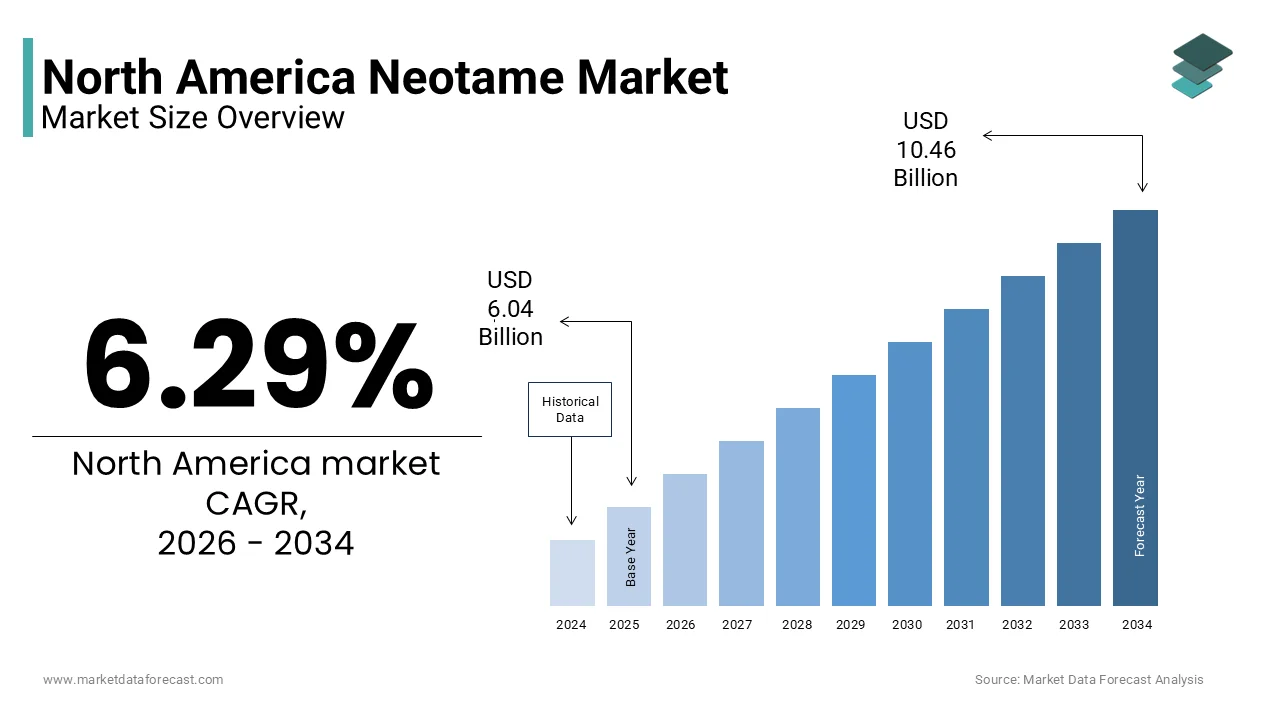
The North America neotame market size was valued at USD 6.04 billion in 2025, is anticipated to reach USD 6.42 billion in 2026, and is projected to scale up to USD 10.46 billion by 2034, registering a compound annual growth rate (CAGR) of 6.29% during the forecast period from 2026 to 2034. Driven by escalating public health initiatives targeting sugar reduction, thermal stability in food processing, and expanding applications in pharmaceutical and geriatric nutrition, the North American neotame market continues to experience robust growth.
Key Executive Metrics (At-a-Glance)
- 2025 Base Valuation: USD 6.04 Billion
- 2026 Current Valuation: USD 6.42 Billion
- 2034 Forecast Valuation: USD 10.46 Billion
- Compound Annual Growth Rate (CAGR): 6.29% (2026–2034)
- Dominant Application Segment: Food and Beverage (commanded an estimated 67.3% share of total consumption in 2025)
- Fastest-Growing Application Segment: Pharmaceuticals (projected to expand at a rapid CAGR of 9.8% from 2026 to 2034)
- Dominant Country Market: United States (accounted for 89.3% of regional consumption in 2025)
Core Market Drivers
- Public Health Policies: Federal and state-level interventions, sugar taxes, and dietary guidelines restricting added sugars to combat obesity and diabetes.
- Geriatric & Medical Nutrition: High demand for metabolic-neutral sweeteners to mask bitterness in pediatric and geriatric oral medications without causing gastrointestinal distress.
Primary Market Restraints & Challenges
- Consumer Skepticism: Persistent public mistrust toward artificial food additives despite extensive FDA, EFSA, and JECFA safety approvals.
- Supply Chain Vulnerabilities: Geographic concentration of primary manufacturing capacity and heavy reliance on imported precursors and specialized catalysts.
North America Neotame Market Segmentation Breakdown
| Segment Category | Leading Sub-Segment (2025 Base) | Fastest-Growing Sub-Segment (2026–2034) |
|---|---|---|
| By Application | Food and Beverage (67.3% share; anchored by carbonated soft drinks, RTD teas, and baked goods) | Pharmaceuticals (9.8% CAGR; driven by bitterness masking in pediatric syrups and antibiotic suspensions) |
| By Country | The United States (89.3% regional share; backed by advanced food infrastructure and early regulatory approval) | Canada (expanding via compounding pharmacies and clean-label hybrid formulations) |
Major Industry Players Profiled
Key enterprises shaping the North American neotame market include NutraSweet Company, Heartland Food Products Group, Nexira, Foodchem International Corporation, Fooding Group Limited, Sweetner Holdings, Inc., Prinova Group LLC, and JJD Enterprises.
North America Neotame Market Size
The North America neotame market size was valued at USD 6.04 billion in 2025 and is expected to reach USD 10.46 billion by 2034 from USD 6.42 billion in 2026, growing at a CAGR of 6.29% from 2026 to 2034.
Neotame is a non-caloric, high-intensity sweetener derived from aspartame but modified through hydrogenation to achieve heightened sweetness potency and metabolic stability. With a sweetness intensity ranging from 7,000 to 13,000 times that of sucrose, neotame is utilized in minute quantities across food, pharmaceutical, and oral care applications, offering formulators an effective tool for sugar reduction without compromising sensory attributes. Unlike its predecessor aspartame, neotame remains stable under high-temperature processing, making it suitable for baked goods, carbonated beverages, and extruded snacks. In Canada, provincial health authorities have launched public education campaigns on hidden sugars, further amplifying demand for alternatives like neotame. Its application extends beyond taste modification—neotame is increasingly used in chewable tablets and pediatric syrups due to its ability to mask bitterness, a factor underscored by research from the University of Toronto’s Faculty of Pharmacy.
 MARKET DRIVERS
Escalating Public Health Initiatives Targeting Sugar Consumption
The intensification of public health policies aimed at curbing excessive sugar intake, which has been directly linked to rising rates of obesity, type 2 diabetes, and cardiovascular disease, is a principal driver shaping the North American neotame market.
According to the Centers for Disease Control and Prevention, more than 11% of the U.S. population has diabetes, with an additional 38% classified as prediabetic, prompting federal and state-level interventions to reform dietary patterns. The Dietary Guidelines for Americans, jointly issued by the U.S. Department of Agriculture and the Department of Health and Human Services, recommend limiting added sugars to less than 10% of daily caloric intake, a directive that has catalyzed widespread product reformulation. Cities such as Philadelphia and Berkeley have implemented sugary drink taxes, leading to a decline in soda sales within taxed categories, as documented by the Drexel University Dornsife School of Public Health. In response, beverage giants like PepsiCo and Keurig Dr Pepper have incorporated neotame into next-generation zero-sugar formulations to maintain palatability while meeting regulatory benchmarks. Neotame’s thermal stability and synergistic performance with other sweeteners make it indispensable in achieving these goals without sacrificing consumer acceptability.
Integration of Neotame in Medical and Geriatric Nutrition Formulations
The expanding utilization of neotame in clinical and age-targeted nutritional products, where taste, safety, and metabolic neutrality are paramount is another pivotal demand catalyst.
With the U.S. Census Bureau projecting that 21% of the American population will be aged 65 or older by 2030, there is growing emphasis on developing palatable yet therapeutic food and pharmaceutical options for elderly patients. Dysgeusia, or altered taste perception, affects nearly a notable share of seniors, often leading to reduced food intake and malnutrition. Neotame’s ability to enhance sweetness at microgram levels without glycemic impact makes it ideal for diabetic-friendly meal replacements, protein supplements, and oral medications. In long-term care facilities, neotame-sweetened products help maintain caloric intake without exacerbating comorbidities. As personalized medicine and home-based care models expand, neotame is emerging not merely as a sweetener but as a critical component of patient-centered therapeutic design.
MARKET RESTRAINTS
Persistent Consumer Mistrust Toward Artificial Ingredients Despite Scientific Endorsement
Widespread consumer skepticism toward artificial food additives, even when supported by rigorous scientific evaluation, is one of the most enduring restraints affecting the North America neotame market. Although neotame has received approval from the FDA, EFSA, and JECFA, public perception remains influenced by conflated narratives surrounding aspartame and other synthetic compounds.
The Clean Label Project, a nonprofit advocacy group, routinely ranks sweetened products based on perceived chemical load, indirectly stigmatizing neotame-containing items despite their safety.
Retailers like Whole Foods Market and Trader Joe’s exclude neotame from their private-label offerings due to customer demand for “natural-only” formulations, limiting distribution channels.
Even when clinical trials confirm safety—as demonstrated by decades of toxicological data compiled by the FDA—emotional responses override rational assessment. Until science communication strategies effectively bridge this gap, neotame will remain marginalized in mainstream retail environments dominated by perception-driven purchasing behavior.
Geographic Concentration of Manufacturing Capacity Creating Supply Vulnerabilities
The extreme concentration of production capabilities, rendering the supply chain susceptible to operational disruptions and geopolitical fluctuations is a significant structural constraint within the North American neotame market. Currently, Heartland Food Products Group operates the sole large-scale neotame manufacturing facility in the United States, located in New Jersey, which supplies the majority of domestic demand and serves as a regional hub for Latin American exports. The synthesis process requires palladium-catalyzed hydrogenation and highly purified precursors, many of which are imported from China and Europe, exposing producers to customs delays and tariff volatility.
Additionally, environmental regulations in states like California and New York impose stringent emissions controls on chemical plants, complicating expansion efforts. The lack of geographic diversification limits resilience, especially during global supply shocks such as those experienced during the pandemic. Without secondary production sites or strategic stockpiling mechanisms, manufacturers face challenges in ensuring uninterrupted supply, undermining long-term confidence among end users in both food and healthcare sectors.
MARKET OPPORTUNITIES
Expansion into Personalized Nutrition and Digital Health Platforms
A transformative opportunity emerging in the North American neotame market lies in its integration with digital health and personalized nutrition ecosystems, where precision ingredient dosing aligns with individual metabolic profiles. Companies such as Zoe, Levels, and Nutrisense utilize continuous glucose monitoring and AI-driven analytics to tailor dietary recommendations, creating demand for sweeteners that deliver sweetness without spiking blood sugar. Neotame’s negligible glycemic impact and ultra-low usage levels make it ideally suited for inclusion in algorithm-guided meal plans targeting insulin resistance and weight management.
Furthermore, direct-to-consumer brands like Huel and Sakara Life are incorporating neotame into ready-to-drink meals designed for biohacking communities who prioritize metabolic efficiency. These formulations are marketed not as diet products but as performance enhancers, reframing neotame’s identity beyond calorie reduction. Collaboration between ingredient suppliers and tech firms is accelerating. As wearable technology and nutrigenomics gain traction, neotame is poised to transition from a passive additive to an active component in data-informed wellness strategies, unlocking premium positioning in a rapidly evolving health economy.
Advancement in Hybrid Sweetening Systems Combining Synthetic and Natural Compounds
An increasingly viable growth avenue is the development of hybrid sweetening systems that combine neotame with plant-derived sweeteners such as stevia, monk fruit, and allulose to optimize taste, labeling, and consumer acceptance. While pure natural sweeteners often exhibit lingering bitterness or poor mouthfeel, blending them with trace amounts of neotame enhances sweetness onset and roundness without exceeding threshold detection levels, allowing manufacturers to claim “reduced sugar” or “no added sugar” while maintaining clean-label appeal.
PepsiCo’s “Bubly Burst” line utilizes such blends to deliver intense fruitiness without aftertaste, appealing to younger demographics resistant to overtly artificial tastes. Similarly, Danone North America has reformulated several Oikos Pro yogurt variants using neotame-stevia combinations to cut sugar while preserving creaminess. These hybrid approaches also reduce overall sweetener costs and improve shelf-life stability. By functioning as a “flavor amplifier” rather than a standalone sweetener, neotame gains entry into segments previously closed off due to clean-label constraints, transforming its market trajectory.
MARKET CHALLENGES
Regulatory Complexity Across Jurisdictions Hindering Unified Market Strategy
The divergence in regulatory interpretation and enforcement across U.S. states, Canadian provinces, and Mexican agencies, complicating harmonized product development and distribution is a persistent challenge in the North American neotame market. Although neotame is not listed, manufacturers face legal uncertainty due to precedent-setting lawsuits against other food additives, leading some to voluntarily exclude it from products sold in the state. The North American Free Trade Agreement’s successor, USMCA, does not include standardized food additive provisions, resulting in redundant compliance processes. This fragmentation increases time-to-market and discourages small innovators from entering the space.
Vulnerability to Alternative Sweetener Innovation and Market Disruption
The North American neotame market faces escalating competitive pressure from next-generation sweeteners developed through biotechnology and fermentation processes, threatening its relevance in the evolving landscape of sugar substitutes. Startups such as Sweegen and Amyris are engineering novel steviol glycosides like Reb-M and Reb-D through precision fermentation, achieving sweetness profiles comparable to sucrose without bitterness, thereby reducing reliance on synthetic enhancers like neotame. The U.S. Department of Energy’s Joint BioEnergy Institute has funded projects to scale microbial production of rare sugars such as allulose, which offers bulk, browning capability, and prebiotic benefits—functional advantages neotame cannot provide alone. Additionally, gene-editing technologies are being used to cultivate monk fruit varieties with higher yields of desirable mogrosides, lowering costs and increasing accessibility.
Without parallel innovation in delivery systems, sustainability credentials, or multifunctionality, neotame risks being relegated to niche applications, unable to compete with biologically derived alternatives positioned at the intersection of science, nature, and consumer trust.
REPORT COVERAGE
| REPORT METRIC | DETAILS |
| Market Size Available | 2025 to 2034 |
| Base Year | 2025 |
| Forecast Period | 2026 to 2034 |
| CAGR | 6.29% |
| Segments Covered | By Application and Region |
|
Various Analyses Covered | Regional & Country Level Analysis, Segment-Level Analysis, DROC, PESTLE Analysis, Porter’s Five Forces Analysis, Competitive Landscape, Analyst Overview on Investment Opportunities |
| Regions Covered | The United States, Canada, Mexico, and Rest of North America |
| Market Leaders Profiled | Foodchem International Corporation, Fooding Group Limited, Sweetner Holdings, Inc., Prinova Group LLC and JJD Enterprises, and others |
SEGMENTAL ANALYSIS
By Application Insights
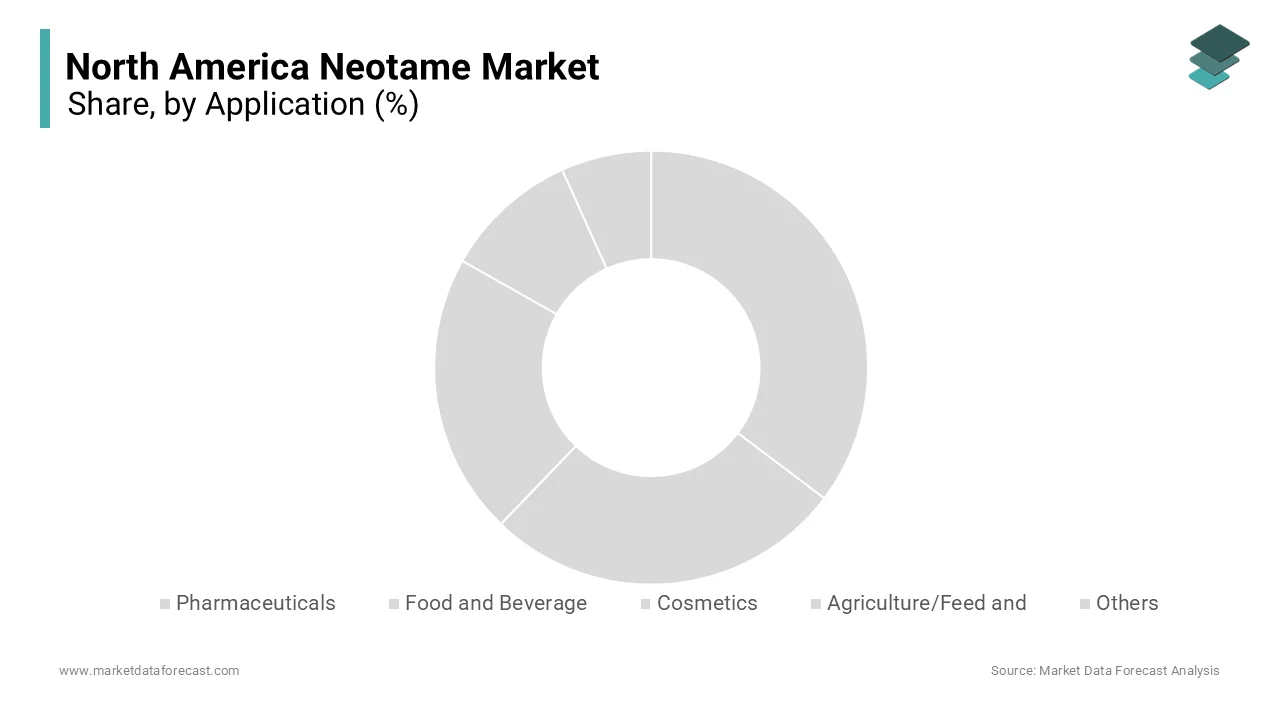
The food and beverage segment stood as the dominant application segment in the North America neotame market by commanding an estimated 67.3% share of total consumption in 2025. This preeminence is anchored in the widespread reformulation of processed foods to align with evolving dietary guidelines and consumer preferences for reduced-sugar options. One of the most influential drivers is the integration of neotame into carbonated soft drinks and ready-to-drink (RTD) teas, where manufacturers seek to eliminate sucrose without compromising sweetness delivery or mouthfeel.
In baked goods, neotame’s thermal stability—retaining potency at temperatures exceeding 200°C—makes it indispensable in low-sugar muffins, cookies, and toaster pastries produced by firms like Kellogg’s and General Mills.
With federal and municipal policies increasingly targeting sugar reduction, the food and beverage industry remains the primary conduit through which neotame reaches end consumers.
The pharmaceuticals segment is emerging as the fastest-growing application area for neotame in North America and is projected to expand at a CAGR of 9.8% from 2026 to 2034. This accelerated uptake is primarily driven by the critical need for palatability enhancement in oral medications, particularly for pediatric and geriatric populations. To address the issue, pharmaceutical developers including Merck and Teva Pharmaceuticals have incorporated neotame into antibiotic suspensions, antiviral syrups, and chewable antacids to effectively mask bitterness without increasing caloric load—a crucial advantage for diabetic patients. Another pivotal factor is neotame’s metabolic inertness; unlike sugar alcohols such as sorbitol, it does not cause gastrointestinal distress, making it ideal for long-term therapeutic use. The U.S. Pharmacopeial Convention has included neotame in its list of approved excipients for oral dosage forms, facilitating broader regulatory acceptance. Furthermore, the rise of compounding pharmacies catering to personalized medicine has increased demand for taste-modifying agents. These converging clinical, regulatory, and demographic forces are transforming neotame from a peripheral additive into a core component of modern drug design.
REGIONAL ANALYSIS
United States
The United States occupied a central position in the North America neotame market by accounting for 89.3% of regional consumption in 2025. As both the largest producer and consumer of neotame, the country benefits from advanced food science infrastructure, established regulatory clarity, and high penetration of functional food products. The FDA’s early approval of neotame in 2002 laid the foundation for its integration across multiple industries, particularly in large-scale beverage and bakery manufacturing. The growing prevalence of metabolic disorders amplifies demand. Retail chains such as Walmart and Target have committed to reducing added sugars in their private-label portfolios. Additionally, digital health platforms like Levels and Nutrisense recommend neotame-sweetened products within personalized nutrition plans, reinforcing its legitimacy among health-conscious consumers. The National Institutes of Health funds ongoing research into taste modulation technologies, further validating neotame’s role in medical nutrition.
Canada
Canada holds a modest yet strategically significant share of the North America neotame market. While domestic production is absent, the country serves as a key importer and formulator of neotame-containing products, particularly in the pharmaceutical and functional food sectors. Moreover, Canadian compounding pharmacies increasingly utilize neotame in custom pediatric medications, supported by guidelines from the Canadian Pharmacists Association. Nevertheless, rising investment in clean-label hybrid formulations—such as those developed by Montreal-based ingredient firm BioNeutra—is helping reposition neotame as a functional enhancer rather than a synthetic additive. These developments underscore Canada’s role as a regulated, innovation-responsive market bridging North American and European formulation trends.
Rest of North America
The Rest of North America, comprising Mexico and Central American territories integrated into North American supply chains. Within this, Mexico represents the sole meaningful consumer, importing neotame primarily for use in pharmaceuticals and premium confectionery. However, adoption remains constrained due to cost sensitivity and entrenched preference for sucrose in traditional food culture. The regulatory shift has incentivized multinational manufacturers like Grupo Bimbo and Herdez to explore neotame in reformulated breads and sauces. Nevertheless, import dependency, lack of local manufacturing, and limited awareness among small and mid-sized enterprises hinder scalability.
KEY MARKET PLAYERS AND COMPETITIVE LANDSCAPE
Key players in the North America Neotame Market are Foodchem International Corporation, Fooding Group Limited, Sweetner Holdings, Inc., Prinova Group LLC and JJD Enterprises.
The competitive dynamics in the North America neotame market are defined more by technological specialization and strategic positioning than by price competition. With only a few entities possessing the scientific expertise and regulatory clearance to handle neotame at scale, the market remains tightly concentrated, allowing established players to exert influence over innovation pathways and application development. Rather than competing on volume, firms differentiate through formulation intelligence, customer support, and integration into broader ingredient ecosystems. The absence of mass-market branding means rivalry unfolds behind closed laboratory doors, where access to R&D capabilities and regulatory dossiers becomes the true battleground. Smaller chemical suppliers face steep entry barriers due to the complexity of synthesis, stringent purity requirements, and the need for extensive safety documentation. Incumbents maintain advantage by embedding themselves in the innovation cycles of major food and pharma corporations, often becoming indispensable partners in product reformulation. While consumer skepticism poses a shared challenge, leading players respond by emphasizing science-backed safety, functional superiority, and compatibility with clean-label trends through hybrid formulations. The competition, therefore, is less about capturing shelf space and more about securing formulation rights—where influence is measured not in sales figures but in inclusion within next-generation product blueprints.
TOP PLAYERS IN THE MARKET
NutraSweet Company
NutraSweet Company pioneered the development of neotame, leveraging its deep expertise in peptide chemistry to engineer a high-intensity sweetener with superior stability and safety. Though no longer an independent manufacturer, NutraSweet’s foundational intellectual property and regulatory filings continue to shape global standards for neotame use. The company played a crucial role in securing FDA approval and establishing toxicological benchmarks that enabled industrial-scale adoption. Today, it functions as a technical advisor within the broader Heartland Food Products Group, contributing formulation insights and supporting client innovation in food and pharmaceutical applications. Its legacy endures in the compound’s widespread acceptance and integration into complex product matrices where taste precision is paramount.
Heartland Food Products Group
Heartland Food Products Group stands as the dominant force in the North American neotame landscape, serving as the primary producer and distributor across the continent. Building on its acquisition of the NutraSweet brand, Heartland has consolidated production, expanded application research, and strengthened supply chain resilience. The company actively collaborates with major food and drug manufacturers to optimize sweetness delivery systems, positioning neotame not just as a sugar substitute but as a functional ingredient in taste modulation. With a focus on sustainability and regulatory compliance, Heartland ensures consistent quality while advancing cleaner synthesis methods, reinforcing its reputation as a trusted partner in health-focused product development.
Nexira
Nexira contributes to the North America neotame market through strategic formulation partnerships, blending neotame with natural excipients to meet clean-label demands without sacrificing performance. As a French-based specialty ingredients firm with a strong North American presence, Nexira specializes in hybrid solutions that bridge synthetic efficacy and consumer-perceived naturality. The company emphasizes sensory enhancement, encapsulation technologies, and bitterness masking, particularly in pharmaceutical and premium confectionery applications. By repositioning neotame as part of multifunctional ingredient systems, Nexira expands its relevance beyond traditional sweetening roles, enabling clients to meet evolving regulatory and consumer expectations in a highly discerning marketplace.
TOP STRATEGIES USED BY KEY PLAYERS
A defining strategy among leading players is the advancement of co-development partnerships with food, beverage, and pharmaceutical companies to create proprietary sweetening systems tailored to specific product requirements. These collaborations allow for precise optimization of flavor profiles, stability, and labeling compliance, fostering long-term client dependency and differentiation in crowded markets.
Another critical approach involves reframing neotame’s value proposition from a mere sugar replacer to a multifunctional taste modulator capable of enhancing mouthfeel, suppressing bitterness, and improving overall sensory balance. This shift enables penetration into premium segments such as medical nutrition, pediatric formulations, and functional foods where performance outweighs origin bias.
A third pivotal strategy is investing in sustainable and transparent manufacturing processes to align with corporate ESG goals and counteract consumer skepticism toward synthetic compounds. Companies are refining catalytic efficiency, reducing solvent waste, and improving traceability to strengthen credibility among environmentally conscious buyers and institutional procurement bodies.
RECENT HAPPENINGS IN THE MARKET
- In January 2023, Heartland Food Products Group launched a dedicated application lab in New Jersey focused on optimizing neotame blends for low-sugar bakery and dairy products, enhancing collaboration with regional food manufacturers.
- In June 2023, NutraSweet Company initiated a technical outreach program targeting U.S. compounding pharmacies, providing formulation guidelines for incorporating neotame into pediatric liquid medications.
- In October 2023, Nexira partnered with a Canadian nutraceutical developer to introduce a neotame-enhanced protein bar designed for diabetic consumers, combining metabolic neutrality with improved palatability.
- In March 2025, Heartland Food Products Group upgraded its palladium recovery system at its New Jersey facility to reduce environmental impact and improve process sustainability in neotame synthesis.
- In July 2025, NutraSweet collaborated with a digital health startup to integrate neotame-sweetened product recommendations into a personalized nutrition app, expanding its reach into data-driven wellness platforms.
MARKET SEGMENTATION
This research report on the North America neotame market has been segmented and sub-segmented based on the following categories.
By Application
- Pharmaceuticals
- Food and Beverage
- Cosmetics
- Agriculture/Feed and
- Others
By Country
- The United States
- Canada
- Rest of North America