North America Nonwoven Fabrics Market Size, Share, Growth, Trends, And Forecasts Report, Segmented Report, Segmented By Product, Material, Technology, Application, And By Country (US, Canada, Mexico and Rest of North America), Industry Analysis From (2026 to 2034)
Market Size, 2025
$18.74 BnMarket Estimate, 2026
$19.63 BnMarket Forecast, 2034
$28.41 BnCAGR, 2026–2034
4.73%North America Nonwoven Fabrics Market Size
The North America Nonwovens fabrics market was valued at USD 18.74 billion in 2025 and is anticipated to reach a valuation of USD 19.63 billion in 2026 and USD 28.41 billion by 2034, growing at a CAGR of 4.73%, from 2026 to 2034.
The nonwoven fabrics are a category of engineered textiles produced directly from staple fibers, long filaments, or melted polymers without weaving. These materials are widely used across diverse industries, including healthcare, personal care, automotive, construction, and filtration, due to their versatility, cost-effectiveness, and disposability. According to the Association of the Nonwoven Fabrics Industry (INDA), the U.S. remains a global leader in both production and consumption of nonwoven fabrics, accounting for a substantial portion of global output. Canada’s market is also expanding, particularly in hygiene and medical applications, driven by increased health awareness post-pandemic. Additionally, Mexico's growing industrial base and increasing investments in the medical and hygiene sectors have contributed to a steady rise in demand for nonwoven products.
MARKET DRIVERS
Rising Demand from the Healthcare and Medical Sector
One of the primary drivers of the North American nonwoven fabrics market is the surging demand from the healthcare and medical industry, particularly for disposable protective gear, surgical drapes, face masks, and wound dressings. According to the Centers for Disease Control and Prevention (CDC), U.S. hospitals alone consume over 5.2 billion face masks annually, a figure that has grown significantly since the onset of the pandemic. Moreover, the expansion of outpatient clinics, ambulatory surgical centers, and home healthcare services has further boosted the requirement for single-use medical textiles. In addition, stringent regulatory guidelines from bodies like the Food and Drug Administration (FDA) regarding the use of disposable medical garments and equipment have reinforced the preference for nonwoven materials over traditional woven textiles.
Expansion of the Personal Care and Hygiene Products Industry
Another key driver of the North America nonwoven fabrics market is the robust growth of the personal care and hygiene sector, particularly in baby diapers, feminine hygiene products, and adult incontinence solutions. According to the National Diaper Bank Network, approximately one in three American families struggles to afford disposable diapers, prompting manufacturers to innovate with cost-effective yet highly absorbent materials made from nonwoven substrates. Furthermore, rising awareness around menstrual hygiene and aging population demographics are contributing to stronger demand for feminine and adult incontinence products. Leading companies such as Kimberly-Clark and Procter & Gamble continue to invest heavily in advanced nonwoven technologies that enhance softness, breathability, and moisture management.
MARKET RESTRAINTS
Environmental Concerns and Regulatory Pressures
A significant restraint affecting the North American nonwoven fabrics market is the growing scrutiny over environmental impact, particularly concerning plastic waste and non-biodegradable materials. Many nonwoven products are derived from polypropylene, a petroleum-based polymer that does not decompose easily and contributes to landfill accumulation. According to the Environmental Protection Agency (EPA), plastics accounted for over 18% of municipal solid waste in the United States in 2023, with nonwoven disposables forming a notable share of this waste stream. Regulatory authorities such as Environment and Climate Change Canada have introduced policies aimed at reducing single-use plastics, which indirectly affect the production and usage of conventional nonwoven fabrics. Additionally, several U.S. states, including California and New York, have implemented bans on certain disposable items, prompting manufacturers to seek alternative biodegradable or compostable fiber sources.
Fluctuating Raw Material Prices and Supply Chain Disruptions
The North American nonwoven fabrics market faces persistent challenges related to fluctuating raw material prices and supply chain disruptions, especially for petrochemical-derived inputs such as polypropylene and polyester. According to the U.S. Energy Information Administration (EIA), crude oil prices experienced significant volatility in 2023, peaking at USD 96 per barrel before retreating, which directly impacted the cost of synthetic fibers used in nonwoven production. This instability has led to unpredictable pricing for manufacturers and downstream consumers alike. Moreover, ongoing logistical bottlenecks and labor shortages at ports have delayed the import of essential feedstocks and semi-finished goods. Trade restrictions and geopolitical tensions have further exacerbated sourcing difficulties. The U.S. International Trade Commission noted a 4.2% decline in textile resin imports from Asia in Q1 2023 due to new customs inspections and tariffs.
MARKET OPPORTUNITIES
Growth in Sustainable and Bio-Based Nonwoven Solutions
A significant opportunity emerging in the North American nonwoven fabrics market is the rising demand for sustainable and bio-based alternatives that align with global environmental goals. Consumers and regulators alike are pushing for greener materials that reduce dependence on fossil fuels and minimize waste generation. Companies are responding by investing in plant-based fibers such as polylactic acid (PLA), cellulose, and bio-polyethylene to develop compostable and biodegradable nonwoven products. In addition, government incentives and corporate sustainability pledges are accelerating the shift toward green manufacturing. As per the U.S. Department of Agriculture (USDA), over 40% of nonwoven fabric manufacturers in the country had adopted bio-based content in at least one product line by the end of 2023.
Increasing Adoption in Industrial and Automotive Applications
Another promising avenue for growth in the North American nonwoven fabrics market is the expanding use of these materials in industrial and automotive sectors. Nonwoven fabrics are increasingly employed in air and liquid filtration systems, insulation, carpet backing, and interior upholstery due to their durability, lightweight properties, and cost-efficiency. According to the Center for Automotive Research (CAR), the North American automotive industry produced over 14 million vehicles in 2023, each incorporating an average of 20–30 kilograms of nonwoven materials. In particular, the transition toward electric vehicles (EVs) is driving demand for specialized nonwoven components designed for battery insulation, cabin air filtration, and acoustic dampening. Moreover, the industrial sector is witnessing increased use of nonwovens in geotextiles, roofing membranes, and HVAC filters. The U.S. Census Bureau recorded a 6.8% growth in non-residential construction spending in 2023, further stimulating demand for durable, high-performance nonwoven solutions.
MARKET CHALLENGES
Technological Complexity in Developing High-Performance Nonwovens
A major challenge confronting the North American nonwoven fabrics market is the increasing complexity involved in developing high-performance, multifunctional nonwoven materials that meet evolving consumer and regulatory expectations. According to the Textile Institute, producing nonwoven fabrics with tailored performance characteristics requires sophisticated engineering, precision in fiber alignment, and controlled bonding processes, which significantly elevate R&D and capital expenditures. Leading manufacturers must continuously invest in cutting-edge technologies such as hydroentanglement, spunmelt, and nanofiber extrusion to stay competitive. Moreover, achieving consistency in large-scale production while maintaining quality standards presents another hurdle. The American Association of Textile Chemists and Colorists (AATCC) notes that variations in fiber orientation and bonding efficiency can compromise product reliability, especially in critical applications like medical gowns and filtration media.
Intense Competition and Price Sensitivity Across End-Use Industries
The North American nonwoven fabrics market faces intense competition from both domestic and international suppliers, resulting in heightened price sensitivity among buyers across various end-use industries. With numerous manufacturers offering similar product portfolios, differentiation based solely on functional attributes has become increasingly difficult. Price pressures are particularly pronounced in commodity-driven segments such as wipes, disposable apparel, and basic hygiene products. As per Nielsen, retail chains and private-label brands have leveraged bulk purchasing power to negotiate lower supplier margins, squeezing profitability for smaller producers. This dynamic has led to consolidation within the industry, with larger players acquiring smaller firms to strengthen economies of scale. However, maintaining a balance between cost reduction and product quality remains a persistent challenge.
REPORT COVERAGE
| REPORT METRIC | DETAILS |
| Market Size Available | 2025 to 2034 |
| Base Year | 2025 |
| Forecast Period | 2026 to 2034 |
| CAGR | 4.73% |
| Segments Covered | By Type, By Control Method, By Application |
| Various Analyses Covered | Global, Regional & Country Level Analysis, Segment-Level Analysis, DROC, PESTLE Analysis, Porter’s Five Forces Analysis, Competitive Landscape, Analyst Overview on Investment Opportunities |
| Regions Covered | U.S.A, Canada |
| Market Leaders Profiled | Ahlstrom, MITSUI & CO., LTD., Polymer Group Incorporation, Asahi Kasei Corporation, Fiberwebindia Ltd., Avgol Industries 1953 Ltd, First Quality Enterprises, Inc., Providencia, PFNonwovens Holding s.r.o., Fibertex. |
SEGMENTAL ANALYSIS
By Product Insights
The disposable nonwoven fabrics segment accounted in holding a dominant share of the North America nonwoven fabrics market in 2025, owing to the continued expansion of the healthcare sector, where disposable products such as face masks, gowns, and wipes are essential for maintaining sterility. As per the Centers for Disease Control and Prevention (CDC), U.S. hospitals alone used more than 5.2 billion disposable face masks in 2023, with a high volume of consumption in clinical settings. Additionally, the personal care industry remains a strong contributor, with baby diapers, feminine hygiene products, and adult incontinence items relying heavily on absorbent, breathable nonwoven layers.
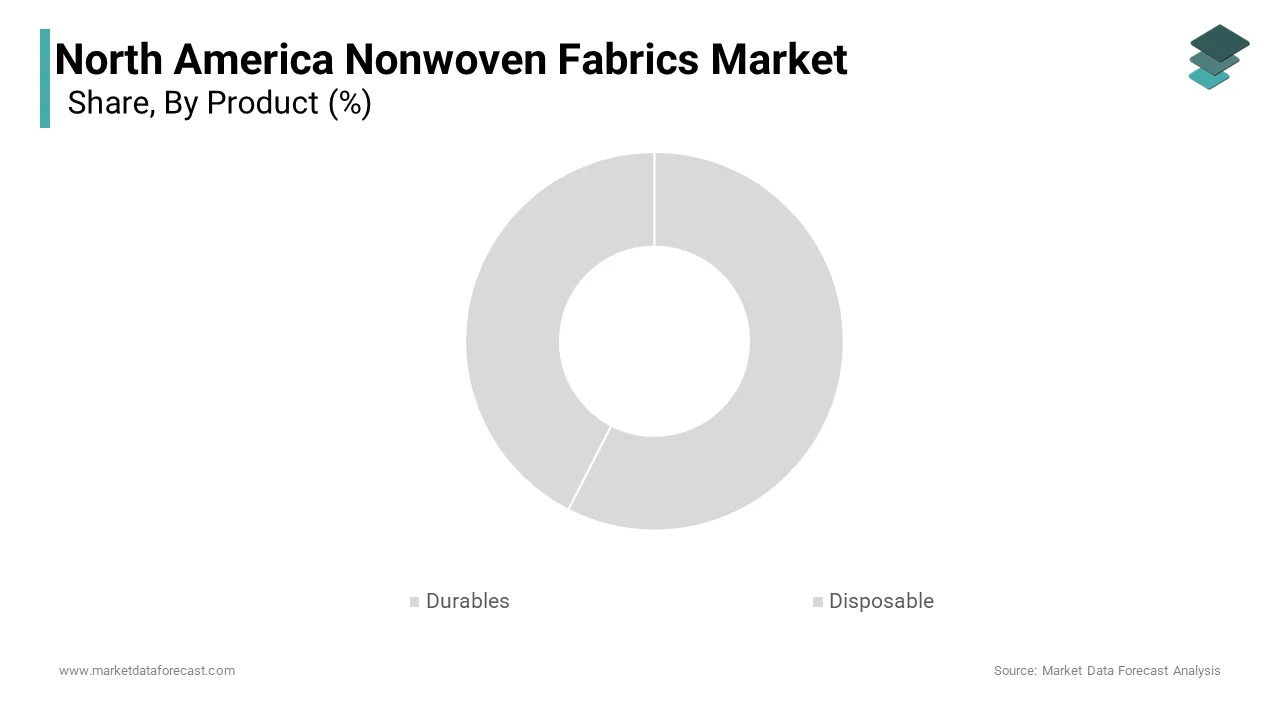
The durable nonwoven fabrics segment is lucratively growing with a CAGR of 6.7% in the coming years, with the automotive industry’s increasing reliance on lightweight materials to improve fuel efficiency and reduce emissions. According to the Center for Automotive Research (CAR), each modern vehicle incorporates an average of 20–30 kilograms of nonwoven fabric in seat covers, headliners, and acoustic insulation. Moreover, the construction and infrastructure sectors are adopting durable nonwovens for geotextile applications, including road stabilization and erosion control.
By Material Insights
The polypropylene (PP) segment dominated the North American nonwoven fabrics market by capturing the highest share in 2025. One primary factor behind its leading position is the material’s extensive use in hygiene and medical products, especially in spunbond and meltblown nonwoven manufacturing processes. The Centers for Disease Control and Prevention (CDC) notes that the majority of surgical gowns, face masks, and disposable wipes produced in the U.S. utilize polypropylene-based nonwovens due to their excellent barrier properties and moisture resistance.
Furthermore, polypropylene is favored for its low weight-to-strength ratio, making it ideal for automotive and industrial applications. As per the Society of the Plastics Industry (SPI), more than 40% of all nonwoven automotive components are manufactured using polypropylene fibers, emphasizing its entrenched role across diverse end-use sectors.
The polyethylene terephthalate (PET) segment is likely to grow with an estimated CAGR of 7.3% in the next years. One major growth driver is the use of PET nonwovens in geotextiles, filtration media, and automotive insulation, where durability and chemical resistance are critical. The Federal Highway Administration (FHWA) reported that over 60% of new road construction projects in the U.S. now incorporate PET-based geotextiles for soil stabilization, which reflects broader acceptance of these materials in civil engineering applications. Additionally, the apparel and home furnishings industries are increasingly turning to PET nonwovens for padding, interlinings, and insulation, leveraging both performance benefits and sustainability credentials.
By Technology Insights
The spunlaid technology segment was the largest by holding 43.2% of the North America nonwoven fabrics market share in 2025. Spunlaid nonwovens are extensively used in hygiene, medical, and filtration applications due to their high strength, uniformity, and ability to be combined with other layers, like meltblown, for composite structures such as SMS (spunbond-meltblown-spunbond). A key reason for its dominant position is the technology’s compatibility with high-speed manufacturing processes, allowing for large-scale production of cost-effective materials. Additionally, the automotive and industrial sectors also rely heavily on spunlaid fabrics for underlay materials, insulation, and filtration media.
The airlaid nonwoven technology segment is likely to grow with an anticipated CAGR of 7.9% from 2025 to 2033. Airlaid nonwovens are widely used in absorbent hygiene products, wipes, and food packaging due to their softness, bulkiness, and high liquid retention capacity. According to Smithers Pira, airlaid capacity in North America increased by 9.2% in 2023, outpacing growth in other nonwoven technologies. Moreover, the expansion of private-label wipe brands and the rise of eco-friendly wet wipes have further boosted airlaid production. As per the Environmental Protection Agency (EPA), biodegradable airlaid wipes accounted for nearly 22% of total wipe sales in the U.S. in 2023, which indicates a shift toward environmentally responsible product formulations.
By Application Insights
The medical and hygiene application segment was the largest by occupying 38.2% of the North America nonwoven fabrics market share in 2025. One key growth driver is the adoption of advanced HVAC filter media in commercial and residential buildings, particularly in response to heightened awareness around indoor air quality post-pandemic. The U.S. Department of Energy reported that HVAC-related energy savings from improved filtration could reach USD 15 billion annually, prompting widespread upgrades to filtration systems incorporating nonwoven media. Additionally, the industrial sector is increasingly utilizing nonwoven fabrics in oil, gas, and chemical processing filtration, where durability and particle retention are crucial.
COUNTRY-LEVEL ANALYSIS
United States Nonwovens Fabrics Market Analysis
The United States was the top performer in the North American nonwoven fabrics market with 75.6% of the share in 2025, with a well-established manufacturing ecosystem, robust demand from healthcare, hygiene, and automotive sectors, and continuous technological advancements in nonwoven production. According to the American Chemistry Council (ACC), the U.S. accounts for nearly 20% of global nonwoven fabric output, with major producers such as Berry Global, Avgol, and Kimberly-Clark maintaining significant operations. Moreover, the automotive and construction industries are key contributors, with nonwovens being used extensively in vehicle interiors, insulation, and geotextiles.
Canada Nonwovens Fabrics Market Analysis
Canada was positioned second with 12.3% of the North American nonwoven fabrics market share in 2025. One of the key growth drivers is the expansion of the healthcare secsectorarticularly in hospital supplies and home health services. Additionally, sustainability efforts are gaining traction, with Environment and Climate Change Canada promoting the use of bio-based and recyclable nonwoven alternatives. As per the Biodegradable Products Institute (BPI), over 15% of nonwoven products launched in Canada in 2023 were certified as compostable or partially biodegradable, which indicates a gradual shift toward greener manufacturing practices.
COMPETITIVE LANDSCAPE
The competition in the North American nonwoven fabrics market is characterized by a mix of large multinational corporations and mid-sized regional players vying for dominance through innovation, sustainability, and operational efficiency. The market remains highly fragmented, with several established firms maintaining strong footholds in specific application areas such as hygiene, healthcare, automotive, and filtration. As consumer preferences shift toward environmentally responsible products, companies are under pressure to adapt quickly by introducing bio-based or compostable alternatives without compromising on performance or cost-effectiveness. Innovation cycles have accelerated, with manufacturers continuously refining production techniques, integrating smart technologies, and exploring novel fiber compositions to enhance functionality and reduce environmental impact. Strategic mergers and acquisitions are also becoming more frequent as companies seek to expand their geographic reach, diversify product offerings, and strengthen supply chain control.
KEY MARKET PLAYERS
These are the market players that are dominating the North American fabrics market include are
- Ahlstrom
- MITSUI & CO., LTD.
- Polymer Group Incorporation
- Asahi Kasei Corporation
- Fiberwebindia Ltd.
- Avgol Industries 1953 Ltd
- First Quality Enterprises, Inc.
- Providencia
- PFNonwovens Holding s.r.o.
- Fibertex.
Top Players In the Market
- One of the leading players in the North American nonwoven fabrics market is Berry Global Group, Inc. The company operates globally and holds a strong presence in North America through its diversified product portfolio, catering to hygiene, healthcare, food service, and industrial applications. Berry’s strategic focus on innovation, sustainability, and vertical integration has allowed it to maintain a competitive edge while contributing significantly to global advancements in nonwoven technologies.
- Another key player is Kimberly-Clark Corporation, renowned for its dominance in consumer and professional hygiene products. The company leverages decades of expertise in absorbent nonwovens used in baby care, feminine hygiene, and adult incontinence products. Its deep-rooted brand equity, coupled with continuous R&D investments, enables Kimberly-Clark to influence global nonwoven trends and set benchmarks in product performance and environmental responsibility.
- Avgol Nonwovens is a global leader in spunmelt technology, plays a pivotal role in supplying high-quality nonwoven fabrics for disposable hygiene applications across North America. With a strong commitment to innovation and customer-centric solutions, Avgol supports major manufacturers in developing advanced materials that meet evolving consumer needs. The company's technological agility and sustainable manufacturing practices have reinforced its position as a key contributor to the regional and global nonwoven fabric ecosystem.
Top Strategies Used By Key Market Participants
- Key players in the North American nonwoven fabrics market are increasingly focusing on product innovation and material diversification to cater to evolving consumer demands and regulatory standards. Companies are investing heavily in research and development to create high-performance, biodegradable, and recyclable nonwoven alternatives that align with global sustainability goals.
- Another major strategy involves expanding production capacities and enhancing supply chain resilience through strategic acquisitions, greenfield investments, and partnerships with raw material suppliers. This helps firms ensure stable operations and quicker response times to fluctuating demand patterns across end-use industries.
- Additionally, strengthening brand positioning through eco-friendly branding and digital engagement has become crucial. Leading companies are leveraging e-commerce platforms, targeted marketing campaigns, and transparent communication regarding sustainable sourcing and manufacturing processes to build consumer trust and differentiate themselves in a highly competitive market landscape.
RECENT MARKET NEWS
- In February 2025, Berry Global announced the launch of a new line of compostable nonwoven wipes designed for household and personal care use by reinforcing its commitment to sustainable product development and reducing plastic waste.
- In April 2025, Kimberly-Clark introduced an upgraded diaper core technology utilizing ultra-absorbent nonwoven structures, which aimed at improving comfort and fluid management while reducing overall material usage.
- In June 2025, Avgol expanded its North American footprint by establishing a new technical support center in Georgia by enhancing its ability to provide real-time assistance to hygiene product manufacturers using its spunmelt nonwovens.
- In August 2025, Glatfelte, a specialty fiber solutions provider, partnered with a leading textile recycling firm to develop nonwoven materials from post-consumer textile waste by supporting circular economy initiatives in the region.
- In October 2025, Freudenberg Performance Materials launched a new range of high-efficiency filtration media made from fine-fiber nonwovens, which is targeting HVAC and industrial air purification markets with enhanced particle capture capabilities.
MARKET SEGMENTATION
This research report on the North American nonwoven fabrics market is segmented and sub-segmented into the following categories.
By Product
- Durables
- Disposable
By Material
- Polypropylene
- Polyethylene Terephthalate
- Polymer
- Rayon
- Wood Pulp
- BICO
- Others
By Technology
- Spunlaid
- Drylaid
- Wetlaid
- Airlaid
By Application
- Medical & Hygiene
- Construction & Geotextile
- Upholstery
- Filtration
- Automobile
- Garments
- Others
By Country
- The United States
- Canada
- Mexico
- Rest of North America
Frequently Asked Questions
What are nonwoven fabrics and why are they important in North America?
Nonwoven fabrics are engineered materials made by bonding fibers together without weaving. They are valued for their versatility, cost-effectiveness, and disposability. In North America, these fabrics play a critical role in healthcare, personal hygiene, automotive interiors, agriculture, construction, and industrial applications. Their adaptability makes them essential across many sectors, especially where single-use, hygienic, or high-performance materials are required.
How has consumer behavior influenced the nonwoven fabric industry in the U.S. and Canada?
Consumers in North America are more informed and conscious about product quality, hygiene, and environmental impact than ever before. This has led to increased demand for premium, dermatologically tested nonwoven products in the personal care segment. Additionally, there’s a growing interest in reusable nonwoven items for household cleaning and eco-friendly fashion, which is prompting manufacturers to rethink traditional product designs.
Are nonwoven fabrics in North America becoming more sustainable?
Yes, sustainability is a major trend shaping the nonwoven fabrics industry in North America. Companies are exploring alternatives like plant-based fibers, bio-polymers such as PLA and PHA, and recycled polyester to reduce dependency on petroleum-based raw materials. Many brands are also adopting transparent labeling and green certifications to meet evolving consumer expectations and comply with stricter environmental regulations.
How do regulations impact the production and use of nonwoven fabrics in North America?
Regulatory bodies like the U.S. Environmental Protection Agency (EPA), the Food and Drug Administration (FDA), and Health Canada have significant influence over the nonwoven fabric industry. Regulations focus on chemical safety, emissions during manufacturing, waste disposal, and recyclability. There’s also increasing pressure from state governments, particularly in California and New York, to phase out single-use plastics, encouraging companies to develop greener alternatives.
Which regions within North America contribute the most to the nonwoven fabric market?
The United States dominates the market due to its large population, well-established healthcare system, and strong presence of key manufacturers. Within the U.S., states like Georgia, Texas, and North Carolina host major production facilities. Canada contributes steadily, with growing demand in the healthcare and construction sectors. Mexico, while not part of this regional focus, often serves as a supply chain partner to U.S. companies.
How important is innovation in the development of new nonwoven fabric products?
Innovation is central to staying competitive in the North American nonwoven fabric market. Manufacturers are investing in R&D to create advanced products with enhanced properties such as antimicrobial finishes, improved breathability, moisture-wicking capabilities, and better thermal insulation. There's also growing interest in smart textiles that integrate sensors or responsive materials for use in medical monitoring and wearable tech.
Has the pandemic had a lasting effect on the nonwoven fabric industry in North America?
Yes, the pandemic had a transformative impact. Demand for nonwoven fabrics surged due to the urgent need for personal protective equipment (PPE), disinfectant wipes, and sterilization wraps. While some of the peak demand has normalized, the overall awareness and usage of nonwoven hygiene products have remained elevated. It also accelerated investments in domestic production capacity to reduce reliance on foreign suppliers.
Is there a shift toward local manufacturing of nonwoven fabrics in North America?
Definitely. After experiencing supply chain vulnerabilities during the pandemic, many companies are re-evaluating sourcing strategies. There is growing support for nearshoring and reshoring initiatives, particularly in the healthcare and defense sectors. Governments are offering incentives for companies to build or expand domestic production facilities, aiming to ensure resilience and security in critical supply chains.
Related Reports
Access the study in MULTIPLE FORMATS
Purchase options starting from
$ 2000
Didn’t find what you’re looking for?
TALK TO OUR ANALYST TEAM
Need something within your budget?
NO WORRIES! WE GOT YOU COVERED!
Call us on: +1 888 702 9696 (U.S Toll Free)
Write to us: sales@marketdataforecast.com