- Product Description Description
- Table of Contents TOC
- List of Table & Figure LOT
- Get Free Sample PDF Sample PDF
Market Size, 2025
$3.42 BnMarket Estimate, 2026
$3.63 BnMarket Forecast, 2034
$5.89 BnCAGR, 2026–2034
6.22%Executive Summary: North America Organic Feed Market Analysis & Growth Forecast (2026-2034)
- Market Scope: Comprehensive regional evaluation encompassing product types (cereals & grains, oilseeds, and others), livestock categories (poultry, ruminants, swine, aquatic animals, and others like equine and pets), feed forms (pellets, crumbles, and mashes), additives (minerals, amino acids, vitamins, enzymes, phytogenic, and others), and country-level markets across the U.S., Canada, and Rest of North America.
- Market Valuation: Valued at USD 3.42 billion in 2025, estimated at USD 3.63 billion in 2026, and projected to reach USD 5.89 billion by 2034, registering a compound annual growth rate (CAGR) of 6.22% from 2026 to 2034.
- Primary Growth Drivers: Rising consumer demand for certified organic meat, dairy, and eggs, along with increasing government-backed policy reforms, subsidies, and sustainable agriculture frameworks across the United States and Canada.
Key North America Organic Feed Market Segment Metrics (2026-2034)
| Category | Leading Segment (Position) | Fastest-Growing / High-Impact Segment |
|---|---|---|
| By Type & Livestock | Cereals & Grains (51.2% share in 2025 via primary energy digestibility) & Poultry (37.4% share driven by urban consumer demand) | Oilseeds (13.4% CAGR due to non-soy alternatives) & Aquatic Animals (14.1% CAGR propelled by sustainable aquaculture and organic aquafeed standards) |
| By Form | Pellets (captures 53.2% share in 2025 due to balanced nutrition, digestion efficiency, and milling scalability) | Crumbles Segment (projected at a 13.9% CAGR ideal for young animals in poultry and early-stage aquaculture settings) |
| Key Country Markets | United States (dominates with 71.2% market share backed by massive organic dairy/poultry production and USDA support) | Canada (accounts for 27.3% share, expanding rapidly via updated CFIA standards and rising certified organic crop acreage) |
Major North America Organic Feed Market Players & Industry Structure
Market Structure: Highly competitive landscape featuring major multinational agribusinesses and regional cooperatives leveraging integrated supply chains, strategic farming partnerships, and rigorous organic certification protocols.
Key Companies: Cargill Incorporated, Archer Daniels Midland Company (ADM), Ridley Corporation Limited, SunOpta, Purina Animal Nutrition LLC, Ranch-Way Feeds, Scratch and Peck Feeds, and Others.
North America Organic Feed Market Size
The North America organic feed market size was valued from USD 3.42 billion in 2025 and is anticipated to reach a valuation of USD 3.63 billion in 2026 and USD 5.89 billion by 2034. growing at a CAGR of 6.22 % from 2026 to 2034.
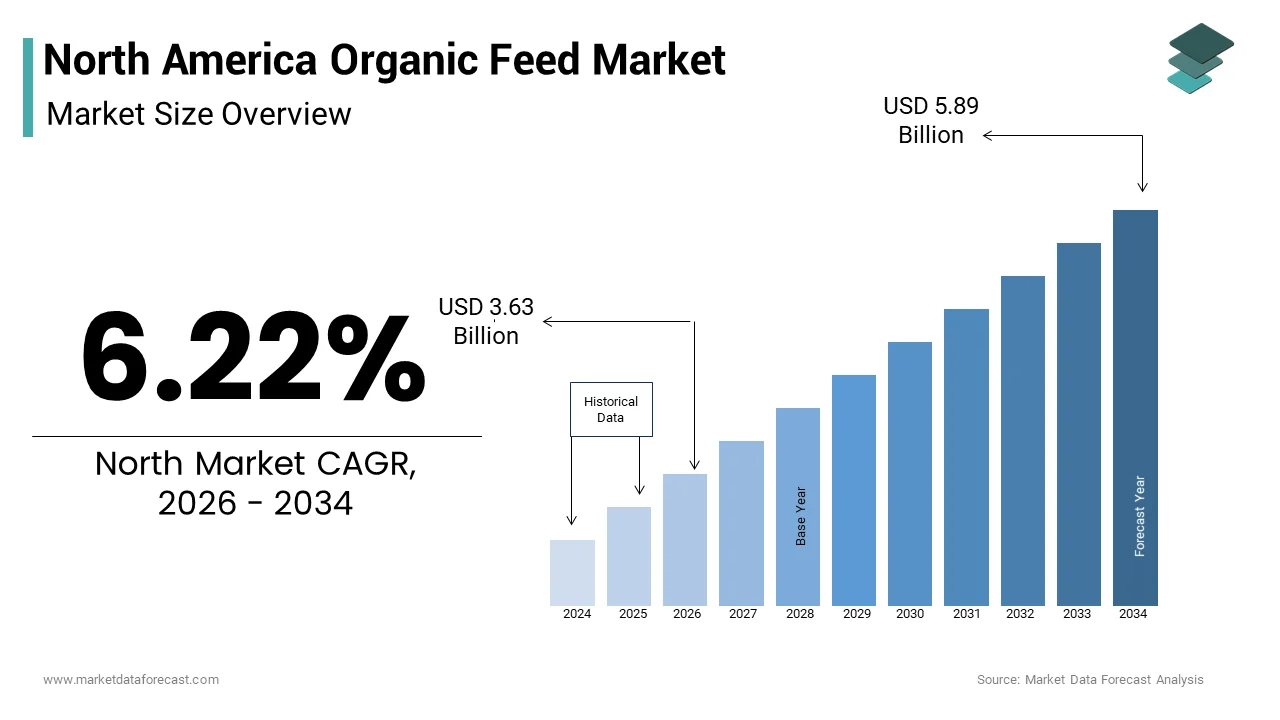
The organic feed is used in livestock, poultry, dairy, and aquaculture industries to support the growing demand for certified organic meat, eggs, milk, and seafood across the United States and Canada. According to the U.S. Department of Agriculture (USDA), consumer demand for organic food has been steadily increasing, with organic dairy and poultry products witnessing particularly strong growth. Moreover, government-backed initiatives promoting sustainable agriculture are reinforcing this trend. The Canadian Food Inspection Agency (CFIA) has updated national organic standards to ensure consistency in feed sourcing, making it easier for farmers to transition to organic practices.
MARKET DRIVERS
Rising Consumer Demand for Organic Animal Products
A key driver of the North America Organic Feed Market is the increasing consumer preference for organic meat, dairy, and egg products, which directly influences the need for certified organic feed inputs. According to the Organic Trade Association (OTA), organic food sales in the U.S. increased by approximately 16% annually between 2020 and 2023, with organic dairy and poultry segments showing the highest growth rates. This trend is particularly noticeable in urban centers such as New York, San Francisco, and Toronto, where consumers are more informed about the benefits of organic food and are willing to pay a premium for sustainably sourced animal products. In response, livestock producers are transitioning to organic feeding systems to meet certification requirements and gain access to premium markets. Additionally, retailers and food service providers are increasingly adopting organic supply chain standards. Major supermarket chains such as Whole Foods, Kroger, and Loblaws have expanded their organic product lines, which is reinforcing the demand-side pull for organically fed livestock and thereby stimulating growth in the North American organic feed market.
Government Support and Regulatory Frameworks for Organic Farming
Another significant factor propelling the North American organic Feed Market is the growing governmental support for organic agriculture through policy reforms, subsidies, and certification programs. According to the United Nations Conference on Trade and Development (UNCTAD), both the U.S. and Canada have implemented national organic farming policies aimed at boosting domestic production and exports of organic goods. In the U.S., the USDA’s Organic Certification Cost Share Program provides financial assistance to farmers seeking organic certification, encouraging more producers to adopt compliant feed sourcing practices. As per the USDA Economic Research Service, this initiative contributed to a 20% increase in organic livestock rearing between 2020 and 2023. Similarly, Canada’s Organic Agriculture Action Plan has facilitated the development of regional organic clusters, offering direct financial incentives to farmers transitioning from conventional to organic systems. Moreover, regulatory harmonization efforts between the U.S. and Canada have streamlined cross-border trade of organic feed products, enhancing market accessibility for producers on both sides of the border.
MARKET RESTRAINTS
High Cost of Organic Feed Production
The relatively high cost of producing organic feed compared to conventional alternatives is hindering the growth of the North American Organic Feed Market. According to the International Fund for Agricultural Development (IFAD), organic feed production involves higher labor inputs, longer crop rotations, and restricted use of synthetic fertilizers and pesticides, all of which contribute to elevated costs. As reported by the University of Minnesota’s College of Food, Agricultural and Natural Resource Sciences, organic feed ingredients such as soybean and maize cost up to 35–45% more than their conventionally grown counterparts in major U.S. markets. Furthermore, the certification process required for organic feed production adds another layer of expense. Additionally, limited economies of scale in organic feed manufacturing reduce cost efficiency. Unlike conventional feed mills, which operate at large volumes, many organic feed producers struggle to achieve similar output levels due to supply chain bottlenecks and fragmented sourcing networks.
Limited Availability of Organic Raw Materials
The insufficient supply of certified organic raw materials necessary for feed formulation is another factor restricting the growth of the North American Organic Feed Market. According to the Food and Agriculture Organization (FAO), only a small fraction of total agricultural land in the region is dedicated to organic crop production, which is leading to shortages of key feed ingredients such as organic grains, legumes, and forage crops. In Iowa, for example, the Department of Agriculture reported that local organic grain production covers only 12% of domestic demand, which is forcing reliance on imports. Import dependency introduces additional complexities, including fluctuating prices, logistical delays, and compliance with international certification standards.
MARKET OPPORTUNITIES
Expansion of Organic Livestock Farming in the U.S. and Canada
The growing adoption of organic livestock farming in the United States and Canada is anticipated to create huge opportunities for the North American Organic Feed Market. According to the U.S. Department of Agriculture (USDA), the number of certified organic dairy and poultry farms has increased by over 20% between 2020 and 2023, reflecting strong momentum in the sector. In the U.S., states like California, Wisconsin, and Vermont have become hubs for organic dairy production, with processors such as Organic Valley and Horizon Organic expanding their sourcing networks to accommodate rising demand. In Canada, the Ministry of Agriculture, Food and Rural Affairs (MAFRA) reported that Ontario and Quebec saw a combined 25% increase in registered organic cattle and poultry farms over the past three years. This growth is supported by rising rural incomes and greater awareness of the health benefits associated with organic milk and meat products. Additionally, private-sector players are investing in integrated organic livestock value chains that include feed supply, animal breeding, and end-product marketing. Companies such as Maple Hill Creamery and Stonyfield Farm are expanding their operations to capitalize on this trend, which is signaling strong potential for sustained market growth.
Increasing Demand for Organic Aquafeed in Sustainable Fisheries
Another promising avenue for the North American organic Feed Market is the rising demand for organic aquafeed in sustainable fisheries and aquaculture operations. Organic aquafeed, which excludes synthetic additives and GMO-based ingredients, is gaining traction among fish farmers supplying premium markets in Europe and Asia. As per the Marine Stewardship Council (MSC), certified organic seafood exports from North America increased by 20% in 2023 compared to the previous year, with the growing importance of feed quality in achieving market access. In the U.S., the National Oceanic and Atmospheric Administration (NOAA) has introduced guidelines promoting the use of organic feed in aquaculture to enhance product safety and sustainability. State-backed research institutions such as the University of Maine’s School of Marine Sciences have developed alternative protein sources, like insect-based and algae-derived feeds, to replace conventional fishmeal in organic formulations. Moreover, multinational companies like Skretting and Biomar are expanding their presence in North America by launching specialized organic aquafeed lines tailored for salmon, trout, and shrimp farming.
MARKET CHALLENGES
Supply Chain Fragmentation and Distribution Gaps
The fragmented nature of the supply chain, which leads to inefficiencies in sourcing, logistics, and distribution, is likely to degrade the growth of the North American Organic Feed Market. According to the U.S. Department of Transportation (USDOT), organic feed producers often face difficulties in securing consistent supplies of certified raw materials due to the lack of well-integrated procurement networks. In regions such as the Upper Midwest and the Pacific Northwest, where smallholder farming dominates, the absence of centralized collection and processing facilities results in inconsistent feed quality and irregular supply. As per the University of Wisconsin-Madison’s Center for Integrated Agricultural Systems, only 10% of organic feed manufacturers have access to reliable supply chains for key ingredients such as organic soy and corn. Additionally, transportation infrastructure remains a constraint, particularly in remote areas. These logistical challenges hinder market scalability and limit the reach of organic feed products to larger commercial farms. Addressing these gaps will require coordinated efforts between governments, cooperatives, and private enterprises to build more resilient and efficient supply networks.
Lack of Awareness and Technical Expertise Among Farmers
Another significant hurdle impeding the growth of the North American organic Feed Market is the limited awareness and technical knowledge among livestock farmers regarding the benefits and implementation of organic feeding systems. According to the U.S. Department of Agriculture (USDA), many small-scale producers continue to rely on conventional feed due to misconceptions about organic alternatives and a lack of extension services. In states like Montana and Saskatchewan, where traditional farming methods prevail, the adoption of organic feed remains low. As per the Rodale Institute’s Farmer Education Program, only 6% of surveyed farmers had received formal training on organic livestock nutrition, indicating a substantial gap in educational outreach. Furthermore, the complexity of transitioning from conventional to organic feed systems poses a barrier. The University of Minnesota Extension noted that without proper guidance, farmers often struggle with feed formulation, disease management, and compliance with organic certification requirements.
REPORT COVERAGE
| REPORT METRIC | DETAILS |
| Market Size Available | 2025 to 2034 |
| Base Year | 2025 |
| Forecast Period | 2026 to 2034 |
| CAGR | 6.22% |
| Segments Covered | By Type, Livestock, For,m, and Region |
| Various Analyses Covered | Global, Regional & Country Level Analysis, Segment-Level Analysis, DROC, PESTLE Analysis, Porter’s Five Forces Analysis, Competitive Landscape, Analyst Overview on Investment Opportunities |
| Regions Covered | North America, Europe, APAC, Latin America, Middle East & Africa |
| Market Leaders Profiled | Ranch-Way Feeds (US), Aller Aqua (Denmark), Scratch and Peck Feeds (US), Cargill (US), K-Much Feed Industry Co., Ltd (Thailand), The Organic Feed Company (UK), B&W Feeds (UK), Feedex Companies (US), Country Junction feed (US), Green Mountian Feeds (US), Unique Organic (US), Kreamer Feed (US), Cargill (US), BernAqua (Belgium), Country Heritage Feeds (Australia), ForFarmers (Netherlands), SunOpta (Canada), Purina Animal Nutrition LLC (US), Yorktown Organics, LLC (US), and Hi Peak Feeds (UK). |
SEGMENTAL ANALYSIS
By Type Insights
The cereals & grains segment accounted in holding 51.2% of the North America organic feed market share in 2025, with the high nutritional value provided by cereals, which serve as a primary energy source in animal diets. According to the U.S. Department of Agriculture (USDA), over 65% of organic dairy farms in the United States rely on cereal-based feeds due to their digestibility and compatibility with USDA Organic certification standards. Additionally, government-backed initiatives promoting organic grain production are contributing to a sustained supply. Moreover, the growing adoption of organic poultry farming in states like California and Wisconsin has further boosted demand for organic maize and wheat-based feeds.
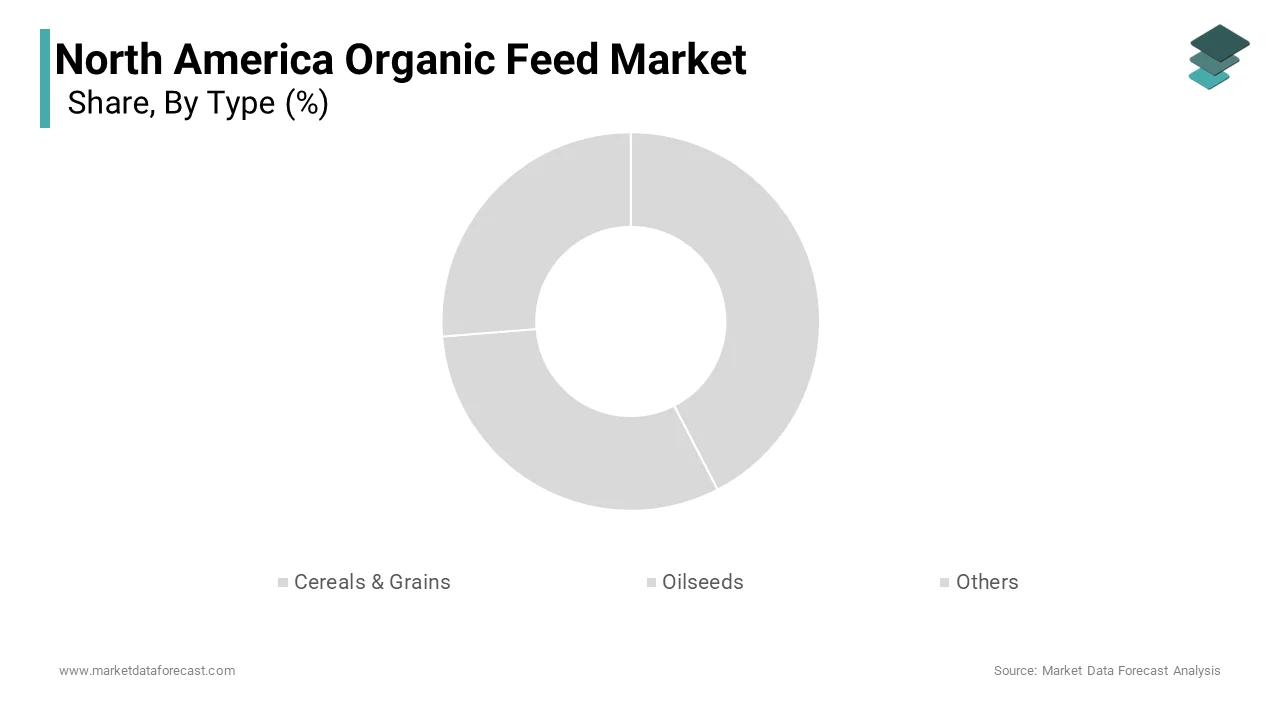
The oilseeds segment is projected to grow with an anticipated CAGR of 13.4% from 2025 to 2033 due to the rising dominance of non-soy alternatives, due to concerns about allergens and GMO contamination in conventional soybean supplies. In addition, the shift toward antibiotic-free and hormone-free animal rearing practices has heightened demand for natural, protein-rich ingredients. The Organic Trade Association (OTA) noted that over 45% of organic egg producers have switched to canola- and mustard-seed-based feeds to enhance omega fatty acid content in eggs. Furthermore, regional governments are encouraging the cultivation of indigenous oilseed crops under organic farming schemes. The Saskatchewan Ministry of Agriculture reported a 20% increase in organic mustard seed production in 2023, which indicates strong momentum for alternative oilseed sourcing.
By Livestock Insights
The poultry segment held 37.4% of the North America organic feed market share in 2025, with the strong consumer demand for organic poultry products, particularly in urban centers such as New York, San Francisco, and Toronto. Moreover, regulatory bodies such as the USDA and CFIA have established clear guidelines for organic poultry feeding, requiring that birds receive 100% certified organic feed throughout their lifecycle. Additionally, major supermarket chains such as Whole Foods, Kroger, and Loblaws have expanded their organic poultry offerings, reinforcing upstream demand for certified organic feed.
The aquatic segment is swiftly emerging with a CAGR of 14.1% in the coming years. Regulatory authorities such as the Global Aquaculture Alliance (GAA) and the Marine Stewardship Council (MSC) have increasingly endorsed organic aquafeed as a means to improve product quality and environmental sustainability. Moreover, scientific research supports the efficacy of organic feed in improving fish health and reducing contamination risks. The University of Maine’s School of Marine Sciences found that incorporating organic plant-based proteins into salmon diets reduced heavy metal accumulation by up to 18%, aligning with consumer preferences for clean-label products. Additionally, the integration of traditional aquaculture knowledge with modern feed formulation is accelerating innovation.
By Form Insights
The pellets segment was the largest by capturing 53.2% of the North America organic feed market share in 2025. The growth of the segment is attributed to be driven by the pelleted feed in delivering balanced nutrition to animals. According to the U.S. Poultry & Egg Association, pelleted organic feed improves digestion and weight gain in broiler chickens by up to 15% compared to loose feed forms. Additionally, commercial feed mills favor pellet production due to its scalability and consistency. The Canadian Feed Industry Association reported that over 70% of certified organic feed produced in the country was in pellet form, which reflects a strong industrial preference for this format. Moreover, the compact structure of pellets enhances storage and transportation logistics, especially in humid climates where moisture can degrade loose feed.
The crumbles segment is expected to witness a CAGR of 13.9% in the coming years, with suitability for young animals in poultry and aquaculture settings where feed particle size plays a crucial role in digestion and nutrient absorption. According to the Global Aquaculture Alliance (GAA), crumbled organic feed improved weight gain and survival rates in juvenile salmon by 16% compared to mash or whole grain alternatives in controlled trials conducted in British Columbia in 2023. Moreover, the transition from mash to crumble forms is being encouraged by veterinary nutritionists who promote the benefits of pre-digested feed formats for early-stage development. Additionally, technological advancements in feed processing have enabled more cost-effective crumble production, making it accessible even for mid-sized organic farms. Companies like Skretting and Ridley Corporation have launched region-specific crumbled organic aquafeed lines tailored for small-scale farmers in the Pacific Northwest and Atlantic Canada.
COUNTRY-LEVEL ANALYSIS
United States
The United States was the top performer in the North America organic feed market with 71.2% of the share in 2025. The country’s dominance in organic dairy and poultry production is majorly propelling the growth of the market in this region. According to the U.S. Department of Agriculture (USDA), over 2,000 certified organic dairy farms were operating in the U.S. by 2023, with Wisconsin, California, and New York leading production. Additionally, the U.S. government provides financial incentives through programs like the Organic Certification Cost Share Program, encouraging more farmers to adopt organic practices. Moreover, major retail and food service companies are expanding their organic product lines. Supermarkets such as Whole Foods, Kroger, and Albertsons have significantly increased shelf space dedicated to organic meats and dairy, creating upstream demand for compliant feed inputs.
Canada
Canada was positioned second in the North American organic feed market by occupying 27.3% of the share in 2025. A major growth enabler is the country’s commitment to sustainable farming and organic certification. The Canadian Food Inspection Agency (CFIA) updated national organic standards in 2022 by ensuring consistency in feed sourcing and livestock management practices across provinces. According to Statistics Canada, the area under certified organic cultivation expanded by 15% between 2020 and 2023, directly boosting the availability of organic grains and legumes for feed production. Ontario and Quebec saw the highest increases, particularly in organic soybean and alfalfa cultivation. Moreover, Canada’s organic livestock sector is gaining traction, especially in dairy and beef farming. The Canadian Organic Growers (COG) reported that the number of certified organic cattle farms increased by 18% during the same period, necessitating a parallel rise in organic feed production. Additionally, private-sector participation is growing, with companies like Maple Leaf Foods and SunOpta launching dedicated organic feed brands to cater to niche markets.
TOP PLAYERS IN THE MARKET
Cargill Incorporated
Cargill plays a leading role in the North American organic feed market by offering sustainable and certified organic feed solutions tailored for livestock, poultry, and aquaculture. The company supports farmers through supply chain integration, technical expertise, and customized feeding programs that align with organic certification standards. Cargill’s global reach and regional presence enable it to influence market trends and promote responsible sourcing practices across the agricultural value chain.
Archer Daniels Midland Company (ADM)
ADM is a key player in supplying high-quality organic ingredients used in animal nutrition across North America. The company focuses on sustainable sourcing, traceability, and value-added processing to ensure compliance with international organic standards. ADM collaborates with local producers and cooperatives to enhance the availability of organic grains and proteins, which is reinforcing its contribution to the global shift toward clean-label and sustainable livestock production systems.
Ridley Corporation Limited
Ridley is a prominent provider of premium animal nutrition products in North America with certified organic feed formulations. The company offers specialized solutions for the dairy, poultry, and aquaculture sectors, ensuring product quality and regulatory compliance. Ridley's commitment to research-driven development and customer-focused service positions it as a strategic contributor to the growth of the organic feed market in the region.
Top Strategies Used By Key Market Participants
One of the primary strategies employed by key players in the North America Organic Feed Market is forming strategic partnerships and collaborations with local farmers, cooperatives, and certification bodies. These alliances help ensure a reliable supply of certified organic raw materials and facilitate market access in regions with growing demand for organic livestock products.
Another major approach involves product innovation and formulation diversification to meet specific nutritional needs across different livestock categories. Companies are investing in R&D to develop high-performance, non-GMO, and antibiotic-free feed options that align with evolving consumer preferences and regulatory standards.
Additionally, market leaders are enhancing their regional distribution networks and investing in localized customer support services. Companies improve accessibility and provide tailored guidance to farmers transitioning to an organic feed system.
COMPETITION OVERVIEW
The competition in the North American organic feed market is intensifying as multinational corporations, regional agribusinesses, and emerging startups vie for stronger footholds in a rapidly evolving landscape. Established global players leverage their extensive supply chains, brand recognition, and technological expertise to maintain dominance, while regional firms capitalize on localized knowledge and cost efficiencies to gain traction. The market is witnessing a shift toward collaborative strategies, with players forming alliances to access indigenous raw materials, navigate certification complexities, and tailor feed formulations to regional livestock needs. At the same time, new entrants are disrupting traditional models by introducing niche organic feed products and leveraging digital platforms for supply chain transparency and traceability.
RECENT HAPPENINGS IN THE MARKET
- In February 2024, Cargill announced the launch of an integrated organic feed sourcing initiative in the Midwest, which is partnering with farmer cooperatives to secure a steady supply of certified organic soy and corn, supporting its regional expansion strategy.
- In June 2023, ADM expanded its organic ingredient processing facility in Iowa, aiming to increase capacity for clean-label feed inputs and strengthen its position in the U.S. organic livestock sector.
- In October 2023, Ridley Corporation introduced a new line of certified organic aquafeed products in Canada, designed specifically for salmon and trout farming by aligning with increasing demand for sustainable seafood production.
- In April 2024, Maple Leaf Foods launched an internal feed sourcing program focused on vertically integrating its organic poultry supply chain, which is reducing dependency on external suppliers and enhancing traceability from farm to feed mill.
- In August 2023, SunOpta initiated a collaboration with a Canadian organic grain cooperative to develop a direct-to-farm feed distribution model, which is improving efficiency and reducing costs for organic livestock producers across Ontario and Quebec.
MARKET SEGMENTATION
This research report on the North America Organic Feed Market is segmented and sub-segmented into the following categories.
By Type
- Cereals & Grains
- Oilseeds
- Others
By Livestock
- poultry
- ruminants
- swine
- aquatic animals, others, such as equine and pets
By Form
- pellets
- crumbles
- mashes
By Additives
- minerals
- amino acids
- vitamins
- enzymes
- phytogenic
- others
By Country
- U.S.A
- Canada
- Rest of North America