North America Plating on Plastics Market Size, Share, Trends & Growth Forecast Report By Plating (Chromium, Copper, Nickel, Others), Plastics, Application, and Country (The United States, Canada and Rest of North America), Industry Analysis From 2026 to 2034
Market Size, 2025
$231 MnMarket Estimate, 2026
$245 MnMarket Forecast, 2034
$394 MnCAGR, 2026–2034
6.12%North America Plating on Plastics Market Size
The Plating on plastics market size in North America was valued at USD 231.35 million in 2025 and is predicted to be worth USD 394.86 million by 2034 from USD 245.51 million in 2026 and grow at a CAGR of 6.12% from 2026 to 2034.
Plating on plastics (PoP) is an advanced surface engineering technique that involves depositing a metallic layer typically copper, nickel, or chromium ssonto polymer substrates to enhance aesthetic appeal, electromagnetic shielding, wear resistance, and thermal conductivity. This process, primarily applied to engineering thermoplastics such as acrylonitrile butadiene styrene (ABS), polycarbonate (PC), and polyamide (PA), combines the lightweight and moldability of plastics with the functional and visual properties of metals. Additionally, the rise of 5G-enabled devices has increased demand for PoP in smartphone frames and connectors due to its ability to provide effective electromagnetic interference (EMI) shielding.
MARKET DRIVERS
Rising Demand for Aesthetic and Functional Components in Automotive Design
The automotive industry’s increasing reliance on plating on plastics for both aesthetic and functional applications is propelling the growth of the North America Plating on Plastics Market. Modern vehicle design emphasizes premium finishes and brand identity, with chrome-plated plastic components widely used in grilles, door handles, mirror housings, and lighting bezels. According to the Center for Automotive Research, over 85% of light-duty vehicles produced in the U.S. in 2023 featured at least one plated plastic exterior component, with luxury and electric vehicle segments exhibiting the highest adoption. The shift toward lightweighting to improve fuel efficiency and meet CAFE standards has further accelerated the replacement of die-cast metals with ABS-PC alloys that can be effectively plated. The U.S. Department of Transportation estimates that replacing metal with plated plastic in trim components reduces part weight by 40% to 60%, directly contributing to emissions reduction. Additionally, plated plastics offer superior design flexibility, enabling complex geometries unachievable with metal stamping.
Expansion of 5G and High-Frequency Electronics Requiring EMI Shielding
The rapid deployment of 5G infrastructure and high-frequency electronic devices is due to its exceptional electromagnetic interference (EMI) shielding capabilities, which is escalating the growth of the North America Plating on Plastics Market. According to the Federal Communications Commission, over 500,000 5G small cell nodes were installed across the United States in 2023, many of which incorporate plated plastic housings to shield sensitive circuitry. The Institute of Electrical and Electronics Engineers reports that electroless nickel-copper plating on ABS provides shielding effectiveness of up to 90 dB in the 1–6 GHz range, making it ideal for routers, base stations, and mobile devices. Consumer electronics manufacturers, including Apple and Samsung, utilize plated plastic frames in smartphones and wearables to maintain sleek designs while meeting FCC Part 15 emissions standards.
MARKET RESTRAINTS
Environmental Regulations and Hazardous Chemical Use in Plating Processes
The stringent environmental regulation surrounding the use of hazardous chemicals in electroless plating baths, particularly hexavalent chromium, formaldehyde, and cyanide-based activators. The U.S. Environmental Protection Agency classifies hexavalent chromium as a known human carcinogen and enforces strict limits under the Clean Air Act and National Emissions Standards for Hazardous Air Pollutants (NESHAP). Facilities conducting chrome plating must install continuous emission monitoring systems and report releases exceeding 0.1 tons annually, a requirement that increases operational costs and compliance complexity. The Occupational Safety and Health Administration mandates extensive worker protection protocols, including ventilation, personal protective equipment, and biological monitoring, due to inhalation and dermal exposure risks. Additionally, the disposal of spent plating solutions and rinsewater is governed by the Resource Conservation and Recovery Act, requiring treatment as hazardous waste. According to the American Electroplaters and Surface Finishers Society, compliance with federal and state regulations can increase operating costs by 18% to 25% for mid-sized plating facilities. In California, the Safer Consumer Products program has listed certain metal plating chemicals as priority substances, prompting manufacturers to seek alternatives. These regulatory pressures limit the scalability of traditional plating lines, discourage new entrants, and accelerate the shift toward alternative surface treatments, constraining market growth despite strong end-use demand.
High Process Complexity and Substrate Sensitivity Limiting Yield Rates
The technical intricacy and substrate-specific nature is limiting the growth of the North America Plating on Plastics Market. The process involves multiple precision stages cleaning, etching, catalyzation, acceleration, and sequential metal deposition each requiring tight control of temperature, pH, and immersion time. According to the Society of Plastics Engineers, even minor deviations in etching duration can lead to under- or over-roughening of the plastic surface, resulting in poor adhesion and delamination. ABS, the most commonly plated polymer, requires chromic-sulfuric acid etching to create micro-porosity for metal anchoring, but this step is highly sensitive to resin formulation and molding conditions. The National Institute of Standards and Technology found that molded-in stresses or residual flow lines can reduce plating adhesion by up to 40%, necessitating rigorous quality control. Additionally, newer engineering plastics such as polyphenylene sulfide (PPS) and liquid crystal polymers (LCP) exhibit poor compatibility with conventional plating chemistries, limiting their use in high-temperature applications.
MARKET OPPORTUNITIES
Adoption of Sustainable and Low-Impact Plating Technologies
The development and commercialization of environmentally sustainable plating processes that reduce reliance on toxic chemicals and energy-intensive operations is greatly influencing the growth of the North America plating on plastics market. Traditional electroless plating relies on formaldehyde as a reducing agent and hexavalent chromium for final finishes, both of which face increasing regulatory and consumer scrutiny. Additionally, innovations in direct metallization technologies such as carbon-based or palladium-free activation systems are eliminating the need for heavy metal catalysts, reducing environmental footprint and material costs. Companies like Atotech and MacDermid Enthone have introduced closed-loop water recycling systems that reduce freshwater consumption by up to 70%, aligning with corporate sustainability goals. In Canada, the Green Centre Canada initiative has funded research into bio-based reducing agents for plating baths, supporting the transition to greener manufacturing. Automakers including General Motors and Ford have committed to zero-waste-to-landfill production, incentivizing suppliers to adopt eco-friendly surface treatments.
Growth in Medical and Surgical Devices Utilizing Plated Polymers
The expanding use of plating on plastics in medical and surgical devices driven by the need for sterile, durable, and functionally enhanced components is solely to propel the growth of the North America plating on plastics market. Advanced polymer substrates such as PEEK and polycarbonate are increasingly being plated with silver, nickel, or gold to provide antimicrobial surfaces, electrical conductivity, and radiopacity in minimally invasive instruments. According to the U.S. Food and Drug Administration, over 1,200 Class II and III medical devices approved between 2021 and 2023 incorporated plated plastic elements, including electrosurgical handles, implantable sensor housings, and diagnostic connectors. The Centers for Disease Control and Prevention emphasize that silver-plated polymers can reduce microbial colonization by up to 99.9% on high-touch surfaces, making them valuable in infection control. Additionally, plated plastics are used in MRI-compatible devices where non-ferrous conductivity is required without magnetic interference.
MARKET CHALLENGES
Competition from Alternative Surface Finishing Technologies
The intensifying competition from alternative surface finishing technologies that offer comparable aesthetics and functionality with lower environmental and operational burdens is hampering the growth of the North America plating on plastics market. Physical vapor deposition (PVD), vacuum metallization, and conductive coatings are increasingly displacing traditional electroless plating in applications requiring metallic finishes. According to the Society of Vacuum Coaters, PVD usage in automotive trim grew by 22% between 2020 and 2023 due to its ability to produce durable, chrome-like finishes without hazardous chemicals. Unlike wet plating, PVD operates in a closed vacuum chamber, eliminating wastewater and air emissions, making it compliant with EPA and OSHA regulations without costly abatement systems. Additionally, conductive polymer coatings—such as polyaniline and PEDOT:PSS—are gaining traction in EMI shielding applications. The National Institute of Standards and Technology reports that carbon nanotube-infused paints can achieve 80 dB shielding effectiveness, rivaling plated metals while being lighter and easier to apply. In consumer electronics, manufacturers are adopting sputtered aluminum and laser-induced direct structuring (LDS) for antenna integration, reducing dependency on plating.
Supply Chain Fragmentation and Dependence on Specialty Chemical Suppliers
The fragmented and highly specialized nature of its supply chain, particularly the reliance on a limited number of chemical formulators for proprietary plating solutions is additionally inhibiting the growth of the North America plating on plastics market. According to the American Chemistry Council, over 60% of specialty plating chemicals used in North America are imported or sourced from single-supplier contracts, creating vulnerability to disruptions. The U.S. International Trade Commission recorded a 35% increase in lead times for palladium-based activators in 2022 due to geopolitical supply constraints, directly impacting plating line uptime. Additionally, reformulations required to comply with environmental regulations such as the phase-out of hexavalent chromium that necessitate extensive requalification of entire plating processes, delaying production and increasing costs. The Society of Manufacturing Engineers notes that revalidating a plating line for a new chemistry can take 8 to 12 weeks, during which output is halted.
REPORT COVERAGE
| REPORT METRIC | DETAILS |
| Market Size Available | 2025 to 2034 |
| Base Year | 2025 |
| Forecast Period | 2026 to 2034 |
| CAGR | 6.12% |
| Segments Covered | By Plating, Plastics, Application, and Region |
| Various Analyses Covered | Regional & Country Level Analysis, Segment-Level Analysis, DROC, PESTLE Analysis, Porter’s Five Forces Analysis, Competitive Landscape, Analyst Overview on Investment Opportunities |
| Regions Covered | The United States, Canada, Mexico, and Rest of North America |
| Market Leaders Profiled | Atotech Inc, Galva Decoparts Pvt Ltd, Philips Plating Corporation, Precision Plating Pty Ltd, MPC Plating Inc, Quality Plated Products Ltd, Sharrets Plating Inc, Macdermid Incorporated, JCU Corporation, Cybershield Inc., and others |
SEGMENTAL ANALYSIS
By Plating Insights
The chromium segment was accounted in holding 42.3% of the North America plating on plastics market share in 2025 with its unmatched aesthetic appeal and widespread use in automotive trim components where a high-gloss, mirror-like finish is essential for brand identity. The Center for Automotive Research notes that over 70% of passenger vehicles produced in the U.S. and Canada feature chrome-plated plastic grilles, badges, and door handles, with luxury and electric vehicle segments exhibiting the highest penetration. According to the Society of Automotive Engineers, chromed plastic components retain over 90% of their reflectivity after 1,000 hours of accelerated weathering tests, outperforming painted or vacuum-metallized alternatives. Additionally, chromium provides moderate wear resistance and corrosion protection when applied over nickel underlayers, extending component lifespan in harsh environments.
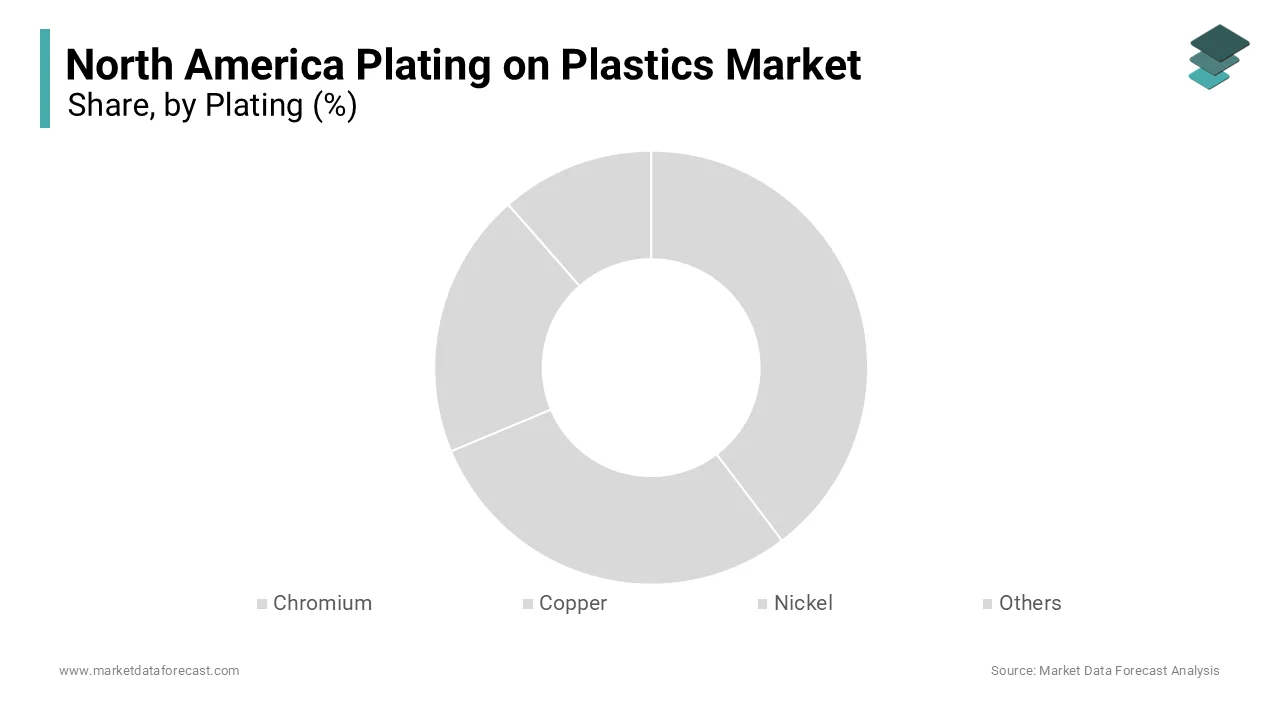
The nickel segment is expected to witness a CAGR of 8.7% from 2026 to 2034 with the electromagnetic interference (EMI) shielding and as an undercoat for chromium in high-performance applications. Another major factor is nickel’s function as a corrosion-resistant base layer in decorative plating stacks. As per the American Society for Testing and Materials, minimum 15–20 µm nickel layer is required beneath chromium to prevent pitting and delamination in automotive exterior parts exposed to road salts and freeze-thaw cycles. Additionally, aerospace and medical device manufacturers use electroless nickel for its uniform thickness and non-magnetic properties.
By Plastics Insights
The Acrylonitrile butadiene styrene (ABS) segment was the largest and held a prominent share of the North America plating on plastics market in 2025. The growth of the segment can be driven by the ABS’s exceptional compatibility with electroless plating chemistry, particularly its ability to undergo effective chromic acid etching, which creates a micro-roughened surface for optimal metal adhesion. Additionally, its low cost and availability from multiple suppliers ensure consistent supply for high-volume manufacturing. The U.S. Department of Energy recognizes ABS as a key enabler of lightweighting in transportation, with plated ABS parts replacing heavier metal counterparts in grilles, mirror housings, and lighting bezels.
The Polyetherimide (PEI) segment is projected to grow with a CAGR of 9.2% during the forecast period with its exceptional thermal stability, inherent flame resistance, and suitability for high-performance applications in aerospace, medical devices, and advanced electronics. A primary driver is PEI’s ability to withstand continuous use temperatures up to 170°C without deformation, making it ideal for components exposed to soldering, sterilization, or engine heat. The National Fire Protection Association recognizes PEI as a UL 94 V-0 rated material, essential for electrical enclosures and connectors in aviation and rail systems. The Institute of Electrical and Electronics Engineers notes that plated PEI is increasingly used in 5G millimeter-wave antenna housings and avionics enclosures due to its low dielectric loss and dimensional stability under thermal cycling. In the medical sector, the U.S. Food and Drug Administration has cleared numerous surgical instrument handles and sterilization trays made from plated PEI, leveraging its autoclave resistance and biocompatibility. The American Society for Testing and Materials has validated plating adhesion on PEI using specialized surface treatments, enabling reliable performance in applications.
By Application Insights
The automotive segment was the largest and held 56.4% of the North America plating on plastics market share in 2025 with the extensive use of plated plastics for both aesthetic and functional components across passenger and commercial vehicles. The industry’s focus on lightweighting to improve fuel efficiency and meet CAFE standards is additionally fuelling the growth of the North America plating on plastics market.
The electrical and electronics segment is lucratively growing with an expected CAGR of 9.5% from 2026 to 2034 with the increasing integration of high-frequency electronics, 5G connectivity, and miniaturized devices requiring effective electromagnetic interference (EMI) shielding and conductive pathways.
REGIONAL ANALYSIS
United States Plating on Plastics Market Insights
The United States was the largest contributor in the North America plating on plastics market by accounting for 85.3% of share in 2025. The country hosts the majority of plating chemical manufacturers and service providers, including MacDermid Enthone and Atotech, ensuring supply chain resilience. Additionally, the U.S. Food and Drug Administration has approved numerous medical devices with plated polymers, particularly in surgical and diagnostic equipment. The rise of electric vehicle manufacturing in Michigan, Texas, and Georgia has further intensified demand for EMI-shielded and decorative components.
Canada Plating on Plastics Market Insights
Canada plating on plastics market held 15.4% of share in 2025 with the rising prominence for the EV production, with Stellantis and Ford utilizing Canadian plants for hybrid and electric vehicle assembly, increasing demand for lightweight, conductive, and decorative parts. The National Research Council of Canada has funded material innovation projects aimed at improving plating adhesion on high-temperature polymers for aerospace use.
COMPETITIVE LANDSCAPE
The competitive landscape of the North America plating on plastics market is defined by technological differentiation, regulatory adaptability, and strategic integration rather than price-based rivalry. Market dominance is determined by the ability to deliver consistent, high-quality finishes that meet both aesthetic and functional demands across automotive, electronics, and medical applications. Dominant players distinguish themselves through proprietary chemical formulations, advanced process control systems, and comprehensive technical support networks that ensure reliability in high-volume production. Smaller regional plating shops compete by specializing in niche applications or offering rapid prototyping services, though they often rely on major chemical suppliers for process stability. The market is increasingly shaped by environmental pressures, with companies investing heavily in sustainable alternatives to hexavalent chromium and formaldehyde-based systems to comply with federal and state regulations. Innovation is also shifting toward digitalization, with real-time monitoring, predictive maintenance, and data-driven process optimization becoming key differentiators.
KEY MARKET PLAYERS
The key players in the North America plating on plastics market are
- Atotech Inc.
- Galva Decoparts Pvt. Ltd.
- Philips Plating Corporation
- Precision Plating Pty Ltd
- MPC Plating Inc.
- Quality Plated Products Ltd.
- Sharrets Plating Inc.
- MacDermid Incorporated
- JCU Corporation
- Cybershield Inc.
TOP PLAYERS IN THE MARKET
- MacDermid Enthone is a global leader in surface finishing technologies and a pivotal force in the North America plating on plastics market. The company is renowned for its advanced chemical formulations that enable high-adhesion metallization on engineering polymers in automotive and electronics applications. Its proprietary electroless nickel and direct metallization systems have set industry benchmarks for reliability, consistency, and environmental compliance. The company provides comprehensive technical support, process integration, and wastewater treatment solutions, positioning itself as a strategic partner rather than a mere chemical supplier. Its R&D collaborations with OEMs and tiered suppliers have driven innovation in EMI shielding, lightweighting, and sustainable manufacturing.
- Atotech has established itself as a dominant innovator in the plating on plastics sector, offering integrated solutions that combine specialty chemicals, equipment, and digital process control systems. The company’s expertise lies in high-performance decorative and functional plating, particularly for automotive trim and consumer electronics. Atotech’s advanced activation and metallization chemistries ensure exceptional adhesion and durability on ABS and other engineering resins, even under extreme environmental conditions. Its digital monitoring platforms enable real-time process optimization, which is reducing defects and improving yield in high-volume production environments. The company has been instrumental in advancing sustainable plating technologies, including closed-loop water recovery and palladium-free activation systems, which reduce environmental impact and operational costs. Atotech’s deep integration with automotive OEMs and contract manufacturers allows it to influence design-for-manufacturability standards and accelerate new product introductions.
- BASF brings significant technological and chemical expertise to the North America plating on plastics market through its performance materials and coatings division. The company’s focus on material science enables the development of plastics with enhanced surface energy, thermal stability, and etch uniformity, directly improving plating adhesion and process efficiency. BASF collaborates closely with plating chemical providers and molders to co-develop solutions that reduce cycle times and improve final part performance. Its commitment to sustainability is reflected in bio-based and recyclable polymer grades that maintain platability without compromising environmental goals. Additionally, BASF supports digitalization in manufacturing through simulation tools that predict plating behavior on complex geometries.
TOP STRATEGIES USED BY KEY MARKET PLAYERS
A primary strategy employed by leading players is vertical integration across the plating value chain, encompassing substrate engineering, chemical formulation, process equipment, and technical service.
Another approach is the development of environmentally sustainable plating technologies that align with tightening regulatory standards and corporate ESG mandates. Firms are investing in trivalent chromium systems, palladium-free activation, and closed-loop water recycling to reduce hazardous waste, lower emissions, and future-proof operations against evolving compliance requirements.
A third major strategy is deep collaboration with original equipment manufacturers and tiered suppliers during the design phase to optimize components for platability, functionality, and cost-efficiency.
RECENT HAPPENINGS IN THE MARKET
- In February 2023, MacDermid Enthone launched a new trivalent chromium plating system designed for automotive trim by offering improved corrosion resistance and reduced environmental impact compared to traditional hexavalent processes.
- In May 2023, Atotech introduced a digital process control platform for electroless nickel plating by enabling real-time monitoring and automated adjustments to enhance consistency and reduce defect rates in high-volume operations.
- In September 2023, BASF collaborated with a major automotive supplier to develop a new grade of platable PBT resin optimized for thin-wall grilles, which is improving adhesion and reducing cycle time in injection molding.
- In January 2025, MacDermid Enthone expanded its technical service center in Michigan to support electric vehicle manufacturers with plating process validation and regulatory compliance for new component designs.
- In March 2025, Atotech partnered with a North American medical device manufacturer to implement a palladium-free activation system for plating on high-temperature polymers used in sterilizable surgical instruments.
MARKET SEGMENTATION
This research report on the North America plating on plastics market has been segmented and sub-segmented based on the following categories.
By Plating
- Chromium
- Copper
- Nickel
- Others
By Plastics
- ABS
- Polypropylene
- Polyetherimide
- Polyethylene Terephthalate
- Others
By Application
- Automotive
- Electrical & Electronics
- Sanitary Fittings
- Others
By Country
- The United States
- Canada
- Rest of North America
Frequently Asked Questions
1. What is the plating on plastics market in North America?
It refers to the process of applying metal coatings, such as chromium, nickel, or copper, onto plastic components for functional and decorative purposes.
2. Which industries are the major users of plating on plastics?
Automotive, electrical & electronics, and sanitary fittings are the leading industries using plated plastics.
3. What factors are driving the North America plating on plastics market?
Growing demand for lightweight automotive parts, aesthetic finishes, and corrosion resistance are key growth drivers.
4. Which plating material is most commonly used in the region?
Chromium plating is the most widely used due to its durability, shine, and resistance to wear.
5. What challenges does the market face in North America?
Stringent environmental regulations on chromium usage and competition from alternative surface treatments are major challenges.
6. Which country leads the plating on plastics market in North America?
The United States holds the largest share, driven by its strong automotive and electronics industries.
7. Who are the major players in the North America plating on plastics market?
Key companies include Atotech Inc, MacDermid Incorporated, JCU Corporation, and Philips Plating Corporation.
8. What is the future outlook for the North America plating on plastics market?
The market is expected to grow steadily, driven by demand for lightweight vehicles, advanced electronics, and decorative finishes.
Access the study in MULTIPLE FORMATS
Purchase options starting from
$ 2000
Didn’t find what you’re looking for?
TALK TO OUR ANALYST TEAM
Need something within your budget?
NO WORRIES! WE GOT YOU COVERED!
Call us on: +1 888 702 9696 (U.S Toll Free)
Write to us: sales@marketdataforecast.com