- Product Description Description
- Table of Contents TOC
- List of Table & Figure LOT
- Get Free Sample PDF Sample PDF
Market Size, 2025
$1.56 BnMarket Estimate, 2026
$1.65 BnMarket Forecast, 2034
$2.62 BnCAGR, 2026–2034
5.95%North America Polyoxymethylene Market Size
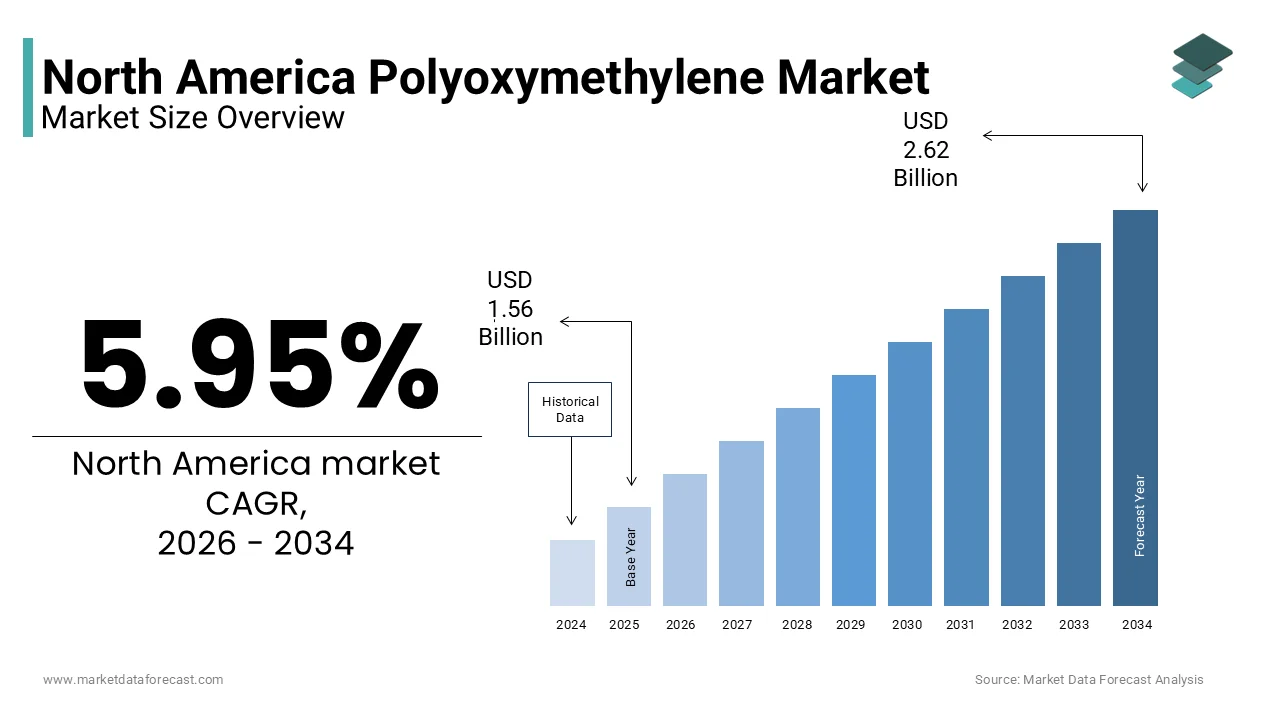
The Polyoxymethylene market size in North America was valued at USD 1.56 billion in 2025 and is predicted to be worth USD 2.62 billion by 2034 from USD 1.65 billion in 2026 and grow at a CAGR of 5.95% from 2026 to 2034.
Polyoxymethylene (POM), also known as acetal resin is a high-performance thermoplastic polymer distinguished by its exceptional mechanical strength, low friction coefficient, dimensional stability, and resistance to fatigue and moisture. According to the U.S. Department of Energy, over 30% of plastic content in light-duty vehicles is dedicated to engineering resins, with POM playing an important role in transmission systems, fuel rails, and door latch mechanisms due to its ability to withstand continuous stress and thermal cycling. Additionally, the U.S. Food and Drug Administration has cleared specific grades of POM for repeated-use medical applications, including surgical instrument handles and dental retainers, reinforcing its status in regulated healthcare environments. Canada’s growing investment in advanced manufacturing in Ontario’s automotive corridor, has further bolstered regional demand.
MARKET DRIVERS
Expansion of Lightweighting Initiatives in the Automotive Sector
The automotive industry’s aggressive pursuit of vehicle lightweighting is driving the growth of the North America polyoxymethylene market. Automakers are increasingly substituting metal components with high-performance plastics to improve fuel efficiency and meet federal emissions standards. According to the Environmental Protection Agency, every 10% reduction in vehicle weight can improve fuel economy by 6% to 8%, a regulatory imperative under the Corporate Average Fuel Economy (CAFE) standards. POM, with its tensile strength of up to 7,000 psi and ability to maintain structural integrity at operating temperatures exceeding 100°C, is extensively deployed in fuel system components, throttle bodies, and seat belt mechanisms. The Center for Automotive Research reports that the average light-duty vehicle in the U.S. contains over 3.5 kilograms of POM, primarily in under-the-hood applications where resistance to hydrocarbons and thermal degradation is also important. Furthermore, the shift toward electric vehicles (EVs) has amplified demand for precision-engineered plastic parts to reduce overall vehicle mass and extend battery range.
Rising Adoption in Medical Device Manufacturing
The growing integration of polyoxymethylene in medical device fabrication is another attribute fuelling the growth of the North America polyoxymethylene market. POM’s biocompatibility, sterilization resistance, and mechanical durability make it ideal for reusable surgical instruments, drug delivery systems, and orthopedic implants. According to the U.S. Food and Drug Administration, over 1,200 Class II medical devices approved between 2020 and 2023 included POM components, particularly in articulating joints and ratcheting mechanisms where metal alternatives pose weight and corrosion risks. The Association of Medical Device Manufacturers notes that POM is increasingly used in insulin pens, inhalers, and biopsy forceps due to its smooth surface finish and low moisture absorption, which prevent microbial retention. In dental applications, POM has replaced acrylics in temporary crowns and retainers, with the American Dental Association citing improved patient comfort and fit. Canadian healthcare facilities have also adopted POM-based devices, particularly in minimally invasive surgery tools, supported by Health Canada’s expedited review pathway for innovative materials.
MARKET RESTRAINTS
Volatility in Feedstock Supply and Pricing of Formaldehyde
The persistent volatility in the supply and pricing of formaldehyde is a primary feedstock in POM synthesis, which is restraining the growth of the North American polyoxymethylene market. Formaldehyde is derived from methanol, which in turn is largely produced from natural gas, making POM manufacturing highly sensitive to fluctuations in energy markets. According to the U.S. Energy Information Administration, natural gas prices in the United States experienced a 42% year-on-year increase in early 2023 due to geopolitical disruptions and constrained pipeline capacity, directly impacting methanol production costs. This volatility disrupts production planning and margin stability, particularly for smaller compounders lacking vertical integration. Additionally, formaldehyde is classified as a hazardous air pollutant under the Clean Air Act, subjecting production facilities to stringent emissions controls. The Environmental Protection Agency mandates continuous monitoring and reporting for facilities emitting more than 10 tons annually, increasing compliance costs. In Canada, Quebec and Alberta have imposed additional environmental levies on formaldehyde producers, further elevating input costs.
Environmental and Regulatory Scrutiny of Polymer End-of-Life Management
The increasing regulatory and environmental scrutiny surrounding the end-of-life management of engineering thermoplastics is restraining the growth of the North American polyoxymethylene market. According to the Environmental Protection Agency, incineration of POM above 250°C generates trace amounts of formaldehyde and carbon monoxide, prompting strict emissions controls under the National Emissions Standards for Hazardous Air Pollutants. Additionally, the European Chemicals Agency has classified formaldehyde as a substance of very high concern (SVHC), influencing North American supply chains through global compliance expectations. The U.S. Environmental Protection Agency’s Toxics Release Inventory shows that formaldehyde emissions from plastic manufacturing facilities increased by 18% from 2020 to 2022, drawing attention from environmental advocacy groups. In Canada, Environment and Climate Change Canada has initiated a review of acetal resins under the Chemicals Management Plan, potentially leading to usage restrictions.
MARKET OPPORTUNITIES
Growth in Precision Components for Electric Vehicle Systems
The rapid expansion of the electric vehicle (EV) ecosystem with the rising need for utilization in high-precision electromechanical components is substantially to pose new opportunities for the growth of the North American polyoxymethylene market. The material’s low creep and high fatigue resistance ensure reliable operation in components subjected to repeated cycling, such as door lock actuators and sunroof sliders. Furthermore, the Biden administration’s National Electric Vehicle Infrastructure (NEVI) program, which funded 50,000 new charging stations by 2025 has spurred demand for durable, weather-resistant connectors. Canadian manufacturers like Magna International are integrating POM into EV transmission modules, citing its compatibility with automated assembly lines.
Advancements in High-Performance Copolymer Formulations
The innovation in high-performance copolymer variants of polyoxymethylene is ascribed to bolster the growth of the North American polyoxymethylene market. Modern copolymer formulations, such as those developed by Celanese under the Hostaform and DuPont’s Delrin ST series, incorporate co-monomers like ethylene oxide to improve hydrolytic stability and reduce formaldehyde emissions during processings. In the medical sector, low-outgassing POM variants have received ISO 10993 biocompatibility certification by enabling use in implantable device housings and surgical robotics. Additionally, aerospace manufacturers such as Boeing are evaluating POM copolymers for interior latch mechanisms due to their flame retardancy and low smoke density when modified with proprietary additives. The National Institute of Standards and Technology has validated these formulations for use in environments exceeding 120°C by expanding their operational envelope.
MARKET CHALLENGES
Competition from Emerging Bio-Based and Sustainable Engineering Plastics
The mounting competitive pressure from next-generation bio-based and sustainable engineering plastics that align with corporate sustainability mandates and regulatory trends is acting as barrier for the growth of the North American polyoxymethylene market. Polymers such as polytrimethylene terephthalate (PTT) derived from renewable feedstocks and bio-based polyamides are gaining traction in automotive and consumer electronics due to their lower carbon footprint and improved end-of-life profiles. According to the Bioplastics Council, sales of bio-engineered thermoplastics in North America grew by 19% annually between 2020 and 2023, driven by commitments from OEMs like Ford and Apple to achieve net-zero supply chains by 2030.
Technical Barriers in Processing and Joining POM Components
The difficulty associated with processing and joining POM components using conventional manufacturing techniques. POM’s high crystallinity and low surface energy make it resistant to adhesives, paints, and solvent bonding, complicating assembly in multi-material systems. According to the Society of Plastics Engineers, over 60% of POM bonding failures in automotive assemblies are attributed to inadequate surface preparation, as the material does not respond well to standard plasma or flame treatments. Welding methods such as ultrasonic and laser welding require precise parameter control to avoid degradation and formaldehyde release, increasing production complexity. The National Institute for Standards and Technology emphasizes that achieving consistent joint strength in POM requires specialized primers or mechanical fastening, adding cost and design constraints. Additionally, POM’s tendency to outgas formaldehyde during regrind processing limits the use of recycled content to below 15% in high-performance applications, as per guidelines from UL Solutions.
REPORT COVERAGE
| REPORT METRIC | DETAILS |
| Market Size Available | 2025 to 2034 |
| Base Year | 2025 |
| Forecast Period | 2026 to 2034 |
| CAGR | 5.95% |
| Segments Covered | By End-User Industry, and Region |
| Various Analyses Covered | Regional & Country Level Analysis, Segment-Level Analysis, DROC, PESTLE Analysis, Porter’s Five Forces Analysis, Competitive Landscape, Analyst Overview on Investment Opportunities |
| Regions Covered | The United States, Canada, Mexico, and Rest of North America |
| Market Leaders Profiled | SABIC, BASF, Mitsubishi Corporation, DuPont, RTP Company, PolyOne Corporation, Westlake Plastics Co., Celanese Corporation, Polyplastics USA, Inc., and others |
SEGMENTAL ANALYSIS
By End-User Industry Insights
The automotive sector dominated the North America polyoxymethylene (POM) market by capturing 48.3% of share in 2025 with the precision-engineered, high-stress components essential to vehicle performance and safety. According to the U.S. Department of Energy’s Office of Energy Efficiency and Renewable Energy, over 2.8 million light-duty vehicles produced in North America in 2023 incorporated POM-based fuel sender units and throttle actuators, with each vehicle using an average of 1.9 kilograms of the polymer. According to the Center for Automotive Research, POM components in automatic transmission systems reduce weight by up to 35% compared to metal equivalents, directly contributing to fuel efficiency gains required under CAFE standards. Additionally, POM’s low moisture absorption ensures consistent performance in under-hood environments exposed to humidity and road salts.
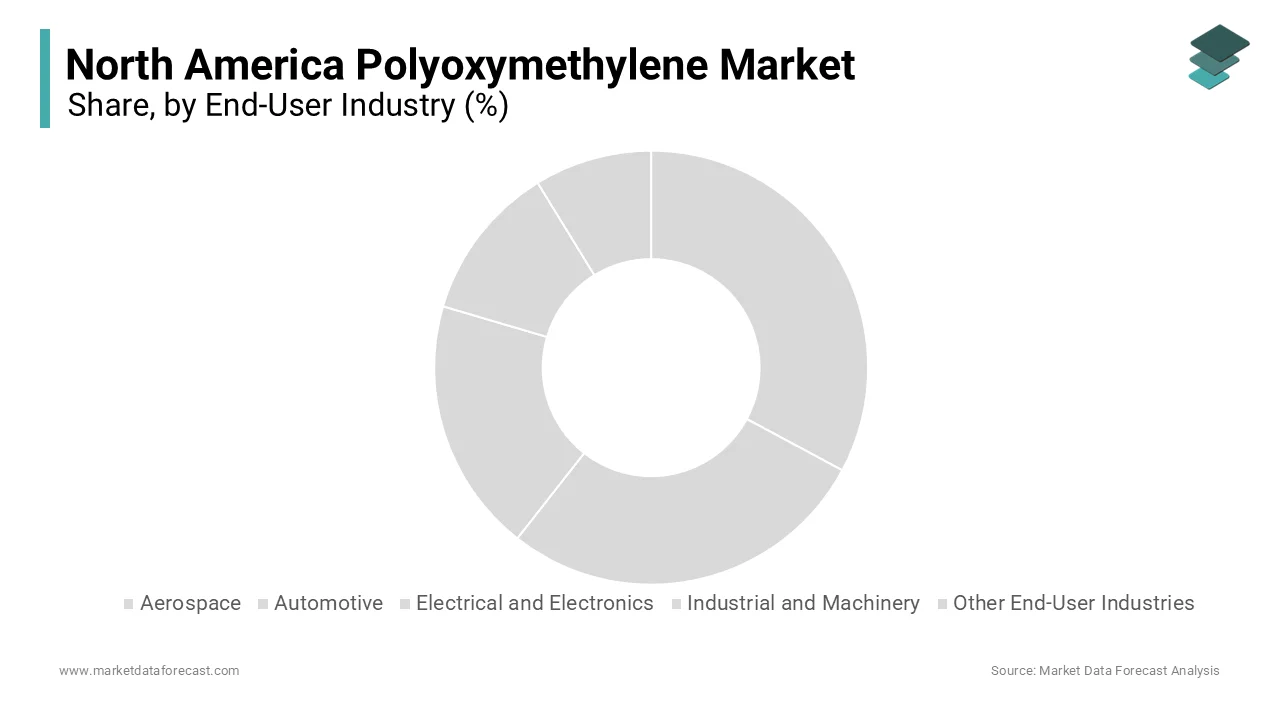
The electrical and electronics industry segment is anticipated to grow with a CAGR of 7.4% during the forecast period owing to the increasing demand for miniaturized, durable, and electrically insulating components in consumer and industrial electronics. As per the Institute of Electrical and Electronics Engineers, over 60% of high-cycle mechanical switches in smart home devices and industrial control panels now utilize POM due to its ability to withstand more than 1 million actuation cycles without deformation.
REGIONAL ANALYSIS
United States Polyoxymethylene Market Insights
The United States was the top performer in the North America polyoxymethylene market by accounting for 89.3% of the share in 2025. The country hosts the majority of POM production facilities, including Celanese’s integrated plant in Texas and DuPont’s compounding operations in Illinois, ensuring supply chain resilience. According to the Bureau of Economic Analysis, the U.S. produced over 11 million motor vehicles in 2023, each incorporating multiple POM components in fuel, transmission, and safety systems, translating to over 20,000 metric tons of annual polymer demand from the automotive sector alone. As per National Institute of Standards and Technology, POM is specified in over 70% of reusable surgical instrument handles cleared by the FDA, underscoring its role in high-value healthcare applications. Additionally, the Department of Defense has approved POM for use in aerospace actuators and communication equipment due to its non-conductive and lightweight properties.
Canada Polyoxymethylene Market Insights
Canada was ranked second in the North America polyoxymethylene market with 11.2% of share in 2025. According to the Canadian Vehicle Manufacturers’ Association, over 1.4 million light vehicles were assembled in Canada in 2023, many of which were exported to the U.S. and incorporated POM components sourced through integrated North American supply chains. A significant driver is the country’s participation in cross-border EV production, with companies like Stellantis and Ford utilizing Canadian plants for hybrid and electric vehicle assembly, increasing demand for lightweight engineering plastics. Additionally, Canada’s medical device sector, regulated by Health Canada, has seen a 15% annual increase in POM-based instrument approvals since 2020, particularly in dental and surgical tools. The National Research Council of Canada has also funded material innovation projects aimed at improving polymer performance in cold-weather applications, where POM’s low-temperature toughness is advantageous.
COMPETITIVE LANDSCAPE
The competitive environment in the North America polyoxymethylene market is defined by a blend of technological dominance, customer intimacy, and strategic agility. Unlike commoditized plastic markets, competition here revolves around performance differentiation, technical support, and reliability rather than price alone. Major players distinguish themselves through proprietary resin formulations, specialized grades for niche applications, and deep integration with original equipment manufacturers. The market is characterized by long-term supply agreements and co-engineering relationships, where polymer producers act as innovation partners rather than mere vendors. Smaller specialty ompounders compete by offering tailored solutions for specific industrial challenges, often in collaboration with regional manufacturers. However, the dominance of established players with integrated production and global R&D networks creates high barriers to entry. Competitive dynamics are further shaped by evolving regulatory expectations around sustainability, emissions, and material circularity, pushing companies to innovate beyond performance into environmental stewardship.
KEY MARKET PLAYERS
The North America polyoxymethylene market is driven by major players such as
- SABIC
- BASF
- Mitsubishi Corporation
- DuPont
- RTP Company
- PolyOne Corporation
- Westlake Plastics Co.
- Celanese Corporation
- Polyplastics USA, Inc.
TOP PLAYERS IN THE MARKET
- Celanese is a leading force in the North American polyoxymethylene market, renowned for its Hostaform brand of acetal resins that serve applications across automotive, medical, and industrial sectors. The company’s integrated production capabilities and deep technical expertise have positioned it as a preferred supplier for high-performance engineering plastics. Celanese distinguishes itself through material innovation, offering specialized POM grades tailored for extreme environments, including high-humidity and chemically aggressive conditions. Its collaboration with OEMs and design engineers ensures that product development aligns with real-world performance demands. The company’s North American footprint provides strategic advantage in supply chain responsiveness, enabling just-in-time delivery and technical support.
- DuPont has long been a cornerstone in the engineering thermoplastics landscape, with its Delrin® polyoxymethylene resin setting benchmark standards for mechanical strength, durability, and processability. The company’s legacy in material science enables it to deliver POM solutions that meet the most rigorous performance criteria in aerospace, electronics, and precision machinery. DuPont’s strength lies in its application-driven innovation, where material development is closely aligned with evolving industry needs, such as miniaturization in electronics and lightweighting in transportation. The company fosters deep partnerships with technology developers and regulatory agencies to ensure compliance and performance reliability. Its global technical service network provides end-users with design support, prototyping assistance, and failure analysis, enhancing customer loyalty.
- Solvay has established a distinctive presence in the North American polyoxymethylene market through its Technyl® and Ensinger®-branded specialty polymers, with a strategic focus on high-end industrial and automotive applications. While traditionally known for its expertise in high-performance nylons, Solvay has strengthened its position in the acetal space by offering differentiated copolymer formulations that address specific challenges such as hydrolytic stability and low outgassing. The company emphasizes performance customization, working closely with engineering firms to develop materials that meet exacting tolerances and regulatory requirements. Solvay’s commitment to innovation is supported by its global research centers, which drive advancements in polymer durability and environmental resilience. Its North American operations benefit from strong ties to aerospace and energy sector clients, where reliability under extreme conditions is non-negotiable.
TOP STRATEGIES USED BY KEY MARKET PLAYERS
A strategy employed by leading players is product differentiation through advanced material engineering, where companies develop specialized POM grades tailored for extreme thermal, chemical, or mechanical environments. These customized formulations enable penetration into high-value sectors such as medical devices, aerospace, and electric vehicles, where performance reliability is paramount.
Another approach is vertical integration and supply chain control, with major producers investing in captive feedstock capabilities and compounding facilities to ensure consistent quality and reduce dependency on external suppliers. This integration strengthens operational resilience, shortens delivery cycles, and allows for rapid response to customer-specific demands, particularly in regulated industries requiring traceability and compliance.
Likewise, collaborative innovation with end-users and research institutions to co-develop next-generation applications is also an important strategy followed by the top key players. Companies are increasingly embedding themselves in the design phase of new products, offering technical support, simulation tools, and prototyping services. These partnerships not only accelerate time-to-market but also long-term relationships by ensuring that POM remains embedded in future product architectures across automotive, electronics, and industrial systems.
RECENT HAPPENINGS IN THE MARKET
- In March 2023, Celanese announced the expansion of its POM compounding facility in Summit, Illinois, to enhance regional supply capabilities and support growing demand from the automotive and medical device sectors.
- In August 2023, DuPont launched a new high-stability grade of Delrin® specifically engineered for electric vehicle battery connectors with its focus on next-generation mobility applications.
- In January 2025, Solvay partnered with a leading aerospace manufacturer to develop a custom POM-based actuator component for next-gen regional aircraft, which is marking a strategic entry into advanced aviation systems.
- In November 2023, Celanese introduced a low-outgassing POM formulation certified for use in Class VI medical devices by expanding its footprint in reusable surgical instrumentation.
- In February 2025, DuPont established a collaborative innovation hub in Detroit to work directly with automotive OEMs on lightweight material integration with its engagement with the North American mobility sector.
MARKET SEGMENTATION
This research report on the North America polyoxymethylene market has been segmented and sub-segmented based on the following categories.
By End-User Industry
- Aerospace
- Automotive
- Electrical and Electronics
- Industrial and Machinery
- Other End-User Industries
By Country
- The United States
- Canada
- Rest of North America