- Product Description Description
- Table of Contents TOC
- List of Table & Figure LOT
- Get Free Sample PDF Sample PDF
Market Size, 2025
$3531.67 MnMarket Estimate, 2026
$3708.25 MnMarket Forecast, 2034
$5478.77 MnCAGR, 2026–2034
5.00%Executive Summary: North America Portable Air Compressor Market
- Market Scope: Comprehensive analysis of the North American portable air compressor sector, detailing product variations, operating modes, industrial and commercial applications, and country-level profiles (forecast period: 2026-2034).
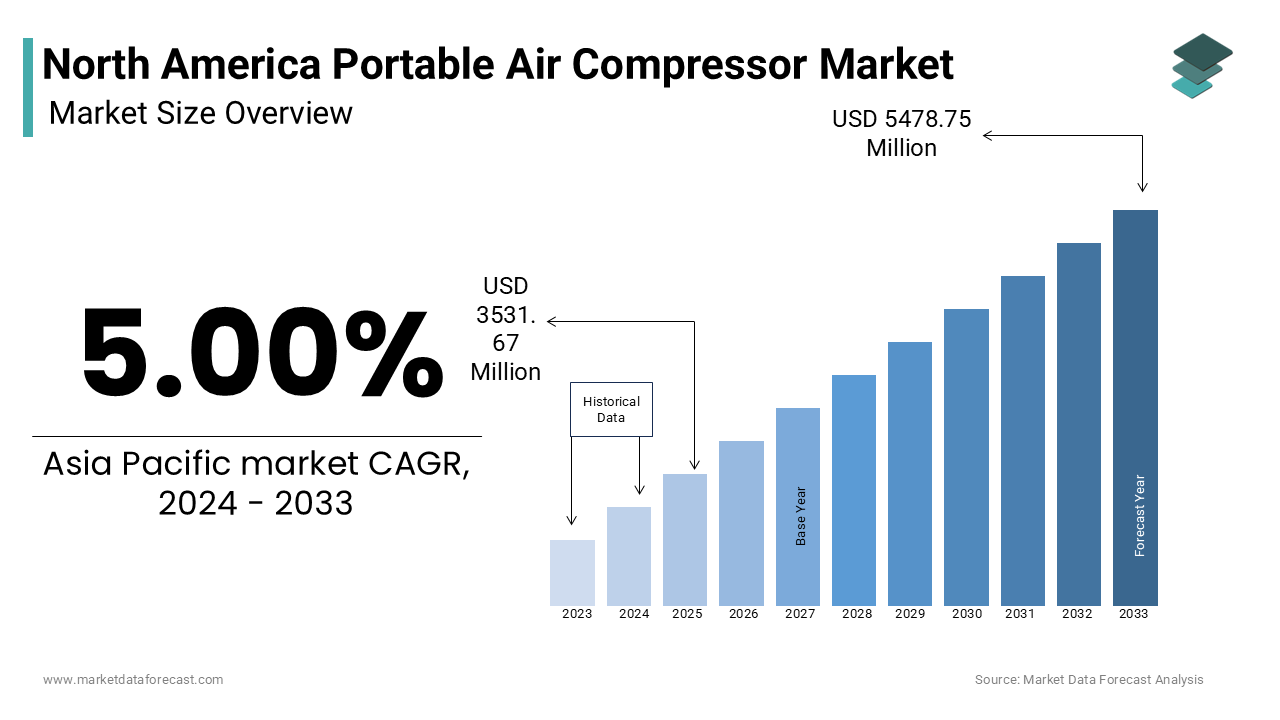
- Market Valuation: Valued at USD 3,531.67 million in 2026, reaching USD 3,708.25 million in 2026, and projected to expand to USD 5,478.77 million by 2034, growing at a robust CAGR of 5.00% from 2026 to 2034.
- Primary Growth Drivers: Extensive infrastructure development initiatives, expansive automotive aftermarket tire inflation services, rising demand for modular construction, and advancements in battery-powered cordless technologies.
Key Market Segment Metrics
| Category | Leading Segment (Base Position) | Fastest-Growing / High-Growth Segment |
|---|---|---|
| By Product | Reciprocating Compressors (commanded a 68.3% share in 2025, driven by cost-effectiveness, universality, and intermittent duty applications) | Rotary Compressors (projected at an 8.3% CAGR, propelled by continuous duty cycle performance and high efficiency in industrial tasks) |
| By Operating Mode | Electric Portable Air Compressors (led the market in 2025, supported by stringent environmental regulations and indoor noise restriction standards) | Internal Combustion Engine Compressors (growing at a 7.8% CAGR, favored in remote location operations and heavy infrastructure projects) |
| By Country | United States (market leader commanding a substantial share in 2025, backed by extensive industrial base and sophisticated distribution networks) | Canada (key regional growth market driven by remote resource extraction and decentralized infrastructure development requirements) |
Major Market Players & Industry Landscape
Market Structure: Highly competitive landscape characterized by established global manufacturers, regional suppliers, and innovators integrating smart IoT diagnostic systems throughout the 2026-2034 forecast period.
Key Companies: Atlas Copco, Ingersoll Rand, Sullair LLC, Doosan Portable Power, Kaeser Kompressoren, Gardner Denver, Rolair Systems, DeWalt (Stanley Black & Decker), Hitachi Industrial Equipment Systems, and Campbell Hausfeld.
 Download Free Sample Report
North America Portable Air Compressor Market Size
The north america portable air compressor market size was valued at USD 3531.67 million in 2026 and is anticipated to reach USD 3708.25 million in 2026 from USD 5478.77 million by 2034, growing at a CAGR of 5.00% during the forecast period from 2026 to 2034.
Portable air compressor is a mobile compressed air systems designed for diverse industrial, commercial, and residential applications requiring on-demand pneumatic power. These versatile units, typically ranging from 1 to 10 horsepower, serve construction sites, automotive repair facilities, manufacturing plants, and emergency response operations where stationary compressors are impractical.
The market's evolution has been shaped by technological advancements in oil-free compression, battery-powered systems, and digital monitoring capabilities that enhance operational efficiency and environmental compliance. Emergency services and disaster response organizations increasingly depend on portable air systems for rapid deployment scenarios, while the growing emphasis on workplace safety and regulatory compliance has elevated the importance of reliable, mobile compressed air solutions in maintaining operational continuity across diverse sectors.
MARKET DRIVERS
Infrastructure Development and Construction Activities
The extensive infrastructure development initiatives across North America have created substantial demand for portable air compressors that support construction activities, road building, and facility maintenance operations. Portable air compressors are essential for powering pneumatic tools such as jackhammers, nail guns, and spray equipment used in concrete work, roofing, and general construction tasks. The trend toward modular construction and prefabrication has increased the need for portable systems that can be easily transported between job sites. Municipal infrastructure upgrades, including water main replacements and sewer system improvements, further drive demand for compact, reliable air compression equipment that can operate in confined spaces and remote locations.
Automotive Aftermarket and Tire Inflation Services
The expansive automotive aftermarket sector in North America represents a significant driver for portable air compressor demand, particularly for tire inflation, brake system maintenance, and paint application services. Tire inflation services alone constitute a substantial market segment. Automotive repair shops utilize portable compressors for brake bleeding, suspension adjustments, and pneumatic tool operation, with the average facility operating 2-3 units depending on service capacity. Also, the growing popularity of performance modifications and custom vehicle builds has increased demand for specialized air compressors that support painting, sanding, and detailing operations. Emergency roadside assistance providers rely on portable compressors for rapid tire inflation services. The expansion of tire retail chains and quick-service maintenance facilities has created additional demand for compact, reliable compressors that can provide consistent air supply for high-volume operations. Fleet maintenance operations for commercial vehicles, delivery services, and public transportation systems further contribute to sustained demand for portable air compression equipment.
MARKET RESTRAINTS
High Energy Consumption and Operating Costs
The substantial energy requirements and associated operating costs of portable air compressors present significant barriers to widespread adoption, particularly for small businesses and individual users who operate on tight budget constraints. Fuel-powered portable compressors face additional cost pressures from fluctuating gasoline and diesel prices. Maintenance expenses, including oil changes, filter replacements, and component repairs, add to annual operating costs. For individual users and small contractors, these ongoing expenses can represent a significant financial burden that limits equipment acquisition and replacement decisions. The lack of standardized energy efficiency ratings for portable compressors makes cost comparison challenging for consumers, often leading to suboptimal purchasing decisions that result in higher long-term operating expenses.
Noise Pollution Regulations and Environmental Concerns
Stringent noise pollution regulations and growing environmental consciousness have created compliance challenges and market constraints for portable air compressor manufacturers and users across North America. The Environmental Protection Agency and various municipal authorities have implemented noise control measures that limit compressor operation in residential areas, construction zones, and environmentally sensitive locations. Many portable air compressors operate between 70-90 decibels, approaching or exceeding regulatory limits in noise-sensitive areas. The push toward environmental sustainability has increased scrutiny of fuel-powered compressors due to emissions concerns, with California's Air Resources Board implementing stricter emission standards that affect portable unit sales. Also, diesel-powered compressors contribute significantly to particulate matter emissions in urban construction zones, prompting calls for cleaner alternatives. The complexity of complying with varying regional noise and emission standards has increased manufacturing costs and reduced product standardization opportunities. These regulatory pressures have forced manufacturers to invest in noise reduction technologies and alternative power sources, which increase equipment costs and may limit market accessibility for price-sensitive customer.
MARKET OPPORTUNITIES
Battery-Powered and Cordless Technology Advancement
The advancement of battery-powered and cordless portable air compressor technology presents significant growth opportunities driven by improved lithium-ion battery performance, enhanced portability, and expanded application possibilities. The cordless segment has experienced remarkable adoption rates. These units eliminate the need for electrical outlets or fuel storage, making them ideal for remote locations, emergency response scenarios, and residential applications where traditional power sources are unavailable. Moreover, the landscaping and grounds maintenance sector has increasingly adopted battery-powered compressors for tire inflation and pneumatic tool operation. The integration of smart battery management systems and fast-charging capabilities has addressed previous limitations regarding runtime and recharge times. Emergency services organizations have recognized the tactical advantages of battery-powered units for rapid deployment in disaster response scenarios, where fuel availability and electrical infrastructure may be compromised. The automotive sector has embraced cordless compressors for mobile service operations, enabling technicians to provide on-site tire inflation and basic pneumatic services without vehicle modifications.
Integration of IoT and Smart Monitoring Systems
The integration of Internet of Things technology and smart monitoring systems in portable air compressors creates substantial opportunities for enhanced operational efficiency, predictive maintenance, and data-driven performance optimization. Smart compressors equipped with pressure sensors, temperature monitoring, and connectivity features enable real-time performance tracking and remote diagnostics that reduce downtime and optimize maintenance schedules. Fleet management companies are increasingly adopting connected compressor systems that provide usage analytics, fuel consumption tracking, and maintenance alerts through cloud-based platforms. Construction companies utilizing smart compressor networks report improved productivity through automated system optimization and reduced manual intervention requirements. The ability to monitor multiple units simultaneously through mobile applications has streamlined maintenance operations for large contractors and equipment rental companies. Data analytics capabilities provide valuable insights into usage patterns, helping operators optimize equipment deployment and identify opportunities for operational improvements. The growing emphasis on workplace safety and regulatory compliance has accelerated adoption of smart monitoring systems that provide continuous equipment status updates and alert notifications.
MARKET CHALLENGES
Supply Chain Disruptions and Component Shortages
The North American portable air compressor market faces persistent supply chain disruptions and component shortages that have constrained production capacity and increased equipment costs throughout 2023 and into 2025. Critical components such as electric motors, pressure tanks, and electronic controls have experienced extended lead times and price volatility due to global manufacturing bottlenecks and geopolitical tensions. The reliance on international suppliers, particularly for specialized electric motors and precision pressure vessels, has created vulnerabilities in the supply chain that affect production schedules and inventory management. The semiconductor shortage has particularly impacted smart compressor models that incorporate digital monitoring systems and electronic pressure controls, with lead times extending many weeks for certain microprocessor components. Freight and logistics challenges have added to transportation costs, further pressuring profit margins for manufacturers and distributors. The concentration of key component manufacturing in specific geographic regions has amplified supply chain risks, making inventory management and supplier diversification critical strategic priorities. These ongoing supply challenges have forced manufacturers to implement longer lead times and minimum order quantities, affecting customer relationships and market responsiveness.
Skilled Technician Shortage and Maintenance Complexity
The North American portable air compressor market confronts a critical shortage of skilled technicians capable of properly maintaining, repairing, and optimizing increasingly complex compressor systems, creating operational challenges for end-users and service providers. Modern portable compressors incorporate advanced electronic controls, variable frequency drives, and smart monitoring systems that require specialized training and diagnostic equipment for proper maintenance. The complexity of warranty claims and manufacturer support programs has increased, requiring certified technicians who understand specific product requirements and diagnostic procedures. Equipment rental companies report difficulty maintaining their compressor fleets due to technician availability. The geographic distribution of skilled technicians is uneven, with rural areas and smaller markets experiencing more severe shortages that affect equipment reliability and customer satisfaction. Training programs and certification initiatives have struggled to keep pace with technological advancements, creating gaps in technician competency and service quality standards.
SEGMENTAL ANALYSIS
By Product Insights
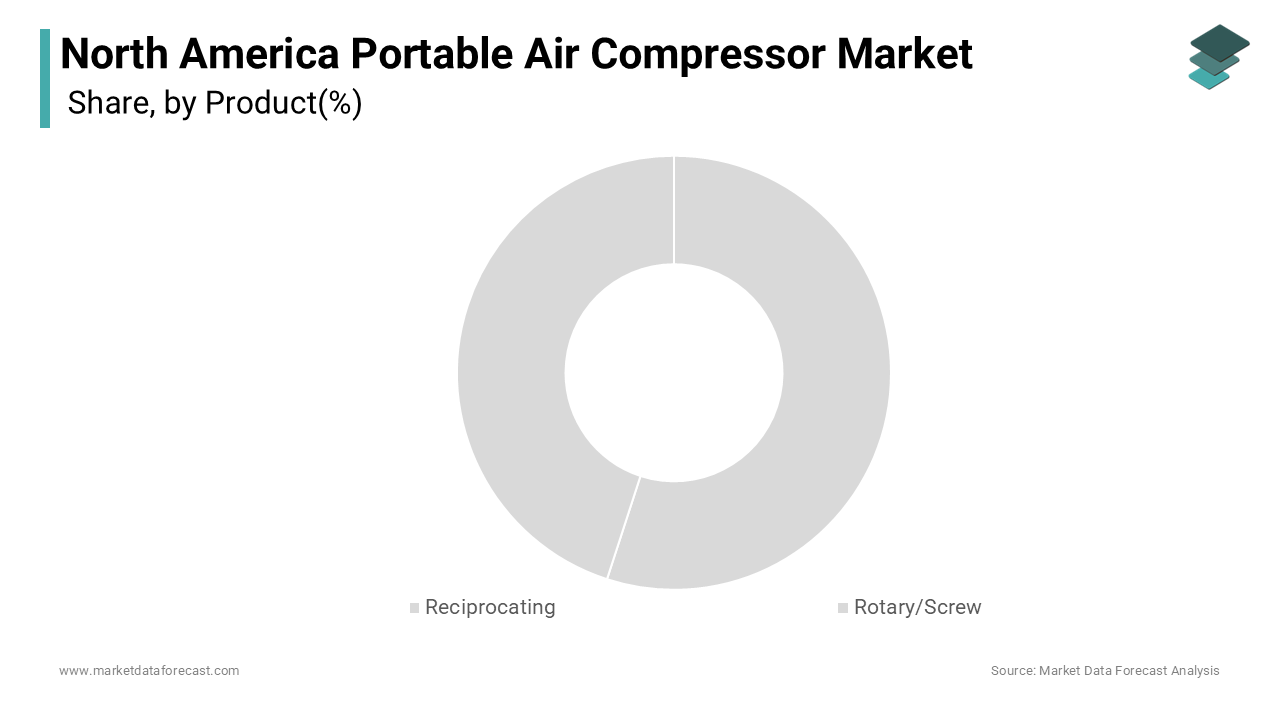
The reciprocating compressors segment dominated the North American portable air compressor market by commanding 68.3% share in 2025. This segment's overwhelming market position is due to its cost-effectiveness, widespread availability, and suitability for intermittent duty applications across diverse industries. Reciprocating units utilize piston-cylinder mechanisms that provide reliable compression for pressures up to 175 PSI, making them ideal for automotive service, construction, and general maintenance tasks. The segment's dominance is particularly pronounced in the consumer and light commercial markets where affordability and simplicity outweigh the need for continuous operation. The extensive distribution network and established manufacturing base have enabled widespread adoption across North American markets, supported by readily available service parts and technical expertise. Market penetration is further enhanced by the compatibility of reciprocating compressors with standard pneumatic tools and equipment used in residential and small business applications.
The cost advantage of reciprocating compressors has established them as the preferred choice for consumer and light commercial applications across North America, where price sensitivity significantly influences purchasing decisions. The simplicity of reciprocating technology enables manufacturers to produce reliable units at competitive price points while maintaining acceptable performance standards for intermittent use applications. The availability of replacement parts and service support through extensive dealer networks has reduced total cost of ownership concerns, making reciprocating compressors economically attractive for budget-conscious consumers. Educational content and product demonstrations emphasizing the value proposition of reciprocating units have further reinforced their market position among price-sensitive customer segments.
The universal compatibility of reciprocating compressors with standard pneumatic tools and equipment has solidified their dominance in North American markets, where tool interoperability and standardization drive equipment selection decisions. The intermittent duty cycle and pressure delivery patterns of reciprocating units align perfectly with typical tool usage patterns in construction, automotive service, and maintenance applications. The standardization of air fittings, pressure ratings, and flow characteristics around reciprocating compressor specifications has created network effects that favor continued adoption. Tool manufacturers optimize their product designs around the performance characteristics of reciprocating compressors, ensuring maximum efficiency and user satisfaction. The training and certification programs for construction workers and tradespeople emphasize reciprocating compressor operation and maintenance, creating institutional preferences that perpetuate market dominance.
The rotary compressor segment represents the fastest-growing category in the North American portable air compressor market and is projected to expand at a CAGR of 8.3% through 2033. The accelerated growth of this segment reflects increasing demand for continuous duty cycle performance, higher efficiency operation, and reduced maintenance requirements in professional and industrial applications. Rotary compressors utilize screw or vane technology that provides smooth, pulsation-free air delivery suitable for demanding applications requiring consistent pressure and flow rates. The segment's growth is particularly pronounced in construction, manufacturing, and emergency services sectors where reliability and operational uptime are critical success factors. The technology's advancement in compact design and weight reduction has expanded its applicability to mobile and portable applications previously dominated by reciprocating units.
The exceptional energy efficiency and continuous operation capabilities of rotary compressors have catalyzed their rapid adoption in professional and industrial applications across North America, where operational uptime and cost optimization are paramount. The continuous duty cycle capability of rotary units eliminates the need for rest periods and pressure recovery time, enabling sustained productivity in construction and manufacturing environments. The smooth, pulsation-free airflow delivery of rotary technology improves tool performance and reduces wear on pneumatic equipment, extending tool lifespan. Emergency response organizations have increasingly adopted rotary compressors for disaster recovery operations due to their reliability and consistent performance under demanding conditions. The integration of variable speed drives in modern rotary units has further enhanced efficiency gains, particularly in applications with variable air demand patterns.
The significantly reduced maintenance requirements and extended service intervals of rotary compressors have accelerated their adoption in North American markets where operational efficiency and service cost reduction are critical business drivers. The absence of oil changes and valve replacements in oil-free rotary units has particularly appealed to clean environment applications in food processing and pharmaceutical facilities. The predictability of rotary compressor maintenance requirements enables better planning and resource allocation, supporting operational efficiency improvements that justify higher initial investment costs.
By Operating Mode Insights
The electric portable air compressors segment led the North American market by accounting for a substantial share in 2025. This overwhelming market position stems from the widespread availability of electrical infrastructure, environmental considerations, and operational cost advantages in applications where stationary power sources are accessible. Electric compressors offer quiet operation, zero direct emissions, and consistent performance that makes them ideal for indoor applications, residential use, and noise-sensitive environments. The segment's dominance is particularly pronounced in consumer markets, automotive service facilities, and light industrial applications where electrical outlets or generator power are readily available. Market penetration is supported by established electrical distribution networks, standardized voltage requirements, and consumer familiarity with plug-in equipment operation. The technology's compatibility with smart grid initiatives and renewable energy integration has further enhanced its appeal in environmentally conscious markets.
Stringent environmental regulations and emission control requirements across North America have propelled electric portable air compressors to market dominance, as organizations seek to minimize their environmental impact and comply with increasingly restrictive air quality standards. The push toward corporate sustainability initiatives has led major corporations to mandate electric equipment usage in their supply chains and contractor requirements, creating substantial demand for electric portable compressors. The integration of electric compressors with solar power systems and battery storage has created new market opportunities in remote applications where traditional fuel supply logistics are challenging. Green building certification programs such as LEED provide points for electric equipment usage, incentivizing project developers to specify electric portable compressors in their construction specifications.
The suitability of electric portable air compressors for indoor applications and compliance with noise restriction regulations has established their dominant market position in North America, where workplace safety and environmental considerations increasingly influence equipment selection. Healthcare facilities, educational institutions, and research laboratories require zero-emission equipment operation, making electric compressors mandatory for maintenance and construction activities in these environments. The trend toward 24-hour construction scheduling in urban areas has increased demand for quiet electric units that can operate during evening and weekend hours without violating noise ordinances. Apartment and condominium renovation projects increasingly specify electric compressors to minimize disturbance to residents and comply with building management requirements. The elimination of fuel storage and ventilation requirements for electric units has simplified logistics and reduced safety risks in confined space applications, supporting their widespread adoption.
The internal combustion engine compressor segment represents the fastest-growing operating mode category in the North American portable air compressor market and is projected to expand at a CAGR of 7.8% through 2033. The accelerated growth of this segment reflects increasing demand for mobile applications, remote location operations, and high-power requirements that cannot be efficiently met by electric alternatives. Internal combustion compressors provide unmatched portability and independence from electrical infrastructure, making them essential for construction sites, mining operations, and emergency response scenarios where power availability is limited or unreliable. The segment's growth is particularly pronounced in heavy construction, oil and gas exploration, and disaster recovery applications where high-volume air delivery and extended operation periods are required. Technological advancements in fuel efficiency, emission control systems, and engine durability have enhanced the segment's appeal while addressing environmental concerns.
The critical need for portable air compression in remote location operations and large-scale infrastructure development projects has driven the rapid growth of internal combustion engine compressors across North American markets where electrical infrastructure is unavailable or impractical. Pipeline construction projects spanning thousands of miles rely on diesel-powered compressors for welding, cleaning, and testing operations where electrical hookups are impossible to establish. Emergency response organizations maintain extensive fleets of internal combustion compressors for disaster recovery operations where power grids may be damaged or non-existent. The expansion of renewable energy projects, including wind and solar installations in remote areas, has created additional demand for mobile compressor systems that support turbine maintenance and panel cleaning operations. Military and defense contractors increasingly specify internal combustion compressors for field operations where electrical security and power independence are mission-critical requirements.
The superior power output capabilities and extended operation requirements of demanding industrial applications have accelerated the adoption of internal combustion engine compressors in North American markets where high-volume air delivery and continuous duty cycles are essential. Emergency services organizations maintain internal combustion compressor fleets specifically for large-scale disaster response operations where multiple pneumatic tools and equipment must operate simultaneously for days without interruption. The agricultural sector has increased adoption of diesel-powered compressors for grain handling, irrigation system maintenance, and equipment servicing in remote farm locations where electrical infrastructure is limited. Industrial manufacturing facilities utilize internal combustion compressors as backup systems for critical pneumatic processes, ensuring operational continuity during power outages or electrical system maintenance. The ability to refuel quickly and operate independently of electrical grid reliability has made internal combustion compressors indispensable for time-sensitive applications where downtime costs exceed fuel expenses.
REGIONAL ANALYSIS
United States Portable Air Compressor Market Insights
The United States represented the dominant force in the North American portable air compressor market by commanding a substantial share in 2025. This overwhelming market position stems from the country's extensive industrial base, diverse construction activity, and sophisticated distribution networks that support widespread equipment adoption across multiple sectors. The United States' portable air compressor market is characterized by high technological adoption rates, stringent regulatory compliance requirements, and significant investment in energy-efficient solutions that reflect broader sustainability trends. The market's maturity is evident in its comprehensive dealer networks, established manufacturing facilities, and robust service infrastructure that supports both large-scale industrial operations and residential applications.
The United States' position as the largest market participant is fundamentally supported by its extensive construction industry and ongoing infrastructure development initiatives that require substantial portable air compressor deployment for diverse applications. Each major construction project typically requires 3-5 portable compressors for various phases including site preparation, concrete work, and finishing operations, creating substantial equipment demand. Residential construction growth has increased demand for consumer-grade portable compressors used by homeowners and small contractors. The trend toward modular construction and prefabrication has created additional demand for compact, reliable compressors that can be easily transported between job sites and assembly locations.
The United States leadership position in the portable air compressor market is reinforced by the extensive automotive aftermarket sector and expanding service industry that requires sophisticated mobile pneumatic solutions for daily operations. Emergency services organizations maintain extensive fleets of portable compressors for rapid deployment in accident response and disaster recovery scenarios. Fleet maintenance operations for commercial vehicles, delivery services, and public transportation systems create sustained demand for reliable portable compressors that can support high-volume tire maintenance and pneumatic tool requirements. The expansion of electric vehicle service centers has created new market opportunities for oil-free and clean-air portable compressors that meet the specialized requirements of EV maintenance operations.
COMPETITIVE LANDSCAPE
The North American portable air compressor market exhibits intense competitive dynamics characterized by the presence of established global manufacturers alongside specialized regional suppliers and emerging technology-focused companies. Market leaders leverage their extensive distribution networks, brand recognition, and financial resources to maintain dominant positions while continuously innovating to address evolving customer requirements. The competitive landscape is marked by strategic acquisitions and partnerships that enable companies to expand their product portfolios and geographic reach. Pricing pressures persist as customers increasingly demand value-added features and services while maintaining cost-effectiveness. Differentiation strategies focus on energy efficiency, smart technology integration, and customized solutions that address specific industry segments. The market's maturity has led to consolidation trends where larger players acquire smaller competitors to strengthen their market positions and eliminate competition. Innovation cycles are accelerating as participants invest in research and development to incorporate advanced materials, digital technologies, and sustainable practices. Customer relationships are becoming increasingly important as switching costs rise and equipment complexity increases. Service capabilities and technical support have emerged as critical competitive factors alongside product performance and reliability.
KEY MARKET PLAYERS
Some of the promising companies that are playing a dominating role in the North American portable air compressor market include
- Atlas Copco
- Ingersoll Rand
- Sullair LLC
- Doosan Portable Power
- Kaeser Kompressoren
- Gardner Denver
- Rolair Systems
- DeWalt (Stanley Black & Decker)
- Hitachi Industrial Equipment Systems
- Campbell Hausfeld
Top Players in the Market
Ingersoll Rand Inc. Ingersoll Rand stands as a global leader in compressed air technology, delivering innovative portable air compressor solutions that serve diverse industrial and commercial applications across North America. The company's extensive product portfolio encompasses both electric and internal combustion portable units designed for construction, manufacturing, and maintenance operations. Their engineering expertise focuses on energy efficiency improvements, emission reduction technologies, and smart connectivity features that enhance operational performance. Ingersoll Rand's commitment to sustainability is evident through their development of oil-free compression systems and low-emission engine technologies that meet stringent environmental regulations. The company's global manufacturing footprint and comprehensive service network enable rapid response to customer requirements while maintaining consistent quality standards. Their research and development investments have resulted in breakthrough technologies that address evolving market needs for quieter operation, reduced maintenance requirements, and enhanced portability. Strategic partnerships with major construction and industrial companies have solidified their position as a preferred supplier for large-scale projects and fleet management programs.
Atlas Copco AB Atlas Copco represents a Swedish multinational corporation renowned for its advanced portable air compressor technology and comprehensive compressed air solutions tailored for North American markets. The company's portable compressor division specializes in high-efficiency units that combine durability with innovative features such as variable speed drives and intelligent monitoring systems. Their focus on customer-centric design has resulted in products that address specific industry requirements while maintaining global quality standards. Atlas Copco's commitment to digitalization has led to the development of connected compressor systems that provide real-time performance data and predictive maintenance capabilities. The company's extensive dealer network across North America ensures comprehensive technical support and parts availability for customers. Their environmental initiatives include the development of hybrid and electric portable compressors that reduce carbon footprints while maintaining performance standards. Atlas Copco's engineering expertise in noise reduction and emission control technologies has positioned them as a preferred supplier for environmentally sensitive applications. Strategic acquisitions and partnerships have expanded their product offerings and market reach, enabling them to serve diverse customer segments from residential users to large industrial operations.
Campbell Hausfeld Campbell Hausfeld has established itself as a leading manufacturer of portable air compressors in North America, specializing in consumer and light commercial solutions that combine affordability with reliable performance. The company's product development focuses on user-friendly designs that appeal to homeowners, DIY enthusiasts, and small business operators who require occasional pneumatic power. Their engineering efforts emphasize portability improvements, noise reduction, and simplified maintenance procedures that enhance customer satisfaction. Campbell Hausfeld's commitment to innovation has resulted in the development of cordless battery-powered compressors that eliminate the need for electrical outlets or fuel storage. The company's extensive distribution network through major retail chains and online platforms ensures widespread market accessibility for their products. Their customer service initiatives include comprehensive warranty programs and educational resources that help users select appropriate equipment for their specific applications. Campbell Hausfeld's focus on value engineering has enabled them to maintain competitive pricing while incorporating advanced features such as automatic shut-off systems and pressure regulation controls. Strategic partnerships with tool manufacturers have created bundled product offerings that provide complete solutions for common applications.
Top Strategies Used by Key Market Participants
Technology Integration and Digital Connectivity Leading manufacturers in the North American portable air compressor market are pursuing comprehensive technology integration strategies that transform traditional compression equipment into intelligent, connected systems. This approach involves incorporating IoT sensors, wireless connectivity, and advanced monitoring capabilities that enable real-time performance tracking and predictive maintenance. Companies are developing proprietary software platforms that provide comprehensive equipment management solutions, allowing operators to optimize performance and reduce downtime. The integration of artificial intelligence and machine learning algorithms enhances operational efficiency while adapting to usage patterns and environmental conditions. This strategic focus on digital transformation not only improves operational effectiveness but also creates new revenue streams through subscription-based service models and data analytics offerings. Smart connectivity features enable remote diagnostics and troubleshooting, reducing service response times and improving customer satisfaction. The emphasis on user interface design and mobile application development has enhanced accessibility for operators and maintenance personnel.
Sustainability and Environmental Compliance Focus Market participants are implementing comprehensive sustainability strategies that emphasize emission reduction, energy efficiency improvements, and environmental compliance across their portable compressor product lines. This involves developing equipment with advanced emission control systems, fuel-efficient engines, and alternative power sources including electric and hybrid technologies. Companies are investing heavily in research and development to transition to low-emission fuels and renewable energy integration while maintaining performance standards. The focus extends to manufacturing processes, where participants are implementing circular economy principles through recycling programs and sustainable material sourcing. Strategic partnerships with environmental organizations and regulatory bodies facilitate the development of compliance solutions that accelerate adoption of environmentally friendly equipment. This sustainability focus not only addresses regulatory requirements but also appeals to environmentally conscious customers seeking to reduce their carbon footprint. Product lifecycle management initiatives ensure that equipment design considers end-of-life disposal and recycling requirements.
Customization and Modular Design Innovation Key players are pursuing customization strategies that address diverse customer requirements through modular design approaches and flexible configuration options. This involves developing standardized platforms that can be easily adapted to specific application requirements, reducing lead times and manufacturing costs. Companies are investing in design engineering capabilities that enable rapid prototyping and customer-specific modifications without compromising quality or performance. The modular approach facilitates scalable solutions that can accommodate business growth and changing operational needs. Strategic partnerships with end-users during the design phase ensure that equipment specifications align with actual usage requirements and environmental conditions. This customization strategy enhances customer satisfaction while creating competitive differentiation through tailored solutions that optimize performance and operational efficiency. Product family expansion enables manufacturers to address multiple market segments with common platform architectures that reduce development costs and improve supply chain efficiency.
RECENT MARKET DEVELOPMENTS
- In March 2024, Ingersoll Rand announced the launch of their new QuietPower series portable compressors featuring advanced noise reduction technology and integrated IoT monitoring capabilities for enhanced operational efficiency.
- In January 2024, Atlas Copco completed the acquisition of Pneumatics International, a specialized manufacturer of industrial air compression systems, expanding their portfolio in the high-efficiency portable compressor segment.
- In February 2024, Campbell Hausfeld partnered with Milwaukee Tool to develop a co-branded line of cordless portable air compressors specifically designed for professional trades and construction applications.
- In May 2024, Ingersoll Rand established a new manufacturing facility in South Carolina to serve North American markets while reducing production costs through optimized supply chain logistics and local sourcing initiatives.
- In April 2024, Atlas Copco launched their ECOdrive initiative, offering comprehensive financing programs and trade-in incentives to customers upgrading to energy-efficient portable compressor systems that meet new environmental standards.
MARKET SEGMENTATION
This research report on the North America Portable Air Compressor Market is segmented and sub-segmented based on categories.
By Product
- Reciprocating
- Rotary/Screw
By Operation Mode
- Electric
- Internal Combustion Engine
By Lubrication
- Oil Free
- Ool Filled
By Power Range Channel
- Up to 20 kW
- 21-50 kW
- 51-250 kW
- 251-500 kW
- Over 500 kW
By End Use
- Construction
- Oil & Gas
- Minning
- Automotive
- Healthcare/Medical
- Food & Beverage
- Others
By Country
- U.S.
- Canada
- Rest of North America