- Product Description Description
- Table of Contents TOC
- List of Table & Figure LOT
- Get Free Sample PDF Sample PDF
Market Size, 2025
$337 MnMarket Estimate, 2026
$345.49 MnMarket Forecast, 2034
$422 MnCAGR, 2026–2034
2.52%North America Potassium Nitrate Market Size, Growth, Trends & Forecast (2026–2034)
The size of the North America potassium nitrate market was worth USD 337 million in 2025, is anticipated to grow at a CAGR of 2.52% from 2026 to 2034, and is projected to reach USD 422 million by 2034 (from USD 345.49 million in 2026). Driven by the rising adoption of precision agriculture, expansion in hydroponics and controlled environment agriculture, and increased use in food preservation and pharmaceutical formulations, the industry continues to advance steadily across the region.
Key Executive Metrics (At-a-Glance)
- 2025 Base Valuation: USD 337 Million
- 2026 Current Valuation: USD 345.49 Million
- 2034 Forecast Valuation: USD 422 Million
- Compound Annual Growth Rate (CAGR): 2.52% (2026–2034)
- Dominant Raw Material: Potassium Chloride (holding 50.4% market share in 2025 due to cost-effectiveness and widespread availability)
- Fastest-Growing Raw Material: Ammonium Nitrate (projected at a CAGR of 6.8% from 2026 to 2034, driven by superior nitrogen content and precision agriculture efficiency)
- Dominant End-Use Segment: Agriculture (holding 55.4% market share in 2025 due to dual-nutrient crop optimization)
- Fastest-Growing End-Use Segment: Pharmaceuticals (registering a CAGR of 7.2% from 2025 to 2033 fueled by medical-grade stabilizing applications)
- Dominant Region/Country: United States (holding 70.4% market share in 2025 backed by its massive agricultural and healthcare sectors)
- Fastest-Growing Region: Canada (leveraging focus on sustainable biotechnology and eco-friendly fertilizer production)
Core Market Drivers
- Rising Demand in Precision Agriculture: Surging deployment of targeted farming technologies for high-value crops, requiring nutrient-efficient sources of nitrogen and potassium.
- Expansion in Food Preservation & Pharmaceuticals: Broadened utilization as a antimicrobial curing agent in meat processing and as a stabilizer in drug formulations.
Primary Market Restraints & Challenges
- Volatility in Raw Material Prices: Fluctuating feedstock costs for potassium chloride and ammonium nitrate driven by geopolitical tensions and trade restrictions.
- Stringent Environmental Regulations & Competition: Strict EPA caps on nitrogen oxide emissions, mounting compliance costs, and low-cost alternative fertilizers like urea.
North America Potassium Nitrate Market Segmentation Breakdown
| Segment Category | Leading Sub-Segment (2025 Base) | Fastest-Growing Sub-Segment (2026–2034) |
|---|---|---|
| By Raw Material | Potassium Chloride (holding 50.4% share due to availability and cost-efficiency) | Ammonium Nitrate (projected CAGR of 6.8% driven by high nitrogen efficiency) |
| By End-Use | Agriculture (holding 55.4% share for crop nutrition) | Pharmaceuticals (projected CAGR of 7.2% fueled by drug and antiseptic stabilization) |
| By Country | United States (holding 70.4% share supported by massive agricultural consumption) | Canada (expanding via sustainable biotechnology and green fertilizer initiatives) |
Major Industry Players Profiled
Key enterprises shaping the competitive North American potassium nitrate market include Yara International ASA, Haifa Group, SQM S.A., AG CHEMI GROUP s.r.o., Positive Chemicals Pvt. Ltd., Arihant Chemical, Ravi Chem Industries, Jagannath Chemicals, SNDB, and KEMAPCO Arab Fertilizers & Chemicals Industries Ltd.
North America Potassium Nitrate Market Size
The size of the North America potassium nitrate market was worth USD 337 million in 2025. The North America market is anticipated to grow at a CAGR of 2.52% from 2026 to 2034 and be worth USD 422 million by 2034, up from USD 345.49 million in 2026.

MARKET DRIVERS
Rising Demand in Precision Agriculture
Precision agriculture is a primary driver of the North America potassium nitrate market. Potassium nitrate is highly valued for its dual role as a source of nitrogen and potassium, essential nutrients for crop health and yield optimization. The adoption of precision farming technologies, which enable targeted fertilizer application, has surged by 10% annually since 2021, according to the U.S. Department of Agriculture. This trend has amplified potassium nitrate demand in high-value crops like fruits, vegetables, and nuts, where nutrient efficiency is critical. Additionally, the growing emphasis on sustainable farming practices has bolstered its appeal, as potassium nitrate minimizes soil degradation compared to traditional fertilizers.
Expansion in Food Preservation Applications
Potassium nitrate’s use in food preservation represents another major driver in the meat processing and dairy industries. The compound acts as a curing agent, preventing microbial growth while enhancing flavor and texture. The rise in consumer demand for shelf-stable and ready-to-eat products has further amplified its usage. Additionally, regulatory approvals for potassium nitrate as a safe additive have expanded its application scope is driving sustained market growth.
MARKET RESTRAINTS
Volatility in Raw Material Prices
Volatility in raw material prices poses a significant challenge to the North America potassium nitrate market, particularly concerning potassium chloride and ammonium nitrate. According to the International Fertilizer Association, fluctuations in these feedstock costs caused production expenses to rise in the coming years which will impact profit margins. Additionally, geopolitical tensions and trade restrictions have disrupted supply chains by forcing manufacturers to operate below capacity or absorb higher costs.
Stringent Environmental Regulations
Stringent environmental regulations present another major restraint, particularly concerning emissions and waste management. The Environmental Protection Agency mandates strict limits on nitrogen oxide emissions during potassium nitrate production by compelling manufacturers to adopt costly pollution control technologies. As per the National Pollution Prevention Roundtable, compliance costs surged by 15% in 2023 by impacting operational efficiency. Furthermore, public scrutiny over synthetic fertilizers' environmental impact has led to calls for greener alternatives, reducing potassium nitrate’s appeal in certain applications.
MARKET OPPORTUNITIES
Growth in Hydroponics and Controlled Environment Agriculture (CEA)
Hydroponics and controlled environment agriculture (CEA) represent significant opportunities for the North America potassium nitrate market owing to the rising demand for urban farming and sustainable food production. Urban farms, which consume 30% of the potassium nitrate used in agriculture, benefit from its ability to enhance crop yields in limited spaces. Additionally, the growing emphasis on reducing water usage in agriculture aligns with hydroponic systems by creating a lucrative niche for potassium nitrate producers.
Advancements in Biobased Production Methods
Biobased production methods are emerging as a transformative opportunity with the need for renewable alternatives. Companies like Novozymes have developed enzymatic processes to produce potassium nitrate from plant-based sources by achieving a 25% reduction in carbon emissions. The potassium nitrate manufacturers can cater to environmentally conscious consumers while complying with stringent environmental norms by adopting biobased technologies.
MARKET CHALLENGES
Competition from Alternative Fertilizers
Competition from alternative fertilizers remains a persistent challenge for the North America potassium nitrate market. Urea and ammonium sulfate are significantly cheaper and widely available by accounting for 60% of global fertilizer consumption, as per the International Fertilizer Association. In 2023, urea prices dropped by 8% by making it an attractive alternative for cost-sensitive farmers. Additionally, the perception of synthetic fertilizers as environmentally harmful further erodes potassium nitrate’s market growth.
Supply Chain Vulnerabilities
Potassium chloride and ammonium nitrate, key feedstocks for potassium nitrate, are derived from mineral deposits by making the market susceptible to geopolitical tensions and trade restrictions. According to the Energy Information Administration, disruptions in global supply chains caused feedstock costs to rise by 18% in 2022 by directly impacting potassium nitrate production. Addressing these logistical complexities requires investments in localized sourcing and diversified supply chain strategies to ensure market stability.
REPORT COVERAGE
| REPORT METRIC | DETAILS |
| Market Size Available | 2025 to 2034 |
| Base Year | 2025 |
| Forecast Period | 2026 to 2034 |
| Segments Covered | By Raw Material, End-use, and Region. |
| Various Analyses Covered | Global, Regional and Country-Level Analysis, Segment-Level Analysis, Drivers, Restraints, Opportunities, Challenges; PESTLE Analysis; Porter’s Five Forces Analysis, Competitive Landscape, Analyst Overview of Investment Opportunities |
| Countries Covered | United States, Canada, Mexico, and the Rest of North America. |
| Market Leaders Profiled | AG CHEMI GROUP s.r.o., Positive Chemicals Pvt. Ltd., Arihant Chemical, Ravi Chem Industries, Jagannath Chemicals, SQM S.A., SNDB, Haifa Negev Technologies Ltd., KEMAPCO Arab Fertilizers & Chemicals Industries Ltd. (Arab Potash Company), Zhejiang Lianda Chemical Co Ltd, and others. |
SEGMENTAL ANALYSIS
By Raw Material Insights

The potassium chloride segment dominated the North America potassium nitrate market share by accounting for 50.4% of the share in 2025 due to its widespread availability and cost-effectiveness by making it the preferred choice for large-scale potassium nitrate synthesis. The mining industry, which supplies 40% of global potassium chloride, benefits from advanced extraction technologies by ensuring consistent quality and supply. Additionally, the growing demand for potassium nitrate in agriculture has further amplified the use of potassium chloride.
The ammonium nitrate segment is lucratively to grow with a CAGR of 6.8% from 2026 to 2034. This growth is fueled by its superior nitrogen content, which enhances the efficiency of potassium nitrate production. The rise in demand for high-nitrogen fertilizers in precision agriculture has created a niche for ammonium nitrate-based potassium nitrate. Additionally, advancements in production technologies have reduced costs by 10% annually since 2021. These innovations have expanded the application scope of ammonium nitrate, which is driving rapid market expansion.
By End-use Insights
The agriculture segment accounted in holding 55.4% of the North America potassium nitrate market share in 2025. The growth of the segment is driven by the compound’s unique properties as a dual nutrient source by providing both nitrogen and potassium essential for crop growth. The rise in precision farming technologies, which enable targeted fertilizer application, has amplified potassium nitrate demand. Additionally, the growing emphasis on sustainable farming practices has bolstered its appeal, as potassium nitrate minimizes soil degradation compared to traditional fertilizers.
The pharmaceuticals segment is likely to register a significant CAGR of 7.2% from 2025 to 2033. This growth is fueled by the compound’s use in drug formulations, particularly as a stabilizing agent in antibiotics and antiseptics. Additionally, the aging population in North America, projected to grow by 18% by 2030 according to the U.S. Census Bureau, is expected to drive demand for medical-grade potassium nitrate products.
COUNTRY LEVEL ANALYSIS
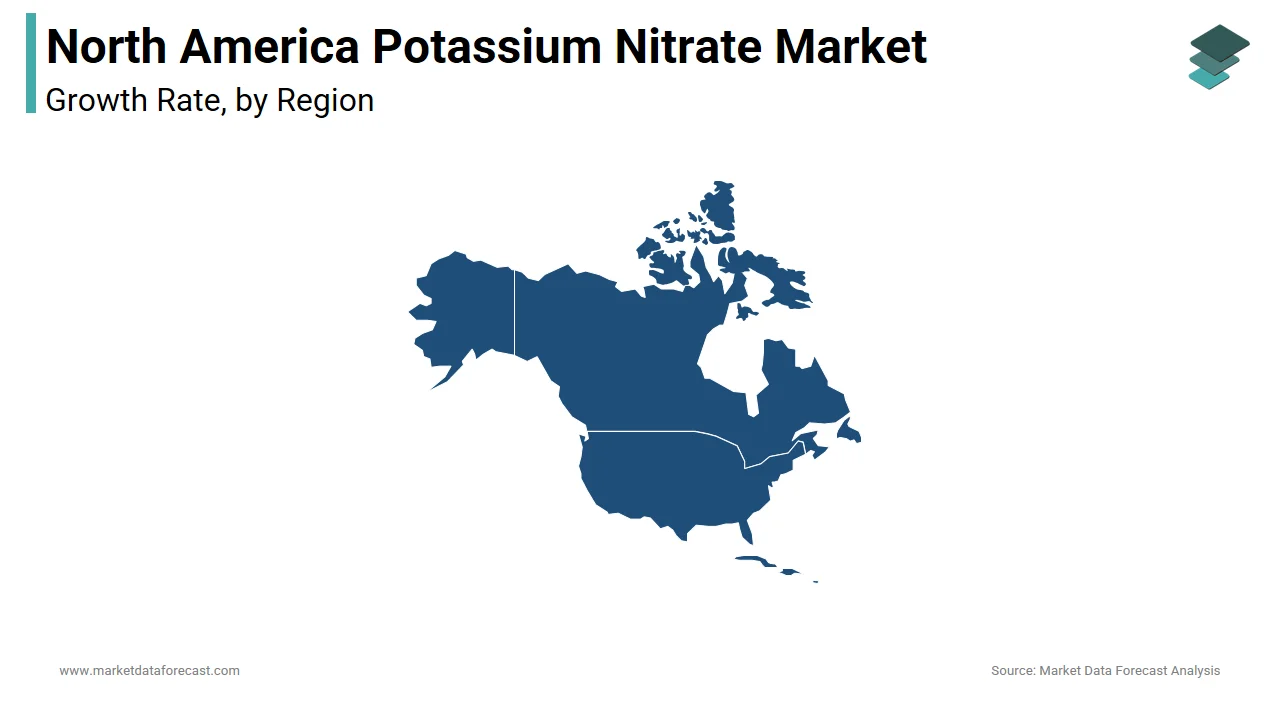
The United States was the top performer in the North America potassium nitrate market, with 70.4% of share in 2025, with the country’s robust agricultural sector, which accounts for nearly 50% of potassium nitrate consumption. The adoption of precision farming technologies has surged by 10% annually since 2021, as per the U.S. Department of Agriculture. These advancements have amplified demand for high-yield fertilizers like potassium nitrate in cash crops such as fruits, vegetables, and nuts. The aging population and growing emphasis on healthcare have also bolstered its use in pharmaceuticals.
Canada held 20.3% of the North America potassium nitrate market share in 2025 by leveraging its focus on sustainable agriculture and renewable feedstocks to carve out a niche in the industry. According to the Canadian Biotechnology Network, Canada ranks among the top five global producers of eco-friendly fertilizers, with investments exceeding $800 million since 2020. This strategic emphasis on green chemistry aligns with global sustainability goals and positions Canada as a leader in biobased potassium nitrate production. Moreover, Canada’s participation in trade agreements, such as the United States-Mexico-Canada Agreement (USMCA), enhances its access to broader North American markets by enabling manufacturers to scale operations efficiently.
MARKET KEY PLAYERS
Companies playing a dominant role in the North America potassium nitrate market profiled in this report are AG CHEMI GROUP s.r.o., Positive Chemicals Pvt. Ltd., Arihant Chemical, Ravi Chem Industries, Jagannath Chemicals, SQM S.A., SNDB, Haifa Negev Technologies Ltd., KEMAPCO Arab Fertilizers & Chemicals Industries Ltd. (Arab Potash Company), Zhejiang Lianda Chemical Co, Ltd, and others.
TOP LEADING PLAYERS IN THE MARKET
Yara International ASA
Yara International ASA is a global powerhouse in the potassium nitrate market. The company operates state-of-the-art integrated manufacturing facilities, ensuring cost efficiency and supply chain resilience. According to the American Chemistry Council, Yara’s focus on sustainability has led to the development of innovative biobased potassium nitrate solutions by catering to environmentally conscious consumers. In 2023, the company launched a pilot plant dedicated to producing renewable potassium nitrate derivatives by aligning with global efforts to reduce carbon footprints. Its strong R&D capabilities and partnerships with industries like agriculture and healthcare enable Yara to maintain its dominant position.
Haifa Group
Haifa Group’s strategic collaborations with farmers and agronomists escalate its commitment to innovation. Haifa has developed advanced formulations optimized for precision farming by addressing the growing demand for nutrient-efficient fertilizers. Additionally, Haifa invests heavily in research to enhance product quality and expand its application scope.
SQM S.A.
SQM S.A. is leveraging its expertise in biobased production methods to align with global sustainability goals. SQM’s investments enable the production of eco-friendly potassium nitrate derivatives. The company’s strategic partnerships with downstream industries ensure a steady demand pipeline, while its global presence enhances market reach. SQM’s emphasis on innovation and sustainability positions it as a key player in the evolving potassium nitrate landscape.
TOP STRATEGIES USED BY KEY MARKET PARTICIPANTS
Key players in the North America potassium nitrate market employ a range of strategies to maintain their competitive edge and drive growth. One prominent approach is vertical integration, which allows companies to streamline operations and reduce dependency on external suppliers. For instance, Yara International operates integrated potassium chloride-to-potassium nitrate production facilities by minimizing costs and enhancing supply chain reliability, as per the Society of Plastics Engineers. Another critical strategy is investing in research and development (R&D) to innovate sustainable products. Haifa Group, for example, collaborates with agricultural giants to develop nutrient-efficient fertilizers, addressing the growing demand for precision farming solutions. Sustainability initiatives are also a focal point, with SQM S.A. spearheading biobased potassium nitrate projects to meet regulatory requirements and consumer preferences. Strategic partnerships and acquisitions further strengthen market positions by enabling companies to expand their portfolios and tap into new application areas.
COMPETITION OVERVIEW
The North America potassium nitrate market is characterized by intense competition, with established players and new entrants vying for market share. According to the Materials Research Society, the market’s competitive dynamics are shaped by factors such as price volatility, substitute materials, and evolving consumer demands. Established companies like Yara International, Haifa Group, and SQM S.A. dominate the landscape by leveraging their scale, technological expertise, and brand reputation to maintain their dominance. However, the entry of smaller firms specializing in biobased potassium nitrate introduces fresh competition, particularly in eco-conscious segments.
RECENT MARKET DEVELOPMENTS
- In June 2023, Yara International launched a biobased potassium nitrate pilot plant, marking a significant step toward sustainable production and enhancing its portfolio of eco-friendly products.
- In March 2023, Haifa Group partnered with U.S. farmers to co-develop precision farming solutions using advanced potassium nitrate formulations, addressing the agricultural industry’s demand for nutrient-efficient fertilizers.
- In January 2023, SQM S.A. announced a $500 million investment in renewable feedstock research, aiming to produce biobased potassium nitrate and align with global sustainability goals.
- In October 2022, Agrium acquired a potassium nitrate facility in Texas, expanding its production capacity and strengthening its position in the North American market.
- In July 2022, OCI Nitrogen introduced a low-emission potassium nitrate derivative designed for eco-conscious consumers, targeting applications in sustainable agriculture and food preservation.
MARKET SEGMENTATION
This research report on the North America potassium nitrate market is segmented and sub-segmented into the following categories.
By Raw Material
- Potassium Chloride
- Ammonium Nitrate
- Sodium Nitrate
By End-use
- Agriculture
- Pharmaceutical
- Food & Beverage
- Glass Manufacturing
- Others
By Country
- United States
- Canada
- Mexico
- Rest of North America