- Product Description Description
- Table of Contents TOC
- List of Table & Figure LOT
- Get Free Sample PDF Sample PDF
Market Size, 2025
$1.92 BnMarket Estimate, 2026
$1.98 BnMarket Forecast, 2034
$2.56 BnCAGR, 2026–2034
3.25%Executive Summary: North America Pretzel Market
- Market Scope: Comprehensive analysis of the North America pretzel market covering product types, flavor/content classifications, distribution channels, regional country dynamics, growth drivers, restraints, and competitive landscapes.
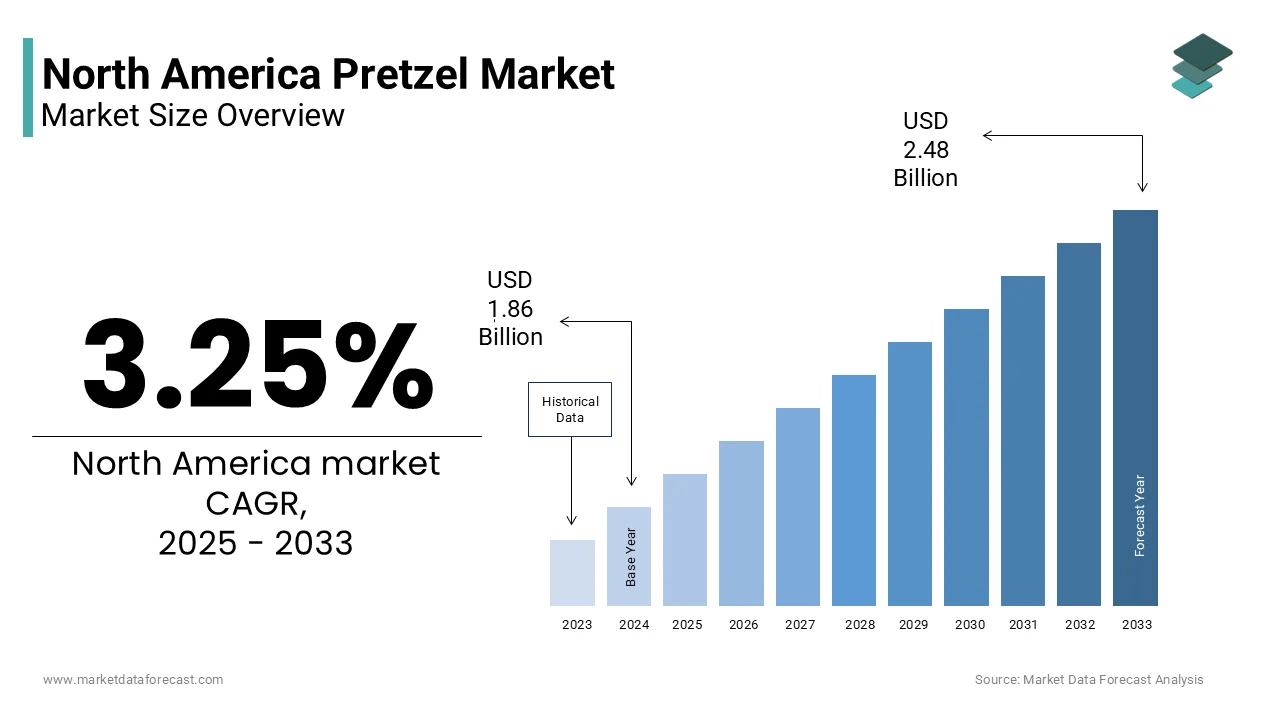
- Market Valuation: Valued at USD 1.92 billion (2025), estimated at USD 1.98 billion (2026), and projected to reach USD 2.56 billion by 2034, registering a solid CAGR of 3.25% during the forecast period (2026–2034).
- Primary Growth Drivers: Rising demand for on-the-go and portable snack options matching fast-paced lifestyles, and the rapid expansion of premium, gourmet, and flavored pretzel varieties catering to diverse consumer tastes.
Key Market Segment Metrics (2026–2034)
| Category | Leading Segment (2025 Position) | Fastest-Growing Segment |
|---|---|---|
| By Type | Hard Pretzels (accounted for 65.6% of total volume in 2023, favored for long shelf life and broad retail availability) | Soft Pretzels (projected to grow at a CAGR of 7.8% driven by foodservice expansion, malls, and artisanal trends) |
| By Content | Salted Pretzels (led the regional market capturing the vast majority of consumption volume via traditional snack formats) | Unsalted & Reduced-Sodium Pretzels (projected to grow at a CAGR of 8.2% driven by health-conscious consumer trends) |
| By Distribution Channel | Supermarkets & Hypermarkets (captured 55.7% of total retail sales in 2025 through extensive mass-market assortments) | Online Retailers (projected to expand at a rapid CAGR of 9.5% backed by digital grocery shopping and doorstep delivery) |
| By Region / Country | United States (accounted for 82.7% of regional consumption in 2025, anchored by Pennsylvania's manufacturing hub) | Canada & Mexico (experiencing steady growth driven by urban demand for premium snacks and cross-border brand expansion) |
Major Market Players & Market Structure
Market Structure: Highly competitive landscape characterized by established national brands, regional family-owned powerhouses, and growing boutique retail players competing on flavor innovation, non-traditional distribution channels, and health-focused formulations.
Key Companies: Auntie Anne's, Boulder Brands, ConAgra Brands, Frito-Lay, Herr Foods, J & J Snack Foods, Mars, Mr. Pretzel, Pretzels Inc., Snyder's-Lance (Campbell Soup Company), and others.
 Download Free Sample Report
North America Pretzel Market Size
The North America pretzel market size was valued at USD 1.92 billion in 2025 and is predicted to reach USD 2.56 billion by 2034 from USD 1.98 billion in 2026, growing at a CAGR of 3.25% from 2026 to 2034.
Pretzel is a traditional baked snack with Germanic origins, have evolved into a staple in mainstream American snacking culture due to their versatility, long shelf life, and adaptability to various flavor profiles and formats.
In the U.S., Pennsylvania remains the epicenter of pretzel production, contributing the majority of national output. The state’s historical significance in pretzel manufacturing has led to the establishment of major brands such as Snyder’s of Hanover and Herr Foods, which supply both retail and foodservice channels. Canadian consumers have also shown growing interest in premium and flavored pretzels, especially in urban centers like Toronto and Vancouver.
Mexico’s pretzel market is still emerging but gaining traction through localized snack adaptations and cross-border brand expansions.
MARKET DRIVERS
Rising Demand for On-the-Go and Portable Snacks
The increasing preference for convenient, ready-to-eat snacks that align with fast-paced lifestyles is one of the primary drivers fueling the North America pretzel market. Consumers are increasingly seeking non-perishable, easy-to-carry foods that offer satiety without compromising on taste or texture. According to the International Snack and Bakery Association, over 60% of U.S. consumers prefer packaged snacks that can be consumed while commuting, working, or engaging in outdoor activities, making pretzels an ideal fit due to their portability and crunch factor.
Pretzels offer a unique combination of crispiness, saltiness, and a relatively long shelf life, making them a popular choice among students, office workers, and travelers. Moreover, the integration of pretzels into vending machines, gas station kiosks, and airport concession stands has expanded accessibility beyond grocery stores. This widespread availability, combined with evolving flavor innovations, continues to drive consistent demand across age groups and geographic regions.
Expansion of Premium and Flavored Pretzel Offerings
The growing popularity of premium and flavored pretzel varieties tailored to changing consumer tastes and dietary preferences is another key driver shaping the North America pretzel market. Traditional plain and salted pretzels are being supplemented with gourmet flavors such as honey mustard, jalapeño cheddar, cinnamon sugar, and even artisanal chocolate-coated versions, appealing to a broader audience segment.
Besides, the rise of boutique pretzel shops and direct-to-consumer e-commerce platforms has enabled smaller producers to compete alongside established brands. Companies like Auntie Anne’s and Wetzel’s Pretzels have capitalized on this trend by offering freshly baked, customizable pretzel options in mall kiosks and amusement parks, reinforcing brand loyalty and impulse purchasing behaviors. This shift toward experiential and indulgent snacking has significantly contributed to the overall growth and diversification of the pretzel category in North America.
 MARKET RESTRAINTS
Intensifying Competition from Alternative Snack Categories
The growing competition from alternative snack categories, including potato chips, popcorn, extruded snacks, and protein bars, is a major restraint affecting the North America pretzel market. These products often benefit from aggressive marketing campaigns, extensive retail placement, and perceived health advantages, drawing consumer attention away from traditional pretzels. Moreover, the expansion of international snack imports, including rice crackers and seaweed snacks, has introduced additional diversity into the marketplace, further fragmenting consumer spending. To counteract this, pretzel manufacturers must invest in reformulation efforts, introduce lower-sodium and whole-grain variants, and enhance packaging messaging to position pretzels as a healthier option within the savory snack category.
Raw Material Price Volatility and Supply Chain Disruptions
The volatility in raw material prices, particularly wheat, salt, and vegetable oils, which form the core ingredients of pretzel production is another significant constraint on the North America pretzel market. Wheat prices are influenced by climatic conditions, global trade policies, and geopolitical tensions, leading to fluctuations that impact manufacturing costs and retail pricing strategies.
These cost variations create challenges for pretzel producers who must manage procurement risks while maintaining stable pricing for consumers. Apart from these, post-pandemic disruptions in logistics, including freight bottlenecks and labor shortages, have delayed ingredient sourcing and finished product deliveries, further complicating supply chain management. To mitigate these risks, companies are exploring vertical integration, supplier diversification, and hedging mechanisms, though the inherent unpredictability of agricultural commodity markets continues to pose a challenge to profitability and scalability.
MARKET OPPORTUNITIES
Growth of Health-Conscious and Functional Pretzel Varieties
The development and commercialization of health-conscious and functional pretzel varieties designed to cater to evolving consumer preferences is an emerging opportunity within the North America pretzel market. With increasing awareness around nutrition and wellness, pretzel manufacturers are reformulating products to include whole grains, reduced sodium, added fiber, and plant-based proteins to appeal to fitness-oriented and diet-conscious demographics. Pretzel brands are responding by introducing high-protein and keto-friendly options fortified with vitamins and minerals.
Furthermore, clean-label initiatives have prompted manufacturers to eliminate artificial preservatives and replace them with natural alternatives, enhancing product appeal among premium and organic shoppers. Companies like Snyder’s-Olivieri and LesserEvil have successfully launched certified gluten-free and non-GMO pretzel lines, tapping into niche markets and expanding their customer base.
Expansion into E-commerce and Direct-to-Consumer Sales Channels
The digital transformation of snack retail presents a significant opportunity for the North America pretzel market through the expansion of e-commerce and direct-to-consumer (DTC) platforms. Online snack delivery services have gained momentum, particularly post-pandemic, as consumers seek convenience, variety, and personalized shopping experiences. Companies like Amazon Fresh, Instacart, and regional artisanal pretzel e-retailers have capitalized on this trend by offering subscription-based models, same-day delivery, and curated gift sets.
Canada has also seen similar growth, with platforms like Well.ca and Bulk Barn expanding their online pretzel offerings through nationwide shipping and smart packaging solutions that maintain product integrity during transit. These developments enable producers to bypass traditional intermediaries, thereby improving profit margins while delivering fresher, more customized products.
MARKET CHALLENGES
Changing Consumer Perceptions Around Sodium Content
The growing scrutiny over sodium content and its potential impact on cardiovascular health is one of the foremost challenges confronting the North America pretzel market. Pretzels have historically been associated with high salt levels, which has led to shifting consumer behavior toward lower-sodium alternatives and health-focused snacking choices. According to Harvard T.H. Chan School of Public Health, several studies published in 2023 highlighted potential links between excessive sodium intake and hypertension, prompting some food brands to reformulate products to meet evolving dietary guidelines.
Regulatory bodies such as the U.S. Food and Drug Administration (FDA) have intensified efforts to reduce sodium in processed foods, urging manufacturers to voluntarily cut salt content in commonly consumed snacks. These developments are pushing pretzel producers to invest in salt reduction techniques while maintaining flavor and texture consistency. Successfully navigating this evolving health narrative will be crucial for sustaining consumer confidence and market relevance, particularly among health-conscious and medically advised demographics.
Brand Saturation and Differentiation Challenges
The North America pretzel market faces intensifying competition among established brands, private labels, and new entrants, leading to challenges in brand differentiation and consumer retention. With numerous players offering similar products across various price points and distribution channels, standing out in a crowded market has become increasingly difficult.
While large manufacturers benefit from economies of scale and strong distribution networks, smaller artisanal and regional brands struggle to gain visibility without substantial marketing investment. Moreover, private-label brands offered by retailers such as Walmart, Kroger, and Aldi have captured significant market share by leveraging competitive pricing and frequent promotions.
REPORT COVERAGE
| REPORT METRIC | DETAILS |
| Market Size Available | 2025 to 2034 |
| Base Year | 2025 |
| Forecast Period | 2026 to 2034 |
| CAGR | 3.25% |
| Segments Covered | By Type, Content, Distribution Channel, and Region |
|
Various Analyses Covered | Regional & Country Level Analysis, Segment-Level Analysis, DROC, PESTLE Analysis, Porter’s Five Forces Analysis, Competitive Landscape, Analyst Overview on Investment Opportunities |
| Regions Covered | The United States, Canada, Mexico, and Rest of North America |
| Market Leaders Profiled | Auntie Annes, Boulder Brands, ConAgra, Frito-Lay, Herr Foods, J & J Snacks, Mars, Mr. Pretzel, Pretzels Inc. and Snyders-Lance, and others |
SEGMENTAL ANALYSIS
By Type Insights
The Hard pretzels segment represented the largest type in the North America pretzel market by accounting for 65.6% of total consumption volume in 2023. Their long shelf life, widespread retail availability, and strong presence in vending machines, convenience stores, and online platforms is primarily attributed to the dominance of Hard pretzels segment. Also, their integration into snack packs, multipacks, and portion-controlled formats that cater to on-the-go consumers is among the key drivers behind the continued supremacy of hard pretzels. Moreover, major manufacturers such as Snyder’s of Hanover and Herr Foods have capitalized on flavor innovation, introducing varieties like honey mustard, ranch, and sour cream onion to appeal to a broader audience. These efforts have helped maintain consumer interest beyond traditional salted versions.
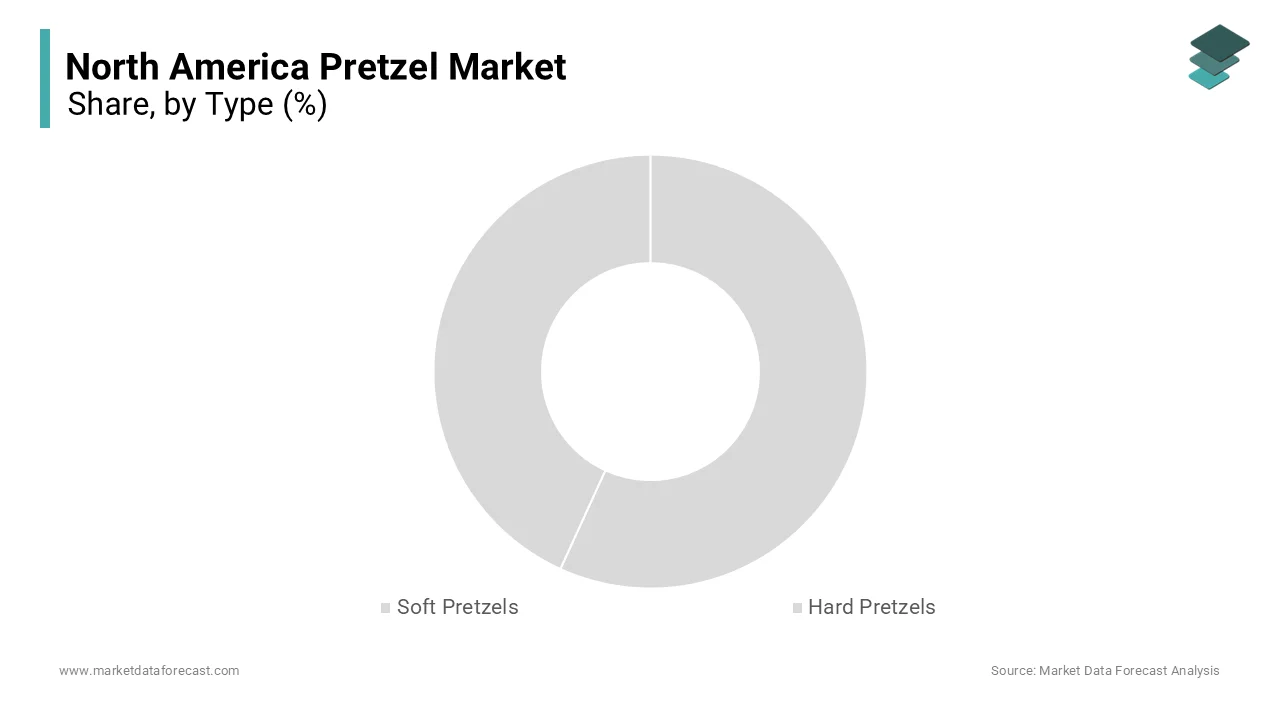
The soft pretzel segment is emerging as the fastest-growing category within the North America pretzel market and is projected to grow at a CAGR of 7.8% between 2026 and 2034. This growth reflects shifting consumer preferences toward indulgent, freshly baked, and customizable snack options. Soft pretzels are increasingly favored in foodservice settings such as malls, stadiums, amusement parks, and quick-service restaurants. Additionally, frozen soft pretzel sales in supermarkets have surged due to home baking trends and microwaveable convenience. As consumer demand for experiential snacking grows, soft pretzels continue to gain traction, offering a warm, chewy texture that differentiates them from the more rigid hard pretzel format.
By Content Insights
The salted pretzels segment led the North America pretzel market by capturing a substantial portion of total consumption volume in 2025. The enduring popularity of salted pretzels stems from their signature flavor profile, which aligns with traditional consumer expectations and enhances taste perception through the contrast of sweet and salty notes. Salt remains a critical ingredient in pretzel formulation , not only for flavor but also for texture and browning during the baking process. Traditional salted pretzels are widely available in bulk, single-serve, and resealable packaging formats, making them accessible across multiple distribution channels. Major brands like Pepperidge Farm and Kellogg’s have reinforced this preference by maintaining salted variants as core offerings while introducing flavored salt combinations such as garlic parmesan and everything seasoning to attract younger demographics. Furthermore, salted pretzels are frequently paired with dips like cheese, mustard, and hummus, reinforcing their role as a versatile and interactive snack. These factors collectively ensure the sustained dominance of salted pretzels in the regional market.
The unsalted pretzel segment is the fastest-growing category within the North America pretzel market, projected to grow at a CAGR of 8.2% during the forecast period. Increasing health consciousness among consumers who seek lower-sodium alternatives without compromising on texture or nutritional value is propelling the growth of this segment. Also, potential links between high sodium intake and cardiovascular risks, prompting food manufacturers to reformulate products accordingly. In response, pretzel producers have introduced unsalted and reduced-salt options tailored to health-focused consumers, including those with hypertension or dietary restrictions. These products are often marketed alongside clean-label claims, gluten-free certifications, and whole-grain formulations, appealing to niche markets and expanding the demographic reach of pretzels beyond traditional consumers. As dietary transparency becomes a priority, the unsalted pretzel segment is well-positioned for sustained expansion.
By Distribution Channel Insights
The Supermarkets and hypermarkets segment was the largest distribution channel for pretzels in North America by capturing a 55.7% of total retail sales in 2025. These large-format retailers dominate due to their broad product assortment, competitive pricing, and established supply chains that cater to mass-market consumers. Major supermarket chains such as Walmart, Kroger, Albertsons, and Costco offer both branded and private-label pretzel options, often featuring promotional deals and bulk packaging to attract value-conscious shoppers. Furthermore, in-store displays, seasonal promotions, and shelf placement strategies enhance visibility and consumer engagement. Retailers have also introduced eco-friendly packaging and non-GMO variants to align with evolving consumer preferences.
The online retail distribution channel is the fastest-growing segment in the North America pretzel market, projected to expand at a CAGR of 9.5% between 2026 and 2034. Increasing adoption of e-commerce platforms for grocery shopping and the rising preference for doorstep delivery of essential commodities is fuelling the rise of this segment. Platforms such as Amazon Fresh, Instacart, Shipt, and regional artisanal pretzel e-retailers have facilitated easy access to both conventional and gourmet pretzel variants. Consumers are drawn to the convenience of comparing product attributes, reading nutritional labels, and accessing customer reviews before purchasing. Additionally, subscription models and bundled offers on digital platforms encourage repeat purchases and brand loyalty. As cold-chain logistics improve and last-mile delivery networks expand, online distribution is becoming a key growth engine for pretzel brands aiming to reach tech-savvy and time-constrained consumers.
REGIONAL ANALYSIS
United States
The United States led the North America pretzel industry by accounting for a 82.7% of regional consumption in 2025. It serves as both the leading producer and consumer of pretzels, driven by a well-established snack culture and a strong manufacturing base concentrated in Pennsylvania. Pennsylvania remains the epicenter of pretzel production, contributing the majority of national output. Brands such as Snyder’s of Hanover, Herr Foods, and Utz Quality Foods have built extensive distribution networks, supplying both retail and foodservice sectors nationwide. In addition to traditional retail channels, the U.S. has seen a resurgence of mall-based pretzel kiosks and gourmet pretzel shops, particularly in urban centers and tourist hubs. With ongoing product innovation and expanding digital commerce, the U.S. continues to shape the trajectory of the North America pretzel market.
Canada
Canada has emerged as a growing consumer market, particularly for premium and specialty pretzels. Urban centers like Toronto, Vancouver, and Montreal are driving growth, with consumers showing increasing interest in gourmet, organic, and imported pretzel varieties. Additionally, the rise of local pretzel bakeries and direct-to-consumer e-commerce platforms has expanded accessibility beyond traditional retail. Companies like St. Urbain Bagel Pretzel Co. and Artisan Pretzel Works have gained traction by offering handcrafted, small-batch pretzels with unique flavor profiles.
Mexico
Mexico constitutes a smaller but rapidly evolving segment of the North America pretzel market. Though traditionally less prominent than the U.S. and Canada, Mexico’s pretzel market is witnessing steady growth due to changing dietary habits and increasing exposure to international snack trends. Imports play a crucial role in meeting local demand. The country’s foodservice sector, particularly in upscale cafes and American-style delis, has been a key driver of this trend. Urban centers like Mexico City, Guadalajara, and Monterrey are leading this shift, with rising middle-class incomes and exposure to global food trends. With ongoing trade agreements under USMCA and increasing food manufacturing investments, Mexico’s pretzel market presents promising potential for future expansion.
KEY MARKET PLAYERS AND COMPETITIVE LANDSCAPE
Some of the major players in the market are Auntie Annes, Boulder Brands, ConAgra, Frito-Lay, Herr Foods, J & J Snacks, Mars, Mr. Pretzel, Pretzels Inc. and Snyders-Lance among others.
The North America pretzel market is characterized by a dynamic competitive landscape shaped by both long-established brands and emerging boutique players. While industry leaders such as Snyder’s-Lance, Herr Foods, and Auntie Anne’s dominate due to their scale, brand recognition, and extensive distribution networks, smaller regional producers are increasingly leveraging niche markets to carve out distinct identities. The market sees competition not only in pricing but also in branding, product differentiation, and consumer experience.
The dual appeal of pretzels—as both a nostalgic snack and a modern, customizable treat—has led to continuous innovation in packaging, flavoring, and format adaptations. In particular, the rise of soft pretzels in foodservice settings has introduced a new dimension to the market, attracting on-the-go consumers seeking warm, indulgent snacks.
Retailers and private-label brands also exert influence by offering cost-effective alternatives that challenge national brands. As health trends evolve and digital commerce expands, companies must continuously adapt to shifting consumer expectations, ensuring relevance in an increasingly fragmented and fast-moving snack environment.
TOP PLAYERS IN THE MARKET
Snyder’s-Lance
Snyder’s-Lance, now part of Campbell Soup Company, is one of the most recognized names in the North America pretzel market. Known for its flagship brand Snyder’s of Hanover, the company offers a wide range of pretzel products, from traditional hard pretzels to flavored and snack-pack variants. The brand has played a pivotal role in mainstreaming pretzels as an everyday snack across the U.S. and Canada.
Herr Foods
Herr Foods is a family-owned regional powerhouse with a strong presence in the Mid-Atlantic and Midwest United States. Herr Foods has built a loyal consumer base through its commitment to quality, kettle-cooked methods, and localized distribution strategies. The company has contributed significantly to the growth of artisanal and premium pretzel offerings, influencing niche market development.
Auntie Anne’s
Auntie Anne’s, a global leader in fresh-baked pretzels, dominates the foodservice segment in North America. With hundreds of kiosks in malls, airports, and entertainment venues, Auntie Anne’s has redefined pretzels as a lifestyle snack—warm, customizable, and experiential. Its influence extends beyond retail, shaping how consumers interact with pretzels in public spaces and travel hubs.
TOP STRATEGIES USED BY KEY PLAYERS
One of the primary strategies employed by key players in the North America pretzel market is product innovation and flavor diversification , where companies continuously introduce new taste profiles, textures, and formats to cater to evolving consumer preferences. This includes gourmet flavors, chocolate-dipped variants, and health-focused options such as whole grain and low-sodium pretzels.
Another critical approach is expansion into non-traditional retail and foodservice channels , particularly mall kiosks, amusement parks, and convenience stores. Brands like Auntie Anne’s have leveraged high-footfall locations to enhance visibility and impulse purchasing, reinforcing brand recall and customer engagement.
Lastly, strategic partnerships and digital transformation initiatives play a significant role in strengthening market positioning. Companies are investing in e-commerce platforms, mobile ordering apps, and loyalty programs to connect directly with consumers while also forming alliances with major retailers to secure prime shelf space and promotional opportunities.
RECENT HAPPENINGS IN THE MARKET
- In February 2023, Snyder’s-Lance launched a new line of protein-enriched pretzels aimed at fitness-conscious consumers, expanding its portfolio into the functional snack category and enhancing its appeal among health-oriented buyers.
- In June 2023, Herr Foods expanded its distribution network by partnering with major grocery chains across the Midwest and Northeast, increasing shelf presence and boosting accessibility to independent retailers and specialty stores.
- In November 2023, Auntie Anne’s introduced a mobile app-based loyalty program that rewards repeat purchases and incentivizes in-store visits, strengthening customer retention and digital engagement across its kiosk locations.
- In January 2025, a joint initiative between two regional pretzel bakeries led to the opening of a shared production facility in Ontario, Canada, aimed at reducing manufacturing costs and improving supply chain efficiency for domestic and cross-border markets.
- In May 2025, a leading natural foods retailer introduced an exclusive line of organic, gluten-free pretzels under its private label, targeting wellness-focused shoppers and expanding the availability of specialty pretzels in mainstream retail.
MARKET SEGMENTATION
This research report on the North America pretzel market has been segmented and sub-segmented based on the following categories.
By Type
- Soft Pretzels
- Hard Pretzels
By Content
- Unsalted Pretzels
- Salted Pretzels
By Distribution Channel
- Convenience Stores
- Supermarkets & Hypermarkets
- Online Retailers
- Specialist Retailers
- Other Distribution Channels
By Country
- The United States
- Canada
- Rest of North America