- Product Description Description
- Table of Contents TOC
- List of Table & Figure LOT
- Get Free Sample PDF Sample PDF
North America Pumps Market Size
In 2024, the North America Pumps Market was valued at USD 17.54 billion and is forecasted to grow to USD 24.41 billion by 2033, at a CAGR of 3.74%.
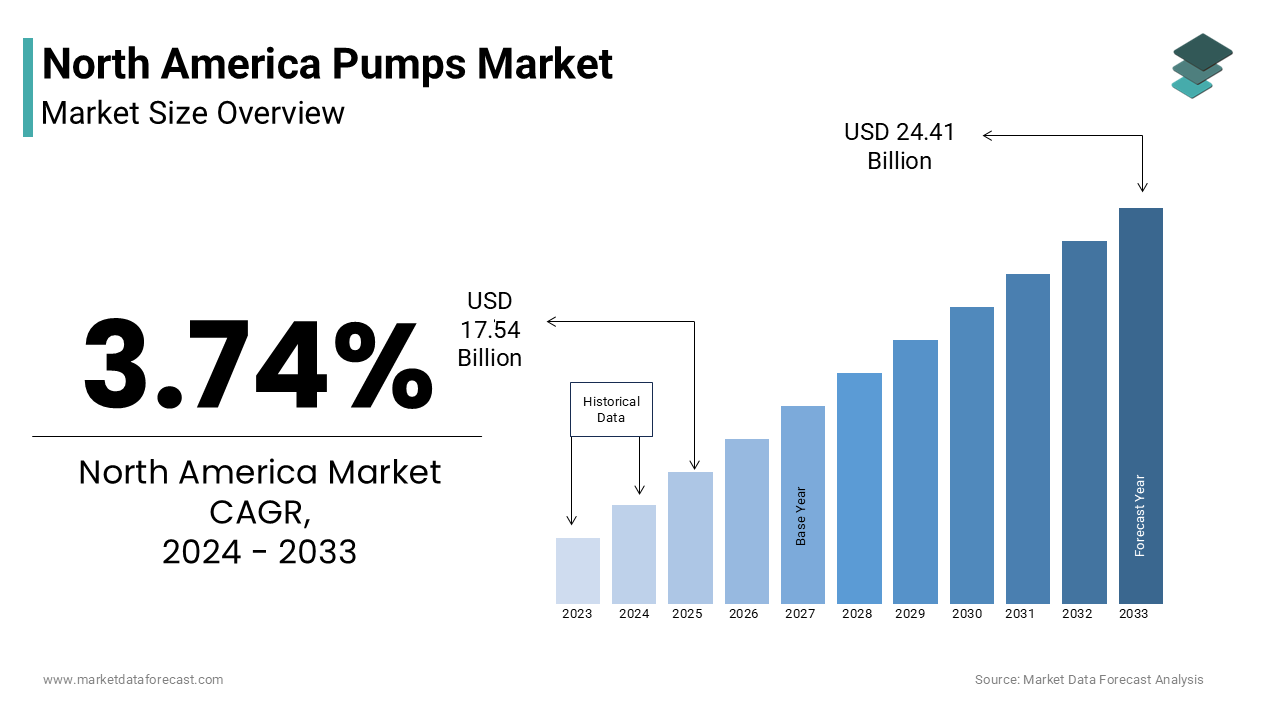
Pumps are mechanical devices designed to move fluids liquids, gases, or slurries by mechanical action. These systems are integral to various industrial, commercial, and residential applications, including water treatment, oil and gas extraction, chemical processing, agriculture, and HVAC systems. The market includes centrifugal, positive displacement, submersible, and specialty pumps, each tailored for specific operational requirements.
As of recent assessments, the United States alone consumes over 12 billion gallons of water daily through public supply systems, much of which is managed using pumping infrastructure according to data from the U.S. Geological Survey (USGS). This underscores the critical role pumps play in sustaining municipal water services across the continent. Additionally, Canada’s oil sands industry, one of the largest contributors to the country's GDP, requires extensive pumping systems for extraction and transportation processes, as per Natural Resources Canada. With growing infrastructural investments and increasing environmental regulations, the demand for energy-efficient and durable pump solutions has surged across the region. The integration of smart technologies and automation within pump systems is also gaining traction, driven by digital transformation in industrial sectors.
MARKET DRIVERS
Growth in Water Infrastructure Investment
The escalating investment in water and wastewater infrastructure modernization is a significant driver propelling the North America pumps market. Aging pipelines, increasing urbanization, and stricter regulatory standards have prompted governments and municipalities to allocate substantial funds toward upgrading water management systems. This translates into increased deployment of advanced pumping systems capable of handling large volumes efficiently while minimizing energy consumption and leakage losses.
In Canada, similar trends are evident. A major portion of this funding is directed toward retrofitting existing pumping stations and installing new ones equipped with variable speed drives and intelligent monitoring capabilities. These enhancements not only improve operational efficiency but also reduce long-term maintenance costs. Moreover, the Environmental Protection Agency (EPA) in the U.S. enforces stringent discharge norms, compelling industries and municipalities to adopt high-performance pumping solutions.
Expansion of Oil & Gas Activities
The continued expansion of oil and gas exploration and production activities, particularly in unconventional reserves such as shale oil and tar sands, is another pivotal factor driving the North America pumps market. As per the U.S. Energy Information Administration (EIA), the United States produced approximately 12 million barrels of crude oil per day in 2023, making it the world's leading oil producer. This level of production necessitates robust pumping infrastructure for drilling, extraction, refining, and transportation processes.
Canada, home to the third-largest proven oil reserves globally, relies heavily on pumps for its oil sands operations. Additionally, the rise in natural gas exports via liquefied natural gas (LNG) terminals in both the U.S. and Canada has spurred the installation of cryogenic and high-pressure pumps.
MARKET RESTRAINTS
High Maintenance and Operational Costs
The high cost associated with maintenance, repair, and operational inefficiencies of existing systems is one of the key restraints affecting the growth of the North America pumps market. Many legacy installations operate below optimal efficiency levels due to aging components, improper sizing, and a lack of real-time monitoring, leading to increased downtime and repair expenses.
Moreover, as per estimates by the National Association of Corrosion Engineers (NACE), corrosion-related failures in industrial pumping systems cost the U.S. economy over $7 billion annually. This is particularly prevalent in sectors such as oil and gas, where exposure to abrasive and corrosive materials accelerates wear and tear. These financial burdens deter smaller operators from investing in new pump installations or upgrades, slowing down overall market expansion.
Additionally, the shortage of skilled labor to perform regular maintenance and troubleshooting exacerbates the issue.
Regulatory and Environmental Compliance Pressures
Stringent environmental regulations imposed by governmental bodies pose another significant restraint on the North America pumps market. The U.S. Environmental Protection Agency (EPA) and Environment and Climate Change Canada (ECCC) enforce rigorous emissions and effluent discharge standards that compel industries to upgrade their pumping systems to comply. While these measures promote sustainability, they also increase capital expenditure for businesses, especially small and medium-sized enterprises.
For instance, the EPA’s Clean Water Act mandates that industrial facilities must treat wastewater before discharge, requiring the use of more sophisticated and costly pumping solutions. Similarly, Canada’s Wastewater Systems Effluent Regulations, updated in 2022, mandate that all municipal wastewater plants meet higher effluent quality standards by 2030, as outlined by ECCC. These changes necessitate retrofits and replacements of older pump models with ones that offer better control over flow rates and energy consumption.
Furthermore, the push for decarbonization has led to increased scrutiny of energy-intensive pumping systems. As per the International Energy Agency (IEA), industrial electric motors, including those used in pumps, account for nearly 50% of global electricity consumption.
MARKET OPPORTUNITIES
Adoption of Smart Pumping Technologies
The integration of smart technologies into pumping systems presents a major opportunity for growth in the North America pumps market. Advancements in IoT-enabled sensors, predictive maintenance algorithms, and remote monitoring capabilities are transforming traditional pump operations into highly efficient, data-driven systems. According to a 2023 report by McKinsey & Company, the adoption of digital solutions in industrial equipment—including pumps—could unlock up to $1.5 trillion in economic value globally by 2030, with North America being a key contributor.
Smart pumps equipped with condition monitoring features allow operators to detect anomalies in real time, reducing unplanned downtime and extending equipment life. Additionally, companies like Grundfos and Xylem have introduced cloud-connected pump solutions that provide analytics on performance metrics, enabling proactive decision-making. In Canada, the adoption of Industry 4.0 practices is accelerating, particularly in the mining and oil and gas sectors.
Increasing Demand for Sustainable and Energy-Efficient Solutions
Rising emphasis on sustainability and energy conservation is opening new avenues for innovation and market expansion in the North America pumps industry. Governments and private entities alike are prioritizing eco-friendly technologies to reduce energy consumption and carbon emissions. According to the U.S. Department of Energy, motor-driven systems—including pumps—account for approximately 60% of the nation’s electricity consumption in industrial settings. Recognizing this, the DOE launched the Better Plants Program in 2023, encouraging manufacturers to commit to improving energy efficiency by at least 25% over ten years.
Moreover, environmental policies such as California’s Title 24 Building Energy Efficiency Standards and Canada’s Energy Star certification program are pushing manufacturers to develop greener products. Companies like Sulzer and Flowserve have responded by introducing low-energy, high-performance pump lines tailored for municipal and industrial applications. As corporate sustainability goals and regulatory mandates converge, the shift toward energy-efficient pumping systems is poised to drive substantial market growth.
MAREKT CHALLENGES
Supply Chain Disruptions and Material Shortages
The ongoing volatility in global supply chains and raw material availability is a pressing challenge confronting the North America pumps market. The aftermath of the pandemic, geopolitical tensions, and trade restrictions have disrupted the procurement of essential components such as steel, copper, and semiconductors, which are crucial for pump manufacturing. According to a 2023 report by the National Association of Manufacturers (NAM), over 70% of U.S. manufacturers faced delays in receiving raw materials, directly impacting production timelines and project completions.
Steel, a primary input in pump construction, has experienced significant price fluctuations. Also, copper prices saw a spike following supply disruptions in South American mines, as per the Copper Development Association (CDA). These cost escalations have forced manufacturers to either absorb the burden or pass on the increased expenses to end-users, affecting market dynamics.
Additionally, semiconductor shortages have impacted the production of smart pumps incorporating electronic controls and IoT functionalities. Such bottlenecks hinder the market’s ability to scale rapidly and meet surging demand across industrial sectors.
Skilled Labor Shortage and Technical Expertise Gaps
The scarcity of skilled labor and technical expertise required for the design, installation, and maintenance of modern pumping systems is another formidable challenge facing the North America pumps market. Despite technological advancements, the industry continues to rely heavily on qualified technicians and engineers to manage complex operations. However, a growing skills gap is impeding the sector’s growth trajectory.
Furthermore, as per the Deloitte’s 2023 Manufacturing Talent Gap Report, 2.1 million manufacturing jobs in the U.S. could go unfilled by 2030 due to a lack of adequately trained workers. This deficit is particularly acute in specialized areas such as pump system optimization and digital diagnostics.
In Canada, the situation mirrors similar concerns. As per the Canadian Manufacturers & Exporters (CME) in 2023, 59% of surveyed companies struggled to find candidates with the necessary technical skills to operate and maintain advanced industrial equipment, including smart pumping systems. Educational institutions have been slow to adapt curricula to include training in modern pump technologies, exacerbating the problem.
SEGMENTAL ANALYSIS
By Type Insights
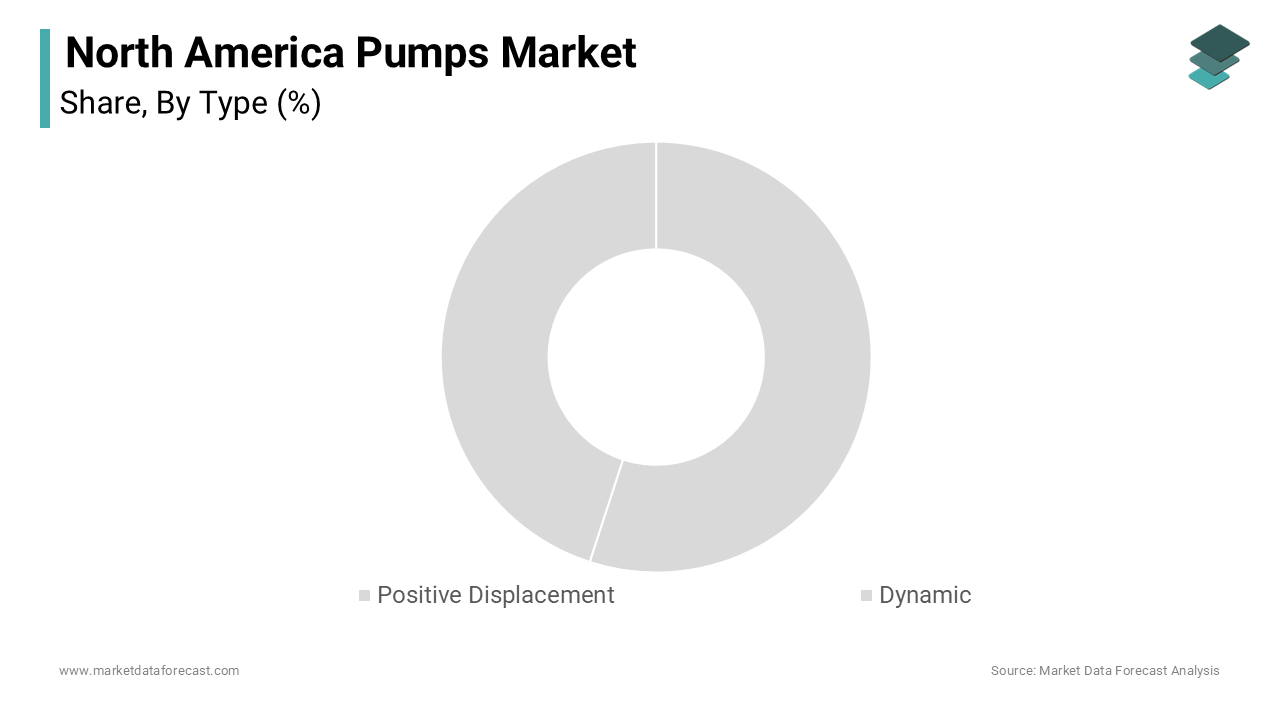
The dynamic pumps segment dominated the North America pumps market by holding 58.5% of the overall share in 2024. This dominance is primarily driven by Their widespread use across high-volume fluid transfer applications in industries such as water & wastewater, power generation, and oil & gas is primarily driving the dominance of dynamic pumps segment.
Extensive deployment of centrifugal pumps, classified under dynamic pumps, in municipal water supply systems is among the key factor contributing to this growth of segment. According to the U.S. Environmental Protection Agency (EPA), over 150,000 public water systems in the United States rely on centrifugal pumps for distribution, with nearly 85% of these systems serving communities with populations exceeding 10,000. These pumps are preferred due to their efficiency in handling large volumes of water at relatively low pressures.
Additionally, the power generation industry heavily depends on dynamic pump systems for cooling and condensate management. Their adaptability, ease of maintenance, and cost-effectiveness further solidify their position as the go-to solution for industrial fluid handling, reinforcing their dominance in the regional market.
The positive displacement pumps segment is emerging as the fastest-growing segment in the North America pumps market and is projected to expand at a CAGR of 6.4% from 2025 to 2033. The expanding pharmaceutical industry in North America, particularly in the U.S., which requires highly accurate dosing and transfer mechanisms, is one major driver of positive displacement pumps segment. This rapid growth is also attributed to increasing demand from niche but high-value sectors such as pharmaceuticals, food & beverage, and chemical processing where precision and consistency in fluid movement are critical. These pumps offer superior control over flow rates, making them indispensable in formulation processes. Simultaneously, the food & beverage sector has seen a surge in adoption of rotary lobe and gear pumps—subcategories of positive displacement pumps—for handling thick liquids like syrups, creams, and edible oils.
By End-User Insights
The oil & gas sector stands as the biggest end-user in the North America pumps market by capturing an estimated 27% of total revenue in 2024. This dominance stems from The essential role pumps play in upstream exploration, midstream transportation, and downstream refining operations across both the U.S. and Canada is driving the growth of the oil & gas sector.
In the U.S., as per the Energy Information Administration (EIA), crude oil production averaged 12.1 million barrels per day in 2023, necessitating extensive pumping infrastructure for extraction and pipeline transport. High-pressure reciprocating and centrifugal pumps are extensively deployed in hydraulic fracturing (fracking) operations, especially in shale-rich basins like Permian and Eagle Ford. Canada's oil sands industry further amplifies this segment’s strength. The steam-assisted gravity drainage (SAGD) method employed in these operations demands high-efficiency, corrosion-resistant pumps to inject steam underground.
The pharmaceutical industry is emerging as the fastest-growing end-user segment within the North America pumps market and is anticipated to grow at a CAGR of 6.8% through 2033. Heightened investment in biopharmaceutical R&D and stricter regulatory standards governing sterile fluid handling processes is fuelling the growth of pharmaceutical industry. Many of these facilities require diaphragm and peristaltic pumps—types of positive displacement pumps—to ensure contamination-free transfer of sensitive compounds. As the industry pivots toward personalized medicine and cell-based therapies, the demand for specialized, high-integrity pumping solutions is expected to escalate rapidly, propelling this segment’s growth in the coming years.
REGIONAL ANALYSIS
United States Pumps Market Insights
The United States held the dominant position in the North America pumps market by accounting for 68.5% of total regional revenue in 2024. Its expansive industrial base, aging water infrastructure, and booming energy sector collectively fuel sustained demand for diverse pump types.
Water infrastructure modernization remains a core driver. The American Society of Civil Engineers (ASCE) gave U.S. drinking water infrastructure a grade of D+ in its 2023 Report Card, highlighting urgent needs for upgrades. It estimates that $114 billion must be invested by 2030 to replace deteriorating pipelines and enhance pumping capacity across cities. Concurrently, the oil & gas boom—driven by shale production—has spurred demand for high-pressure pumps. EIA data shows U.S. crude oil output hit 12.1 million barrels per day in 2023, requiring continuous deployment of frac pumps and pipeline transfer systems.
Moreover, the U.S. pharmaceutical and semiconductor industries have emerged as strong adopters of precision pumping technology. FDA approvals and semiconductor manufacturing expansions under CHIPS Act funding have created a ripple effect across auxiliary equipment markets. These factors, combined with aggressive digital transformation initiatives in utilities and manufacturing, reinforce the U.S.’s commanding presence in the regional pumps landscape.
Canada Pumps Market Insights
Canada contributes notably to the North America pumps market and is positioning itself as key market in the region. The country’s heavy reliance on resource-based industries, particularly oil sands and mining, drives substantial demand for durable and high-capacity pumping systems.
As per Natural Resources Canada, oil sands accounted for 93% of the nation’s crude oil production in 2023, much of which utilizes steam injection techniques requiring high-efficiency, corrosion-resistant pumps. CAPP forecasts production to reach 4.4 million barrels per day by 2030, signaling continued investment in thermal recovery methods that depend on reliable pumping infrastructure.
Beyond oil, Canada’s mining industry also plays a pivotal role. The Mining Association of Canada recorded mineral extraction revenues of CAD 61 billion in 2023, with companies increasingly adopting submersible and slurry pumps to manage dewatering and ore processing. Furthermore, federal programs such as the Green Infrastructure Stream under the Investing in Canada Plan have allocated CAD 30 billion to upgrade municipal water treatment facilities, enhancing demand for centrifugal and variable-speed pump installations. These cross-sector developments solidify Canada’s significant contribution to the regional pumps market.
Rest of North America Pumps Market Insights
The remaining North American countries, including Mexico and select Caribbean economies, collectively hold notable share of the regional pumps market share. While smaller in scale, these markets are exhibiting steady growth driven by industrialization and infrastructural development initiatives.
Mexico, in particular, has become a focal point for pump manufacturers due to its growing automotive and food processing industries. Automotive assembly plants, concentrated in states like Guanajuato and Nuevo León, are deploying industrial coolant and lubricant circulation pumps at an accelerated pace.
Simultaneously, Mexico’s water infrastructure challenges mirror those of the U.S. and Canada. Meanwhile, in the Caribbean, nations such as Jamaica and Trinidad and Tobago are upgrading wastewater treatment plants with support from multilateral institutions like the Inter-American Development Bank (IDB). These efforts, though modest compared to larger neighbors, contribute to a gradual but notable expansion of the pumps market in the broader North American region.
KEY MARKET PLAYERS AND COMPETITIVE LANDSCAPE
Flowserve Corporation, Xylem Inc., Grundfos Holding A/S, ITT Inc., and KSB SE & Co. KGaA. Other prominent companies operating in the region are SPX FLOW, Inc., Ebara Corporation, Pentair plc, Weir Group PLC, Sulzer Ltd, and Franklin Electric Co., Inc.
The competition in the North America pumps market is marked by the presence of established global players and a growing number of regional manufacturers striving for technological differentiation and market expansion. The market is highly fragmented, with key players continuously innovating to maintain their dominance across diverse industrial sectors. Companies are increasingly focusing on developing energy-efficient, digitally integrated, and application-specific pump solutions to cater to evolving customer demands. Strategic acquisitions, partnerships, and localized service networks have become essential tools for securing long-term contracts and enhancing brand loyalty. Additionally, with increasing emphasis on sustainability and regulatory compliance, vendors are prioritizing product reliability, lifecycle efficiency, and environmental impact reduction. As industries across North America continue to modernize, competition is expected to intensify, with innovation and customer-centric service offerings playing decisive roles in market positioning.
Top Players in the North America Pumps Market Insights
Grundfos
Grundfos, a global leader in advanced pump solutions, plays a pivotal role in shaping the North America pumps market. The company is known for its innovation in energy-efficient and smart pumping technologies. With a strong presence across residential, commercial, and industrial sectors, Grundfos contributes significantly to sustainable water management and system optimization. Its focus on digital integration and lifecycle efficiency has positioned it as a trusted partner in both municipal and private infrastructure projects across the region.
Xylem Inc.
Xylem Inc. is a key player in the North American pumps landscape, recognized for its comprehensive portfolio of water technology solutions. The company delivers advanced pumping systems tailored for water treatment, wastewater management, and industrial applications. Xylem’s emphasis on smart infrastructure, data-driven analytics, and sustainability has made it a go-to provider for municipalities and industrial clients seeking reliable and future-ready pumping solutions. Its continuous investment in R&D and digital innovation further strengthens its market position.
Flowserve Corporation
Flowserve Corporation is a major contributor to the pumps market in North America, particularly in the oil & gas, power generation, and chemical processing sectors. The company is renowned for its high-performance industrial pumps and sealing technologies that ensure operational reliability and safety. Flowserve’s engineering expertise and commitment to delivering durable, precision-engineered pump systems have made it a preferred choice among heavy industries. Its ability to provide customized solutions for demanding environments reinforces its leadership in the regional market.
Top Strategies Used by Key Market Participants
One of the primary strategies employed by leading players in the North America pumps market is product innovation and digital integration. Companies are increasingly investing in smart pump technologies that offer remote monitoring, predictive maintenance, and energy optimization. This not only enhances operational efficiency but also aligns with broader industry trends toward automation and sustainability.
Another crucial strategy is strategic acquisitions and partnerships. Major players are acquiring smaller firms with niche capabilities or forming alliances to expand their technological reach and service offerings. These moves allow them to strengthen their foothold in specialized market segments and improve customer support networks across the region.
Lastly, expansion of service and support infrastructure is gaining prominence. Companies are focusing on localized after-sales services, training centers, and digital support platforms to ensure faster response times and better customer engagement. This strategy helps in building long-term client relationships and maintaining a competitive edge.
RECENT MARKET DEVELOPMENTS
- In February 2024, Grundfos announced the launch of a new line of smart circulator pumps equipped with real-time performance analytics, aimed at enhancing energy efficiency in commercial buildings across North America.
- In May 2024, Xylem introduced an advanced digital water management platform designed to optimize pump operations in municipal water systems, improving reliability and reducing maintenance costs.
- In July 2024, Flowserve expanded its industrial pump service center network in Texas to better support oil & gas clients with faster turnaround times and on-site technical assistance.
- In September 2024, Sulzer unveiled a new high-efficiency wastewater pump series tailored for North American municipal applications, emphasizing durability and reduced lifecycle costs.
- In November 2024, Pentair launched a sustainability-focused campaign promoting its eco-friendly pump solutions, targeting industrial and agricultural sectors aiming to reduce energy consumption and carbon footprints.
MARKET SEGMENTATION
This research report on the North America Pumps Market has been segmented and sub-segmented into the following categories.
By Type
- Positive Displacement
- Dynamic
By End-User
- Oil & Gas
- Water & Wastewater
- Power Generation
- Chemicals
- Pharmaceutical
- Food & Beverage
- Others
By Country
- U.S.
- Canada
- Rest of North America