- Product Description Description
- Table of Contents TOC
- List of Table & Figure LOT
- Get Free Sample PDF Sample PDF
Market Size, 2025
$428.61 MnMarket Estimate, 2026
$442.67 MnMarket Forecast, 2034
$573 MnCAGR, 2026–2034
3.28%North America Rainwater Harvesting Market Summary
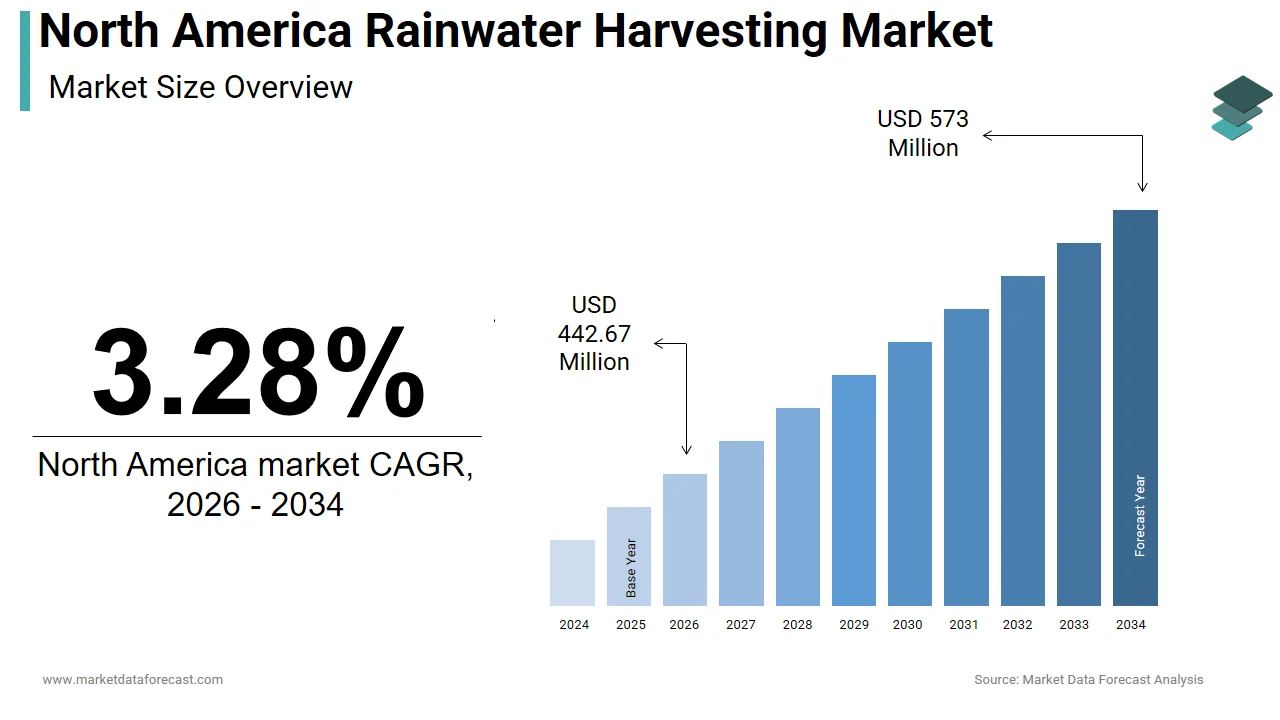
The North America rainwater harvesting market was valued at USD 428.61 million in 2025, is estimated to reach USD 442.67 million in 2026, and is projected to reach USD 573 million by 2034, growing at a CAGR of 3.28% from 2026 to 2034. Increasing water scarcity, favorable regulations, and integration with green infrastructure and smart technologies are key growth factors.
Key Market Trends & Insights
- United States was the top-performing country in 2024, capturing 89.1% of the regional share.
- Canada ranked second in 2024, with 11.2% market share.
- Based on harvesting method, the above-ground segment dominated the market in 2025.
- Based on end-user, the residential segment held the largest share in 2025.
- Underground systems and commercial users are expected to register notable growth during the forecast period.
Market Size & Forecast
- 2025 Market Size: USD 428.61 Million
- 2026 Estimated Market Size: USD 442.67 Million
- 2034 Projected Market Size: USD 573 Million
- CAGR (2026 to 2034): 3.28%
- United States: Largest market in 2025 (89.1% share)
- Canada: Second-largest market in 2025 (11.2% share)
North America Rainwater Harvesting Market Size
The North America rainwater harvesting market was valued at USD 428.61 million in 2025, is estimated to reach USD 442.67 million in 2026, and is projected to reach USD 573 million by 2034, growing at a CAGR of 3.28% from 2026 to 2034.
Rainwater harvesting in North America is the collection, storage, and utilization of precipitation for non-potable and, in select cases, portable applications, including landscape irrigation, toilet flushing, and industrial processes. The integration of rainwater systems into building codes and green certification standards reflects a paradigm shift toward decentralized water infrastructure. As of 2023, over 60% of U.S. states have established regulatory frameworks supporting rainwater harvesting, with Texas and California leading in policy maturity, according to the American Rainwater Catchment Systems Association (ARCSA). According to the U.S. Environmental Protection Agency, a typical household can save up to 40% of its potable water demand through rainwater reuse for irrigation and laundry, particularly in suburban and semi-arid regions.
MARKET DRIVERS
Escalating Water Scarcity in Arid and Semi-Arid Regions
The intensifying water scarcity in arid and semi-arid regions is fuelling the growth of the North America rainwater harvesting market. Climate change has significantly altered precipitation patterns, reducing natural recharge of aquifers and diminishing surface water availability. The situation is mirrored in California, where prolonged droughts have led to a 30% reduction in Sierra Nevada snowpack over the past two decades, as reported by the California Department of Water Resources. In response, states are incentivizing decentralized water solutions: Texas, for instance, offers property tax exemptions for rainwater harvesting systems under its Water Code, leading to a 22% increase in residential installations between 2020 and 2023, as documented by the Texas Water Development Board. Municipalities like Tucson have gone further, mandating rainwater harvesting for new commercial developments exceeding 5,000 square feet. These regulatory and environmental pressures are compelling homeowners, agricultural operators, and industrial facilities to adopt rainwater capture as a buffer against supply uncertainty.
Integration with Green Building and Sustainable Urban Development Initiatives
The integration of rainwater harvesting into green building standards and sustainable urban planning is additionally accelerating the growth of the North America rainwater harvesting market. According to the U.S. Green Building Council’s Leadership in Energy and Environmental Design (LEED) certification system awards points for on-site water reuse, including rainwater capture for irrigation and non-potable indoor use, directly influencing architectural design decisions. As of 2023, over 105,000 commercial projects in the U.S. have achieved LEED certification, with water efficiency contributing significantly to scoring, according to the U.S. Green Building Council. Municipal zoning reforms are further accelerating adoption: New York City’s 2022 Climate Mobilization Act mandates stormwater retention for large developments, which is prompting widespread installation of cisterns and rooftop collection systems.
MARKET RESTRAINTS
High Initial Installation and Maintenance Costs
The substantial upfront capital investment required for installation and long-term maintenance is restraining the growth of the North America rainwater harvesting market. Comprehensive residential systems, including gutters, filtration units, storage tanks, and pumps, can cost between $8,000 and $15,000, depending on capacity and technology, according to the American Society of Civil Engineers. These expenses deter cost-sensitive homeowners and small businesses, especially in regions without robust financial incentives. Additionally, ongoing maintenance, including periodic cleaning of tanks, replacement of filters, and inspection of first-flush diverters, adds recurring expenses averaging $300–$600 annually, according to a 2022 study by the Water Research Foundation. In colder climates, such as northern U.S. states and most of Canada, systems require winterization to prevent freezing, increasing operational complexity and cost. The lack of standardized installation practices further inflates labor expenses, with certified contractors charging up to 40% more than general plumbers, as reported by the Plumbing-Heating-Cooling Contractors Association. These financial and logistical burdens limit scalability in low- and middle-income communities, where water affordability remains a concern despite growing environmental awareness.
Fragmented Regulatory Framework and Lack of Uniform Standards
The absence of a cohesive, continent-wide regulatory framework for rainwater harvesting significantly impedes the growth of the North America rainwater harvesting market. Regulations vary drastically between U.S. states, Canadian provinces, and even municipalities, which is creating confusion for homeowners, developers, and manufacturers. This patchwork of rules complicates system design, increases compliance costs, and discourages national manufacturers from scaling production. Ontario permits rainwater use for irrigation and toilet flushing under the Ontario Building Code, but Quebec imposes stringent permitting requirements that deter adoption. As per the National Research Council of Canada, only 12% of municipalities have clear guidelines for integrating rainwater systems into new construction. Moreover, the lack of harmonized water quality standards for non-potable reuse creates liability concerns for property managers and insurers.
MARKET OPPORTUNITIES
Expansion of Municipal Stormwater Management Programs
The municipal stormwater management initiatives in aging urban centers grappling with combined sewer overflows and flooding is ascribed to promote new opportunities for the growth of the North America rainwater harvesting market. The U.S. Environmental Protection Agency estimates that over 700 municipalities operate combined sewer systems, serving approximately 40 million people, and experience more than 75,000 overflows annually, discharging untreated wastewater into rivers and lakes. Philadelphia’s Green City, Clean Waters program, launched in 2011, has invested over $2.4 billion in decentralized solutions, including rain barrels and underground storage by reducing stormwater runoff by 1.5 billion gallons annually, as reported by the Philadelphia Water Department. Similarly, Toronto’s TransformTO climate strategy includes a target to capture 80% of rainfall on 30% of impervious surfaces by 2050, driving demand for large-scale harvesting in public and private developments.
Advancements in Smart Water Technologies and IoT Integration
The integration of smart water technologies and Internet of Things (IoT) platforms is boosting unprecedented efficiency, and user engagement is also propelling the growth of the North America rainwater harvesting market. Modern systems now incorporate real-time monitoring, automated filtration, and predictive analytics to optimize water use based on weather forecasts, demand patterns, and tank levels. Companies such as Rainwater HOG and SmartRain offer IoT-enabled controllers that integrate with home automation systems, allowing users to remotely manage irrigation schedules and detect leaks. Municipal pilots are also emerging: the City of San Diego’s Smart Water Network has deployed sensor-equipped cisterns in public parks, achieving a 42% decrease in potable water use for landscaping.
MARKET CHALLENGES
Public Perception and Lack of Awareness Regarding System Efficacy
The public skepticism and limited awareness about the efficacy and safety of rainwater harvesting systems remain a persistent challenge for the growth of the North America rainwater harvesting market. A 2022 survey conducted by the Water Quality Association revealed that 62% of U.S. respondents believed rainwater was unsafe for any household use, even after treatment, while 45% were unaware that properly filtered rainwater could legally be used for toilet flushing or laundry in their jurisdiction. This perception gap is particularly pronounced in urban and suburban populations, where reliance on centralized water utilities has diminished familiarity with decentralized alternatives. Educational outreach remains fragmented: only 18 U.S. states include rainwater harvesting in K–12 environmental curricula, as reported by the North American Association for Environmental Education. Moreover, media coverage often focuses on extreme cases of system failure or contamination, reinforcing negative stereotypes. In Canada, a 2021 study by the University of British Columbia found that 70% of homeowners in Vancouver were unaware of municipal rebates for rainwater systems, despite active programs.
Climate Variability and Unpredictable Precipitation Patterns
The increasing volatility of precipitation due to climate change is solely challenging the growth of the North America rainwater harvesting market. According to the National Oceanic and Atmospheric Administration, the frequency of extreme precipitation events in the U.S. has increased by 55% since the 1950s, with the Northeast seeing a 58% rise and the Southwest enduring a 30% decline in annual rainfall over the past two decades. This imbalance undermines the predictability of rainwater yield: a cistern sized for historical averages may remain underfilled during dry years or overwhelmed during deluges, leading to overflow and wasted potential. Agricultural users in Texas, who increasingly rely on rainwater for crop irrigation, reported a 40% inconsistency in annual harvest yields between 2018 and 2022 due to rainfall unpredictability, according to the Texas A&M AgriLife Extension Service.
REPORT COVERAGE
| REPORT METRIC | DETAILS |
| Market Size Available | 2025 to 2034 |
| Base Year | 2025 |
| Forecast Period | 2026 to 2034 |
| Segments Covered | By Harvesting Method, End-User, and Region. |
| Various Analyses Covered | Global, Regional and Country-Level Analysis, Segment-Level Analysis, Drivers, Restraints, Opportunities, Challenges; PESTLE Analysis; Porter’s Five Forces Analysis, Competitive Landscape, Analyst Overview of Investment Opportunities |
| Countries Covered | United States, Canada, Mexico, Rest of North America |
| Market Leaders Profiled | Kingspan Group, Watts Water Technologies, Inc., Graf Group, WISY AG, Innovative Water Solutions LLC, D&D Ecotech Services, Rain Harvesting Supplies, Inc., Water Field Technologies Pvt. Ltd, Stormsaver, Climate Inc, Water Harvesters, and Heritage Tanks. |
SEGMENTAL ANALYSIS
By Harvesting Method Insights
The above-ground rainwater segment was the largest and held a dominant share of the North America rainwater harvesting market in 2025, with its accessibility, ease of installation, and lower labor intensity compared to underground alternatives. According to the U.S. Census Bureau’s 2022 Housing Vacancy Survey, over 82 million single-family homes exist in the United States, a vast majority of which feature sloped roofs and gutter systems ideal for above-ground collection. These systems typically cost 30–50% less than underground installations due to the absence of excavation and concrete lining, as noted by the National Association of Home Builders. Municipal programs such as Austin’s Rainwater Harvesting Rebate initiative have further accelerated adoption, with over 7,500 above-ground systems installed under the program since 2010, according to the City of Austin Watershed Protection Department.
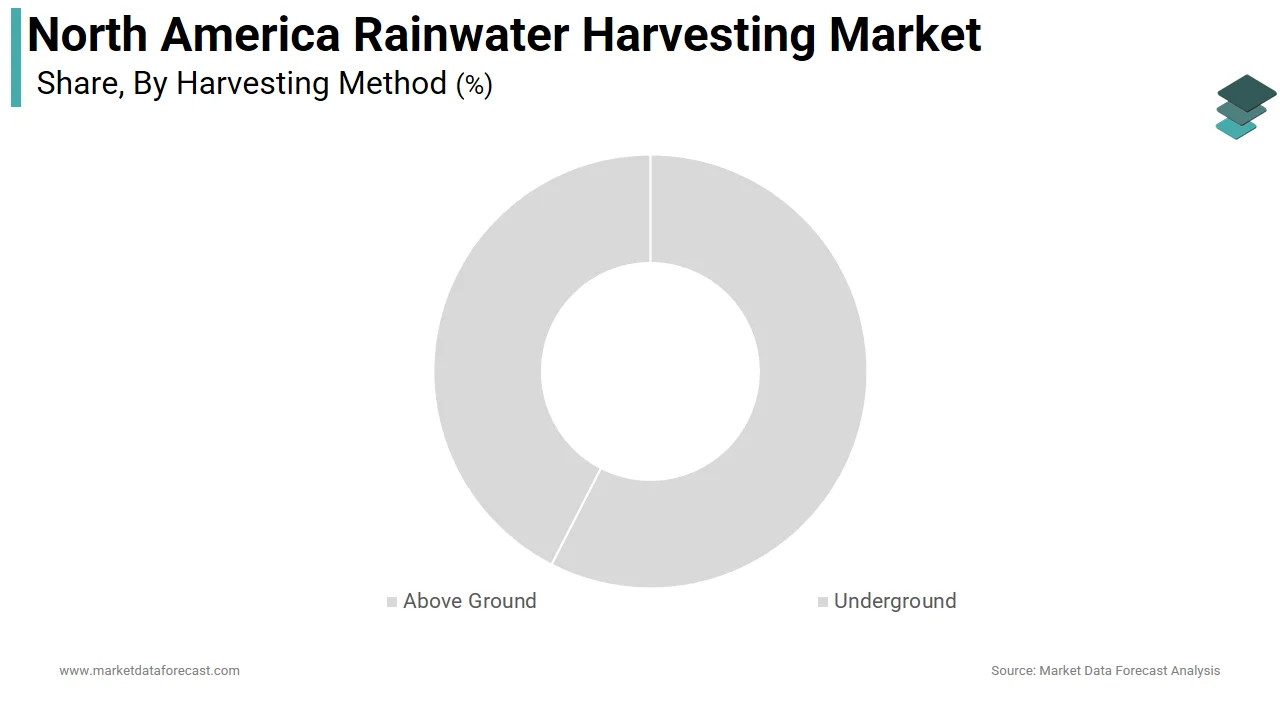
The underground segment is expected to grow with an expected CAGR of 9.4% from 2026 to 2034 due to its integration into large-scale urban and commercial developments where space efficiency and aesthetic integration are paramount. In cities like New York and Toronto, zoning regulations increasingly require stormwater retention on-site, prompting developers to embed large cisterns beneath buildings. The Hudson Yards redevelopment in Manhattan, for example, includes a 50,000-gallon underground storage system that supplies 100% of its landscape irrigation needs, as documented by the New York City Department of Environmental Protection. Moreover, these systems are less vulnerable to freezing in northern climates when properly insulated, expanding their viability across Canada and the northern U.S.
By End-User Insights
The residential sector was the largest and held 54.3% of the North American rainwater harvesting market share in 2024, with the widespread deployment of decentralized systems in single-family homes, particularly in water-stressed regions and off-grid communities. According to the U.S. Drought Monitor, as of 2023, over 40% of the contiguous United States experienced moderate to severe drought conditions, with states like California and Texas implementing rotational outdoor watering bans. State-level incentives further catalyze adoption: Texas offers a property tax exemption for rainwater harvesting equipment, leading to a 27% year-over-year increase in residential installations between 2021 and 2023, according to the Texas Water Development Board. The modularity and scalability of residential systems allow incremental investment, which is making them accessible to a broad demographic. Coupled with increasing homeowner awareness of water security, the residential segment remains the backbone of market volume.
The commercial segment is likely to grow with a CAGR of 8.7% from 2026 to 2034, with the stringent sustainability mandates and the economic advantages of water reuse in large-scale facilities. Commercial buildings, including offices, shopping centers, and educational institutions, consume vast quantities of water for cooling, landscaping, and sanitation. As of 2023, over 40% of new commercial constructions in major U.S. cities pursued LEED certification, with water efficiency contributing directly to point accumulation, as reported by the U.S. Green Building Council. The Salesforce Tower in San Francisco, for instance, captures and treats 30,000 gallons of rainwater and greywater daily, reducing its potable water demand by 70%, according to the San Francisco Public Utilities Commission. Municipal policies are also accelerating adoption: Toronto’s Green Standard requires new large developments to meet 50% of non-potable water needs through alternative sources, including rainwater.
COUNTRY-LEVEL ANALYSIS
United States Rainwater Harvesting Market Insights
The United States was the top performer of the North American rainwater harvesting market by capturing 89.1% of the share in 2024 due to its vast geographic diversity, regulatory maturity, and proactive state-level water management strategies. Chronic water stress in the Southwest has catalyzed systemic adoption, with the Colorado River Basin supplying water to 40 million people, which is facing a structural deficit due to over-allocation and climate change. Urban centers are also driving innovation. Philadelphia’s Green City, Clean Waters program has diverted over 1.5 billion gallons of stormwater annually using decentralized capture, as documented by the Philadelphia Water Department. Additionally, federal agencies such as the Department of Defense have mandated water resilience on military bases, with over 200 installations incorporating rainwater systems since 2018, as per the Defense Logistics Agency Energy.
Canada Rainwater Harvesting Market Insights
Canada rainwater harvesting market was positioned second with 11.2% of the share in 2024. British Columbia leads the country in policy innovation, with the province’s 2016 Water Sustainability Act explicitly recognizing rainwater as a legitimate water source by enabling its use for non-potable applications without requiring a license. Metro Vancouver’s Rainwise program has supported over 1,200 residential and commercial installations since 2015, reducing stormwater runoff by 35% in targeted watersheds, according to the Greater Vancouver Regional District. Indigenous communities in the Northwest Territories, such as Tuktoyaktuk, are piloting rainwater and meltwater harvesting to reduce reliance on diesel-powered desalination, as reported by Indigenous Services Canada. Moreover, green building standards are gaining traction—Ontario’s Building Code now permits rainwater use for toilet flushing in new constructions exceeding 400 square meters, a provision expected to influence over 1,500 commercial projects annually, according to the Ontario Ministry of Municipal Affairs and Housing.
COMPETITIVE LANDSCAPE
The competitive landscape of the North America rainwater harvesting market is characterized by a blend of specialized niche players and established infrastructure solution providers, each vying to shape the future of decentralized water management. While no single company dominates the entire value chain, differentiation occurs through technological innovation, design aesthetics, and integration capabilities. Smaller firms often lead in product creativity and sustainability, introducing modular, eco-conscious storage solutions tailored for urban settings, while larger companies leverage distribution networks and engineering expertise to serve commercial and municipal projects. Competition is less about price and more about performance, reliability, ease of installation, and compliance with evolving regulatory and environmental standards. Brand reputation and alignment with green building certifications play a crucial role in influencing specifier decisions. Companies are increasingly positioning themselves not just as equipment suppliers but as knowledge partners, offering design support, training, and system integration services.
KEY MARKET PLAYERS
Noteworthy Companies dominating the North America rainwater harvesting market profiled in the report are
- Kingspan Group
- Watts Water Technologies, Inc.
- Graf Group
- WISY AG
- Innovative Water Solutions LLC
- D&D Ecotech Services
- Rain Harvesting Supplies, Inc.
- Water Field Technologies Pvt. Ltd
- Stormsaver
- Climate Inc
- Water Harvesters
- Heritage Tanks
TOP LEADING PLAYERS IN THE MARKET
- Rainwater HOG is a pioneering brand in the design and distribution of modular, low-profile rainwater storage systems tailored for urban and residential environments. The company has redefined aesthetic integration by developing collapsible, wall-mounted tanks made from recycled materials, enabling discreet installation in spaces where traditional barrels or cisterns are impractical. Their focus on sustainable manufacturing and user-friendly design has positioned them as a preferred choice for green architects and environmentally conscious homeowners.
- NDS, Inc. is a leading innovator in sustainable site solutions by offering a comprehensive portfolio of rainwater harvesting, stormwater management, and landscape water conservation products. The company integrates engineering precision with ecological design, delivering systems that serve both functional and regulatory needs in residential, commercial, and municipal applications. Known for its AquaBlox storage chambers and EZ-Flow leaching systems, NDS emphasizes durability, scalability, and ease of installation. Their collaboration with landscape architects, civil engineers, and government agencies has enabled widespread adoption in infrastructure projects.
- Grotop Products Ltd. specializes in high-performance rainwater filtration and conveyance systems, serving as an enabler of safe and efficient water reuse. The company’s expertise lies in first-flush diverters, roof washers, and sediment traps that ensure harvested water meets quality standards for non-potable applications. By focusing on the pre-treatment phase, Grotop addresses a fundamental challenge in system reliability and public confidence. Their products are widely specified in off-grid homes, agricultural operations, and commercial buildings where water purity is essential. Grotop’s engineering-driven approach and commitment to innovation have made it a behind-the-scenes force in system performance, supporting broader market growth by enhancing functionality and long-term viability across diverse climatic and usage conditions.
TOP STRATEGIES USED BY KEY MARKET PARTICIPANTS
One major strategy employed by leading companies is product innovation focused on space efficiency and aesthetic integration. Recognizing the constraints of urban environments, firms are designing modular, low-profile, and architecturally compatible systems that blend into residential and commercial spaces without compromising functionality. These advancements appeal to developers and homeowners seeking sustainable solutions that do not disrupt design integrity.
Another prevalent strategy is strategic collaboration with green building certification programs and municipal sustainability initiatives. Companies are aligning their offerings with LEED, WELL, and Living Building Challenge standards, enabling specifiers to earn credits while promoting their products as essential components of high-performance buildings. This alignment enhances credibility and drives adoption in regulated and environmentally driven markets.
RECENT MARKET DEVELOPMENTS
- In March 2023, Rainwater HOG launched a new line of recycled polymer-based modular tanks designed for urban rooftops by enhancing integration with architectural aesthetics and expanding its appeal in high-density residential developments.
- In July 2023, NDS, Inc. partnered with the U.S. Green Building Council to develop training modules on stormwater and rainwater system design for LEED professionals, which strengthens its influence in sustainable construction specifications.
- In November 2023, Grotop Products Ltd. introduced an advanced first-flush diverter with automated sensors and remote monitoring capabilities by improving water quality assurance and system efficiency for off-grid and commercial users.
- In January 2024, NDS, Inc. expanded its manufacturing facility in Southern California to increase production capacity for stormwater and rainwater management systems, which is supporting growing demand in drought-prone regions.
- In May 2024, Rainwater HOG collaborated with a major Canadian homebuilder to integrate its storage units into a net-zero community project in British Columbia by marking a strategic entry into large-scale sustainable housing developments.
MARKET SEGMENTATION
This North America rainwater harvesting market research report is segmented and sub-segmented into the following categories.
By Harvesting Method
- Above Ground
- Underground
By End-User
- Commercial
- Residential
- Industrial
By Country
- United States
- Canada
- Mexico
- Rest of North America