- Product Description Description
- Table of Contents TOC
- List of Table & Figure LOT
- Get Free Sample PDF Sample PDF
Market Size, 2025
$3,555.00 MnMarket Estimate, 2026
$3,771.86 MnMarket Forecast, 2034
$6,057.29 MnCAGR, 2026–2034
6.10%Executive Summary: North America Resistant Starch Market
- Market Scope: Comprehensive analysis of the North America resistant starch market covering sources, variations, functional types, application segments, regional country dynamics, growth drivers, and competitive landscapes.
- Market Valuation: Valued at USD 3,555 million (2025), estimated at USD 3,771.86 million (2026), and projected to reach USD 6,057.29 million by 2034, registering a robust CAGR of 6.10% during the forecast period (2026–2034).
- Primary Growth Drivers: Rising incidence of chronic health problems (such as diabetes and digestive disorders), increasing consumer health and wellness awareness regarding dietary fiber benefits, and surging demand for functional foods like cereal bars and fortified baked goods.
Key Market Segment Metrics (2026–2034)
| Category | Leading Segment (2025 Position) | Fastest-Growing Segment |
|---|---|---|
| By Source | Grains (dominant source including corn, wheat, rice, and oats used widely in commercial food processing) | Vegetables & Fruits (driven by consumer demand for plant-based, clean-label, and specialty fiber sources) |
| By Application | Bakery Products & Breakfast Cereals (captures the largest share due to high daily consumption and functional fiber fortification) | Snacks & Dairy Products (expanding rapidly through health-conscious product innovations and sports nutrition) |
| By Type | Resistant Starch Type 2 & Type 3 (widely utilized commercially for thermal stability and digestive health benefits) | Chemically Modified & Novel Types (Type 4 and Type 5, growing via advanced functional food formulations) |
| By Region / Country | United States (leads the global and regional market share, backed by high health awareness and massive food processing sectors) | Canada & Mexico (experiencing steady growth driven by rising disposable incomes and demand for preventive healthcare foods) |
Major Market Players & Market Structure
Market Structure: Moderately consolidated and highly competitive ingredient-manufacturing landscape featuring multinational food science corporations and specialty starch producers competing on purity, functional efficacy, proprietary extraction methods, and clean-label certifications.
Key Companies: Ingredion Incorporated, Opta Food Ingredients, Inc., National Starch and Chemical Co., Cerestar Inc., MGP Ingredients, Cargill Foods, Penford Corporation, Tate & Lyle PLC, Arcadia Biosciences, Stawi Foods and Fruits Limited, and others.
 Download Free Sample Report
North America Resistant Starch Market
The North America Resistant Starch market was valued at USD 3,555 million in 2025, is estimated to reach USD 3,771.86 million in 2026, and is projected to reach USD 6,057.29 million by 2034, growing at a CAGR of 6.10% from 2026 to 2034.

The resistant starch is a dietary carbohydrates that resists digestion in the small intestine and undergoes fermentation in the large colon. This functional ingredient serves as a prebiotic fiber supporting gut microbiota health, while modulating postprandial glucose responses. The commercial production and incorporation of Types 2 through 4 resistant starch into food formulations, beverages, and supplements across the United States and Canada. Consumer awareness regarding metabolic health drives the classification of these ingredients beyond mere fillers to active nutritional components. The widespread metabolic dysfunction creates a foundational demand for glycemic control solutions within the region. These physiological realities position resistant starch not merely as a niche additive but as a critical tool in preventive nutrition strategies adopted by manufacturers targeting the broad population affected by insulin resistance and digestive irregularities.
MARKET DRIVERS
Rising Prevalence of Metabolic Disorders Drives Ingredient Adoption
The escalating burden of type 2 diabetes and obesity is greatly influencing the growth of the North America resistant starch market. Manufacturers increasingly formulate products with this ingredient to meet regulatory pressures and consumer demands for healthier alternatives. According to the American Diabetes Association, more than 38 million people in the United States have diabetes, representing over 11% of the total population. This vast demographic enecessitates dietary interventions that stabilize blood sugar levels without relying solely on pharmaceuticals. Resistant starch effectively lowers the glycemic index of foods, making it an ideal component for bread, pasta, and snack items consumed by these individuals. Food companies leverage these statistics to justify product reformulations that appeal to health conscious consumers seeking natural management tools for chronic conditions. The alignment between clinical needs and industrial capabilities ensures sustained volume growth for suppliers who can demonstrate efficacy in reducing post meal glucose spikes.
Surge in Demand for Gut Health Oriented Functional Foods
The consumer interest in gastrointestinal wellness has shifted focus toward prebiotics that support microbial diversity rather than just adding bulk is propelling the growth of the North America resistant starch market. Resistant starch functions as a selective substrate for beneficial bacteria such as Bifidobacteria and Lactobacilli, promoting short chain fatty acid production. According to the World Gastroenterology Organisation, irritable bowel syndrome affects approximately 11% of the global population, with North American incidence rates reflecting similar trends due to dietary habits. This high prevalence creates a substantial market for therapeutic foods that alleviate bloating and improve regularity without harsh laxatives. This scientific consensus empowers brands to market resistant starch enriched products as essential for maintaining a resilient gut ecosystem. Retailers now dedicate shelf space to items labeled with specific prebiotic benefits, driving sales velocity for innovative formulations. The correlation between poor gut health and systemic inflammation motivates consumers to adopt preventative measures through diet. Brands capitalize on this narrative by embedding resistant starch into everyday staples like cereals and protein bars. Such strategic positioning transforms a specialized ingredient into a mass market commodity. The resulting increase in household consumption patterns validates long term investment in supply chain infrastructure dedicated to sourcing and processing native and modified starches suitable for human ingestion.
MARKET RESTRAINTS
Technical Limitations in Texture and Sensory Profile Integration
The incorporating resistant starch often compromises the organoleptic properties of final food products is acting as a barrier for the growth of the North America resistant starch market. High concentrations can lead to gritty textures or altered mouthfeel that alienate average consumers accustomed to traditional refined grains. According to the study, sensory rejection remains the primary reason for failure in new functional food launches, with texture accounting for over 40% of negative feedback in bakery applications. This technical hurdle forces formulators to balance efficacy against palatability, often limiting inclusion rates below therapeutic thresholds. Moreover, studies featured in the Journal of Cereal Science reveal that Type 2 resistant starch derived from raw potatoes retains crystalline structures that resist gelatinization during baking, resulting in dense crumb issues in bread loaves. Manufacturers must invest heavily in enzymatic modification technologies to mitigate these effects, increasing production costs significantly. Smaller enterprises lack the capital to develop proprietary processing methods, restricting market entry to established giants. The disconnect between nutritional intent and eating experience persists despite technological advancements. Consumers perceive healthy foods as inferior in taste, leading to lower repeat purchase rates unless the flavor profile is indistinguishable from conventional options.
Regulatory Ambiguity Regarding Health Claim Substantiation
The uncertainty surrounding permissible labeling claims are also declining the growth of the North America resistant starch market. Regulatory bodies require rigorous clinical evidence before approving statements linking the ingredient to disease risk reduction. Only qualified health claims are currently authorized for fibers regarding coronary heart disease, leaving many other benefits unsubstantiated for direct advertising. This legal framework prevents companies from explicitly stating that their products aid in weight management or glucose control, diluting the value proposition. Furthermore, the nutrient content claims for high in fiber do not automatically confer prebiotic status, requiring separate validation for gut health assertions. Brands face inconsistent interpretations across state and federal jurisdictions, complicating national distribution strategies. Marketing teams must navigate complex compliance landscapes, often resorting to vague terminology that fails to resonate with informed shoppers. The absence of standardized definitions for resistant starch in labeling regulations allows competitors to use varying forms with differing efficacies under identical descriptors. This confusion erodes consumer trust and diminishes brand loyalty. Without clear regulatory pathways for substantiating emerging benefits like immune modulation, investment in R&D yields uncertain returns.
MARKET OPPORTUNITIES
Expansion into Plant Based Meat Analogues
The rapid growth of alternative proteins for resistant starch application, as both binder and fiber fortifier is solely creating new opportunities for the growth of the North America resistant starch market. Plant based burgers and sausages often lack sufficient dietary fiber compared to their animal counterparts by creating a nutritional gap. It enhances satiety and improves the textural matrix without altering the savory flavor profile significantly. Moreover, flexitarians actively seek higher fiber content in their plant-based purchases. This demand aligns perfectly with the functional properties of Type 4 resistant starch, which withstands high heat processing typical in extrusion cooking. Suppliers can differentiate their offerings by providing customized particle sizes optimized for specific extruder configurations. Strategic partnerships between starch producers and alt protein startups accelerate innovation cycles. By positioning resistant starch as a key enabler of clean label plant based nutrition, vendors tap into a sector expanding faster than traditional dairy or meat replacements.
Development of Personalized Nutrition Platforms
The advancements in microbiome sequencing enable precise customization of resistant starch types tailored to individual gut flora profiles. The development of personalized nutrition platforms is another factor to bolster the expansion of the North America resistant starch market. Tech driven nutrition firms utilize this data to prescribe specific ratios of Type 2 and Type 3 resistant starches. Such precision increases adherence and perceived efficacy, allowing premium pricing models. Furthermore, insights from the Human Microbiome Project suggest that interindividual variability in starch digestion is influenced by genetic polymorphisms affecting amylase activity. Understanding these biological nuances helps manufacturers design blends that maximize benefit for distinct genetic cohorts. Digital platforms integrate real time glucose monitoring with dietary logs, validating the impact of resistant starch consumption. This feedback loop builds strong consumer engagement and retention. Brands leveraging this technology can offer subscription services delivering monthly custom formulated powders or snacks. The intersection of biotechnology and food science opens new intellectual property avenues for process patents related to strain specific fermentation optimization.
MARKET CHALLENGES
Volatility in Raw Material Supply Chains
The dependence on agricultural commodities exposes the industry to price shocks caused by climate anomalies and geopolitical tensions. The volatility in raw material supply chains is major factor to limit the growth of the North America resistant starch market in coming years. Native potato and maize crops serve as primary sources for Type 2 resistant starch, subject to seasonal yield variations. This scarcity drives up input costs unpredictably, squeezing margins for mid-tier processors. Moreover, export restrictions imposed by major producing nations disrupt global availability of waxy maize varieties essential for high purity extraction. Companies struggle to maintain consistent quality standards when switching between domestic and international suppliers. Inventory holding costs rise as firms attempt to buffer against shortages. Long term contracts become difficult to negotiate due to fluctuating spot prices. This instability hampers planning for capacity expansions and new product launches. Smaller entities often exit the market unable to absorb sudden cost increases passed down from upstream farmers. The lack of diversified feedstock options limits resilience against systemic agricultural risks. Transitioning to alternative sources like legumes requires revalidation processes that delay time to market.
Competition from Alternative Soluble Fibers
The other prebiotic ingredients are offering comparable benefits with established supply chains that is additional factor to decline the growth of the North America resistant starch market. These substitutes often possess superior solubility and neutral taste profiles, making them easier to incorporate into beverages. Resistant starch faces challenges in dissolving uniformly, sometimes causing sedimentation issues in ready to drink products. Furthermore, market analysis from Mintel reveals that 45% of new product launches featuring gut health claims utilized chicory root fiber instead of resistant starch. Brand owners prefer familiar ingredients with extensive safety dossiers and lower allergenic potential concerns. Price competitiveness also favors large scale inulin producers who benefit from economies of scope in agave cultivation. Differentiating resistant starch requires emphasizing its unique colonic fermentation end products like butyrate, which some competitors produce less efficiently. However, consumer education gaps persist, leading to preference for known quantities. Overcoming entrenched supplier relationships demands aggressive marketing and proof of superior clinical outcomes.
REPORT COVERAGE
| REPORT METRIC | DETAILS |
| Market Size Available | 2025 to 2034 |
| Base Year | 2025 |
| Forecast Period | 2026 to 2034 |
| CAGR | 6.10% |
| Segments Covered | By Source, Application Type, and Region |
| Various Analyses Covered | Regional & Country Level Analysis, Segment-Level Analysis, DROC, PESTLE Analysis, Porter’s Five Forces Analysis, Competitive Landscape, Analyst Overview on Investment Opportunities |
| Regions Covered | The United States, Canada, Mexico, and Rest of North America |
| Market Leaders Profiled | Ingredion Incorporated, Opta Food Ingredients, Inc., Natl. Starch and Chemical Co., Cerestar Inc., MGP Ingredients, Cargill Foods, Penford Corporation, Tate & Lyle Plc, Arcadia Biosciences, Stawi Foods, and Fruits Limited |
SEGMENTAL ANALYSIS
By Source Insights
The grains segment was the largest by holding 46.1% of the North America Resistant Starch Market share in 2025 due to their abundant availability and established processing infrastructure. Corn stands as the primary feedstock because of its high amylose content potential when genetically modified or processed specifically. The sheer volume of corn production in the United States ensures a stable supply chain that other sources cannot match economically. This massive output provides manufacturers with low cost raw materials essential for scaling resistant starch production without prohibitive price hikes. This specialization reduces competition from food grade markets and secures consistent quality parameters required for Type 4 resistant starch synthesis. The existing ethanol and sweetener industries also create synergies where residual streams can be valorized into functional fibers. Manufacturers leverage these integrated biorefineries to minimize waste and maximize yield efficiency. Consequently, the grain segment maintains its leadership position through superior economics and logistical advantages inherent to North American agriculture.
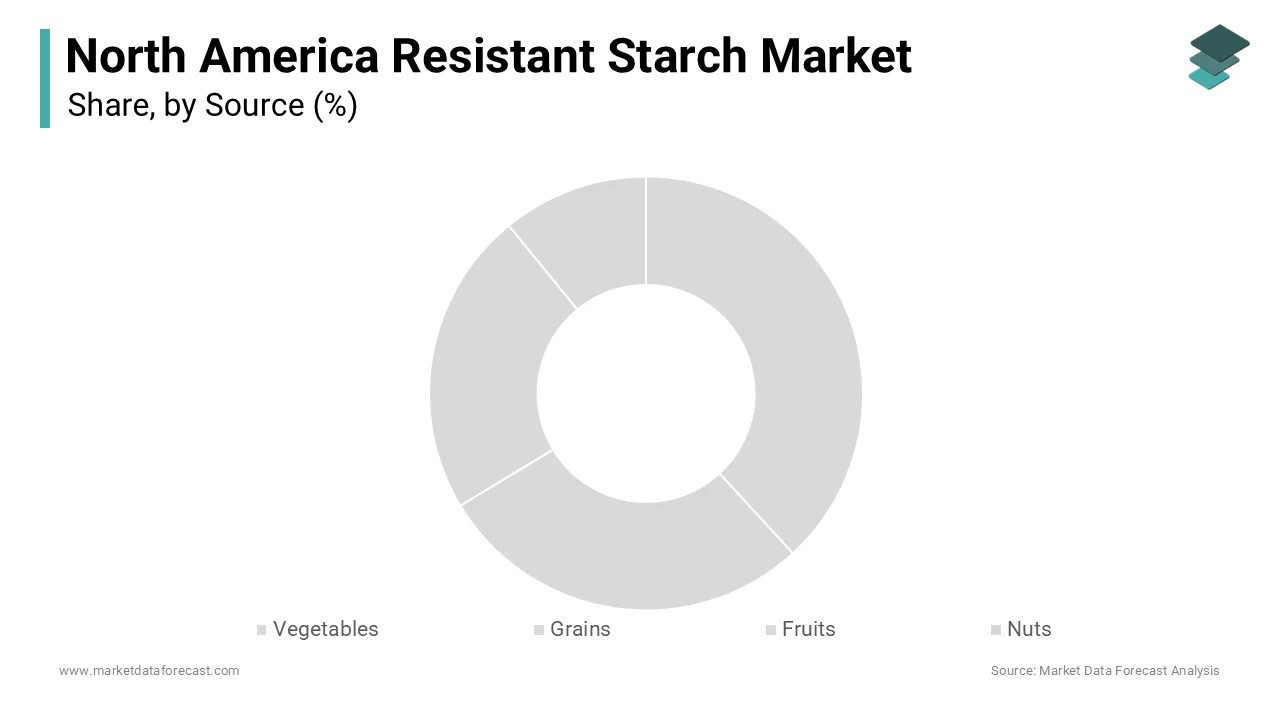
The vegetables segment is projected to grow at a fastest of 7.8% during the forecast period owing to the rising consumer preference for clean label ingredients derived from recognizable whole foods rather than chemically modified starches. Potato and green banana flour serve as key vegetable-based sources by gaining traction among health conscious buyers. This trend directly supports the adoption of vegetable sourced resistant starches which are perceived as more wholesome and less processed. Moreover, research published in the Journal of Agricultural and Food Chemistry demonstrates that potato derived resistant starch exhibits higher thermal stability during baking compared to corn variants. This technical advantage allows formulators to include higher concentrations without compromising product integrity. Brands increasingly market these ingredients as non GMO and allergen free appealing to sensitive demographics. The versatility of vegetable flours in gluten free formulations further boosts their appeal in specialized dietary niches. As consumers scrutinize ingredient lists more closely the transparency offered by vegetable sources drives rapid market expansion. Investment in processing technologies for extracting pure starch from tubers and fruits continues to rise facilitating faster growth rates than traditional grain methods.
By Application Insights
The bakery products segment was accounted in holding a significant share of the North America Resistant Starch Market in 2025 with the universal consumption of bread and pastries. Incorporating resistant starch into dough systems enhances nutritional value without drastically altering flavor profiles. This enormous volume creates significant demand for functional ingredients that can be easily integrated into standard recipes. Bakeries respond by adding resistant starch to boost fiber content while maintaining texture expectations. The heat stability of Type 4 resistant starch ensures survival during baking processes providing measurable health benefits. Retailers prioritize these enhanced products to meet evolving consumer health standards and labeling regulations. Strategic partnerships between starch suppliers and millers facilitate widespread adoption across commercial bakeries.
The beverages segment is anticipated to witness a fastest CAGR of 8.2% from 2026 to 2034. Innovation in liquid formats allows for seamless integration of resistant starch into ready to drink products. Advances in microencapsulation technology prevent sedimentation and ensure uniform dispersion in aqueous solutions. Moreover, consumers actively seek beverages with added health benefits such as improved digestion. Producers formulate protein shakes and smoothies with resistant starch to enhance satiety and nutrient absorption. The convenience factor of drinking one's daily fiber quota appeals to busy urban demographics. Cold process compatibility distinguishes this segment from heat sensitive applications allowing broader ingredient selection. Brands launch premium lines targeting fitness enthusiasts who prioritize macro nutrient balance. Regulatory clarity regarding fiber claims in liquids encourages clearer labeling boosting consumer trust. The scalability of bottling operations supports rapid market penetration across retail channels.
REGIONAL ANALYSIS
United States Market Analysis
The United States was the largest contributor of the North America Resistant Starch Market by accounting for 85.3% of share in 2025 owing to the robust food processing industry and high consumer awareness regarding metabolic health. Major multinational corporations headquartered here drive innovation and distribution networks globally. The immense scale enables economies of scope that reduce per unit costs for resistant starch producers. Policy initiatives promoting fiber rich diets align with corporate sustainability goals accelerating product launches. The presence of advanced R&D facilities fosters continuous improvement in starch modification techniques. Domestic consumption patterns favor convenient healthy snacks reinforcing steady demand streams. Export capabilities allow U.S. firms to capture international markets enhancing profitability. Strong venture capital funding supports startups specializing in novel ingredient applications. The regulatory environment though complex offers clear pathways for approved health claims. Consolidation among ingredient suppliers strengthens bargaining power and supply chain resilience.
Canada Market Analysis
Canada resistant starch market was ranked second with 12.2% of share in 2025 with the strict labeling laws and health consciousness. Canadian consumers exhibit high sensitivity to ingredient provenance favoring locally sourced and sustainably produced items. This expenditure pattern supports premium pricing strategies for certified resistant starch products. Moreover, reports from Health Canada emphasize stringent guidelines for functional food claims by compelling manufacturers to utilize clinically validated ingredients. This regulatory rigor ensures quality but raises entry barriers limiting smaller competitors. The maple syrup and oat industries explore resistant starch derivatives to diversify export portfolios. Cross border trade agreements facilitate seamless movement of goods between provinces and states. Indigenous knowledge systems contribute unique botanical sources for novel starch exploration. Urban centers like Toronto and Vancouver lead adoption trends mirroring U.S. metropolitan behaviors. Government subsidies for agricultural innovation encourage development of high amylose crop varieties. Consumer advocacy groups push for transparent nutritional labeling driving reformulation efforts.
COMPETITIVE LANDSCAPE
The competitive landscape of the North America Resistant Starch Market is characterized by intense rivalry among established multinational corporations and specialized niche ingredient suppliers. Major incumbents leverage economies of scale to offer cost-effective solutions, while simultaneously investing in premium quality tiers for health-conscious segments. New entrants face significant barriers due to stringent regulatory requirements for health claim substantiation and the need for advanced processing technologies. Differentiation occurs through unique molecular structures of starches that provide superior textural properties in final food products. Companies engage in aggressive patent filings to protect innovations in extraction and modification methods, preventing imitation by competitors. Price competition remains moderate as buyers prioritize consistency and reliability over marginal cost savings, given the critical nature of ingredient functionality. Strategic alliances between starch producers and end users foster long-term contracts, reducing churn rates. Furthermore, sustainability credentials increasingly influence procurement decisions, forcing all participants to adopt eco-friendly practices.
KEY MARKET PLAYERS
Some of the key players in the North America resistant starch market are
- Ingredion Incorporated
- Opta Food Ingredients, Inc.
- Natl. Starch and Chemical Co.
- Cerestar Inc.
- MGP Ingredients
- Cargill Foods
- Penford Corporation
- Tate & Lyle Plc
- Arcadia Biosciences
- Stawi Foods
- Fruits Limited
Top Players in the Market
- Ingredion Incorporated stands as a pivotal entity within the North America Resistant Starch Market by leveraging its extensive portfolio of clean label ingredients. The company focuses on developing native resistant starch variants that meet consumer demand for transparency and minimal processing. Recent strategic initiatives include expanding production capacities to accommodate rising orders from bakery and snack manufacturers seeking fiber enrichment solutions. Ingredion collaborates closely with food brands to co-create formulations that maintain sensory appeal, while boosting nutritional profiles. Their investment in research facilities ensures continuous innovation in texture modification technologies. By prioritizing sustainable sourcing practices, the company reinforces its commitment to environmental stewardship, which resonates with modern consumers. These efforts collectively strengthen their operational footprint and deepen relationships across key industrial segments in the region.
- Cargill contributes significantly to the market through its comprehensive ingredient solutions division that specializes in functional starches. The company emphasizes technological advancements in enzymatic conversion processes to produce high-purity resistant starch types suitable for diverse applications. Cargill recently launched new product lines targeting the plant-based protein sector, where binding and texturizing properties are critical. Their global supply chain network ensures consistent availability of raw materials, such as corn and potatoes, essential for stable manufacturing outputs. Strategic partnerships with academic institutions further bolster their R&D capabilities, allowing them to anticipate regulatory changes and consumer trends effectively, thereby securing long-term competitive advantages in the evolving landscape.
- Tate & Lyle plays a crucial role by offering innovative sweetener and fiber solutions, including resistant starch derivatives designed for metabolic health benefits. The company actively engages in educational campaigns to inform stakeholders about the physiological impacts of prebiotic fibers on gut microbiota composition. Recent actions involve optimizing manufacturing workflows to reduce energy consumption and carbon emissions, aligning with corporate sustainability goals. Tate & Lyle expands its distribution channels by partnering with regional distributors to penetrate underserved markets in Canada and Mexico. They invest heavily in clinical trials to substantiate health claims, providing robust scientific backing for their products.
Top Strategies Used by Key Market Participants
Key players in the North America Resistant Starch Market primarily employ vertical integration strategies to secure raw material supplies and control production costs effectively. Another dominant tactic involves heavy investment in research and development, focusing on enzymatic modification techniques that enhance the thermal stability and solubility of resistant starches. Firms also pursue strategic collaborations with food manufacturers to co-develop proprietary blends tailored for specific applications, like gluten-free baking or dairy alternatives. Marketing initiatives emphasize clinical validation of health benefits, particularly regarding glycemic control and digestive wellness, to differentiate products from generic fibers. Additionally, expansion into emerging markets within North America through localized distribution networks allows firms to capture growing middle-class demand for affordable functional foods. Digital transformation efforts streamline supply chain visibility, enabling just-in-time deliveries that reduce inventory holding costs and improve responsiveness to sudden order spikes from retail clients.
MARKET SEGMENTATION
This Research Report on the North America resistant starch market is segmented, and sub segmented into following categories
By Source
- Vegetables
- Grains
- Fruits
- Nuts
By Application
- Dairy Products
- Snack
- Breakfast Cereal
- Bakery Products
- Confectionary Food
- Processed Food
- Beverages
- Meat
By Type
- Resistant Starch Type 1
- Resistant Starch Type 2
- Resistant Starch Type 3
- Resistant Starch Type 4
- Resistant Starch Type 5
By Region
- United States
- Canada
- Mexico
- Rest of North America