- Product Description Description
- Table of Contents TOC
- List of Table & Figure LOT
- Get Free Sample PDF Sample PDF
Market Size, 2025
$168.16 MnMarket Estimate, 2026
$170.83 MnMarket Forecast, 2034
$193.81 MnCAGR, 2026–2034
1.59%Executive Summary: North America Samarium Cobalt Magnets Market
- Market Scope: Regional North American samarium cobalt magnets market analysis covering application sectors, country leadership frameworks, and critical mineral supply chain adoption metrics.
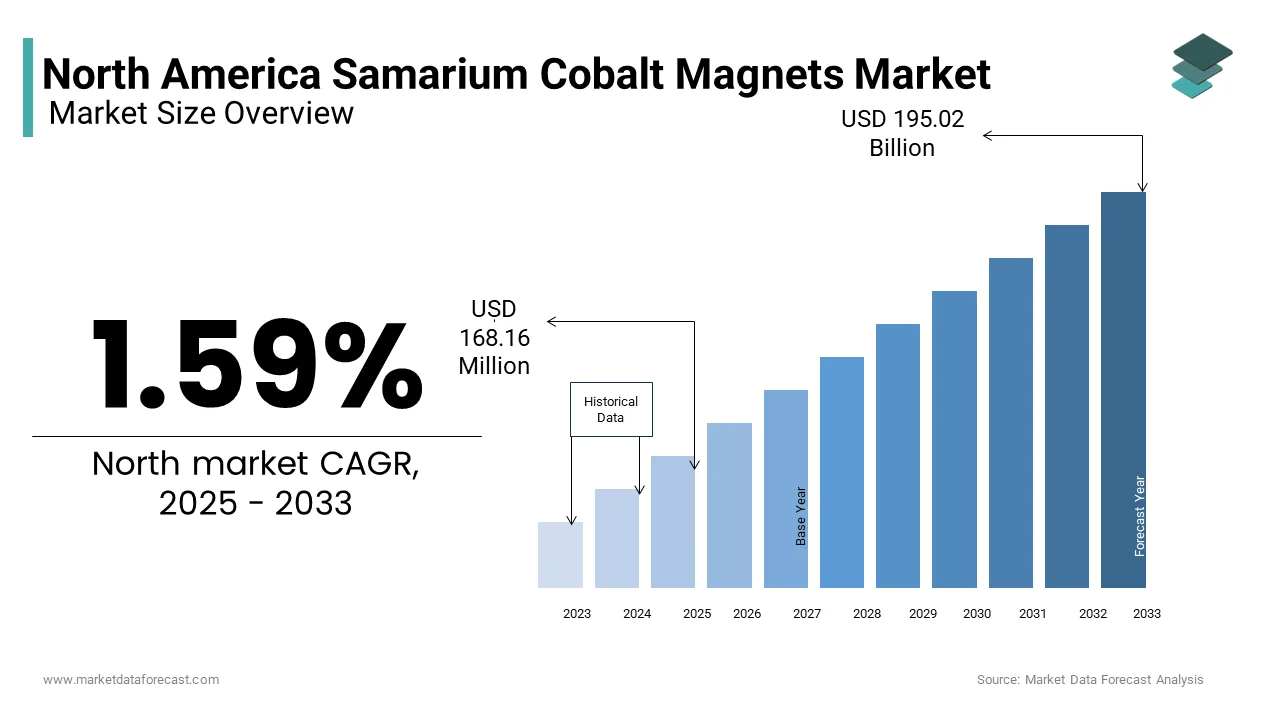
- Market Valuation: Valued at USD 168.16 million in 2025, estimated at USD 170.83 million in 2026, and projected to reach USD 193.81 million by 2034, registering a CAGR of 1.59% from 2026 to 2034.
- Primary Growth Drivers: Expansion of aerospace and defense electronics systems, growing demand for high-temperature permanent magnets, increased deployment in oil & gas downhole drilling equipment, rising defense modernization and space exploration investments, alongside mission-critical industrial automation adoption.
Key Market Segment Metrics (2026–2034)
| Category | Leading Segment (Position) | Fastest-Growing / Key Growth Segment |
|---|---|---|
| By Application Area | Defense (largest application) | Aerospace (fastest-growing application, including eVTOL propulsion) |
| By Industrial Sector | Aerospace, defense electronics, and oil & gas drilling systems | Hybrid-electric aircraft propulsion and critical infrastructure |
| By Technology & Innovation | Traditional high-temperature permanent magnet fabrication | Domestic rare earth refining, vertically integrated manufacturing, and corrosion-resistant magnetic solutions |
| By Region / Country | United States (leading country) | Canada (second-largest country with expanding mineral processing initiatives) |
Major Market Players & Market Structure
Market Structure: Highly strategic North American permanent magnet industry characterized by domestic rare earth processing expansion, high-performance magnet innovation for aerospace and defense, government and defense agency partnerships, and vertically integrated manufacturing.
Key Companies: Arnold Magnetic Technologies Corporation, Thomas & Skinner Inc., ADAMS Magnetic Products Co., Bunting, Eclipse Magnetics Ltd., NingBo NingGang Permanent Magnetic Materials Co., Ltd. (NGYC), Ningbo Ketian Magnet Co., Ltd., and Hangzhou Permanent Magnet Group Ltd.
North America Samarium Cobalt Magnets Market Size
The North America samarium cobalt magnets market size was valued at USD 168.16 million in 2025, and is anticipated to reach USD 170.83 million in 2026 and USD 193.81 million by 2034, growing at a CAGR of 1.59%, during from 2026 to 2034.
The samarium cobalt (SmCo) magnets are rare-earth permanent magnets known for exceptional thermal stability, corrosion resistance, and magnetic strength at elevated temperatures. These include aerospace propulsion systems, defense electronics, oil and gas drilling instrumentation, and high-efficiency motors in aerospace and industrial automation. The U.S. Department of Defense identifies SmCo magnets as essential components in over 30 weapon systems, including radar arrays, guidance mechanisms, and satellite communication systems, due to their ability to function reliably at temperatures exceeding 300°C. Additionally, NASA and private space ventures such as SpaceX use SmCo magnets in reaction wheels and attitude control systems for spacecraft, where performance degradation is not an option.
MARKET DRIVERS
Expansion of Aerospace and Defense Electronics Systems
The sustained modernization of aerospace and defense technologies is driving the growth of the North America samarium cobalt (SmCo) magnets market. In military aviation, SmCo magnets are used in electric actuators, radar systems, and turbine engine sensors, where operational temperatures can exceed 250°C. According to the U.S. Department of Defense’s 2025 budget justification documents, over $12 billion was allocated to advanced avionics and electronic warfare systems, many of which incorporate SmCo-based components for signal transmission and motor control. The F-35 Lightning II fighter jet, produced by Lockheed Martin, utilizes SmCo magnets in its electro-hydrostatic actuators and onboard power generation systems, with each aircraft requiring over 150 specialized magnet units.
Growth in Downhole and Subsurface Energy Exploration Equipment
The growing demand for oil and gas exploration, particularly in high-temperature directional drilling systems, is also expanding the growth of the North American samarium cobalt (SmCo) magnets market. In deep-well drilling operations, especially in shale formations across the Permian Basin and Western Canada Sedimentary Basin, electronic measurement-while-drilling (MWD) and logging-while-drilling (LWD) instruments are exposed to temperatures exceeding 200°C and extreme mechanical stress. According to the Society of Petroleum Engineers, neodymium magnets degrade under these conditions, whereas SmCo magnets retain over 90% of their magnetic flux density at 300°C, which is making them the only viable option for reliable tool operation. Baker Hughes reports that over 85% of new MWD tools deployed in North American unconventional wells in 2023 incorporated SmCo-based sensors and motors. These tools enable precise trajectory control during horizontal drilling, which is essential for maximizing hydrocarbon recovery in tight reservoirs.
MARKET RESTRAINTS
Geopolitical Vulnerability in Rare Earth and Cobalt Supply Chains
The region’s heavy reliance on foreign sources for both samarium and cobalt creates strategic and operational vulnerabilities. While SmCo magnets are manufactured in the U.S. and Canada, the raw materials are predominantly processed in China, which controls over 90% of global rare earth refining capacity, as per the U.S. Department of Energy’s 2023 Critical Materials Assessment. Samarium is a byproduct of bastnäsite and monazite ore processing, which is almost exclusively refined in China by leaving North American producers dependent on a single geopolitical entity for supply.
High Manufacturing and Material Costs
The elevated cost of producing samarium cobalt magnets presents a significant barrier to broader commercial adoption in cost-sensitive industrial sectors. SmCo magnets are among the most expensive permanent magnets due to the high price of raw materials and the complex, energy-intensive sintering process required for manufacturing. According to the U.S. Geological Survey, the average price of samarium oxide reached $85,000 per metric ton in 2023, while cobalt metal averaged $32,000 per metric ton, which is making SmCo magnets two to three times more expensive than neodymium-iron-boron alternatives. The production process involves vacuum induction melting, jet milling, and high-temperature sintering under inert atmospheres, all of which require specialized equipment and skilled labor. The National Institute of Standards and Technology estimates that the energy input for SmCo magnet fabrication is 40% higher than for standard ferrite magnets, further inflating production costs. These factors limit the use of SmCo magnets to niche, high-reliability applications where performance outweighs cost considerations.
MARKET OPPORTUNITIES
Development of Domestic Rare Earth Refining and Magnet Manufacturing Infrastructure
The ongoing development of domestic rare earth processing and magnet fabrication capabilities, which are aimed at reducing reliance on foreign supply chains, is creating new opportunities for the growth of the North American samarium cobalt magnets market. According to the Congressional Research Service, the Department of Energy’s Loan Programs Office has approved $350 million in financing for Noveon Magnetics to establish a rare earth magnet manufacturing plant in Texas, expected to produce SmCo magnets for defense and aerospace clients by 2026. Canada is also advancing its position, with Vital Metals’ Torex facility in Saskatchewan set to become the first rare earth separation plant in North America capable of processing samarium by 2025, as reported by Natural Resources Canada.
Integration into High-Temperature Electric Motors for Next-Generation Aviation
The integration into high-efficiency, high-temperature electric motors for hybrid-electric and all-electric aircraft, with a rapidly evolving segment in sustainable aviation, is elevating the growth of the North America samarium cobalt magnets market. Traditional neodymium magnets lose magnetic strength above 150°C, making them unsuitable for the thermal environments of aircraft propulsion systems. SmCo magnets, however, maintain performance at temperatures exceeding 300°C, enabling their use in axial flux and transverse flux motor designs for electric vertical takeoff and landing (eVTOL) vehicles and regional hybrid aircraft. According to NASA’s Advanced Air Vehicles Program, over 30 eVTOL prototypes in North America utilize SmCo-based motors to achieve power densities above 10 kW/kg, essential for lift and thrust efficiency. Companies like Joby Aviation and Beta Technologies are incorporating SmCo magnets into their propulsion units to ensure reliability under continuous high-load operation.
MARKET CHALLENGES
Limited Availability of Skilled Workforce in Advanced Magnet Fabrication
The scarcity of skilled technicians and engineers capable of operating advanced magnet manufacturing and quality assurance systems is substantially to challenge the growth of the North America samarium cobalt magnets market. According to the National Science Foundation, fewer than 1,200 engineers in the U.S. possess advanced training in rare earth materials processing, with most concentrated in a few defense contractors and research labs. In 2023, Noveon Magnetics reported a six-month delay in commissioning its pilot line due to difficulties in recruiting qualified operators for its sintering furnaces. Community colleges and vocational programs have only recently begun developing curricula in advanced materials manufacturing, with limited enrollment.
Environmental and Regulatory Hurdles in Rare Earth Processing
The rare earth processing in North America faces significant environmental and regulatory challenges that impede de supply chain, which is attributed to slowing down the growth of the North America samarium cobalt magnets market. Rare earth extraction and refining generate radioactive thorium and uranium byproducts, as well as acidic effluents, requiring stringent containment and waste management protocols. According to the Government Accountability Office, the permitting process for a new rare earth processing facility in the U.S. takes an average of seven to ten years due to overlapping federal, state, and tribal reviews under NEPA and the Clean Water Act. In 2022, a proposed rare earth refinery in Texas was suspended after local communities raised concerns about air quality and long-term ecological impact. Additionally, the disposal of cobalt-laden sludge from magnet recycling is classified as hazardous waste under RCRA, increasing compliance costs.
REPORT COVERAGE
| REPORT METRIC | DETAILS |
| Market Size Available | 2025 to 2034 |
| Base Year | 2025 |
| Forecast Period | 2026 to 2034 |
| CAGR | 1.59% |
| Segments Covered | By Application, and By Country |
| Various Analyses Covered | Global, Regional & Country Level Analysis; Segment-Level Analysis, DROC, PESTLE Analysis, Porter’s Five Forces Analysis, Competitive Landscape, Analyst Overview of Investment Opportunities |
| Regions Covered | The United States, Canada, Mexico, Rest of North America |
| Market Leaders Profiled | NingBo NingGang Permanent Magnetic Materials Co., Ltd. (NGYC), Ningbo Ketian Magnet Co., Ltd., Arnold Magnetic Technologies Corporation, ADAMS Magnetic Products Co., Bunting, Eclipse Magnetics Ltd, Hangzhou Permanent Magnet Group Ltd., Thomas & Skinner Inc. |
SEGMENTAL ANALYSIS
By Application Insights
The defense segment accounted in holding 44.3% of the North America samarium cobalt (SmCo) magnets market share in 2025, with the indispensable role SmCo magnets play in high-reliability military systems where performance under extreme conditions is non-negotiable. These magnets are components in precision-guided munitions, radar systems, sonar arrays, and secure communication equipment, where their ability to maintain magnetic integrity at temperatures exceeding 300°C ensures operational reliability. The U.S. Navy’s AN/SPY-6 radar, deployed on Arleigh Burke-class destroyers, relies on SmCo magnets in its active electronically scanned array (AESA) modules, which must function continuously in high-humidity and salt-corrosive environments. Additionally, the Pentagon’s Strategic Materials Protection Program has prioritized securing domestic access to SmCo magnets to mitigate supply chain vulnerabilities.
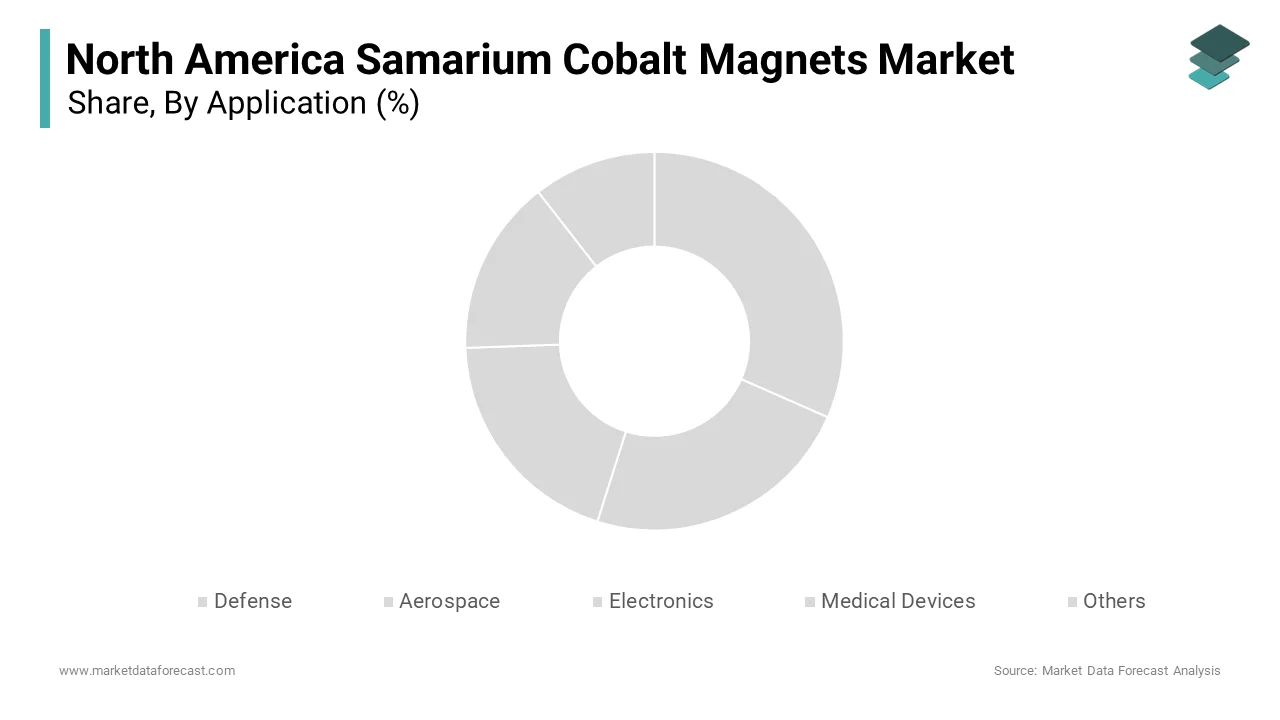
The aerospace segment is likely to grow with a CAGR of 9.8% during the forecast period with the integration of SmCo magnets into next-generation commercial and private aerospace systems, particularly electric propulsion units, satellite attitude control mechanisms, and high-efficiency auxiliary power units. According to the Federal Aviation Administration, over 40 next-generation aircraft programs, including Boeing’s ecoDemonstrator and Airbus’s Urban Air Mobility initiatives, are testing SmCo-based motors for hybrid-electric propulsion. The rise of private space ventures has further accelerated demand. SpaceX uses SmCo magnets in reaction wheels and magnetorquers on Starlink satellites, with over 5,000 launched by 2023, each requiring multiple high-stability magnetic components.
COUNTRY LEVEL ANALYSIS
United States outperformed with 82.3% of the North America samarium cobalt magnets market share in 2025, with the largest defense and aerospace industrial base, extensive R&D infrastructure, and strategic focus on supply chain sovereignty. The Department of Defense identifies SmCo magnets as essential for over 30 weapon systems, including advanced radar, missile guidance, and satellite communications, with procurement managed through the Defense Logistics Agency. Additionally, private-sector innovation is accelerating; companies like Arnold Magnetic Technologies and Thomas & Skinner operate high-precision SmCo fabrication lines serving aerospace and defense clients. The Inflation Reduction Act and Defense Production Act Title III have provided funding to support domestic magnet development.
Canada was positioned second by accounting for 14.2% of the North American samarium cobalt magnets market in 2025. Canada hosts significant deposits of rare earth elements in the Northwest Territories and Quebec, with the Torex Rare Earths project in Saskatchewan expected to begin samarium separation by 2025. The National Research Council of Canada is leading a joint initiative with Magellan Aerospace to test SmCo magnets in next-generation satellite systems, enhancing domestic technical expertise. Additionally, Canada’s ethical mining standards and alignment with NATO procurement policies make it an attractive alternative to Asian supply chains. Proximity to U.S. aerospace and defense manufacturers further enhances its logistical advantage.
KEY MARKET PLAYERS
NingBo NingGang Permanent Magnetic Materials Co., Ltd. (NGYC), Ningbo Ketian Magnet Co., Ltd., Arnold Magnetic Technologies Corporation, ADAMS Magnetic Products Co., Bunting, Eclipse Magnetics Ltd, Hangzhou Permanent Magnet Group Ltd., Thomas & Skinner Inc. are the market players that are dominating the North America samarium cobalt magnets market.
Top Players In The Market
- Arnold Magnetic Technologies is a subsidiary of Compass Diversified that stands as a leading innovator in the design and production of high-performance samarium cobalt magnets for applications. The company specializes in custom-engineered magnetic solutions tailored for aerospace, defense, and medical device manufacturers. Its vertically integrated manufacturing process ensures tight control over material traceability and quality compliance, meeting stringent MIL-STD and AS9100 standards. Arnold collaborates closely with U.S. defense contractors and space agencies to co-develop next-generation magnetic systems with its role as a strategic supplier in national security and advanced technology programs.
- Thomas & Skinner, Inc. is playing a dominant role in North America’s advanced magnet manufacturing landscape, which is renowned for its precision engineering and high-reliability production of samarium cobalt magnets. The company serves a niche but vital segment of the market, focusing on aerospace actuators, satellite systems, and downhole oilfield instrumentation where thermal and mechanical resilience are paramount. Thomas & Skinner’s expertise lies in producing complex magnet geometries with exacting tolerances, enabling integration into compact, high-efficiency motors and sensors. Its manufacturing facilities adhere to rigorous aerospace and defense quality protocols, ensuring full documentation and lot traceability for every component. The company has long-standing relationships with prime defense contractors and government agencies, functioning as a trusted domestic source for magnets that cannot be outsourced due to security concerns.
- Eclipse Magnetics is headquartered in the UK with a strategic operational presence in North America through partnerships and technical collaborations, contributing to the region’s samarium cobalt magnet ecosystem. The company specializes in high-temperature magnetic assemblies and custom solutions for aerospace and industrial applications. Eclipse brings advanced coating technologies and magnetic modeling capabilities that enhance the durability and efficiency of SmCo components in extreme environments. Its engineering support and rapid prototyping services are leveraged by North American OEMs seeking to accelerate product development cycles.
Top Strategies Used By Key Market Participants
One of the most pivotal strategies employed by key players in the North America samarium cobalt magnets market is vertical integration of the supply chain, extending from material sourcing to final magnet assembly. Companies are securing long-term agreements with rare earth refiners and investing in in-house sintering and machining capabilities to ensure quality control, reduce dependency on foreign suppliers, and meet defense-grade traceability requirements. This end-to-end oversight enhances reliability and supports national security mandates.
Another strategy is deep collaboration with government and defense agencies to align product development with strategic industrial policies. Firms are actively participating in Defense Production Act initiatives, SBIR grants, and aerospace innovation programs to co-develop next-generation magnetic systems. These partnerships provide access to funding, technical validation, and preferential procurement status, reinforcing their role as trusted domestic suppliers.
Also, the investment in advanced material engineering and protective technologies, such as hermetic coatings, grain boundary diffusion, and thermal aging optimization, is a top strategy followed by the key players. These innovations enable entry into next-generation applications in electric aviation, space systems, and hypersonic propulsion, where only the most robust materials are viable.
COMPETITION OVERVIEW
The competitive environment in the North America samarium cobalt magnets market is defined not by price or volume, but by technological precision, regulatory compliance, and strategic alignment with national security imperatives. Incumbents maintain dominance through long-standing relationships with prime contractors and government agencies, where trust and proven reliability outweigh cost considerations. However, new entrants supported by federal funding are emerging, aiming to break supply chain dependencies and introduce innovative processing techniques. The market is also witnessing a shift toward domestic sovereignty, with companies positioning themselves as essential to national resilience rather than mere suppliers. Intellectual property in coating technologies, sintering methods, and magnetic circuit design serves as a key differentiator. Additionally, competition is influenced by workforce capability, facility certification, and access to secure logistics networks.
RECENT HAPPENINGS IN THE MARKET
- In February 2023, Arnold Magnetic Technologies launched a new advanced coating facility in Massachusetts dedicated to applying hermetic, corrosion-resistant layers on samarium cobalt magnets by enhancing their durability in aerospace and defense applications.
- In July 2023, Thomas & Skinner entered into a strategic partnership with a major U.S. defense contractor to co-develop high-temperature SmCo motors for use in next-generation hypersonic missile guidance systems, which is reinforcing its role in national security programs.
- In November 2023, Arnold Magnetic Technologies was selected by NASA to supply custom SmCo assemblies for a deep-space probe mission by validating its magnets for long-duration performance in extreme thermal and radiation environments.
- In March 2025, Thomas & Skinner expanded its production floor in Indiana with a new cleanroom-certified sintering line by enabling stricter contamination control and compliance with AS9100D aerospace manufacturing standards.
- In September 2025, Eclipse Magnetics collaborated with a Canadian aerospace OEM to integrate its high-temperature magnetic sensors into a new urban air mobility prototype, which is marking its growing influence in North America’s electric aviation ecosystem.
MARKET SEGMENTATION
This research report on the North America samarium cobalt magnets market is segmented and sub-segmented into the following categories.
By Application
- Defense
- Aerospace
- Electronics
- Medical Devices
- Others
By Country
- The USA
- Canada
- Mexico