- Product Description Description
- Table of Contents TOC
- List of Table & Figure LOT
- Get Free Sample PDF Sample PDF
Market Size, 2025
$6.64 BnMarket Estimate, 2026
$6.88 BnMarket Forecast, 2034
$9.18 BnCAGR, 2026–2034
3.66%Executive Summary: North America Sanitary Napkin Market
- Market Scope: Regional North American sanitary napkin market analysis covering product types, distribution channels, country leadership frameworks, and menstrual hygiene adoption metrics.
- Market Valuation: Valued at USD 6.64 billion in 2025, estimated at USD 6.88 billion in 2026, and projected to reach USD 9.41 billion by 2034, registering a CAGR of 3.66% from 2026 to 2034.
- Primary Growth Drivers: Increasing awareness of menstrual hygiene, rising demand for sustainable and organic feminine hygiene products, supportive government initiatives, and continuous innovation in biodegradable, ultra-thin, and high-absorbency sanitary napkins. Key operational trends include expanding retail and e-commerce distribution channels.
Key Market Segment Metrics (2026–2034)
| Category | Leading Segment (2025 Position) | Fastest-Growing Segment |
|---|---|---|
| By Product / Pad Type | Menstrual Pad segment (dominated with an 86.4% share, driven by widespread adoption and reliable protection) | Biodegradable, organic cotton, and ultra-thin sustainable sanitary napkins |
| By Distribution Channel | Supermarkets and Hypermarkets (accounted for the largest share at 41.7%, supported by broad availability) | Online Stores (projected to register the fastest growth with a CAGR of 14.8% due to e-commerce adoption) |
| By Material / Formulation | Standard non-woven and high-absorbency polymer materials | Skin-friendly, dermatologically tested, and eco-friendly organic formulations |
| By Region / Country | United States (led regional market with a 78.9% share, backed by advanced retail infrastructure and spending) | Canada (accounting for 15.3% share with expanding digital retail platforms) |
Major Market Players & Market Structure
Market Structure: Competitive North American personal care landscape characterized by investments in biodegradable materials, organic cotton-based products, dermatologically tested formulations, sustainable packaging, omnichannel distribution, and menstrual health awareness initiatives.
Key Companies: Procter & Gamble, Kimberly-Clark Corporation, Hengan International Group Company Limited, Edgewell Personal Care Company, and Kao Corporation.
North America Sanitary Napkin Market Size
The North America sanitary napkin market size was valued at USD 6.64 billion in 2025 and is anticipated to reach a valuation of USD 6.88 billion in 2025 and USD 9.18 billion by 2034, growing at a CAGR of 3.66%, from 2026 to 2034.
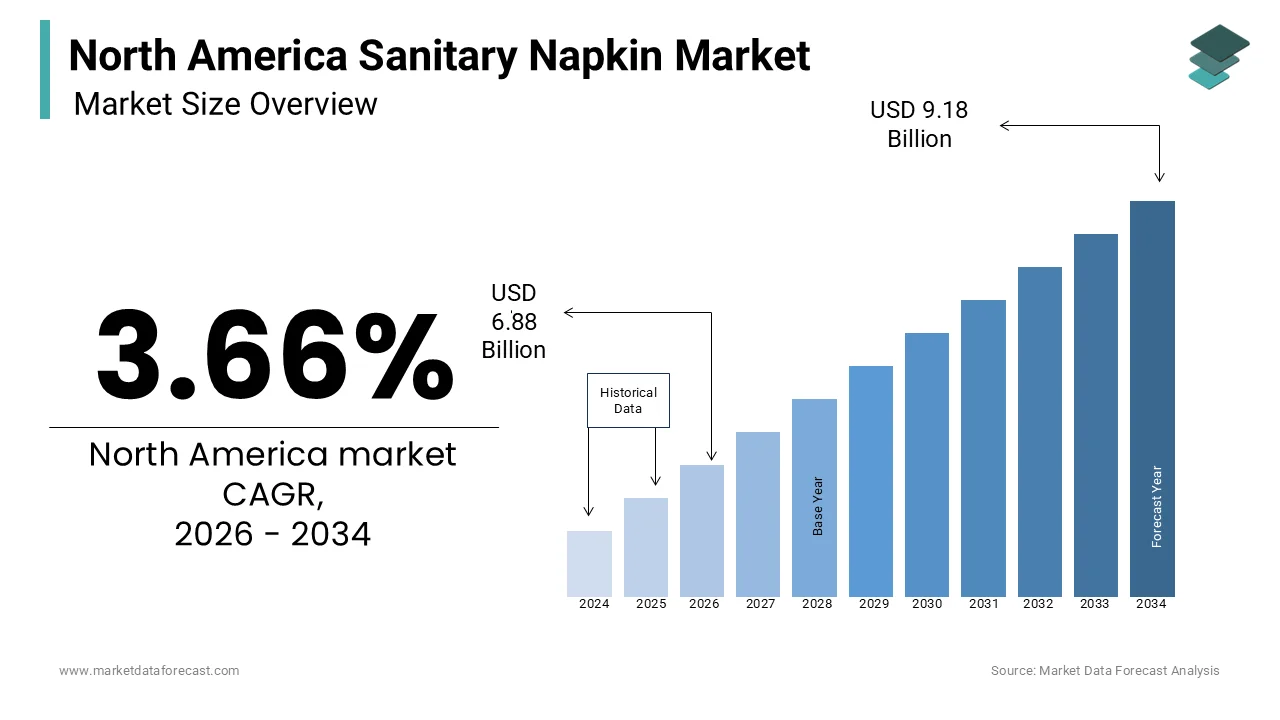
The sanitary napkins are absorbent hygiene products designed for menstrual management, including pads with wings, ultra-thin variants, and organic or sensitive-skin formulations. These products are integral to menstrual health infrastructure, serving individuals across diverse age groups, lifestyles, and physiological needs. As per the Centers for Disease Control and Prevention in 2023, approximately 57 million females aged 12 to 52 in the United States experience menstruation, forming the primary user base for sanitary napkins. Canada’s Statistics Canada indicates a similar demographic footprint, with over 9 million menstruating individuals. A notable shift in recent years has been the growing demand for transparency in product composition, driven by awareness of potential chemical exposure from synthetic materials. The U.S. Food and Drug Administration classifies sanitary napkins as Class II medical devices, which require adherence to strict manufacturing and labeling standards.
MARKET DRIVERS
Growing Awareness of Menstrual Health and Hygiene Education
The expanding emphasis on menstrual health literacy and school-based hygiene education programs is propelling the growth of the North America sanitary napkin market. Adolescents and young adults are increasingly receiving structured guidance on menstrual management, reducing stigma and encouraging consistent use of safe, reliable products. According to the Guttmacher Institute, as of 2023, 38 U.S. states mandate some form of sex education that includes menstrual health, up from 29 in 2018, by ensuring that over 7.2 million middle and high school students annually receive standardized information on period hygiene. This educational shift directly influences purchasing behavior, as informed individuals are more likely to prioritize product safety, absorbency levels, and dermatological compatibility.
Increasing Adoption of Organic and Hypoallergenic Materials
The rising consumer preference for organic, plant-based, and hypoallergenic materials, which is fueled by heightened health consciousness and dermatological concern, is propelling the growth of the North America sanitary napkin market. Traditional sanitary napkins often contain synthetic fragrances, chlorine-based bleaches, and petroleum-derived polymers, which the American College of Obstetricians and Gynecologists notes can trigger irritation, allergic reactions, or microbial imbalances in up to 18% of users. In response, brands like Natracare, Seventh Generation, and Cora have gained traction by offering products made from certified organic cotton, biodegradable cores, and fragrance-free formulations. As per data from the Environmental Working Group, 63% of female consumers in the U.S. surveyed in 2023 expressed concern about chemical exposure from menstrual products, with 41% actively switching to organic alternatives.
MARKET RESTRAINTS
Persistent Stigma and Cultural Taboos Surrounding Menstruation
The cultural stigma and social taboo are declining the growth of the North American sanitary napkin market. Many individuals in conservative or rural communities experience shame or embarrassment associated with menstruation, which leads to delayed product adoption or reliance on improvised alternatives. This silence perpetuates misinformation and discourages proactive health management. The National Alliance to End Homelessness estimates that over 1.3 million menstruating individuals in homeless shelters lack consistent access to proper hygiene supplies, with staff noting reluctance among users to request pads due to perceived social judgment.
Environmental Impact and Waste Management Concerns
The environmental footprint of disposable sanitary napkins is additionally hindering the growth of the North American sanitary napkin market in 2025. Each year, an estimated 12 billion sanitary pads are discarded in the United States alone, according to the Environmental Protection Agency, contributing to non-biodegradable landfill accumulation and marine pollution. Conventional pads contain plastic layers that take over 500 years to decompose, with polyethylene and superabsorbent polymers constituting up to 90% of their mass. The Ocean Conservancy reports that menstrual products, though not always categorized separately, are frequently recovered during coastal cleanups, indicating improper disposal and sewer system leakage. In Canada, Environment and Climate Change Canada estimates that feminine hygiene waste accounts for approximately 20,000 tons of annual landfill input, with limited municipal recycling programs equipped to handle contaminated materials. Moreover, greenwashing concerns have emerged, with the Federal Trade Commission issuing warnings in 2023 to brands making unsubstantiated "eco-friendly" claims without third-party certification.
MARKET OPPORTUNITIES
Expansion of Period Poverty Alleviation Programs
The institutionalization of period poverty alleviation initiatives, which are expanding access and normalizing product usage across marginalized communities, is greatly influencing the growth of thAmerican American sanitary napkin market. Governments, school districts, and nonprofits are increasingly recognizing menstrual equity as a public health imperative, which is leading to policy-driven distribution programs. As of 2023, 18 U.S. states have enacted laws mandating free menstrual products in public schools, benefiting over 8.5 million students, according to the National Conference of State Legislatures. These programs not only address basic hygiene needs but also create sustained demand for standardized, high-volume sanitary napkin procurement.
Innovation in Biodegradable and Flushable Product Designs
The development of biodegradable, compostable, and flushable product designs that align with sustainability goals without compromising performance is inclined to promote the growth of the American sanitary napkin market. Traditional disposal challenges have spurred R&D investments into novel materials such as polylactic acid (PLA), bamboo fibers, and water-soluble adhesives that break down safely in waste systems. According to the Biodegradable Products Institute, over 20 sanitary napkin products in North America have achieved certification for industrial compostability under ASTM D5338 standards as of 2023. Companies like Flexi and Saalt are pioneering flushable pad technologies that disintegrate within 15 minutes in sewage systems, reducing environmental load and improving user convenience.
MARKET CHALLENGES
Supply Chain Vulnerabilities in Raw Material Sourcing
The fragility of raw material supply chains for wood pulp, superabsorbent polymers (SAP), and organic cotton is degrading the growth of the American North America sanitary napkin market. SAP, a key component f, or absorbency, is predominantly derived from petrochemakeshich is makes it susceptible to oil price volatility. Organic cotton, which is essential for eco-friendly variants, faces even greater constraints. Textile Exchange reports that global organic cotton production dropped by 12% in 2022 due to climate-related crop failures in India and the United States.
Regulatory Ambiguity and Lack of Ingredient Transparency
The absence of mandatory ingredient disclosure inhibiting the growth of the American sanitary napkin market. As per a 2023 investigation by the Government Accountability Office, only 12 of the 45 leading sanitary napkin brands sold in the U.S. voluntarily disclosed full ingredient lists, leaving consumers unaware of potential exposure to endocrine-disrupting chemicals such as phthalates or dioxins. Meanwhile, advocacy groups like Women’s Voices for the Earth have tested popular pads and detected trace amounts of carcinogens and allergens, findings corroborated by third-party labs at the University of California, Berkeley. This lack of oversight undermines consumer confidence and complicates product differentiation based on safety. Retailers and insurers are increasingly demanding proof of non-toxicity, yet without standardized testing protocols or federal mandates, manufacturers operate in a gray zone.
REPORT COVERAGE
| REPORT METRIC | DETAILS |
| Market Size Available | 2025 to 2034 |
| Base Year | 2025 |
| Forecast Period | 2026 to 2034 |
| CAGR | 3.66% |
| Segments Covered | By Type, End-User, and By Country |
| Various Analyses Covered | Global, Regional & Country Level Analysis; Segment-Level Analysis, DROC, PESTLE Analysis, Porter’s Five Forces Analysis, Competitive Landscape, Analyst Overview of Investment Opportunities |
| Regions Covered | The United States, Canada, Mexico, Rest of North America |
| Market Leaders Profiled | Procter & Gamble, Kimberly-Clark Corporation, Hengan International Group Company Limited, Edgewell Personal Care Company, Kao Corporation. |
SEGMENTAL ANALYSIS
By Type Insights
The Menstrual Pad segment dominated the North America sanitary napkin market by capturing 86.4% of the share in 2025, with its essential role in managing moderate to heavy menstrual flow, particularly during peak days of the cycle, when higher absorbency and leak protection are important. A primary factor driving its sustained dominance is the entrenched consumer reliance on pads for nighttime use and during early or late cycle phases. According to data from the Centers for Disease Control and Prevention, the average menstrual flow lasts 4.6 days, with heaviest discharge occurring on days two and three, necessitating robust protection that pantyliners cannot provide. Furthermore, as per the American College of Obstetricians and Gynecologists, over 78% of menstruating individuals in the U.S. continue to use pads as their primary or secondary hygiene product, citing comfort, ease of use, and familiarity as key reasons.
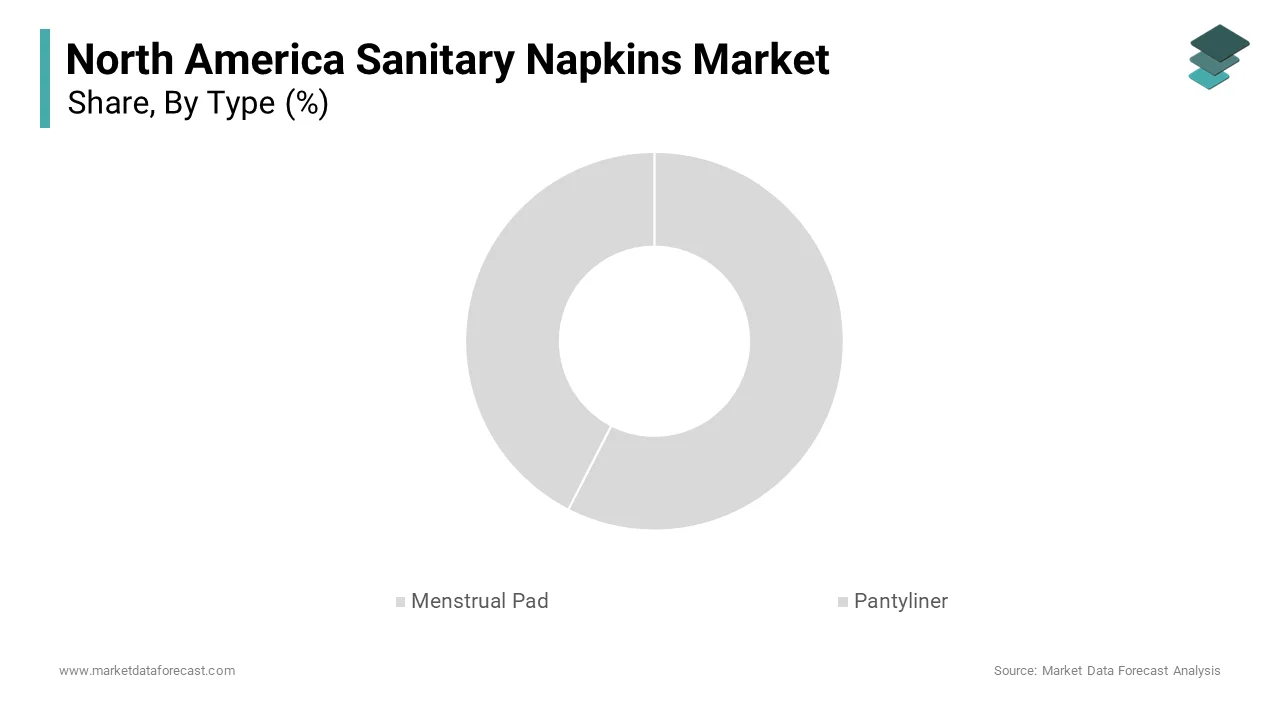
The Pantyliner segment is anticipated to grow at a CAGR of 9.3% from 202,5 to 2033 with the shifting lifestyle patterns and a rising emphasis on daily hygiene maintenance beyond menstruation. Pantyliners are increasingly used not only during light menstrual days but also for managing daily vaginal discharge, sweat, and odor, particularly among physically active and health-conscious individuals. According to the National Women’s Health Network, over 65% of women in the U.S. report using pantyliners on non-menstrual days to maintain freshness and confidence, especially in warm climates or during exercise. Brands like Carefree and o.b. have capitalized on this trend by marketing pantyliners as part of a daily self-care routine, akin to deodorant or facial wipes. Additionally, the rise of tight-fitting clothing and seamless apparel has amplified demand for invisible, ultra-thin protection. The NPD Group notes that sales of "daily wellness" feminine hygiene products, including pantyliners, grew 2.7 times faster than regular sanitary pads between 2021 and 2023.
By Distribution Channel Insights
Largest Segment – Supermarkets and Hypermarkets
The supermarkets and hypermarkets segment was the largest and held 41.7% of the North America sanitary napkin market share in 2025. The majority of sanitary napkin purchases are unplanned or urgent, and supermarkets located in close proximity to residential areas offer immediate access. These retailers stock a wide range of brands, from premium to value, catering to diverse socioeconomic segments. Additionally, supermarkets frequently deploy promotional pricing, bundle offers, and loyalty program discounts, which significantly influence purchasing decisions. The U.S. Department of Agriculture confirms that 89% of American households shop at supermarkets at least once a week, creating consistent exposure to menstrual product aisles.
The Online Stores segment is likely to register a CAGR of 14.8% from 2025 to 2033 with the growing preference for discreet, convenient, and subscription-based purchasing models, particularly among younger, digitally native consumers. Online marketplaces such as Amazon, Walmart.com, and brand-owned websites offer private, judgment-free shopping experiences with home delivery, often within two days. Subscription services like Dollarhide and Boxed have gained traction by automating replenishment, reducing the risk of stockouts during menstruation. According to the U.S. Census Bureau, e-commerce accounted for 15.6% of total retail sales in 2023, with personal care products showing the second-highest growth rate after electronics. In Canada, Canada Post data shows a 42% increase in deliveries of health and hygiene products to rural and remote areas between 2021 and 2023, indicating improved access. Moreover, digital platforms enable detailed product comparisons, customer reviews, and educational content, empowering informed decisions.
COUNTRY LEVEL ANALYSIS
United States
The United States was the largest contributor in the Americanmerica sanitary napkin market with 78.9% of share i,n 2025, with a large menstruating population, high consumer spending on personal care, and a mature retail infrastructure that ensures widespread product availability. Additionally, corporate social responsibility initiatives, such as Always’ #EndPeriodPoverty campaign, have distributed over 20 million pads to underserved communities since 2020. The integration of e-commerce and subscription models has further modernized distribution, with Amazon reporting a 35% year-on-year increase in sanitary product sales in 2023.
Canada
Canada was the second largest contributor to then American sanitary napkin market by accounting for 15.3% share,e i 2025, with the strong government involvement in menstrual equity and a growing emphasis on sustainable and health-conscious product choices. In 2023, the government allocated CAD 100 million under the National Strategy on Endometriosis and Menstrual Health to improve access in schools, shelters, and Indigenous communities. Retailers like Loblaws and Shoppers Drug Mart have expanded private-label organic lines, responding to consumer demand for transparency y. As per Women’s College Research Institute, 44% of Canadian women now prefer brands disclosing full ingredients, a figure 12 percentage points higher than in the U.S.
KEY MARKET PLAYERS
Procter & Gamble, Kimberly-Clark Corporation, Hengan International Group Company Limited, Edgewell Personal Care Capany, and Kao Corporation. are the market players that are dominating the North America sanitary napkin market.
Top Players in the Market
Procter & Gamble (Always)
Procter & Gamble holds a central position in theNorth Americana sanitary napkin market by combining decades of consumer trust with continuous product innovation. The brand has redefined menstrual care by emphasizing comfort, discretion, and skin health, integrating advanced absorbent technologies and breathable materials into its product lines. Always has also played a transformative role in reshaping cultural narratives around menstruation through purpose-driven campaigns such as #LikeAGirl, which challenge gender stereotypes and promote confidence among young women. Its extensive distribution network ensures presence across supermarkets, pharmacies, and e-commerce platforms, making it a household name.
Kimberly-Clark (Kotex)
Kimberly-Clark is operating under the Kotex brand in the North American sanitary napkin market, which is known for its focus on innovation, inclusivity, and user-centric design. Kotex has consistently introduced pioneering products, including ultra-thin pads, wings technology, and tampon-free applicators, enhancing comfort and convenience for a broad spectrum of consumers. The brand distinguishes itself through a deep commitment to understanding diverse menstrual experiences, actively engaging with users to refine product functionality and packaging. Kotex has also been at the forefront of sustainability efforts by launching lines made with more responsibly sourced materials and advocating for greater transparency in ingredient disclosure. Its presence in both mass retail and specialty channels ensures wide accessibility, while its digital outreach fosters community engagement and education. Internationally, Kotex supports global health initiatives, contributing to period poverty alleviation and menstrual health programs in low-resource settings.
Edgewell Personal Care (Playtex)
Edgewell Personal Care, through its Playtex brand, occupies a distinctive niche in the American sanitary napkin market by emphasizing innovation, discretion, and ergonomic design. Playtex has built a reputation for developing products that align with active, contemporary lifestyles, offering slim profiles, secure fit technologies, and sensitive-skin formulations that cater to health-conscious users. The brand’s focus on user experience extends beyond functionality to include packaging that prioritizes privacy and ease of use, particularly in public settings. Playtex has also invested in expanding its portfolio to include eco-conscious options, responding to growing consumer demand for sustainable menstrual care. Its strategic presence in drugstores, supermarkets, and online platforms ensures es broad market reach, while targeted marketing campaigns resonate with younger demographics.
Top Strategies Used By Key Market Participants
One major strategy employed by leading companies is brand humanization, where firms craft emotionally resonant narratives that destigmatize menstruation and foster deeper consumer connections. Another key approach is sustainability integration, with companies reengineering product lifecycles to reduce environmenta, impact by adopting biodegradable materials, minimizing plastic, and pursuing carbon-neutral manufacturing, thereby aligning with eco-conscious consumer values. A third strategy is omnichannel engagement, where brands optimize presence across physical retail, e-commerce, and direct-to-consumer platforms, ensuring seamless access and personalized experiences. This includes subscription models, mobile apps, and AI-driven customer support that enhance loyalty and convenience.
COMPETITION OVERVIEW
The competitive environment in ttheAmerica sanitary napkin market is marked by a blend of entrenched multinational corporations and agile challenger brands, each vying for relevance in an evolving social and commercial landscape. Dominance is primarily held by legacy players with extensive distribution networks, decades of brand equity, and robust R&D capabilities. The rivalry extends beyond product features to encompass brand ethos, with companies investing heavily in purpose-led marketing, environmental stewardship, and public advocacy. Retail shelf space and digital visibility are fiercely contested, particularly as e-commerce reshapes purchasing behavior and enables direct consumer engagement. Innovation is no longer limited to absorbency or comfort but includes biodegradable materials, minimalist design, and ethical sourcing.
RECENT HAPPENINGS IN THE MARKET
- In February 2023, Procter & Gamble launched a redesigned Always Ultra pad with a plant-based top sheet and recyclable packaging, which is reinforcing its commitment to sustainability and appealing to eco-conscious consumers.
- In July 2023, Kimberly-Clark introduced a new line of fragrance-free, dermatologist-tested Kotex pads formulated for sensitive skin by expanding its reach among health-aware users and medical professionals.
- In November 2023, Edgewell Personal Care partnered with a national school health initiative to distribute Playtex sanitary products in underserved school districts by enhancing brand visibility and social impact.
- In January 2025, Always unveiled an augmented reality campaign on social media platforms to educate teens about menstrual health, blending digital innovation with public awareness.
- In March 2025, Kotex collaborated with a leading environmental nonprofit to launch a consumer-facing tool that calculates the plastic footprint of menstrual products by promoting transparency and responsible consumption.
MARKET SEGMENTATION
This research report on the NoAmericanrica sanitary napkin market is segmented and sub-segmented into the following categories.
By Type
- Menstrual Pad
- Pantyliner
By Distribution Channel
- Supermarkets and Hypermarkets
- Pharmacies
- Convenience Stores
- Online Stores
- Specialty Stores
- Others
By Country
- The United States
- Canada
- Mexico