North America Separation Machinery Market Size, Share, Trends & Growth Forecast Report, Segmented By Technology, Equipment, Application, Operation Mode, End-User, And By Country (The United States, Canada, Mexico), Industry Analysis From 2026 to 2034
Market Size, 2025
$9.32 BnMarket Estimate, 2026
$9.73 BnMarket Forecast, 2034
$13.72 BnCAGR, 2026–2034
4.39%Executive Summary: North America Separation Machinery Market
- Market Scope: Comprehensive regional market analysis covering separation technologies, application sectors, equipment types, country-level leadership frameworks, and industrial process optimization metrics for the North American separation machinery sector.
- Market Valuation: Valued at USD 9.32 billion (2025), estimated at USD 9.73 billion (2026), and projected to reach USD 13.72 billion by 2034, registering a steady CAGR of 4.39% (2026–2034).
- Primary Growth Drivers: Pharmaceutical manufacturing expansion, stringent food safety regulations (99.9% pathogen removal standards), AI process optimization, predictive maintenance (reducing downtime by up to 50%), and advanced biopharmaceutical purification demands. Market challenges include high capital investment and supply chain disruptions, while opportunities lie in membrane separation energy efficiency, sustainable processing, and water treatment modernization.
Key Market Segment Metrics (2026–2034)
| Category | Leading Segment Position | Fastest-Growing Segment |
|---|---|---|
| By Technology / Application / Equipment | Filtration segment (dominated in 2025 for quality assurance) & Food & beverage industry (held dominant share in 2025 across over 28,000 facilities) & Filters (accounted for largest share in 2025) | Membrane separation technology segment (anticipated significant CAGR driven by energy efficiency) & Water treatment industry (growing with significant CAGR due to water scarcity) & Membrane systems (prominent CAGR) |
| By Region / Country | United States (top performer holding 89.3% share in 2024 supported by industrial base and high R&D investment) | Canada (accounted for 11.2% share in 2025, driven by mining and environmental sector demands) |
Major Market Players & Market Structure
Market Structure: Highly competitive North American separation machinery landscape centering on AI-enabled systems (improving efficiency by 20-30% and cutting energy consumption by 15-25%), smart sensor R&D investments, modular system engineering, and eco-friendly manufacturing practices.
Key Companies: Alfa Laval, Evoqua Water Technologies, 3M, Parker Hannifin, Siemens, Veolia, KSB, Sartorius, Bucher Unipektin, Hawkins Inc., GEA Group, Koch Industries, Thermo Fisher Scientific, Schlumberger, and Danaher.
North America Separation Machinery Market Size
The North Separation machinery market size was valued at USD 9.32 billion in 2025 and is anticipated to reach a valuation of USD 9.73 billion in 2026 and USD 13.72 billion by 2034, growing at a CAGR of 4.39%, from 2026 to 2034.
The separation machinery is a diverse array of industrial equipment designed to isolate, concentrate, or purify materials through physical, chemical, or mechanical processes across multiple sectors, including food and beverage, pharmaceuticals, chemicals, and mining. This sophisticated equipment portfolio includes centrifuges, filters, screens, magnetic separators, and membrane systems that enable precise material separation for quality enhancement, waste reduction, and resource recovery applications. According to the American Society of Mechanical Engineers, over 2.8 million industrial separation units are currently operational across North American manufacturing facilities, reflecting the critical role these systems play in production efficiency and product quality assurance.
MARKET DRIVERS
Pharmaceutical Industry Expansion and Drug Development Activities
The extensive expansion of pharmaceutical manufacturing and drug development activities for advanced separation machinery that supports critical purification and concentration processes in drug production is driving the growth of the North American separation machinery market. The complexity of modern biopharmaceutical products, including monoclonal antibodies and gene therapies, requires multiple purification steps using specialized centrifugation, filtration, and chromatography systems that can achieve ultra-pure product specifications. As per the Biotechnology Innovation Organization, biopharmaceutical manufacturing facilities have increased by 28% over the past five years, each requiring extensive separation infrastructure to support production processes. The trend toward personalized medicine and orphan drug development has created demand for flexible separation systems that can accommodate small batch sizes while maintaining regulatory compliance standards. Contract manufacturing organizations report that 75% of new drug development projects require custom separation solutions that can handle sensitive biological materials without compromising product integrity. The implementation of continuous manufacturing processes in pharmaceutical production has increased demand for inline separation systems that can operate seamlessly within integrated production lines.
Food Safety Regulations and Quality Standards Enhancement
The intensification of food safety regulations and quality standards to ensure contaminant removal, product purity, and compliance with stringent health authority requirements is additionally prompting the growth of the North American separation machinery market. According to the Food and Drug Administration's Food Safety Modernization Act implementation data, food processing facilities must demonstrate 99.9% effectiveness in pathogen removal and foreign material separation, necessitating investment in sophisticated screening, filtering, and magnetic separation systems. The Global Food Safety Initiative has established benchmark standards that require continuous monitoring and validation of separation processes, driving adoption of automated systems with real-time quality assurance capabilities. As per the Institute of Food Technologists, over 65% of food recalls in 2023 were attributed to physical contamination issues that could have been prevented through proper separation equipment implementation.
MARKET RESTRAINTS
High Capital Investment and Equipment Complexity
The substantial capital investment requirements and inherent complexity of advanced separation machinery for small and medium-sized enterprises that operate with limited financial resources and technical expertise are degrading the growth of the North American separation machinery market. According to the National Association of Manufacturers, the average cost of industrial separation equipment ranges from $50,000 to $500,000, depending on capacity and sophistication, representing a substantial capital commitment that many smaller operations cannot justify. The complexity of modern separation equipment, particularly systems incorporating automation, digital controls, and multiple processing stages, necessitates extensive operator training and ongoing technical support that adds to the total cost of ownership. The lead times for custom-designed separation systems can extend 12-18 months, creating project scheduling challenges and cash flow pressures for businesses operating in competitive markets. Maintenance and service requirements for sophisticated separation equipment often necessitate specialized technicians and proprietary parts that may not be readily available in all geographic regions. The rapid pace of technological advancement in separation systems creates concerns about equipment obsolescence and the need for frequent upgrades, which is making long-term investment planning particularly challenging for resource-constrained organizations.
Stringent Regulatory Compliance and Validation Requirements
The increasingly stringent regulatory compliance and validation requirements for separation machinery across North America have created significant operational challenges and cost burdens for manufacturers serving highly regulated industries such as pharmaceuticals and food processing. According to the International Society for Pharmaceutical Engineering, pharmaceutical manufacturers must invest an average of $250,000 in validation activities for each new separation system installation, including documentation, testing, and regulatory submission preparation. The complexity of validation protocols has increased substantially with the implementation of risk-based approaches and continuous monitoring requirements that necessitate extensive documentation and quality assurance procedures. As per the Food Processing Suppliers Association, food processing facilities report that regulatory compliance costs for separation equipment have increased by 40% over the past three years due to enhanced inspection requirements and documentation standards. The need for third-party certification and regulatory approval can extend equipment deployment timelines by 6-12 months, which is creating project delays and operational inefficiencies that impact business performance.
MARKET OPPORTUNITIES
Integration of Artificial Intelligence and Machine Learning Technologies
The integration of artificial intelligence and machine learning technologies in separation machinery presents significant growth opportunities by enabling predictive maintenance, process optimization, and autonomous operation capabilities that enhance efficiency and reduce operational costs. According to a 2023 report by the Industrial Internet Consortium, AI-enabled separation systems can improve operational efficiency by 20-30% while reducing energy consumption by 15-25% through real-time process optimization and adaptive control algorithms. Machine learning algorithms can analyze vast amounts of operational data to identify patterns and predict equipment failures before they occur, enabling proactive maintenance scheduling that reduces unplanned downtime by up to 50% according to the ARC Advisory Group. The integration of computer vision and sensor fusion technologies enables real-time contaminant detection and automatic rejection systems that improve product safety and reduce waste generation. Predictive analytics capabilities allow operators to optimize separation parameters based on feedstock characteristics, environmental conditions, and production requirements, maximizing throughput while minimizing resource consumption. The development of digital twin technologies for separation equipment enables virtual testing and optimization of process parameters before implementation, reducing commissioning time and operational risks. Cloud-based analytics platforms provide centralized monitoring and performance benchmarking capabilities that enable best practice sharing and continuous improvement across multiple facilities and operations.
Sustainable Processing and Circular Economy Initiatives
The growing emphasis on sustainable processing and circular economy initiatives across North America has created substantial opportunities for the growth of the North American separation machinery market. According to the Ellen MacArthur Foundation, the adoption of circular economy principles in North American manufacturing could reduce material waste by 45% and create $4.5 trillion in economic value by 2030, driving demand for advanced separation systems that enable material recovery and recycling. The implementation of zero-waste manufacturing initiatives has increased demand for separation equipment that can recover valuable materials from process streams and convert waste products into reusable resources. As per the U.S. Environmental Protection Agency, industrial facilities that implement comprehensive material separation and recovery programs can reduce disposal costs by 35-50% while generating additional revenue streams from recovered materials. The development of biodegradable and compostable materials has created demand for specialized separation systems that can sort and process these materials without cross-contamination or quality degradation.
MARKET CHALLENGES
Supply Chain Disruptions and Component Shortages
The persistent supply chain disruptions and component shortages have constrained production capacity and increased equipment costs throughout 2023 and into 2025. Critical components such as precision bearings, specialty filters, control systems, and custom-fabricated parts have experienced extended lead times and price volatility due to global manufacturing bottlenecks and geopolitical tensions. According to the Institute for Supply Management, the manufacturing purchasing managers' index for industrial equipment components remained below 50 for nine consecutive months in 2023, indicating continued supply constraints that affect equipment delivery schedules. The reliance on international suppliers, particularly for specialized filtration media, precision machining components, and electronic controls, has created vulnerabilities in the supply chain that impact production planning and inventory management. As per the National Association of Manufacturers, 71% of separation machinery manufacturers reported component shortages that delayed product deliveries by an average of 8-12 weeks during 2023. The semiconductor shortage has particularly impacted smart separation systems that incorporate digital monitoring and control capabilities, with lead times extending beyond 20 weeks for certain microprocessor components. Freight and logistics challenges have added 20-30% to transportation costs according to the American Trucking Associations, further pressuring profit margins for manufacturers and distributors.
Skilled Workforce Shortage and Technical Expertise Gaps
The critical shortage of skilled technicians and engineers capable of properly operating, maintaining, and optimizing increasingly complex separation systems was creating operational challenges for end-users and service providers. According to the National Institute for Metalworking Skills, the manufacturing sector faces a shortfall of over 600,000 skilled workers, with specialized separation equipment technicians representing a significant portion of unfilled positions requiring advanced technical knowledge. Modern separation machinery incorporates advanced automation, digital controls, and integrated monitoring systems that require specialized training and diagnostic equipment for proper maintenance and optimization. The complexity of validation and compliance requirements for pharmaceutical and food processing applications has increased, requiring certified technicians who understand specific regulatory requirements and documentation procedures. Equipment rental and service companies report difficulty maintaining their separation machinery fleets due to technician availability, with average repair turnaround times increasing by 45% over the past two years. The geographic distribution of skilled technicians is uneven, with rural areas and smaller markets experiencing more severe shortages that affect equipment reliability and customer satisfaction.
REPORT COVERAGE
| REPORT METRIC | DETAILS |
| Market Size Available | 2025 to 2034 |
| Base Year | 2025 |
| Forecast Period | 2026 to 2034 |
| CAGR | 4.39% |
| Segments Covered | By Technology, Equipment, Application, Operation Mode, End-User, and Region. |
| Various Analyses Covered | Global, Regional & Country Level Analysis, Segment-Level Analysis, DROC, PESTLE Analysis, Porter’s Five Forces Analysis, Competitive Landscape, Analyst Overview on Investment Opportunities |
| Regions Covered | The United States, Canada, Mexico, Rest of North America |
| Market Leaders Profiled | Alfa Laval, Evoqua Water Technologies, 3M, Parker Hannifin, Siemens, Veolia, KSB, Sartorius, Bucher Unipektin, Hawkins Inc., Gea Group, Koch Industries, Thermo Fisher Scientific, Schlumberger, Danaher |
SEGMENT ANALYSIS
By Separation Technology Insights
The filtration technology segment held a dominant share of the North American separation machinery market in 2025. Filtration systems utilize physical barriers to separate particles, fluids, and contaminants based on size exclusion principles, making them fundamental to quality assurance and process optimization in numerous applications. The technology's dominance is reinforced by continuous advancements in filter media materials, automated cleaning systems, and modular design approaches that enhance operational efficiency and reduce maintenance requirements. Market participants have extensively adopted filtration solutions due to their proven reliability, scalability, and compatibility with existing industrial processes. The FDA's Current Good Manufacturing Practices require sterile filtration for injectable drugs and biologics, with 0.22-micron membrane filters being the industry standard for bacterial retention in critical applications. As per the Parenteral Drug Association, over 95% of sterile pharmaceutical products utilize membrane filtration for final product sterilization, representing a critical quality control step that cannot be compromised.
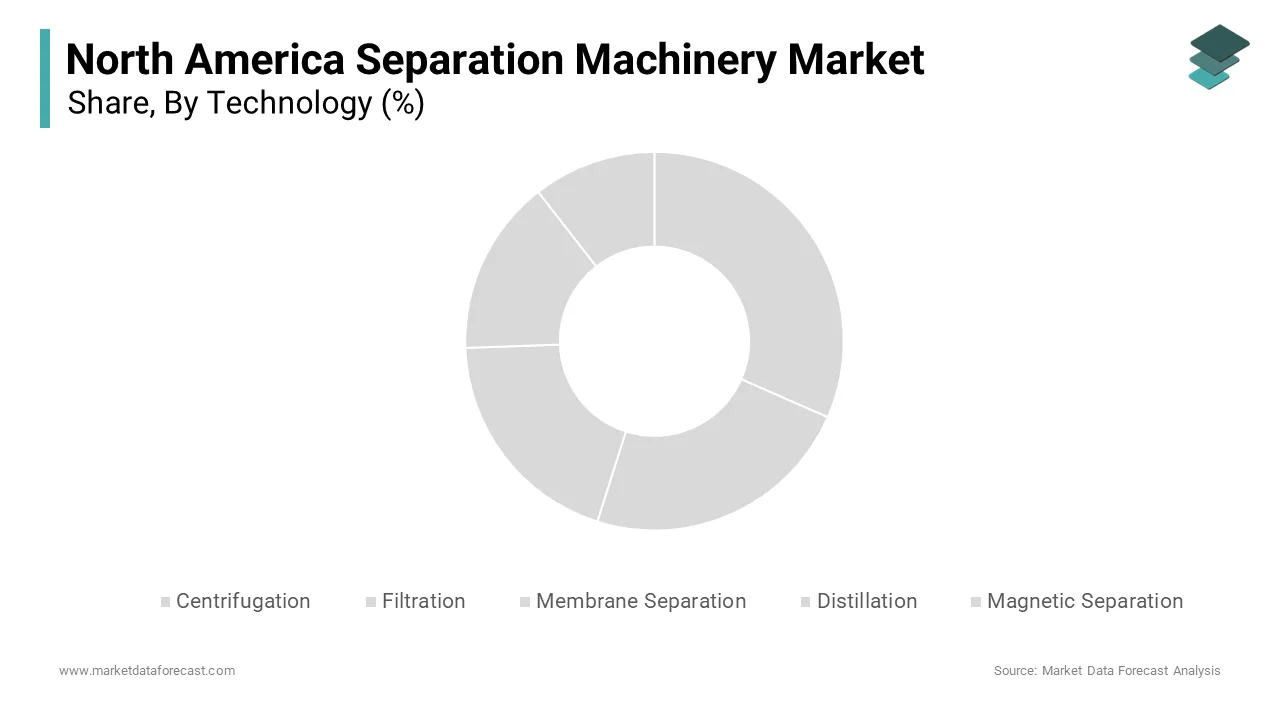
The membrane separation technology segment is anticipated to grow with a significant CAGR during the forecast period, with technological advancements and expanding application opportunities across diverse industries. This growth trajectory reflects increasing demand for selective separation processes that can achieve molecular-level purification while maintaining energy efficiency and operational flexibility. Membrane systems utilize semi-permeable barriers to separate components based on size, charge, or solubility differences, enabling precise fractionation in applications ranging from water purification to biopharmaceutical processing. The segment's rapid expansion is particularly evident in water treatment, food processing, and specialty chemical applications where traditional separation methods cannot achieve required purity levels or energy efficiency targets. Market revenues for membrane separation systems in North America are projected to increase significantly through 2030, supported by declining membrane costs, improved durability, and enhanced fouling resistance characteristics.
By Industry Application Insights
The food & beverage industry segment held a dominant share of the North American separation machinery market in 2025, with the industry's need for consistent product quality, extended shelf life, contaminant removal, and efficient resource utilization across diverse food categories, including dairy, beverages, meat processing, and packaged foods. The Food & Beverage sector's reliance on separation machinery encompasses clarification, concentration, purification, and waste reduction processes that are fundamental to commercial food production operations. According to the Food Processing Suppliers Association, over 28,000 food processing facilities operate across North America, each utilizing multiple separation systems for various production stages.
The Water Treatment industry segment is expected to grow with a significant CAGR in the coming years, with the increasing water scarcity concerns, regulatory compliance requirements, and infrastructure modernization initiatives across municipal and industrial sectors. This accelerated growth reflects the critical importance of water purification, wastewater treatment, and resource recovery applications in addressing environmental challenges and supporting sustainable development goals. The segment's expansion encompasses diverse separation technologies, including membrane systems, filtration units, and advanced oxidation processes that enable efficient water treatment while meeting stringent quality standards.
By Equipment Insights
The filters segment accounted for the largest share of the North American separation machinery market in 2025. The segment's growth is likely to grow with the universal need for particle removal, fluid clarification, and quality assurance across industries, including food and beverage, pharmaceuticals, chemicals, and water treatment. According to the Filtration Society, over 60% of industrial separation processes incorporate filtration equipment as primary or secondary separation stages due to the technology's reliability and operational simplicity. The versatility of filter systems allows for customization based on specific application requirements, including flow rates, pressure ratings, temperature ranges, and material compatibility. Market participants have extensively adopted filter solutions due to proven performance characteristics, established supply chains, and readily available technical support.
The membrane systems segment is likely to register a prominent CAGR during the forecast period. Membrane systems utilize semi-permeable barriers to separate components based on size, charge, or solubility differences, enabling precise fractionation in applications ranging from reverse osmosis water purification to protein concentration in biopharmaceutical manufacturing. The segment's rapid expansion is particularly evident in water treatment, food processing, and specialty chemical applications where traditional separation methods cannot achieve required purity levels or energy efficiency targets.
COUNTRY ANALYSIS
United States
The United States was the top performer of the North American separation machinery market with 89.3% of the share in 20,24, with the country's extensive industrial base, diverse manufacturing sectors, and sophisticated infrastructure that requires advanced separation technologies for process optimization and quality assurance. The United States' separation machinery market is characterized by high technological adoption rates, stringent regulatory compliance requirements, and significant investment in energy-efficient solutions that reflect broader sustainability trends. The United States' position as the global leader in pharmaceutical research and development has established it as the dominant market for separation machinery, with extensive investment in advanced purification and concentration technologies that support drug discovery and manufacturing operations. According to the Pharmaceutical Research and Manufacturers of America, the U.S. pharmaceutical industry invested over $120 billion in research and development during 2023, representing the largest R&D expenditure globally and creating substantial demand for sophisticated separation equipment. The complexity of modern biopharmaceutical products, including monoclonal antibodies, gene therapies, and personalized medicines, requires multiple purification steps using specialized centrifugation, filtration, and membrane separation systems that can achieve ultra-pure product specifications. The FDA's emphasis on quality by design principles and process analytical technology has accelerated ed adoption of advanced separation systems that provide real-time monitoring and control capabilities. Contract manufacturing organizations report that 75% of new drug development projects require custom separation solutions that can handle sensitive biological materials without compromising product integrity. The implementation of continuous manufacturing processes in pharmaceutical production has increased demand for inline separation systems that can operate seamlessly within integrated production lines while maintaining sterility assurance levels.
Canada
Canadian separation machinery market accounted in holding 11.2% of the share in 2025. The Canadian market's distinctive characteristics include rigorous environmental regulations, cold climate adaptations, and unique resource processing requirements that shape equipment specifications and performance expectations. Canada's separation machinery sector demonstrates strong growth potential driven by expanding resource extraction activities, water treatment infrastructure development, and increasing pharmaceutical manufacturing capabilities. The market benefits from proximity to major U.S. manufacturers while maintaining distinct regional preferences that influence product development and distribution strategies. According to Natural Resources Canada, the mining sector contributed over $120 billion to the Canadian economy in 2023, representing one of the country's largest industrial sectors and creating substantial demand for advanced separation equipment. The complexity of Canadian mineral deposits, including oil sands, base metals, and rare earth elements, requires specialized separation systems that can handle challenging feed materials and achieve high recovery rates under harsh operating conditions. As per the Mining Association of Canada, over 65% of new mining projects incorporate advanced separation technologies, including centrifuges, magnetic separators, and flotation systems to improve operational efficiency and reduce environmental impact. The implementation of tailings management regulations has increased demand for dewatering and solid-liquid separation systems that enable safe waste disposal and water recovery in mining operations.
KEY MARKET PLAYERS
Alfa Laval, Evoqua Water Technologies, 3M, Parker Hannifin, Siemens, Veolia, KSB, Sartorius, Bucher Unipektin, Hawkins Inc., Gea Group, Koch Industries, Thermo Fisher Scientific, Schlumberger, Danaher. Are the market players that are dominating the separation Machinery market?
MARKET SEGMENTATION
This research report on the North American separation Machinery market is segmented and sub-segmented into the following categories.
By Technology
- Centrifugation
- Filtration
- Membrane Separation
- Distillation
- Magnetic Separation
By Application
- Food Beverage
- Pharmaceuticals
- Chemical Processing
- Water Treatment
- Mining Mineral Processing
By Equipment Type
- Centrifuges
- Filters
- Separators
- Membrane Systems
- Evaporators
By Operation Mode
- Batch
- Continuous
- Semi-Continuous
By End User
- Manufacturers
- Research Institutions
- Service Providers
- Government Agencies
By Country
- The United States
- Canada
- Mexico
Frequently Asked Questions
What types of machinery are included in the separation machinery market?
The market includes centrifuges, filters, separators, decanters, magnetic separators, vibratory screens, hydrocyclones, and industrial sieves used for solid-liquid, solid-gas, and liquid-liquid separation.
Which industries are the primary end-users of separation machinery in North America?
Key end-user industries include food and beverage, pharmaceuticals, chemicals, oil & gas, mining, wastewater treatment, and biotechnology.
What are the main drivers of growth in this market?
Growth is fueled by increasing regulatory focus on product purity, rising automation in manufacturing, demand for water recycling, and stricter environmental compliance in industrial discharges.
How is automation impacting the separation machinery sector?
Automation is enabling real-time monitoring, predictive maintenance, and improved separation efficiency, leading to reduced downtime and higher throughput, especially in pharmaceutical and food processing industries.
Which region within North America holds the largest market share?
The United States accounts for the largest share, driven by a mature industrial base, high R&D investment, and strong presence of key machinery manufacturers.
Are there regional differences in adoption across North America?
Yes. The U.S. leads in high-tech and automated systems, while Canada shows growing demand in mining and environmental sectors. Mexico is emerging as a manufacturing hub, increasing demand for cost-effective separation solutions.
What role do sustainability regulations play in this market?
Environmental regulations mandating reduced waste, water reuse, and cleaner production processes are pushing industries to adopt advanced separation technologies, especially in wastewater and chemical processing.
How has the pharmaceutical industry influenced market growth?
The pharmaceutical sector requires high-precision separation for drug formulation and purification, driving demand for sterile, GMP-compliant machinery with high separation efficiency.
Are there challenges related to equipment maintenance and operational costs?
Yes. High initial investment and maintenance of precision machinery, especially in continuous operation environments, remain key concerns for small and medium enterprises.
What innovations are shaping the future of separation machinery?
Emerging trends include smart sensors for real-time performance tracking, energy-efficient designs, modular systems for scalability, and integration with Industry 4.0 platforms.
Access the study in MULTIPLE FORMATS
Purchase options starting from
$ 2000
Didn’t find what you’re looking for?
TALK TO OUR ANALYST TEAM
Need something within your budget?
NO WORRIES! WE GOT YOU COVERED!
Call us on: +1 888 702 9696 (U.S Toll Free)
Write to us: sales@marketdataforecast.com