- Product Description Description
- Table of Contents TOC
- List of Table & Figure LOT
- Get Free Sample PDF Sample PDF
Market Size, 2025
$0.31 BnMarket Estimate, 2026
$0.35 BnMarket Forecast, 2034
$0.90 BnCAGR, 2026–2034
12.47%North America Solar Panel Cleaning Market Size
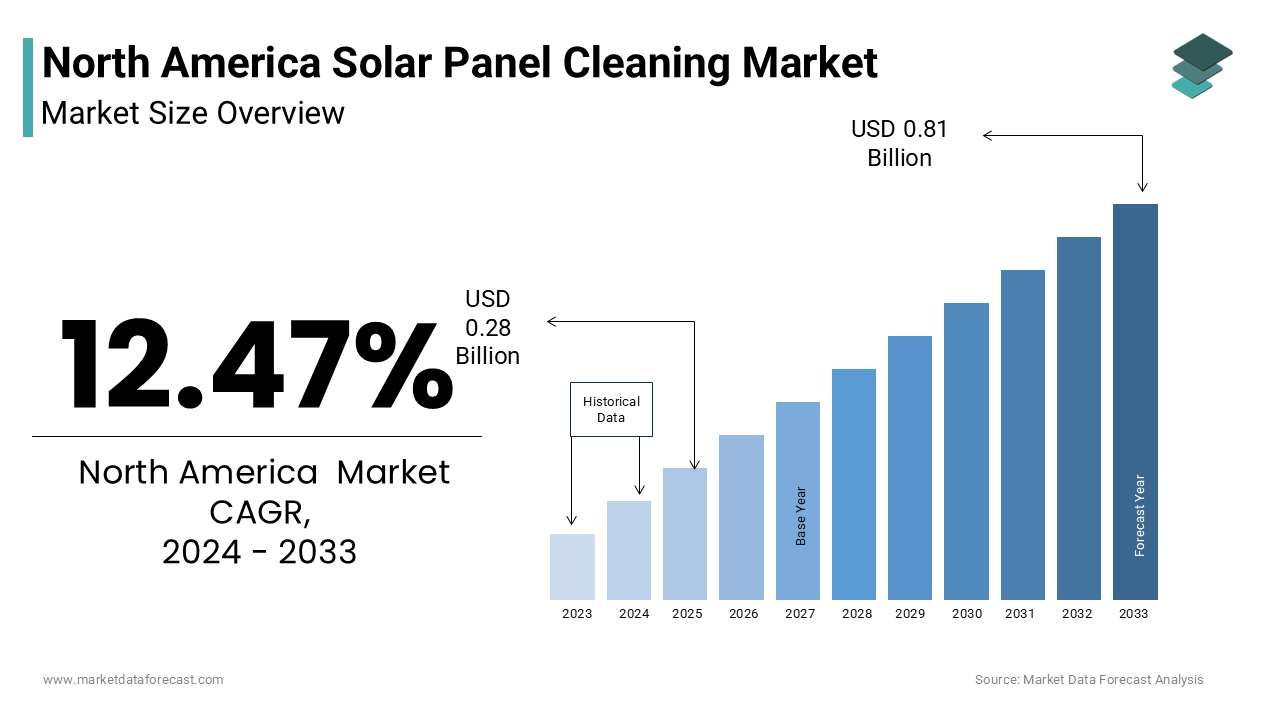
The North America solar panel cleaning market size was valued at USD 0.31 billion in 2025 and is anticipated to reach USD 0.35 billion in 2026 from USD 0.90 billion by 2034, growing at a CAGR of 12.47% during the forecast period from 2026 to 2034.
Solar panel cleaning refers to the specialized services and technologies employed to maintain the efficiency and performance of photovoltaic (PV) systems by removing dust, dirt, pollen, bird droppings, and other contaminants that accumulate on panel surfaces. As solar energy adoption expands across residential, commercial, and utility-scale installations, the need for regular and effective cleaning has become increasingly critical to ensuring optimal energy output.
Solar panels are highly sensitive to soiling, with even a thin layer of grime capable of significantly reducing their electricity generation capacity. According to the National Renewable Energy Laboratory (NREL), uncleaned solar panels can experience efficiency losses ranging from 5% to over 30%, depending on regional environmental conditions. This growing awareness has spurred demand for both manual and automated cleaning solutions tailored to different installation types and geographic locations.
In recent years, technological advancements have introduced robotic cleaning systems, waterless brushes, and AI-driven monitoring platforms into the mainstream. As per the U.S. Department of Energy, utility-scale solar farms in arid regions such as California and Arizona are among the fastest adopters of advanced cleaning methods due to high particulate exposure.
MARKET DRIVERS
Expansion of Utility-Scale Solar Installations in Arid Regions
The rapid expansion of large-scale solar farms, particularly in arid and semi-arid regions where dust accumulation significantly impacts panel efficiency, is one of the key drivers of the North America solar panel cleaning market. According to the U.S. Energy Information Administration (EIA), utility-scale solar power generation in the United States increased by over 25% between 2021 and 2023, with states like California, Nevada, and Texas leading deployment. These areas are particularly prone to high levels of airborne particulates, sandstorms, and limited rainfall, all of which accelerate soiling on solar arrays.
As per data from the National Renewable Energy Laboratory (NREL), dust buildup in desert environments can cause energy losses of up to 30% if left unaddressed, making regular cleaning essential for maintaining return on investment. To mitigate these losses, many solar farm operators are investing in automated cleaning systems or contracting professional cleaning services equipped with dry-cleaning robots and high-efficiency filtration tools. Additionally, the Bureau of Land Management (BLM) has approved over 4 million acres of federal land for solar development in the southwestern U.S., further reinforcing the long-term demand for reliable cleaning solutions.
Rising Awareness of Performance Optimization Among Commercial Solar Users
The growing awareness among commercial and industrial solar users regarding performance optimization and cost efficiency is another major driver of the North America solar panel cleaning market. Businesses operating under corporate sustainability mandates are increasingly recognizing that clean solar panels yield higher energy output, directly affecting energy savings and carbon footprint reduction goals.
As per a 2023 survey conducted by the Solar Energy Industries Association (SEIA), over 60% of commercial solar system owners had either implemented or were planning to implement regular cleaning schedules to ensure maximum return on their solar investments. Many businesses, especially those in logistics, retail, and manufacturing sectors, rely on uninterrupted solar energy production to support operations and lower utility costs. Furthermore, facility managers are increasingly opting for contract-based cleaning services that offer scheduled maintenance, performance tracking, and customized cleaning plans tailored to local climate conditions. Besides, state-level incentives and net metering policies encourage businesses to maintain peak solar efficiency to maximize financial returns.
MARKET RESTRAINTS
High Cost of Automated Cleaning Systems for Small-Scale Installations
The relatively high cost of automated cleaning systems, which limits their adoption among small-scale residential and community solar projects, is a significant restraint affecting the North America solar panel cleaning market. While robotic cleaners and self-cleaning coatings offer substantial efficiency gains, their initial investment often exceeds the budget constraints of individual homeowners and smaller cooperatives. According to the Solar Energy Industries Association (SEIA), nearly 60% of solar installations in the U.S. in 2023 were residential, yet only a fraction of these systems incorporated advanced cleaning mechanisms due to cost barriers.
As per data from the National Renewable Energy Laboratory (NREL), fully automated solar panel cleaning robots can range from $1,500 to $5,000 per installation, depending on the size and complexity of the array. For many residential users, this additional expense does not justify the marginal increase in energy output unless they reside in extremely dusty or low-rainfall regions. Consequently, most small-scale solar owners opt for manual cleaning or periodic maintenance rather than investing in automation.
Moreover, the lack of standardized financing options for cleaning equipment further discourages adoption. Unlike solar panels, which benefit from tax credits and leasing programs, cleaning technologies remain largely excluded from incentive structures.
Limited Awareness and Inconsistent Maintenance Practices
The limited awareness and inconsistent maintenance practices among solar system owners, particularly in residential and small commercial settings, are another major constraint in the North America solar panel cleaning market. Despite the well-documented impact of soiling on energy output, many users still believe that natural precipitation is sufficient to keep panels clean.
This misconception leads to suboptimal performance, especially in regions with low rainfall or high air pollution. As per a study published by the National Renewable Energy Laboratory (NREL), even in moderately dusty environments, solar panels could lose up to 15% efficiency within just three months without cleaning. However, awareness campaigns about the importance of routine maintenance remain limited, and service providers face challenges in educating consumers about the tangible benefits of professional cleaning.
Additionally, the absence of standardized maintenance guidelines from regulatory bodies contributes to inconsistent cleaning habits. While some utility companies and installers include cleaning advice in post-installation guides, there is no unified industry recommendation on frequency or methodology.
MARKET OPPORTUNITIES
Integration of AI-Powered Monitoring and Predictive Cleaning Solutions
The integration of artificial intelligence (AI)-powered monitoring and predictive maintenance solutions is an emerging opportunity in the North America solar panel cleaning market. These advanced systems leverage real-time weather data, sensor analytics, and machine learning algorithms to determine optimal cleaning schedules based on localized environmental conditions.
Several tech-driven startups and established energy management firms are now offering cloud-connected platforms that analyze factors such as dust accumulation, humidity, wind speed, and solar irradiance to recommend precise cleaning intervals. This approach minimizes unnecessary labor and water usage while maximizing energy output. As reported by BloombergNEF, AI-enabled cleaning solutions are gaining traction among utility-scale solar farms, where operational efficiency and cost control are paramount.
Furthermore, the growing trend of digitalization in renewable energy infrastructure is accelerating the adoption of smart cleaning systems. Companies specializing in Internet of Things (IoT) applications are partnering with solar asset managers to develop integrated platforms that optimize maintenance workflows.
Expansion of Waterless and Eco-Friendly Cleaning Technologies
The rising adoption of waterless and environmentally sustainable cleaning technologies is a promising opportunity shaping the North America solar panel cleaning market. Traditional cleaning methods often require large volumes of water, posing logistical and ecological challenges, especially in drought-prone regions such as California, Arizona, and Nevada. According to the National Renewable Energy Laboratory (NREL), a typical utility-scale solar farm may consume over 20,000 gallons of water annually for panel cleaning alone, prompting the search for alternative solutions.
Waterless cleaning techniques, including electrostatic brushes, dry-robotic systems, and nanocoatings that repel dust, are gaining momentum due to their efficiency and minimal environmental impact. The U.S. Department of the Interior has encouraged the use of non-water-intensive cleaning methods in federally managed solar projects, aligning with broader conservation policies. Besides, investor interest in green technology startups has surged.
MARKET CHALLENGES
Lack of Standardized Industry Regulations and Service Certification
The absence of standardized industry regulations and service certification frameworks, which creates inconsistencies in service quality and customer confidence, is a pressing challenge in the North America solar panel cleaning market. Unlike the solar installation sector, which benefits from established certification programs through entities like the North American Board of Certified Energy Practitioners (NABCEP), the cleaning segment lacks uniform training, safety protocols, and performance benchmarks. According to the Solar Energy Industries Association (SEIA), this gap has led to a fragmented marketplace with varying levels of expertise among service providers.
Without standardized qualifications, customers, especially commercial and utility-scale operators, face difficulties in assessing the reliability and effectiveness of cleaning vendors. A 2023 report by the National Renewable Energy Laboratory (NREL) pointed out concerns around improper cleaning techniques causing micro-abrasions or residual film buildup that can degrade panel performance over time. This inconsistency undermines trust and slows the adoption of professional cleaning services.
Furthermore, regulatory agencies such as the Occupational Safety and Health Administration (OSHA) have yet to establish formal guidelines for solar panel cleaning operations, particularly for rooftop and elevated installations. The lack of oversight also complicates insurance and liability considerations for both service providers and clients.
Seasonal Variability and Regional Climate Differences Impacting Demand
The seasonal variability and regional climate differences that affect soiling rates and cleaning frequency requirements is another significant challenge influencing the North America solar panel cleaning market. The effectiveness and necessity of panel cleaning fluctuate dramatically depending on geographic location, weather patterns, and environmental conditions. According to the National Renewable Energy Laboratory (NREL), solar installations in arid and low-precipitation zones experience much higher dust accumulation compared to those in humid or rainy regions, leading to uneven demand distribution.
For instance, solar farms in the Southwest U.S. may require weekly cleaning during dry seasons, whereas systems in the Northeast might only need biannual maintenance due to frequent rainfall. This inconsistency makes it difficult for service providers to establish predictable revenue streams and develop standardized pricing models. As per data from the U.S. Department of Energy, cleaning frequency can vary by more than 300% between regions, complicating business planning for national service operators.
Additionally, seasonal changes such as winter snowfall and spring pollen surges introduce further unpredictability. Some regions also experience sudden environmental events like wildfires or sandstorms, necessitating emergency cleaning interventions.
SEGMENTAL ANALYSIS
By Technology Insights
, spearheaded the market with 52.5% in 2024. Its compatibility with large-scale utility solar farms, where efficiency losses due to soiling are most pronounced, is one of the key factors contributing to the rise of the wet cleaning segment. This dominance is also driven by the widespread reliance on water-based methods for removing heavy particulate buildup, especially in regions with high dust accumulation such as California, Nevada, and Arizona.
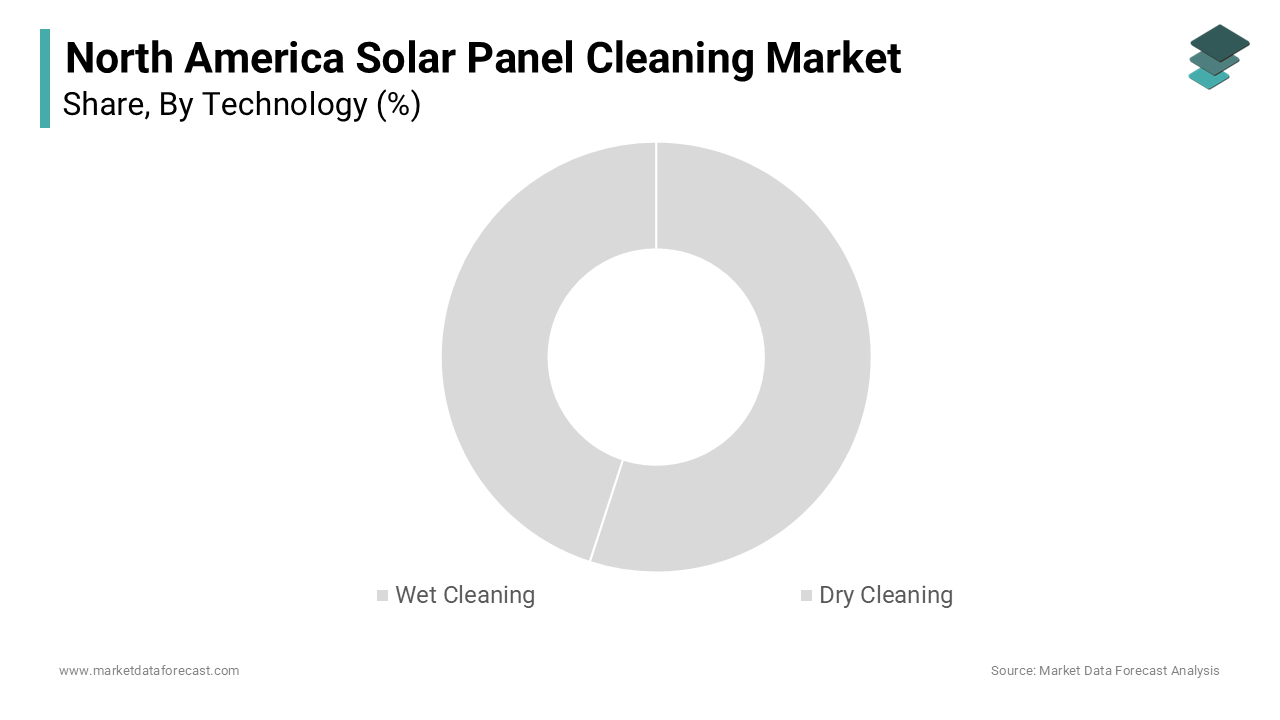
According to the National Renewable Energy Laboratory (NREL), utility-scale solar installations in arid zones can experience energy output reductions of up to 30% without regular cleaning. Water-based cleaning offers an effective solution for restoring panel performance, particularly when integrated into scheduled maintenance routines.
Besides, semi-automated water brush systems are cost-effective and scalable, making them a preferred choice among mid-sized commercial solar operators who seek efficiency improvements without investing in fully automated robotic cleaners. As per the U.S. Department of Energy, these systems account for over 40% of all utility solar cleaning operations, offering a balance between labor input and cleaning efficacy.
The Automated Wet Cleaning sub-segment is swiftly expanding in the North America solar panel cleaning market which is projected to expand at a CAGR of 8.1% between 2026 and 2034. The increasing deployment of fixed-mount solar arrays in utility-scale projects, where manual cleaning becomes impractical due to sheer scale and remote locations is is one of the main drivers behind this growth. While not the largest in terms of current market share, this segment is gaining traction due to its ability to deliver consistent cleaning performance with minimal human intervention.
Automated wet cleaning systems, often equipped with programmable timers and sensor-based triggers, ensure that panels remain clean without requiring frequent technician visits. As per the U.S. Energy Information Administration (EIA), over 60% of new utility solar farms installed in 2023 were located in areas with limited rainfall, reinforcing the need for reliable automated solutions.
The integration of IoT-enabled monitoring platforms, allowing real-time tracking of panel efficiency and triggering cleaning cycles based on soiling levels, is another major catalyst. Companies like NEXTracker and First Solar have begun incorporating automated washing systems into their turnkey solar plant designs, enhancing operational efficiency.
By Dry Cleaning Insights
The Automated Robotic Cleaning segment has emerged as the largest segment by capturing a 32.4% of the total share in 2025. Its ability to provide efficient, low-maintenance cleaning without water consumption, aligning with sustainability goals and regulatory mandates, is one of the main reasons for the segment's leading position. This dominance is also attributed to the rising preference for waterless cleaning solutions, especially in drought-prone regions such as California, Arizona, and Texas, where water conservation regulations restrict traditional washing methods.
According to the U.S. Department of the Interior, federal solar projects in the Southwest are increasingly required to adopt non-water-intensive cleaning practices to minimize environmental impact. Automated robotic cleaners, equipped with soft brushes and electrostatic dust removal mechanisms, offer a viable alternative that preserves panel efficiency while conserving resources.
Moreover, the scalability of robotic systems makes them ideal for utility-scale solar farms, where manual cleaning is labor-intensive and logistically challenging. A report from the National Renewable Energy Laboratory (NREL) highlights that robotic cleaning can reduce labor costs by up to 60% compared to manual techniques while maintaining consistent performance.
A significant development in the North America solar panel cleaning market is the fastest-growing sub-segment within dry cleaning Electrostatic Dust Removal Technology, projected to expand at a CAGR of 9.3% between 2025 and 2033. The increasing deployment of bifacial solar panels, which require both front and rear surfaces to remain free of dust for optimal energy capture, is a key driver behind this growth. Although still smaller than robotic cleaning in absolute terms, this segment is experiencing rapid adoption due to its innovative approach to dust mitigation without physical contact or water usage.
Electrostatic cleaning systems use charged fields to repel fine particulates, preventing accumulation without mechanical abrasion. According to the Solar Energy Industries Association (SEIA), over 25% of new solar installations in 2023 included bifacial modules, particularly in commercial and utility-scale applications.
Also, electrostatic systems are highly compatible with smart grid and AI-driven energy management platforms, enabling predictive cleaning based on environmental conditions. As per the U.S. Department of Energy, integrating such systems into existing solar farms can improve energy yield by up to 12% annually, making them an attractive option for performance-conscious operators.
By Process Insights
The Water Brush system held the largest market share at 45% in 2024. Their cost-effectiveness and ease of operation, making them accessible to a broad range of users, is one of the primary reasons for the continued dominance of water brushes. This method remains the most widely used cleaning process, particularly among small to mid-sized commercial installations and residential rooftop solar setups where simplicity and affordability are key considerations. Unlike fully automated systems that require significant capital investment, water brushes offer a manual yet efficient way to remove dust and debris from panel surfaces.
Additionally, water brushes are often deployed in combination with standard garden hoses or low-pressure water sources, reducing dependency on specialized equipment. As per the National Renewable Energy Laboratory (NREL), in areas with seasonal rainfall patterns, many solar users rely on water brushes for supplementary cleaning during dry periods to maintain peak performance.
A notable shift is occurring in the North America solar panel cleaning market, with the Automated Robotic Cleaning process emerging as the fastest-growing segment, projected to grow at a CAGR of 8.7% between 2025 and 2033. This rapid expansion is driven by increasing demand for precision cleaning in large-scale solar farms, where manual methods are inefficient and labour-intensive. The rising deployment of ground-mounted and fixed-tilt solar arrays, particularly in utility-scale projects across the southwestern United States, also contributes to the rise of this segment. These installations often span hundreds of acres, making manual cleaning impractical. Automated robotic systems, capable of operating on pre-programmed schedules and triggered by sensor data, offer a scalable and reliable alternative.
Additionally, advancements in artificial intelligence and IoT integration have enhanced the efficiency of robotic systems. Smart sensors now allow for real-time soiling detection, optimizing cleaning cycles based on actual performance degradation rather than fixed intervals.
REGIONAL ANALYSIS
United States Solar Panel Cleaning Market Insights
The United States led the North America solar panel cleaning market by holding 65.4% of total regional demand in 2025. This dominant position is fueled by the country’s aggressive expansion of solar power generation, with 32.4 gigawatts of new solar capacity installed in 2023 alone, according to the Solar Energy Industries Association (SEIA). The high concentration of utility-scale solar farms in states like California, Nevada, and Texas, combined with favorable federal incentives such as the Inflation Reduction Act (IRA), has intensified the need for regular panel maintenance.
The U.S. market benefits from a well-established network of solar O&M service providers, many of whom offer contract-based cleaning solutions tailored to regional climate conditions. Additionally, the National Renewable Energy Laboratory (NREL) estimates that uncleaned solar panels can lose up to 30% of their efficiency in arid environments, reinforcing the economic rationale for professional cleaning services. With increasing digitalization and adoption of AI-driven cleaning scheduling tools, the U.S. remains at the forefront of innovation and market expansion in solar panel cleaning.
Canada Solar Panel Cleaning Market Insights
Canada holds a notable position in the North America solar panel cleaning market. Though smaller in scale compared to the U.S., Canada’s market is steadily growing due to expanding solar energy adoption, particularly in provinces like Ontario, Alberta, and British Columbia. One of the key factors influencing the Canadian market is the need for seasonal cleaning due to snowfall and temperature fluctuations, which affect panel performance. While natural precipitation helps in some regions, winter snow cover and spring pollen accumulation necessitate structured cleaning programs.
Additionally, government initiatives promoting clean energy infrastructure are fostering growth in solar operations and maintenance (O&M) services. Provinces like Ontario have introduced funding programs to support solar asset longevity, indirectly boosting demand for cleaning solutions.
Rest of North America (RONA) Solar Panel Cleaning Market Insights
The Rest of North America (RONA), which includes Mexico and other territories. Mexico, in particular, is emerging as a strategic player in the solar energy landscape, with increasing investments in large-scale photovoltaic (PV) projects that require consistent panel maintenance. One of the key drivers behind RONA’s market expansion is the booming solar power sector in Mexico. The country’s abundant sunshine and favorable regulatory environment have attracted international developers, resulting in a surge of utility-scale installations that necessitate efficient cleaning solutions. Additionally, limited annual rainfall in northern regions such as Baja California and Sonora exacerbates dust accumulation, making regular cleaning essential for optimal energy output. Furthermore, Mexican authorities are encouraging the adoption of waterless cleaning technologies to align with national water conservation policies.
COMPETITIVE LANDSCAPE
The competition in the North America solar panel cleaning market is characterized by a dynamic mix of established technology providers, emerging startups, and traditional cleaning service firms adapting to renewable energy demands. As solar power generation expands across residential, commercial, and utility-scale sectors, the need for efficient and sustainable cleaning solutions has intensified, prompting companies to differentiate themselves through innovation, scalability, and service excellence. Market participants range from global players offering fully automated robotic systems to regional firms specializing in semi-automated or manual cleaning services tailored to local conditions.
A key aspect of the competitive landscape is the growing emphasis on water conservation and automation, driven by regulatory pressures and operational efficiency requirements. Companies are investing heavily in R&D to develop smarter, more adaptive cleaning technologies that integrate seamlessly with solar plant management systems. At the same time, service differentiation is becoming increasingly important, with providers offering bundled O&M packages, remote diagnostics, and performance guarantees to attract long-term clients. Strategic acquisitions and partnerships are also shaping the market, allowing firms to expand their capabilities and geographic reach. With increasing investor focus on clean energy infrastructure, the competition is expected to intensify further, pushing companies toward greater technological sophistication and operational resilience.
KEY MARKET PLAYERS
The key market players in the North America Solar Panel Cleaning Market include
- Ecoppia
- Kärcher
- Boson Robotics
- SunBrush
- Heliotex
- Nomadd
- SolarCleano
- Alion Energy
- Clean Solar Solutions
- Premier Solar Cleaning
- NovaSource Power Services
- SunPower
- NextEra Energy
- First Solar
Top Players in the North America Solar Panel Cleaning Market
One of the leading players in the North America solar panel cleaning market is Ecoppia, a global provider of robotic and waterless solar cleaning solutions. The company has made significant contributions to sustainable cleaning technologies, offering autonomous robotic systems that eliminate reliance on water and manual labor. Ecoppia's presence in North America has grown steadily as utility-scale solar farms seek efficient and environmentally responsible maintenance options.
Another key player is Alion Energy, known for its innovative solar asset management and cleaning automation solutions. Alion specializes in scalable robotic platforms designed for large solar installations, helping operators reduce downtime and improve energy output. Their engineering-driven approach has positioned them as a trusted partner for solar developers seeking integrated operations and maintenance strategies.
Sunne Solar, a U.S.-based firm, is also a major contributor to the regional market. Sunne focuses on advanced dry-cleaning robots tailored for commercial and utility applications. By emphasizing ease of deployment, reliability, and compatibility with diverse climates, Sunne Solar has become a preferred choice among solar farm operators looking to optimize performance without compromising sustainability goals.
Top Strategies Used by Key Market Participants
A primary strategy adopted by leading players in the North America solar panel cleaning market is technology innovation and product diversification. Companies are continuously investing in research and development to enhance the efficiency and adaptability of their cleaning solutions. This includes the integration of AI, IoT, and sensor-based monitoring to enable predictive and automated cleaning cycles tailored to specific environmental conditions.
Another key approach is strategic partnerships and collaborations with solar developers and O&M service providers. By aligning with major stakeholders in the solar industry, cleaning technology firms can integrate their solutions directly into project planning and maintenance frameworks. These alliances help ensure long-term contracts and seamless adoption across new and existing solar farms.
Lastly, expansion of service networks and localized support infrastructure is a widely pursued strategy. Major players are establishing regional service centers, training technicians, and deploying mobile maintenance units to offer faster response times and customized support. This enhances customer satisfaction and strengthens brand presence across different climate zones and installation types.
RECENT MARKET DEVELOPMENTS
- In February 2024, Ecoppia announced a strategic partnership with a leading U.S. solar asset manager to deploy its robotic cleaning systems across multiple utility-scale solar farms in Arizona and Nevada. The collaboration was aimed at enhancing panel efficiency while reducing water consumption in arid regions.
- In April 2024, Alion Energy launched an updated version of its autonomous solar cleaning robot, featuring enhanced AI-driven scheduling and real-time dust detection capabilities. This upgrade allowed for improved cleaning precision and integration with smart grid monitoring platforms.
- In June 2024, Sunne Solar expanded its North American operations by opening a new regional service center in Texas, strengthening its ability to provide rapid deployment and technical support for customers operating large photovoltaic installations.
- In August 2024, a prominent independent solar O&M provider acquired a specialized solar cleaning startup based in California, integrating its proprietary electrostatic dust removal technology into its broader maintenance offerings.
- In October 2024, a consortium of solar cleaning technology firms formed a joint research initiative with a major U.S. university to explore next-generation surface treatments that minimize dust adhesion and reduce cleaning frequency.
MARKET SEGMENTATION
This research report on the North America solar panel cleaning market has been segmented and sub-segmented based on technology, process, mode of operation, application, and region.
By Technology
- Wet Cleaning
- Automated
- Water Brushes
- Semi-Automated
- Dry Cleaning
- Electrostatic
- Automated Robotic
By Process
- Automated
- Semi-Automated
- Water Brushes
- Automated Robotic
- Electrostatic
By Mode of Operation
- Autonomous
- Manual
By Application
- Commercial
- Residential
- Industrial
- Utility
By Application
- Commercial
- Residential
- Industrial
- Utility
By Country
- U.S.
- Canada
- Rest of North America