- Product Description Description
- Table of Contents TOC
- List of Table & Figure LOT
- Get Free Sample PDF Sample PDF
Market Size, 2025
$5,262.41 MnMarket Estimate, 2026
$5,541.31 MnMarket Forecast, 2034
$8,376.05 MnCAGR, 2026–2034
5.3%North America Stents Market Size
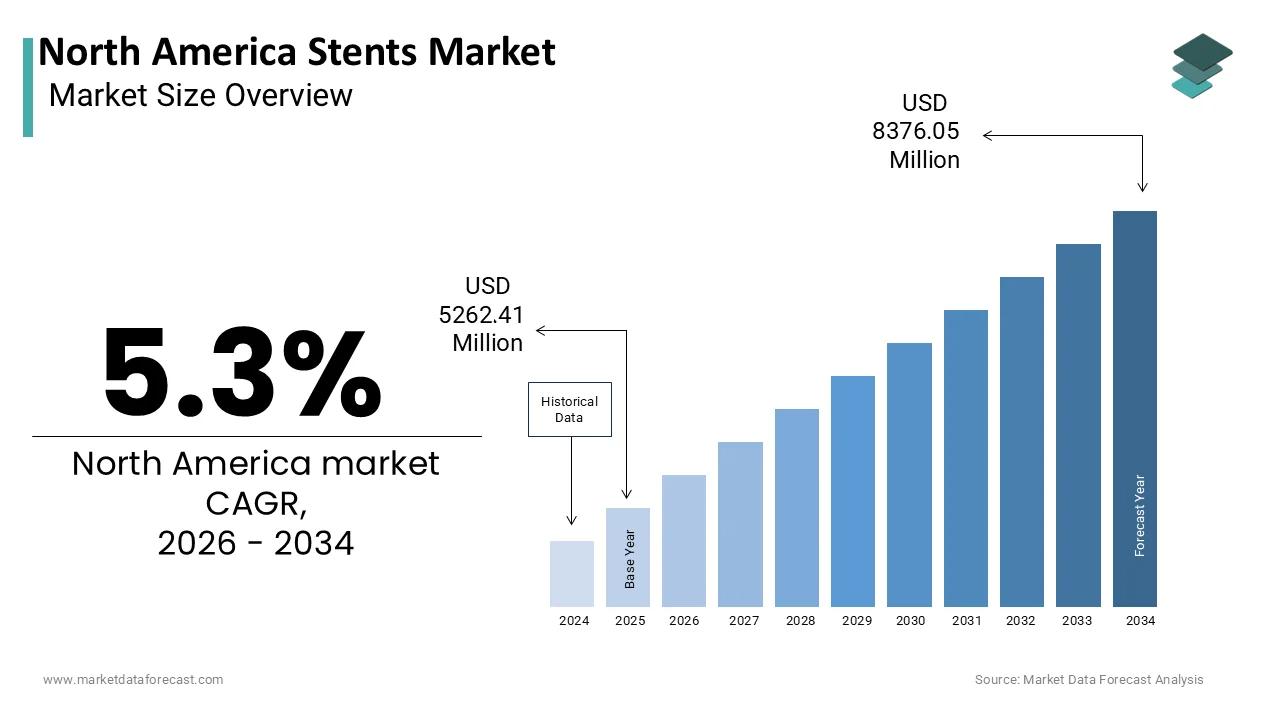
The North America Stents Market Size was valued at USD 5262.41 million in 2025, is expected to have 5.3 % CAGR from 2026 to 2034 and be worth USD 8376.05 million by 2034 from USD 5541.31 million in 2026.
The stents are designed for the treatment of vascular and non-vascular obstructions, primarily through minimally invasive procedures. Stents are commonly used in cardiology, gastroenterology, urology, and neurology to support weakened or blocked ducts and vessels. Coronary stents, in particular, remain the largest application segment due to the high prevalence of cardiovascular diseases across the region. According to the Centers for Disease Control and Prevention (CDC), heart disease remains the leading cause of death in the United Stats , contributing to a sustained demand for interventional cardiology procedures.
MARKET DRIVERS
Rising Prevalence of Cardiovascular Diseases
The increasing prevalence of cardiovascular diseases (CVDs, including) coronary artery disease (CAD), which necessitates interventional treatments involving stents is prompting the growth of the North America stent,s market. According to the Centers for Disease Control and Prevention (CDC), more than 600,000 people die from heart disease annually in the U.S., which is making it the leading cause of death among adults. A major contributing factor to this trend is the rising incidence of hypertension, diabetes, obesity, and sedentary lifestyle , all of which increase the risk of atherosclerosis and myocardial infarction. Moreover, advancements in early diagnosis and imaging technologies have improved detection rates of arterial blockages by enabling timely interventions and higher procedural volumes. Hospitals and cardiac centers across North America have expanded their catheterization lab capacities to accommodate growing patient inflows, further boosting stent utilization. Additionally, public health initiatives promoting heart health awareness and preventive screenings have contributed to increased case identification by ensuring more patients receive life-saving interventions.
Technological Advancements and Product Innovations
Another significant driver of the North American stents market is the continuous development of advanced stent technologies and product innovations aimed at improving clinical outcomes and reducing complications. Over the past decade, manufacturers have introduced next-generation drug-eluting stents (DES), bioresorbable vascular scaffolds (BVS), and ultra-thin strut stents, enhancing safety profiles and long-term efficacy. According to the National Institutes of Health (NIH), clinical trials have demonstrated that modern DES reduce restenosis rates to below 5%, compared to over 20% with older bare-metal stents, significantly improving patient prognosis. A primary enabler of this innovation cycle is the strong presence of leading medical device companies and academic research institutions in the U.S. and Canada , which drive R&D activities in biomaterials, coaing technologies, and biodegradable polymers.
MARKET RESTRAINTS
High Cost of Advanced Stents and Reimbursement Challenges
A major restraint affecting the North America stents market is the high cost of advanced Americanand inconsistent reimbursement policies, which limit accessibility and hinder market expansion. While drug-eluting and bioresorbable stents offer superior clinical benefits, they come with significantly higher price tags compared to traditional bare-metal alternatives. According to the Healthcare Cost and Utilization Project (HCUP), the average cost of a PCI procedure with stent implantation in the U.S. exceeds USD 20,000, with stents accounting for a substantial portion of total expenses. Reimbursement complexities further exacerbate this issue in outpatient and ambulatory surgical settings where coverage varies by insurer and geographic region. Additionally, Medicare and Medicaid reimbursements for stent procedures have remained stagnant despite rising inflation , putting financial pressure on hospitals and cliics that perform these interventions. The Kaiser Family Foundation (KFF) noted that hospitals in several states faced negative margins for certain stent-related procedures in 2023 , discouraging volume growth.
Risk of Complication and Regulatory Scrutiny
Another significant constraint impacting the North America stents market is the risk of post-procedural complications such as in-stent restenosis, thrombosis, and allergic reactions, which have led to heightened regulatory scrutiny and cautious adoption of newer stent technologies. As per the U.S. Food and Drug Administration (FDA), several stent models were subject to recalls or label updates between 2021 and 2023 due to concerns regarding strut fracture, delayed healing, and late stent thrombosis , raising questions about long-term reliability. Moeover, regulatory agencies have imposed stricter post-market surveillance requirements ,mandating extensive clinical follow-up studies before approving novel stent designs.
MARKET OPPORTUNITIES
Expansion of Minimally Invasive Procedures Across Medical Specialties
A significant opportunity emerging in the North America stents market is the growing adoption of minimally invasive procedures across multiple medical specialties beyond cardiology, including gastroenterology, pulmonology, and neurology. As healthcare systems prioritize cost-effective, outpatient-friendly treatments, stent-based interventions are increasingly replacing open surgeries and complex endoscopic procedures. According to the Society of Interventional Radiology (SIR), the use of biliary and esophageal stents for gastrointestinal conditions rose by 12% in 2023 , reflecting broader acceptance of interventional echniques in non-cardiac applications. Additionally, neurovascular stents for stroke prevention and treatment are gaining traction, with the American Stroke Association reporting that endovascular interventions using stent retrievers accounted for nearly 30% of acute ischemic stroke treatments in 2023, up from 20% in 2021.
Increasing Adoption of Bioresorbable Vascular Scaffolds
Another promising avenue for growth in the North America stents market is the increasing interest in bioresorbable vascular scaffolds (BVS), which offer temporary structural support and dissolve over time, eliminating long-term metallic implants. Although initial generations of BVS faced challenges related to strut thickness and mechanical failure, recent iterations have shown marked improvements in radial strength and degradation timelines. As per the Journal of the American College of Cardiology (JACC), newer-generation BVS demonstrated a 12-month target lesion failure rate comparable to second-generation drug-eluting stents , reigniting interest among interventional cardioloists. Furthermore, leading manufacturers are investing heavily in real-world evidence generation and physician training programs, aiming to restore confidence in resorbable technologies after earlier setbacks.
MARKET CHALLENGES
Intense Competition and Pricing Pressures
A major challenge confronting the North AAmericanstents market is the intensifying competition among global and regional players, resulting in aggressive pricing strategies and margin pressures. The market is dominated by a few multinational corporations such as Abbott Laboratories, Boston Scientific, and Medtronic, which hold substantial shares in boththe coronary and peripheral stent segments. According to IBISWorld, over 1,200 medical device companies operate in the U.S. cardiovascular space, many of which compete directly in the stents sector.
Price sensitivity is particularly pronounced in government-funded healthcare programs and large hospital procurement contracts, where buyers leverage bulk purchasing power to negotiate lower unit costs. As reported by the PremierHealthcare Alliancee, group purchasing organizations (GPOs) secured an average price reduction of 15–20% for stents in 2023 by squeezing profitability for manufacturers. Moreover, the influx of cost-competitive offerings from emerging domestic and international vendors has intensified pressure on established firms to maintain market share without compromising quality or innovation.
Stringent Regulatory Requirements and Clinical Trial Burdens
Another critical challenge facing the NorthAmericana stents market is the increased stringency of regulatory pathways and the growing complexity of clinical trial requirements, which prolong product development timelines and raise entry barriers for new entrants. The U.S. Food and Drug Administration (FDA) mandates rigorous pre-market testing, including long-term follow-up studies, especially for novel stent technologies such as bioresorbable scaffolds and bioengineered stents.
As noted by the FDA’s Center for Devices and Radiological Health (CDRH), the average approval timeline for a new stent platform exceeds three years during which extensive data must be generated to p,rove safety, efficacy, and long-term performance. This prolonged evaluation period increases R&D expenditures and delays market access. Additionally, post-market surveillance requirements have become more demandin , with regulators insisting on real-world evidence and registry-based monitoring even after commercial launch.
REPORT COVERAGE
| METRIC | DETAILS |
| Market Size Available | 2025 to 2034 |
| Base Year | 2025 |
| Forecast Period | 2026 to 2034 |
| Segments Covered | By Product, Material, End User, and Country. |
| Various Analyses Covered | Global, Regional & Country Level Analysis, Segment-Level Analysis; DROC, PESTLE Analysis, Porter's Five Forces Analysis, Competitive Landscape, Analyst Overview of Investment Opportunities |
| Country Covered | The U.S., Canad,a anthe restst of North America |
| Market Leader Profiled | Medtronic, Abbott, Cook, Biotronik SE & Co. KG, Teleflex Incorporated |
SEGMENTAL ANALYSIS
By Product Insights
The vascular stents segment was the largest and held a prominent share of the North America stents market in 2025 owing to the high preAmerican of cardiovascular di,seases, particularly coronary artery disease and peripheral vascular conditions, which necessitate interventional procedures involving stent placements. According to the Centers for Disease Control and Prevention (CDC), heart disease remains the leading cause of death in the United States with over 600,000 fatalities annually, reinforci,ng the necessity for vascular interventions. Additionally, the growing incidence of peripheral arterial disease (PAD), especially among aging populations, has expanded the application of vascular stents beyond cardiology into vascular surgery and interventional radiology. The Society of Vascular Surgery noted that over 150,000 peripheral vascular interventions were conducted in North America in 2023 further reinforcing the segment's strong market position.

The non-vascular stents segment is likely to grow with an expected CAGR of 8.3% in the neming years. This rapid ascent is driven by the increasing use of stents in non-cardiac applications such as gastroenterology, urology, pulmonology, and neurology. According to the Society of Interventional Radiology (SIR), the utilization of biliary and esophageal stents rose by 12% in 2023, which is reflecting broader acceptance of minimally invasreflects thes across medical specialties. Moreover, advancements in endoscopic and bronchoscopic stenting techniques have improved patient outcomes and reduced hospitalization durations by making non-vascular stents more appealing for both clinicians and healthcare providers.
By Material Insights
The metallic stents segment wccounted for a dominant share of the North American stents market in 2024. A primary factor driving this segment’s dominance is the superior mechanical properties of metallic materials , which provide reliable scaffolding in high-presure vascular environments. As reported by the National Institutes of Health (NIH), metallic stents demonstrated significantly lower rates of acute recoil and collapse compared to early-generation bioresorbable alternative , ensuring their continued preference in complex cases. Furthermore, established manufacturing capabilities and extensive clinical validation have reinforced physician confidence in metallic stent , despite ongoing advancements in alternative materials.
The non-metallic stents segment is likely to grow with an expected CAGR of 9.1% from 2025 to 2033. This rapid growth is primarily fueled by advancements in polymer-based and bioresorbable vascular scaffolds (BVS), which offer temporary structural support before dissolving naturally, reducing long-term complications associated with permanent implants. One key growth driver is the increasing focus on vessel restoration and natural healing, particularly in younger patient cohorts where lifelong metallic implants are less desirable. Additionally, research institutions and device manufacturers are investing heavily in optimizing polymer composition and deployment techniques, enhancing safety and efficacy. The Medical Device Innovation Consortium (MDIC) reported that clinical trials tracking non-metallic stents saw a 25% increase in enrollment in 2023, whichsignals ag growing industry commitment to advancing this technology.
By End-use Insights
The hospitals segment was the largest by holding a significant share of the North America stents market in 2024. A key growth driver is the high volume of emergency and elective cardiovascular procedures conducted in hospital environments, especially for acute myocardial infarction and critical limb ischemia cases requiring immediate intervention. As reported by the Centers for Disease Control and Prevention (CDC), over 800,000 Americans were hospitalized for heart-related conditions in 2023 , many of whom underwent stent-based treatments. Mreover, hospital reimbursement structures favor comprehensive procedural coverage , enabling greater access to advanced stent technoogies. The Healthcare Cost and Utilization Project (HCUP) noted that hospitals accounted for nearly 95% of all PCI procedures in 2023 by emphasizing their central role in sustaining demand for stents across the region.
The ambulatory care centers segment is likely to grow with an expected CAGR of 8.7% in the coming year,s owing to the increasing shift toward outpatient vascular interventions, supported by advances in minimally invasive techniques, shorter recovery times, and cost-efficiency considerations. According to the Ambulatory Surgery Center Association (ASCA), over 12 million procedures were performed in ambulatory surgery centers (ASCs) in 203 , with vascular interventions representing a growing proportion. Additionally, technological improvements in stent design and delivery systems have made outpatient stenting safer and more feasible , particularly for non-cardiac applications such a gastrointestinal and urological stents.
COUNTRY LEVEL ANALYSIS
The United States was the top performer in the NorthAmericana stents market by holding 76.4% of the share in 2024. A key growth driver is the large number of interventional cardiology centers and catheterization labs across the country, with the Society for Cardiovascular Angiography and Interventions (SCAI) reporting that over 2,500 facilities offered PCI services in 2023 by ensuring broad accessibility to stent procedures. Additionally, favorable regulatory pathways and strong R&D investments from leading manufacturers like Abbott, Boston Scientific, and Medtronic have enabled the rapid introduction of next-generation stents.

Canada was positioned second by holding 13.3% of share in 2024. One of the key growth drivers is the expansion of provincial healthcare programs that cover stent procedures under publicly funded health plans , ensuring equitable access across urban and rural regions. As per the Canadian Institute for Health Information (CIHI), cardiovascular interventions in Canada increased by 5.4% in 2023 with stent placements forming a significant portion of these procedures. Moreover, Canadian hospitals are adopting advanced imaging and robotic-assisted stent deployment techniques by improving procedural accuracy and patient outcomes.
KEY MARKET PLAYERS AND COMPETITIVE LANDSCAPE
Medtronic, Abbott, Cook, Biotronik SE & Co. KG, Teleflex Incorporated, MicroPort Scientific Corporation, Fuji Systems Corp., MICRO-TECH EUROPE, Vascular Concepts, Boston Scientific Corporation, Olympus, Merit Medical Systems, Novatech SA, Terumo Corporation, W. L. Gore & Associates Inc., B. Braun Melsungen AG, Meditek Systems Pvt. Ltd., and Thoracent, Inc. are some of the noteworthy players in the North American stents market.
The competition in the North America stents market is intense and highly dynamic, characterized by a few dominant multinational corporations and a growing number of specialized medical device firms. The market remains largely consolidated, with Abbott, Boston Scientific, and Medtronic collectively holding the majority share due to their strong product pipelines, deep clinical expertise, and well-established distribution networks. However, smaller and emerging companies are increasingly challenging this dominance by introducing cost-effective alternatives and niche innovations tailored for specific vascular conditions.
Innovation cycles have accelerated, with manufacturers competing not only on material science and design but also on clinical outcomes, ease of deployment, and compatibility with imaging and robotic-assisted intervention platforms. Strategic mergers and acquisitions are becoming more frequent, allowing firms to consolidate their technological strengths and expand into underpenetrated therapeutic areas. In addition, regulatory agencies are playing an influential role by enforcing stringent clinical validation requirements, which favor companies with robust post-market surveillance capabilities.
Customer-centric approaches such as physician education programs, customized procedural support, and real-time data integration are becoming key differentiators. In this evolving landscape, success depends on a company’s ability to balance innovation with regulatory readiness and deliver high-performance, clinically proven stent solutions that align with shifting healthcare priorities.
Top Players in the Market
One of the leading players in the North America stents market is Abbott Laboratories , a global healthcare innovator known for its pioneering work in cardiovascular devices. Abbott’s flagship product, the Absorb bioresorbable vascular scaffold, has played a crucial role in shaping next-generation stent technologies. The company continues to drive advancements in drug-eluting and ultra-thin strut stents, reinforcing its leadership in interventional cardiology.
Another key player is Boston Scientific Corporation, which has established itself as a major force in both coronary and peripheral vascular interventions. Boston Scientific's broad portfolio includes advanced stent systems designed for complex lesions and long-term durability. Its focus on clinical research, physician training, and digital integration has made it a preferred partner across leading catheterization labs in North America.
Medtronic plc is also a dominant participant in the regional stents market, recognized for its comprehensive range of vascular solutions including drug-eluting, bare-metal, and self-expanding stents. Medtronic plays a pivotal role in setting clinical benchmarks through extensive trials and real-world data generation by contributing significantly to global standards in stent performance and patient outcomes.
Top Strategies Used by Key Market Participants
Key players in the North America stents market are leveraging continuous innovation and product differentiation to maintain competitive advantage. Companies are investing heavily in R&D to develop thinner-strut designs, biodegradable materials, and enhanced drug coatings that improve healing and reduce complications, ensuring sustained clinical relevance.
Another major strategy involves expanding into adjacent therapeutic areas beyond cardiology , such as gastroenterology, urology, and neurology, where minimally invasive stenting procedures are gaining traction.
Additionally, firms are focusing on strategic acquisitions and partnerships to strengthen their technological capabilities and geographic reach. Collaborations with academic institutions, clinical trial networks, and digital health platforms allow companies to integrate AI-driven diagnostics, predictive analytics, and remote monitoring into stent-based treatment pathways by enhancing overall value propositions in modern healthcare delivery.
RECENT HAPPENINGS IN THE MARKET
In February 2024, Abbott launched a next-generation ultra-thin strut coronary stent, which is featuring enhanced flexibility and improved vessel conformity, aimed at optimizing outcomes in complex lesion treatments across North America.
In April 2024, Boston Scientific announced a strategic partnership with a leading AI-driven cardiovascular imaging firm, which is integrating machine learning algorithms into its stent delivery systems to enhance precision during interventional procedures.
In June 2024, Medtronic expanded its manufacturing capabilities in Minnesota with a new facility dedicated to producing peripheral vascular stents by addressing rising demand for limb-saving interventions among diabetic and elderly patients.
In August 2024, a prominent Japanese medical device manufacturer acquired a U.S.-based startup specializing in bioresorbable stent technology by aiming to accelerate commercialization of next-generation transient scaffolds in the North American market.
In October 2024, Terumo Cardiovascular introduced a novel line of hybrid stents combining metallic and polymer elements, which is targeting niche applications in bifurcated arteries and small-vessel interventions, further diversifying the regional stent landscape.
MARKET SEGMENTATION
This research report on the North America stents market has been segmented and sub-segmented into the following categories.
By Product
- Vascular
- Non-vascular
By Material
- Metallic
- Non-metallic
By End User
- Hospitals
- Ambulatory Care Centers
- Specialty Clinics
By Country
- The United States
- Canada
- Rest of North America