North America Subsea Umbilicals Risers and Flowlines Market Size, Share, Trends & Growth Forecast Report – Segmented By Water Depth, Product, and Country (The United States, Canada and Rest of North America), Industry Analysis From 2026 to 2034
Market Size, 2025
$783 MnMarket Estimate, 2026
$849 MnMarket Forecast, 2034
$1,626 MnCAGR, 2026–2034
8.46%North America Subsea Umbilicals Risers and Flowlines Market Size
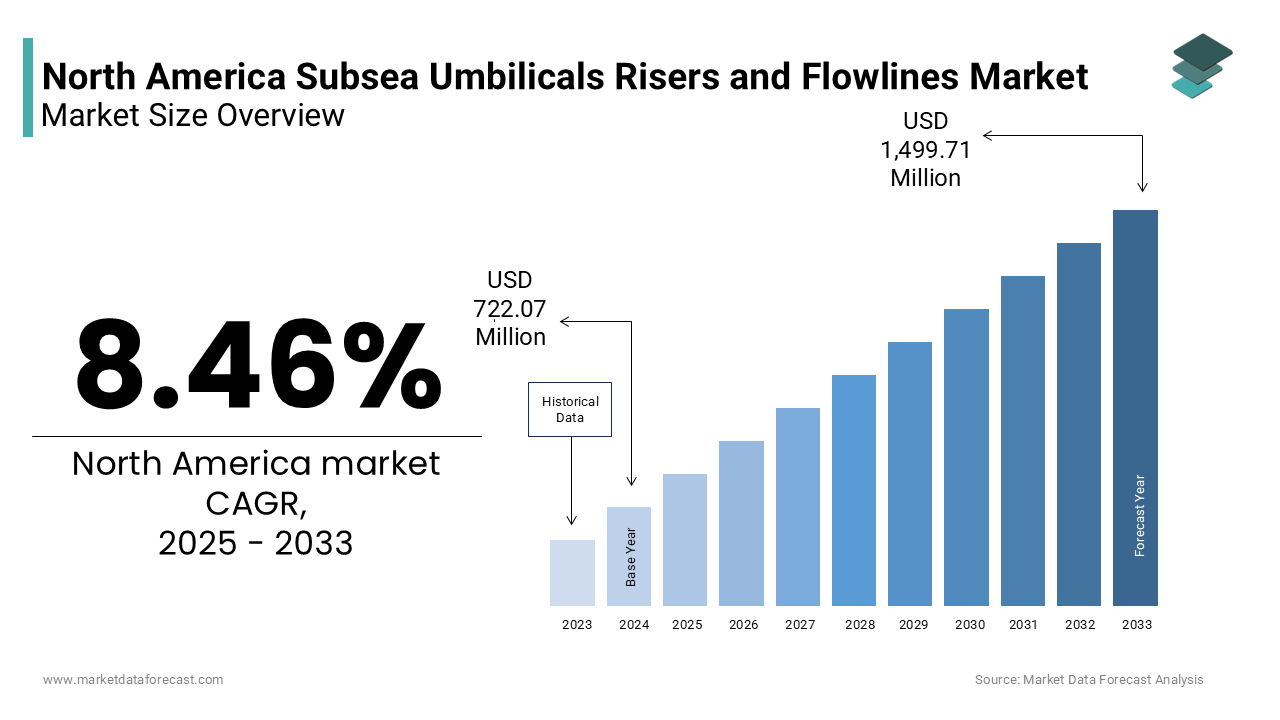
The North America subsea umbilicals risers and flowlines market size was valued at USD 783.16 million in 2025 and is projected to reach USD 1,626.59 million by 2034 from USD 849.42 million in 2026, growing at a CAGR of 8.46%.
The subsea umbilicals, risers, and flowlines are the offshore oil and gas infrastructure ecosystem, encompassing specialized flexible pipe systems that facilitate the transportation of hydrocarbons, chemicals, and control signals between subsea production systems and surface facilities. These engineered solutions serve as the lifelines of deepwater and ultra-deepwater developments, enabling the extraction and processing of hydrocarbon resources from challenging marine environments. According to the U.S. Bureau of Ocean Energy Management, the Gulf of Mexico hosts over 1,800 active offshore platforms, with water depths ranging from shallow waters to ultra-deep environments exceeding 10,000 feet, necessitating sophisticated subsea infrastructure solutions. Canada's offshore Newfoundland and Labrador regions have also emerged as significant markets, with recent discoveries in the Jeanne d'Arc Basin requiring extensive subsea infrastructure investments. The technological complexity of these systems involves multi-layered composite materials, advanced polymers, and corrosion-resistant alloys designed to withstand extreme pressure differentials, corrosive seawater environments, and mechanical stresses over operational lifespans exceeding 25 years.
MARKET DRIVERS
Deepwater and Ultra-Deepwater Exploration Activities
The intensification of deepwater and ultra-deepwater exploration activities, across North American offshore basins serves as the primary catalyst driving demand for subsea umbilicals, risers, and flowlines. As conventional shallow-water reserves become increasingly depleted, energy companies are focusing their exploration efforts on technically challenging environments that require sophisticated subsea infrastructure solutions. According to the U.S. Energy Information Administration, over 70% of new offshore drilling permits in the Gulf of Mexico target water depths exceeding 1,000 meters, with ultra-deepwater projects representing 35% of total exploration activities. The Shenandoah field development by Shell and the Anchor field discovery by ExxonMobil exemplify the scale of these projects, requiring extensive subsea infrastructure networks spanning hundreds of kilometers to connect multiple wellheads to floating production systems. Recent technological advancements in subsea processing equipment have enabled the economic development of reservoirs located at depths exceeding 3,000 meters, creating substantial demand for specialized umbilical systems capable of transmitting high-pressure hydraulic fluids and electrical power across extreme distances. As per Wood Mackenzie's offshore development analysis, North American deepwater projects typically require 25-40 kilometers of umbilical systems per wellhead, with complex developments incorporating multiple control umbilicals, chemical injection lines, and power distribution networks. The Gulf of Mexico's Walker Ridge and Green Canyon regions have witnessed a 45% increase in subsea infrastructure investments since 2020, driven by major developments including Chevron's Jack/St. Malo complex and BP's Thunder Horse expansion. Additionally, the emergence of subsea processing hubs and tie-back developments has created demand for flexible flowlines capable of accommodating thermal expansion and mechanical movement while maintaining pressure integrity across varying operational conditions.
Floating Production Systems and FPSO Deployments
The widespread adoption of floating production systems, including Floating Production Storage and Offloading vessels and Floating Liquefied Natural Gas platforms, has emerged as a significant driver for the North America subsea umbilicals, risers, and flowlines market. These mobile production facilities require extensive subsea infrastructure connections to enable continuous hydrocarbon extraction and processing, while maintaining operational flexibility in challenging marine environments. According to the International Association of Floating Production Systems, over 60% of new offshore developments in North American waters now incorporate floating production concepts, necessitating dynamic riser systems and flexible flowline connections that can accommodate vessel movement, while maintaining fluid transfer integrity. The Gulf of Mexico has become a global leader in floating production deployments, with recent projects including the Magnolia FPSO and the South Timbalier Block 230 development requiring specialized subsea infrastructure solutions to connect subsea wells to surface processing facilities. Modern FPSO vessels typically incorporate 15-25 individual riser systems, including production risers, export risers, and utility umbilicals that must withstand cyclic loading conditions and environmental forces over extended operational periods. As per Rystad Energy's floating production analysis, North American offshore developments utilizing floating production systems require an average of 35 kilometers of flexible risers and flowlines per vessel, with ultra-deepwater deployments often exceeding 100 kilometers of subsea infrastructure connections. The increasing complexity of these systems has driven demand for advanced materials and manufacturing techniques, including thermoplastic hoses, steel catenary risers, and hybrid umbilical designs that integrate multiple functionality layers within single cable assemblies.
MARKET RESTRAINTS
Supply Chain Disruptions and Material Shortages
The persistent supply chain disruptions and specialized material shortages that impact project timelines and cost structures is one of the major factors restricting the growth of . The complex manufacturing processes required for subsea infrastructure components involve specialized polymers, corrosion-resistant alloys, and advanced composite materials that are sourced from a limited number of global suppliers. According to the American Petroleum Institute, the subsea equipment manufacturing sector experienced a 25% increase in lead times during 2022-2023, primarily due to raw material shortages and manufacturing capacity constraints. The concentration of critical material suppliers in Europe and Asia has created logistical vulnerabilities, with transportation delays and customs bottlenecks affecting delivery schedules for essential components including high-grade stainless steel, fluoropolymers, and specialized elastomers. Major subsea contractors including Subsea 7 and TechnipFMC have reported project delays averaging 18-24 weeks due to supply chain disruptions, with some developments experiencing cost overruns exceeding 15% as a result of expedited shipping requirements and alternative material sourcing. The semiconductor shortage has also impacted the availability of electronic components required for intelligent umbilical systems, affecting the integration of fiber optic communication cables and pressure monitoring sensors within subsea infrastructure networks. As per IHS Markit's supply chain analysis, North American subsea projects have experienced average material cost increases of 22% since 2021, with specialty polymers and corrosion-resistant alloys showing the most significant price volatility. These supply constraints have forced operators to reconsider project timelines and explore alternative sourcing strategies, including regional manufacturing partnerships and inventory optimization programs.
Regulatory Compliance and Environmental Permitting Requirements
Stringent regulatory compliance requirements and complex environmental permitting processes is additionally hampering the growth of North America subsea umbilicals, risers, and flowlines market. The regulatory landscape governing offshore development activities involves multiple federal agencies including the Bureau of Ocean Energy Management, the Bureau of Safety and Environmental Enforcement, and the Environmental Protection Agency, each imposing distinct compliance requirements that must be satisfied before project implementation. According to the National Oceanic and Atmospheric Administration, the average environmental review process for major subsea infrastructure projects in North American waters now exceeds 24 months, with comprehensive environmental impact assessments required for developments in sensitive marine ecosystems. The introduction of enhanced safety regulations following recent offshore incidents has created additional compliance burdens, including mandatory third-party verification of subsea equipment design, installation procedures, and operational protocols. As per the Offshore Operators Committee, compliance costs for major subsea developments have increased by 30% since 2020, with regulatory documentation and third-party certification requirements representing 12-15% of total project expenditures. The Marine Protection, Research, and Sanctuaries Act imposes strict limitations on subsea infrastructure placement in designated marine protected areas, requiring alternative routing solutions that may increase project complexity and cost. Additionally, state-level regulations in Louisiana, Texas, and Alaska have introduced additional permitting requirements for coastal zone management and wildlife protection, which is creating jurisdictional complexities that extend project development timelines. The evolving regulatory framework also includes emerging climate change considerations and carbon emission reduction mandates that may impact future subsea development approvals and operational requirements.
MARKET OPPORTUNITIES
Renewable Energy Integration and Offshore Wind Developments
The emergence of offshore wind energy projects, as these renewable energy installations require extensive subsea infrastructure connections for power transmission, array cabling, and inter-array connections is also leveraging new opportunities for the growth of North America subsea umbilicals, risers, and flowlines market. The Biden administration's commitment to achieving 30 gigawatts of offshore wind capacity by 2030 has created substantial demand for specialized subsea cable systems and flexible pipe solutions that can accommodate the unique requirements of renewable energy applications. According to the National Renewable Energy Laboratory, North American offshore wind projects will require approximately 15,000 kilometers of subsea export cables and 8,000 kilometers of inter-array cables by 2030, representing a significant market opportunity for established subsea infrastructure providers. The technical requirements for offshore wind cable systems share many similarities with traditional oil and gas umbilicals, including dynamic load management, corrosion resistance, and environmental compliance considerations. Major offshore wind developments including the Vineyard Wind project off Massachusetts and the Empire Wind development off New York require specialized subsea infrastructure solutions to connect individual turbines to offshore substations and mainland power grids. As per the Offshore Wind Development Coalition, each offshore wind turbine requires 3-5 kilometers of subsea array cables, with larger projects incorporating multiple export cable systems to accommodate power transmission requirements. The integration of hybrid cable systems that combine power transmission with fiber optic communication capabilities has created demand for advanced manufacturing capabilities and specialized installation vessels that can support both traditional oil and gas applications and renewable energy infrastructure requirements.
Digitalization and Smart Subsea Infrastructure
The digital transformation of subsea infrastructure systems through the integration of advanced monitoring systems, predictive maintenance technologies, and intelligent control capabilities, which is additionally enhancing the growth of North America subsea umbilicals risers and flowlines market. The adoption of digital twin technologies and real-time monitoring systems has created demand for enhanced umbilical designs that incorporate fiber optic communication networks, distributed temperature sensing capabilities, and advanced pressure monitoring systems. According to the Society of Petroleum Engineers, over 75% of new subsea developments in North American waters now incorporate intelligent completion systems that require sophisticated umbilical connections to enable real-time data transmission and remote operational control. The integration of Internet of Things sensors within subsea infrastructure components has created demand for hybrid umbilical systems that combine traditional hydraulic and electrical functionality with advanced communication capabilities. Major operators including ExxonMobil, Chevron, and Shell have implemented digital subsea monitoring programs that require extensive fiber optic networks and sensor integration within existing umbilical infrastructure. As per Wood Mackenzie's digital transformation analysis, the North American subsea market has witnessed a 40% increase in demand for intelligent umbilical systems since 2021, driven by operator requirements for enhanced production optimization and predictive maintenance capabilities. The development of autonomous underwater vehicle inspection programs has also created demand for subsea infrastructure components that can accommodate advanced monitoring equipment and provide real-time operational data to surface facilities. Additionally, the implementation of artificial intelligence and machine learning algorithms for production optimization requires high-bandwidth communication systems that can support continuous data transmission from subsea sensors to surface processing facilities.
MARKET CHALLENGES
Technical Complexity and Installation Risks
The inherent technical complexity associated with subsea umbilicals, risers, and flowlines installation presents significant operational challenges that impact project execution and cost management within the North America market. These sophisticated systems must be deployed in challenging marine environments characterized by extreme water depths, harsh weather conditions, and complex seabed topography that require specialized installation vessels and advanced deployment techniques. According to the International Marine Contractors Association, the failure rate for subsea infrastructure installations in North American waters averages 8-12%, with technical complications during deployment representing the primary cause of project delays and cost overruns. The dynamic nature of marine environments creates additional challenges, as subsea systems must accommodate thermal expansion, mechanical movement, and environmental loading, while maintaining pressure integrity and operational functionality over extended periods. As per the Offshore Technology Research Centre, installation complexity increases exponentially with water depth, with ultra-deepwater deployments requiring specialized installation vessels equipped with dynamic positioning systems, advanced winch technology, and real-time monitoring capabilities. The integration of multiple functionality layers within single umbilical assemblies has increased manufacturing complexity and quality control requirements, with defect rates for complex hybrid systems exceeding 5% during recent installation campaigns. Additionally, the requirement for precise positioning and alignment during subsea infrastructure installation necessitates advanced surveying equipment and specialized diving support that significantly increases project costs and operational risks. Weather-related delays and equipment failures during installation campaigns can result in project delays exceeding 90 days, with associated cost impacts often exceeding 20% of total project budgets.
Corrosion and Integrity Management
Corrosion management and long-term integrity maintenance, as these systems must maintain operational performance in highly corrosive seawater environments, while withstanding mechanical stresses and pressure differentials over extended operational lifespans is certainly to impede the growth of the North America subsea umbilicals, risers, and flowlines market. The marine environment presents unique corrosion challenges, including galvanic corrosion, microbiologically influenced corrosion, and stress corrosion cracking that can compromise subsea infrastructure integrity and operational safety. According to the National Association of Corrosion Engineers, corrosion-related failures account for approximately 25% of all subsea infrastructure maintenance activities in North American waters, with repair costs averaging 3-5 times the original equipment cost. The complexity of subsea systems makes inspection and maintenance activities particularly challenging, requiring specialized remotely operated vehicles and advanced non-destructive testing techniques to identify and address potential integrity issues. As per the American Society of Mechanical Engineers, the average inspection interval for critical subsea components has decreased from 5 years to 3 years due to increasing concerns regarding material degradation and fatigue accumulation in harsh marine environments. The development of advanced corrosion-resistant materials and protective coatings has created additional manufacturing complexity and cost pressures, with specialized alloys and polymer systems representing 40-50% of total subsea infrastructure costs. Additionally, the integration of multiple material types within single subsea systems creates galvanic compatibility challenges that require careful design consideration and ongoing monitoring to prevent premature failure. The implementation of comprehensive integrity management programs requires significant investment in inspection equipment, specialized personnel, and advanced monitoring systems that continuously track system performance and identify potential failure modes before they impact operational safety or production continuity.
REPORT COVERAGE
| REPORT METRIC | DETAILS |
| Market Size Available | 2025 to 2034 |
| Base Year | 2025 |
| Forecast Period | 2026 to 2034 |
| CAGR | 8.46% |
| Segments Covered | By Water Depth, Product, and Region |
| Various Analyses Covered | Global, Regional, & Country Level Analysis; Segment-Level Analysis; DROC, PESTLE Analysis; Porter’s Five Forces Analysis; Competitive Landscape; Analyst Overview of Investment Opportunities |
| Regions Covered | The United States, Canada, Mexico, and Rest of North America |
| Market Leaders Profiled | ArcelorMittal Downstream Solutions, Aker Solutions, Bartell Machinery, Baker Hughes Company, Dril-Quip, Inc., Halliburton, John Wood Group PLC, JDR Cable Systems Ltd., Oil States Industries, Inc., Oceaneering International, Inc., Saipem SpA, Syensqo, Subsea7, Tenaris, TechnipFMC plc, and Vallourec |
SEGMENTAL ANALYSIS
By Water Depth Insights
The deep water segment was the largest by capturing 45.3% of the North America subsea umbilicals risers and flowlines market share in 2025 with the subsea infrastructure deployments in water depths ranging from 500 to 1,500 meters, representing the optimal balance between technical feasibility and economic viability for offshore development projects. The prevalence of deep-water developments stems from the maturation of shallow water reserves and the discovery of significant hydrocarbon accumulations in deeper offshore basins that require sophisticated subsea infrastructure solutions for economic extraction. According to the U.S. Bureau of Ocean Energy Management, the Gulf of Mexico hosts over 1,200 active deepwater wells, with water depths ranging from 500 to 3,000 meters, creating substantial demand for specialized umbilical, riser, and flowline systems designed for challenging marine environments. Major discoveries including the Shenandoah field by Shell, the Anchor field by ExxonMobil, and the Mad Dog Phase 2 development by BP have required extensive subsea infrastructure networks spanning hundreds of kilometers to connect multiple wellheads to floating production systems. As per Wood Mackenzie's Gulf of Mexico development analysis, deepwater projects in this region typically require 30-50 kilometers of umbilical systems per development, with complex infrastructure networks incorporating multiple control umbilicals, chemical injection lines, and power distribution systems. Additionally, the maturation of shallow water reserves has compelled operators to focus their exploration efforts on deepwater prospects, with over 70% of new drilling permits in the Gulf of Mexico targeting water depths exceeding 1,000 meters according to the International Association of Oil & Gas Producers. The technical expertise and manufacturing capabilities required for deepwater subsea infrastructure have concentrated within specialized vendors, creating economies of scale that favor continued investment in this market segment. According to the International Association of Floating Production Systems, over 65% of new deepwater developments in North American waters, now incorporate floating production concepts, necessitating dynamic riser systems and flexible flowline connections that can accommodate vessel movement while maintaining fluid transfer integrity. Modern floating production storage and offloading vessels typically incorporate 18-28 individual riser systems, including production risers, export risers, and utility umbilicals that must withstand cyclic loading conditions and environmental forces over extended operational periods. Major developments including the Magnolia FPSO and the South Timbalier Block 230 project require specialized subsea infrastructure solutions to connect subsea wells to surface processing facilities, with each connection requiring 25-40 kilometers of flexible risers and flowlines. The increasing complexity of these systems has driven demand for advanced materials and manufacturing techniques, including thermoplastic hoses, steel catenary risers, and hybrid umbilical designs that integrate multiple functionality layers within single cable assemblies. Additionally, the requirement for quick disconnect systems and emergency release mechanisms in floating production applications has created demand for specialized subsea infrastructure components that can accommodate rapid deployment and retrieval operations while maintaining operational safety and environmental protection standards.

The ultra-deep water segment is expected to grow with a prominent CAGR of 18.4% from 2026 to 2034. The rapid advancement of ultra-deepwater drilling technologies and subsea processing capabilities has emerged as the primary catalyst driving unprecedented growth within the ultra-deep water subsea infrastructure, across North America. According to the Society of Petroleum Engineers, technological breakthroughs in drilling equipment, subsea processing systems, and installation vessels have enabled the economic development of reservoirs located at depths exceeding 3,000 meters, creating substantial demand for specialized subsea infrastructure solutions. Major developments including BP's Thunder Horse expansion and Chevron's Blind Faith project require specialized subsea infrastructure networks spanning over 200 kilometers to connect multiple wellheads to floating production systems in water depths exceeding 2,000 meters. As per Wood Mackenzie's ultra-deepwater development analysis, each ultra-deepwater project requires an average of 65 kilometers of umbilical systems, with complex infrastructure networks incorporating multiple control umbilicals, chemical injection lines, and power distribution systems. Additionally, the development of subsea processing hubs and tie-back developments has created demand for flexible flowlines capable of accommodating thermal expansion and mechanical movement, while maintaining pressure integrity across varying operational conditions. Substantial capital investments by major international operators in frontier ultra-deepwater developments have rapid market expansion, as these companies commit significant resources to access previously unreachable hydrocarbon reserves in the most challenging marine environments. ExxonMobil's commitment to the Hadrian ultra-deepwater development requires $8.2 billion in subsea infrastructure investments, including 180 kilometers of specialized umbilical systems and 240 kilometers of flexible flowlines designed for water depths exceeding 2,500 meters. Chevron's Blind Faith project represents another significant investment, with the company allocating $6.8 billion for subsea infrastructure development to connect multiple wellheads in water depths ranging from 2,200 to 2,800 meters. As per the American Petroleum Institute's infrastructure investment report, ultra-deepwater projects typically require 2-3 times the subsea infrastructure investment compared to conventional deepwater developments, with specialized equipment and installation services representing 65-70% of total project costs. Additionally, the formation of strategic partnerships between major operators and specialized subsea contractors has accelerated ultra-deepwater development timelines, with joint ventures enabling risk sharing and technology transfer that reduces individual company exposure while accelerating project execution. The requirement for specialized installation vessels and advanced deployment techniques has created opportunities for subsea infrastructure manufacturers to develop next-generation products specifically designed for ultra-deepwater applications, including enhanced corrosion-resistant materials and advanced monitoring systems that ensure long-term operational reliability in extreme marine environments.
By Product Insights
The flowlines segment was accounted in holding 48.3% of the North America subsea umbilicals risers and flowlines market share in 2025 with the flexible and rigid pipe systems designed for the transportation of hydrocarbons, chemicals, and produced water between subsea wells, processing equipment, and surface facilities. The fundamental requirement for extensive pipeline networks in subsea development projects has established flowlines as the largest product segment within the North America subsea infrastructure market, as these systems represent the backbone of hydrocarbon transportation between multiple wellheads and processing facilities. Major developments including the Mad Dog Phase 2 project by BP require over 200 kilometers of specialized flowline systems to connect multiple wellheads to central processing facilities, with individual flowlines ranging from 6-12 inches in diameter to accommodate varying production rates and pressure requirements. The Gulf of Mexico's deepwater developments have witnessed a 55% increase in flowline infrastructure investments since 2020, driven by major projects including Chevron's Jack/St. Malo complex expansion and Shell's Appomattox development. Additionally, the requirement for multiple flowline connections in subsea processing hub configurations has created demand for specialized pipeline systems featuring advanced corrosion-resistant materials and thermal insulation capabilities. The integration of pigging systems and inline inspection capabilities within flowline designs has further enhanced their operational importance, with 95% of new flowline installations incorporating intelligent pipeline monitoring systems that enable real-time pressure and flow monitoring according to the Pipeline Research Council International's infrastructure integrity analysis. The increasing focus on production optimization and enhanced oil recovery techniques has emerged as a significant catalyst for flowline market expansion, as operators require specialized pipeline systems to accommodate injection fluids, chemical treatments, and produced water management in complex subsea environments. Major developments including the Thunder Horse expansion by BP require over 150 kilometers of specialized injection flowlines to support water flooding operations, with individual pipelines featuring corrosion-resistant linings and pressure monitoring systems to ensure optimal injection performance. The Gulf of Mexico's mature fields have witnessed a 48% increase in enhanced recovery flowline installations since 2021, driven by operator requirements to maximize recovery factors and extend field life through advanced production techniques. Additionally, the implementation of subsea separation and boosting systems has created demand for specialized flowline configurations that can accommodate multiphase flow and pressure boosting requirements in remote subsea environments.
The umbilicals segment is more likely to witness a fastest CAGR of 16.2% from 2026 to 2034 with specialized flexible cable systems that provide hydraulic power, electrical power, and communication signals between surface facilities and subsea equipment by enabling remote control and monitoring of subsea production systems. According to the Society of Petroleum Engineers, over 82% of new subsea developments in North American waters now incorporate intelligent completion systems that require extensive umbilical connections to enable real-time data transmission and remote operational control. The integration of Internet of Things sensors within subsea infrastructure components has created demand for hybrid umbilical systems that combine traditional hydraulic and electrical functionality with advanced communication capabilities, including fiber optic networks and high-speed data transmission systems. Major operators including ExxonMobil, Chevron, and Shell have implemented digital subsea monitoring programs that require extensive fiber optic networks and sensor integration within existing umbilical infrastructure, with individual developments requiring 40-60 kilometers of specialized umbilical systems. The development of autonomous underwater vehicle inspection programs has also created demand for subsea infrastructure components that can accommodate advanced monitoring equipment and provide real-time operational data to surface facilities. Additionally, the implementation of artificial intelligence and machine learning algorithms for production optimization requires high-bandwidth communication systems that can support continuous data transmission from subsea sensors to surface processing facilities, with individual umbilical systems now incorporating multiple fiber optic strands and advanced signal processing capabilities. The proliferation of complex subsea processing hub configurations has rapid expansion, as these sophisticated developments require extensive control and communication infrastructure to enable remote operation and monitoring of multiple subsea processing units and wellhead systems. Major developments including the Mad Dog Phase 2 project by BP require over 80 kilometers of specialized umbilical systems to connect subsea separation and boosting equipment to surface processing facilities, with individual umbilicals incorporating multiple functionality layers including hydraulic control lines, electrical power cables, and fiber optic communication systems. Additionally, the requirement for redundant control systems and emergency shutdown capabilities in subsea processing applications has created demand for specialized umbilical configurations featuring multiple backup systems and enhanced reliability specifications. The integration of subsea power distribution systems has also accelerated umbilical demand, with operators deploying high-voltage electrical umbilicals to power remote subsea processing equipment and reduce the requirement for surface-based power generation systems.
REGIONAL ANALYSIS
United States Subsea Umbilicals Risers and Flowlines Market Analysis
The United States was the top performer of the North America subsea umbilicals risers and flowlines market by occupying 88.3% of the share in 2025 from the country's status as the global epicenter for deepwater and ultra-deepwater development activities, hosting the world's most concentrated portfolio of offshore oil and gas reserves in the Gulf of Mexico and maintaining the largest fleet of specialized subsea installation vessels and manufacturing facilities. The United States' market supremacy is further reinforced by its advanced technological capabilities, extensive regulatory framework, and substantial investments in next-generation subsea infrastructure technologies including intelligent completion systems and digital monitoring platforms. The unprecedented deepwater development activities in the Gulf of Mexico, extensive floating production system deployments, and emerging offshore wind energy projects that require sophisticated subsea cable systems and flexible pipe solutions. According to the International Association of Oil & Gas Producers, the Gulf of Mexico hosts over 1,800 active offshore platforms, with water depths ranging from shallow waters to ultra-deep environments exceeding 10,000 feet, necessitating sophisticated subsea infrastructure solutions for continued production optimization. Major international operators including ExxonMobil, Chevron, BP, and Shell have collectively invested over $120 billion in Gulf of Mexico offshore infrastructure between 2020 and 2023, with subsea umbilicals, risers, and flowlines representing 25-30% of total development expenditures according to Rystad Energy's operator spending analysis. The proliferation of subsea processing hubs and tie-back developments has created substantial demand for flexible flowlines and specialized umbilical systems capable of accommodating thermal expansion and mechanical movement while maintaining pressure integrity across varying operational conditions. As per Wood Mackenzie's Gulf of Mexico development analysis, deepwater projects in this region typically require 40-60 kilometers of umbilical systems per development, with complex infrastructure networks incorporating multiple control umbilicals, chemical injection lines, and power distribution systems. The Gulf of Mexico's Walker Ridge, Green Canyon, and Mississippi Canyon regions have witnessed a 58% increase in subsea infrastructure investments since 2020, driven by major developments including Chevron's Jack/St. Malo complex expansion and Shell's Appomattox development. Additionally, the emergence of offshore wind energy projects along the U.S. East Coast has created demand for specialized subsea cable systems and flexible pipe solutions that can accommodate the unique requirements of renewable energy applications, with the Biden administration's commitment to achieving 30 gigawatts of offshore wind capacity by 2030 representing a significant market opportunity for established subsea infrastructure providers.
Canada Subsea Umbilicals Risers and Flowlines Market Analysis
Canada subsea umbilicals risers and flowlines market ranked second by capturing 10.3% of the share in 2025. The country's subsea infrastructure market presence is characterized by strong government support for offshore development activities, strategic geographic positioning for transatlantic energy trade, and growing adoption of advanced subsea technologies in the challenging marine environments of the Atlantic provinces. According to the Canada-Newfoundland and Labrador Offshore Petroleum Board, the Jeanne d'Arc Basin hosts over 200 active offshore wells, with water depths ranging from 100 to 300 meters by creating substantial demand for specialized subsea infrastructure solutions designed for harsh North Atlantic marine environments. Major developments including the West White Rose expansion and the Bay du Nord discovery have required extensive subsea infrastructure networks spanning over 100 kilometers to connect multiple wellheads to floating production systems, with individual projects requiring 25-35 kilometers of umbilical systems and 40-60 kilometers of flexible flowlines. The implementation of subsea separation and boosting systems has created demand for specialized flowline configurations that can accommodate multiphase flow and pressure boosting requirements in remote subsea environments, with individual developments incorporating advanced corrosion-resistant materials and thermal insulation capabilities. Additionally, the requirement for produced water reinjection systems has accelerated flowline demand, with environmental regulations mandating 98% of produced water reinjection in Canadian offshore developments according to the Canada-Nova Scotia Offshore Petroleum Board's environmental compliance analysis.
COMPETITIVE LANDSCAPE
The North America subsea umbilicals risers and flowlines market exhibits intense competitive dynamics characterized by technological innovation, strategic positioning, and customer-centric solution development among established players and emerging vendors. Market competition is primarily driven by performance differentiation, pricing strategies, and service capabilities as operators increasingly demand flexible, scalable, and reliable subsea infrastructure solutions for challenging offshore environments. The competitive landscape is marked by continuous product innovation cycles, with major vendors regularly introducing enhanced subsea systems featuring improved materials, advanced monitoring capabilities, and optimized installation techniques. Strategic acquisitions and partnerships have become commonplace as companies seek to expand their technological capabilities and market reach while addressing evolving customer requirements for complex offshore development projects and emerging renewable energy applications. Price competition remains significant, particularly in segments where commoditization pressures exist, forcing vendors to differentiate through value-added services, extended warranties, and comprehensive support offerings. The market also experiences competition from alternative subsea technologies and installation methodologies that challenge traditional infrastructure deployment models and operational approaches. Regional competition varies significantly based on local market conditions, regulatory requirements, and customer preferences, requiring vendors to adapt their strategies while maintaining global competitiveness and operational efficiency.
KEY MARKET PLAYERS
Some of the notable key players in the North America subsea umbilicals risers and flowlines market are
- ArcelorMittal Downstream Solutions
- Aker Solutions
- Bartell Machinery
- Baker Hughes Company
- Dril-Quip, Inc.
- Halliburton
- John Wood Group PLC
- JDR Cable Systems Ltd.
- Oil States Industries, Inc.
- Oceaneering International, Inc.
- SAIPEM SpA
- Syensqo
- SUBSEA7
- Tenaris
- TechnipFMC plc
- VALLOUREC
Top Players in the Market
- TechnipFMC maintains a dominant position in the North America subsea umbilicals risers and flowlines market through its comprehensive portfolio of integrated subsea solutions and advanced engineering capabilities. The company's significant global market contribution stems from its ability to deliver end-to-end subsea infrastructure systems that encompass flexible pipe technology, rigid flowlines, and specialized umbilical solutions for the most challenging offshore environments. TechnipFMC's extensive manufacturing facilities and specialized installation vessels enable seamless project execution from design through deployment by ensuring optimal performance and reliability in deepwater and ultra-deepwater applications. The company's commitment to innovation has resulted in breakthrough technologies including advanced polymer formulations, intelligent monitoring systems, and hybrid umbilical designs that integrate multiple functionality layers within single cable assemblies. TechnipFMC's global presence and strategic partnerships with major operators have facilitated widespread adoption of its subsea infrastructure solutions across diverse geographic regions and operational environments. The company's emphasis on sustainability and environmental responsibility has resonated well with operators seeking to minimize their environmental footprint while maintaining high-performance subsea infrastructure capabilities essential for modern offshore development projects.
- Subsea 7 stands as a prominent force in the global subsea umbilicals risers and flowlines market through its specialized engineering expertise and comprehensive project execution capabilities. The company's significant market contribution originates from its ability to deliver complex subsea infrastructure installations utilizing advanced installation vessels and specialized deployment techniques that ensure optimal system performance in challenging marine environments. Subsea 7's commitment to safety and operational excellence has established it as a preferred contractor for major international operators seeking reliable subsea infrastructure solutions for deepwater and ultra-deepwater developments. The company's extensive fleet of specialized vessels including the Seven Borealis and Seven Atlantic enables efficient deployment of umbilicals, risers, and flowlines across diverse water depth environments while maintaining stringent quality and safety standards. Subsea 7's strategic focus on digitalization and intelligent monitoring systems has enhanced its value proposition by providing operators with real-time operational data and predictive maintenance capabilities that optimize system performance and reduce operational risks. The company's global reach extends through strategic partnerships with major equipment manufacturers and technology providers, enabling comprehensive solution delivery that addresses specific customer requirements while maintaining compatibility with existing infrastructure systems. Subsea 7's emphasis on innovation and continuous improvement has resulted in advanced installation techniques and specialized equipment that enhance operational efficiency and reduce project execution timelines.
- Saipem maintains a distinguished presence in the North America subsea umbilicals risers and flowlines market through its advanced engineering capabilities and comprehensive project management expertise. The company's global market contribution stems from its ability to deliver complex subsea infrastructure solutions utilizing cutting-edge technology and specialized installation vessels that ensure optimal performance in the most challenging offshore environments. Saipem's commitment to research and development has resulted in innovative subsea technologies including advanced flexible pipe systems, intelligent umbilical designs, and specialized flowline configurations that accommodate extreme operational conditions and environmental requirements. The company's extensive experience in executing major offshore projects across diverse geographic regions has established its reputation for reliability and technical excellence among international operators and energy companies. Saipem's strategic focus on sustainability and environmental responsibility has enabled it to develop subsea infrastructure solutions that minimize environmental impact while maintaining high-performance standards essential for modern offshore development projects. The company's comprehensive service portfolio encompasses engineering, procurement, construction, and installation services that provide customers with end-to-end solutions for subsea infrastructure development. Saipem's emphasis on safety and operational integrity has resulted in advanced monitoring systems and quality control processes that ensure long-term reliability and optimal performance of subsea infrastructure systems across diverse operational environments.
Top Strategies Used by Key Market Participants
- Strategic Partnerships and Joint Ventures: Leading players in the North America subsea umbilicals risers and flowlines market actively pursue strategic partnerships with major operators, technology providers, and specialized service companies to create comprehensive solution ecosystems that address complex offshore development challenges. These collaborations enable subsea infrastructure manufacturers to offer integrated solutions that combine advanced engineering capabilities with specialized installation expertise and long-term operational support services. By establishing strong partnerships with international operators, subsea contractors can ensure optimal compatibility and performance when customers deploy complex subsea infrastructure networks across diverse operational environments. Additionally, ecosystem development involves working closely with material suppliers, engineering consultants, and regulatory compliance specialists to expand market reach and provide localized support services. This strategy allows companies to leverage complementary capabilities while reducing project execution risks and creating mutually beneficial revenue opportunities across the entire subsea infrastructure value chain.
- Innovation-Driven Technology Development: Key market participants consistently invest heavily in research and development initiatives focused on advancing subsea infrastructure technology through innovative design approaches and emerging material science integration. This strategy involves developing next-generation flexible pipe systems, advanced corrosion-resistant materials, and intelligent monitoring technologies that enhance performance while reducing maintenance requirements and operational complexity. Companies focus on creating modular and scalable subsea infrastructure architectures that can adapt to evolving operational requirements and emerging offshore development paradigms including floating production systems and subsea processing hubs. The emphasis on innovation extends to installation techniques, automated deployment systems, and predictive maintenance technologies that improve operational efficiency and reduce downtime. By maintaining leadership in technological advancement, market leaders can command premium pricing while establishing barriers to entry for competitors and ensuring long-term customer loyalty through continuous value delivery and performance optimization.
- Geographic Expansion and Market Diversification: Major players in the subsea umbilicals risers and flowlines market have adopted comprehensive geographic expansion strategies that emphasize market diversification and regional specialization to capture emerging opportunities across diverse offshore development environments. This approach involves establishing local manufacturing facilities, regional service centers, and specialized installation capabilities that enable rapid response to customer requirements while maintaining competitive cost structures and operational efficiency. Companies focus on developing region-specific subsea infrastructure solutions that accommodate local environmental conditions, regulatory requirements, and operational standards while maintaining compatibility with global technology platforms. The strategy includes investing in local workforce development, regulatory compliance expertise, and supply chain optimization programs that enhance regional competitiveness and customer satisfaction. Additionally, vendors emphasize strategic market entry initiatives and partnership development programs that facilitate access to emerging offshore development opportunities while maintaining global competitiveness and operational excellence across diverse geographic markets.
MARKET SEGMENTATION
This research report on the North America subsea umbilicals risers and flowlines market has been segmented and sub-segmented based on categories.
By Water Depth
- Shallow
- Umbilicals
- Risers
- SCR
- Flexible
- Others
- Flowlines
- Deep
- Umbilicals
- Risers
- SCR
- Flexible
- Others
- Flowlines
- Ultra Deep
- Umbilicals
- Risers
- SCR
- Flexible
- Others
- Flowlines
By Product
- Umbilicals
- Risers
- SCR
- Flexible
- Others
- Flowlines
By Country
- The United States
- Canada
- Rest of North America
Frequently Asked Questions
1. What is the North America subsea umbilicals, risers, and flowlines (SURF) market?
The market includes subsea systems used to transport hydrocarbons, power, control signals, and chemicals between subsea wells and surface production facilities in offshore oil and gas operations.
2. What are the key drivers of the North America SURF market?
Market growth is driven by deepwater and ultra-deepwater exploration, increased offshore production activities, subsea tie-back projects, and investments in the Gulf of Mexico.
3. Which region dominates the North America SURF market?
The Gulf of Mexico dominates the market due to its extensive offshore infrastructure, high concentration of deepwater fields, and continued development activities.
4. What role do subsea umbilicals play in offshore production?
Subsea umbilicals supply power, hydraulic fluids, chemicals, and communication signals required to operate and control subsea equipment from surface facilities.
5. How are subsea risers used in offshore oil and gas projects?
Subsea risers provide vertical connections between seabed flowlines and surface platforms, enabling safe transport of oil and gas for processing.
6. Why are subsea flowlines critical for offshore operations?
Flowlines transport hydrocarbons across the seabed from wells to processing units, ensuring continuous production and efficient field development.
7. What materials are commonly used in SURF systems?
Steel, flexible composites, thermoplastics, and corrosion-resistant alloys are widely used to ensure durability and long-term subsea performance.
8. What challenges does the North America SURF market face?
High capital costs, complex installation requirements, oil price volatility, and stringent regulatory standards are major challenges.
9. How are technological advancements influencing the SURF market?
Innovations such as flexible risers, enhanced insulation systems, digital monitoring, and improved corrosion protection are improving operational efficiency.
10. Who are the major end users in the North America SURF market?
Major end users include offshore oil and gas operators, energy companies, and engineering, procurement, and construction (EPC) service providers.
Access the study in MULTIPLE FORMATS
Purchase options starting from
$ 2000
Didn’t find what you’re looking for?
TALK TO OUR ANALYST TEAM
Need something within your budget?
NO WORRIES! WE GOT YOU COVERED!
Call us on: +1 888 702 9696 (U.S Toll Free)
Write to us: sales@marketdataforecast.com