North America Truck Loader Crane Market Size, Share, Growth, Trends, And Forecasts Research Report, Segmented By Product, Type, End-user, And By Region (US, Canada, and Rest of North America), Industry Analysis From (2025 to 2033)
North America Truck Loader Crane Market Size
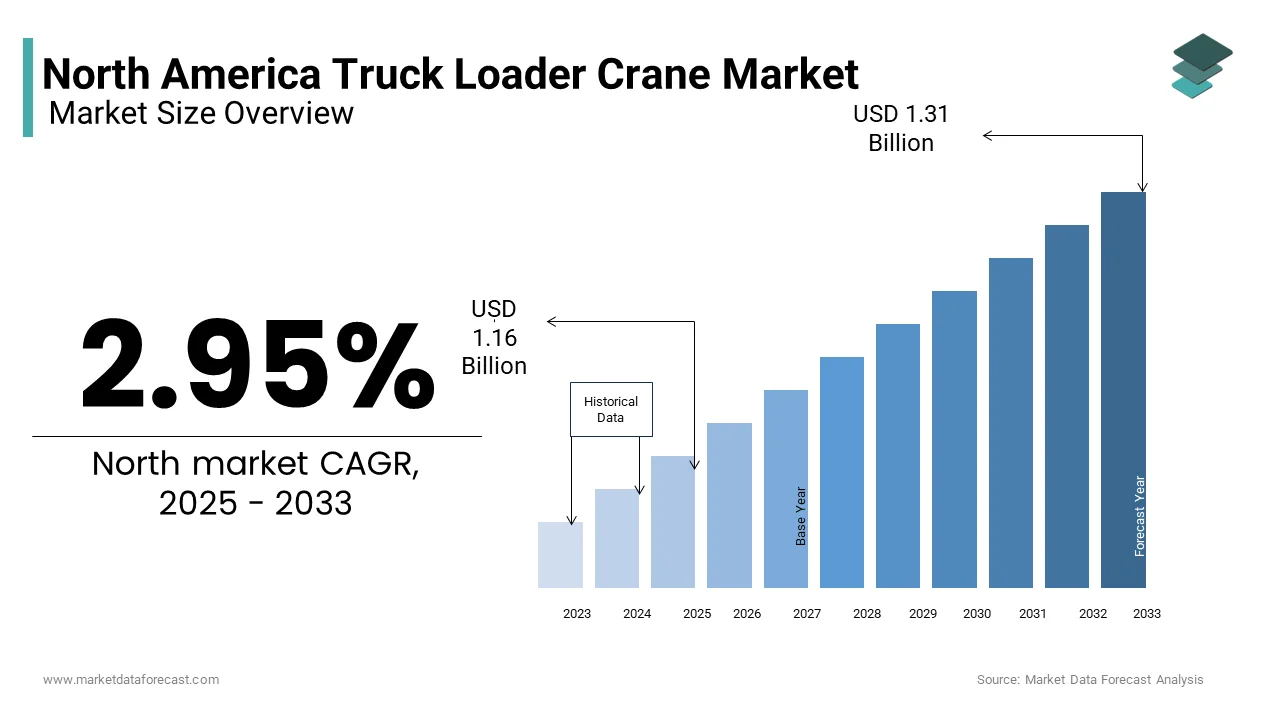
The North America truck loader crane market was valued at USD 1.14 billion in 2024 and is anticipated to reach USD 1.16 billion in 2025 to USD 1.31 billion by 2033, growing at a CAGR of 2.95% during the forecast period from 2025 to 2033.
The truck loader crane is an industrial and commercial equipment that integrates crane mechanisms directly onto trucks to facilitate lifting, loading, and transportation of heavy materials across diverse sectors such as construction, logistics, mining, and forestry. These cranes, mounted on chassis, offer mobility, versatility, and operational efficiency, making them indispensable in infrastructure development and resource extraction activities.
MARKET DRIVERS
Growth in Construction and Infrastructure Development
The sustained growth in construction and infrastructure development across the United States and Canada is accelerating the growth of the North America truck loader crane market. According to the U.S. Census Bureau, total construction spending in the U.S. reached $1.8 trillion in 2023, reflecting a 6.2% year-over-year increase. These large-scale infrastructure projects necessitate efficient material handling solutions, particularly in urban and semi-urban areas where space is limited and mobility is critical. Truck loader cranes offer a dual advantage of transport and lifting capabilities, making them ideal for construction sites where time and cost efficiency are paramount. In Canada, infrastructure investments have also gained momentum, with the federal government committing over CAD 30 billion through the Investing in Canada Plan, as reported by Infrastructure Canada. The plan focuses on green infrastructure, public transit, and trade corridors, all of which require robust equipment for on-site logistics.
Expansion of the Logistics and Transportation Sector
The rapid expansion of the logistics and transportation sector in North America is fueling the growth of the truck loader crane market. As per the U.S. Department of Transportation, freight movement in the U.S. is expected to grow by 40% by 2045, driven by e-commerce expansion, supply chain modernization, and increased cross-border trade. The American Trucking Associations noted that in 2023, the trucking industry hauled over 11.8 billion tons of freight, representing nearly 72% of all domestic freight tonnage. This surge in freight movement necessitates efficient loading and unloading solutions at distribution centers, warehouses, and ports, where truck loader cranes provide a compact and mobile alternative to fixed lifting equipment. Moreover, the warehousing and storage sector in the U.S. has seen significant growth, with over 1.8 billion square feet of new warehouse space under construction in 2023 as reported by CBRE, a global commercial real estate services firm. These facilities require flexible material handling systems that can adapt to varying cargo sizes and weights. Truck loader cranes, especially those with multi-functional attachments and remote operation capabilities, are increasingly being adopted to streamline operations and reduce labor dependency.
MARKET RESTRAINTS
High Initial Investment and Maintenance Costs
The high initial investment and ongoing maintenance costs associated with these machines are limiting the growth of the North American truck loader crane market. According to a 2023 report by the Equipment Leasing and Finance Association, the average cost of a new truck loader crane ranges between $150,000 and $450,000, depending on lifting capacity, technological features, and brand. For small and medium-sized enterprises (SMEs) in the logistics and construction sectors, this represents a substantial capital outlay, often leading to reliance on leasing or financing options that add to the overall financial burden. Additionally, maintenance costs for these machines are considerable due to the complexity of hydraulic systems, load-bearing components, and electronic controls. The U.S. Bureau of Labor Statistics noted in 2023 that repair and maintenance expenses for heavy machinery, including truck loader cranes, account for approximately 12% of total operational costs in the construction industry. Furthermore, the availability of skilled technicians for servicing advanced crane models remains limited, especially in rural areas.
Regulatory and Safety Compliance Requirements
The stringent regulatory and safety compliance standards in North America pose another major challenge for the truck loader crane market. In the U.S., the Occupational Safety and Health Administration (OSHA) mandates comprehensive guidelines for crane operations, including operator certification, load capacity assessments, and routine inspections. According to OSHA’s 2023 enforcement report, over 1,200 violations related to crane safety were recorded in the construction sector, with penalties averaging $15,000 per violation. WorkSafeBC, for example, reported in 2023 that crane-related incidents accounted for 14% of all heavy equipment accidents in the province, prompting stricter enforcement of training and inspection protocols. These compliance requirements not only increase the cost of crane ownership but also delay deployment timelines. As per the Canadian Construction Association, compliance-related delays have added an average of 7–10 days to project timelines in 2023.
MARKET OPPORTUNITIES
Integration of Smart and IoT-Enabled Technologies
The integration of smart and IoT-enabled technologies into truck loader cranes presents a significant opportunity for market growth in North America. Manufacturers are increasingly embedding telematics, remote diagnostics, and predictive maintenance systems into crane models to enhance operational efficiency and reduce downtime. These benefits are particularly compelling for large-scale construction and logistics firms that rely on high availability of equipment. Major crane manufacturers such as Manitex and Hiab have introduced models equipped with real-time load monitoring, GPS tracking, and automated diagnostics. As per the Association of Equipment Manufacturers (AEM), nearly 40% of surveyed companies in 2023 indicated a preference for smart-enabled cranes due to their ability to improve job site safety and reduce operator error.
Increasing Demand in Renewable Energy and Green Infrastructure Projects
The rising demand for renewable energy and green infrastructure projects in North America is creating new growth opportunities for the growth of the truck loader crane market. According to the U.S. Department of Energy’s 2023 Wind Market Report, over 15 gigawatts of new wind capacity were installed in the U.S. in 2023 alone, requiring specialized equipment for transporting and erecting turbine components. Truck loader cranes, with their mobility and lifting flexibility, are increasingly being used for these applications in remote and rural locations where fixed cranes are impractical. This includes support for solar farms, hydroelectric upgrades, and sustainable transportation hubs, all of which require efficient material handling. As per the Canadian Wind Energy Association, over 2,000 megawatts of wind energy capacity were under development in 2023, further driving the need for mobile lifting solutions. The growing emphasis on clean energy and sustainable infrastructure is positioning truck loader cranes as essential tools in the evolving North American industrial landscape.
MARKET CHALLENGES
Skilled Labor Shortage in Heavy Equipment Operation
The persistent shortage of skilled labor in heavy equipment operation is also restricting the growth of the North American truck loader crane market. As per the U.S. Bureau of Labor Statistics, employment in construction and extraction occupations is projected to grow by 4% from 2022 to 2032, but the supply of qualified crane operators is not keeping pace. This labor gap is exacerbated by an aging workforce and limited vocational training programs. According to the National Center for Construction Education and Research (NCCER), the average age of a crane operator in the U.S. is 55, with fewer young professionals entering the field. Training programs are often lengthy and costly, with certification requiring both classroom instruction and field experience. As per the International Union of Operating Engineers, the certification process can take up to two years, limiting the speed at which new operators can be deployed.
Supply Chain Disruptions and Component Shortages
The supply chain disruptions and component shortages are also a challenge for the growth of the North American truck loader crane market. The global semiconductor shortage, which began in 2021, has continued to impact the manufacturing of electronic and hydraulic control systems used in modern cranes. According to the U.S. Chamber of Commerce’s 2023 supply chain report, 65% of equipment manufacturers faced delays in sourcing critical components such as sensors, control modules, and microprocessors, leading to extended lead times for new crane deliveries. Additionally, the U.S. International Trade Commission reported that steel prices, a primary material in crane manufacturing, increased by 18% in 2023 due to supply constraints and geopolitical tensions. This has directly affected production costs and pricing for end users.
REPORT COVERAGE
| REPORT METRIC | DETAILS |
| Market Size Available | 2024 to 2033 |
| Base Year | 2024 |
| Forecast Period | 2025 to 2033 |
| CAGR | 2.39% |
| Segments Covered | By Product, Type, End-User, and Region. |
| Various Analyses Covered | Global, Regional, & Country Level Analysis, Segment-Level Analysis, DROC, PESTLE Analysis, Porter’s Five Forces Analysis, Competitive Landscape, Analyst Overview on Investment Opportunities |
| Regions Covered | The United States, Canada, Mexico, And By Country |
| Market Leaders Profiled | Alfinger AG, Tadano Ltd, Fassi Gru S.p.A, Texer Corporation, Hiab AB, Manitex International Inc., Amco Veba, Sany Group Co., Ltd, Hyva Crane, PM OIL & STEEL S.P.A., EFFER S.R.L., F.lli Ferrari., |
SEGMENTAL ANALYSIS
By Product Insights
The medium-duty truck loader crane segment accounted in holding 38.2% of the North America truck loader crane market share in 2024 due to its optimal balance between lifting capacity and operational flexibility. According to the U.S. Census Bureau, the construction industry spent over $1.8 trillion in 2023, with a significant portion allocated to residential and commercial developments that rely on medium-capacity lifting equipment. The American Road & Transportation Builders Association reported that in 2023, over 40% of all road and bridge rehabilitation projects in the U.S. were categorized as medium-scale, requiring mobile lifting solutions that do not necessitate the logistical complexity of heavy-duty models.
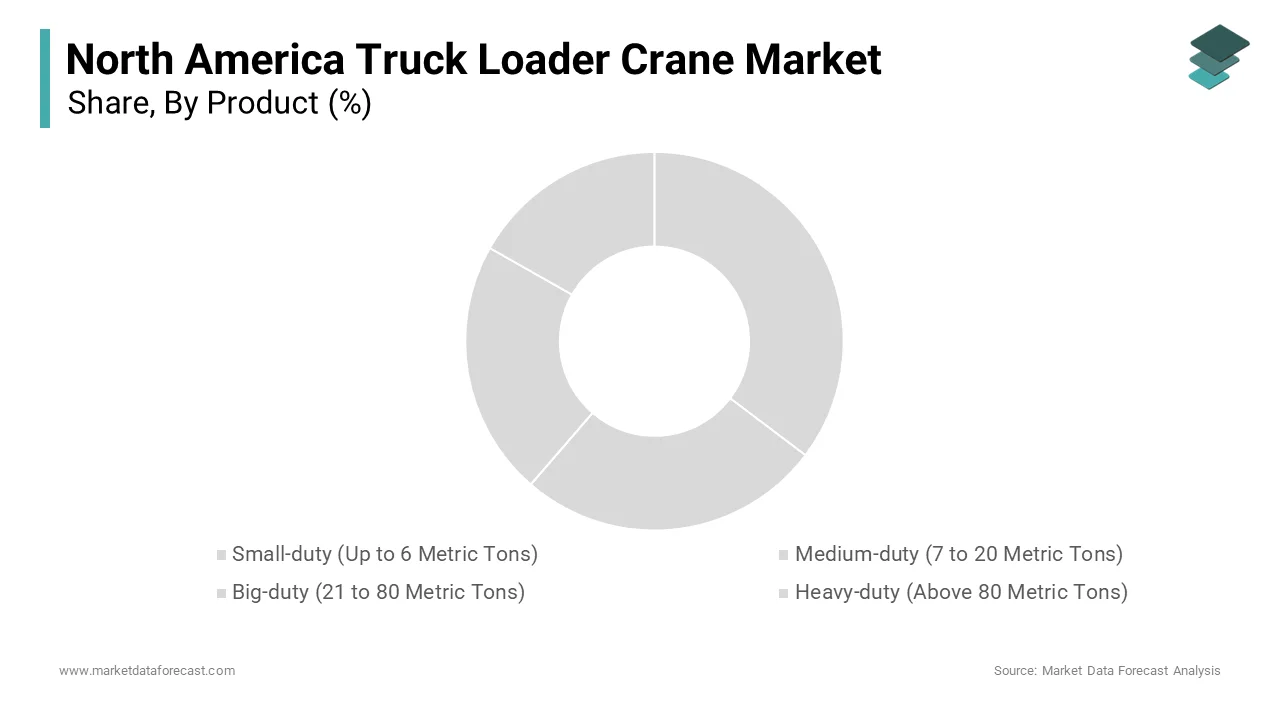
The heavy-duty truck loader crane segment is projected to register a CAGR of 6.7% during the forecast period, with the increasing demand for high-capacity lifting equipment in large-scale infrastructure and energy projects. According to the U.S. Department of Energy, over 15 gigawatts of wind energy capacity were installed in 2023, requiring robust equipment for transporting and assembling massive turbine components. Additionally, the expansion of oil and gas exploration activities in North America has significantly contributed to the rise in demand for heavy-duty models. The U.S. Energy Information Administration reported that domestic crude oil production reached 12.5 million barrels per day in 2023, necessitating specialized equipment for on-site logistics and maintenance.
By Type Insights
The knuckle boom segment dominated the North America truck loader crane market by capturing 57.3% of share in 2024 with its superior articulation and adaptability by making it ideal for applications in construction, forestry, and municipal services. The growing demand for versatile lifting equipment in urban infrastructure maintenance is also fuelling the growth of the North American truck loader crane market. Additionally, in Canada, Infrastructure Canada noted that over 60% of municipal repair projects in 2023 involved knuckle boom-equipped trucks for sewer and road maintenance.
The stiff boom truck loader crane segment is expected to grow with a projected CAGR of 6.1% from 2025 to 20,33 with the rising demand in industrial logistics and large-scale transportation sectors where high-speed loading and unloading operations are essential. According to the American Trucking Associations, freight tonnage in the U.S. increased by 3.8% in 2023 compared to the previous year, indicating a strong need for efficient cargo handling equipment. Stiff boom cranes offer a significant advantage in terms of speed and lifting efficiency, especially in high-volume distribution centers. CBRE reported that over 1.8 billion square feet of new warehouse space was under construction in 2023, much of which is designed for rapid e-commerce fulfillment.
By End-user Insights
The construction sector was the largest and held 35.4% of the North America truck loader crane market share in 2024, with the ongoing expansion of residential, commercial, and infrastructure development projects across the U.S. and Canada. According to the U.S. Census Bureau, total construction spending in the U.S. reached $1.8 trillion in 2023, reflecting a year-over-year increase of 6.2%. The federal government’s commitment to infrastructure modernization through the Infrastructure Investment and Jobs Act (IIJA), which allocates $1.2 trillion over five years for transportation, water systems, and digital infrastructure. The American Road & Transportation Builders Association reported that in 2023, over 250,000 lane miles of roads were under construction, requiring mobile lifting solutions for on-site material handling. In Canada, Infrastructure Canada indicated that the Investing in Canada Plan had funded over 85,000 infrastructure projects nationwide by 2023, further boosting crane adoption.
The energy sector is gaining traction wither the growth, with an expected CAGR of 7.3% from 2025 to 203,3, with the expansion of renewable energy infrastructure, particularly wind and solar power installations. According to the U.S. Department of Energy’s 2023 Wind Market Report, over 15 gigawatts of new wind capacity were installed in the U.S. in 2023. In addition, the U.S. Environmental Protection Agency reported that renewable energy accounted for 22% of total electricity generation in 2023, with solar and wind leading the transition. These projects often take place in remote and rural locations, where truck loader cranes provide the necessary mobility and lifting capacity.
COUNTRY ANALYSIS
United States
The United States was the top performer of the North America truck loader crane market with 82.3% the share in 2024, with the vast industrial and infrastructure development activities. According to the U.S. Bureau of Economic Analysis, the construction sector alone contributed over $1.5 trillion in value-added output in 2023, driving demand for efficient material handling equipment. The American Road & Transportation Builders Association reported that in 2023, over 250,000 lane miles of roads were under construction, requiring mobile lifting solutions.
Canada
Canadian truck loader crane market held 18.2% of the share in 2024, with the demand from natural resource extraction, infrastructure development, and logistics sectors. Infrastructure investment is also a key growth driver. Infrastructure Canada reported that over 85,000 infrastructure projects have been funded nationwide under the Investing in Canada Plan, with a total investment of over CAD 30 billion. The Canadian Construction Association noted that construction output in Canada grew by 4.5% in 2023, with a strong emphasis on green and sustainable infrastructure. Additionally, Prologis estimated that industrial leasing activity reached 40 million square feet in 2023, supporting the demand for mobile lifting solutions in logistics and warehousing.
KEY MARKET PLAYERS
Alfinger AG, Tadano Ltd, Fassi Gru S.p.A, Texer Corporation, Hiab AB, Manitex International Inc., Amco Veba, Sany Group Co., Ltd, Hyva Crane, PM OIL & STEEL S.P.A., EFFER S.R.L., F.lli Ferrar., are the market players that are dominating the North America truck loader crane market.
Top Players In The Market
Manitex Inc.
Manitex is a leading manufacturer of specialized mobile lifting and material handling equipment in North America. The company is known for its durable and high-performance truck loader cranes designed for construction, infrastructure, and industrial applications. With a strong distribution network and a focus on innovation, Manitex plays a pivotal role in shaping market trends. The company consistently introduces advanced crane models that offer improved safety, efficiency, and adaptability, which is making it a preferred choice among end-users across various sectors in the region.
Hiab (A Subsidiary of Cargotec Corporation)
Hiab is a globally recognized brand in the loader crane industry and holds a strong presence in North America. Known for its intelligent load handling solutions, Hiab offers a wide range of truck loader cranes that combine precision, performance, and digital integration. The company emphasizes sustainability and smart technology by enhancing its market position. Hiab’s strategic partnerships, customer-centric approach, and commitment to innovation have made it a dominant player in the region, contributing significantly to the evolution of modern lifting solutions.
Terex Corporation
Terex is a diversified global manufacturer with a strong footprint in the North American crane market. The company offers a broad portfolio of lifting equipment, including truck loader cranes tailored for rugged environments and heavy-duty applications. Terex focuses on engineering excellence and operational efficiency, ensuring its products meet the evolving needs of industries such as construction, mining, and logistics.
Top Strategies Used By Key Market Participants
One of the primary strategies employed by leading players in the North American truck loader crane market is product innovation and technological advancement. Companies are continuously developing cranes with enhanced features such as remote-control operation, smart diagnostics, and fuel-efficient systems to meet the growing demand for high-performance and sustainable equipment.
Another key strategy is strategic partnerships and collaboration. Manufacturers are forging alliances with technology providers, logistics firms, and construction companies to integrate advanced functionalities and improve after-sales service networks. These collaborations help in expanding market reach and ensuring customer satisfaction through tailored solutions.
The expansion through acquisitions and regional market penetration is a widely adopted approach. Companies are acquiring smaller regional players or complementary businesses to strengthen their distribution channels, enhance product portfolios, and gain a competitive edge in key markets across North America.
COMPETITIVE LANDSCAPE
The competition in the North American truck loader crane market is marked by the presence of well-established global players and a growing number of regional manufacturers striving for market share. Key participants are focusing on innovation, product diversification, and localized service networks to cater to the specific needs of end-users across construction, logistics, energy, and resource extraction sectors. The market is witnessing a shift toward smarter, more efficient crane models equipped with digital technologies, creating a competitive edge for those investing in R&D and sustainable engineering. Strategic collaborations, mergers, and acquisitions are also shaping the industry landscape, allowing companies to strengthen their foothold and enhance customer engagement. With increasing infrastructure investments and evolving end-user demands, competition is intensifying, prompting manufacturers to differentiate themselves through performance, reliability, and after-sales support.
RECENT HAPPENINGS IN THE MARKET
- In January 2024, Manitex launched a new line of hybrid-powered truck loader cranes designed to reduce fuel consumption and emissions while maintaining high lifting performance. This move aligns with growing environmental regulations and customer demand for sustainable equipment.
- In March 2024, Hiab introduced an advanced telematics system integrated into its crane models, enabling real-time monitoring of load capacity, maintenance alerts, and operator performance. This digital enhancement supports predictive maintenance and improves operational efficiency for end-users.
- In June 2024, Terex expanded its service network in the Midwest region of the United States by opening three new regional support centers. This expansion aims to improve customer response times and after-sales service accessibility for crane operators in key industrial hubs.
- In September 2024, a leading North American distributor of lifting equipment, LiftPro Solutions, partnered with Cargotec to distribute Hiab cranes across Canada. This partnership enhances Hiab’s market reach and strengthens its presence in the Canadian logistics and construction sectors.
- In November 2024, Manitex announced a strategic collaboration with a North American vocational training institute to develop specialized crane operator training programs. This initiative addresses the growing need for skilled labor and supports long-term industry workforce development.
MARKET SEGMENTATION
This research report on the North America truck loader crane market is segmented and sub-segmented into the following categories.
By Product
- Small-duty (Up to 6 Metric Tons)
- Medium-duty (7 to 20 Metric Tons)
- Big-duty (21 to 80 Metric Tons)
- Heavy-duty (Above 80 Metric Tons)
By Type
- Knuckle Boom
- Stiff Boom
By Sales
- New Sales
- Aftermarket
By End-use
- Rental
- Construction
- Mining
- Oil & Gas
- Energy
- Forestry
- Logistics
By Country
- The United States
- Canada
- Mexico
Frequently Asked Questions
What is a truck loader crane?
A truck loader crane is a hydraulic lifting device mounted on a truck chassis, used to load, unload, and position heavy materials without needing external equipment. It increases operational independence for transport and field service operations.
Why is this market growing in North America?
Rising demand in construction, utilities, and logistics sectors is driving adoption, especially for jobs requiring mobility and quick deployment. The push for faster, more efficient material handling in remote or urban sites is also fueling growth.
Which industries use truck loader cranes the most?
Construction, telecom, utility maintenance, and industrial services are the top users, especially for handling poles, HVAC units, and machinery. Waste management and municipal services also rely on them for routine field operations.
What are the key crane types in use?
Knuckle boom cranes are popular for their compact design and flexibility, while stick boom cranes are preferred for longer reach and heavier lifts. Choice depends on application, load capacity, and space constraints.
How do regulations impact crane installations?
Crane installations must comply with OSHA and FMVSS safety standards, including load ratings, operator training, and vehicle stability requirements. Proper certification and regular inspections are mandatory across commercial fleets.
Are electric or hybrid loader cranes emerging?
Yes, some manufacturers are developing electric-powered cranes integrated with hybrid or electric trucks to meet emissions goals. These systems reduce noise and fuel use, especially in city environments with strict environmental rules.
What role does automation play in modern cranes?
Newer models feature joystick controls, load-sensing hydraulics, and stability alerts that make operation safer and more precise. Some include remote control options or assistive features to reduce operator fatigue.
Who are the main buyers of these cranes?
Municipal fleets, utility companies, private contractors, and specialized service providers are the primary purchasers. Many opt for custom truck-crane configurations tailored to their daily operational needs.
How important is after-sales service in this market?
Service and support are critical—buyers value quick access to parts, training, and field technicians due to the high utilization of cranes. Brands with strong dealer networks have a competitive edge.
What’s driving innovation in this market?
Demand for lighter, stronger materials like high-tensile steel and smart controls is pushing design upgrades. Integration with telematics for maintenance tracking and job logging is also becoming standard.
Access the study in MULTIPLE FORMATS
Purchase options starting from
$ 2000
Didn’t find what you’re looking for?
TALK TO OUR ANALYST TEAM
Need something within your budget?
NO WORRIES! WE GOT YOU COVERED!
Call us on: +1 888 702 9696 (U.S Toll Free)
Write to us: sales@marketdataforecast.com