North America Vinyl Chloride Monomer Market Size, Share, Growth, Trends, and Forecast Report – Segmented By Application (PVC, Other Applications), End-user Industry, and Region (The United States, Canada and Rest of North America) - Industry Analysis from 2026 to 2034
North America Vinyl Chloride Monomer Market Summary
The North America vinyl chloride monomer market size was valued at USD 4.06 billion in 2025 and is projected to reach USD 6.84 billion by 2034, growing at a CAGR of 5.98% from 2026 to 2034. Demand is driven by infrastructure renewal, healthcare device use, and PVC’s dominance in construction.
Key Market Trends & Insights
- United States led the North America vinyl chloride monomer market in 2025.
- Canada to experience steady growth through infrastructure upgrades.
- PVC applications held the dominant share in 2025.
- Healthcare segment expected to grow at a CAGR of 6.2% during the forecast period.
- Innovations in plasticizer technology and medical-grade PVC support healthcare growth.
Market Size & Forecast
- 2025 Market Size: USD 4.06 Billion
- 2026 Market Size: USD 4.30 Billion
- 2034 Projected Market Size: USD 6.84 Billion
- CAGR (2026–2034): 5.98%
- United States: Largest market in 2025
- Canada: Steady growth region
North America Vinyl Chloride Monomer Market Size
The North America vinyl chloride monomer market size was valued at USD 4.06 billion in 2025, and the market size is expected to reach USD 6.84 billion by 2034 from USD 4.30 billion in 2026. The market's promising CAGR for the predicted period is 5.98%.

The Vinyl chloride monomer (VCM) is a petrochemical intermediate primarily utilized in the production of polyvinyl chloride (PVC) with a versatile polymer embedded in construction, healthcare, automotive, and infrastructure applications. The substance is synthesized predominantly via the thermal chlorination or oxychlorination of ethylene, with the U.S. Gulf Coast serving as the central hub due to its concentration of ethylene crackers and chlor-alkali plants. Environmental and safety regulations governing VCM, a known human carcinogen, are stringent across the region. Furthermore, the Chemical Safety Board has recorded 14 major incidents involving vinyl chloride since 1980, including the 2023 derailment in East Palestine, Ohio, which intensified public scrutiny and regulatory oversight. As per the American Chemistry Council, North American VCM producers operate under rigorous process safety management protocols, integrating advanced leak detection systems and emergency shutdown mechanisms.
MARKET DRIVERS
Expansion of Residential and Commercial Construction Sectors
The sustained growth of construction activity is a fuelling the growth of the North America vinyl chloride monomer market. PVC piping alone accounts for more than 60% of municipal water and wastewater distribution systems in the United States, as noted by the Plastics Pipe Institute, due to its corrosion resistance, longevity, and cost efficiency compared to metal alternatives. Municipalities such as Chicago and Phoenix have initiated large-scale water main replacement programs, with Chicago planning to replace 900 miles of aging cast iron pipes with PVC and HDPE variants by 2030, according to the city’s Department of Water Management. The commercial construction sector further amplifies demand, with non-residential construction spending totaling USD 1.03 trillion in 2023, as per the U.S. Bureau of Economic Analysis. The prevalence of PVC in electrical conduit systems, insulation, and interior finishes ensures a stable and expanding downstream market for VCM as urbanization and infrastructure renewal efforts gain momentum across the continent.
Shale Gas-Driven Cost Advantage in Feedstock Supply
The abundance of shale-derived ethylene has fundamentally reshaped the economic viability of vinyl chloride monomer production is also driving the growth of the North America vinyl chloride monomer market. The U.S. shale revolution has led to a sustained surplus of ethane, a primary feedstock for ethylene crackers, which in turn is a key precursor in VCM synthesis via the balanced process involving chlorine and ethylene. This domestic feedstock security has allowed VCM manufacturers to maintain stable operating rates, even during periods of global supply volatility. For instance, the Gulf Coast’s integrated petrochemical complexes, including those operated by OxyChem and Formosa Plastics, benefit from co-location with ethylene crackers and chlor-alkali units, minimizing transportation costs and enhancing process efficiency.
MARKET RESTRAINTS
Stringent Environmental and Occupational Health Regulations
The production and handling of vinyl chloride monomer are significantly constraining operational flexibility and increasing compliance costs for manufacturers is restraining the growth of the North America vinyl chloride monomer market. VCM is classified as a known human carcinogen by the U.S. Department of Health and Human Services, with long-term exposure linked to hepatic angiosarcoma and other serious health conditions. Facilities must implement closed-vent systems, flame suppression, and continuous monitoring, as outlined in EPA 40 CFR Part 63 Subpart HH. The Chemical Safety Board has emphasized that aging infrastructure in VCM plants poses persistent risks, citing that 30% of incidents in the sector between 2000 and 2022 involved equipment failure due to corrosion or fatigue.
Public Opposition and Community Resistance to Industrial Facilities
The growing public scrutiny and community-led resistance against VCM production facilities is also to limit the growth of the North America vinyl chloride monomer market. The Environmental Working Group reported that over 1.2 million people in Louisiana live within three miles of a facility producing or processing vinyl chloride, placing them in high-risk zones. Similarly, in 2022, the Texas Commission on Environmental Quality received over 1,400 public comments opposing Formosa Plastics’ proposed USD 9.4 billion complex in St. James Parish, ultimately leading to the suspension of key permits due to environmental justice concerns. The Biden administration’s emphasis on environmental justice, as outlined in Executive Order 14008, has empowered federal agencies to scrutinize permitting decisions in historically overburdened communities.
MARKET OPPORTUNITIES
Modernization of Aging Water Infrastructure
The urgent need to replace deteriorating water and wastewater systems across North America presents a transformative opportunity for the vinyl chloride monomer market, as PVC piping remains a preferred material for its durability, corrosion resistance, and cost-effectiveness. Municipalities are increasingly adopting PVC pressure pipes for water mains, with the Plastics Pipe Institute noting that over 70% of new water main installations in cities like Atlanta, Denver, and San Antonio now use PVC due to its 100-year service life and resistance to root intrusion and chemical degradation. The use of VCM-derived PVC in trenchless installation methods such as horizontal directional drilling further enhances its appeal by reducing disruption and costs.
Growth in Medical and Specialty PVC Applications
The expanding use of PVC in medical devices and specialty applications is additionally to fuel thee growth of the North American vinyl chloride monomer market. Medical-grade PVC, derived from VCM, is widely used in blood bags, IV tubing, catheters, and oxygen masks due to its flexibility, transparency, and compatibility with sterilization processes. The U.S. Food and Drug Administration recognizes medical PVC as a safe and established material in healthcare, with over 25% of all medical devices containing PVC components, as stated by the Association of Medical Device Manufacturers. Additionally, the pandemic with the role of PVC-based disposable medical supplies, prompting healthcare systems to maintain larger inventories. Innovations in plasticizer technology have also addressed earlier concerns about phthalate leaching, with manufacturers like Teknor Apex developing non-phthalate compounds compliant with EU REACH and U.S. FDA standards. The specialty packaging sector, including blister packs and sterile wraps, further utilizes VCM-based resins for their barrier properties and formability.
MARKET CHALLENGES
Feedstock Price Volatility Despite Shale Abundance
The feedstock price volatility in the chlorine segment of the balanced process is hampering the growth of the North America vinyl chloride monomer market. The U.S. Gulf Coast, home to over 80% of domestic VCM capacity, experienced multiple forced shutdowns in 2021 and 2023 during extreme weather events, including Winter Storm Uri and Hurricane Idalia, which disrupted chlor-alkali operations and caused chlorine shortages. According to the Edison Electric Institute, electricity prices in Texas surged by over 300% during peak crisis periods, directly impacting chlorine production economics. Additionally, global demand for chlorine in disinfectants and caustic soda creates competition for supply, particularly during public health emergencies. The interdependence of chlorine and caustic soda markets means that oversupply of the latter can lead to curtailments in chlorine production, further destabilizing VCM feedstock availability.
Technological Obsolescence and Capital Intensity of Plant Upgrades
The rising demand for the modernize aging production facilities is a challenge for the growth of the North American vinyl chloride monomer market. Many VCM plants in operation today were commissioned between the 1970s and 1990s, relying on outdated control systems, containment technologies, and energy inefficient processes. According to the American Chemistry Council, over 40% of VCM production assets in the U.S. are more than 40 years old, increasing the risk of mechanical failure, unplanned downtime, and non-compliance with evolving safety standards. Furthermore, integrating new technologies such as AI-driven predictive maintenance or zero-bleed valve systems demands specialized expertise and prolonged shutdown periods, disrupting supply continuity. The transition toward electrification and carbon reduction adds another layer of complexity, as traditional VCM processes are inherently reliant on fossil-based feedstocks and high-temperature reactions. With increasing investor focus on ESG performance, companies face dual pressure to reduce emissions and improve safety while maintaining profitability. However, the long payback periods and regulatory uncertainty deter rapid reinvestment, which is leaving parts of the asset base vulnerable to obsolescence and operational risk in an increasingly scrutinized industrial landscape.
REPORT COVERAGE
| REPORT METRIC | DETAILS |
| Market Size Available | 2025 to 2034 |
| Base Year | 2025 |
| Forecast Period | 2026 to 2034 |
| CAGR | 5.98% |
| Segments Covered | By Application, End-user Industry, and Region |
| Various Analyses Covered | Regional & Country Level Analysis, Segment-Level Analysis, DROC, PESTLE Analysis, Porter’s Five Forces Analysis, Competitive Landscape, Analyst Overview on Investment Opportunities |
| Regions Covered | The United States, Canada, Mexico, and Rest of North America |
| Market Leaders Profiled | Westlake Chemical Corporation, Formosa Plastics Corporation, Shintech Inc., Oxy Vinyls LP (Occidental Chemical Corporation), Mexichem S.A.B. de C.V., Axiall Corporation, INEOS Group Holdings S.A., Kaneka Corporation, Georgia Gulf Corporation, and others |
SEGMENTAL ANALYSIS
By Application Insights
The polyvinyl chloride (PVC) application segment was accounted in holding a dominant share of the North America vinyl chloride monomer (VCM) market in 2025. According to the U.S. Environmental Protection Agency, over 600,000 miles of water mains in the United States require repair or replacement, with PVC accounting for more than 60% of new pipe installations due to its corrosion resistance and 100-year lifespan, according to the Plastics Pipe Institute. The Bipartisan Infrastructure Law allocated USD 55 billion for water infrastructure, directly stimulating PVC pipe production.
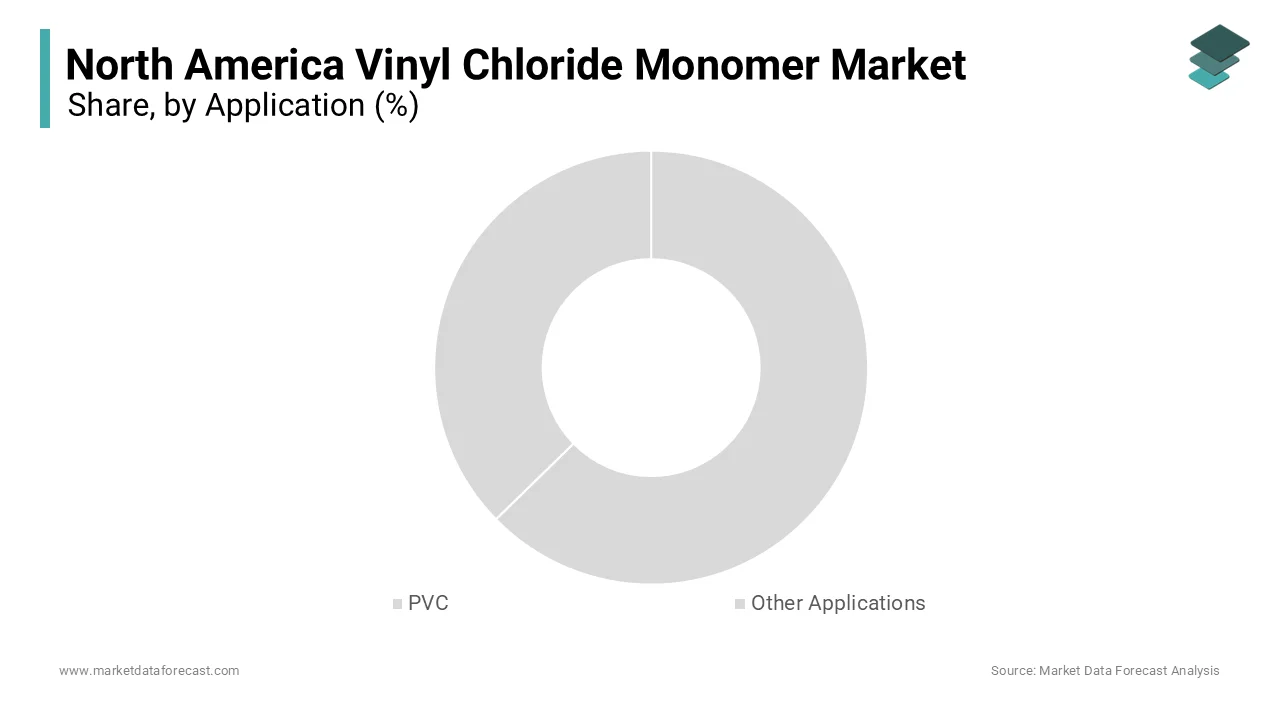
The “Other Applications” segment is emerging with a CAGR of 5.8% from 2026 to 2034 with the rising use of VCM-derived copolymers in coatings, adhesives, and specialty films. For instance, vinyl chloride-vinyl acetate copolymers are widely used in automotive underbody coatings and industrial protective linings due to their exceptional adhesion and chemical resistance. The Centers for Disease Control and Prevention states that over 1.2 million hospital procedures involving intravenous therapy occur daily in the U.S., many of which depend on flexible, sterilizable PVC. Innovations in plasticizer technology have also revitalized interest, with non-phthalate plasticizers like DINCH and TOTM enabling safer, compliant formulations. Furthermore, the aerospace and defense sectors are adopting vinyl-based barrier films for fuel bladders and protective enclosures, where impermeability and durability are important.
By End-User Industry Insights
The building and construction sector was the largest with a dominant share of the North American vinyl chloride monomer market in 2025 with the widespread use of PVC across residential, commercial, and civil infrastructure projects. The material’s resistance to corrosion, root intrusion, and chemical degradation makes it ideal for underground water and sewer lines in regions with acidic soils or fluctuating pH levels. Municipalities such as Los Angeles and Toronto have adopted PVC for over 70% of new water main installations, citing a service life exceeding a century, as noted by the Canadian Water Network. The Department of Energy estimates that replacing single-pane windows with PVC-framed double-glazed units can reduce household energy consumption by 12–30%, a factor increasingly emphasized in green building certifications like LEED. Additionally, the surge in housing starts 1.4 million new residential units initiated in the U.S. in 2023, per the U.S. Census Bureau has amplified demand for PVC siding, flooring, and electrical conduits. The material’s low maintenance, fire retardancy, and cost advantage over wood or metal further enhance its appeal.
The healthcare industry segment is likely to grow with an expected CAGR of 6.2% from 2026 to 2034 with the indispensable role of PVC in medical devices and disposable supplies. The U.S. Food and Drug Administration recognizes PVC as a safe and effective material for short-term medical contact, and the Association of Medical Device Manufacturers reports that over 30 billion medical devices containing PVC are used annually in the U.S. alone. The aging population is a compounding factor; the U.S. Census Bureau projects that by 2030, one in five Americans will be aged 65 or older, significantly increasing the demand for chronic care treatments involving IV therapy, dialysis, and catheterization. The Centers for Disease Control and Prevention notes that hospital stays involving infusion therapy rose by 19% between 2018 and 2022. According to the Society for Healthcare Epidemiology of America, over 80% of U.S. hospitals now prioritize disposable over reusable devices in high-risk units to reduce cross-contamination. PVC’s ability to be easily molded, sterilized, and disposed of safely aligns perfectly with this trend. Additionally, advancements in plasticizer technology have mitigated earlier concerns about leaching, with manufacturers like Teknor Apex and Lubrizol introducing phthalate-free compounds compliant with FDA and EU standards.
REGIONAL ANALYSIS
United States
The United States was the top performer of the North America vinyl chloride monomer market with 94.2% of the share in 2025 with an integrated petrochemical ecosystem concentrated along the Gulf Coast, where access to shale-derived ethylene and chlor-alkali capacity enables cost-efficient VCM synthesis. Over 80% of domestic VCM production occurs in Texas and Louisiana, home to world-scale complexes operated by OxyChem, Formosa Plastics, and Westlake Chemical. The U.S. Department of Energy confirms that the Gulf Coast accounts for over 90% of North America’s ethylene production, providing a secure feedstock base. Regulatory oversight is stringent but well-established, with the Environmental Protection Agency enforcing strict emission controls under the Risk Management Program and NESHAP regulations.
Canada
Canada vinyl chloride monomer market held 6.1% of the share in 2025. Canadian demand is primarily driven by construction and municipal infrastructure projects, particularly in provinces like Ontario and British Columbia, where urban renewal and water system upgrades are underway. The Federation of Canadian Municipalities estimates that CAD 31 billion is required over the next decade to replace aging water and wastewater pipes, many of which are being substituted with PVC due to its durability and freeze resistance. Additionally, Canada’s healthcare sector relies on imported VCM-based medical devices, with over 70% of IV sets and blood bags containing PVC components, as noted by Health Canada. The country’s strict Workplace Hazardous Materials Information System (WHMIS) regulations ensure safe handling, while environmental policies under the Canadian Environmental Protection Act limit emissions.
TOP PLAYERS IN THE MARKET
OxyChem (Occidental Petroleum Corporation)
OxyChem is a leading producer of vinyl chloride monomer in North America by operating as a core component of Occidental’s chlor-alkali and vinyls business. The company maintains a vertically integrated production model, linking its chlorine, ethylene, and VCM operations to ensure supply chain efficiency and cost control. The oxyChem supplies VCM to both captive and external PVC producers, which is reinforcing its strategic position in the downstream value chain. The company emphasizes operational excellence, process safety, and environmental stewardship by aligning with stringent regulatory standards and community expectations. OxyChem actively invests in technology upgrades and emission reduction initiatives, contributing to industry best practices.
Formosa Plastics Corporation, U.S.A.
Formosa Plastics is a subsidiary of Taiwan’s Formosa Plastics Group with a major integrated player in the North American vinyl chloride monomer market, operating one of the largest petrochemical complexes in Point Comfort, Texas. The company controls the entire production chain from ethylene crackers to VCM and PVC, allowing for high operational efficiency and economies of scale. Known for its long-term investment in industrial infrastructure, Formosa emphasizes engineering precision, plant reliability, and large-volume output to serve both domestic and export markets. The company’s North American operations serve as a strategic foothold for the global group, enabling access to low-cost shale feedstocks and proximity to key downstream industries. Despite facing regulatory and community scrutiny, Formosa continues to focus on technological advancement and process optimization. Its global influence stems from its ability to leverage U.S.-based production advantages to support international supply chains in Asia and South America, where PVC demand remains strong.
Westlake Chemical Corporation
Westlake Chemical is a prominent integrated producer of vinyl chloride monomer in North America, with significant operations in Louisiana and Texas. The company operates a fully integrated model, combining chlor-alkali, ethylene, VCM, and PVC production under one umbrella by allowing for tight control over quality, and cost.
KEY MARKET PLAYERS AND COMPETITIVE LANDSCAPE
Westlake Chemical Corporation, Formosa Plastics Corporation, Shintech Inc., Oxy Vinyls LP (Occidental Chemical Corporation), Mexichem S.A.B. de C.V., Axiall Corporation, INEOS Group Holdings S.A., Kaneka Corporation, Georgia Gulf Corporation (consolidated by Westlake Chemical Corporation), and LG Chem Ltd. in the North America vinyl chloride monomer market.
The competitive landscape of the North America vinyl chloride monomer market is defined by a concentrated oligopoly, where a few large, integrated chemical companies dominate production and supply. These players compete not through price alone, but through operational reliability, safety performance, and long-term supply contracts with downstream PVC manufacturers. The high capital intensity, regulatory scrutiny, and technical complexity of VCM production act as significant barriers to entry, limiting competition to established firms with deep expertise and extensive infrastructure. Differentiation emerges through process efficiency, environmental stewardship, and responsiveness to evolving safety standards, particularly in the wake of high-profile incidents that have intensified public and regulatory oversight. Companies are increasingly judged not only on output but on their ability to operate transparently and sustainably within host communities. Strategic positioning along the Gulf Coast provides logistical and feedstock advantages, creating a geographic concentration that reinforces incumbent dominance. While direct competition in spot pricing is limited, rivalry manifests in export market share, technological upgrades, and reputation management. The interdependence of chlorine and VCM production further constrains flexibility, requiring precise balancing of co-product outputs.
TOP PLAYERS IN THE MARKET
OxyChem (Occidental Petroleum Corporation)
OxyChem is a leading producer of vinyl chloride monomer in North America, operating as a core component of Occidental’s chlor-alkali and vinyls business. The company maintains a vertically integrated production model, linking its chlorine, ethylene, and VCM operations to ensure supply chain efficiency and cost control. With major manufacturing facilities along the U.S. Gulf Coast, OxyChem supplies VCM to both captive and external PVC producers, reinforcing its strategic position in the downstream value chain. The company emphasizes operational excellence, process safety, and environmental stewardship by aligning with stringent regulatory standards and community expectations. OxyChem actively invests in technology upgrades and emission reduction initiatives, contributing to industry best practices.
Formosa Plastics Corporation, U.S.A.
Formosa Plastics, a subsidiary of Taiwan’s Formosa Plastics Group, is a major integrated player in the North American vinyl chloride monomer market, operating one of the largest petrochemical complexes in Point Comfort, Texas. The company controls the entire production chain from ethylene crackers to VCM and PVC, allowing for high operational efficiency and economies of scale. The company’s North American operations serve as a strategic foothold for the global group, enabling access to low-cost shale feedstocks and proximity to key downstream industries. Its global influence stems from its ability to leverage U.S.-based production advantages to support international supply chains, particularly in Asia and South America, where PVC demand remains strong.
Westlake Chemical Corporation
Westlake Chemical is a prominent integrated producer of vinyl chloride monomer in North America with significant operations in Louisiana and Texas. The company operates a fully integrated model, combining chlor-alkali, ethylene, VCM, and PVC production under one umbrella by allowing for tight control over quality, cost, and supply continuity. Westlake is recognized for its disciplined capital allocation, operational safety culture, and long-term customer relationships across construction, infrastructure, and healthcare sectors. The company places strong emphasis on sustainability, investing in energy-efficient technologies and emission control systems to meet evolving environmental standards. Its North American footprint provides a competitive edge in serving regional markets with reliable, high-purity VCM. Globally, Westlake’s U.S.-based production strength supports its international sales network, particularly in Latin America and Europe, where it supplies both resin and fabricated products. The company’s vertical integration and focus on innovation position it as a stable and influential player in the global vinyls chain.
TOP STRATEGIES USED BY KEY MARKET PLAYERS
A strategy among leading VCM producers is vertical integration across the vinyls chain by encompassing chlor-alkali, ethylene, VCM, and PVC production. This integration enables companies to control feedstock costs, ensure supply reliability, and optimize margins across cyclical market conditions.
Another approach is investment in process safety and environmental compliance systems. Given the hazardous nature of vinyl chloride, companies are prioritizing advanced monitoring, automated shutdown mechanisms, and closed-loop operations to minimize emissions and prevent accidents. These efforts not only meet regulatory requirements but also strengthen community trust and support long-term operational permits.
Also, strategy is expanding export capabilities and global customer networks will promote new opportunies for the expansion of the product portfolio of the companies. North American VCM producers are leveraging their cost advantage to supply international markets, particularly in Latin America, Europe, and Southeast Asia. This includes developing logistics infrastructure, forming strategic partnerships, and aligning product specifications with global regulatory standards to enhance market penetration.
RECENT HAPPENINGS IN THE MARKET
- In February 2023, OxyChem announced the expansion of its VCM production unit in LaPlace, Louisiana, which is incorporating advanced emission control systems and digital process monitoring to enhance safety and compliance with evolving EPA regulations.
- In June 2023, Formosa Plastics initiated a comprehensive modernization program at its Point Comfort complex, upgrading aging control systems and installing real-time leak detection sensors across its VCM and chlorine processing units.
- In October 2023, Westlake Chemical launched a new sustainability initiative focused on reducing flaring and fugitive emissions at its Lake Charles facility by integrating infrared monitoring and predictive maintenance technologies.
- In January 2025, OxyChem strengthened its supply chain resilience by securing long-term ethane supply agreements with shale producers in the Permian Basin by ensuring stable feedstock availability for its Gulf Coast operations.
- In April 2025, Formosa Plastics enhanced its community engagement framework in St. James Parish, which is establishing an independent safety oversight panel and launching public air quality monitoring portals to rebuild trust after regulatory scrutiny.
MARKET SEGMENTATION
This research report on the North America vinyl chloride monomer market has been segmented and sub-segmented based on the following categories.
By Application
- PVC
- Other Applications
By End-User Industry
- Building and Construction
- Healthcare
- Electrical
- Other End-User Industries
By Country
- The United States
- Canada
- Rest of North America
Frequently Asked Questions
1. What is the North America vinyl chloride monomer (VCM) market?
It refers to the production and consumption of VCM, a key raw material used in the manufacturing of PVC, across North America.
2. What is vinyl chloride monomer used for?
VCM is primarily used to produce polyvinyl chloride (PVC), which is used in pipes, cables, packaging, and construction materials.
3. Which country leads the VCM market in North America?
The United States dominates the regional market due to its large-scale PVC production facilities and infrastructure demand.
4. What industries drive the demand for VCM in North America?
Construction, automotive, electrical & electronics, and packaging are the primary end-user industries.
5. What are the key factors driving VCM market growth?
Rapid urbanization, infrastructure development, and rising demand for lightweight, durable materials are key drivers.
6. Who are the major players in the North America VCM market?
Key companies include Westlake Chemical, Formosa Plastics, Shintech Inc., Oxy Vinyls LP, and LG Chem Ltd.
7. What regulations affect the VCM market in North America?
Regulations from the U.S. Environmental Protection Agency (EPA) and OSHA govern production, handling, and emissions.
8. What is the future outlook for the North America VCM market?
The market is projected to grow steadily, driven by infrastructure demand and advancements in PVC applications.
Access the study in MULTIPLE FORMATS
Purchase options starting from
$ 2000
Didn’t find what you’re looking for?
TALK TO OUR ANALYST TEAM
Need something within your budget?
NO WORRIES! WE GOT YOU COVERED!
Call us on: +1 888 702 9696 (U.S Toll Free)
Write to us: sales@marketdataforecast.com