North America Water Filters Market Size, Share, Trends & Growth Forecast Report By Technology, Distribution Channel, Portability, End-user and Country (The United States, Canada and Rest of North America), Industry Analysis From 2026 to 2034
Market Size, 2025
$4.78 BnMarket Estimate, 2026
$5.16 BnMarket Forecast, 2034
$9.56 BnCAGR, 2026–2034
8.01%North America Water Filters Market Report Summary
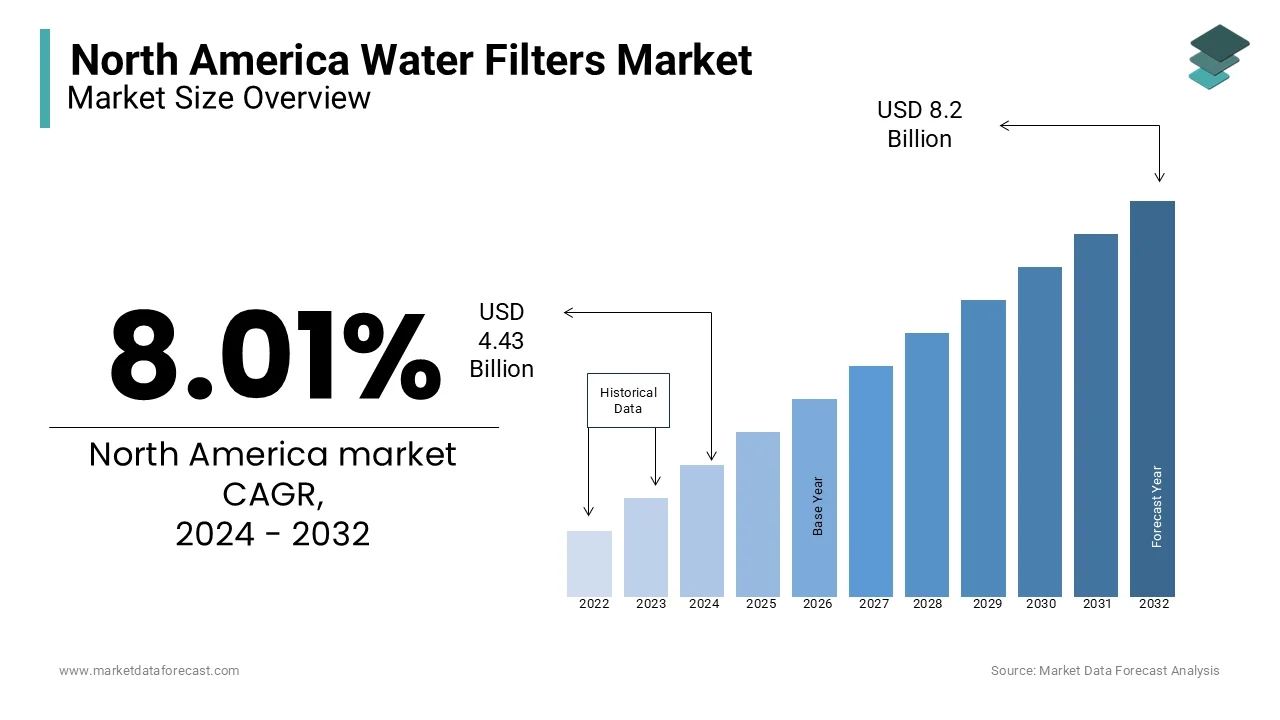
The North America water filters market was valued at USD 4.78 billion in 2025, is estimated to reach USD 5.16 billion in 2026, and is projected to reach USD 9.56 billion by 2034, growing at a CAGR of 8.01% during the forecast period. Market growth is driven by increasing concerns over water quality, rising awareness of health and hygiene, and growing demand for safe drinking water solutions. The adoption of advanced filtration technologies, along with increasing urbanization and aging water infrastructure, is further supporting market expansion. In addition, the rising preference for point of use and point of entry filtration systems is contributing to strong market growth across North America.
Key Market Trends
- Increasing concerns regarding water contamination and safety are driving demand for water filtration systems.
- Rising adoption of advanced filtration technologies such as reverse osmosis is boosting market growth.
- Growing awareness of health and hygiene is encouraging the use of residential water filters.
- Expansion of smart and connected filtration systems is enhancing user convenience and monitoring.
- Increasing demand for sustainable and energy efficient water treatment solutions is influencing product development.
Segmental Insights
- Based on technology, the reverse osmosis segment was the largest and held 48.6% of the North America water filters market share in 2025. This dominance is attributed to its high efficiency in removing contaminants, dissolved solids, and impurities, making it a preferred choice for residential and commercial applications.
- Based on distribution channel, the retail sales segment accounted for 52.8% of the North America water filters market share in 2025. The segment’s growth is driven by easy product availability, consumer convenience, and strong presence of retail outlets.
- Based on end user, the residential segment held a prominent share of the North America water filters market in 2025, supported by increasing household adoption and rising awareness of safe drinking water.
Regional Insights
- The North America water filters market is experiencing strong growth across the region, supported by increasing water quality concerns and technological advancements.
- The United States was the largest contributor, accounting for 82.4% of the North America water filters market share in 2025, driven by high consumer awareness, advanced infrastructure, and widespread adoption of filtration systems.
Competitive Landscape
The North America water filters market is highly competitive, with major players focusing on product innovation, technological advancements, and expansion of distribution networks to strengthen their market position. Companies are investing in smart filtration solutions, sustainable technologies, and brand differentiation strategies. Prominent players in the North America water filters market include Culligan International Company, A O Smith Corporation, Pentair plc, 3M Company, Whirlpool Corporation, Ecolab Inc, Brita GmbH Clorox Company, Aquasana Inc A O Smith Corporation, LG Electronics Inc, Kenmore Sears Holdings Corporation, DuPont de Nemours Inc, GE Appliances Haier Group Corporation, EcoWater Systems LLC, WaterChef Lifeguard Technologies, Krystal Pure Water Filters Home Guard Technologies, Aquaguard Eureka Forbes Ltd, PurePro USA Corporation, Omnipure Filter Company, and Everpure LLC Pentair plc.
North America Water Filters Market Size
The North America Water Filters Market was valued at USD 4.78 billion in 2025, is estimated to reach USD 5.16 billion in 2026, and is projected to reach USD 9.56 billion by 2034, growing at a CAGR of 8.01% from 2026 to 2034.
The water filters are filtration technologies designed to eliminate physical, chemical, and biological impurities from residential, commercial, and industrial water supplies. These systems range from point-of-use devices such as under-sink and pitcher filters to whole-house and point-of-entry units utilizing reverse osmosis, activated carbon, and ultraviolet disinfection. With increasing concerns over aging infrastructure and environmental contamination, water filtration has transitioned from a convenience to a public health necessity. As per the United States Environmental Protection Agency, over 220 million Americans rely on public water systems, yet more than 10% of community water systems violated safety standards in 2022. Additionally, Environment and Climate Change Canada reports that some groundwater sites monitored across Canada showed nitrate concentrations exceeding guidelines, underscoring the urgency for advanced filtration solutions.
MARKET DRIVERS
Growing Incidence of Water Contamination Incidents
The escalating frequency of water contamination events linked to industrial discharge, agricultural runoff, and deteriorating infrastructure is major factor propelling the growth of North America water filters market. In the U.S., the Environmental Protection Agency identified over 80,000 violations of the Safe Drinking Water Act between 2018 and 2022, affecting approximately 21 million people. Lead contamination remains a concern, as per the Natural Resources Defense Council, more than 186 million Americans in 2023 were served by water systems that detected lead levels above the agency’s action level at some point. Furthermore, per- and polyfluoroalkyl substances (PFAS) have been detected in 45% of U.S. tap water samples, according to a 2023 U.S. Geological Survey analysis of 716 locations. These findings have heightened consumer awareness, prompting households to adopt certified filtration systems capable of removing such contaminants, thereby accelerating demand across both urban and rural regions.
Rising Consumer Health Consciousness and Preventive Wellness Trends
The growing public emphasis on preventive health and clean living, which has redefined water consumption habits is escalating the growth of North America water filters market. A 2023 survey by the International Bottled Water Association revealed that 72% of American households now consider water quality a top health priority, with over 55% investing in home filtration systems. This shift is reinforced by increasing diagnoses of waterborne illnesses, where the Centers for Disease Control and Prevention estimates that contaminated drinking water cases of gastrointestinal illness is increasing annually in the U.S. Moreover, the prevalence of immunocompromised individuals, numbering over 3% of the U.S. population as per the National Health Interview Survey has amplified demand for microbiologically safe water. Consequently, consumers are opting for advanced filters with NSF/ANSI 53 and 58 certifications, driving innovation and market expansion across retail and e-commerce channels.
MARKET RESTRAINTS
High Upfront and Maintenance Costs Limiting Mass Adoption
The financial burden associated with acquisition and long-term upkeep of high-performance systems is one of the primary factor degrading the growth of North America water filters market. Reverse osmosis units, which effectively remove heavy metals and PFAS, typically cost between $150 and $1,500 for installation, with annual maintenance expenses averaging $100 to $300 for membrane replacements and filter changes. As per the U.S. Census Bureau’s 2023 data, nearly 11.5% of households in the U.S. live below the poverty line, rendering such investments unaffordable for a significant segment. Similarly, in rural Canada, where median household income is 12% lower than the national average according to Statistics Canada, adoption remains limited despite elevated contamination risks. These economic barriers restrict market penetration, particularly among low-income populations who are often most vulnerable to poor water quality, thereby creating a disparity in access to safe drinking water.
Lack of Uniform Regulatory Enforcement and Certification Awareness
The fragmented regulations and limited consumer understanding of filtration standards are also impeding the growth of North America water filters market. While the U.S. Environmental Protection Agency regulates public water systems, it does not oversee point-of-use devices, leaving certification to third-party organizations like NSF International. However, as per a 2022 Water Quality Association survey, only 38% of American consumers can identify NSF certification marks, leading to the purchase of substandard products. In Canada, provincial regulations vary widely; for example, Ontario mandates certification for drinking water devices under O. Reg. 169/11, whereas other provinces lack equivalent requirements. This inconsistency fosters market confusion and undermines trust in product efficacy. Additionally, a 2023 study published in Environmental Science & Technology found that 30% of online-listed filters failed to meet their claimed contaminant reduction performance by exacerbating consumer awareness and hindering widespread adoption.
MARKET OPPORTUNITIES
Integration of Smart Technology and IoT-Enabled Filtration Systems
The emergence of water filtration with smart technology and real-time monitoring capabilities is certainly to pose new opportunities for the growth of North America water filters market. The proliferation of connected home ecosystems has spurred demand for intelligent filters that track water usage, detect contaminants, and alert users to maintenance needs via mobile applications. As per Statista, the number of smart home devices in North America reached 135 million in 2023, with water-related sensors accounting for a growing share. Companies like Aquasana and Frizzlife have introduced Wi-Fi-enabled systems that provide usage analytics and automatic filter replacement scheduling. This technological evolution not only enhances user experience but also positions filtration systems as integral components of preventive home health infrastructure.
Expansion of Decentralized Water Treatment in Underserved Regions
The need for decentralized, off-grid water solutions in remote and Indigenous communities, where centralized infrastructure is lacking will also to boost the growth of North America filters market. In Canada, as per Indigenous Services Canada, over 100 long-term drinking water advisories were in effect in First Nations communities as of late 2023, despite federal efforts to eliminate them. Similarly, in rural Alaska, nearly 3,000 households lack piped water services, according to the Alaska Native Tribal Health Consortium. These gaps present a compelling case for portable and modular filtration units that can operate independently of municipal systems. Solar-powered and gravity-fed filters, such as those developed by organizations like Water Mission, have demonstrated efficacy in removing pathogens and turbidity in off-grid settings.
MARKET CHALLENGES
Ensuring Consistent Performance Amid Diverse Water Quality Profiles
The engineering systems that deliver reliable performance across vastly different water chemistries is solely to act as a major barrier for the growth of North America water filters market. Groundwater in the Midwest, for instance, often contains high levels of nitrates and hardness, while surface water in the Northeast may carry elevated organic matter and chlorine byproducts. As per the U.S. Geological Survey, many domestic wells in the U.S. exceed at least one federal health benchmark, but contaminant profiles vary significantly by region. This heterogeneity complicates product design, as a filter optimized for lead removal may be ineffective against arsenic or PFAS. Manufacturers must therefore develop adaptable or multi-stage systems, increasing complexity and cost. Moreover, inconsistent water pressure and temperature fluctuations in older housing stock further strain system efficacy, necessitating robust engineering and frequent recalibration.
Managing Environmental Impact of Filter Disposal and Plastic Waste
The environmental footprint associated with disposable filter cartridges and plastic waste is greatly influencing the growth of North America water filters market. The Water Quality Association estimates that over 20 million point-of-use filter units are sold annually in the U.S., each generating multiple replaceable cartridges per year. Most of these components, composed of mixed plastics and activated carbon, are not recyclable through standard municipal programs. A 2023 study by the University of Toronto found that discarded filter housings contribute over 8,000 metric tons of non-biodegradable waste annually in Canada alone. Additionally, the production of activated carbon is energy-intensive, with lifecycle emissions averaging 2.5 kg CO₂ per kilogram of carbon produced, as reported by the International Energy Agency.
REPORT COVERAGE
| REPORT METRIC | DETAILS |
| Market Size Available | 2025 to 2034 |
| Base Year | 2025 |
| Forecast Period | 2026 to 2034 |
| CAGR | 8.01% |
| Segments Covered | By Technology, Distribution Channel, Portability, End User, and Region |
| Various Analyses Covered | Global, Regional, & Country Level Analysis; Segment-Level Analysis; DROC, PESTLE Analysis; Porter’s Five Forces Analysis; Competitive Landscape; Analyst Overview of Investment Opportunities |
| Regions Covered | United States, Canada and rest of North America |
| Market Leaders Profiled | Culligan International Company, A.O. Smith Corporation, Pentair plc, 3M Company, Whirlpool Corporation, Ecolab Inc., Brita GmbH (Clorox Company), Aquasana Inc. (A.O. Smith Corporation), LG Electronics Inc., Kenmore (Sears Holdings Corporation), DuPont de Nemours, Inc., GE Appliances (Haier Group Corporation), EcoWater Systems LLC, WaterChef (Lifeguard Technologies), Krystal Pure Water Filters (Home Guard Technologies), Aquaguard (Eureka Forbes Ltd.), PurePro USA Corporation, Omnipure Filter Company and Everpure LLC (Pentair plc). |
SEGMENTAL ANALYSIS
By Technology Insights
The Reverse Osmosis (RO) segment was the largest by holding 48.6% of the North America Water Filters Market share in 2025 with its unmatched efficacy in removing a broad spectrum of contaminants, including heavy metals, nitrates, and emerging pollutants such as PFAS. As per the U.S. Geological Survey, over 20% of private wells in the United States exceed federal thresholds for at least one health-related contaminant, with arsenic and uranium prevalent in regions like the Southwest and New England. RO systems, which can eliminate up to 99% of dissolved solids, are increasingly perceived as essential for households relying on such sources. The Environmental Protection Agency confirms that RO is one of the few technologies capable of reducing PFAS levels below 4 parts per trillion, the health advisory limit set in 2022.

The Ultraviolet (UV) disinfection segment is anticipated to grow at a fastest CAGR of 9.6% from 2026 to 2034 with the role in neutralizing microbiological threats in both municipal and decentralized water systems. Unlike chemical or mechanical filtration, UV technology effectively inactivates bacteria, viruses, and protozoa without altering water taste or introducing byproducts. According to the Centers for Disease Control and Prevention, waterborne pathogens such as Cryptosporidium and Legionella are responsible for over 7 million illnesses annually in the U.S., with outbreaks increasingly linked to aging distribution networks and climate-induced flooding. UV systems, which require no consumables and operate with minimal maintenance, are being adopted in homes, healthcare facilities, and off-grid communities where microbial safety is paramount.
By Distribution Channel Insights
The retail sales segment was the largest by capturing 52.8% of the North America Water Filters Market in 2025 owing to the accessibility and consumer trust associated with brick-and-mortar outlets such as home improvement stores and appliance retailers. Major chains like The Home Depot and Lowe’s collectively account for over 65% of in-store water filter sales in the U.S., as per the National Retail Federation. These retailers offer hands-on product demonstrations, immediate availability, and installation support, which are particularly valuable for first-time buyers navigating complex filtration options. The strategic partnerships between manufacturers and large distributors is escalating the growth of segment. For instance, brands like Brita and PUR maintain prominent shelf space in grocery and pharmacy chains, leveraging impulse buying behavior.
The online distribution segment is projected to grow at a CAGR of 12.3% throughout the forecast period with the shifting consumer behavior toward digital commerce and the availability of detailed product comparisons, customer reviews, and subscription-based filter replacement services. According to Statista, e-commerce accounted for 38% of all water filter sales in North America in 2023, up from 24% in 2019. Platforms like Amazon and Wayfair have become primary marketplaces, offering niche and high-performance systems that may not be available locally. A 2023 Adobe Analytics report revealed that searches for “best under-sink water filter” increased by 67% year-over-year, reflecting growing consumer sophistication in online research.
The rise of direct-to-consumer (DTC) brands that leverage digital marketing and subscription models to build customer loyalty is also fuelling the growth of segment. Companies such as Clearly Filtered and Aquasana offer bundled packages with automatic filter deliveries, enhancing convenience and reducing churn. Additionally, online platforms enable access to third-party certifications and independent testing data, empowering buyers to make informed decisions.
By End User Insights
The residential sector was the largest by holding a prominent share of the North America Water Filters Market in 2025 owing to the widespread concerns over household water safety and the decentralization of water treatment responsibility from municipal authorities to individual homeowners. The Environmental Protection Agency does not regulate private wells, leaving owners solely responsible for testing and treatment. This regulatory gap has driven demand for point-of-use and point-of-entry systems, particularly in rural areas where contamination risks from nitrates, arsenic, and bacteria are elevated. The expansion of the residential segment is also propelled by new home construction trends and renovation activity. Builders are increasingly incorporating under-sink RO units and whole-house sediment filters to meet buyer expectations for health and sustainability. A 2023 Joint Center for Housing Studies at Harvard University report found that 44% of homeowners who renovated kitchens or bathrooms included water filtration upgrades, citing improved taste and appliance protection as key motivators.
The commercial sector is anticipated to grow at a CAGR of 10.8% from 2026 to 2034 owing to the stringent health regulations and operational imperatives across food service, healthcare, and hospitality industries. In the U.S., the Food and Drug Administration mandates that all food establishments use water that meets EPA standards, prompting restaurants and cafes to install commercial-grade filtration to ensure compliance and protect equipment. As per the National Restaurant Association, over 750,000 establishments in the U.S. now use dedicated water filters to prevent scale buildup in ice machines and espresso systems, reducing maintenance costs by up to 30% annually. The increasing focus on workplace wellness and occupant health in office buildings and institutional facilities is additionally promoting new opportunities for the growth of the segment. Hospitals and clinics, in particular, are investing in multi-barrier filtration systems to prevent Legionella outbreaks, where the CDC estimates that 8,000 to 18,000 people are hospitalized annually due to Legionnaires’ disease, often linked to contaminated building water systems.
REGIONAL ANALYSIS
United States Water Filters Market Analysis
The United States was the top performer in the North America Water Filters Market by holding 82.4% of the share in 2025. As the largest and most technologically advanced market, the U.S. benefits from a combination of aging infrastructure, regulatory complexity, and high consumer spending on health and home improvement. Lead, PFAS, and microbial contamination remain persistent concerns, particularly in older cities like Flint, Michigan, and Newark, New Jersey. These incidents have catalyzed both public and private investment in filtration, with homeowners and institutions alike seeking independent safeguards.
Canada Water Filters Market Analysis
Canada was positioned next by holding 16.4% of the North American water filters market share in 2025 with growth anchored in rural and Indigenous communities facing persistent water insecurity. Indigenous Services Canada confirms that as of late 2023, 56 long-term drinking water advisories remained in effect across First Nations reserves, despite federal commitments to eliminate them. This systemic challenge has spurred targeted government funding and NGO-led initiatives to deploy point-of-use and community-scale filtration systems. Additionally, provinces like British Columbia and Alberta have seen increased residential adoption due to wildfire-related water contamination, with ash and debris altering water chemistry.
COMPETITIVE LANDSCAPE
The competition in the North America water filters market is intense and dynamically evolving, characterized by technological differentiation and brand positioning. Established players such as 3M, Pentair, and AO Smith compete alongside specialized firms and emerging direct-to-consumer brands that leverage digital channels for rapid scaling. The market is witnessing a shift from basic filtration to advanced, health-focused solutions, prompting companies to emphasize third-party certifications, contaminant-specific performance, and smart features. Price sensitivity coexists with premiumization, as consumers seek both affordability and high efficacy. Regional variations in water quality drive customization, requiring localized product offerings. Competitive advantage is increasingly derived from after-sales service, filter subscription models, and environmental sustainability.
KEY MARKET PLAYERS
Some of the notable key players in the Europe water filters market are
- Culligan International Company
- A.O. Smith Corporation
- Pentair plc
- 3M Company
- Whirlpool Corporation
- Ecolab Inc.
- Brita GmbH (Clorox Company)
- Aquasana Inc. (A.O. Smith Corporation)
- LG Electronics Inc.
- Kenmore (Sears Holdings Corporation)
- DuPont de Nemours, Inc.
- GE Appliances (Haier Group Corporation)
- EcoWater Systems LLC
- WaterChef (Lifeguard Technologies)
- Krystal Pure Water Filters (Home Guard Technologies)
- Aquaguard (Eureka Forbes Ltd.)
- PurePro USA Corporation
- Omnipure Filter Company
- Everpure LLC (Pentair plc)
Top Players in the Market
- 3M has established a formidable presence in the North America Water Filters Market through its advanced filtration technologies and broad product portfolio targeting both residential and commercial applications. The company’s filtration solutions, including its Filtrete and Purification product lines, integrate electrostatically charged media and activated carbon to capture fine particulates and reduce chlorine, VOCs, and heavy metals. In recent years, 3M has intensified its focus on PFAS removal, launching certified under-sink systems validated to reduce multiple types of per- and polyfluoroalkyl substances. In April 2023, the company expanded its manufacturing capacity in Decatur, Alabama, to meet rising demand for liquid filtration systems. Additionally, 3M has strengthened its distribution network through partnerships with home improvement retailers and HVAC service providers, enhancing accessibility and technical support.
- Pentair has emerged as a leader in smart and sustainable water solutions across North America, leveraging its expertise in residential and industrial filtration systems. The company’s Everpure and Pentair Home Filtration brands offer point-of-use, point-of-entry, and reverse osmosis systems engineered for high efficiency and ease of maintenance. In 2023, Pentair launched the Everpure Home H2O+ Smart Filtration System, integrating IoT-enabled monitoring that alerts users to filter status and water quality changes via a mobile app. This innovation aligns with growing consumer demand for connected home health technologies.
- AO Smith has solidified its influence in the North America Water Filters Market through aggressive product innovation and strategic expansion into smart and zero-waste filtration systems. The company’s A.O. Smith Water Treatment division offers a wide array of reverse osmosis, alkaline, and UV-based filters tailored for American households, emphasizing contaminant reduction and water taste enhancement. AO Smith introduced the A.O. Smith Zenith Series, a high-efficiency RO system with a 2:1 wastewater ratio, significantly improving upon traditional 3:1 or 4:1 models. The company has also deepened its digital integration by incorporating Wi-Fi connectivity and filter life tracking into its premium units.
Top Strategies Used by the Key Market Participants
Key players in the North America Water Filters Market are deploying multifaceted strategies to consolidate their positions and capture emerging opportunities. Product innovation remains a cornerstone, with companies investing heavily in R&D to develop filters capable of removing PFAS, heavy metals, and microbial contaminants. Firms are increasingly integrating smart technologies, such as IoT-enabled monitoring and mobile app integration, to enhance user experience and retention. Strategic partnerships with retailers and HVAC contractors are expanding distribution reach, while direct-to-consumer models are being leveraged to build brand loyalty. Mergers and acquisitions are being used to acquire niche technologies and software capabilities. Sustainability is another focal point, with manufacturers introducing recyclable cartridges and low-waste RO systems. Additionally, companies are engaging in public awareness campaigns and collaborating with health agencies to position filtration as essential for preventive wellness, thereby driving long-term demand.
MARKET SEGMENTATION
This research report on the North American water filter market is segmented and sub-segmented based on the following categories.
By Technology
- UV
- RO
- Gravity-Based
By Distribution Channel
- Retail Sales
- Direct Sales
- Online
By Portability
- Portable
- Non-portable
By End User
- Commercial
- Residential
By Country
- The U.S.
- Canada
- Rest of North America
Frequently Asked Questions
1.What is the North America water filters market?
The North America water filters market includes point of use and point of entry filtration systems designed to remove contaminants and improve drinking water quality for residential, commercial, and industrial users.
2.What factors are driving growth in the North America water filters market?
Growth is driven by rising concerns over water contamination, increasing health awareness, aging water infrastructure, and growing adoption of home water purification systems.
3.Which countries dominate the North America water filters market?
The United States dominates the market, followed by Canada and Mexico, supported by high consumer awareness and strong demand for safe drinking water.
4.What types of water filters are commonly used in North America?
Common types include activated carbon filters, reverse osmosis systems, UV filters, ceramic filters, and ion exchange systems.
5.How does health awareness influence water filter adoption?
Rising health awareness encourages consumers to use water filters to reduce exposure to chemicals, heavy metals, and microorganisms.
6.What role does regulations play in the water filters market?
Water quality standards and safety regulations drive adoption of certified filtration systems for residential and commercial use.
7.What are the main applications of water filters?
Water filters are widely used in residential households, offices, restaurants, healthcare facilities, and industrial applications.
8.How important is sustainability in the water filters market?
Sustainability is increasingly important, driving demand for reusable filters, reduced plastic waste, and energy efficient filtration technologies.
9.What challenges does the North America water filters market face?
Key challenges include high initial costs, regular maintenance requirements, filter replacement costs, and competition from bottled water.
10.What is the future outlook for the North America water filters market?
The market is expected to grow steadily, supported by increasing water quality concerns, technological innovation, and rising consumer demand for safe drinking water.
Related Reports
Access the study in MULTIPLE FORMATS
Purchase options starting from
$ 2000
Didn’t find what you’re looking for?
TALK TO OUR ANALYST TEAM
Need something within your budget?
NO WORRIES! WE GOT YOU COVERED!
Call us on: +1 888 702 9696 (U.S Toll Free)
Write to us: sales@marketdataforecast.com