- Product Description Description
- Table of Contents TOC
- List of Table & Figure LOT
- Get Free Sample PDF Sample PDF
Market Size, 2025
$9.56 BnMarket Estimate, 2026
$9.96 BnMarket Forecast, 2034
$13.80 BnCAGR, 2026–2034
4.16%North America Well Intervention Market Size, Growth, Trends & Forecast (2026–2034)
The North America Well Intervention Market size was calculated to be USD 9.56 billion in 2025, is anticipated to be worth USD 9.96 billion in 2026, and is expected to reach USD 13.80 billion by 2034, growing at a compound annual growth rate (CAGR) of 4.16% during the forecast period from 2026 to 2034. Market growth is primarily driven by the maturation of North America's extensive well inventory and ongoing technological innovations in downhole intervention equipment.
Key Executive Metrics (At-a-Glance)
- 2025 Base Valuation: USD 9.56 billion
- 2026 Current Valuation: USD 9.96 billion
- 2034 Forecast Valuation: USD 13.80 billion
- Compound Annual Growth Rate (CAGR): 4.16% (2026–2034)
- Dominant Service Segment: Stimulation services segment (holding 38.2% of the market share in 2025)
- Fastest-Growing Service Segment: Logging and bottomhole survey segment (projected at a CAGR of 8.2%)
- Dominant Intervention Segment: Light intervention services segment (holding 45.3% share in 2025)
- Fastest-Growing Intervention Segment: Heavy intervention services segment (projected at a CAGR of 6.8%)
- Dominant Application Segment: Onshore applications segment (dominant market share in 2025)
- Fastest-Growing Application Segment: Offshore applications segment (projected at a CAGR of 5.9%)
- Dominant Country Hub: United States (holding 92.3% of the regional market share in 2025)
- Key Growth Region: Canada (accounting for 3.2% share in 2025, driven by oil sands and sedimentary basin recovery)
Core Market Drivers
- Maturing Well Infrastructure: High demand to optimize production from aging assets rather than premature abandonment.
- Technological Innovation: Advanced coiled tubing, intelligent completions, and real-time downhole sensing capabilities.
Primary Market Restraints & Challenges
- Volatile Commodity Pricing: Cyclical capital allocation constraints impacting discretionary well intervention budgets.
- Regulatory & Workforce Hurdles: Stringent environmental permitting frameworks alongside skilled workforce shortages and technical expertise gaps.
North America Well Intervention Market Segmentation Breakdown
| Segment Category | Leading Sub-Segment | Fastest-Growing Sub-Segment |
|---|---|---|
| By Service | Stimulation Services (38.2% share in 2025) | Logging & Bottomhole Survey (CAGR of 8.2%) |
| By Intervention | Light Intervention Services (45.3% share in 2025) | Heavy Intervention Services (CAGR of 6.8%) |
| By Application | Onshore Applications Segment | Offshore Applications Segment (CAGR of 5.9%) |
| By Region | United States (92.3% share in 2025) | Canada (3.2% share in 2025, thermal and heavy oil recovery) |
Major Industry Players Profiled
Key market leaders and service providers shaping the North American well intervention sector include Schlumberger Limited, Halliburton Company, Baker Hughes Company, Weatherford International, Archer Limited, Trican Well Service Ltd., Superior Energy Services, Altus Intervention, Oceaneering International, Expro Group, Nine Energy Service, Helix Energy Solutions, National Oilwell Varco, Precision Drilling Corporation, and Key Energy Services.
North America Well Intervention Market Size
The North America well intervention market Size was calculated to be USD 9.56 billion in 2025 and is anticipated to be worth USD 13.80 billion by 2034, from USD 9.96 billion in 2026, growing at a CAGR of 4.16% during the forecast period.
The well intervention is a sophisticated array of specialized services and technologies designed to restore, maintain, and optimize hydrocarbon production from existing oil and gas wells throughout their operational lifecycle. According to the American Petroleum Institute, the United States operates approximately 960,000 active oil and gas wells as of 2023, with Canada maintaining an additional 350,000 producing wells that collectively require ongoing intervention services to sustain optimal production rates. The market's scope extends beyond conventional remediation procedures to include sophisticated techniques such as hydraulic fracturing, acidizing treatments, sand control installations, and artificial lift system deployments.
MARKET DRIVERS
Maturing Well Infrastructure and Enhanced Recovery Requirements
The maturation of North America's extensive well inventory represents a primary catalyst driving substantial demand within the well intervention market, as operators seek to optimize production from aging assets rather than prematurely abandoning potentially productive formations. According to IHS Markit energy analytics, approximately 45% of active wells across the United States and Canada have been in production for more than two decades by creating inevitable deterioration in completion integrity and production performance that necessitates remedial intervention services. Enhanced oil recovery techniques have become increasingly important as primary and secondary recovery methods yield diminishing returns, with the U.S. Energy Information Administration reporting that enhanced recovery operations currently contribute approximately 3.2 million barrels per day to total domestic production. Steam injection, chemical flooding, and carbon dioxide injection programs require extensive well intervention services to modify completion configurations and install specialized downhole equipment. The economic imperative of maximizing asset value has prompted operators to invest significantly in intervention technologies, with mature field redevelopment projects typically requiring 2.5 intervention operations per well over their productive lifetime, according to SPE operational databases.
Technological Innovation in Downhole Intervention Equipment
The advanced technological development in specialized intervention equipment and techniques is another attribute that is fuelling the growth of the North American well intervention market. The evolution of coiled tubing technology has revolutionized intervention accessibility, with modern coiled tubing units capable of reaching depths exceeding 30,000 feet while maintaining precise downhole tool placement and real-time operational monitoring. Schlumberger's advanced intervention portfolio demonstrates industry leadership through integrated service offerings that combine real-time downhole sensing with automated control systems, reducing intervention operation times by approximately 40% compared to conventional methods, according to field performance studies. The development of intelligent completion systems incorporating downhole sensors and automated flow control devices has created new intervention service categories focused on production optimization and reservoir management. The integration of digital technologies, including artificial intelligence and machine learning algorithms, into intervention planning and execution processes has enhanced operational efficiency while reducing non-productive time by an average of 25% as documented in industry performance benchmarking studies. Advanced materials science applications have improved tool reliability and extended operational intervals by creating demand for sophisticated intervention services that maximize equipment utilization and minimize replacement costs.
MARKET RESTRAINTS
Volatile Commodity Pricing and Capital Allocation Constraints
The commodity price volatility is restricting the growth of the North American well intervention market. According to Rystad Energy market analysis, well intervention expenditure declined by 35% during 2020 compared to 2019 levels, with discretionary intervention projects representing the first category of operational activities subject to budget reduction during periods of commodity price stress. The cyclical nature of intervention demand creates substantial operational challenges for service providers who must maintain skilled workforce capabilities and equipment readiness while managing reduced activity levels that compromise operational efficiency and profitability. Credit facility restrictions imposed by lending institutions during periods of commodity price weakness further constrain operator ability to fund intervention projects, particularly for marginal producing assets that require economic justification based on sustained commodity price assumptions.
Stringent Environmental Regulations and Permitting Requirements
The evolving environmental regulatory frameworks and increasingly complex permitting requirements have emerged as substantial is, also limiting the growth of the North American well intervention market. California's stringent groundwater protection regulations require extensive environmental impact assessments and mitigation measures for intervention activities in sensitive geological formations, adding an average of 45 days to project execution timelines according to state regulatory agency processing statistics. The implementation of methane emission reduction requirements under federal and state regulatory programs has necessitated additional intervention services for wellsite equipment upgrades and leak detection remediation, creating operational complexity while increasing compliance costs that may exceed project economic justification. Cross-border regulatory harmonization challenges between U.S. federal agencies and Canadian provincial authorities create additional permitting complexity for intervention service providers operating in multiple jurisdictions, requiring specialized regulatory expertise and extended approval processes. The increasing prevalence of community opposition to intervention activities in populated areas has prompted regulatory agencies to implement additional public consultation requirements and environmental monitoring mandates that further constrain operational flexibility and increase project costs.
MARKET OPPORTUNITIES
Unconventional Resource Development and Horizontal Well Intervention
The unconventional resource regarding specialized services required for horizontal well completion optimization and production enhancement in shale and tight formation environments is creating new opportunities for the growth of the Latin American sports Sunglasses Market. The rapid proliferation of horizontal drilling techniques has created entirely new intervention service categories focused on multi-stage completion optimization, fracture stimulation enhancement, and production monitoring in complex wellbore geometries that demand specialized equipment and technical expertise. The Eagle Ford Shale development alone has generated demand for over 15,000 annual intervention operations focused on completion optimization and production enhancement, representing one of the most active intervention market segments in North America according to regional service company operational statistics. The development of enhanced completion designs incorporating dissolvable materials and autonomous inflow control devices has created new intervention service opportunities focused on post-completion optimization and remediation.
Digital Transformation and Predictive Intervention Technologies
The ongoing digital transformation within the oil and gas industry through advanced predictive analytics, real-time monitoring systems, and automated intervention technologies that enhance operational efficiency while reducing unplanned downtime and maintenance costs will additionally propel the growth of the Latin America Sports Sunglasses Market. The integration of Internet of Things sensor networks into well completion systems enables continuous production monitoring and early intervention requirement identification, creating demand for sophisticated diagnostic services and predictive maintenance programs that optimize well performance throughout operational lifecycles. Digital twin technology development for well completion systems enables virtual intervention simulation and optimization prior to physical intervention execution, reducing operational risks while improving intervention success rates and cost efficiency. Machine learning algorithms applied to historical intervention performance data have enabled service providers to develop predictive models that identify optimal intervention timing and methodology selection, improving customer satisfaction while reducing repeat intervention requirements.
MARKET CHALLENGES
Skilled Workforce Shortage and Technical Expertise Gaps
The workforce challenges stemming from an aging technical workforce, limited new talent pipeline development, and increasing technical complexity of intervention services that require specialized skills and extensive training to execute safely and effectively is limiting the growth of the North American well intervention market. The Society of Petroleum Engineers workforce demographics analysis indicates that nearly 50% of experienced intervention specialists in North America are aged fifty-five or older, creating imminent retirement wave concerns that threaten operational continuity and technical knowledge retention within the industry. Educational institution enrollment in petroleum engineering and related technical programs has declined by 25% over the past decade, according to the American Society for Engineering Education, creating fundamental challenges in developing adequate replacement workforce capacity to meet future intervention service demands. The increasing technical sophistication of intervention equipment and procedures requires extensive specialized training programs that may take two to three years to complete, creating significant delays in workforce development and deployment that constrain market growth potential. Rural location characteristics of many intervention operation sites create additional workforce challenges through limited local talent availability and increased costs associated with personnel mobilization and accommodation requirements.
Equipment Standardization and Interoperability Issues
The equipment standardization and interoperability operational obstacles within the North American well intervention market, as diverse equipment manufacturers, proprietary technologies, and varying operational requirements create complexity in service delivery and increase operational risks while reducing efficiency potential. The proliferation of proprietary intervention tool designs and operational protocols among major equipment manufacturers has created compatibility challenges that require extensive equipment modification and specialized interface components that increase project costs and operational complexity. Communication protocol incompatibility between downhole monitoring systems and surface control equipment from different manufacturers creates data integration challenges that limit real-time operational optimization and increase intervention project risks according to operational performance studies conducted by major operators. The lack of standardized equipment interfaces has necessitated extensive customization and modification programs that increase equipment procurement costs while extending delivery timelines and reducing operational flexibility in responding to changing customer requirements. Cross-border equipment certification and regulatory compliance requirements create additional complexity for intervention service providers operating in both U.S. and Canadian markets, requiring duplicate equipment inventories and specialized compliance documentation that increase operational costs and reduce equipment utilization efficiency.
REPORT COVERAGE
| REPORT METRIC | DETAILS |
| Market Size Available | 2025 to 2034 |
| Base Year | 2025 |
| Forecast Period | 2026 to 2034 |
| CAGR | 4.16% |
| Segments Covered | By Service, Intervention, Application, And Region |
| Various Analyses Covered | Global, Regional & Country Level Analysis; Segment-Level Analysis; DROC, PESTLE Analysis; Porter’s Five Forces Analysis; Competitive Landscape; Analyst Overview of Investment Opportunities |
| Regions Covered | Us, Canada, and the Rest of North America |
| Market Leaders Profiled | Schlumberger, Halliburton, Baker Hughes, Weatherford International, Archer Limited, Trican Well Service Ltd., Superior Energy Services, Altus Intervention, Oceaneering International, Expro Group, Nine Energy Service, Helix Energy Solutions, National Oilwell Varco, Precision Drilling Corporation, Key Energy Services |
SEGMENTAL ANALYSIS
By Service Insights
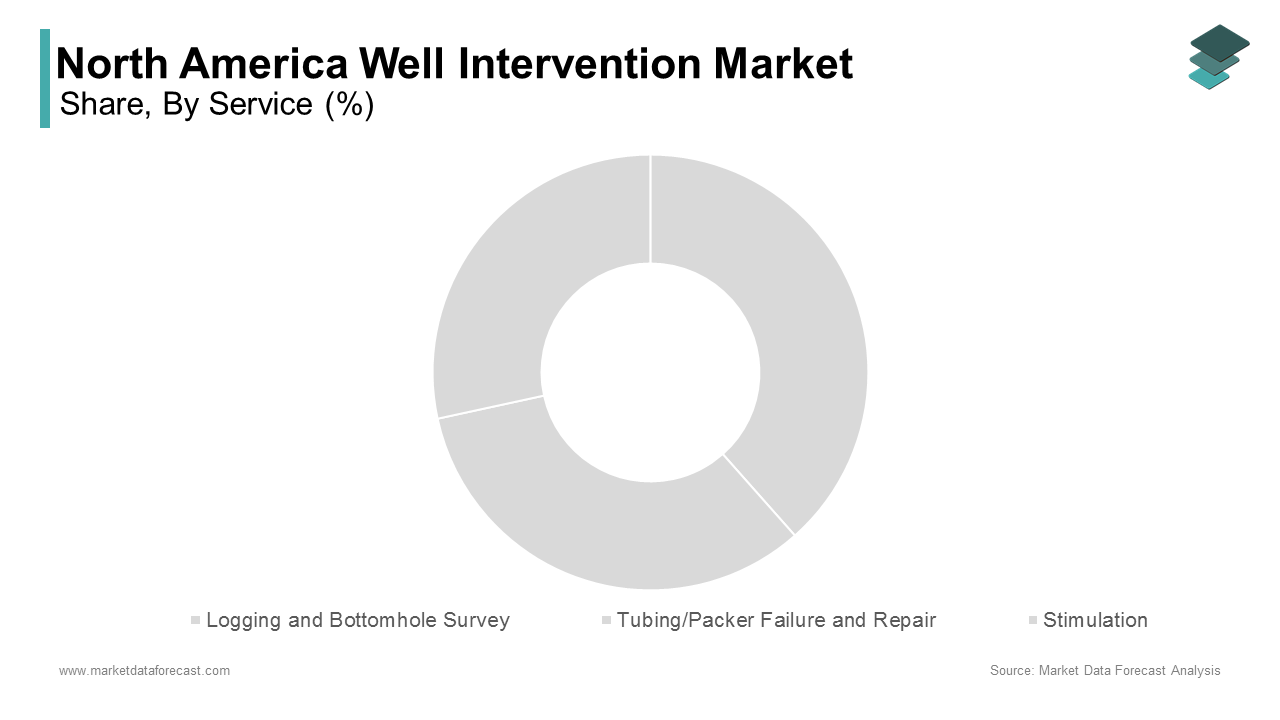
The stimulation services segment was the largest and held 38.2% of the North America well intervention market share in 2025 with the essential role stimulation treatments play in enhancing hydrocarbon production from both conventional and unconventional reservoirs across mature producing basins. The Permian Basin alone accounts for over 40% of total North American stimulation activity, with operators conducting an average of 2.8 stimulation treatments per horizontal well according to IHS Markit operational databases. Acidizing stimulation treatments remain for carbonate reservoir enhancement, with the Eagle Ford Shale and Austin Chalk formations requiring systematic acid stimulation programs to maintain production efficiency and prevent formation damage. The development of enhanced stimulation techniques including slickwater fracturing and gel-based treatments has expanded market scope while increasing service complexity and commercial value. Multi-stage fracturing technology advancement has created demand for specialized stimulation services that can effectively treat multiple reservoir zones within single wellbores, commanding premium pricing due to technical complexity and equipment requirements.
The logging and bottomhole survey segment is likely to growth an anticipated CAGR of 8.2% throughout the forecast period with the rapid expansion reflects the increasing importance of real-time reservoir characterization and wellbore condition assessment in optimizing intervention operations and maximizing production efficiency. Advanced logging technologies, including nuclear magnetic resonance and spectral gamma ray analysis, enable detailed formation evaluation that directly influences intervention strategy selection and operational parameter optimization. The development of real-time logging capabilities has revolutionized intervention decision-making processes, with operators increasingly relying on immediate formation response data to adjust intervention procedures and improve operational success rates. The integration of artificial intelligence algorithms into logging data interpretation has improved formation evaluation accuracy while reducing operational decision-making time by approximately 40% according to field performance studies. Multi-well pad development strategies have concentrated logging service demand in specific geographical areas by enabling service providers to achieve operational efficiency through equipment consolidation and personnel optimization.
By Intervention Insights
The light intervention services segment was the largest and held 45.3% of the North America well intervention market share in 2025 with the fundamental role light intervention services play in routine well maintenance, production optimization, and minor remediation activities that require minimal equipment mobilization and operational complexity. Routine maintenance activities, including rod pump replacement, tubing scale removal, and basic wellbore cleaning, represent the primary demand drivers for light intervention services, creating consistent market demand regardless of commodity price cycles. The development of specialized light intervention equipment, including coiled tubing units and wireline trucks has enhanced service delivery capabilities while reducing operational costs and improving efficiency compared to traditional workover rig operations. Artificial lift system maintenance represents a significant component of light intervention demand, with over 60% of producing wells utilizing some form of artificial lift according to the American Petroleum Institute operational statistics. The increasing adoption of predictive maintenance strategies has created demand for regular light intervention services that prevent major equipment failures and maintain optimal production rates. Cost-effectiveness considerations favor light intervention services over heavy intervention alternatives when addressing minor operational issues, creating sustained market demand for efficient and economical service delivery.
The heavy intervention services segment is likely to witness a CAGR of 6.8% throughout the forecast period with the increasing complexity of well completion designs and the need for sophisticated intervention capabilities to address major wellbore integrity issues and completion failures in mature producing assets. The proliferation of multi-zone completion systems in horizontal wells has created demand for complex heavy intervention services including completion replacement, casing repair, and wellbore reconfiguration that require specialized equipment and extensive operational planning. Enhanced recovery program implementation has necessitated heavy intervention services for wellbore modification and completion system installation that enable secondary and tertiary recovery techniques including steam injection and chemical flooding. The development of advanced heavy intervention equipment, including heavy-duty workover rigs and specialized downhole tools, has expanded service capabilities while improving operational safety and efficiency. Aging well infrastructure across North America's established producing basins has created increasing demand for major remediation services, including casing patching, tubing replacement, and completion system overhaul that require heavy intervention capabilities.
By Application Insights
The onshore applications segment was the largest with significant share of the North America well intervention market in 2025 with the extensive onshore well inventory across North America's diverse producing basins and the fundamental operational advantages of onshore intervention activities compared to offshore alternatives. The United States alone operates over 960,000 active onshore wells according to the American Petroleum Institute, creating substantial demand for intervention services that can be efficiently delivered using land-based equipment and personnel. Onshore intervention operations benefit from simplified logistics and reduced operational costs compared to offshore activities, with mobilization time typically 60% shorter and equipment costs 40% lower according to industry operational benchmarking studies.
The offshore applications segment is likely to gain huge traction with a CAGR of 5.9% during the forecast period with the increasing complexity of offshore well development projects and the need for sophisticated intervention capabilities to maintain production efficiency in challenging marine environments. Deepwater and ultra-deepwater well development has created demand for specialized offshore intervention services including subsea completion maintenance, riser system repair, and underwater wellhead intervention that require advanced equipment and highly trained personnel. Enhanced safety requirements for offshore intervention operations have necessitated specialized equipment including blowout preventer systems and emergency response capabilities that add value to basic intervention service offerings. The development of floating production systems and subsea processing equipment has created new intervention service categories focused on underwater equipment maintenance and repair that command premium pricing due to technical complexity and safety requirements. Advanced positioning systems and dynamic positioning vessel technology have improved offshore intervention operational efficiency while reducing weather-related operational delays and improving service delivery consistency.
REGIONAL ANALYSIS
United States Well Intervention Market Insights
The United States was the top performer of the North American well intervention market with 92.3% of share in 2025 with the extensive onshore well inventory, sophisticated service infrastructure, and advanced technological capabilities that support comprehensive intervention service delivery across diverse geological environments. Major producing basins, including the Permian Basin, Eagle Ford Shale, and Bakken Formation, concentrate intervention activity in specific geographical regions while enabling service providers to achieve operational efficiency through equipment and personnel consolidation. The development of unconventional resource plays has created demand for specialized intervention services including multi-stage fracturing optimization and horizontal well completion enhancement that command premium pricing due to technical complexity. Advanced service delivery infrastructure, including major equipment manufacturing facilities and specialized training centers, supports the sophisticated intervention service requirements of U.S. operators. Regulatory framework evolution including environmental protection requirements and safety standards has created demand for specialized intervention services that ensure regulatory compliance while maintaining operational efficiency.
Canada Well Intervention Market Insights
Canada well intervention market held 3.2% of the share in 2025 with the substantial oil and gas production infrastructure, particularly in Alberta's oil sands and Western Canada Sedimentary Basin, which requires ongoing intervention services to maintain production efficiency and optimize hydrocarbon recovery. Canada operates approximately 350,000 active wells according to the Canadian Association of Petroleum Producers, creating consistent intervention service demand that supports specialized service capabilities and regional market development. The unique characteristics of Canadian oil sands production, including thermal recovery operations and heavy oil extraction, create demand for specialized intervention services that address unique operational challenges and maintain production efficiency. Arctic and northern region well development has necessitated specialized intervention capabilities including cold weather equipment operation and remote location service delivery that require advanced planning and specialized equipment. Regulatory harmonization between federal and provincial authorities creates standardized intervention service requirements that facilitate market development while ensuring environmental protection and operational safety.
LEADING PLAYERS IN THE NORTH AMERICAN WELL INTERVENTION MARKET
Schlumberger Limited
Schlumberger maintains leadership through comprehensive intervention service portfolios spanning conventional and unconventional resource applications across North America's diverse producing basins. The company's technological innovation in coiled tubing operations, wireline services, and stimulation technologies has established industry standards for intervention efficiency and safety performance. Their integrated service delivery model combines advanced equipment capabilities with specialized technical expertise to address complex wellbore challenges and optimize production outcomes. Schlumberger's extensive equipment fleet and strategically located service centers enable rapid response capabilities and efficient resource mobilization across major producing regions. The company's commitment to digital transformation has enhanced intervention planning and execution through real-time monitoring systems and predictive analytics applications. Their comprehensive training programs ensure technical competency and safety compliance while maintaining operational excellence standards. Schlumberger's collaborative approach with operators facilitates customized intervention solutions that address specific well challenges and production optimization requirements. The company's global research and development capabilities enable continuous technology advancement and service innovation that maintain competitive advantages. Their environmental stewardship initiatives ensure regulatory compliance while supporting sustainable intervention practices. Schlumberger's extensive service network and technical capabilities position them as preferred intervention service providers for major operators across North America.
Halliburton Company
Halliburton has established a strong market presence through innovative intervention technologies and comprehensive service delivery capabilities that address diverse operational requirements across North American producing basins. The company's specialization in stimulation services and completion optimization has created significant value for operators seeking to enhance production from both conventional and unconventional reservoirs. Their advanced equipment fleet includes state-of-the-art coiled tubing units and wireline trucks that enable efficient service delivery across diverse operational environments. Halliburton's integrated approach combines technical expertise with advanced equipment capabilities to deliver customized intervention solutions that optimize well performance and extend productive life. The company's commitment to safety excellence ensures regulatory compliance while maintaining operational efficiency and personnel protection standards. Their digital technology integration enhances intervention planning and execution through real-time data analytics and automated control systems. Halliburton's collaborative relationships with major operators facilitate technology development and service innovation that addresses evolving operational challenges. The company's extensive service network enables rapid mobilization and efficient resource allocation while maintaining consistent service quality standards. Their environmental protection initiatives ensure sustainable intervention practices while supporting regulatory compliance requirements. Halliburton's comprehensive service capabilities and technical expertise position them as key market participants in North America's well intervention sector.
Baker Hughes Company
Baker Hughes has developed a strong market position through specialized intervention technologies and comprehensive service capabilities that address complex wellbore challenges across North American producing operations. The company's focus on artificial lift systems and production enhancement technologies has created significant value for operators seeking to optimize production from mature field assets. Their advanced equipment portfolio includes specialized coiled tubing systems and wireline tools that enable efficient intervention operations in challenging wellbore environments. Baker Hughes' integrated service approach combines technical expertise with advanced equipment capabilities to deliver customized solutions that address specific operational requirements and production optimization goals. The company's commitment to operational excellence ensures consistent service delivery while maintaining safety and environmental compliance standards. Their digital transformation initiatives enhance intervention efficiency through real-time monitoring and predictive maintenance capabilities that improve operational decision-making. Baker Hughes' collaborative partnerships with operators facilitate technology development and service innovation that addresses evolving industry requirements. The company's extensive training programs ensure technical competency and safety compliance while maintaining high service quality standards. Their global technology development capabilities enable continuous innovation and service advancement that maintains competitive positioning. Baker Hughes' specialized capabilities and comprehensive service offerings establish them as key contributors to North America's well intervention market development.
TOP STRATEGIES USED BY KEY MARKET PARTICIPANTS
Technological Innovation and Digital Integration
Leading well intervention service providers focus extensively on developing advanced technologies and integrating digital solutions to enhance operational efficiency and service delivery capabilities. Companies invest significantly in research and development programs focused on equipment automation, real-time monitoring systems, and predictive analytics applications that improve intervention success rates while reducing operational risks. Advanced sensor technologies and data analytics capabilities enable service providers to optimize intervention planning and execution through enhanced formation evaluation and wellbore condition assessment. Artificial intelligence applications accelerate decision-making processes and improve operational parameter optimization while reducing non-productive time and enhancing safety performance. The development of autonomous intervention equipment and remote operation capabilities enables service providers to address challenging operational environments while maintaining personnel safety and operational efficiency. Digital twin technology applications facilitate virtual intervention simulation and optimization prior to physical execution, reducing operational risks and improving project economics. These technological advancement strategies enable companies to differentiate their service offerings while maintaining competitive advantages through enhanced operational capabilities and service quality improvements.
Strategic Partnerships and Collaborative Development
Key market participants actively pursue strategic partnerships with equipment manufacturers, technology companies, and operators to accelerate innovation and expand service capabilities while sharing development costs and operational risks. Joint development agreements facilitate access to specialized expertise and advanced technologies that might otherwise be unavailable internally or require substantial investment to develop independently. Collaborative research initiatives with academic institutions and technology companies enable rapid technology advancement and commercial application deployment that maintains competitive positioning. Strategic alliances with major operators facilitate customized service development and technology integration that address specific operational challenges and production optimization requirements. Equipment supplier partnerships ensure access to advanced technologies and specialized components while maintaining cost-effective procurement and supply chain management.
Geographic Expansion and Market Diversification
Major well intervention service providers pursue geographic expansion strategies to access new market opportunities and diversify revenue streams while reducing dependency on specific producing regions or operational environments. Regional market expansion enables companies to leverage existing technical capabilities and equipment fleets while addressing diverse operational requirements and regulatory environments. Service diversification strategies encompass multiple intervention service categories, including conventional workover operations, unconventional resource development support, and specialized completion enhancement services. Cross-border service delivery capabilities enable companies to access international markets while maintaining regional specialization and operational expertise. Geographic expansion strategies also encompass establishing local service centers and equipment staging facilities that enable rapid response capabilities and efficient resource mobilization. These expansion strategies enable companies to maintain growth momentum while reducing market concentration risks and enhancing operational flexibility.
KEY MARKET PLAYERS AND COMPETITION OVERVIEW
Major Players of the North American well intervention market include Schlumberger, Halliburton, Baker Hughes, Weatherford International, Archer Limited, Trican Well Service Ltd., Superior Energy Services, Altus Intervention, Oceaneering International, Expro Group, Nine Energy Service, Helix Energy Solutions, National Oilwell Varco, Precision Drilling Corporation, Key Energy Services
The North American well intervention market presents intensely competitive dynamics characterized by established service giants, specialized niche providers, and emerging technology companies vying for market share through differentiated service offerings and operational excellence. Competition intensity varies significantly across service categories and geographical regions, with major service providers maintaining dominant positions in conventional intervention services while facing increasing competition from specialized companies in emerging technology segments. The market's competitive landscape is shaped by technological advancement, operational efficiency requirements, and evolving customer expectations that favor comprehensive service capabilities and innovative solution delivery. Service quality differentiation has become increasingly important as operators seek reliable intervention services that minimize operational risks while maximizing production optimization outcomes. Price competition remains significant in routine intervention services where operational efficiency and cost-effectiveness determine market positioning and customer retention. Equipment capability and technical expertise represent key competitive differentiators, particularly for complex intervention operations requiring specialized capabilities and advanced planning. Geographic proximity and rapid response capabilities influence competitive positioning in time-sensitive intervention operations where operational delays significantly impact project economics. Safety performance and environmental compliance have emerged as competitive factors as regulatory requirements become more stringent and operators prioritize risk mitigation. The increasing prevalence of collaborative partnerships and joint ventures has created new competitive dimensions where companies combine capabilities to address complex operational challenges and emerging technology requirements.
RECENT HAPPENINGS IN THE MARKET
- In February 2025, Schlumberger announced the launch of its next-generation coiled tubing intervention system featuring advanced real-time monitoring capabilities and automated control systems for enhanced operational efficiency in horizontal well applications.
- In December 2023, Halliburton completed the acquisition of ProTechnics Ltd, strengthening its well integrity services portfolio with specialized casing and tubing repair technologies for complex intervention operations in mature field environments.
- In October 2023, Baker Hughes entered into a strategic partnership with Microsoft to develop artificial intelligence applications for predictive intervention planning and real-time operational optimization in unconventional resource development projects.
- In July 2023, Weatherford International launched its integrated well intervention digital platform that combines real-time monitoring, predictive analytics, and automated decision support systems to enhance intervention success rates and operational safety.
- In April 2023, National Oilwell Varco announced the development of its advanced wireline intervention system featuring enhanced downhole tool capabilities and real-time data transmission for improved formation evaluation and wellbore condition assessment.
MARKET SEGMENTATION
This research report on the North American well intervention market has been segmented and sub-segmented based on service, intervention, application, and region.
By Service
- Logging and Bottomhole Survey
- Tubing/Packer Failure and Repair
- Stimulation
By Intervention
- Light
- Medium
- Heavy
By Application
- Onshore
- Offshore
By Region
- US
- Canada
- Rest of North America