- Product Description Description
- Table of Contents TOC
- List of Table & Figure LOT
- Get Free Sample PDF Sample PDF
Market Size, 2025
$8.68 BnMarket Estimate, 2026
$9.18 BnMarket Forecast, 2034
$14.42 BnCAGR, 2026–2034
5.80%Norway Cards and Payments Market Size, Growth, Trends & Forecast (2026–2034)
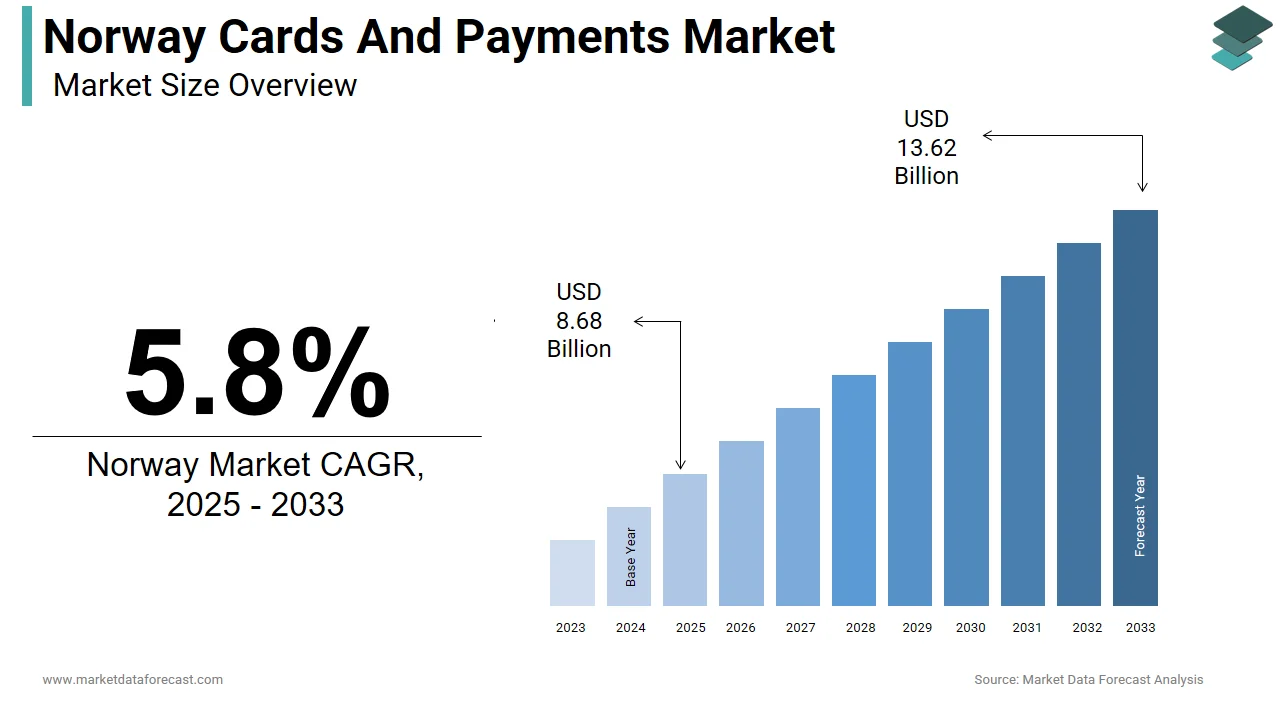
The Norway cards and payments market size was valued at USD 8.68 billion in 2025, stands at USD 9.18 billion in 2026, and is projected to reach USD 14.42 billion by 2034, growing at a compound annual growth rate (CAGR) of 5.8% from 2026 to 2034. Driven by advanced digital readiness, widespread mobile wallet and contactless preference, robust open banking initiatives (PSD2), and high penetration of national digital authentication tools like BankID, the Norwegian financial landscape represents a highly progressive cashless market.
Key Executive Metrics (At-a-Glance)
- 2025 Base Valuation: USD 8.68 Billion
- 2026 Current Valuation: USD 9.18 Billion
- 2034 Forecast Valuation: USD 14.42 Billion
- Compound Annual Growth Rate (CAGR): 5.8% (2026–2034)
- Regional Highlights: High urban mobile and contactless usage countered by declining physical ATM availability and cash acceptance points across rural municipalities.
Core Market Drivers & Growth Triggers
- High Digital Penetration & Contactless Preference: Rapid consumer pivot toward convenience-led touch-free payments, with contactless transactions capturing nearly 75% of POS payments under NOK 500.
- Regulatory Support & Open Banking: Implementation of PSD2 fostering competitive third-party providers and scaling national digital trust through BankID framework.
Primary Market Restraints & Challenges
- Declining Cash Infrastructure: Rapid reduction in physical ATMs and localized cash-acceptance options impacting older or remote populations.
- Cybersecurity & Fraud Threats: Rising digital vulnerabilities, phishing risks, and higher compliance costs associated with AML/KYC mandates for emerging fintech actors.
Norway Cards and Payments Market Segmentation Breakdown
| Segment Category | Largest Segment | Fastest-Growing Segment |
|---|---|---|
| By Cards | Debit Cards | Credit & Virtual Cards |
| By Payment Terminals | POS (Point of Sale) | Mobile & SoftPOS Terminals |
| By Payment Instruments | Payment Cards | Open Banking APIs & Mobile Wallets (Vipps) |
Major Industry Players Profiled
Key financial institutions shaping the Norway cards and payments market include Nordea Bank, Danske Bank, Handelsbanken, SpareBank 1 SMN, DNB, SEB, EnterCard, Santander, BankAxept, and Gavekort.
Norway Cards And Payments Market Size
The Norway cards and payments market size was valued at USD 8.68 billion in 2025. This market is expected to grow at a CAGR of 5.8% from 2026 to 2034 and be worth USD 14.42 billion by 2034, up from USD 14.42 billion in 2026.
MARKET DRIVERS
High Digital Penetration and Consumer Preference for Contactless Payments
One of the primary drivers of Norway’s cards and payments market is the country's high digital penetration and widespread consumer preference for contactless and mobile-based payment solutions. This digital readiness has significantly fueled the adoption of card and mobile payments. The Norwegian Central Bank (Norges Bank) reported that in 2023, contactless card transactions accounted for nearly 75% of all point-of-sale (POS) transactions under NOK 500, up from 60% in 2020. These trends reflect a broader shift toward convenience-driven financial behavior, supported by strong telecom infrastructure and a highly educated population.
Strong Government and Regulatory Support for Financial Innovation
Another key driver of Norway’s cards and payments market is the proactive role played by government and regulatory bodies in fostering a secure and innovative financial ecosystem. The implementation of the EU’s revised Payment Services Directive (PSD2) through the EEA Agreement has enabled open banking initiatives and enhanced competition in the financial services sector. According to the Financial Supervisory Authority of Norway (FSA), as of 2023, more than 30 third-party providers were authorized to offer payment initiation and account information services. Furthermore, the Norwegian government has actively promoted financial inclusion and digital trust through initiatives such as the national digital identity platform, BankID, which is used by over 90% of the adult population for online authentication and transactions. Data from Difi (Norwegian Agency for Public Management and ICT) shows that in 2023, BankID facilitated over 5 billion digital interactions across public and private sectors.
MARKET RESTRAINTS
Declining Number of Physical ATMs and Cash Acceptance Points
A significant restraint on Norway’s cards and payments market is the rapid decline in physical ATMs and cash acceptance points, which poses challenges for certain segments of the population who still rely on cash. According to Norges Bank, the number of ATMs in Norway fell by 14% between 2021 and 2023, dropping from around 3,500 to just over 3,000 units. In rural areas, where digital infrastructure is less developed, this reduction has limited access to physical currency. Additionally, a 2023 survey by SSB found that 12% of the population primarily older individuals and those living in remote regions still preferred cash for daily transactions due to concerns about privacy, ease of budgeting, and lack of trust in digital systems. Moreover, only 23% of small businesses in rural municipalities accepted cashless payments consistently, according to the Confederation of Norwegian Enterprise (NHO).
Rising Concerns Over Data Privacy and Cybersecurity in Digital Payments
Despite Norway’s advanced digital payment infrastructure, rising concerns over data privacy and cybersecurity are acting as restraints on further expansion of the cards and payments market. A 2023 report by the Norwegian Centre for Information Security (NorSIS) revealed that cyberattacks targeting financial institutions increased by 22% compared to the previous year, with phishing, ransomware, and payment fraud being the most common threats. These apprehensions are particularly pronounced among older consumers and first-time digital users. Meanwhile, the FSA recorded payment-related fraud losses exceeding NOK 1.1 billion in 2023. As digital payment channels expand, maintaining consumer trust will require continuous investment in robust encryption technologies, real-time fraud detection systems, and comprehensive consumer education programs.
MARKET OPPORTUNITIES
Expansion of Open Banking and API-Based Financial Services
A major opportunity for Norway’s cards and payments market lies in the continued expansion of open banking and API-based financial services, driven by PSD2 compliance and increasing demand for personalized financial products. According to the Financial Supervisory Authority of Norway (FSA), by the end of 2023, over 25 banks had implemented open banking APIs by enabling third-party providers to offer innovative services such as real-time budgeting tools, cross-bank transaction aggregators, and instant loan approvals. Leading players such as DNB, Nordea, and SpareBank 1 have launched dedicated API marketplaces to foster collaboration with fintech startups.
Growth of Embedded Finance and Integrated Payment Solutions
The rise of embedded finance presents a transformative opportunity for Norway’s cards and payments market, allowing non-financial platforms from e-commerce sites to mobility apps to integrate payment and credit services directly into their ecosystems. According to a 2023 report by Deloitte Norway, the embedded finance market is projected to grow at a compound annual rate of 12% through 2027, driven by partnerships between fintechs and traditional banks. For example, Klarna has expanded its buy now, pay later (BNPL) offerings across local e-commerce platforms, while Vipps has integrated its payment gateway into ride-hailing and food delivery services. The Norwegian Business Association (Virke) reported that in 2023, over 60% of mid-sized online retailers adopted at least one form of embedded payment solution to streamline checkout processes and enhance customer experience.
MARKET CHALLENGES
Growing Threat of Sophisticated Financial Fraud and Identity Theft
As digital payment adoption accelerates in Norway, the sector faces an escalating challenge from sophisticated financial fraud and identity theft schemes. Phishing scams, fake merchant websites, and synthetic identity fraud have become increasingly prevalent, exploiting gaps in multi-factor authentication and consumer awareness. Addressing this growing threat requires coordinated efforts between regulators, financial institutions, and tech companies to enhance fraud detection capabilities, strengthen verification protocols, and improve digital literacy across all age groups.
Regulatory Compliance Burden for Emerging Fintech Innovations
The evolving regulatory environment in Norway, while supportive of financial innovation, presents a challenge for emerging fintech companies seeking to scale quickly. The implementation of PSD2, along with stringent anti-money laundering (AML) and know-your-customer (KYC) requirements, has increased operational complexity and compliance costs. Startups also face ongoing reporting obligations and capital adequacy rules that can hinder agility and speed to market. While regulation ensures financial stability and consumer protection, streamlining oversight and enhancing dialogue between regulators and innovators could help accelerate the development of next-generation payment solutions in Norway.
MARKET KEY HIGHLIGHTS
The impact of alternative payments in Norway Alipay for Chinese tourists visiting the country, and Vipps, the first mobile P2P solution introduced by DNB without asking the bank account details. Vipps requires the users to link their mobile numbers, debit card, bank account, and national identity number to avail the services. Close to 106 banks in Norway are supporting Vipps.
The revised Payment Services Directive (PSD2) governs the regulations relating to the payments as per the required authentication standards including banks adhering to API and third-party account access standards with the aim to simplify payments and accelerate innovation.
KEY MARKET PLAYERS
Top players in the Norway cards and payments market include
- Nordea Bank
- Danske Bank
- Handelsbanken
- SpareBank 1 SMN
- DNB
- SEB
- EnterCard
- Santander
- BankAxept
- Gavekort
MARKET SEGMENTATION
This research report on the Norway cards and payments market has been segmented and sub-segmented based on the following categories.
By Cards
- Debit Cards
- Credit Cards
- Prepaid Cards
By Payment Terminals
- POS
- ATM's
By Payment Instruments
- Credit Transfers
- Direct Debit
- Cheques
- Payment Cards