- Product Description Description
- Table of Contents TOC
- List of Table & Figure LOT
- Get Free Sample PDF Sample PDF
Market Size, 2025
$21.41 BnMarket Estimate, 2026
$25.58 BnMarket Forecast, 2034
$106.24 BnCAGR, 2026–2034
19.48%Global Ocular Implants Market Size, Growth, Trends & Forecast (2026–2034)
The global ocular implants market size was valued at USD 21.41 billion in 2025, is estimated to reach USD 25.58 billion in 2026, and is projected to scale up to USD 106.24 billion by 2034, registering a compound annual growth rate (CAGR) of 19.48% during the forecast period from 2026 to 2034. Driven by the rapidly increasing incidence of cataracts and age-related eye disorders worldwide, a growing geriatric population, and continuous technological breakthroughs in vision care devices, the market is positioned for exceptional long-term expansion globally.
Key Executive Metrics (At-a-Glance)
- 2025 Base Valuation: USD 21.41 Billion
- 2026 Current Valuation: USD 25.58 Billion
- 2034 Forecast Valuation: USD 106.24 Billion
- Compound Annual Growth Rate (CAGR): 19.48% (2026–2034)
- Dominant Implant Type Segment: Glaucoma Implants (holding the leading market share due to widespread diagnostic needs)
- Fastest-Growing Implant Type Segment: Intraocular Lenses (IOLs) (projected to experience the quickest growth during the forecast period)
- Dominant End-User Segment: Hospitals (capturing a leading share due to high patient volumes and advanced treatment facilities)
- Fastest-Growing End-User Segment: Specialty Eye Institutes (projected as the quickest-growing due to expanding eye care services in regional areas)
- Dominant Regional Market: North America (commanding the top position backed by favorable insurance coverage and advanced technology adoption, with the U.S. leading)
- Fastest-Growing Regional Market: Asia Pacific (projected to develop at a rapid pace driven by a surging senior citizen population and rising incidence of cataracts/glaucoma in China, India, and Japan)
Core Market Drivers
- Rising Incidence of Cataracts: Surging patient numbers requiring surgical intervention and lens replacements globally.
- Aging Population & Tech Developments: Expanding elderly demographics susceptible to chronic eye diseases alongside ongoing product innovations by market leaders.
Primary Market Restraints & Challenges
- Implantation Complexities: Technical challenges and risks associated with surgical implantation and post-implantation care.
- Shortage of Skilled Surgeons: A deficit of specialized ophthalmic professionals capable of executing complex ocular procedures.
Global Ocular Implants Market Segmentation Breakdown
| Segment Category | Key Offerings / Sub-Segments |
|---|---|
| By Implant Type | Intraocular Lenses (Fastest-Growing), Corneal Implants, Glaucoma Implants (Leading), Orbital Implants, Ocular Prosthesis, Others |
| By Application | Glaucoma Surgery (Considerable Share), Age-Related Macular Degeneration (Fastest-Growing), Oculoplasty, Drug Delivery, Aesthetic Purpose, Others |
| By End User | Hospitals (Leading), Specialty Eye Clinics, Eye Institutes (Fastest-Growing) |
| By Region | North America (Dominant), Europe (Second-Largest), Asia Pacific (Fastest-Growing), Latin America, Middle East & Africa |
Major Industry Players Profiled
Key enterprises shaping the global ocular implants market include Bausch & Lomb, Alcon, Carl Zeiss, Johnson & Johnson, MORCHER GmbH, and STAAR Surgical.
Global Ocular Implants Market Size
The size of the global ocular implants market was worth USD 21.41 billion in 2025. The global market is anticipated to grow at a CAGR of 19.48% from 2026 to 2034 and be worth USD 106.24 billion by 2034 from USD 25.58 billion in 2026.

MARKET DRIVERS
The rising incidence of cataracts worldwide is a significant factor contributing to the growth of the global ocular implants market. A cataract is one of the most common problems and is expected to surge in the upcoming years. According to the evaluation done by the CDC, cataract cases are estimated to rise to 30.1 million in the United States by 2050. The increasing aging population, growing correction cases of vision in children and adults, and technological developments in this area are further expected to propel the ocular implants market growth globally. Expansion in alertness among people and a rise in government initiatives for vision care management are projected to escalate the market growth, and increasing incidences of chronic diseases are increasing the growth rate of the market.
MARKET RESTRAINTS
Difficulties associated with implantation and post-implantation are impeding the global market growth. The shortage of skilled surgeons to implement the procedures is restraining the market growth during the time frame.
REPORT COVERAGE
| REPORT METRIC | DETAILS |
| Market Size Available | 2025 to 2034 |
| Base Year | 2025 |
| Forecast Period | 2026 to 2034 |
| Segments Covered | By Implant Type, Application, End-User, and Region. |
| Various Analyses Covered | Global, Regional, and Country-Level Analysis, Segment-Level Analysis, Drivers, Restraints, Opportunities, Challenges; PESTLE Analysis; Porter’s Five Forces Analysis, Competitive Landscape, Analyst Overview of Investment Opportunities |
| Regions Covered | North America, Europe, Asia Pacific, Latin America, Middle East & Africa |
| Market Leaders Profiled | Bausch & Lomb, Alcon, Carl Zeiss, Johnson & Johnson, MORCHER GmbH, and STAAR Surgical., and Others. |
SEGMENTAL ANALYSIS
By Implant Type Insights
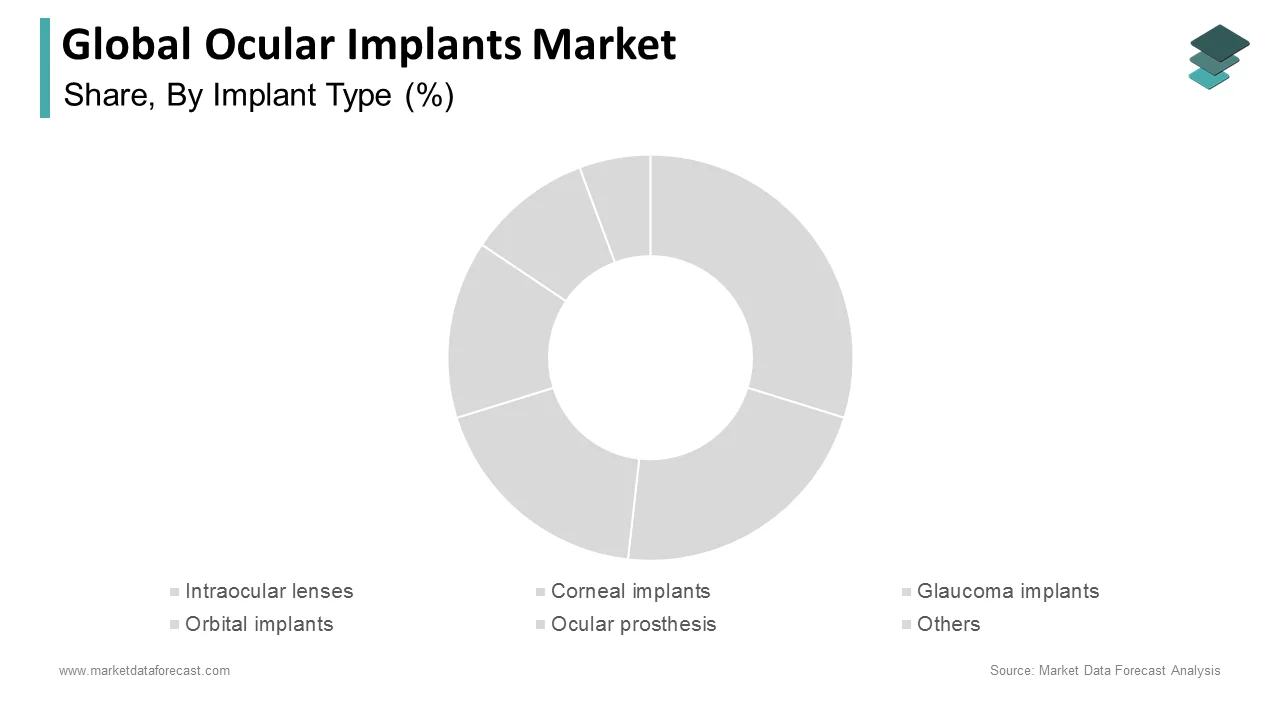
Based on implant type, the glaucoma implants segment had the leading share of the market in 2024. The Intraocular lenses segment is projected to have the quickest growth in the global ocular implants market during the forecast period.
By Application Insights
Based on the application, the glaucoma surgery segment accounts for a considerable share of the worldwide market owing to the growing consciousness regarding eye diseases among people. The age-related macular degeneration segment is considered to be the quickest-growing segment in the market. Advancements in technology and common AMD are projected to augment the segment growth in the market.
By End User Insights
Based on the end user, the hospital segment had a leading share in the global market in 2024 among all the other segments. The growing regularity of treatment for vision impairment in hospitals and the large patient count affected with eye-relevant diseases integrated with experienced physicians is predicted to surge the market segment's growth globally. Specialty eye institutes are predicted to be the quickest-growing segment because of the expanding need for eye care services in rural areas.
REGIONAL ANALYSIS
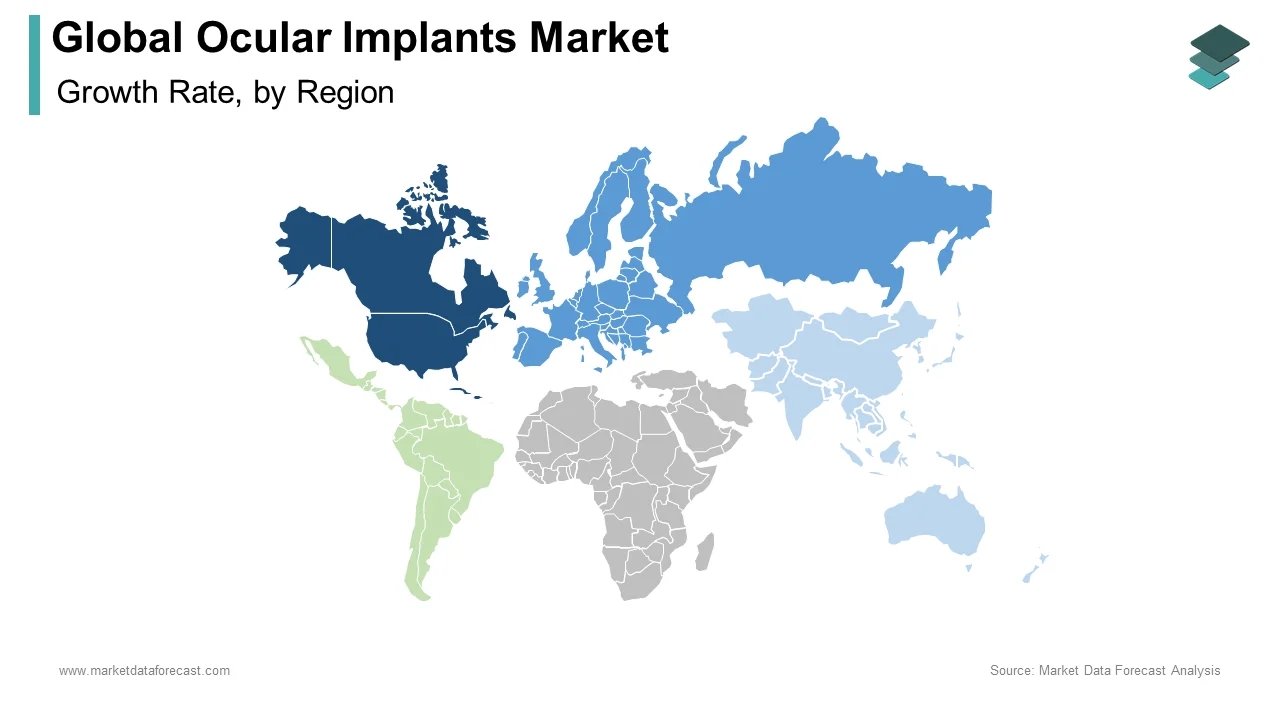
Geographically, the global ocular implants market was dominated by North America, closely followed by Europe. Asia Pacific is expected to grow at a high CAGR. The increasing adoption of advanced ocular implants and the rising focus of key players on launching eyewear in the U.S. are majorly supporting the market in this region. The United States accounted for the majority of the North American market in 1019 due to the high population base that has supportive insurance coverage and technological advancements. The Canadian market of ocular implants is expected to showcase a substantial growth rate during the forecast period.
The European market is projected to be positioned as the second-largest market for ocular implants due to the rise in the aging population, technological developments, and burgeoning cases of ocular disorders. The UK is estimated to lead the European market. This country has increased awareness associated with glaucoma diseases and the need for early glaucoma surgical treatment to augment the region's market growth.
Asia-Pacific is projected to develop at a quick pace during the forecast period and is assumed as the fastest-growing region in the global ocular implants market. Rise in senior citizens population and frequency of cataracts and glaucoma in countries like China, Japan, and India. The surge in the spread of awareness associated with ocular implants, incorporated with the growing availability of IOL and glaucoma devices, is fueling the market growth in the region. Moreover, an acceptable patient population and improving healthcare infrastructure in the area are impelling the market region.
The ocular implants market's Latin American market is projected to hike at a steady rate between 2025 and 2033. The market growth is attributed to factors such as the high number of regulatory clearances for ocular devices and advancements in eye diagnostic technology leading to extensive product assumptions. Brazil is leading the ocular implants market with an average share.
The ocular implants market in the Middle East & Africa is projected to have the least share. Increasing the targeted huge old age population and reducing the funds and investments for research and development related to healthcare to eye research institutes bolstered market growth.
KEY MARKET PLAYERS
The leading companies operating in the global ocular implants market include:
- Bausch & Lomb
- Alcon
- Carl Zeiss
- Johnson & Johnson
- MORCHER GmbH
- STAAR Surgical
MARKET SEGMENTATION
This research report on the global ocular implants market has been segmented and sub-segmented based on the implant type, application, end-user, and region.
By Implant Type
- Intraocular lenses
- Corneal implants
- Glaucoma implants
- Orbital implants
- Ocular prosthesis
- Others
By Application
- Glaucoma Surgery
- Oculoplasty
- Drug Delivery
- Age-Related Macular Degeneration
- Aesthetic Purpose
- Others
By End User
- Hospitals
- Specialty Eye Clinics
- Eye Institutes
By Region
- North America
- Europe
- Asia Pacific
- Latin America
- The Middle East and Africa