- Product Description Description
- Table of Contents TOC
- List of Table & Figure LOT
- Get Free Sample PDF Sample PDF
Market Size, 2025
$0.66 BnMarket Estimate, 2026
$0.69 BnMarket Forecast, 2034
$1.01 BnCAGR, 2026–2034
4.92%Global Oil Accumulator Market Report Summary
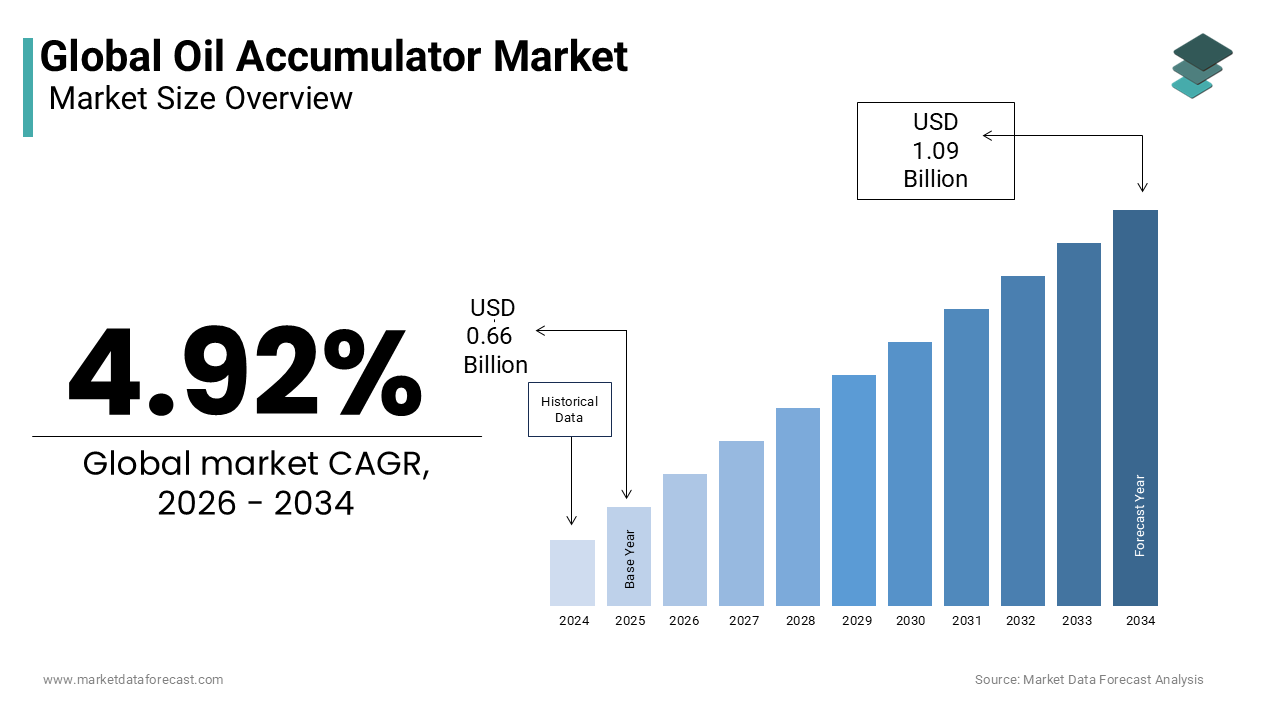
The global oil accumulator market was valued at USD 0.66 billion in 2025 and is anticipated to reach USD 0.69 billion in 2026 from USD 1.01 billion by 2034, growing at a CAGR of 4.92% during the forecast period from 2026 to 2034. The growth of the global oil accumulator market is driven by the expansion of heavy machinery and construction activities, increasing investments in oil and gas exploration, and growing adoption of advanced hydraulic systems across industrial applications. Rising demand for energy-efficient hydraulic equipment, increasing integration of smart monitoring technologies, and expanding utilization of accumulators in hybrid automotive systems are further accelerating market growth. Moreover, advancements in high-pressure accumulator technologies, integration of IoT-enabled predictive maintenance solutions, and increasing adoption of hydraulic energy storage systems in renewable energy applications are supporting the expansion of the global oil accumulator market.
Key Market Trends
-
Rising integration of IoT-enabled sensors for real-time monitoring and predictive maintenance of hydraulic accumulators.
-
Increasing adoption of high-pressure accumulators in offshore oil and gas exploration activities.
-
Growing utilization of hydraulic accumulators in hybrid and electric vehicle braking and energy recovery systems.
-
Rising investments in renewable energy storage systems utilizing hydraulic accumulator technologies.
-
Increasing development of lightweight composite accumulator materials for improved efficiency and durability.
Segmental Insights
- Based on type, the bladder accumulators segment dominated the global oil accumulator market and accounted for 44.3% of the market share in 2025. The dominance of the segment is attributed to its superior response time, compact design, excellent shock absorption capabilities, lower maintenance requirements, and widespread adoption across automotive, construction, manufacturing, and agricultural hydraulic systems. Continuous advancements in elastomer materials further enhance product durability and operational performance
- Based on pressure rating, the up to 6000 psi segment dominated the global oil accumulator market in 2025. The growth of the segment is driven by widespread deployment across standard hydraulic equipment used in construction machinery, agricultural equipment, industrial manufacturing systems, and mobile hydraulic applications. Mature technology, established safety standards, and competitive manufacturing costs continue to strengthen segment leadership.
- Based on location, the onshore segment dominated the global oil accumulator market in 2025. The dominance of the segment is attributed to extensive land-based oil and gas production, growing infrastructure development, expanding manufacturing activities, increasing agricultural mechanization, and widespread utilization of hydraulic machinery across industrial sectors.
- Based on application, the blowout preventer (BOP) and wellhead control systems segment dominated the global oil accumulator market and accounted for 40.3% of the market share in 2025. The growth of the segment is driven by stringent safety regulations, increasing offshore drilling activities, mandatory redundancy requirements for hydraulic safety systems, and growing investments in advanced well control infrastructure.
Regional Insights
- North America dominated the global oil accumulator market and accounted for 30.3% of the global market share in 2025. The region's leadership is driven by extensive shale oil production, advanced hydraulic equipment manufacturing, strong oil and gas exploration activities, growing infrastructure investments, and widespread adoption of IoT-enabled hydraulic systems. Strict safety regulations and technological innovation continue to strengthen regional market growth.
- Europe held 21.2% of the global oil accumulator market share in 2025 owing to stringent environmental regulations, strong industrial automation, expanding offshore wind energy projects, increasing adoption of energy-efficient hydraulic systems, and advanced manufacturing capabilities across Germany, Italy, and other European countries.
- Asia Pacific is projected to witness the fastest growth during the forecast period due to rapid industrialization, expanding infrastructure development, increasing manufacturing activities, growing oil and gas exploration, rising automotive production, and continuous investments in hydraulic equipment across China, India, Japan, and Southeast Asia.
- Latin America continues to maintain steady growth owing to expanding offshore oil exploration in Brazil, increasing mining activities across Chile and Peru, growing investments in construction machinery, and strengthening domestic manufacturing capabilities for hydraulic equipment.
- The Middle East & Africa is expected to experience notable growth during the forecast period due to increasing upstream oil and gas investments, expanding infrastructure development, rising demand for high-performance hydraulic systems in harsh operating environments, and growing diversification of industrial sectors beyond petroleum production.
Competitive Landscape
The global oil accumulator market is highly competitive and characterized by the presence of multinational hydraulic equipment manufacturers and specialized engineering companies competing through technological innovation, product reliability, digital integration, and customized hydraulic solutions. Leading companies are focusing on developing IoT-enabled smart accumulators, lightweight composite designs, high-pressure hydraulic systems, and predictive maintenance technologies to improve operational efficiency and equipment reliability. Strategic acquisitions, partnerships with original equipment manufacturers, expansion into emerging markets, and continuous investments in research and development continue to strengthen competitive positioning across the global oil accumulator market. The prominent players operating in the global oil accumulator market include Hydac, Parker Hannifin, Eaton, Freudenberg, Bosch Rexroth, Nippon Accumulator, Roth Hydraulic, Technetics Group, Tobul Accumulator Inc., and GE Oil & Gas.
 Download Free Sample Report
Global Oil Accumulator Market Size
The Global oil accumulatior market was worth USD 0.66 billion in 2025 and is anticipated to reach a valuation of USD 1.01 billion by 2034 from USD 0.69 billion in 2026. It is predicted to register a CAGR of 4.92% during 2026 to 2034.
The oil accumulator is hydraulic energy storage device that maintain system pressure absorb shock and compensate for fluid leakage in industrial and mobile machinery. These components utilize compressed gas typically nitrogen to store potential energy, which is released to supplement pump flow during peak demand or maintain pressure during power failures. The strict safety protocols govern the design and testing of pressure vessels ensuring operational integrity under extreme conditions. The global push toward sustainable manufacturing practices has intensified the focus on hydraulic systems that minimize energy waste and reduce carbon footprints. Technological advancements in bladder piston and diaphragm designs have enhanced performance metrics such as response time and cycle life. Regulatory bodies like the American Society of Mechanical Engineers provide comprehensive codes for pressure vessel construction influencing material selection and engineering standards. The integration of smart sensors into modern accumulators enables real time monitoring of pressure and temperature facilitating predictive maintenance.
MARKET DRIVERS
Expansion Of Heavy Machinery And Construction Activities
The robust expansion of the global construction and heavy machinery sector due to the essential role these components play in hydraulic system stability and performance is accelerating the growth of the oil accumulator market. Hydraulic excavators cranes and bulldozers rely heavily on accumulators to smooth out pulsations from pumps and provide immediate power for high load operations. Emerging economies in Asia Pacific and Latin America are witnessing unprecedented urbanization rates with the World Bank reporting that 56% of the global population now resides in urban areas driving demand for residential and commercial construction. This surge necessitates a vast fleet of heavy equipment where hydraulic efficiency directly impacts productivity and fuel consumption. Accumulators enable energy recovery in hybrid hydraulic systems reducing engine load and emissions which aligns with stringent environmental regulations. The International Labour Organization notes that infrastructure projects create millions of jobs globally further stimulating equipment procurement. Manufacturers prioritize durability and high pressure ratings to withstand harsh operating environments leading to continuous product innovation. The replacement market also contributes significantly as aging fleets require upgraded components to meet modern efficiency standards. This driver is reinforced by government stimulus packages aimed at revitalizing national infrastructure ensuring long term demand for hydraulic components.
Advancements In Automotive Hybrid And Electric Systems
The rapid advancement of automotive hybrid and electric vehicle technologies in hybrid hydraulic systems and braking applications is additionally propelling the growth of the oil accumulator market. Modern vehicles increasingly utilize hydraulic hybrids where accumulators store kinetic energy during braking and release it during acceleration improving fuel efficiency by up to 30%. This transition drives the need for compact high pressure accumulators capable of handling frequent charge discharge cycles without degradation. Regulatory mandates, such as the European Union’s CO2 emission standards requiring a 55% reduction by 2030 compel automakers to adopt energy recovery technologies. Accumulators also play a critical role in electric vehicle braking systems providing backup pressure for regenerative braking mechanisms ensuring safety and reliability. The Society of Automotive Engineers highlights that hydraulic energy storage offers higher power density compared to battery systems for short burst applications making it ideal for start stop functions. Automotive manufacturers are investing in lightweight composite materials for accumulator shells to reduce overall vehicle weight and enhance range. Collaborative research between component suppliers and OEMs focuses on integrating accumulators into modular chassis platforms.
MARKET RESTRAINTS
High Manufacturing Costs And Material Price Volatility
The high manufacturing costs associated with precision engineering and material requirements impacting profitability and pricing strategies is hindering the growth of the oil accumulator market. Accumulators must withstand extreme pressures often exceeding 300 bar requiring high grade steel alloys and advanced welding techniques that increase production expenses. According to the research, global steel prices fluctuated by 20% in 2024 due to supply chain disruptions and energy cost variations directly affecting component manufacturing budgets. Specialized materials such as stainless steel and composite fibers used for lightweight designs command premium prices limiting their adoption in cost sensitive segments. Small and medium sized manufacturers struggle to compete with established players who benefit from economies of scale and vertical integration. The complexity of quality control processes including non-destructive testing and pressure certification adds further to operational costs. Customers in price sensitive markets often opt for lower quality alternatives or delay replacements compromising system performance. The capital intensive nature of setting up production facilities creates high entry barriers discouraging new competitors. These financial constraints limit the ability of manufacturers to invest in research and development slowing innovation cycles.
Stringent Safety Regulations And Compliance Burdens
The stringent safety regulations and compliance burdens is additionally slowing down the growth of the oil accumulator market. Pressure vessels are classified as high-risk equipment requiring adherence to rigorous standards, such as the ASME Boiler and Pressure Vessel Code in the United States and the Pressure Equipment Directive in Europe. According to the study, failure of pressure vessels can result in catastrophic accidents prompting strict inspection and certification protocols. Variations in regulatory requirements across different regions complicate global trade forcing companies to maintain multiple product variants and certification portfolios. The European Committee for Standardization updates norms frequently requiring continuous adaptation of design and manufacturing processes. Delays in obtaining certifications can postpone product launches causing missed market opportunities and revenue loss. Small enterprises often lack the resources to navigate complex regulatory landscapes leading to market consolidation favoring large corporations. Liability concerns also drive up insurance premiums for manufacturers further increasing operational overheads. The fear of legal repercussions from non compliance encourages conservative design approaches that may limit innovation.
MARKET OPPORTUNITIES
Integration Of IoT And Smart Monitoring Technologies
The integration of Internet of Things (IoT) and smart monitoring technologies by transforming passive components into intelligent assets is to foster new opportunities for the growth of the oil accumulator market. Modern accumulators equipped with sensors can transmit real time data on pressure temperature and gas pre charge levels enabling predictive maintenance and preventing unexpected failures. According to the research, predictive maintenance can reduce machine downtime by 30 to 50% and extend asset life by 20 to 40% offering substantial cost savings for industrial users. Manufacturers can offer value added services such as remote diagnostics and automated alerts creating recurring revenue streams beyond hardware sales. Smart accumulators facilitate condition based maintenance replacing fixed interval schedules with data driven interventions optimizing resource allocation. Integration with factory automation systems allows for dynamic adjustment of hydraulic parameters improving overall energy efficiency. The aviation and marine sectors are early adopters seeking enhanced safety and reliability through continuous monitoring. Partnerships with software developers enable the creation of user friendly dashboards for fleet management. This technological convergence appeals to industries prioritizing operational excellence and digital transformation.
Growth Of Renewable Energy Storage Applications
The expansion of renewable energy storage applications, particularly in hydraulic energy storage systems for wind and solar power plants is also to amplify the growth of the oil accumulator market. Hydraulic accumulators provide rapid response energy buffering stabilizing grid fluctuations caused by intermittent renewable sources. As per the International Renewable Energy Agency, global renewable capacity additions reached 510 gigawatts in 2024 driving demand for efficient storage solutions. Unlike batteries hydraulic systems offer longer lifespans and higher power density for short duration storage making them ideal for frequency regulation and peak shaving. Offshore wind farms utilize hydraulic pitch control systems where accumulators ensure blade adjustment during power outages enhancing safety and energy capture. The hybrid energy storage systems combining batteries and hydraulic accumulators can improve grid stability by 15%. Emerging technologies like pumped hydro storage with variable speed turbines rely on accumulators for pressure stabilization. Government incentives for green energy infrastructure accelerate investment in these technologies. Manufacturers are developing specialized accumulators resistant to corrosion and extreme weather conditions suitable for offshore environments. Collaborations with energy firms facilitate pilot projects demonstrating technical viability and economic benefits.
MARKET CHALLENGES
Technical Limitations In Extreme Operating Conditions
The technical limitations in extreme operating conditions are affecting reliability and lifespan in demanding applications, which is likely to pose as a major challenge for the growth of the oil accumulator market. High temperature environments can degrade bladder materials and reduce gas permeability leading to premature failure and loss of pre charge pressure. According to the research, exposure to temperatures above 100 degrees Celsius can reduce the service life of standard elastomers by 50% necessitating expensive high performance alternatives. Cryogenic conditions in aerospace applications cause material embrittlement risking structural integrity under pressure cycles. Corrosive environments in marine and chemical processing industries accelerate metal fatigue and seal degradation requiring specialized coatings and materials that increase costs. Vibration and shock loads in mobile machinery induce micro fractures in welds and fittings compromising safety margins. The lack of universal standards for testing under combined stress factors complicates performance prediction and warranty claims. Manufacturers face difficulties in balancing weight reduction with durability as thinner walls are more susceptible to fatigue. Developing materials that withstand wide temperature ranges and corrosive agents without compromising flexibility remains a scientific hurdle.
Supply Chain Disruptions For Critical Raw Materials
The supply chain disruptions for important raw materials impacting production schedules and cost stability is another attribute to hinder the growth of the oil accumulator market. Dependence on specific grades of steel aluminum and rare earth elements for sensors creates vulnerability to geopolitical tensions and trade restrictions. Shortages of high purity nitrogen used for pre charging accumulators affect final assembly lines causing production halts. Trade tariffs on imported metals increase input costs forcing manufacturers to absorb margins or pass prices to customers. The concentration of rare earth mining in few countries creates strategic risks for sensor component availability. Natural disasters in key manufacturing hubs disrupt component supplies leading to inventory shortages. Lack of transparency in tier two and tier three supplier networks hinders risk mitigation efforts. Companies struggle to qualify alternative suppliers quickly due to rigorous quality requirements. These disruptions force manufacturers to hold higher inventory levels tying up capital and reducing liquidity.
REPORT COVERAGE
| REPORT METRIC | DETAILS |
| Market Size Available | 2025 to 2034 |
| Base Year | 2025 |
| Forecast Period | 2026 to 2034 |
| Segments Covered | By Type, Pressure Rating, Location, Application, and Region. |
| Various Analyses Covered | Global, Regional, & Country Level Analysis; Segment-Level Analysis, Drivers, Restraints, Opportunities, Challenges, PESTLE Analysis, Porter’s Five Forces Analysis, Competitive Landscape, Analyst Overview of Investment Opportunities |
| Regions Covered | North America, Europe, Asia Pacific, Latin America, Middle East, and Africa |
| Key Market Players | Hydac, Parker Hannifin, Eaton, Freudenberg, Bosch Rexroth, Nippon Accumulator, Roth Hydraulic, Technetics Group, Tobul Accumulator Inc., GE Oil & Gas, and Others. |
SEGMENTAL ANALYSIS
By Type Insights
The bladder accumulators segment was accounted in holding 44.3% of the oil accumulator market share in 2025 due to their superior response time compact design and ability to handle high frequency cycling in dynamic hydraulic systems. These units utilize a flexible elastomeric bladder to separate the gas and fluid, which allows for rapid energy storage and release essential for shock absorption and pulsation dampening. The separation mechanism prevents gas absorption into the hydraulic oil ensuring consistent performance and reducing maintenance requirements compared to piston types. As per the study, bladder accumulators are preferred in automotive suspension and braking systems where space constraints and weight reduction are critical design parameters. Their ability to operate efficiently at pressures up to 350 bar makes them suitable for a wide range of standard industrial machinery. Manufacturing advancements in bladder materials, such as nitrile rubber and fluorocarbon have enhanced durability and chemical resistance extending service life. The cost effectiveness of bladder units compared to piston accumulators further drives adoption in mass market segments. Industries including construction agriculture and manufacturing rely on these components for reliable operation under varying load conditions. The ease of installation and replacement also contributes to their dominance as end users prioritize minimal downtime.
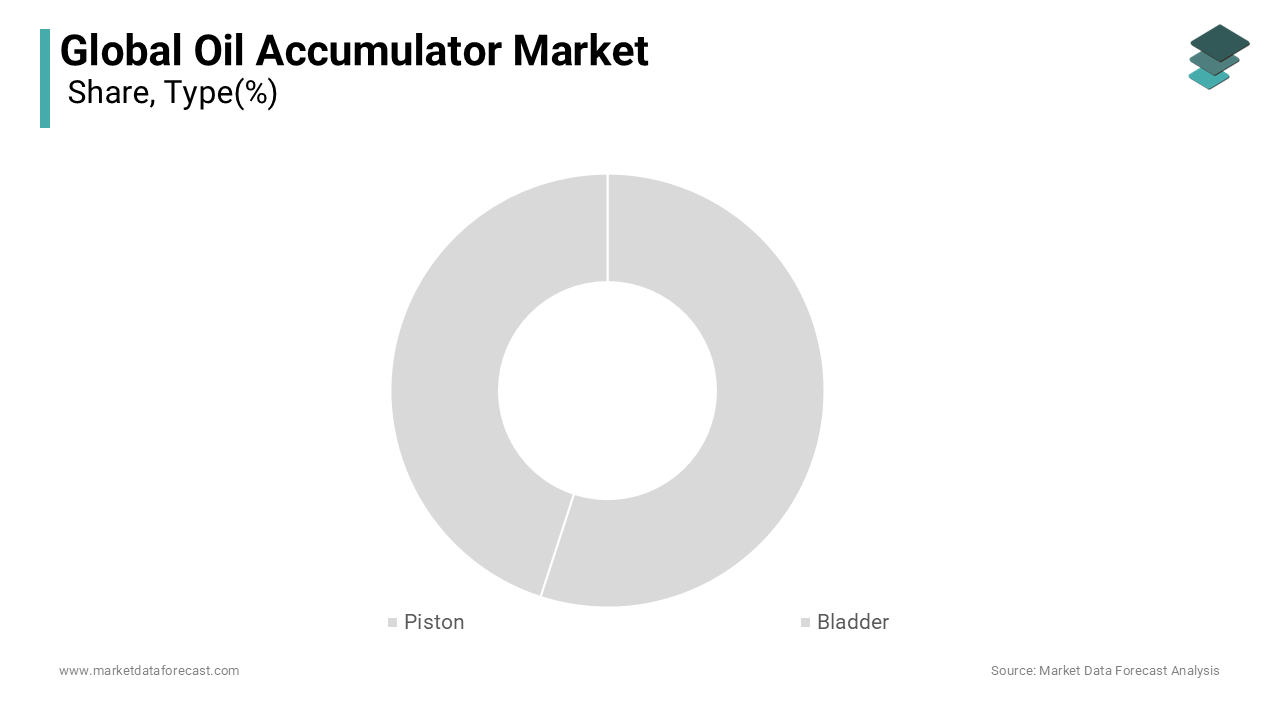
The piston accumulators segment is likely to grow at an anticipated CAGR of 6.2% from 2026 to 2034 with their capability to handle extremely high pressures and large fluid volumes making them ideal for heavy duty industrial and offshore applications. As per the research, offshore drilling operations increasingly utilize piston accumulators in blowout preventer systems due to their reliability under extreme deep sea pressures exceeding 10000 psi. The robust construction of piston units enables them to withstand harsh environments including high vibration and temperature fluctuations common in mining and steel production. Advances in sealing technology have reduced friction and leakage issues historically associated with piston designs improving efficiency and lifespan. The demand for energy recovery systems in hybrid hydraulic excavators also favors piston types due to their high power density. Manufacturers are developing lightweight composite pistons to reduce inertia and improve response times.
By Pressure Rating Insights
The up to 6000 psi pressure rating segment was the largest by accounting for a dominant share of the oil accumulator market in 2025 with the widespread use of standard hydraulic systems in construction agriculture and general manufacturing, which typically operate within this pressure range. Most mobile machinery, such as excavators loaders and tractors utilize hydraulic pumps rated between 2500 and 5000 psi making accumulators in this category universally compatible. The cost effectiveness of manufacturing components for moderate pressure levels allows for competitive pricing appealing to price sensitive markets. As per data, safety regulations for pressure vessels are well established for this range facilitating easier certification and entry. The maturity of technology in this segment ensures high reliability and availability of spare parts. Industrial applications such as injection molding machines and press brakes also rely heavily on this pressure class for efficient operation.
The above 6000 psi pressure rating segment is projected to grow at a fastest CAGR of 7.5% from 2026 to 2034 with the expansion of deep water offshore drilling and high pressure industrial processes requiring robust energy storage solutions. Modern subsea exploration activities often involve pressures exceeding 10000 psi necessitating specialized accumulators capable of maintaining integrity under extreme conditions. Aerospace applications also contribute to this growth as aircraft hydraulic systems operate at 3000 to 5000 psi but next generation systems are moving toward higher pressures to reduce weight and component size. The development of supercritical carbon dioxide power cycles requires accumulators rated above 6000 psi to manage fluid dynamics efficiently. Advances in metallurgy and composite materials enable the production of lighter yet stronger vessels capable of withstanding these stresses. Regulatory push for higher efficiency in industrial hydraulics encourages the adoption of high pressure systems that reduce flow rates and pipe sizes.
By Location Insights
The onshore segment was the largest by holding a significant share of the oil accumulator market in 2025 due to the vast number of land based industrial and construction activities. Onshore applications encompass a wide range of sectors including manufacturing plants agricultural machinery and land based oil and gas extraction facilities. According to the research, onshore oil production accounts for nearly 90% of global crude output requiring extensive hydraulic infrastructure for drilling and processing operations. The sheer volume of mobile construction equipment used in infrastructure projects worldwide drives consistent demand for standard hydraulic accumulators. Onshore installations benefit from easier access for maintenance and lower logistical costs compared to offshore counterparts. The proliferation of smart factories and automated production lines further boosts demand for precision hydraulic control systems. Agricultural mechanization in emerging economies also contributes significantly as farmers adopt advanced tractors and harvesters equipped with hydraulic systems. The established supply chain and service network for onshore equipment ensure rapid replacement and support.
The offshore segment is likely to grow at a fastest CAGR of 8.1% from 2026 to 2034 with the shift toward deep water and ultra deep water oil and gas exploration where high pressure hydraulic systems are critical for safety and operational efficiency. Offshore platforms require reliable accumulators for blowout preventers subsea control modules and crane operations where failure is not an option. The harsh marine environment demands corrosion resistant and highly durable accumulators creating opportunities for specialized manufacturers. Technological advancements in subsea production systems allow for longer tie backs to shore increasing the complexity and number of hydraulic components required. Regulatory mandates for safety in offshore operations enforce strict maintenance and replacement schedules ensuring recurring demand. The development of floating production storage and offloading units also utilizes extensive hydraulic networks for mooring and processing. High barriers to entry due to technical specifications and certification requirements limit competition allowing established players to capture premium pricing.
By Application Insights
The blowout preventer and wellhead control systems segment held 40.3% of the oil accumulator market share in 2025. These critical safety systems rely on hydraulic accumulators to provide immediate pressure for closing blowout preventers in emergency situations preventing catastrophic oil spills. Regulatory requirements mandate redundant hydraulic power sources ensuring that accumulators are always charged and ready for activation. This regulatory compliance drives consistent demand regardless of oil price fluctuations as safety cannot be compromised. The complexity of modern wellhead systems with multiple valves and chokes requires precise hydraulic control which accumulators facilitate by smoothing pressure fluctuations. As per data from Spears & Associates the global rig count stabilizing at 1000 active units ensures a steady base demand for replacement and maintenance. Onshore drilling operations also utilize similar wellhead control systems expanding the addressable market. The critical nature of this application means that operators prioritize quality and reliability over cost fostering loyalty to established brands. Regular testing and certification requirements create a predictable replacement cycle for accumulator bladders and seals.
The mud pumps application segment is expected to grow at a fastest CAGR of 7.8% throughout the forecast period. Mud pumps are essential for circulating drilling fluid down the drill string and back to the surface requiring high pressure hydraulic assistance to manage pulsations and maintain consistent flow. Accumulators installed on mud pump manifolds absorb pressure spikes caused by the reciprocating action of pump pistons protecting downstream equipment from damage. The improved drilling efficiency in shale formations has led to higher pump pressures and faster cycling rates increasing the wear and tear on hydraulic components. The trend toward extended reach drilling requires more powerful mud pumps which in turn demand larger and more robust accumulators. The adoption of automated drilling systems enhances the need for precise hydraulic control to optimize pump performance and reduce energy consumption. Manufacturers are developing specialized accumulators with enhanced damping characteristics to handle the specific frequency profiles of modern mud pumps. Maintenance intervals for mud pump accumulators are shorter due to high vibration environments driving frequent replacements.
REGIONAL ANALYSIS
North America Oil Accumulator Market Analysis
North America was the top performer in the oil accumulator market by holding 30.3% of the share in 2025 with a mature industrial base and significant oil and gas activity. The United States leads this region with extensive shale oil production requiring advanced hydraulic systems for drilling and completion operations. As per the research, US crude oil production averaged 13.2 million barrels per day in 2024 sustaining demand for high pressure accumulators in wellhead control and mud pump applications. The presence of major hydraulic component manufacturers and stringent safety regulations enforced by the Occupational Safety and Health Administration ensure high quality standards. The construction sector also contributes significantly with infrastructure bills funding road and bridge projects that utilize heavy machinery. Canada’s oil sands operations require robust hydraulic equipment capable of withstanding extreme temperatures driving demand for specialized accumulators. The region benefits from advanced technological adoption including IoT enabled smart accumulators for predictive maintenance. Strong distribution networks and after sales support services enhance customer retention. Regulatory focus on environmental protection encourages the use of leak free and efficient hydraulic systems.
Europe Oil Accumulator Market Analysis
Europe oil accumulator market growth was ranked second by holding 21.2% of share in 2025 with the strict environmental regulations and a strong focus on energy efficiency and industrial automation. Germany and Italy are key manufacturing hubs producing high precision hydraulic components for automotive and industrial machinery. The European Union’s Green Deal initiatives promote the adoption of energy efficient hydraulic systems that utilize accumulators for energy recovery and peak shaving. As per the European Committee for Standardization, rigorous pressure equipment directives ensure product safety and reliability influencing design and material selection. The offshore wind energy sector in the North Sea is expanding rapidly requiring hydraulic systems for turbine pitch control and maintenance vessels. Aging industrial infrastructure in Western Europe drives replacement demand for modernized hydraulic components. The region’s emphasis on sustainability encourages the use of bio degradable hydraulic fluids which require compatible accumulator seals and materials. Research and development investments focus on lightweight and compact designs for electric vehicle applications. Collaborative projects between universities and industry players foster innovation in smart hydraulic technologies.
Asia Pacific Oil Accumulator Market Analysis
Asia Pacific oil accumulator market growth is expected to grow at a fastest CAGR in coming years with the rapid industrialization infrastructure development and expanding oil and gas exploration. China and India are the primary drivers with massive investments in manufacturing facilities and urban infrastructure projects. The shift of manufacturing bases to Southeast Asia countries like Vietnam and Thailand further boosts regional demand. Offshore oil exploration in the South China Sea and Australia increases the need for high pressure subsea accumulators. Government initiatives to improve energy efficiency in industrial sectors promote the adoption of hydraulic energy recovery systems. Local manufacturers are improving quality standards to compete with international brands offering cost effective alternatives. The rising middle class drives demand for automobiles and consumer goods stimulating production lines equipped with advanced hydraulic systems.
Latin America Oil Accumulator Market Analysis
Latin America oil accumulator market growth is driven primarily by the oil and gas sector in Brazil and Venezuela. Brazil’s Petrobras continues to invest in deep water exploration projects in the Santos Basin requiring sophisticated hydraulic systems for subsea production. The oil production reached record levels in 2024 supporting demand for high pressure accumulators in wellhead control applications. Economic volatility in some countries affects investment in non-essential industrial projects but critical energy infrastructure remains a priority. The mining sector in Chile and Peru also utilizes hydraulic equipment for excavation and processing driving demand for rugged accumulators. Local content regulations in Brazil encourage domestic manufacturing of hydraulic components fostering local industry growth. Limited availability of specialized spare parts in remote areas creates opportunities for distributors with strong logistics networks.
Middle East and Africa Oil Accumulator Market Analysis
The Middle East and Africa oil accumulators market growth is expected to grow with the extensive oil and gas production and ongoing infrastructure development. Saudi Arabia and the United Arab Emirates lead in adoption due to massive upstream investments by national oil companies aiming to maintain production capacity. Harsh desert conditions require durable hydraulic components resistant to heat and sand abrasion driving demand for high quality accumulators. Infrastructure projects in Qatar and Egypt related to tourism and urbanization increase the use of construction machinery. The African mining sector in countries like South Africa and Ghana utilizes hydraulic equipment for mineral extraction. Limited local manufacturing capacity relies on imports from Europe and Asia creating opportunities for international suppliers. Government initiatives to diversify economies beyond oil are leading to investments in manufacturing and construction sectors. Regulatory frameworks are strengthening to ensure safety and environmental compliance in oil operations.
COMPETITIVE LANDSCAPE
The competition in the Oil Accumulator Market is characterized by a mix of established multinational corporations and specialized regional manufacturers vying for dominance through technological innovation and service excellence. Large players leverage economies of scale and extensive distribution networks to offer comprehensive product portfolios while niche firms differentiate themselves through specialized expertise in high pressure or corrosive environment applications. The market exhibits moderate consolidation with key participants investing heavily in research and development to create smarter and more efficient accumulator designs. Price competition is intense in standard segments but premium pricing is achievable for specialized high performance units with proven reliability. Competitive dynamics are shaped by the ability to provide technical support and custom engineering solutions to end users. Sustainability credentials increasingly influence purchasing decisions prompting companies to adopt green manufacturing practices. Intellectual property protection for novel sealing technologies and sensor integrations fosters differentiation. Collaboration with industry bodies helps shape safety standards and regulatory frameworks.
KEY MARKET PLAYERS
Companies playing a prominent role in the global oil accumulator market include
- Hydac
- Parker Hannifin
- Eaton
- Freudenberg
- Bosch Rexroth
- Nippon Accumulator
- Roth Hydraulic
- Technetics Group
- Tobul Accumulator Inc.
- GE Oil & Gas
- Others
Top Players in the Global Oil Accumulator Market
Bosch Rexroth
Bosch Rexroth operates as a global leader in drive and control technologies providing high performance hydraulic accumulators for industrial and mobile applications. The company focuses on integrating smart sensors into accumulator units to enable predictive maintenance and real time monitoring of system health. Recent actions include launching the CytroPac compact hydraulic power unit which incorporates advanced accumulator technology to reduce energy consumption by up to 80%. Bosch Rexroth collaborates with machine builders to develop customized hydraulic solutions that enhance efficiency and reduce carbon footprints. The company invests heavily in digital services allowing customers to optimize system performance through data analytics.
Parker Hannifin
Parker Hannifin is a prominent manufacturer of motion and control technologies offering a comprehensive range of bladder piston and diaphragm accumulators. The company leverages its extensive global distribution network to serve diverse sectors including aerospace oil and gas and construction. Recent initiatives involve expanding production capabilities for high pressure accumulators designed for subsea applications where reliability is crucial. Parker Hannifin introduces innovative sealing materials that extend service life in harsh chemical and temperature conditions. The company actively participates in industry standards development ensuring its products meet rigorous safety and performance requirements. Strategic acquisitions of specialized hydraulic component firms enhance its technical portfolio and market reach. Its commitment to innovation drives the development of lightweight and efficient accumulator solutions that address evolving industry needs for energy efficiency and operational safety.
HYDAC International
HYDAC International specializes in fluid engineering and hydraulic systems providing robust accumulator solutions for various industrial applications. The company is renowned for its expertise in gas charged accumulators used for energy storage shock absorption and pulsation dampening. Recent actions include the development of eco friendly hydraulic fluids compatible accumulator seals to support sustainable manufacturing practices. HYDAC invests in research and development to create compact and high capacity accumulators for electric vehicle hydraulic systems. The company offers comprehensive testing and certification services ensuring product compliance with international safety standards. Strategic partnerships with automotive manufacturers facilitate the integration of accumulators into hybrid braking systems. Its global presence and technical expertise enable it to deliver tailored solutions that improve system efficiency and reduce total cost of ownership for clients across multiple industries.
Top Strategies Used by Key Market Participants
Key players in the Oil Accumulator Market employ strategic approaches to maintain competitiveness and drive growth. Product innovation remains central as companies develop smart accumulators with integrated sensors for predictive maintenance and energy efficiency. Expansion into emerging markets ensures broader reach and access to growing industrial and infrastructure sectors. Strategic acquisitions of specialized firms enhance technical portfolios and accelerate entry into niche applications like subsea drilling. Partnerships with original equipment manufacturers facilitate co development of customized hydraulic solutions that meet specific performance requirements. Investment in sustainable materials and eco friendly designs aligns with global environmental regulations and consumer preferences. Digital transformation through IoT integration enables remote monitoring and data driven insights for optimized system performance. Regulatory compliance and safety certifications build trust and facilitate market access in strict jurisdictions. Marketing efforts focus on demonstrating total cost of ownership benefits through improved reliability and reduced downtime. These multifaceted strategies enhance brand loyalty operational efficiency and market penetration across diverse global regions.
RECENT MARKET HAPPENINGS
- EnerMech and Oil & Gas Proserv (OGP), an Azerbaijan-based subsidiary of Nobel Energy Group, have received their first two contracts in the region, for a total of $3 million. This is also expected to result in a recruiting drive later this year as part of the company's continuous commitment to local workforce employment and development to help drive future business growth.
- Freudenber's Filtration Technologies business group has concluded another deal in the United States after purchasing Protect Plus Air Holding, Inc. in September. It has purchased RPS Products, a filter producer that also sells air filters to retailers for home and commercial buildings.
MARKET SEGMENTATION
This research report on the global oil accumulator market has been segmented and sub-segmented based on type, application, pressure type, and region.
By Type
- Piston
- Bladder
- Diaphragm
By Pressure Rating
- Up to 6000 Psi
- Above 6000 Psi
By Location
- Onshore
- Offshore
By Application
- BOP & Wellhead Control
- Offshore Rigs
- Mud Pumps
By Region
- North America
- Europe
- Asia Pacific
- Latin America
- Middle East & Africa