- Product Description Description
- Table of Contents TOC
- List of Table & Figure LOT
- Get Free Sample PDF Sample PDF
Market Size, 2025
$19.44 BnMarket Estimate, 2026
$20.47 BnMarket Forecast, 2034
$30.94 BnCAGR, 2026–2034
5.3%Global Oil and Gas Robotics Market Size
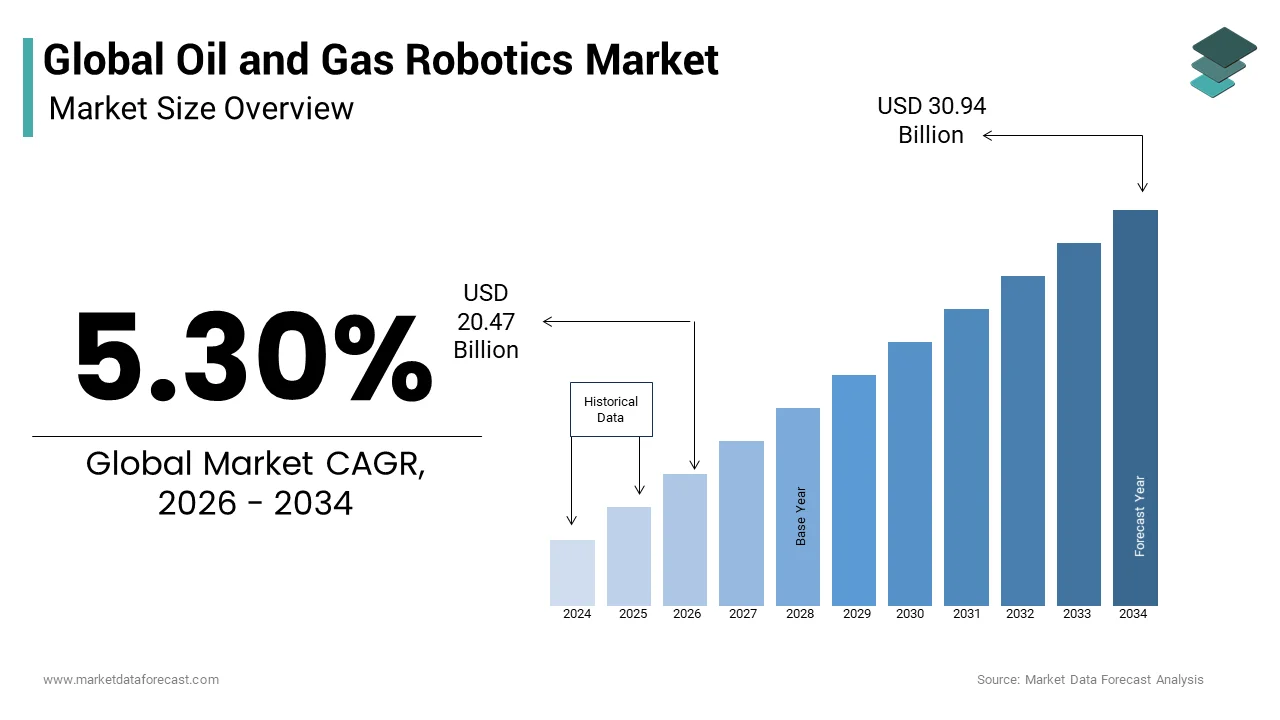
The size of the global oil and gas robotics market was worth USD 19.44 billion in 2025 and is expected to be reach USD 20.47 billion in 2026 and USD 30.94 billion by 2034, growing at a CAGR of 5.3% during the forecast period 2026 to 2034.
Inspection robotics are used to perform inspection and maintenance tasks on industrial resources, reducing human intervention, increasing operational productivity, and improving well-being. There are a few types of mechanical arrangements accessible in the oil, gas, and petrochemical industries, ranging from subsea frames to versatile automated frames.
Inspection robots in the oil and gas industry are intelligent robots and devices developed and used for the inspection, monitoring, and surveillance of oil and gas pipelines, platforms, storage tanks, and other oil and gas structures. Oil and gas examination robots incorporate Unmanned Underwater Vehicles (UUVs), Unmanned Aerial Vehicles (UAVs), and Unmanned Ground Vehicles (UGVs). UUVs incorporate remotely operated underwater vehicles (ROVs) and autonomous underwater vehicles (AUVs).
MARKET DRIVERS
Increasing investments in research, creation, and drilling exercises, and the number of upstream companies around the world are needed by oil manufacturers such as the United States and OPEC to drive inspection robotics in the oil and gas robotics market.
The oil and gas industry is extremely mind-boggling and dangerous by nature. Due to the staggering cost of inspecting oil and gas pipelines, storage tanks, and stages using ordinary strategies, the oil and gas industries are forced to rethink their current percentage of commercial mechanization. Offshore fields, often located in scandalous conditions, pose fundamental safety challenges for both man and the environment. As offshore drilling exercises move into deep and ultra-deepwater, exercise well-being, for example, submerged maintenance and inspection, becomes increasingly important. This, in turn, leads to increased interest in inspection robotics. The oil and gas industry is now focused on increasing its operating expenses by investing in the latest innovations.
MARKET RESTRAINTS
A robot automation task can be troublesome, particularly for organizations with no related knowledge. High capital consumption is required for the acquisition of the robot, as well as for joining, programming, and upkeep. Now and again, a custom mix might be required, which can additionally add to your overall cost. Organizations don't generally have the space and foundation to execute robots.
REPORT COVERAGE
| REPORT METRIC | DETAILS |
| Market Size Available | 2025 to 2034 |
| Base Year | 2025 |
| Forecast Period | 2026 to 2034 |
| CAGR | 5.3% |
| Segments Covered | By Product, Application, Component, and Region |
| Various Analyses Covered | Global, Regional & Country Level Analysis, Segment-Level Analysis, DROC, PESTLE Analysis, Porter’s Five Forces Analysis, Competitive Landscape, Analyst Overview on Investment Opportunities |
| Regions Covered | North America, Europe, APAC, Latin America, Middle East & Africa |
| Market Leaders Profiled | ABB Ltd., AeroVironment Inc., Alstom Inspection Robots, Cyberhawk Innovations Ltd., ECA Group, Flyability S.A., FMC Technologies Inc., Honeybee Robotics, Hydrovision Ltd., IKM Subsea AS, ING Robotic Aviation, International Submarine Engineering (ISE) Ltd., Inuktun Services Ltd., MISTRAS Group Inc., OC Robotics, Seegrid, Sky-Futures, VDOS, and Others. |
SEGMENTAL ANALYSIS
By Product Insights
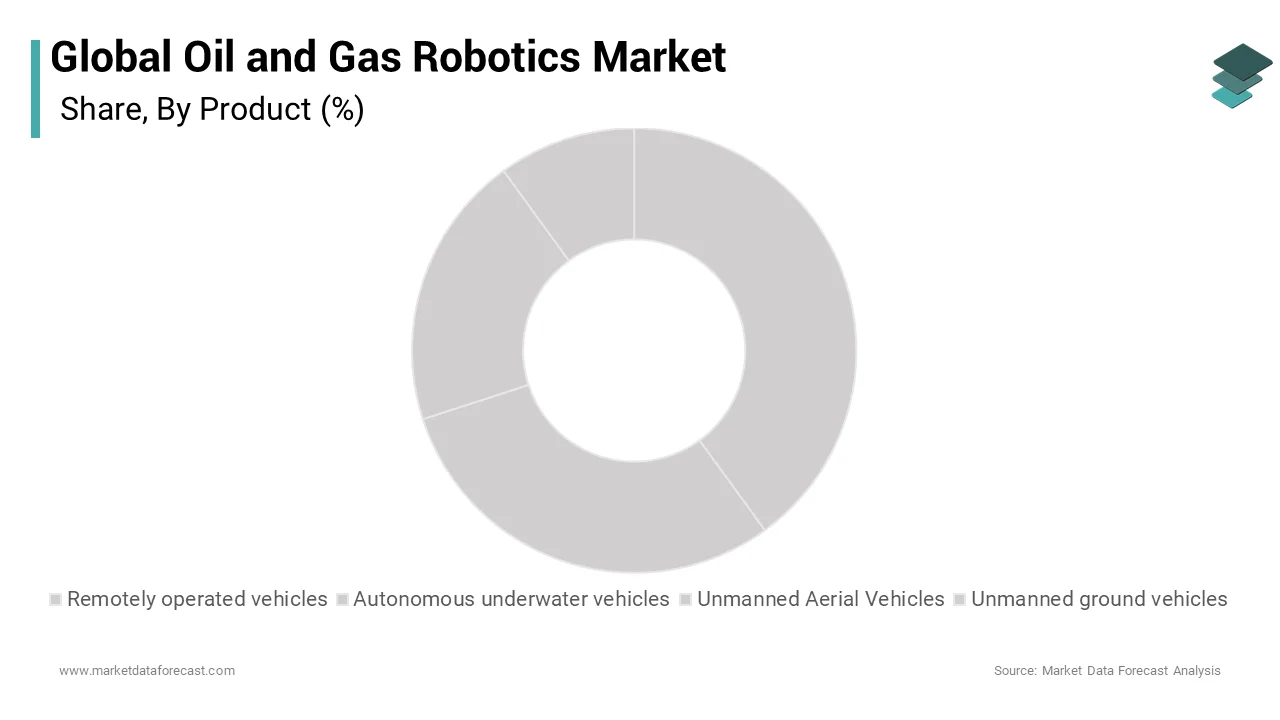
The autonomous underwater vehicles segment is leading with the highest shares of the market. An autonomous underwater vehicle (AUV) is an unmanned submersible vehicle that does not require any real-time input or command from a human operator or driver and therefore operates autonomously. AUVs are robotic vehicles pre-programmed with mission parameters and then deployed to the ocean. An unmanned ground vehicle (UGV) is a vehicle that operates in contact with the ground and without a human presence on board.
By Application Insights
By application, the inspection segment is leading with the dominant shares of the market. The purpose of the inspection is to verify the climatic conditions; the product is manufactured in accordance with the standards and the specifications by checking the products at random. At the program level, the purpose of monitoring and evaluation is to systematically monitor implementation and results and to measure the effectiveness of programs. It helps determine exactly when a program is on track and when changes may be necessary.
By Component Insights
The hardware segment is anticipated to hold the largest share of the oil and gas robotics market. PC hardware alludes to the actual pieces of a PC and related peripherals. Internal equipment gadgets incorporate motherboards, hard drives, and RAM. The interior equipment parts of a PC are regularly called segments, while the outer equipment gadgets are generally called peripherals. Programming is the projects and schedules of a PC or the software program of an electronic device that makes it work.
REGIONAL ANALYSIS
Among these, the Asia-Pacific region is expected to be an important part due to high adoption from countries such as China and India. Asia-Pacific has just launched major projects to investigate the offshore oil and gas industry. The oilfield directors have also distributed a large amount of cash for the advancement of offshore fields, which in turn, is expected to offer an open door to a remarkable business development for robotic inspection in the oil industry market for oil and gas.
COMPETITIVE LANDSCAPE
KEY MARKET PLAYERS
Major Key Players in the Global Oil and Gas Robotics Market are
- ABB Ltd.
- AeroVironment Inc.
- Alstom Inspection Robots
- Cyberhawk Innovations Ltd.
- ECA Group
- Flyability S.A.
- FMC Technologies Inc
- Honeybee Robotics
- Hydrovision Ltd.
- IKM Subsea AS
- ING Robotic Aviation
- International Submarine Engineering (ISE) Ltd.
- Inuktun Services Ltd.
- MISTRAS Group Inc.
- OC Robotics
- Seegrid
- Sky-Futures
- VDOS
RECENT MARKET NEWS
- Honeybee Robotics has long supported NASA exploration missions. The company's systems for drilling, coring, and physical sampling of Mars, the Moon, and asteroids are designed to support scientific research and human exploration.
- FMC Technologies, Inc. (NYSE: FTI) reported today that it had finished the exchange to acquire the excess 55% of the exceptional portions of Schilling Robotics LLC ("Schilling").
- Flyability will present Elios 2 and a live demonstration of the BVLOS UAS RVI confined space at the ASME Robotics for Inspection and Maintenance Forum in Disaster City, TX.
- AeroVironment, which claims to be the largest drone supplier to the US Army, is also an example of a pure and profitable robotics company.
- ABB India announced on Friday the opening of its new robotics plant in Bangalore to support the digital transformation of manufacturing in India.
MARKET SEGMENTATION
This research report on the global oil and gas robotics market has been segmented and sub-segmented based on product, application, component, and region.
By Product
- Remotely operated vehicles
- Autonomous underwater vehicles
- Unmanned Aerial Vehicles
- Unmanned ground vehicles
By Application
- Inspection
- Monitoring
- Surveillance
By Component
- Hardware
- Software
By Region
- North America
- Europe
- Asia Pacific
- Latin America
- Middle East and Africa