- Product Description Description
- Table of Contents TOC
- List of Table & Figure LOT
- Get Free Sample PDF Sample PDF
Market Size, 2025
$5.98 BnMarket Estimate, 2026
$6.54 BnMarket Forecast, 2034
$13.38 BnCAGR, 2026–2034
9.36%Global One-Component Polyurethane Foam Market Size, Share, Trends & Forecast (2026–2034)
- Market Scope: Comprehensive global chemical market assessment evaluating foam types, application sectors, density variations, form factors, and regional adoption metrics across construction, automotive, and industrial domains.
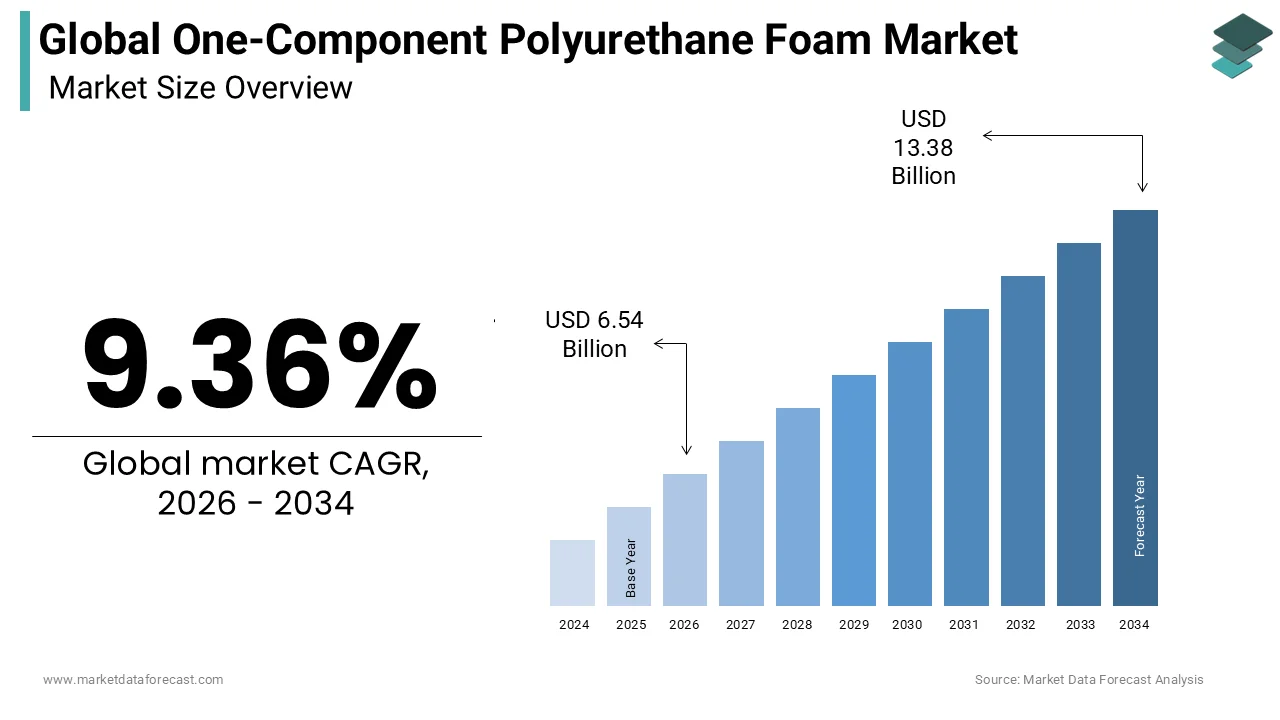
- Market Valuation: Valued at USD 5.98 billion in 2025, estimated at USD 6.54 billion in 2026, and projected to reach USD 13.38 billion by 2034, expanding at a compound annual growth rate (CAGR) of 9.36% from 2026 to 2034.
- Primary Growth Drivers & Challenges: Growth is fueled by surging demand for energy-efficient building insulation, green building mandates, and automotive lightweighting trends in electric vehicles. Key challenges include raw material price volatility (MDI and polyols), VOC emission regulations, and health safety hazards associated with isocyanate exposure.
Key Global One-Component Polyurethane Foam Market Segment Metrics (2026–2034)
| Category | Leading Segment (Position) | Fastest-Growing Segment |
|---|---|---|
| By Foam Type | Closed-Cell Foam Segment (occupied a commanding share in 2025 due to superior structural strength and thermal insulation) | Open-Cell Foam Segment (growing rapidly driven by demand for sound absorption and acoustic control in urban spaces) |
| By Application | Construction Segment (dominated in 2025 driven by building energy codes and green building certifications) | Automotive Segment (expected to register the highest CAGR from 2026 to 2034 via EV lightweighting and cavity filling) |
| By Density | Low-Density Segment (held the majority share in 2025 due to high expansion rates and cost efficiency in bulk filling) | High-Density Segment (growing fastest due to high load-bearing capabilities and structural reinforcement properties) |
| By Form | Spray Foam Segment (led the global market in 2025 by delivering a seamless, continuous air barrier) | Molded Parts Segment (exhibiting noteworthy growth due to precision components for automotive and electronics) |
| By Region | North America (outperformed other regions with a 32.1% share in 2025 supported by mature construction and energy codes) | Asia-Pacific (rapidly expanding via unprecedented urbanization, massive infrastructure, and automotive manufacturing) |
Major One-Component Polyurethane Foam Market Players & Industry Structure
Market Structure: Highly competitive landscape characterized by intense rivalry between multinational chemical giants and specialized regional manufacturers focusing on eco-friendly formulations, supply chain resilience, and strategic B2B partnerships.
Key Companies: Polybag (Switzerland), Den Braven Sealants (Netherlands), Aerosol-service a.s. (Czech Republic), Soudal Group (Belgium), Akkim Construction Chemicals (Turkey), Krimelte OÜ (Estonia), Selena Group (Poland), and Henkel AG & Company (Germany).
Global One-Component Polyurethane Foam Market Size
The Global One Component Polyurethane Foam market was valued at USD 5.98 billion in 2025. The global market size is expected to grow at a CAGR of 9.36% from 2026 to 2034 and be worth USD 13.38 billion by 2034 from USD 6.54 billion in 2026.
One Component Polyurethane Foam is a specialized chemical product designed for sealing, bonding, and insulating applications across various industrial and commercial sectors. This material consists of a prepolymer mixture contained within an aerosol can or cartridge that cures upon exposure to atmospheric moisture. The United Nations Environment Programme reports that the global buildings and construction sector accounts for approximately 37% of global energy- and process-related carbon dioxide emissions, highlighting the critical need to decarbonise building operations and industrial materials. International Energy Agency assessments indicate that deploying high-performance building envelope strategies, including advanced insulation, high-albedo roofs, and energy-efficient windows, is foundational to reducing global space cooling and heating energy intensity. The versatility of this foam allows it to expand and fill irregular cavities, providing excellent thermal and acoustic insulation properties. It is extensively utilized in window and door installation, pipe sealing, and roof insulation. The ongoing global push toward sustainable urban development and stringent building codes mandating lower energy consumption heavily influence the adoption of these advanced sealing solutions. Furthermore, the automotive and manufacturing industries utilize this foam for sound deadening and structural bonding. The continuous evolution of chemical formulations aims to reduce volatile organic compound emissions, aligning with global environmental protection standards.
MARKET DRIVERS
Surging Demand for Energy-Efficient Building Insulation Accelerates Product Adoption
The rapid expansion of green building initiatives and stringent energy conservation codes globally drives the consumption of moisture-curing sealing foams and, in turn, accelerates the growth of the one-component polyurethane foam market. Governments worldwide are implementing aggressive policies to achieve net-zero carbon emissions, which heavily rely on upgrading building envelopes to prevent thermal leakage. According to the European Commission, approximately 75 percent of the building stock in the European Union is currently energy inefficient, requiring massive renovation efforts to meet future climate targets. One Component Polyurethane Foam provides an exceptional air barrier that eliminates drafts and reduces thermal bridging around windows, doors, and structural joints. The United States Department of Energy states that properly sealing and insulating a residential structure can reduce heating and cooling costs by up to 15 percent, making it a highly attractive investment for homeowners and commercial developers. The material expands to fill microscopic gaps that traditional insulation batts cannot reach, ensuring a continuous thermal barrier. As urbanization accelerates in emerging economies, the volume of new residential and commercial construction projects multiplies, creating a vast addressable base for advanced chemical sealants. This relentless focus on minimizing operational energy consumption in the built environment guarantees sustained volume growth for expanding polyurethane products across all major global regions.
Expansion of Automotive Manufacturing and Lightweighting Trends Boosts Industrial Consumption
The global automotive industry is undergoing a massive transformation focused on vehicle lightweighting and acoustic comfort, which significantly elevates the requirement for specialized expanding foams and fuels the expansion of the one-component polyurethane foam market. Electric vehicle manufacturers are particularly driven to reduce overall vehicle mass to maximize battery range and improve performance metrics. According to the United States Department of Energy, reducing the weight of a passenger vehicle by just 10 percent can improve fuel economy or battery range by 6 to 8 percent. One-component polyurethane foam is increasingly utilized for structural cavity filling, acoustic dampening, and vibration reduction within vehicle chassis and door panels. The material offers an outstanding strength-to-weight ratio, allowing engineers to reinforce structural pillars without adding excessive mass. The foam expands to conform perfectly to complex irregular geometries inside car doors and dashboards, eliminating rattling noises and enhancing the premium feel of the cabin. Consumer expectations for quiet, comfortable driving experiences are rising alongside the rapid shift toward electric mobility. As a result, automotive assembly plants are integrating more advanced chemical sealants into their production lines, which drives robust industrial consumption.
MARKET RESTRAINTS
Volatility in Raw Material Pricing and Supply Chain Disruptions Restricts Profitability
The manufacturing of moisture-curing polyurethane products relies heavily on specific petrochemical derivatives such as methylene diphenyl diisocyanate and specialized polyols, which hinder the growth of the one-component polyurethane foam market. This makes the market highly vulnerable to raw material price fluctuations. These base chemicals are intrinsically linked to global crude oil and natural gas markets, which are notoriously unstable due to geopolitical tensions and production quota changes. World Bank commodity markets assessments show that energy commodities and fossil-fuel baselines experience heavy volatility, driving price fluctuations across the broader global industrial manufacturing sector. When the cost of methylene diphenyl diisocyanate spikes, producers of one-component polyurethane foam face the difficult choice of absorbing the increased expenses or passing them onto price-sensitive consumers and contractors. Furthermore, global supply chain bottlenecks frequently delay the delivery of essential propellants and chemical precursors, leading to production halts and inventory shortages. The International Energy Agency monitors crude oil distillation capacity and global refining outputs to assess vulnerabilities in international fuel supply chains and energy security. This unpredictability makes long-term financial planning difficult for manufacturers and discourages large-scale capital investments in new production facilities. Hence, the inherent instability of the upstream petrochemical supply base acts as a significant barrier to consistent market expansion and stable pricing structures.
Stringent Environmental Regulations Regarding Volatile Organic Compounds Limit Formulation Flexibility
Growing environmental awareness and strict government mandates targeting air quality are forcing manufacturers to fundamentally alter their chemical formulations, which increases production complexity and costs, and thereby impedes the expansion of the one-component polyurethane foam market. Traditional expanding foams often utilize propellants and solvents that release volatile organic compounds into the atmosphere, contributing to smog formation and indoor air pollution. According to the United States Environmental Protection Agency, architectural and industrial maintenance coatings, including specialized sealants and foams, are strictly regulated with volatile organic compound limits often capped at extremely low thresholds to protect public health. The European Chemicals Agency similarly enforces rigorous registration, evaluation, authorization, and restriction of chemicals protocols that phase out hazardous propellants and isocyanate monomers. Complying with these evolving environmental standards requires extensive research and development to create low-emission alternatives that maintain the necessary expansion and curing properties. Formulating one-component polyurethane foam with water-based propellants or low-volatile organic compound solvents often compromises the product's curing speed and overall structural integrity. Manufacturers must invest heavily in advanced chemical engineering and specialized manufacturing equipment to meet these stringent air quality standards. This regulatory burden disproportionately affects smaller chemical producers who lack the financial resources to rapidly reformulate their product lines, thereby restricting overall innovation and limiting the variety of available products in highly regulated jurisdictions.
MARKET OPPORTUNITIES
Development of Bio-Based and Renewable Polyol Formulations Opens Sustainable Avenues
The global shift toward circular economy principles and sustainable manufacturing offers a massive opportunity for chemical companies to develop and commercialize renewable alternatives to traditional petrochemical foams, which is likely to drive the growth of the one-component polyurethane foam market. Researchers are successfully synthesizing polyols from agricultural feedstocks such as soybean oil, castor oil, and lignin, which significantly reduces the carbon footprint of the final product. The United States Department of Agriculture indicates that the displacement of petroleum materials by biobased alternatives can yield greenhouse gas emissions reductions of up to 60% across evaluated product sectors. Integrating these renewable ingredients into One Component Polyurethane Foam allows manufacturers to target environmentally conscious consumers and secure lucrative contracts for sustainable infrastructure projects. The Leadership in Energy and Environmental Design certification program frequently awards points for utilizing materials with high recycled, bio-based content, incentivizing architects and builders to specify these advanced sealants. Furthermore, advancements in catalytic chemistry have improved the performance characteristics of plant-derived polyols, ensuring they match the durability and expansion rates of conventional formulas. By establishing strategic partnerships with agricultural processors and investing in green chemistry patents, companies can capture premium pricing and differentiate their offerings in a crowded marketplace. This transition toward renewable raw materials not only mitigates the risks associated with crude oil volatility but also aligns corporate portfolios with global decarbonization goals.
Rising Adoption in Renewable Energy Infrastructure and Wind Turbine Assembly Creates New Revenue Streams
The aggressive global deployment of renewable energy systems, particularly wind and solar power installations, offers a highly lucrative and largely untapped application area for advanced expanding chemical sealants and is expected to propel the toner-component polyurethane foam market. Modern wind turbine blades require massive structural bonding void filling and acoustic dampening during the manufacturing process to ensure aerodynamic efficiency and long-term durability. One-component polyurethane foam is increasingly utilized to seal the root ends of turbine blades and fill internal cavities, preventing moisture ingress and structural degradation in harsh offshore and onshore environments. Similarly, large-scale solar farms utilize these foams for sealing inverter housings and protecting sensitive electrical junction boxes from environmental contaminants and extreme temperature fluctuations. By developing specialized high-temperature and ultraviolet-resistant formulations, chemical manufacturers can establish themselves as critical suppliers to the rapidly expanding clean energy sector. This strategic pivot diversifies revenue streams away from traditional cyclical construction markets and embeds companies within the high-growth renewable energy supply chain.
MARKET CHALLENGES
Health and Safety Hazards Associated with Isocyanate Exposure Complicate Occupational Compliance
The fundamental chemistry of moisture-curing polyurethane products relies on isocyanate monomers, which pose significant respiratory and dermal health risks to construction workers and manufacturing personnel if not handled correctly, and ultimately hamper the growth of the one-component polyurethane foam market. Inhalation of isocyanate vapors or aerosols during the application and curing process is a leading cause of occupational asthma and severe respiratory sensitization globally. According to the Occupational Safety and Health Administration, isocyanate exposure is strictly regulated with permissible exposure limits set at extremely low thresholds requiring comprehensive workplace monitoring and specialized personal protective equipment. The European Agency for Safety and Health at Work frequently cites chemical handling in the construction sector as a primary area of concern necessitating mandatory safety training and strict ventilation protocols for all applicators. Ensuring compliance with these rigorous occupational health standards increases operational costs for contractors and slows down project timelines. Many independent contractors and small construction firms lack the resources to implement comprehensive safety programs, leading to improper application and increased liability risks. Furthermore, the negative perception surrounding hazardous chemical handling discourages new workers from entering the trades, creating labor shortages that indirectly affect the consumption volume of One Component Polyurethane Foam. Overcoming this challenge requires continuous investment in safer application technologies and extensive educational campaigns to protect worker health while maintaining productivity.
Technical Limitations in Extreme Climatic and Substrate Conditions Hinder Universal Application
The fundamental curing mechanism of these expanding sealants relies entirely on ambient atmospheric moisture, which creates significant performance challenges in arid climates or freezing temperatures, and negatively impacts the expansion of the one-component polyurethane foam market. This trend is despite its versatility. In extremely dry environments, the foam may cure only on the exterior surface while remaining liquid or uncured in the center, leading to structural failure and poor insulation values. When applied in cold weather, the expansion rate decreases dramatically and the curing time extends significantly, causing project delays and increased material waste. Furthermore, prolonged exposure to ultraviolet radiation causes the surface of the cured foam to degrade and become brittle, necessitating immediate secondary coating or painting, which adds labor and material costs. The International Building Code mandates specific fire resistance and structural integrity standards that standard expanding foams often fail to meet without additional intumescent coatings or physical barriers. These inherent chemical and physical limitations prevent the product from being a universal solution for all construction and industrial applications. Manufacturers must invest heavily in developing specialized climate-specific formulations, which increases research costs and complicates inventory management for global distributors.
REPORT COVERAGE
| REPORT METRIC | DETAILS |
| Market Size Available | 2025 to 2034 |
| Base Year | 2025 |
| Forecast Period | 2026 to 2034 |
| CAGR | 9.36% |
| Segments Covered | By Raw Material, Application, and Region |
| Various Analyses Covered | Global, Regional & Country Level Analysis, Segment-Level Analysis, DROC, PESTLE Analysis, Porter’s Five Forces Analysis, Competitive Landscape, Analyst Overview on Investment Opportunities |
| Regions Covered | North America, Europe, Asia Pacific, Latin America, and the Middle East & Africa |
| Market Leaders Profiled | Polybag (Switzerland), Den Braven Sealants (Netherlands), Aerosol - service a.s. (Czech Republic), Soudal Group (Belgium), Akkim Construction Chemicals (Turkey), Krimelte OÜ (Estonia), Selena Group (Poland), Henkel AG & Company (Germany) |
SEGMENTAL ANALYSIS
By Foam Type Insights
The closed-cell foam segment was the largest in the one-component polyurethane foam market and occupied a commanding share in 2025. Moreover, the physical density of closed-cell foam significantly enhances the structural strength of building envelopes and industrial components. The Home Innovation Research Labs demonstrate that filling wood-frame wall cavities with closed-cell polyurethane spray foam can increase racking load resistance by up to 300% compared to conventional insulation methods. This added rigidity is highly valued in regions prone to severe weather conditions, such as hurricanes and high winds, where structural resilience is non-negotiable. Additionally, the material adheres strongly to various substrates, including wood, metal, and concrete, creating a monolithic layer that reinforces the overall framework. The Federal Emergency Management Agency classifies closed-cell spray polyurethane foam as a Class 5 flood damage-resistant material that is highly effective at resisting moisture degradation in severe flood zones. This dual function of providing both elite thermal insulation and substantial structural reinforcement makes closed-cell foam an indispensable material in modern construction and industrial manufacturing applications, driving its continuous market dominance.
However, the open cell foam segment is likely to experience the fastest CAGR over the forecast period due to its flexible and less dense structure. This makes it an exceptional material for sound absorption and acoustic control. According to the World Health Organization, excessive noise pollution contributes to severe health issues, including sleep disturbance and cardiovascular stress, driving the demand for effective soundproofing solutions in urban environments. Open cell foam boasts a high noise reduction coefficient often exceeding 0.,80 which means it absorbs the majority of sound waves rather than reflecting them. A study confirms that light, porous open-cell polyurethane foam serves as an effective sound-absorbing medium to reduce indoor reverberation and optimize room acoustics. The interconnected cellular structure allows sound waves to enter the material and dissipate as thermal energy. With rapid urbanization increasing the density of residential and commercial spaces, the need for superior acoustic insulation is accelerating the adoption of open-cell formulations at the fastest rate in the global market.
By Application Insights
The construction segment dominated the one-component polyurethane foam market and held a commanding share in 2025. This dominance of the segment was mainly driven by increasingly stringent global building energy codes and the widespread adoption of green building certifications. Data from the International Energy Agency indicates that the global operations of buildings account for approximately 30% of global final energy consumption. One Component Polyurethane Foam provides an airtight seal that drastically reduces thermal bridging and energy leakage, aligning perfectly with these regulatory requirements. As per the United States Green Building Council, the number of projects achieving Leadership in Energy and Environmental Design certification has grown exponentially, with many requiring advanced air sealing materials to earn critical points. Contractors and developers utilize these foams to ensure compliance with modern energy codes, which often mandate specific air leakage rates for new residential and commercial structures. This regulatory push guarantees a massive and consistent baseline demand for high-performance insulating foams across the global construction industry.
But the automotive segment is on the rise and is expected to be the fastest-growing segment in the market by registering the highest CAGR from 2026 to 2034. This segment is aggressively pursuing vehicle lightweighting strategies to improve fuel efficiency and extend the driving range of electric vehicles, which makes advanced expanding foams highly desirable. One-component polyurethane foam is increasingly utilized for structural cavity filling and component bonding because it offers an exceptional strength-to-weight ratio compared to traditional metal reinforcements. The International Energy Agency reports that global electric car sales have scaled rapidly, consistently tracking past 10 million units annually to capture a substantial share of the international automotive landscape. By replacing heavier mechanical fasteners and metal brackets with lightweight expanding foams, manufacturers can significantly reduce overall vehicle mass. This critical need for mass reduction in the transition toward electrified mobility is accelerating the adoption of specialized polyurethane foams in automotive assembly lines.
By Density Insights
In 2025, the low-density segment held the majority share of the global market because of its exceptional expansion rates and cost efficiency, which are highly valued in large volume filling applications. The high yield significantly reduces the per square foot cost of insulation and sealing projects, making it the most economical choice for residential attic wall cavities,and large commercial roofs. Builders and contractors operating on tight profit margins heavily favor these cost-effective solutions that do not compromise on basic thermal performance. The ability to maximize coverage while minimizing raw material expenditure ensures that low-density variants maintain their leading position in global consumption volumes.
On the other hand, the high-density segment is experiencing the fastest growth due to its exceptional load-bearing capabilities and structural reinforcement properties in demanding industrial and commercial applications. A study confirms that rigid high-density closed-cell polyurethane foams can achieve compressive strengths exceeding 60 pounds per square inch, making them suitable for sub-slab insulation and heavy load-bearing structural panel reinforcement. This material is increasingly utilized in the manufacturing of cold storage facilities, industrial doors, and heavy-duty packaging, where structural integrity is paramount. The ability of high-density foam to withstand significant mechanical stress without deforming ensures the longevity and safety of critical industrial assets. This unique combination of elite insulation and structural strength is driving rapid adoption in specialized high-performance sectors.
By Form Insights
The spray foam segment led the global market and captured a significant share in 2025. This leading position of the segment was attributed to the fact that it provides a completely seamless and continuous air barrier that conforms perfectly to any substrate or irregular geometry. Spray foam expands in place, filling every crack, crevice, and joint, creating a monolithic seal that eliminates thermal bridging and drafts. Contractors highly prefer this form because it requires minimal cutting or fitting, reducing installation errors and ensuring consistent performance across the entire building envelope. The unmatched ability to create a flawless continuous barrier makes spray foam the undisputed leader in both residential and commercial insulation applications.
The molded parts segment is expected to exhibit a noteworthy CAGR over the forecast period, owing to the increasing demand for precision-manufactured components in the automotive electronics and medical device industries. Manufacturing assessments establish that molded polyurethane components exhibit high dimensional reliability, with standard production tolerances typically mapping to ±0.010 inches depending on part geometry and size. This precision allows manufacturers to produce intricate geometries that fit perfectly into tight assemblies without requiring secondary machining or finishing operations. The ability to consistently produce highly accurate parts at high volumes makes molded polyurethane indispensable for modern mass production techniques. This demand for exact precision in high-tech manufacturing is accelerating the growth of the molded parts segment at an unprecedented rate.
REGIONAL ANALYSIS
North America One Component Polyurethane Foam Market Analysis
North America outperformed other regions in the global one-component polyurethane foam market and accounted for a 32.1% share in 2025. This supremacy of the regional market was supported by a mature construction sector and stringent energy efficiency mandates. The market status in this region is showing high adoption rates of advanced insulation materials in both new residential builds and extensive commercial retrofitting projects. Moreover, the United States Census Bureau establishes that total annualised construction spending in the United States routinely tracks past the USD 1.8 trillion threshold across private and public sectors. The United States Department of Energy provides technical assistance and issues formal determinations to help states review, adopt, and implement updated energy conservation building codes that improve structural thermal resistance. Furthermore, the robust automotive manufacturing base in the region heavily utilizes these materials for vehicle lightweighting and acoustic dampening. A study outlines that the deployment of electric vehicles requires advanced material designs, including lightweight structural acoustic components and thermal management insulation systems, to balance vehicle weight and cabin comfort. The combination of aggressive energy policies, massive construction volumes, and advanced automotive manufacturing ensures that North America remains a dominant and highly lucrative market for these chemical products.
Europe One Component Polyurethane Foam Market Analysis
Europe followed closely behind in the global market and occupied a 26.1% share in 2025. This expansion of the European market was propelled by strict environmental regulations and a massive push toward sustainable building practices. The market status in this region is heavily influenced by the European Green Deal, which mandates drastic reductions in carbon emissions from the building sector. According to the European Commission, the European Union renovation wave strategy aims to renovate at least 35 million existing buildings by 2030 to improve energy efficiency and reduce carbon footprints. This massive retrofitting initiative requires vast quantities of high-performance insulating materials, making Europe a primary hub for advanced polyurethane foam consumption. Sources confirm that the operational energy consumption of the European Union's building stock accounts for approximately 40% of the region's final energy consumption. Additionally, the region is home to leading chemical manufacturers who are pioneering the development of bio-based and low-volatile organic compound formulations to comply with stringent regional chemical regulations. The relentless regulatory focus on sustainability and energy conservation drives continuous innovation and robust market growth across the European continent.
Asia Pacific One Component Polyurethane Foam Market Analysis
Asia Pacific is a rapidly expanding region in the global market due to unprecedented urbanization and massive infrastructure development across emerging economies. The region's market growth reveals itself to be highly dynamic, with China and India leading the charge in residential construction and industrial manufacturing. Projections from the United Nations Department of Economic and Social Affairs show that the gradual shifting of the global population from rural to urban areas will be highly concentrated, with Asia and Africa together expected to comprise just under 90% of global urban growth. As per the Asian Development Bank, developing member countries in the region require an estimated 1.7 trillion USD in annual infrastructure investment to sustain economic growth and support urbanization. This massive construction boom directly translates to surging demand for efficient insulating and sealing materials. Furthermore, the region is the world's largest automotive manufacturing hub, with countries like Japan, South Korea, and China producing millions of vehicles annually. The International Organization of Motor Vehicle Manufacturers shows that the Asia-Pacific region accounts for the clear majority of total global vehicle production volume.
South America One Component Polyurethane Foam Market Analysis
South America holds a steady position in the one-component polyurethane foam market owing to gradual economic recovery and expanding residential construction activities. The regional market is evolving, driven by a growing demand for energy efficiency and a transition toward sustainable building materials in major economic hubs like São Paulo and Buenos Aires. In addition, the Economic Commission for Latin America and the Caribbean indicates that structural infrastructure investment and construction activity across Latin American economies remain highly volatile and tied to local fiscal constraints. The region's diverse climate, ranging from tropical to temperate, creates a strong need for effective thermal insulation and moisture control in building envelopes. While economic volatility and inflationary pressures occasionally impact purchasing power, the long-term trend toward urbanization and improved building standards ensures a stable and progressive growth trajectory for polyurethane foam products across the South American continent.
Middle East and Africa One Component Polyurethane Foam Market Analysis
The Middle East and Africa region is expected to grow notably in the global market from 2026 to 2034 due to massive mega projects and extreme climate adaptation requirements. Regional market activity is concentrated within the Gulf Cooperation Council, fueled by unprecedented investments in advanced infrastructure and luxury commercial real estate. According to the Middle East North Africa economic update, the construction sector in the Gulf region is experiencing a multi-billion USD boom driven by national vision programs aimed at economic diversification and tourism development. The material's ability to withstand harsh environmental conditions and provide airtight seals makes it indispensable for modern skyscrapers and industrial facilities in the region. Meanwhile, in Africa, the market is in its nascent stages but is gradually expanding as urbanization accelerates and international development funds support improved housing infrastructure. The focus on extreme climate resilience and mega project development ensures steady growth for advanced insulating materials in this unique regional market.
COMPETITION OVERVIEW
The competition in the One Component Polyurethane Foam Market is characterized by intense rivalry among multinational chemical giants and specialized regional manufacturers. Established players leverage their extensive research and development capabilities to innovate high-performance and eco-friendly formulations that comply with evolving regulatory standards. Smaller niche competitors focus on specific applications such as acoustic dampening or structural bonding to differentiate their offerings. Price competition remains moderate as customers prioritize product reliability, technical support, and compliance certifications over lowest cost options. Strategic partnerships with end users in the construction and automotive sectors create strong entry barriers for new entrants. Intellectual property protection through patents on unique catalyst systems and polymer blends secures competitive advantages. Supply chain resilience has become a critical differentiator following recent global disruptions, prompting companies to diversify sourcing and production locations. Customer loyalty is driven by consistent quality and responsive technical service rather than brand recognition alone. The market sees continuous innovation driven by the need for faster curing times and improved thermal properties. Collaborative ecosystems involving suppliers, manufacturers, and regulators accelerate technological advancements and market expansion.
KEY MARKET PLAYERS
A few major players of the global one-component polyurethane foam market include
- Polybag
- Den Braven Sealants
- Aerosol
- Soudal Group
- Akkim Construction Chemicals
- Krimelte OÜ
- Selena Group
- Henkel AG & Company
- Tremco Illbrück Group
- Polybag
Top Strategies Used by Key Market Participants
Key players in the One Component Polyurethane Foam Market primarily focus on product innovation to develop low-volatile organic compound and bio-based formulations that meet strict environmental regulations. Companies invest heavily in expanding manufacturing capacities in emerging economies to capitalize on rapid urbanization and infrastructure development trends. Strategic acquisitions of regional distributors and smaller chemical firms enable market leaders to strengthen their supply chains and broaden their geographic reach. Partnerships with the construction and automotive industries facilitate the co-development of specialized applications tailored to specific industry needs. Market participants prioritize sustainability initiatives by introducing recyclable packaging and carbon-neutral production processes to enhance brand reputation. Digital transformation through advanced supply chain management systems ensures timely delivery and inventory optimization. Pricing strategies are adjusted to balance raw material volatility with competitive positioning. These multifaceted approaches drive long-term growth and maintain leadership in the evolving global chemical landscape.
Leading Players in the Global Market
- BASF SE stands as a global leader in chemical innovation with a significant footprint in the polyurethane foam sector. The company produces high-quality prepolymers and specialized formulations for one-component applications used in construction and automotive industries. Recent actions include expanding its production capacity in Asia to meet rising demand from emerging markets and developing bio-based raw materials to support sustainability goals. BASF actively collaborates with construction firms to create energy-efficient insulation solutions that comply with stringent environmental regulations. Their investment in research and development focuses on improving curing speeds and reducing volatile organic compound emissions. By integrating digital tools for supply chain optimization, they ensure consistent product availability. These strategic initiatives reinforce their position as a primary supplier of advanced chemical sealing and insulating materials worldwide.
- Sika AG is a prominent specialty chemicals company renowned for its comprehensive range of construction and industrial sealing solutions, including one-component polyurethane foams. The company serves diverse sectors such as building renovation, automotive manufacturing, and marine applications with high-performance adhesive and insulating products. Recent actions involve acquiring regional manufacturers to strengthen local distribution networks and enhance technical support capabilities. Sika invests heavily in developing low-emission formulas that meet rigorous international safety standards. They partner with major automotive OEMs to provide lightweight acoustic dampening solutions for electric vehicles. Their commitment to sustainability is evident in the launch of recyclable packaging and carbon-neutral production processes. These efforts solidify their reputation as a trusted provider of innovative and reliable polyurethane foam technologies across global markets.
- Huntsman Corporation operates as a key player in the global polyurethane market, offering a wide array of one-component foam systems for insulation and bonding. The company focuses on delivering customized solutions for residential, commercial, and industrial applications, ensuring optimal thermal performance and structural integrity. Recent actions include upgrading manufacturing facilities to increase efficiency and reduce environmental impact through advanced process controls. Huntsman collaborates with academic institutions to pioneer new catalyst technologies that accelerate curing times without compromising quality. They expand their presence in the Middle East by establishing regional technical centers to support large-scale infrastructure projects. Their dedication to customer education and technical assistance helps contractors achieve superior application results. These strategic moves enhance their competitive edge and drive sustained growth in the global one-component polyurethane foam market.
MARKET SEGMENTATION
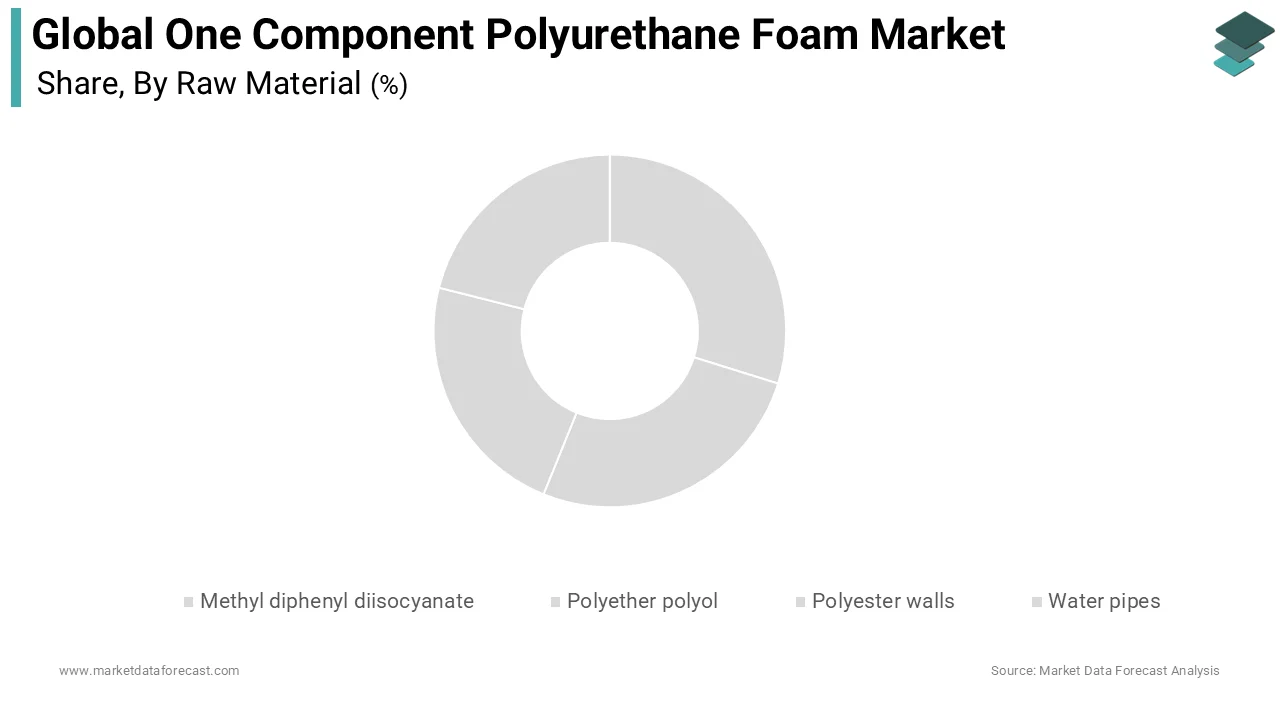
This research report on the global one-component polyurethane foam market has been segmented and sub-segmented based on raw material, application, and region.
By Raw Material
- Methyl diphenyl diisocyanate
- Polyether polyol
- Polyester walls
- Water pipes
By Application
- Door and window frame jambs
- Ceiling and floor joints
- Partition walls
- Water pipes
By Region
- North America
- Latin America
- Europe
- Asia Pacific
- Middle East & Africa