- Product Description Description
- Table of Contents TOC
- List of Table & Figure LOT
- Get Free Sample PDF Sample PDF
Market Size, 2025
$416.8 BnMarket Estimate, 2026
$437.1 BnMarket Forecast, 2034
$638.9 BnCAGR, 2026–2034
4.86%Global Fruit Snacks Market Size, Growth, Trends & Forecast (2025–2034)
The global fruit snacks market size was valued at USD 13.24 billion in 2025, stands at USD 14.32 billion in 2026, and is projected to scale up to USD 26.84 billion by 2034, registering a compound annual growth rate (CAGR) of 8.17% during the forecast period. Driven by fundamental shifts toward health-conscious nutritional diets, rising demand for ready-to-eat convenience foods, and innovative multi-channel marketing campaigns, the industry continues to experience robust worldwide expansion.
Key Executive Metrics (At-a-Glance)
- 2025 Base Valuation: USD 13.24 Billion
- 2026 Current Valuation: USD 14.32 Billion
- 2034 Forecast Valuation: USD 26.84 Billion
- Compound Annual Growth Rate (CAGR): 8.17% (2026–2034)
- Dominant Type Segment: Sweet & Savory Segment (leading due to high consumer preference for nutrient-rich processed foods among children and households)
- Dominant Distribution Channel: Online Retail Channels (alongside widespread availability in supermarkets and hypermarkets)
- Fastest-Growing Distribution Channel: Convenience Stores (expanding rapidly due to centralized product variety, displays, and bulk discounts)
- Dominant & Fastest-Growing Region: North America (holding >35% of total sales) & Asia-Pacific (projected to record the fastest regional CAGR)
Core Market Drivers & Challenges
- Drivers: Consumer transition toward health-focused snack patterns, high demand for fiber and vitamin-rich immunity boosters, busy modern lifestyles, and expansive e-commerce retail networks.
- Restraints & Challenges: Increasingly stringent government regulatory standards on processed foods, growing consumer awareness regarding artificial additives, and obesity-related policy shifts.
Market Segmentation Breakdown
| Segment Category | Leading Sub-Segment (2025 Base) | Fastest-Growing Sub-Segment (2026–2034) |
|---|---|---|
| By Type | Sweet & Savory Segment (market leader) | Gluten-Free & Nutrient-Dense Fruit Snacks |
| By Distribution Channel | Online Stores & Supermarkets | Convenience Stores (higher CAGR potential) |
| By Region | North America (dominant market share >35%) | Asia-Pacific (fastest projected CAGR) |
Major Industry Players
SunOpta, Sunkist Growers Inc., Welch's, General Mills, Inc., Bare Foods Co., Flaper SA, Kellogg Co., Crispy Green Inc., Crunchies Natural Food Company LLC, and Mount Franklin Foods LLC.
Global Paper Packaging Materials Market Size
The global paper packaging materials market size was valued at USD 416.85 billion in 2025 and is expected to reach USD 638.95 billion by 2034 from USD 437.11 billion in 2026. The market's promising CAGR for the predicted period is 4.86%.
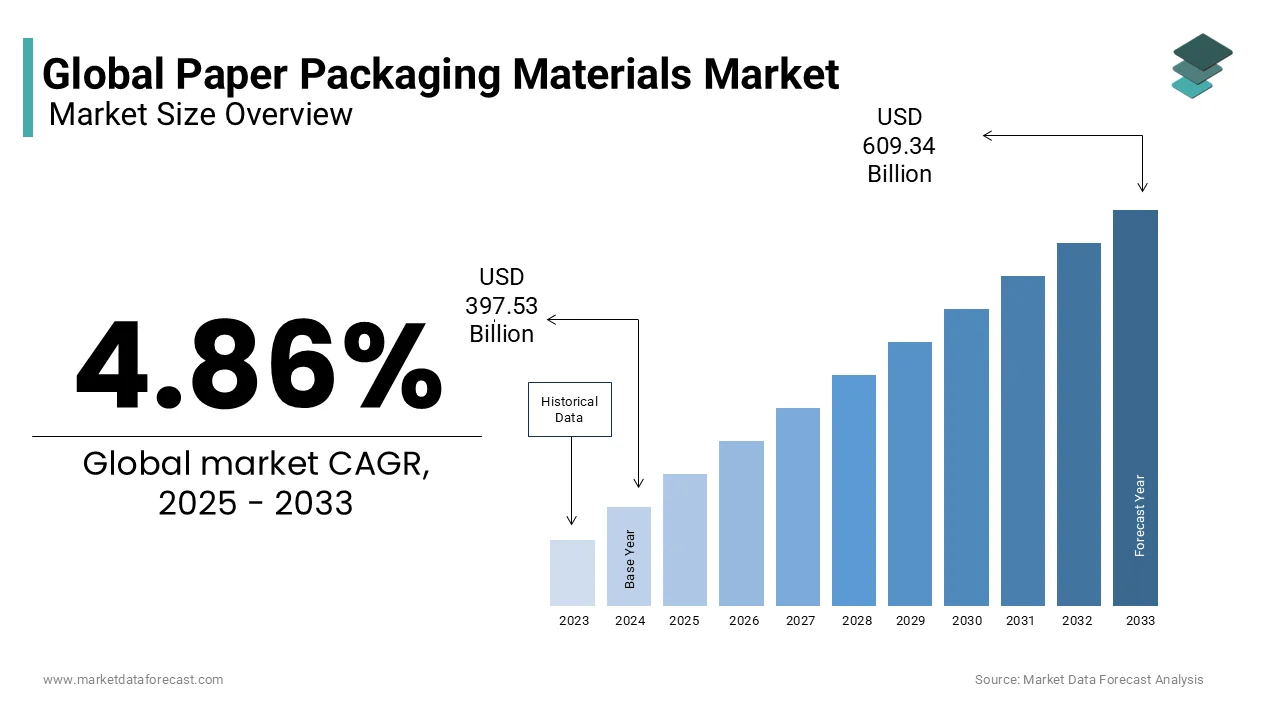
The paper packaging materials is a wide range of products including corrugated boxes, paperboards, folding cartons, sacks, and bags used for protecting, transporting, and marketing goods across industries such as food & beverage, consumer goods, healthcare, and e-commerce. According to Statista, global consumption of paper packaging materials exceeded 200 million metric tons in 2023, which is reflecting a steady rise driven by environmental concerns and regulatory pressure on single-use plastics.
MARKET DRIVERS
Regulatory Push Toward Sustainable Packaging
The increasing regulatory emphasis on sustainable packaging practices is fuelling the growth of the Paper Packaging Materials Market. Governments worldwide are enacting stringent policies to reduce reliance on non-biodegradable materials, especially plastics. For instance, the European Commission’s Single-Use Plastics Directive, implemented in 2021, mandates member states to significantly curtail the use of plastic packaging, directly boosting the adoption of paper-based alternatives. In Asia, countries like South Korea and Japan have introduced mandatory recycling laws and extended producer responsibility (EPR) programs that compel companies to manage post-consumer packaging waste. According to the Korea Environment Corporation, over 85% of paper packaging in the country was recycled in 2023, demonstrating the effectiveness of such policies.
Surge in E-Commerce and Logistics Demand
The rapid expansion of e-commerce has led to an unprecedented increase in product delivery volumes is prompting the growth of the Paper Packaging Materials Market. Corrugated paper packaging, particularly in the form of shipping boxes and padded envelopes, has become indispensable in this sector due to its structural integrity, cost-efficiency, and recyclability. Amazon is one of the world's largest online retailers, reported that in 2023 it shipped over 7 billion packages globally, many of which utilized paper-based packaging materials. The company has committed to achieving 100% recyclable packaging by 2026, aligning with broader industry trends. In addition, logistics providers such as FedEx and DHL have adopted standardized paper-based packaging systems to optimize supply chain efficiency while minimizing environmental impact.
MARKET RESTRAINTS
Volatility in Raw Material Prices
The fluctuation in raw material prices such as wood pulp and recycled fiber is restricting the growth of the Paper Packaging Materials Market. These inputs constitute a major portion of production costs for paper packaging manufacturers. According to the Food and Agriculture Organization (FAO), global pulp prices surged by approximately 25% between 2021 and 2023 due to supply chain disruptions, increased energy costs, and reduced forest harvesting in key producing regions such as North America and Scandinavia. For example, in 2022, the price of kraft pulp is a primary component of corrugated boxes that reached a decade high, exceeding USD 1,200 per ton, as reported by RISI (Resource Information Systems, Inc.). This volatility has placed immense pressure on small and medium-sized enterprises (SMEs) that lack the financial cushion to absorb sudden cost increases. Moreover, geopolitical tensions, such as those affecting trade routes between Russia and Europe, have further disrupted the availability of raw materials. Companies like International Paper and WestRock have had to pass on some of these increased costs to consumers, that is potentially dampening demand elasticity for paper packaging in price-sensitive markets.
Limited Barrier Properties Compared to Plastic
The paper packaging still faces limitations in terms of barrier properties such as moisture, grease, and oxygen resistance is also inhibiting the growth of the Paper Packaging Materials Market. This restricts its application in sectors requiring long shelf life or exposure to harsh conditions, such as frozen foods or industrial chemicals. According to the American Chemical Society, traditional paper packaging allows moisture vapor transmission rates up to 10 g·mm/m²/day, significantly higher than plastic films like polyethylene terephthalate (PET), which offer less than 1 g·mm/m²/day. A study published in the Journal of Cleaner Production found that coated paper packaging requires specialized recycling infrastructure, which is currently available in less than 30% of global recycling facilities. This limitation hampers widespread adoption, especially in emerging economies where recycling systems are underdeveloped.
MARKET OPPORTUNITIES
Innovation in Smart and Functional Paper Packaging
Technological advancements are opening new avenues for smart and functional paper packaging, enhancing both usability and sustainability. Innovations such as antimicrobial coatings, temperature-sensitive inks, and embedded sensors are being integrated into paper-based packaging to meet evolving consumer and industrial needs. For instance, Xerox has developed printable electronics that allow paper packaging to display real-time freshness indicators for perishable goods, which is improving food safety and reducing waste. In the pharmaceutical sector, companies like Noventis are using dissolvable paper-based sensors to track medication adherence, a development supported by the World Health Organization’s push for better patient compliance tools. These innovations not only expand the utility of paper packaging beyond traditional applications but also position it as a viable competitor to plastic in high-value sectors.
Expansion of Green Finance and Sustainability Investment
The growing global focus on green finance and corporate sustainability goals is creating significant opportunities in the Paper Packaging Materials Market growth. Financial institutions and governments are increasingly offering preferential loans, tax incentives, and grants to companies adopting eco-friendly packaging solutions. According to the Climate Bonds Initiative, green bond issuance reached USD 650 billion globally in 2023, with a substantial portion directed toward sustainable manufacturing and circular economy initiatives. For example, in 2023, Stora Enso, a leading paper and packaging company, secured EUR 500 million in green financing to expand its biomaterials division and develop fully recyclable paper-based packaging alternatives. Similarly, the Indian government announced a USD 2.5 billion fund under its National Clean Energy Fund to support sustainable packaging startups and R&D projects. These financial instruments are enabling firms to scale operations, invest in cleaner production technologies, and enter new markets without compromising profitability.
MARKET CHALLENGES
Competition from Alternative Packaging Materials
The stiff competition from alternative materials such as plastic, metal, and glass in niche applications where performance and aesthetics are important shall pose great challenge for the growth of the paper packaging materials market. For instance, in the beverage sector, aluminum cans and PET bottles dominate due to their lightweight, shatterproof nature, and superior barrier properties. Moreover, bioplastics derived from corn starch or sugarcane are gaining traction as compostable alternatives, posing another challenge to paper packaging. According to Nova Institute, global bioplastic production capacity is set to increase by 35% by 2027, which is reaching 6.3 million tons annually. These materials often combine the benefits of traditional plastics with biodegradability, making them attractive for premium brands seeking innovative packaging solutions.
Inadequate Recycling Infrastructure in Developing Regions
The absence of robust recycling infrastructure in many developing economies limits its full potential, which is potentially impeding the growth of the paper packaging materials market. According to the United Nations Environment Programme (UNEP), less than 40% of municipal solid waste is formally collected in low-income countries, with even lower recycling rates. This gap in infrastructure leads to high levels of contamination, landfilling, and incineration of paper waste, undermining environmental benefits. Furthermore, informal waste collection systems often result in inefficient sorting and poor quality of recovered fibers, reducing the economic viability of recycling. In response, organizations like the World Bank have launched urban waste management programs in countries like Indonesia and Nigeria to modernize recycling ecosystems.
REPORT COVERAGE
| REPORT METRIC | DETAILS |
| Market Size Available | 2025 to 2034 |
| Base Year | 2025 |
| Forecast Period | 2026 to 2034 |
| CAGR | 4.86% |
| Segments Covered | By Product, Application, and Region. |
| Various Analyses Covered | Global, Regional and Country Level Analysis; Segment-Level Analysis; DROC; PESTLE Analysis; Porter’s Five Forces Analysis; Competitive Landscape; Analyst Overview of Investment Opportunities |
| Regions Covered | North America, Europe, APAC, Latin America, Middle East & Africa |
| Market Leaders Profiled | Smurfit Kappa Group Plc, Napco National Paper Products Company, Billerudkorsnas, International Paper Company, WestRock Compan, Georgia Pacific LLC, Pratt Industries, DS Smith Packaging Limited, Stora Enso Oyj, Mondi Group Plc. |
SEGMENTAL ANALYSIS
By Product Insights
The corrugated segment dominated the global paper packaging materials market by accounting for 35.4% of share in 2025 with the expansion of the global e-commerce sector , which relies heavily on corrugated boxes for product shipment. According to Pitney Bowes, global parcel volumes exceeded 20 billion units in 2023 , with major players like Amazon using corrugated packaging for more than 90% of its shipped orders. The increasing demand from the food industry, where corrugated packaging is used for transporting fresh produce, frozen goods, and processed foods is prompting the growth of the segment. As per FAO (Food and Agriculture Organization), over 80% of fruits and vegetables traded internationally are packed in corrugated containers by ensuring protection and extending shelf life.
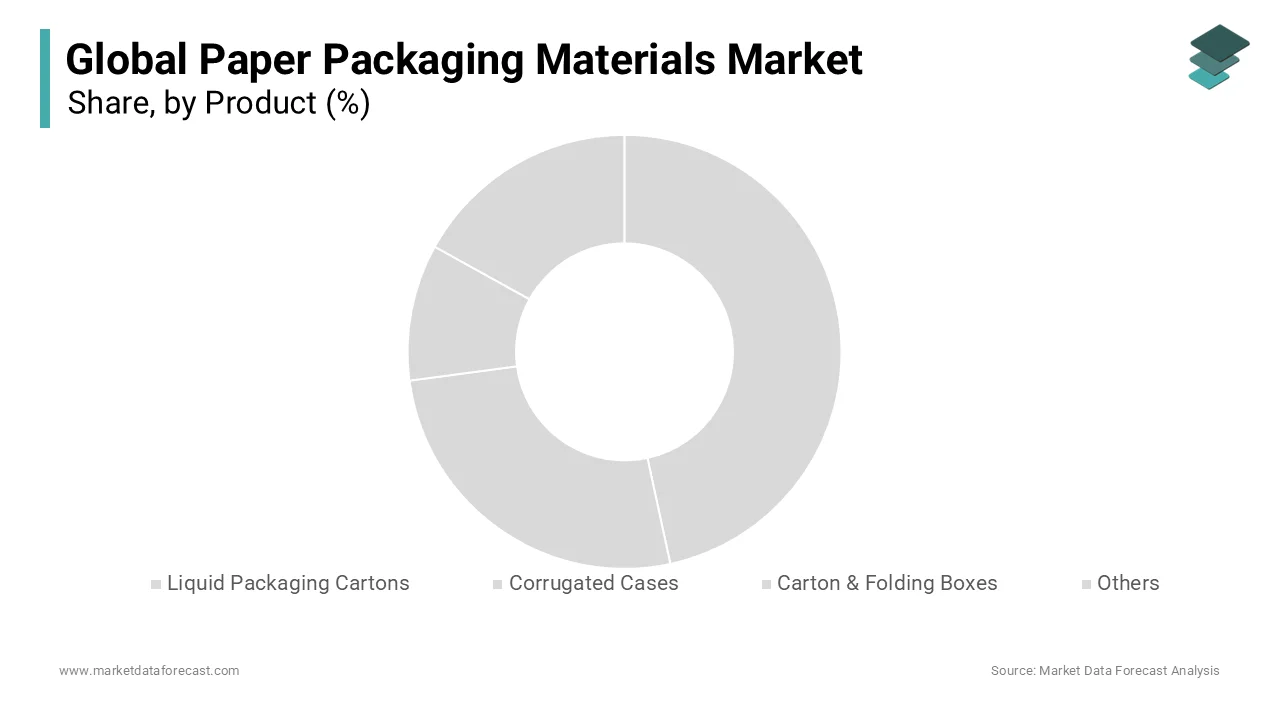
The liquid packaging cartons segment is swiftly emerging with a CAGR of 6.2% in the next coming years with the surge in plant-based and functional beverages , such as almond milk, oat milk, and probiotic drinks. Additionally, urbanization and on-the-go consumption habits are boosting demand for single-serve liquid cartons. In India, for example, the Tetra Pak report noted that liquid carton usage grew by 12% annually between 2020 and 2023, driven by increasing penetration of packaged beverages in Tier II and Tier III cities.
By Application Insights
The beverages application segment was the largest and held 28.3% of the paper packaging materials market share in 2025 owing to the rising popularity of ready-to-drink (RTD) beverages , including juices, energy drinks, and bottled water. According to Beverage Marketing Corporation, RTD beverage sales in the U.S. alone surpassed USD 80 billion in 2023, with over 60% of these products utilizing paper-based secondary packaging for branding and environmental appeal. Moreover, regulatory pressure on plastic bottles has accelerated the shift toward fiber-based alternatives. For instance, the European Union’s Single-Use Plastics Directive mandates that beverage producers reduce reliance on plastic, encouraging the adoption of paperboard carriers and cartons.
The bakery products application segment is anticipated to grow with a CAGR of 6.5% from 2026 to 2034 with the booming artisanal and specialty bakery industry in North America and Asia-Pacific. In addition, the rise of online food delivery platforms has increased the need for leak-proof and heat-resistant paper packaging. Paper-based bakery trays, grease-resistant wraps, and windowed folding cartons have become preferred choices among operators aiming to balance functionality with environmental responsibility.
REGIONAL ANALYSIS
Asia Pacific
Asia Pacific was the top performer in the paper packaging materials market by accounting for 42.3% of share in 2025. China and India are the major contributors for the growth of the market in the region with the rising domestic consumption and foreign investment in FMCG and e-commerce sectors. As per FICCI, the Indian e-commerce market is expected to reach USD 200 billion by 2026, which is significantly boosting demand for corrugated and folding carton packaging. Japan paper packaging materials market growth is driven with advanced recycling infrastructure and a focus on premium-grade packaging. According to Japan Paper Association, over 82% of paper packaging was recycled in 2023, which is making it a model for circular economy practices.
Europe
Europe paper packaging materials market held 24.3% of share in 2025. Germany is leading with highest share in the market. France and Italy are next with the leveraging strong food processing and luxury goods sectors that rely on high-quality folding cartons and rigid boxes. According to Eurostat, paper packaging recycling rates in the EU averaged over 84% in 2023, among the highest globally, reinforcing its sustainable credentials. The UK has seen a surge in demand for recyclable packaging post-Brexit, with companies adapting to new environmental levies.
North America
North America paper packaging materials market is more likely to have highest CAGR in the coming years. The United States is the dominant with the strong demand from the foodservice, beverage, and e-commerce sectors. Amazon alone shipped over 7 billion packages globally in 2023, where many of which utilized corrugated and kraft paper packaging. Canada complements the regional growth with progressive environmental policies and high consumer awareness.
Latin America
Latin America paper packaging materials market growth is likely to grow eventually with Brazil leading the region in both production and consumption. As per ABIPA (Brazilian Association of Corrugated Packaging), the country produced over 5 million metric tons of corrugated packaging in 2023, largely driven by agro-industrial exports and domestic FMCG growth.
Mexico and Colombia are also gaining traction, with rising middle-class populations and increased urban retail activity fueling demand for branded and hygienic packaging. In Mexico, the National Chamber of the Transformation Industry reported that packaging demand in the food sector grew by 6.4% in 2023 , with paper-based solutions capturing a growing share.
Chile and Argentina are focusing on improving recycling systems, with Chile achieving a paper recycling rate of 68% in 2023, according to CONAMA. While regulatory frameworks remain inconsistent across the region, increasing awareness and government support are gradually enhancing the market environment.
Middle East & Africa
Middle East & Africa paper packaging materials market growth is escalating steadily during the forecast period. According to PAMSA (Paper Manufacturers Association of South Africa), local production reached over 2.3 million metric tons in 2023 with the growing beverage and pharmaceutical packaging needs. Egypt and Nigeria are also showing promise, driven by population growth and rising packaged food consumption. While recycling infrastructure remains underdeveloped in many parts of the region, increasing public-private collaboration and international funding are laying the groundwork for sustainable packaging development in the coming decade.
KEY MARKET PLAYERS AND COMPETITIVE LANDSCAPE
Key market players in the Paper Packaging Material Market are Smurfit Kappa Group Plc, Napco National Paper Products Company, Billerudkorsnas, International Paper Company, WestRock Compan, Georgia Pacific LLC, Pratt Industries, DS Smith Packaging Limited, Stora Enso Oyj, Mondi Group Plc.
The Paper Packaging Materials Market is characterized by intense competition among a mix of large multinational corporations and regional players striving to capture market share through differentiation and innovation. Major companies are continuously expanding their production capacities, investing in sustainable technologies, and enhancing supply chain efficiencies to maintain a competitive edge. Strategic partnerships, acquisitions, and joint ventures are common tactics used to enter new markets or strengthen footholds in existing ones. Additionally, the growing emphasis on environmental responsibility has intensified rivalry, with firms competing to offer the most sustainable and high-performance packaging solutions. Innovation in material science, digital printing, and smart packaging features further fuels this competition, as companies aim to cater to evolving consumer preferences and regulatory mandates.
TOP PLAYERS IN THE MARKET
International Paper Company
International Paper is a global leader in paper packaging materials, known for its extensive product portfolio that includes containerboard, corrugated packaging, and folding cartons. The company operates across North America, Europe, Latin America, and Asia, serving diverse industries such as food and beverage, e-commerce, and consumer goods. International Paper plays a pivotal role in shaping industry standards by promoting recyclability and investing in fiber-based alternatives to plastic with a strong focus on sustainability and innovation.
WestRock Company
WestRock has established itself as a major player through its customer-centric approach and integrated manufacturing capabilities. The company specializes in corrugated packaging, paperboard, and consumer packaging solutions, which is catering to leading brands worldwide. WestRock emphasizes sustainable sourcing, supply chain efficiency, and design innovation to meet evolving market demands. Its collaborative model with clients enables tailored packaging solutions that enhance brand value while reducing environmental impact.
DS Smith plc
DS Smith is a prominent European-based packaging company with a strong global footprint. It focuses on sustainable packaging solutions, circular economy principles, and advanced recycling technologies. DS Smith supports the transition from plastic to fiber-based packaging through strategic acquisitions and continuous investment in research and development. The company works closely with retailers and manufacturers to deliver high-performance, eco-friendly packaging solutions that align with global sustainability goals.
TOP STRATEGIES USED BY KEY MARKET PLAYERS
One of the primary strategies employed by leading players is sustainable innovation , where companies invest heavily in developing eco-friendly packaging solutions that reduce carbon footprints and replace non-recyclable materials. This includes enhancing product recyclability, using renewable fibers, and incorporating biodegradable coatings.
The strategic mergers and acquisitions, which allow companies to expand their geographical presence, diversify product offerings, and strengthen supply chain networks is another important approach followed by the key players. These moves help firms integrate vertically, improve operational efficiencies, and better serve multinational clients.
The customer collaboration and co-creation play a crucial role in strengthening market positions. Companies work closely with brand owners to develop customized packaging solutions that align with branding objectives, logistical needs, and sustainability targets, which is fostering long-term partnerships and improving market responsiveness.
RECENT HAPPENINGS IN THE MARKET
- In February 2025, International Paper announced a new initiative to develop fully recyclable paper-based packaging for frozen foods, which is aiming to replace plastic-lined containers in retail settings.
- In June 2025, DS Smith launched an expanded recycling program in partnership with several European municipalities to increase collection rates and improve the quality of recovered fibers for reuse in packaging production.
- In September 2025, WestRock introduced a line of lightweight, high-strength corrugated boxes designed specifically for e-commerce fulfilment by focusing on reducing shipping costs and environmental impact.
- In November 2025, Tetra Pak invested in a new paperboard production facility in Southeast Asia to support rising demand for liquid cartons and strengthen its supply chain in the region.
- In March 2026, Stora Enso collaborated with a biotech firm to develop enzyme-based coatings for paper packaging that enhance moisture resistance without compromising recyclability.
MARKET SEGMENTATION
This research report on the global paper packaging materials market has been segmented and sub-segmented based on product, application, and region.
By Product
- Liquid Packaging Cartons
- Corrugated Cases
- Carton & Folding Boxes
- Others
By Application
- Fresh Foods
- Fast Foods
- Beverages
- Dairy & Bakery
- Frozen foods
- Others
By Region
- North America
- Asia Pacific
- Europe
- Latin America
- Middle East and Africa