- Product Description Description
- Table of Contents TOC
- List of Table & Figure LOT
- Get Free Sample PDF Sample PDF
Market Size, 2025
$5,222.61 MnMarket Estimate, 2026
$6,925.18 MnMarket Forecast, 2034
$66,188 MnCAGR, 2026–2034
32.60%Executive Summary: Global PARP Inhibitor Market
- Market Scope:Global analysis of the PARP inhibitor market, detailing drug types, oncological applications, distribution channels, and regional adoption patterns.
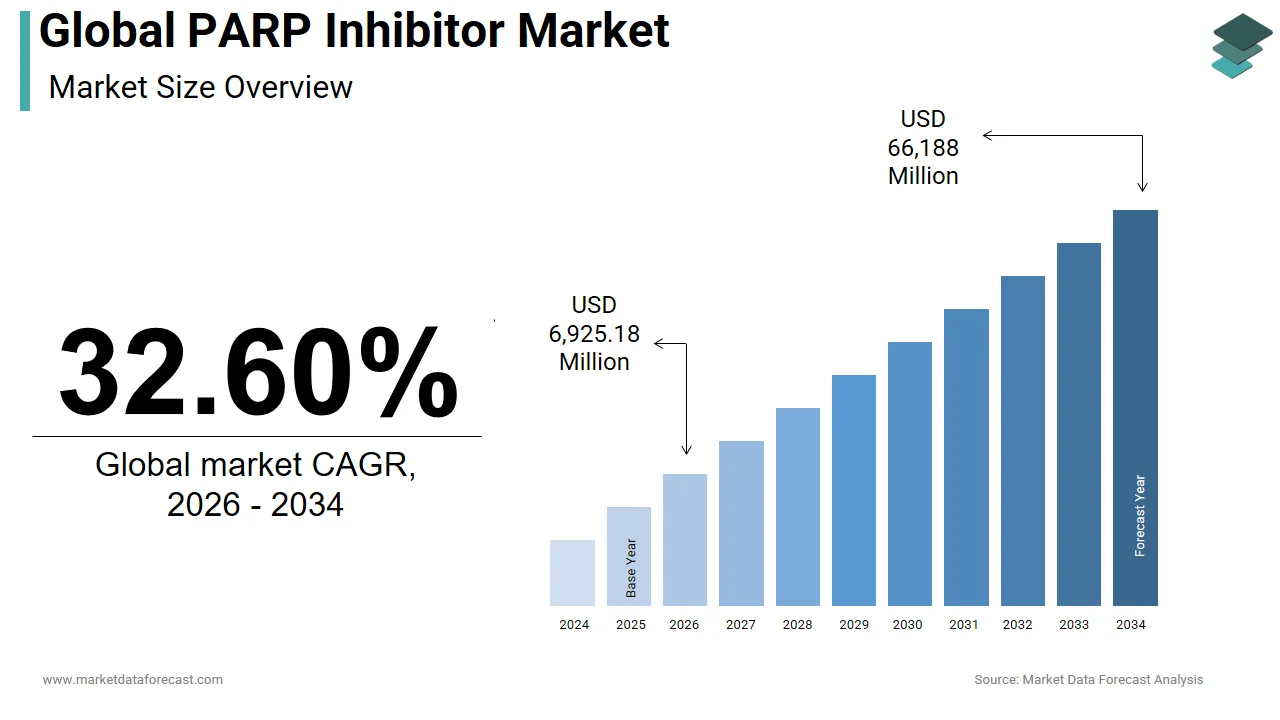
- Market Valuation:Valued at USD 5,222.61 million in 2025, reaching USD 6,925.18 million in 2026, and projected to expand to USD 66,188 million by 2034, growing at a robust CAGR of 32.60% from 2026 to 2034.
- Primary Growth Drivers:Rising global prevalence of cancer, favorable health reimbursement policies for targeted therapies, and intensive R&D investments by major biopharmaceutical companies.
Key Market Segment Metrics
| Category | Leading Segment (Base Position) | Fastest-Growing / High-Growth Segment |
|---|---|---|
| By Drug Type | Niraparib (significant market share backed by clinical flexibility and efficacy across ovarian, breast, and prostate cancers) | Talazoparib (high-growth segment driven by selective targeting and reduced side-effect profiles) |
| By Application | Ovarian Cancer (dominant share established as standard-of-care with proven progression-free survival benefits) | Breast Cancer (high-growth segment fueled by targeted genetic variation treatments like BRCA mutations) |
| By Distribution Channel | Hospital Pharmacies (established primary channel for specialized oncology prescription fulfillment) | Online Pharmacies (fastest-growing segment providing patient access ease and rapid distribution) |
| By Region | North America (regional leader with advanced oncology research, well-established clinical trials, and regulatory support) | Asia-Pacific (lucrative high-growth region driven by rising cancer incidence and increasing healthcare expenditures) |
Major Market Players & Industry Landscape
Market Structure:Competitive oncology landscape featuring leading global biopharmaceutical companies advancing targeted precision medicines and clinical pipelines.
Key Companies:AstraZeneca, Tesaro, AbbVie Inc., Medivation, and Clovis Oncology.
 Download Free Sample Report
Global PARP Inhibitor Market Size
The size of the global PARP inhibitor market was worth USD 5,222.61 million in 2025. The global market is anticipated to grow at a CAGR of 32.60% from 2026 to 2034 and be worth USD 66,188 million by 2034 from USD 6,925.18 million in 2026.
MARKET DRIVERS
The growing prevalence of cancer is the first major factor propelling the market growth during the projected period. Effective cancer treatments require immediate attention as cancer incidence rates increase globally. Patients now have new hope due to PARP medicines' remarkable ability to target particular cancers, including ovarian and breast cancer. As a result of this rising need for novel, focused medicines, PARP inhibitors will play a crucial role in the fight against cancer during the anticipated duration as they maintain their effectiveness in clinical settings.
Favorable health reimbursement policies are the second factor propelling the market growth during the projected period. Governments and insurance companies are more likely to include PARP inhibitors in their coverage as they become more aware of their clinical efficacy in treating particular tumors.
Rising research and development activities by the prominent key players further favor the market growth during the forecast period. Companies are strongly funding the development of PARP inhibitor technology to expand their applications in different cancer types. Adherence to innovation encourages regulatory approvals, clinical advancements, and the creation of more effective treatments.
MARKET RESTRAINTS
The high cost associated with the clinical trials and the stringent regulatory requirements are the major factors hampering the growth of the market during the projected period. High costs require to conduct extensive clinical trials to ensure safety and efficacy. Furthermore, establishing a complex regulatory environment for drug approval can be expensive and time-consuming. These strong barriers can deter smaller pharmaceutical businesses and limit the rate of research, preventing market expansion. The increasing number of product recalls furthermore limits the market growth during the projected period.
REPORT COVERAGE
| REPORT METRIC | DETAILS |
| Market Size Available | 2025 to 2034 |
| Base Year | 2024 |
| Forecast Period | 2026 to 2034 |
| Segments Covered | By Drug Type, Application, Distribution Channel, and Region. |
| Various Analyses Covered | Global, Regional, and Country-Level Analysis, Segment-Level Analysis, Drivers, Restraints, Opportunities, Challenges; PESTLE Analysis; Porter’s Five Forces Analysis, Competitive Landscape, Analyst Overview of Investment Opportunities |
| Regions Covered | North America, Europe, Asia Pacific, Latin America, Middle East & Africa |
| Market Leaders Profiled | AstraZeneca, Tesaro, AbbVie Inc., Medivation, Clovis Oncology, Johnson & Johnson, GlaxoSmithKline plc., Pfizer Inc., Bristol-Myers Squibb, Merck KGaA, Genentech Inc., Repare Therapeutics, Sierra Oncology, Karyopharm Therapeutics Inc., and Ono Pharmaceutical Co. Ltd. |
SEGMENT ANALYSIS
By Drug Type Insights
Based on the drug type, the Niraparib segment is predicted to hold a significant share of the market during the projected period. Niraparib's flexibility and potential for additional applications fuel its market growth as clinical research shows that it is effective in treating a variety of cancer types, including ovarian, breast, and prostate cancer. Niraparib is used more frequently by medical professionals to treat various cancer types, which increases demand and market share.
The Talazoparib segment is also projected to hold a notable share of the market during the forecast period. Talazoparib is an effective therapy option due to its improved capacity to target cancer cells while preserving healthy ones. Because of its selectivity, which reduces side effects, it is widely used among patients and medical professionals. Talazoparib's special qualities are driving its market expansion as there is an increasing need for more specialized and efficient cancer treatments.
By Application Insights
Based on the application, the ovarian cancer segment is predicted to hold a significant share of the market during the projected period. The growing acceptance of PARP inhibitors as a standard of care for the treatment of ovarian cancer. They have been widely accepted as a result of clinical evidence showing their effectiveness in enhancing progression-free survival and response rates. The market for this particular use is anticipated to grow significantly as physicians more frequently include PARP inhibitors in ovarian cancer therapy treatments.
The breast cancer segment is projected to hold a considerable share of the market during the projected period. The increased acceptance of PARP inhibitors as an efficient, targeted therapy for breast cancer patients with particular genetic variations, such as BRCA mutations, is the primary market driver for the breast cancer segment in the PARP inhibitor market over the anticipated period.
By Distribution Channel Insights
Based on the distribution channel, the online pharmacies segment is predicted to hold a significant share of the market during the forecast period. The ease it provides to patients in obtaining these specialized pharmaceuticals, allowing simple access and rapid distribution of PARP inhibitors to those in need, is the main market driver for the online pharmacies segment in the PARP inhibitor market during the forecast period.
The retail pharmacies segment is anticipated to hold a notable share of the market during the forecast period. The accessibility and individualized support that these physical pharmacies provide for patients, facilitating in-person consultations, prescription satisfaction, and patient education regarding PARP inhibitor usage and side effects, will serve as the market driver for the retail pharmacies segment during the projected period in the PARP inhibitor market.
REGIONAL ANALYSIS
North America region is projected to dominate the market with a major share during the projected period. The robust healthcare infrastructure and significant research and development activities are the main market drivers in the North American region for the PARP inhibitor market during the period of projection. The healthcare system is well-established, there are advanced clinical trials, and oncology research is heavily emphasized in North America, especially in the United States. These factors, along with regulatory support, make North America an important center for the research and use of PARP inhibitors.
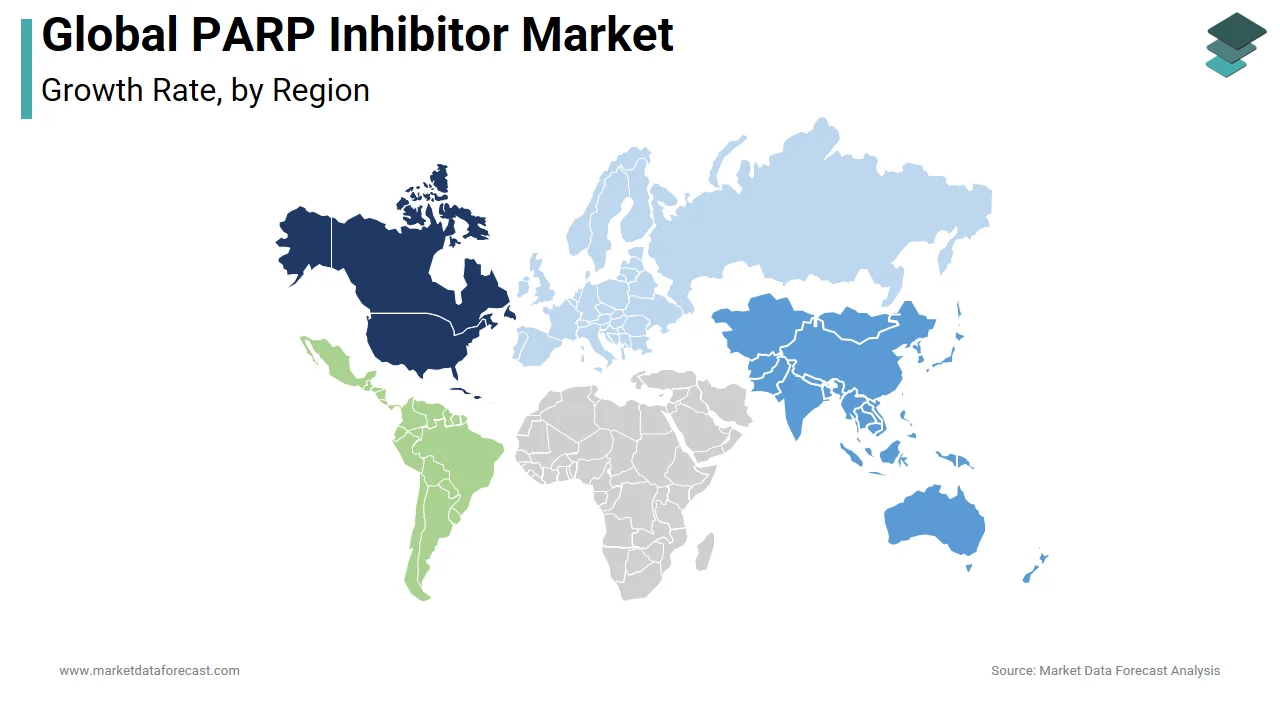
Europe region is projected to grow at a healthy CAGR during the forecast period. The increased adoption of precision medicine techniques. Targeted therapies like PARP inhibitors are becoming increasingly recognized in Europe as effective cancer treatments. This awareness fuels the demand for PARP inhibitors, which, when added to the availability of clinical expertise and healthcare resources, makes Europe a significant contributor to the market's growth during the projected period.
APAC region is anticipated to show lucrative growth in the market during the projected period. The increasing incidence of cancer and rising healthcare spending are prompting market shares in the Asia Pacific region. Governments and healthcare institutions are focusing resources on innovative treatments like PARP inhibitors as cancer incidence rises in this region and is leveraging the market growth rate.
Latin America, the Middle East, and Africa are anticipated to show a considerable share of the market during the forecast period.
KEY MARKET PLAYERS
The prominent key players in the global PARP inhibitor market are
- AstraZeneca
- Tesaro
- AbbVie Inc.
- Medivation
- Clovis Oncology
- Johnson & Johnson
- GlaxoSmithKline plc
- Pfizer Inc.
- Bristol-Myers Squibb
- Merck KGaA
- Genentech Inc.
- Repare Therapeutics
- Sierra Oncology
- Karyopharm Therapeutics Inc.
- Ono Pharmaceutical Co. Ltd.
MARKET SEGMENTATION
This research report on the PARP inhibitor market has been segmented and sub-segmented into Drug type, Application, Distribution Channel, and Region.
By Drug Type
- Niraparib
- Olaparib
- Rucaparib
- Talazoparib
By Application
- Ovarian Cancer
- Breast Cancer
- Others
By Distribution Channel
- Hospital Pharmacies
- Retail Pharmacies
- Online Pharmacies
By Region
- North America
- Latin America
- Europe
- Asia-Pacific
- Middle East and Africa