Global Permanent Magnet Motor Market Size, Share, Trends, & Growth Forecast Report, Segmented By Motor (AC motors, DC Motors, Hermetic motors), Magnet (Neodymium, Samarium Cobalt, Ferrite), Power Range (4.0 kW and below, Between 4.0 22.0 kW, Between 22.0 75.0 kW, 75.0 kW and above), Applications (Factory Automation, Automotive, Lab Equipment, Military/Aerospace), & Region, Industry Forecast From 2026 to 2034
Market Size, 2025
$61.80 BnMarket Estimate, 2026
$67.61 BnMarket Forecast, 2034
$138.72 BnCAGR, 2026–2034
9.4%Global Permanent Magnet Motor Market Size
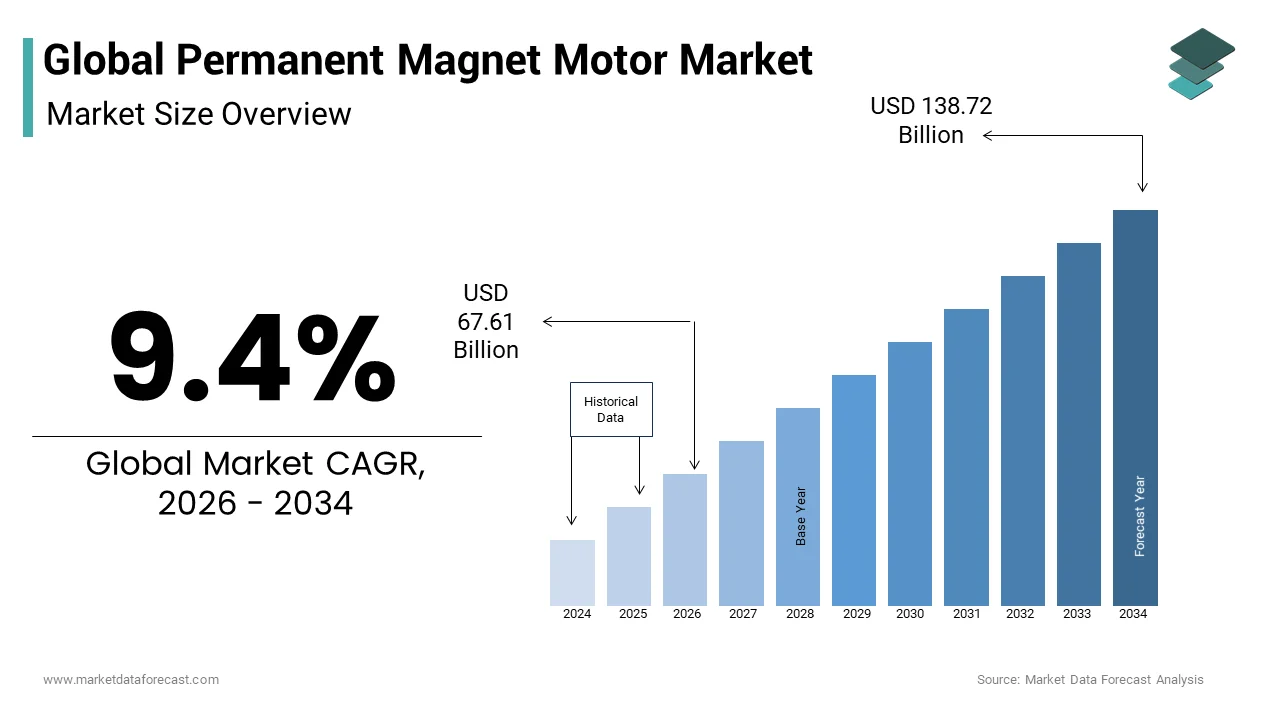
The global permanent magnet motor market size was valued at USD 61.80 billion in 2025 and is anticipated to reach USD 67.61 billion in 2026 to reach USD 138.72 Bilion by 2034, growing at a CAGR of 9.4% during the forecasted period from 2026 to 2034.
A permanent magnet motor is a type of electric motor that uses a magnet to generate a magnetic field, which then combines with the electric current in the motor to produce mechanical rotation. Permanent magnet motors are highly efficient, reliable, and compact devices used in various applications such as industrial machinery, household appliances, consumer electronics, electric vehicles, and renewable energy systems like wind turbines. There are different types of permanent magnet motors, such as the Brushed DC motors, which use brushes to change the direction of the current in the motor; Permanent Magnet Synchronous Motors (PMSM), which are used in high-performance applications; and AC Synchronous Motors use permanent magnets on the rotor and works in synchronism alternating current (AC) supplied to the motor. Permanent magnets in the motor reduce energy loss, making these motors environmentally friendly as compared to traditional motors.
MARKET DRIVERS
Increasing focus and awareness of energy efficiency is the major driving factor that is contributing to the rise in the permanent magnet motor market share.
A permanent magnet motor has higher energy efficiency as compared to traditional induction motors, and this efficiency is due to the currents in the motor's magnetic field. In traditional motors, the magnetic field is induced by the stator's rotating magnetic field. This leads to loss of energy because of heating, whereas permanent magnet motors use fixed magnets on the rotor, creating a constant magnetic field and reducing energy losses, causing improved efficiency and lower operating temperatures. Therefore, it lowers the operational cos,t causes cost-saving, and also benefits the environment has driven the widespread adoption of permanent magnet motors in various applications, including electric vehicles, industrial machinery, renewable energy systems, and consumer electronicsThe increasingng growth of industries, urbanization, and a surge in manufacturing activities have also led to the demand and necessity for energy efficiency and sustainability. Hence, permanent magnet motors are emerging in the market due to their energy-efficient features. And has an awareness of the environment, and sustainability is increasing, and the adoption of magnet motors has increased, which has caused its growth in market size. Hence, permanent magnet motor is used in the manufacturing, mining, and construction sectors, and therefore, switching to permanent magnet motor industries and manufacturers can save costs and reduce energy consumption.
Moreover, as the government worldwide is implementing rules and guidelines and making manufacturers aware of the energy-efficient and sustainability features of permanent magnet motors, this has directly caused the usage of permanent magnet motors in various industries, which has therefore caused an increase in the permanent magnet motor market size.
The increasing adoption of electric vehicles (EVs) and the rise in the market of electric vehicles has led to a surge in the permanent magnet motor, as these motors play an imperative role in electric vehicles due to their energy efficiency and high-performance features.
As consumers and andthed government are becoming aware of the environment and sustainability, this has caused rapid growth in the usage of electric vehicles, and it has led to a significant opportunity for permanent magnet motors. Permanent magnet motors offer several advantages that make them ideal for use in electric vehicles. Their high power density resulted in improved acceleration and overall vehicle performance. Additionally, permanent magnet motors have higher energy efficiency, which extends the driving range of EVs, reduces charging times, and enhances battery life.
With increasing environmental awareness and stringent emissions regulations, automobile manufacturers are shifting their focus toward the adoption of electric vehicles. As a result, the demand for electric vehicles is increasing, creating a significant market for permanent magnet motors. Moreover, the development of more affordable and technologically advanced electric vehicles is attracting a broader consumer base, further driving the demand for these motors. This has created an opportunity for the permanent magnet motor market.
MARKET RESTRAINTS
One of the significant market restraints for the permanent magnet market is the high cost involved in the extraction process of rare earth elements such as neodymium, dysprosium, and praseodymium. These materials are extracted from the limited geographical regions, and their extraction process can be environmentally destructing. Therefore, this can limit the permanent magnet motor market growth.
The high cost and limited availability of rare earth materials can disrupt the supply chain of permanent magnet production, which ultimately can disrupt the production and demand of permanent magnet motors. And can increase the overall cost of permanent magnet motors and devices.
REPORT COVERAGE
| REPORT METRIC | DETAILS |
| Market Size Available | 2025 to 2034 |
| Base Year | 2025 |
| Forecast Period | 2026 to 2034 |
| CAGR | 9.4% |
| Segments Covered | By Motor, Magnet, Applications, Power Range, and Region |
| Various Analyses Covered | Global, Regional & Country Level Analysis, Segment-Level Analysis, DROC, PESTLE Analysis, Porter’s Five Forces Analysis, Competitive Landscape, Analyst Overview of Investment Opportunities |
| Regions Covered | North America, Europe, APAC, Latin America, Middle East & Africa |
| Market Leaders Profiled | ABB Ltd., Siemens AG, General Electric Company, Toshiba Corporation, Hitachi Ltd, Mitsubishi Electric Corporation, Danaher Motion, LLC, Nidec Corporation, Johnson Electric Holdings Limited, WEG S.A., Regal Beloit Corporation, and Others. |
SEGMENTAL ANALYSIS
By Motor Insights
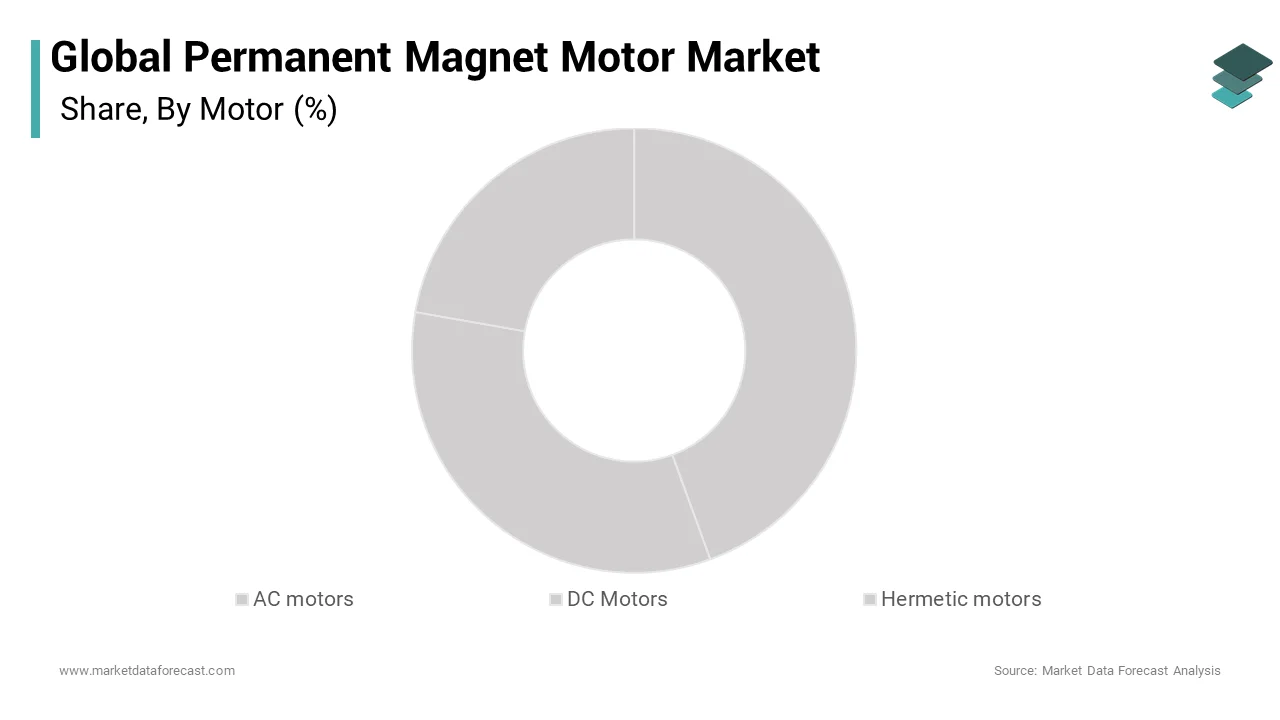
Based on the motor type, the permanent magnet motor market is divided into AC motors, DC motors, and Hermetic motors. AC motors dominate the market and have the highest market share; this dominance is due to their wide application in electric vehicles, industrial automation, and renewable energy generation. Their efficiency and reliability caused the high demand for AC motors. Whereas DC motors, which are commonly used for cost-effectiveness, were the major factor. Hermetic motors are mainly used in refrigeration and air conditioning compressors.
By Magnet Insights
The neodymium segment accounts for the highest market share due to its excellent magnetic properties, and it is the most widely used earth element, becoming bbecomingthe preferred choice for various applications, such as in permanent magnet motors used in electric vehicles, industrial machinery, consumer electronics, and wind turbines. Whereas the Samarium Cobalt magnet type has strong magnetic properties, is less commonly found in earth cores, and is used in applications where high-temperature stability or radiation resistance is required.
Ferrite magnets are the most common type of permanent magnet and are less costly as compared to neodymium and samarium cobalt magnets. But has limitations in application due to less magnetic strength.
By Power Insights
Based on the power range, 4.0 to 22.0 kW has the highest share in the permanent magnet motor market, as it is commonly used in small electric vehicles, household appliances, fans, and industrial machinery. This dominance of the 4.0 kW to 22.0 kW is due to the increasing adoption of electric vehicles, energy-efficient household appliances, and industrial automation. Also, the emphasis on sustainability and energy conservation contributed to the permanent magnet motor market growth.
By Applications Insights
Based on the applications, the automotive segment contributed to the highest share in the permanent magnet motor market; this was due to the wide usage of electric vehicles, to energy efficiency. Moreover, the increasing awareness of electric vehicles has led to a growing demand for permanent magnet motors. The fastest-growing segment is factory automation and is forecasted to have significant growth over the period. Lab equipment and military/Aerospace show steady growth in the forecasted period.
REGIONAL ANALYSIS
Based on the region, the Asia Pacific region accounted for the highest market share in the permanent magnet motor market and contributed to the maximum revenue generation.
This dominance was due to the increasing demand for permanent magnet motors in the automotive industry, as countries like India and China are seeing increasing growth in automation, which has led to the demand for permanent magnet motors. North America is the fastest-growing market and has significant growth in the forecasted period. This is due to the increasing urbanization and industrialization, which is causing the surge of permanent magnet motors. Europe is forecasted to have significant growth due to awareness of environmental safety and sustainability. The Middle East and Africa have low market growth compared to other regions.
KEY MARKET PLAYERS
Major Key Players in the Global Permanent Magnet Motor Market are
- ABB Ltd. Siemens AG
- General Electric Company
- Toshiba Corporation
- Hitachi Ltd.
- Mitsubishi Electric Corporation
- Danaher Motion, LLC
- Nidec Corporation
- Johnson Electric Holdings Limited
- WEG S.A.
- Regal Beloit Corporation
- Allied Motion Technologies Inc.
- Franklin Electric Co. Inc.,
- Rockwell Automation Inc.
- Brook Crompton UK Ltd.
- Parker Hannifin Corporation
- Lafert SpA
- Bonfiglioli Riduttori S.p.A.
- Oriental Motor Co., Ltd.
- Moog Inc., and others.
RECENT MARKET NEWS
- On 23rd April 2023, Cake, a Swedish electric motorcycle, launched Jante, which is a high-performance electric IPM motor for lightweight electric vehicles.
- On 31st March 2022, Mercedes-Benz and Siemens together collaborated to produce cars in an environmentally friendly manner. As a result of this, the automobile industry will see breakthrough digitization and flexible production.
MARKET SEGMENTATION
This research report on the global permanent magnet motor market has been segmented and sub-segmented based on motor, magnet, applications, power range, and region.
By Motor Type
- AC motors
- DC Motors
- Hermetic motors
By Magnet Type
- Neodymium
- Samarium Cobalt
- Ferrite
By Power Range
- 4.0 kW and below
- Between 4.0 to 22.0 kW
- Between 22.0 to 75.0 kW
- 75.0 kW and above
By Applications
- Factory Automation
- Automotive
- Lab Equipment
- Military/Aerospace
By Region
- North America
- Europe
- Asia Pacific
- Latin America
- Middle East and Africa
Frequently Asked Questions
What is the permanent magnet motor market?
The permanent magnet motor market includes electric motors that use permanent magnets to generate efficient mechanical motion.
What is driving the growth of the permanent magnet motor market?
The market is growing due to increasing demand for energy-efficient motors and rising adoption of electric vehicles.
What are the main types of permanent magnet motors?
Common types include brushless DC motors, synchronous motors, and stepper motors.
Which segment dominates the permanent magnet motor market?
Brushless DC motors dominate the market due to their high efficiency and low maintenance requirements.
Who are the primary users of permanent magnet motors?
Automotive, industrial, consumer electronics, and renewable energy sectors are the main users.
How do permanent magnet motors improve energy efficiency?
They reduce energy loss and provide higher power density compared to conventional motor technologies.
Which regions lead the permanent magnet motor market?
Asia-Pacific leads the market due to strong manufacturing activities and expanding electric vehicle production.
How is technology influencing the permanent magnet motor market?
Advancements in magnetic materials and smart motor control systems are improving performance and reliability.
What challenges does the permanent magnet motor market face?
High rare earth material costs and supply chain limitations can affect market growth.
What is the future outlook for the permanent magnet motor market?
The market is expected to grow steadily with increasing focus on electrification and energy-efficient technologies.
Related Reports
Access the study in MULTIPLE FORMATS
Purchase options starting from
$ 2500
Didn’t find what you’re looking for?
TALK TO OUR ANALYST TEAM
Need something within your budget?
NO WORRIES! WE GOT YOU COVERED!
Call us on: +1 888 702 9696 (U.S Toll Free)
Write to us: sales@marketdataforecast.com